Call for Papers and Posters | Synagogue and Museum
From H-ArtHist:
Synagogue and Museum: 3rd International Congress on Jewish Architecture
Technische Universität Braunschweig, 21–23 November 2016
Paper proposals due by 29 July 2016; poster proposals due by 30 September 2016
Since antiquity and especially since the destruction of the Jerusalem Temple in the year 70 CE, synagogues have become the central places of gathering of Jewish communities. They are complex, highly significant and polyvalent objects of for religious, social, economic, architectural, and artistic developments in Jewish culture. At the same time, they reflect the interdependencies with the surrounding cultures. Since the holocaust, historic synagogues also gained high importance as focal points of remembrance and education.
However, scholars were interested in the material culture(s) of Jews all over the world well before the holocaust and turned synagogues and their furnishings into a focus of their research. The documentation of synagogues as objects of cultural and historical significance started alongside with the establishment of Jewish ethnography (jüdische Volkskunde) as an academic discipline at the end of the 19th century. They became items of collecting, which were set up in exhibitions and museums. Objects from the religious and cultural practice got ‘musealised’, as well as entire synagogue furnishings and sometimes even architectural elements. After 1945, the interest in synagogues as objects of cultural history continued. Besides ritual objects and furnishings, the ’empty’ buildings of the annihilated communities became objects of interest. Historic synagogue buildings were regarded as museums, their material substance was and is restored and interpreted in different ways. The virtual and haptic reconstruction of destroyed synagogues generated another group of ‘immaterial’ exhibits.
The congress will examine the subject in a wide range of perspectives of theoretical and historical reflections. Historic and actual examples of documenting, collecting, and researching synagogues and their furnishing will shed light on the history, the presence, and the future of synagogues in and as museums. Thus, the organisers encourage scholars in the fields of art and architectural history, cultural sciences, Jewish studies, restoration and museology as well as experts in museums, collections, preservation authorities, and education programs to take part in the congress.
This call asks for papers for talks and for posters for a posters-section. It is open for young researchers as well as museums, collections and initiatives who want to present their institutions and their ongoing or future projects. The members of the international and interdisciplinary academic board and the organisers will decide on the acceptance of the papers and the posters. The publication of selected papers and posters in the book series of the Bet Tfila – Research Unit for Jewish Architecture is scheduled for 2017. The conference language is English. Provisions to refund travel expenses will depend on the approval of running applications.
To propose a paper, please send an abstract of up to 1500 characters for a lecture of 15 minutes and a short-CV of up to 500 characters in English by July 29th, 2016. To propose a poster, please send a poster (PDF-file, 5 MB max.) for the poster presentation in English by September 30th, 2016. The email address is u.knufinke@gmx.de.
The congress is organised by the Bet Tfila – Research Unit for Jewish Architecture (Braunschweig/ Jerusalem) and the Lehrstuhl für Kunstgeschichte at the Hochschule für Jüdische Studien, Heidelberg in cooperation with the Braunschweigisches Landesmuseum, Braunschweig, and the Israel Jacobson Netzwerk für jüdische Kultur und Geschichte e.V.
Conference | The Staircase in Europe, 1450–1800
From H-ArtHist:
Rencontres européennes d’architecture
L’escalier en Europe: Formes, fonctions, décors, 1450–1800
Institut national d’histoire de l’art, Paris, 9–11 June 2016
J E U D I , 9 J U I N 2 0 1 6
9.30 Accueil des participants
9.45 Introduction
10.00 Première Session: La Renaissance (1)
Président : Jean Guillaume
• Krista de Jonge (Université de Leuven), « L’escalier à la Renaissance : les anciens Pays-Bas revisités »
• Stephan Hoppe (Ludwig-Maximilians-Universität München), « New standards of social climbing. Staircases in Rennaissance Germany »
• Renate Leggatt-Hofer (Federal Monuments Authority Austria-Bundesdenkmalamt, Wien), « Imperial staircase-architecture within the residences of Ferdinand Ist (1521–1564) : Some bold experiments »
13.30 Deuxième Session: La Renaissance (2)
Président : Alexandre Gady
• Marco Rosario Nobile (Università Palermo), « Scale a chiocciola « imperiali ». Due esempi a Malta e in Sicilia »
• Fernando Marias (universidad Complutense, Madrid), « Scala in Spania en longue durée : disegno e stereotomia »
• Nunos Sensos (universidad nova de Lisboa), « L’escalier au Portugal (XVe–XVIIIe s.) »
• Pascal Julien (université de Toulouse II), « Escaliers sculptés de la Renaissance française »
V E N D R E D I , 1 0 J U I N 2 0 1 6
9.30 Troisième Session: Les temps modernes (1)
Président : Basile Baudez
• Gordon Higott (Historien de l’architecture), « Inigo Jones, Sir Christopher Wren et l’escalier en vis à jour central en Angleterre, 1616 – c.1720 »
• Konrad Ottenheym (Utrecht University), « Les escaliers monumentaux dans les palais XVIIe de la cour d’Orange »
• Richard Biegel (Faculty of Arts, Charles University, Prague), « L’escalier des temps modernes en Bohème ? »
• Daniela del Pesco (università Roma III), « Escaliers à Naples au XVIIIe siècle: les ‘scale aperte’ »
14.30 Quatrième Session: Les temps modernes (2)
Président : Emmanuel Lurin
• Christina Strück (Friedrich-Alexander Universität, Erlangen-Nurenberg), « Stagecraft and stairways. Monumental 17th- and 18th-century staircases in Germany »
• Jorge Fernandez-Santos (ETSA, Universidad San Jorge, Saragosse), « Les escaliers entre tradition et académie dans l’Espagne du XVIIIe siècle : un classicisme oblique ? »
• Stefano Piazza (Università di Palermo), « Les escaliers des palais siciliens du XVIIIe siècle »
S A M E D I , 1 1 J U I N 2 0 1 6
9.30 Cinquième Session: études de cas
Président : Pascal Julien
• Guillaume Fonkenell (Musée national de la Renaissance, Ecouen), « Ecouen. Un château d’escaliers »
• Alexandre Gady (Paris-Sorbonne, Centre Chastel), « Du bon usage du vide central. Les escaliers de Versailles »
• Paolo Corniglia (Politecnico di Torino), « Des marches qui ne portent nulle part. Le grand escalier de Juvarra au palais royal inachevé de Rivoli »
12.00 Conclusions, par Claude Mignot
Fellowship | Ornamentation and Decoration, 1680–1750
From H-ArtHist:
Ornamentation and Decoration: The Grammar of the Orders, the Rhetoric
of Opulence, the Appeal to the Eye at European Courts, 1680–1750
La Fondazione 1563 per l’Arte e la Cultura, Torino, January — December 2017
Applications due by 24 July 2016
The Study Program on the Age and the Culture of Baroque aims to promote research in this field of knowledge and to open up career opportunities to young scholars at academic and cultural institutions. Toward this end, the Foundation has launched from 2013 to 2016 a call for proposals to award fellowships on the Culture of Baroque for young Italian and foreign scholars 35 years old and younger. Now in its fourth edition, the program is currently accepting applications addressing the theme Ornamentation and Decoration: The Grammar of the Orders, the Rhetoric of Opulence, the Appeal to the Eye at European Courts, 1680–1750 (Ornamento e decorazione: La grammatica degli ordini, la retorica dell’opulenza, la piacevolezza dello sguardo nell’Europa delle Corti, 1680–1750).
Between the late 17th century and the first half of the 18th century, ornamentation and decoration become central at the Courts across Europe. The peculiar formulations of the various European Courts, that reflect individual artistic expressions and diversified trends in taste, pursue the definition of a new rhetoric: the association, implementation, and reinvention of the orders; the affirmation or complete redefinition of artistic hierarchies; a new balance between internal and external spaces; new and diff erentiated approaches to the memories of the past. The resulting subjects and shapes become characteristic in their own right and serve as models of variations on set themes that, together,
make up whole repertoires in architecture, painting and sculpture as well as in the art of jewelry and in furniture design for the Courts spaces. The centrality of the ornament takes different forms in the culture of the Baroque period, and sweeps across history, literature, philosophy, and music.
Applicants are invited to submit research proposals and original projects that, in the framework of the theme and time-frame presented here, or significant segments thereof, provide a comparative synchronic or diachronic analysis of two or more geographical centers or of limited territories.
Each of the five Fellowships will consist of an annual grant amounting to €23,000 before tax and other charges. Each Fellowship will last for one year, starting 1st January 2017 and ending 31st December 2017. It may be renewed for an additional quarter, without compensation and upon request of the Fellow, supported by the tutors opinion and subject to approval by the Foundation, that reserves the right to decide on the matter. A tutor will be appointed by the Foundation as an expert in the selected discipline, in agreement with the grantee, to support the grantee in the research activity and to evaluate the outcomes. Refunds of documented travel expenses related to the Fellowship project are envisaged for up to €1,500 per year and must be authorized in advance by the Foundation (‘mission procedure’) on a proposal by the tutor. The 2016 Notice of Competition and the online application forms are available on the Foundation’s website.
Online Resource | James Gillray: Caricaturist

James Gillray, A Cognocenti Contemplating ye Beauties of ye Antique, 1801 (London: The British Museum)
James Gillray: Caricaturist
For those of you interested in eighteenth-century caricature and particularly James Gillray, there is a new online resource: James Gillray: Caricaturist. The site includes a chronological catalogue of Gillray’s known prints, a list of major museums and archives where his work can be seen, information about him and his methods and techniques, and links to short biographical sketches of some of the people he caricatured.
The work of Jim Sherry, who has written on the modes of caricature as well as the humor of Thomas Rowlandson, the site continues to grow as Jim adds commentaries on individual Gillray prints (48 so far).
Conference | The Art Market, Collectors, and Agents
From the Seminar on Collecting and Display:
The Art Market, Collectors, and Agents: Then and Now
The Warburg Institute, London, 13 July 2016
Registration due by 11 July 2016
Organized by the Collecting and Display Seminar Group, which is based at the Institute of Historical Research in London. For booking, please email agent.candd2016@gmail.com. A further 2-day conference will take place in Paris in October 2016.
10.00 Registration and coffee
10.15 Introduction
10.30 Session I
• Annemarie Jordan Gschwend — Statesman, Art Agent and Connoisseur: Hans Kevenhüller, Imperial Ambassador at the Court of Philip II of Spain
• Taryn Marie Zarrillo — Marco Boschini and Paolo del Sera: Art Dealers, Advisors and Associates in Seicento Venice
• Michael Wenzel — Sales Strategies of Philipp Hainhofer’s Art Cabinets: The Self-Marketing of Artworks in Early Seventeenth-Century Germany
• Sandra van Ginhoven — The Business Strategies of Guilliam Forchondt’s Art Dealership in Antwerp, 1643–78
• Ulf R. Hansson — ‘An Oracle for Collectors’: Philipp von Stosch and the Collecting and Dealing in Antiquities in Early Eighteenth-Century Rome and Florence
13.00 Lunch
14.00 Session 2
• Maria Celeste Cola — Scottish Agents in Rome in the Eighteenth Century: The Case of Peter Grant
• Christine Godfroy-Gallardo — Establishing Honest Trading Relationships: The Guillaume Martin Case
• Robert Skwirblies — Edward Solly, Felice Cartoni and Their Purchases of Paintings: A ‘Milord’ and His ‘Commissioner’ Creating a Transnational Network of Dealers, ca. 1820
• Lukas Fuchsgruber — Otto Mündler, 9 rue Laval, Paris
• Lynn Catterson — The Mysterious Maurice de Bosdari, a Would-Be Agent of Stefano Borden
16.30 Tea
17.30 Session 3
• Julie Codell — Agent-Scholar Martin Birnbaum (1878–1970): Modernizing the Agent
• Nicola Foster — The Case of Uli Sigg: Collector, Agent, Advisor and Promoter of Contemporary Chinese Art
18.30 Keynote Lecture
• Sophie Raux — Mapping the Agents of the Art Market in Early Modern Europe: An Experimental Research Database
19.15 Reception
New Book | Court, Country, City: British Art and Architecture, 1660–1735
Distributed by Yale UP:
Mark Hallett, Nigel Llewellyn, and Martin Myrone, eds., Court, Country, City: British Art and Architecture, 1660–1735 (New Haven: Yale Center for British Art, 2016), 544 pages, ISBN: 978-0300214802, £55 / $85.
 The late 17th and early 18th centuries saw profound changes in Britain and in its visual arts. This volume provides fresh perspectives on the art of the late Stuart and early Georgian periods, focusing on the concepts, spaces, and audiences of court, country, and city as reflected in an array of objects, materials, and places.
The essays discuss the revolutionary political and economic circumstances of the period, which not only forged a new nation-state but also provided a structural setting for artistic production and reception. Contributions from nineteen authors and the three editors cover such diverse topics as tapestry in the age of Charles II and painting in the court of Queen Anne; male friendship portraits; mezzotint and the exchange between painting and print; the interpretation of genres such as still life and marine painting; the concept of remembered places; courtly fashion and furnishing; the codification of rules for painting; and the development of aesthetic theory.
Mark Hallett is director of studies at the Paul Mellon Centre for Studies in British Art. Nigel Llewellyn is former head of research, and Martin Myrone is lead curator, pre-1800 British art, at Tate Britain.
◊ ◊ ◊ ◊ ◊
C O N T E N T S
Acknowledgments
Introduction
• Mark Hallett, Through Vertue’s Eyes: Looking Again at British Art and Architecture, 1660–1735
Spaces, Stages, Arenas
• Richard Stephens, The Palace of Westminster and the London Market for Pictures
• Christine Stevenson, Making Empire Visible at the Second Royal Exchange, London
• Anya Matthews, Honour, Ornament, and Frugality: The Reconstruction of London’s Livery Halls after the Great Fire
• Sebastian Edwards, Fashioning and Furnishing for Performance: The Rise and Fall of the State Bedchamber in the English Royal Palace
• Anthony Geraghty, Castle Howard and the Interpretation of English Baroque Architecture
Kings, Queens, Commanders
• Richard Johns, Antonio Verrio and the Triumph of Painting at the Restoration Court
• Matthew Hargraves, The Public Image of John Churchill, First Duke of Marlborough, 1702–1708
• Lydia Hamlett, Rupture through Realism: Sarah Churchill and Louis Laguerre’s Murals at Marlborough House
• Tabitha Barber, ‘All the World is ambitious of seeing the Picture of so Great a Queen’: Kneller’s State Portraits of Queen Anne and the Pictorial Currency of Friendship
• Claudine van Hensbergen, Public Sculpture of Queen Anne: The Minehead Commission (1715)
• David Solkin, The English Revolution and the Revolution of History Painting: The Bowles Brothers’ Life of
Charles I
Networks, Shared Practices, Communities
• Diana Dethloff, Lely, Drawing, and the Training of Artists
• Helen Pierce, ‘This Ingenious young Gent and excellent artist’: William Lodge (1649–1689) and the York Virtuosi
• Tim Batchelor, ‘Deceives in an acceptable, amusing, and praiseworthy fashion’: Still Life, Illusion, and Deception
• Jacqueline Riding, ‘As Session of Painters’: Legacy, Succession, and the Prospects for British Portraiture after Kneller
Prospects, Print, Empire
• John Bonehill, The View from the Gentleman’s Seat
• Emily Mann, Thirty Different Drafts of Guinea: A Printed Prospectus of Trade and Territory in West Africa
• Peter Moore, Dialogues in Paint and Print: Mezzotint Portraiture and Intermedial Exchange
Theory, Artwords, Periodization
• Caroline Good, A Royal Subject: William Sanderson’s Guide to Painting on the Eve of the Restoration
• Martin Myrone, Engraving’s Third Dimension
• Nigel Llewellyn, A Taxonomy for the Invisible: Categories for English Funeral Monuments
Notes on Contributors
Credits
Index
Call for Papers | A Year’s Art: The Royal Academy Summer Exhibition
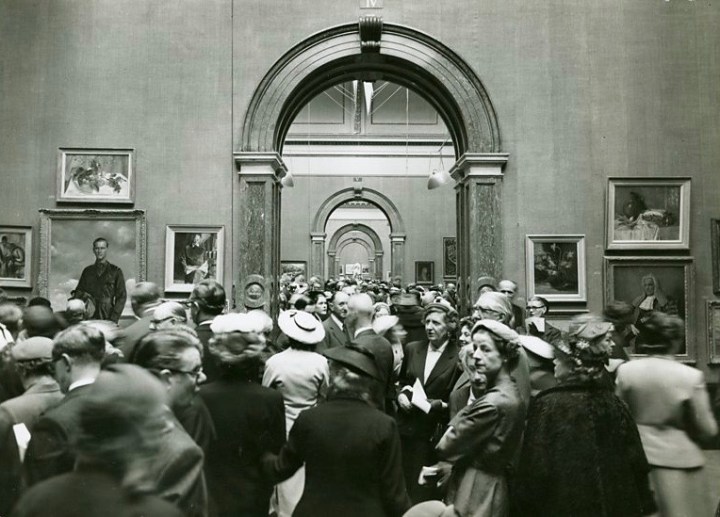
The Main Galleries of the Royal Academy of Arts during the Summer Exhibition, 1956 (unidentified photographer working for Keystone Press Agency Ltd. Photo credit: © Royal Academy of Arts, London)
◊ ◊ ◊ ◊ ◊
From the PMC:
A Year’s Art: The Royal Academy Summer Exhibition, 1769–2016
The Paul Mellon Centre for Studies in British Art, London, 29–30 September 2016
Proposals due by 17 June 2016
2018 will see the opening of a major exhibition devoted to the history of the Royal Academy’s annual Summer Exhibition. Provisionally entitled The Great Spectacle: The Royal Academy and Its Summer Exhibitions, 1769–2018, this display is planned to take place in what will be the Academy’s newly expanded and interconnected premises in Burlington House and Gardens. Forming part of the Academy’s 250th Anniversary celebrations, the exhibition will be curated by Mark Hallett and Sarah Turner of the Paul Mellon Centre, with the assistance of the Academy’s Per Rumberg and the PMC’s Jessica Feather.
Alongside the exhibition and its accompanying catalogue, the PMC members of the team are planning to develop an extensive, multi-authored online chronicle of the RA Summer Exhibition’s histories. This will take the form of a series of 250 short, illustrated texts—of around 1000 words each—that will focus on every individual exhibition in turn, beginning with the first such display, held in 1769. Featuring a wide range of scholarly and critical voices telling a multitude of stories about the exhibition, the chronicle will be developed in tandem with an ambitious digitisation programme that will place historic and contemporary summer exhibition catalogues online. This innovative project is designed to offer scholars, students, and exhibition-visitors with an intellectually lively online resource for research and learning, long after the exhibition itself closes. Whilst focusing on the Academy’s summer exhibitions, it will also contribute to the growing field of study on exhibition histories more broadly. As the longest running exhibition of contemporary art in the world, the Royal Academy Summer Exhibition offers an extremely rich focus for this area of research.
In advance of the 2018 Great Spectacle exhibition, the Paul Mellon Centre is organising and hosting a two-day event that is designed to highlight and develop new perspectives on the Academy’s display. The conference will take place on 29th–30th September 2016.
In the spirit of our planned online chronicle, the conference will be structured around groupings of short papers dealing with individual years in the exhibition’s history. It is designed to be fast-moving, provocative, and surprising, and to feature time both for speedy feedback and extended discussion. We invite proposals for 1000-word papers that, through focusing on an individual year, enable us to think afresh about the Royal Academy’s summer exhibition, and that do so from different art-historical perspectives. The premium on such papers will be to deliver pithy, refreshing, and original insights into the exhibition: to offer an illuminating art-historical snapshot, alighting on a particular work or artist, or a prominent theme to come out of an individual year.
We are especially keen to showcase new research into the histories of the exhibition and into its contemporary character, appeal, and function. We invite proposals that deal with the different kinds of objects that have been exhibited at the Academy, including sculpture, drawings, prints, and architectural models, as well as the paintings that have been the mainstay of the display since its inception. Proposals might focus on the summer exhibition as a venue of artistic competition and collaboration; on its status as an entertaining form of urban spectacle; on the interaction of works of art within its walls; on its fluctuating critical fortunes and its shifting status within the British art world; on the role of women artists within its history; on its position within the London social scene; on the function and impact of its selection and hanging committees; on its engagement with the themes of war, empire and celebrity; on the kinds of art-criticism it has generated; and on a wide range of other topics. We especially welcome applications from junior scholars and researchers, as well as from experienced academics, curators, critics and independent art-historians. Cross-disciplinary, comparative and collaborative studies are also very welcome.
Please submit proposals, of no more than 250 words, together with a short cv to Ella Fleming (efleming@paul-mellon-centre.ac.uk) by Friday, 17th June 2016. We will accept up to three proposals from individual applicants, and we would encourage multiple proposals to be on non-sequential years. Travel and accommodation will be provided for speakers travelling from outside the London area.
Conference | Becoming Roman: Artistic Immigration
From H-ArtHist:
Becoming Roman: Artistic Immigration in the
Urbe from the Sixteenth to the Twentieth Centuries
The British School at Rome, 20 May 2016
Organized by Ariane Varela Braga and Thomas-Leo True
Questions of artistic travel and mobility have been the focus of recent scholarly attention. Rome’s special status as caput mundi and the opportunities it provided as a cultural centre have attracted migrant artists from the Renaissance to the present day.
This conference addresses the issue of mobility from a novel perspective, by concentrating on case-studies of artists—or groups of artists—that not only travelled to, but settled in, Rome and examines issues of mobility, artistic exchange and cultural transfer, patronage and professional networks, cultural identity, and strategies for integration or voluntary exclusion from the local artistic life. When (and how) do foreign artists become Roman artists? What is the role played by social and institutional networks for their integration? How does the process of integration evolve and modify over time? For what sort of clientele (particularly foreign or local) do foreign artists work? How do foreign artist interact with the local artistic environment? How does their activity shape questions of Romanitas or Roman cultural identity?
The conference is an initiative of the Rome Art History Network (RAHN), an independent and international network, based in Rome, which encourages the exchange of ideas between researchers from foreign academies and Italian universities, at an early stage of their career.
◊ ◊ ◊ ◊ ◊
P R O G R A M M E
9:30 Welcome by Thomas-Leo True (BSR)
9:40 Introduction by Ariane Varela Braga (RAHN/University of Zurich)
10:00 Session 1 | Dynamics of Settlement and Integration: Studying Foreign Artists in Rome
Chair: Francesca Cappelletti (Università degli studi di Ferrara)
• Patrizia Cavazzini (BSR), La popolazione dei pittori a Roma nel Cinquecento
• Laura Bartoni (Universita Telematica Internazionale Uninettuno), Artisti stranieri nella Roma del Seicento tra fortuna e fallimento
• Gilles Montègre (Université de Grenoble Alpes), Sono stranieri o diventati romani ? Indagare sugli artisti e residenti francesi nella Roma settecentesca
11:40 Break
12:00 Session 2 | Networks and Socio-institutional Connections
Chair: Raffaella Morselli (Università degli Studi di Teramo)
• Piers Baker-Bates (The Open University), Tierra Tan Extraña: Spanish artists in sixteenth-century Rome
• Elisabeth Kieven (Bibliotheca Hertziana-Istituto Max Planck per la Storia dell‘Arte), Becoming successfully Roman: the case of Gaspar van Wittel (1653–1736)
13:40 Lunch
15:00 Session 3 | Cosmopolitan Circles
Chair: Sarah Linford (Accademia di Belle Arti di Roma)
• Anna Frasca-Rath (Universität Wien), Antonio Canova ed i borsisti internazionali a Roma
• Sarah Kinzel (Humboldt-Universität zu Berlin), Patrons, parties, priceless portraits: Franz von Lenbach’s network in Rome
16:10 Break
16:30 Session 4 | Out of Time: The Choice of Rome
Chair: Laura Iamurri (Università degli Studi Roma Tre)
• Anna Vyazentseva (Università dell’Insubria), Alcuni artisti e architetti Russi a Roma nel Primo Novecento: le questioni dell’integrazione
• Peter Benson Miller (American Academy in Rome), Resident/Alien: American artists in postwar Rome
18:00 Evening Lecture
• Irene Fosi (Università degli Studi “G. d’Annunzio”, Chieti-Pescara), Roma in età moderna: un mosaico di ‘nationes’
Study Day | Kimbolton Castle, Huntingdonshire
From the Society of Architectural Historians of Great Britain:
SAHGB Study Day: Kimbolton Castle
Huntingdonshire (Cambridgeshire), 13 July 2016
 Pete Smith and Nora Butler (Kimbolton School) will be leading a Study Day at Kimbolton Castle on Wednesday 13th July 2016. Kimbolton Castle was purchased by Sir Henry Montagu in around 1605. He was created Earl of Manchester by Charles I. It was his great-grandson Charles, the 4th Earl who inherited in 1683 and who, between 1690 and 1720, entirely rebuilt the original courtyard house. This rebuilding was carried out in three phases. The first possibly by Henry Bell of Kings Lynn between 1691 and 1696, the second by Sir John Vanbrugh between 1707 and 1710 and finally the east portico was added in 1719, this is usually assigned to Alessandro Galilei though recently discovered evidence suggests it may have been designed by Thomas Archer. Antonio Pellegrini decorated the staircase with paintings of The Triumph of Caesar in 1711–12. A new service range and gateway was added by Robert Adam for the 4th Duke of Manchester in around 1764. In the 1860s William Montagu, the 7th Duke, employed William Burn to modernize the house including new ceilings in the Dining Room and Saloon. He added an attic storey to the central section of north front and built a new stable block 1869–70. The 10th Duke of Manchester sold the castle to Kimbolton School in 1949. The school employed Marshall Sisson to restore the castle including the re-instatement of the glazing bars to all the sash windows. Cost: £35 (£25 students).
Lecture | Douglas Fordham on Aquatint Empires
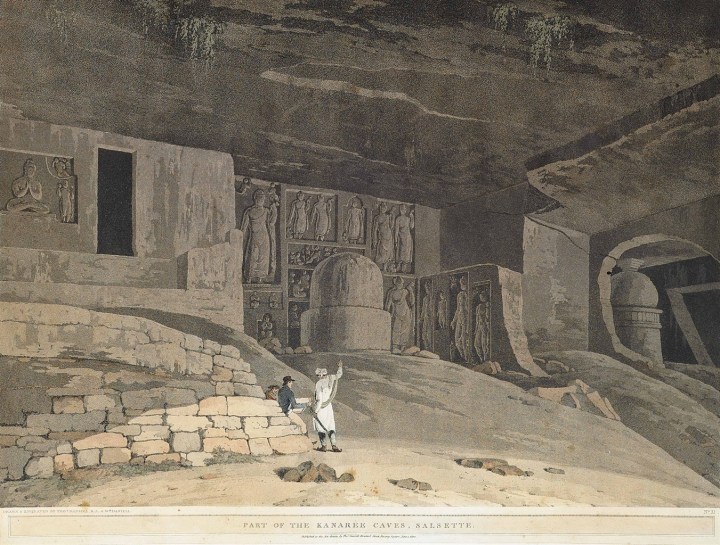
Thomas Daniell, “Part of the Kanaree [Kanheri] Caves, Salsette,” handcoloured aquatint, from Oriental Scenery, 1799.
◊ ◊ ◊ ◊ ◊
This week at the Paul Mellon Centre:
Douglas Fordham, Aquatint Empires
The Paul Mellon Centre for Studies in British Art, London, 18 May 2016
This talk considers the importance of what used to be known as ‘English Coloured Books’ to the conceptualization and visualization of the British Empire. Particular attention will be given to aquatint as a medium, and the ways in which this tonal intaglio process encouraged certain types of visual themes, historical narratives, and viewer responses. Making particular use of the J.R. Abbey collection of ‘Travel in Aquatint and Lithography’ in the Yale Center for British Art, this project explores the production and reception of three ambitious and beautifully illustrated publications: Thomas Daniell’s Hindoo Excavations (1803), William Alexander’s Costume of China (1805), and Samuel Daniell’s African Scenery and Animals (1804–05). This talk asks what these publications might reveal about Britain’s place in the world following the Treaty of Amiens. More broadly, it considers seriality as empire: how did elaborate aquatint publications colour British visions of Africa, Asia, and beyond?
Douglas Fordham is the author of British Art and the Seven Years’ War: Allegiance and Autonomy (University of Pennsylvania Press, 2010) and a co-editor with Tim Barringer and Geoff Quilley of Art and the British Empire (Manchester University Press, 2007). He has published articles relating to British art, visual culture, and empire in Art History, The Art Bulletin, Representations, Oxford Art Journal, and elsewhere.
All are welcome! However, places are limited; so if you would like to attend, please book a place in advance. The seminar will be followed by a drinks reception. Wednesday, 18 May 2016, 6:00–8:00pm.










 Enfilade
leave a comment