Exhibition | Yinka Shonibare MBE
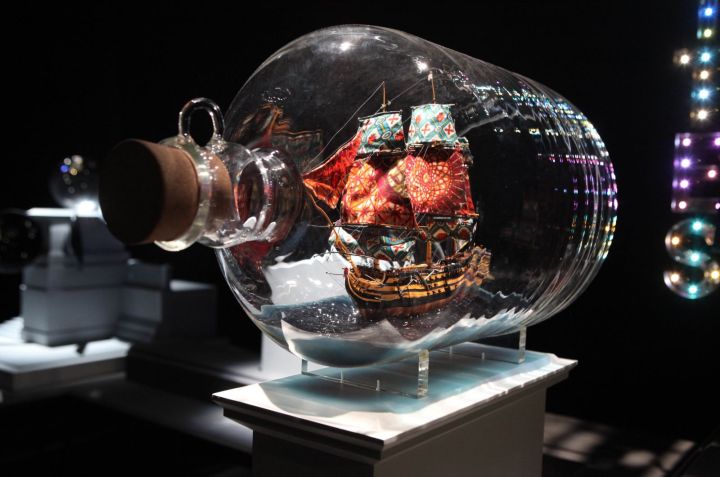
Yinka Shonibare MBE, Nelson’s Ship in a Bottle (maquette), 2007, as installed in the exhibition Fourth Plinth: Contemporary Monument (London: ICA, 2012–13).
◊ ◊ ◊ ◊ ◊
From the YCBA:
Yinka Shonibare MBE
Yale Center for British Art, New Haven, 1 September — 11 December 2016
Curated by Martina Droth
The contemporary British Nigerian artist Yinka Shonibare is best known for his explorations of the legacies of colonialism through sculpture, installations, film, and photography. This display, which coincides with the Center’s exhibition Spreading Canvas: Eighteenth-Century British Marine Painting, will focus on Shonibare’s interest in the British historical figure Admiral Lord Nelson, whom he uses as an emblem of Britain’s imperial history. An important feature of Shonibare’s work is the consistent use of colorful, wax-printed cotton fabrics, which are associated with Africa but originated in Indonesia and Holland, a product of global trade and imperial markets. The fabric sums up the themes at the heart of Shonibare’s work.
Yinka Shonibare MBE will be curated by Martina Droth, Deputy Director of Research and Curator of Sculpture, Yale Center for British Art.
Exhibition | Spreading Canvas

Charles Brooking, Shipping in the English Channel, ca. 1755, oil on canvas (New Haven: Yale Center for British Art, Paul Mellon Collection)
◊ ◊ ◊ ◊ ◊
From the YCBA:
Spreading Canvas: Eighteenth-Century British Marine Painting
Yale Center for British Art, New Haven, 15 September — 4 December 2016
Curated by Eleanor Hughes
This is the first major exhibition to survey the tradition of marine painting that was inextricably linked to Britain’s rise to prominence as a maritime and imperial power, and to position the genre at the heart of the burgeoning British art world of the eighteenth century. The demand for marine paintings—and the prints made after them—in the eighteenth century, from ship launches to shipwrecks, naval battles to serene coastal views, reflects Britain’s absolute dependence on the sea. In an age when Britain claimed to rule the waves, marine paintings found a new importance and helped the island nation tell its stories of triumph and disaster. This exhibition will reconstruct the full array of representational modes—pictorial, planimetric, narrative, and plastic—that were deployed throughout the century to represent the maritime exploits of the nation. Drawn primarily from the collections of the Yale Center for British Art and augmented by spectacular loans, Spreading Canvas will demonstrate that marine painting was both ubiquitous and fundamental to eighteenth-century British culture.
Spreading Canvas: Eighteenth-Century British Marine Painting has been organized by the Center and will be curated by Eleanor Hughes, Deputy Director for Art & Program at the Walters Art Museum. The organizing curator at the Center is Matthew Hargraves, Chief Curator of Art Collections and Head of Collections Information and Access.
◊ ◊ ◊ ◊ ◊
From Yale UP:
Eleanor Hughes, ed., with essays by Eleanor Hughes, Richard Johns, Geoff Quilley, Christine Riding, and Catherine Roach and contributions by Sophie Lynford, John McAleer, and Pieter van der Merwe, Spreading Canvas: Eighteenth-Century British Marine Painting (New Haven: Yale Center for British Art, 2016), 312 pages, ISBN 978-0300221572, $75.
 Spreading Canvas takes a close look at the tradition of marine painting that flourished in 18th-century Britain. Drawing primarily on the extensive collections of the Yale Center for British Art and the National Maritime Museum in Greenwich, London, this publication shows how the genre corresponded with Britain’s growing imperial power and celebrated its increasing military presence on the seas, representing the subject matter in a way that was both documentary and sublime. Works by leading purveyors of the style, including Peter Monamy, Samuel Scott, Dominic Serres, and Nicholas Pocock, are featured alongside sketches, letters, and other ephemera that help frame the political and geographic significance of these inspiring views, while also establishing the painters’ relationships to concurrent metropolitan art cultures. This survey, featuring a wealth of beautifully reproduced images, demonstrates marine painting’s overarching relevance to British culture of the era.
Exhibition | Moving Earth
From the YCBA:
Moving Earth: ‘Capability’ Brown, Humphry Repton, and the Creation of the English Landscape
Sterling Memorial Library, Yale University, New Haven, 7 March — 3 June 2016
Curated by Elizabeth Morris
Approximately one hundred objects from the Center’s collection are represented in this exhibition, which is on view at Yale’s Sterling Memorial Library. Curated by Beth Morris, Assistant Librarian at the Center, the exhibition includes items from the Reference Library and Archives, and reproductions from the Rare Books and Manuscripts, Prints and Drawings, and Paintings collections. Featured here are representations of work by Nathaniel Dance-Holland (Portrait of Lancelot ‘Capability’ Brown, 1773), William Taverner (Classical Landscape, ca. 1760), and Humphrey Repton (Sketches and hints on landscape gardening [London: W. Bulmer and Co., 1794]).
More information is available at the exhibition website.
YCBA Reopens on Wednesday
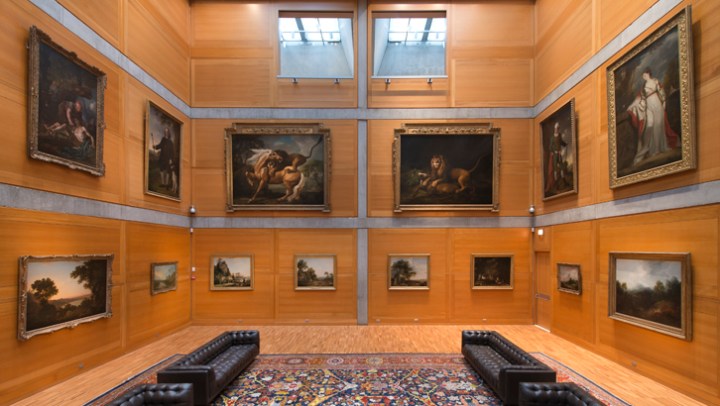
Yale Center for British Art, Library Court following reinstallation facing west, March 2016
Photo by Richard Caspole
◊ ◊ ◊ ◊ ◊
Press release for the reopening of the Yale Center for British Art upon the completion of the interior conservation of its landmark Louis Kahn building:
The Yale Center for British Art will reopen to the public on May 11, 2016, after completing the third phase of a major building conservation project. Visitors to the renovated building will experience a stimulating new installation of the Center’s unparalleled collection of more than five centuries of British art, largely the gift of the institution’s founder, Paul Mellon (Yale College, Class of 1929).
The Long Gallery, located on the fourth floor, will be wholly reconfigured, restoring the original conception of the space as a teaching and study gallery, as formulated by the Center’s founding director, Jules Prown, and as designed by Kahn. Over two hundred works will be installed from floor to ceiling across seven bays. Adjacent to this gallery, in a space that formerly served as an office, will be a new seminar room for faculty, students, and visiting scholars to engage in the close study of collection objects. In addition to the reinstallation of the collection, which explores the theme of “Britain in the World,” the reopening will also feature two special exhibitions.

Yale Center for British Art, fourth floor, Long Gallery following reinstallation, January 2016
Photo by Richard Caspole
◊ ◊ ◊ ◊ ◊
The Center first opened to the public in April 1977, and this project marks the most complex and comprehensive interior conservation work undertaken to date, affecting the entire structure, including the basement and roof. The project features significant mechanical, electrical, plumbing, and telecommunications upgrades, as well as important improvements to accessibility, re prevention systems, and patron amenities.
During the closure, construction crews have been busily restoring the galleries to pristine condition. Old linen and plywood were removed from the permanent walls, the former donated to the Yale School of Art and the latter given to the Hartford Area Habitat for Humanity. After insulation was removed from the exterior walls, the inside of the exterior stainless steel panels was revealed, allowing areas of corrosion to be treated and the interior of the walls to be rebuilt. Two layers of mineral wool insulation were covered with galvanized steel, re-rated plywood, and fresh Belgian linen. Worn synthetic carpet was replaced with new wool carpet, refinished wood trim was installed, and some travertine floor tiles were repaired or replaced. The existing moveable gallery partitions, known as “pogo” walls, were also dismantled, and will be replaced by new ‘pogo’ panels based closely on a drawing produced by Kahn shortly before his death in March 1974.
Extensive renovations also have also been undertaken in the Lecture Hall, which is the only remaining space that has never been refurbished. New seats have been configured in the center of the room, flanked by new steps and railings along each side wall. Five seats for disabled patrons have been installed, each with a companion seat. Audio/visual and lighting upgrades will enable better broadcasting and performance capabilities, including integrated video conferencing. There are also two new accessible public restrooms on the basement level, as well as a bank of new lockers for use by Center visitors.
As with past building conservation projects, the Center has benefited from the expertise and dedication of its partners in the Yale Office of Facilities; Knight Architecture LLC, New Haven; Peter Inskip + Peter Jenkins Architects, London; and Turner Construction Company; as well as the talents and hard work of numerous other collaborators.
This project follows more than a decade of research on the history of the design, construction, and renovation of the Center’s landmark building, as well as the publication in 2011 of Louis Kahn and the Yale Center for British Art: A Conservation Plan by the Center in association with Yale University Press. Written by Peter Inskip and Stephen Gee, in association with Constance Clement, the Center’s deputy director, this book details the conservation plan and proposes a series of policies for the building’s care and maintenance in the years ahead. The first of its kind in the United States, the conservation plan addresses the evolution and appropriate upkeep of a modern building, rather than the preservation of an historic structure, by identifying the key features characterizing its cultural significance and determining those which should be protected and others that could be allowed to change.
The first phase of work to be guided by the conservation plan involved the rehabilitation of the Center’s exterior Lower Court and extensive repairs to the adjacent Lecture Hall Lobby in 2010–2013. This was followed by two additional projects addressing the building’s interior spaces: The second phase, in 2013, focused on refurbishment of the department of Prints & Drawings and Rare Books & Manuscripts. Along with vitally increasing storage capacity for works on paper, behind-the-scenes renovations included the replacement of carpeting and wall coverings; the renewal of the finish on white oak storage cabinets; and the reconfiguration of offices to better accommodate the needs of staff. The third phase, begun in 2015, concentrated primarily on enhancing the Center’s public spaces, while also addressing extensive building-wide mechanical and electrical upgrades, as well as improvements to safety and accessibility.
The Yale Center for British Art houses the largest collection of British art outside the United Kingdom. Presented to the university by Paul Mellon, the collection reflects the development of British art and culture from the Elizabethan period onward. The Center’s collections include more than 2,000 paintings and 200 sculptures, 20,000 drawings and watercolors, 30,000 prints and 35,000 rare books and manuscripts. More than 30,000 volumes supporting research in British art and related fields are available in the Center’s library.
In celebration of the reopening, the Center will host extended hours on Wednesday, May 11, and Thursday, May 12, with special behind-the-scenes tours on opening day. On Saturday, May 14, the Center will welcome the community with a full day of programs and activities. Screenings of a brief documentary on the architecture of the institution’s iconic building, designed by Louis I. Kahn, will be shown in the newly refurbished Lecture Hall. The film will provide insight into the architecture, the building conservation project, and the relationship of the building to the collections. Visitors will be able to tour the reinstallation, which interprets the museum’s extraordinary collections of five centuries of British art in the context of the larger world. The reinstallation is presented in the galleries on the fourth and second floors. The special exhibitions Modernism and Memory: Rhoda Pritzker and the Art of Collecting (May 11–August 21, 2016) and Art in Focus: Relics of Old London (May 11–August 14, 2016) are located on the third-floor galleries. Everyone is welcome. Admission is free.
Exhibition | A Third Gender: Beautiful Youths in Japanese Prints
Press release (via Art Daily) for the exhibition now on view at ROM:
A Third Gender: Beautiful Youths in Japanese Prints
Royal Ontario Museum, Toronto, 7 May — 27 November 2016
Japan Society, New York, 10 March — 11 June 2017
Curated by Asato Ikeda

Suzuki Harunobu, Mitate-e of a Poem by Saigyō Hōshi. 1767/68 (Ontario: ROM, Sir Edmund Walker Collection 926.18.113)
The ground-breaking A Third Gender: Beautiful Youths in Japanese Prints opened at the Royal Ontario Museum on Saturday, May 7, 2016. Featuring stunning woodblock prints, samurai armor, a kimono, screen paintings, lacquerwork, and illustrated books, the exhibition explores issues of gender and tells a pivotal story of sexuality in Japan’s Edo period (1603–1868).
A Third Gender is the first North American display on wakashu. Four hundred years ago in Japan, a complex social structure existed in which gender involved more than a person’s biological sex. Age, position in the sexual hierarchy, and appearance were also considered. Fundamental to this structure were youths termed wakashu. Neither ‘adult man’ nor ‘woman’—each a separate gender—wakashu were objects of desire for both, playing distinct social and sexual roles. Constituting a third gender, they are visually represented in these Edo period woodblock prints.
The exhibition features approximately 60 woodblock prints (ukiyo-e), visually representing wakashu. Many never before displayed, they are from the ROM’s Japanese art collection—the largest in Canada. Produced since the 8th century in Japan, woodblock prints, created collaboratively by a designer, engraver, printer, and publisher, became popular in the 17th century. The exhibition’s prints were created in early 18th to mid-19th centuries by major ukiyo-e masters including Okumura Masanobu, Suzuki Harunobu, and Kitagawa Utamaro.
A Third Gender is curated by Dr. Asato Ikeda, Assistant Professor of Art History at Fordham University, New York and the ROM’s 2014–16 Bishop White Postdoctoral Fellow of Japanese Art and Culture. In Ikeda’s words, “A Third Gender invites ROM visitors to think differently about gender and sexuality and we anticipate the exhibition will be of interest to a diverse audience.”
◊ ◊ ◊ ◊ ◊
From Brill:
Joshua Mostow, Asato Ikeda, and Ryoko Matsuba, A Third Gender: Beautiful Youth in Japanese Edo-period Prints, 1600–1868 (Leiden: Hotei, 2016), 215 pages, ISBN 978-0888545145, $50.
 For the first time outside Japan, A Third Gender examines the fascination with wakashu in Edo-period culture and their visual representation in art, demonstrating how they destabilize the conventionally held model of gender binarism. The volume will reproduce, in color, over a hundred works, mostly woodblock prints and illustrated books from the eighteenth and nineteenth centuries produced by a number of designers ranging from such well-known artists as Okumura Masanobu, Suzuki Harunobu, Kitagawa Utamaro, and Utagawa Kunisada, to lesser known artists such as Shigemasa, Eishi, and Eiri. A Third Gender is based on the collection of the Royal Ontario Museum, which houses the largest collection of Japanese art in Canada, including more than 2500 woodblock prints.
Joshua S. Mostow is Professor of Asian Studies at the University of British Columbia, Vancouver. Asato Ikeda is Assistant Professor of Art History at Fordham University, New York and the ROM’s 2014–16 Bishop White Postdoctoral Fellow of Japanese Art and Culture.
◊ ◊ ◊ ◊ ◊
P R O G R A M S E R I E S
Elements of Sake
3 May 2016
Join Michael Tremblay for an introduction and guided tasting of sake, designed to demystify and engage. This special evening will explore the basics of sake, its production and history, and the culture that created it.
Japanese Visual Culture: Gender and Sexual Diversity
12 May 2016
Asato Ikeda, the curator of A Third Gender, will examine the role of male youths in Edo-period Japan and how this gender and sexuality system can be understood from a contemporary North American perspective.
It’s Complicated: Gender Ambiguity in Early-Mondern Japan
7 June 2016
Explore the roles of gender, sexuality, and erotic art in Japanese culture with internationally renowned scholar Joshua Mostow. Please note this lecture will contain explicit images and discussions of a sexual nature, and is not recommended for those under the age of 18.
Lost in Translation? Gender and Sexuality Across Time and Cultures
21 June 2016
How do we understand representations of sexuality, including same sex sexuality, across different historical and cultural moments without imposing contemporary norms? Join our panel as they explore concepts surrounding our exhibition A Third Gender.
The Art of Japan
16 October 2016
Experience the fundamentals of Japanese art in this in-depth workshop lead by ROM Educator George Hewson. This full day workshop includes a guided visit of the exhibition A Third Gender and lunch.
◊ ◊ ◊ ◊ ◊
Note (added 14 March 2017) — The original posting did not include the Japan Society as a venue.
Jonathan Bober Named Senior Curator of Prints and Drawing at NGA
Press release (6 May 2016) from the NGA:

Jonathan Bober in the prints and drawings study room at the National Gallery of Art, Washington (Photo by Division of Imaging and Visual Services)
Jonathan Bober has been named the National Gallery of Art’s Andrew W. Mellon Senior Curator of Prints and Drawings. Bober’s appointment becomes effective on October 1, 2016, when he succeeds Andrew Robison, who retires from the position on September 30, 2016. Bober will oversee the continuing work and growth of the Gallery’s three departments of prints and drawings that Robison cultivated and nurtured for more than 40 years.
“Jonathan Bober is a brilliant curator and connoisseur with an outstanding track record of exhibitions and publications, and a remarkable degree of knowledge about both prints and drawings,” said Earl A. Powell III, director, National Gallery of Art. “We are delighted that he is assuming this prestigious role in our curatorial ranks.”
Since 2011 Bober has served as curator and head of old master prints at the National Gallery of Art and has played a very active role across the institution, from key acquisitions to mentoring emerging scholars. Bober led the acquisition of some 2,000 prints by purchase, gift, and promised gift, most notably 18th-century Venetian and 19th-century Italian, making the Gallery’s holdings the most significant in the U.S. During his tenure at the Gallery, Bober organized four Gallery exhibitions: The Baroque Genius of Giovanni Benedetto Castiglione (2012), Northern Mannerist Prints from the Kainen Collection (2013), From Neoclassicism to Futurism: Italian Prints and Drawings, 1800–1925 (2014), and Recent Acquisitions of Italian Renaissance Prints: Ideas Made Flesh (2015). Since 2015, Bober has been the Gallery’s curatorial liaison to the Center for Advanced Study in the Visual Arts (CASVA).
The Gallery’s division of old master and modern prints and drawings, with nine curators, oversees one of the nation’s finest collections of works on paper. In total, the Gallery’s collection of prints, drawings, and illustrated books contains approximately 121,000 Western European and American works on paper and vellum dating from the 11th century to the present day.
Bober came to the Gallery in 2011 from the Blanton Museum at the University of Texas at Austin, where he served as a curator since 1987, first as curator of prints and drawings; from 1998 as curator of prints, drawings, and European painting; and from 2010 as senior curator of European art. Prior to his work at the Blanton Museum, he was curatorial associate in the print department of the Fogg Art Museum, Harvard University, from 1984 to 1987, where he completed his graduate work with Sydney Freedberg and Henri Zerner.
Over the course of Bober’s career his exhibitions and publications have focused on old master paintings and old master and modern prints and drawings. They include Luca Cambiaso, 1527–1585, the international loan exhibition of the paintings, drawings, and prints of Luca Cambiaso and his Genoese contemporaries, (co-organized with the Palazzo Ducale, Genoa; Austin, September 2006–January 2007, and Genoa, March–July 2007), and Capolavori della Suida-Manning Collection (co-organized with Giulio Bora, Museo Civico, Cremona, October 2001–April 2002). In addition to catalogs of the Italian drawings in the Fogg Art Museum (1988) and Blanton Museum (2001), and numerous exhibition catalogs at the Blanton, Bober is the author of many catalog essays and scholarly articles appearing in such periodicals as Master Drawings, The Burlington Magazine, and Arte Lombarda. These concern painting and drawing as well as printmaking in 16th- and 17th-century Milan, Cremona, Venice, and Genoa.
Bober acquired for the Blanton Museum 11,000 of its 18,000 works (most with private support), including the extraordinary Suida-Manning Collection of old master paintings and drawings, art critic Leo Steinberg’s extensive collection of old master prints, and many outstanding individual works in the field, including modern and contemporary. In addition to organizing exhibitions from the Blanton Museum’s collection, such as Prints of the Ancien Régime (1996) and The Language of Prints (2008), Bober maintained a rotation of prints and drawings from the permanent collection in seven dedicated galleries. He helped develop the design of the new Blanton Museum and oversaw the creation of a new center for prints and drawings, which opened in April 2006.
Andrew Robison joined the curatorial staff of the National Gallery of Art in 1974, becoming Senior Curator in 1983 and A. W. Mellon Senior Curator in 1991. Over four decades Robison has curated dozens of exhibitions on art from the 15th through the 20th centuries, especially drawings and prints by early German artists, Rembrandt, 18th-century Venetian artists, German expressionists, and Pablo Picasso, as well as the multimedia exhibitions Art for the Nation: Gifts in Honor of the 50th Anniversary of the National Gallery of Art (1991), The Glory of Venice: Art in the Eighteenth Century (1994–1995), Ernst Ludwig Kirchner: 1880–1938 (2003), and Albrecht Dürer: Master Drawings, Watercolors, and Prints from the Albertina (2013).
Exhibition | The British Landscape Tradition
Press release from Pallant House:
The British Landscape Tradition: From Gainsborough to Nash
Pallant House Gallery, Chichester, 11 May – 26 June 2016

Thomas Gainsborough, A Suffolk Lane, 1750–60 (Chichester: Pallant House Gallery)
A new exhibition at Pallant House Gallery showcases the Gallery’s significant but rarely-seen collection of historic works on paper from the 18th to 20th centuries. The exhibition forms a representative overview of depictions of the British landscape, beginning with early watercolours and drawings by Alexander Cozens, Thomas Gainsborough, and John Sell Cotman, to watercolours by 20th-century artists associated with ‘Neo-Romanticism’ in Britain in particular Ivon Hitchens, Paul Nash and Graham Sutherland. The exhibition will go on display in the De’Longhi Print Room at Pallant House Gallery from 11 May until 26 June 2016.
The majority of the Gallery’s collection of historic works on paper were donated by Walter Hussey, Dean of Chichester Cathedral from 1956 to 1978. Best known for commissioning and collecting the work of modern artists such as Moore, Piper, and Sutherland, which formed the founding collection of the Gallery in 1982, Hussey also collected exquisite Old Master watercolours and drawings that are represented in this exhibition.
Although heavily influenced by Dutch landscape paintings, Thomas Gainsborough often travelled into the English countryside, sketching directly from nature in order to record scenes that he thought to be particularly picturesque, such as his drawing A Suffolk Lane (ca. 1750–60). For Gainsborough, landscapes were a relief from painting grand portraits and he wished “to take my viola da gamba and walk off to some sweet village where I can paint landskips and enjoy the fag end of life in quietness and ease.”
Born in Russia, Alexander Cozens is thought to have been the first English artist to work entirely with landscape subjects. Cozens was famous for inventing a ‘blot’ technique in the 1750s, which he developed as a teaching aid to liberate the mind of students, whom he felt spent too much time copying the work of others. His son John Robert Cozens was considered by John Constable to be “the greatest genius that ever touched landscape,” describing his work as “all poetry.” Cozens worked extensively in Italy but concentrated on English subjects in the last decade of his life.
A brilliant watercolourist, John Sell Cotman was one of the leading members of the Norwich School of Artists in the early 19th century. Born in Norwich, Cotman moved to London then toured widely in England and Wales before settling again in Norwich. His watercolour of Capel Curig (ca. 1802) was probably created during his second tour of Wales.
The Welsh countryside was also an inspiration for John Varley who made numerous sketching trips to Wales between 1798 and 1802. His sketches and memories of these trips were used in works he created until the end of his life and include Snowdon (With Lyn Padorn) (ca. 1809), which features in the exhibition.
Artists such as Varley and Cotman were an important point of reference for artists in the early 20th-century such as Paul Nash. Art historian John Rothenstein noted in 1957 that Nash “was too personal an artist to imitate an Old Master, but what he did was to assimilate something of the spirit of Girtin, Cotman and others, and to evolve a free contemporary version of traditional idioms.” In 1929 the critic R. H. Wilenski went so far as to call Nash ‘the John Sell Cotman’ of today.
At the outbreak of the Second World War Graham Sutherland produced a number of paintings based on the view of Sandy Lane in Pembrokeshire. The preliminary studies in the Gallery’s collection for the celebrated completed oil known as Entrance to a Lane in the Tate collection, reveal Sutherland’s process of ‘paraphrasing nature’, drawing on continental abstraction as a way of representing the Welsh landscape in a poetic and modern way.
Also included in the exhibition are several views of the Sussex landscape around Chichester. These include George Romney’s ink and wash view of Eartham Park, the home of his patron William Hayley—a rare example of landscape in his oeuvre. Also featured are watercolours of the South Downs by George Catt (1869–1920), who taught the young Eric Gill at Chichester College, and one of Ivon Hitchens’s earliest known works: Didling on the Downs (ca. 1920) featuring a pastoral scene before he had developed his abstract style of the 1930s onwards.
New Book | Marie-Antoinette
From The Getty:
Hélène Delalex, Alexandre Maral, and Nicolas Milovanovic, Marie-Antoinette (Los Angeles: J. Paul Getty Museum, 2016), 216 pages, ISBN 978-1606064832, $50.
 Marie-Antoinette (1755–1793) continues to fascinate historians, writers, and filmmakers more than two centuries after her death. She became a symbol of the excesses of France’s aristocracy in the eighteenth century that helped pave the way to dissolution of the country’s monarchy. The great material privileges she enjoyed and her glamorous role as an arbiter of fashion and a patron of the arts in the French court, set against her tragic death on the scaffold, still spark the popular imagination.
In this gorgeously illustrated volume, the authors find a fresh and nuanced approach to Marie-Antoinette’s much-told story through the objects and locations that made up the fabric of her world. They trace the major events of her life, from her upbringing in Vienna as the archduchess of Austria, to her ascension to the French throne, to her execution at the hands of the revolutionary tribunal. The exquisite objects that populated Marie-Antoinette’s rarefied surroundings—beautiful gowns, gilt-mounted furniture, chinoiserie porcelains, and opulent tableware—are depicted. But so too are possessions representing her personal pursuits and private world, including her sewing kit, her harp, her children’s toys, and even the simple cotton chemise she wore as a condemned prisoner. The narrative is sprinkled with excerpts from her correspondence, which offer a glimpse into her personality and daily life.
Hélène Delalex is curator attaché at the Palace of Versailles, where Alexandre Maral is curator. Nicolas Milovanovic is curator at the Louvre Museum.
New Book | Carl Gustaf Pilo
Available from Nyt Nordisk Forlag (New Nordic Publishing) . . .
Charlotte Christensen, Drømmebilleder: Carl Gustaf Pilos Portrætkunst (Copenhagen: Nyt Nordisk Forlag, 2016), 448 pages, ISBN 978-8717044999, 400KR.
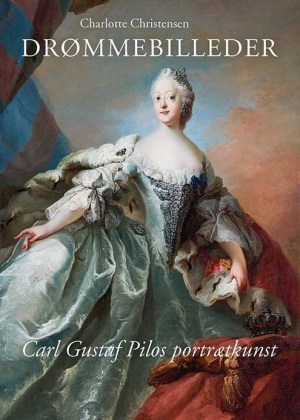 Carl Gustaf Pilo (1711–1793), der var rokokoens fremmeste hofmaler i Norden, fødtes i Sverige, men levede i Danmark i størstedelen af sin tid som kunstner. Skæbnen bragte ham fra en periode som adelens portrættør i Skåne til hofmalerposten i Danmark, hvor han særligt kom til at definere den gyldne tid for de danske riger under Frederik V til de turbulente år med Christian VII og Struensee. Han blev i 1772 udvist af Danmark, og skabte sig derefter i Gustaf IIIs Sverige sin alderdoms fremragende og helt særegne mesterværk, maleriet af den svenske konges kroning.
Som kongernes kunstner var Pilos liv afhængigt af de skiftende magtkonstellationer i Danmark, og han var med til at forme kunstakademiet i København. Bogen sætter Pilos kunstnergerning ind i den kulturhistoriske ramme, den hører til i, foruden at den redegør for de politiske og idehistoriske omvæltninger i de nordiske lande, der var med til at forme hans til tider dramatiske livsløb.
Bogen præsenterer et rigt udvalg af Carl Gustav Pilos kunstværker, der i dag er spredt på herregårde og slotte, i privatsamlinger og museer, med nyoptagelser af de ofte kolossal store malerier og detaljer, der er karakteristiske for hans malemåde.
Charlotte Christensen har været vidt omkring i det danske kunstliv. Samtidens billedkunst og teaterliv har haft en vigtig plads i hendes arbejde inden for museumsverdenen og som direktør for Kunstforeningen i København. Hun har undervist på universiteterne i Aarhus og København og på Statens Teaterskole. Formidlingen af ældre kunst har haft lige så stor prioritet, og 1600-tallet var i centrum, da hun var generalsekretær for Christian IV-året 1988. Christensen har skrevet monografier om Jens Juel og Nicolai Abildgaard og bidraget med artikler om Vigilius Eriksen og Laurits Tuxen til kataloget for Frederiksborgmuseets udstilling Danmark og zarernes Rusland, 1600–1900. Hun er også kendt som forfatter til Gyldendals bog om engle. Seneste har Christensen været tilknyttet Designmuseum Danmark og publiceret museets art nouveau-samling og udgivet … At give af et godt Hjerte og et glad Sind: Kunstindustrimuseets Venner, 1910–2010.
National Gallery of Denmark’s Plans for Digitizing Its Collection
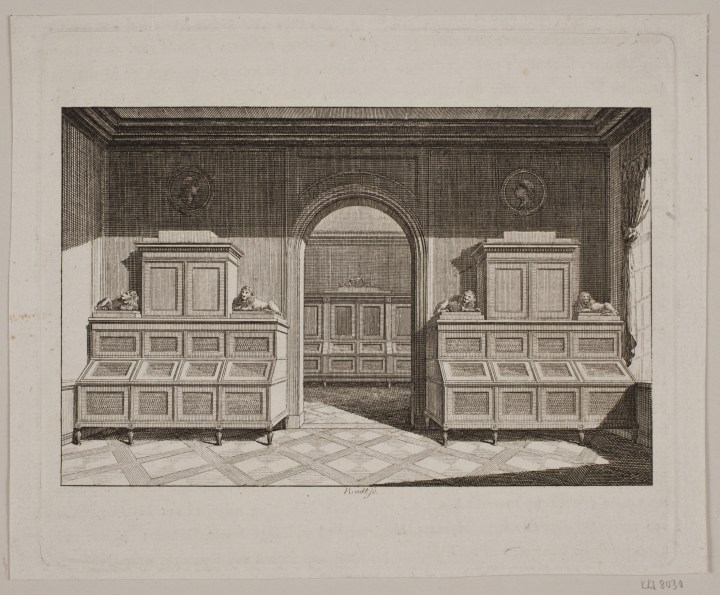
Frederik Ludvig Bradt (1747–1829), Coin Cabinet at Rosenborg, etching, 1791
(Copenhagen: SMK / The National Gallery of Denmark, KKS8030)
◊ ◊ ◊ ◊ ◊
As of today, a search of the SMK collection with the filter for 1700 to 1800 turns up 8204 works. From the press release (2 May 2016). . .
The SMK, The National Gallery of Denmark, launches a digital project that will, over the course of the next four years, make the National Gallery’s art collection freely available to everyone—for any purpose, ranging from fun to serious production. The objective is to make art relevant to more people. The project is made possible by a generous donation from the Nordea Foundation of DKK 11.7 million (EUR 1.6 million).
In countries such as The Netherlands, the USA and the UK, large museums have digitised their collections and made them available to everyone for years now, thereby endeavouring to meet the demands of present and future consumers of art and culture who are no longer satisfied with being spectators. They want to participate actively, and they want to put culture to use in their own lives. The lessons learned from these efforts are clear: being able to actively select, re-purpose, remix, and share works means that far more people access and use the collections. Including people who would not usually have visited or used the museum.
The SMK collection comprises more than 250,000 works of art. Approximately one per cent of that collection is on display and can be accessed by visitors to the museum in Copenhagen. In recent years the SMK has launched a range of pilot projects to explore how the museum’s digital treasures can be used in new ways, in new contexts and by all users. These initiatives have progressed by increments and been modest in scale, but the results have shown that there is demand for such activities. In fact, the findings proved so promising that the SMK will now, thanks to a generous donation of DKK 11.7 million (EUR 1.6 million) from the Nordea Foundation, embark on a new project: SMK Open. Scheduled to run until 2020, the SMK Open project will pave the way for truly democratic use of the museum’s art collections.
The history and many stories of art will continue to be explored and presented by the museum’s in-house experts. At the same time the SMK will open up its collection in digital form, offering a huge toolbox full of building blocks in the form of high-quality image files that can be used by anyone for any purpose—for example for books, education materials, online blogs, Wikipedia articles, film and TV productions, interior design and outdoor decoration—the only limit is the users’ imagination.
“SMK Open makes the National Gallery of Denmark’s art collection—which belongs to us all—available to anyone at all times. There will be no admission fee, but plenty of excellent and informative presentation materials and a warm invitation to have fun, play around and explore the wondrous world of art. The project will make even more people co-owners and co-producers of our shared art heritage,” says Henrik Lehmann Andersen, director of the Nordea Foundation, which aims to support and enhance ‘the good life’ for everyone.
The SMK Open project gives each work its own digital webpage that can also contain materials such as film footage, articles, audio tracks, x-rays of the work, and information on any future events or exhibitions at the museum which feature that work. In addition to this, thousands of photographs of art works will be made available in the highest possible resolution and quality. All works on which no copyright restrictions apply can be used by anyone for any purpose.
Users can also comment on each work, contribute their own information and insights or enter into a dialogue with the museum staff. Users are also invited to take part in the project’s development and will be involved in shaping and defining the end result right from the outset.
“In recent years we at the SMK have worked to offer many different gateways to the world of art. Our experience tells us that art becomes relevant to more people when they can approach it in their own way. Many wish to actively use art in their own lives. SMK Open will make it possible to download and use a wealth of information from the SMK toolbox—and at the same time we want to incorporate the users’ insights and information about the collection in that toolbox. This is because we want to forge closer links between our collection—which belongs to public—and the greatest possible number of people we can—of any age, gender, level of education and social or cultural background,” says Mikkel Bogh, director of the SMK.










 Enfilade
leave a comment