Exhibition | William Hogarth: A Harlot’s Progress and Other Stories
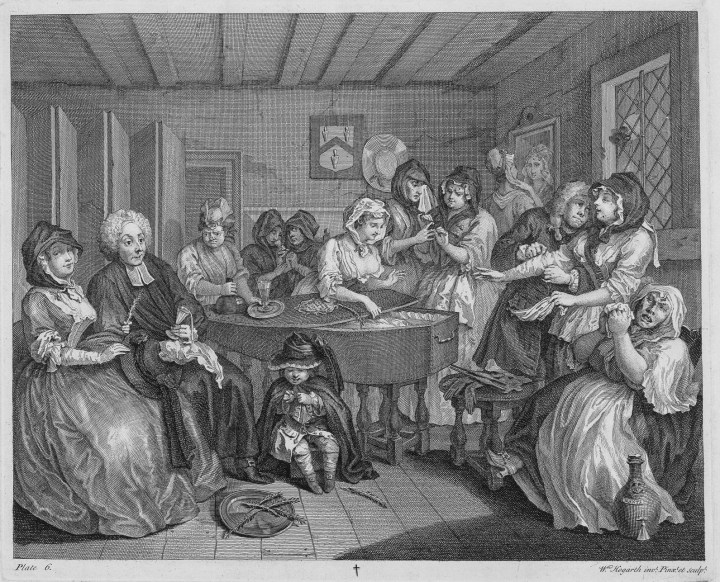
William Hogarth, A Harlot’s Progress, Plate 6, 1732, 364 × 440 mm
(Copenhagen: SMK – The National Gallery of Denmark)
◊ ◊ ◊ ◊ ◊
Press release (22 February 2016) from the National Gallery of Denmark:
William Hogarth: A Harlot’s Progress and Other Stories
William Hogarth: En skøges liv og andre historier
Statens Museum for Kunst, Copenhagen, 14 April — 7 August 2016
Curated by Vibeke Vibolt Knudsen
A young country girl arrives in London in search of work. Instead she ends up a prostitute, and her life spirals steadily downwards, bringing stints in prison and venereal disease. With the exhibition William Hogarth: A Harlot’s Progress and Other Stories, the SMK turns back time to visit eighteenth-century city life in London. The exhibition presents work by the British artist and satirist William Hogarth (1697–1764), who invented a new kind of narrative picture series that served up satirical and moral points with acerbic wit. His style of social critique was unique for the time, focusing on many highly topical subjects: Prostitution, poverty, violence, drunkenness, deceit, self-aggrandisement and desire.
 Three series hold a particularly prominent position in Hogarth’s oeuvre: A Harlot’s Progress (1732), A Rake’s Progress (1735), and Marriage à-la-mode (1745). Each series describes a main protagonist who strives to climb the rungs of the class ladder, but loses their way in debauchery, heading directly for self-destruction and death.
In his autobiographical notes Hogarth states that his pictures are scenes from a play and his subjects are actors strutting soundlessly on the stage. His stories became highly successful, attracting a large audience that included the lower echelons of society as well as the elite. Hogarth insisted that a picture must capture the viewer’s attention by entertaining and pleasing the eye, thereby allowing the serious aspects of its subject to gradually sink in as the narrative progresses towards its tragic climax.
Hogarth’s art is closely linked to London and city life. Around the year 1700 the city had swelled to a population of 600,000, making it the largest city in Europe. He made daily records of the chaotic urban crowds, of all the many and varied forms of life unfolding in the city’s streets and houses; he had a particularly keen eye for the contrasts between different social strata and how they met and clashed.
William Hogarth: A Harlot’s Progress and Other Stories is an exhibition of works from The Royal Collection of Graphic Arts, which is one of the oldest collections of prints and drawings in the world. Housing more than 240,000 works, the collection has roots that date back to the sixteenth century. In 1843 the collection was opened to the public, and in 1896 it was relocated to the new National Gallery of Denmark alongside The Royal Collection of Paintings and The Royal Cast Collection.
The catalogue is available from Arnold Busck:
Vibeke Vibolt Knudsen, William Hogarth: En skøges liv og andre historier (Odder: Narayana Press, 2016), 96 pages, ISBN 978-8792023971, 128KR.
New Book | The Shining Inheritance: Italian Painters at the Qing Court
From The Getty:
Marco Musillo, The Shining Inheritance: Italian Painters at the Qing Court, 1699–1812 (Los Angeles: Getty Research Institute, 2016), 192 pages, ISBN 978-1606064740, $60.
 During Qing dynasty China, Italian artists were hired through Jesuit missionaries by the imperial workshops in Beijing. In The Shining Inheritance: Italian Painters at the Qing Court, 1699–1812, Marco Musillo considers the professional adaptations and pictorial modifications to Chinese traditions that allowed three of these Italian painters—Giovanni Gherardini (1655– ca. 1729), Giuseppe Castiglione (1688–1766), and Giuseppe Panzi (1734–1812)—to work within the Chinese cultural sphere from 1699, when Gherardini arrived in China, to 1812, the year of Panzi’s death. Musillo focuses especially on the long career and influence of Castiglione (whose Chinese name was Lang Shining), who worked in Beijing for more than fifty years. Serving three Qing emperors, he was actively engaged in the pictorial discussions at court.
The Shining Inheritance perceptively explores how each painter’s level of professional artistic training affected his understanding, selection, and translation of the Chinese pictorial traditions. Musillo further demonstrates how this East-West artistic exchange challenged the dogma of European universality through a professional dialogue that became part of established workshop routines. The cultural elements, procedures, and artistic languages of both China and Italy were strategically played against each other in negotiating the successes and failures of the Italian painters in Beijing. Musillo’s subtle analysis offers a compelling methodological model for an increasingly global field of art history.
Marco Musillo is a research fellow at the Kunsthistorisches Institut in Florence.
Lecture | Tobias Locker on ‘Rococo for the Spanish Court’
Tomorrow at the BGC:
Tobias Locker, Rococo for the Spanish Court:
The Interiors of Mattia Gasparini in the European Context
Bard Graduate Center, New York, 4 May 2016

Mattia Gasparini (design), José Canops (execution): (one of two) Chest of drawers (with secret compartments), HWD 94.5 x 95.3 x 45.3 cm, 1760/65, different exotic marquetry woods (partly sculpted) and engraved brass marquetry on mahogany, gilt bronze mounts and marble top (Palacio Real Madrid).
The presentation focuses on the person and the production of Mattia Gasparini, who worked for Charles III of Spain in Madrid. Its research follows three axis. A first focus is set on Gasparini and the creation of his Spanish Rococo interiors, that is the reconstruction of workshops and working practice on the basis of written sources and selected furniture—as objects as well as documents show manifold connection to the French capital (French workforce, technical and stylistic aspects). A second is set on distinguishing the French influence of the furniture by way of comparison with Parisian examples. Finally, the presentation contextualizes the interiors through comparison of the above mentioned aspects (style, technique, knowledge and provenance of workforce, quality) with the interiors at Potsdam/Prussia and Schönbrunn/Austria.
Tobias Locker is Adjunct Lecturer of Art History, Pompeu Fabra University and Visiting Fellow, Bard Graduate Center.
Coffee and tea will be served; attendees are welcome to bring their own lunch. RSVP is required. Please click on the registration link or contact academicevents@bgc.bard.edu. The event will also be live-streamed.
Wednesday, May 4, 2016, 12:00–1:30pm
Bard Graduate Center (38 West 86th Street)
New Book | Exuberant Apotheoses
From Brill:
Daniel Fulco, Exuberant Apotheoses—Italian Frescoes in the Holy Roman Empire: Visual Culture and Princely Power in the Age of Enlightenment (Leiden: Brill, 2016), 600 pages, ISBN: 978-9004308046, €181 / $234.
 From the late seventeenth through the mid-eighteenth centuries, large-scale Italian frescoes soared in popularity as nobles in the German principalities of the Holy Roman Empire constructed new palaces at an unprecedented rate. They competed with one another to produce lavish decorative schemes that expressed their claim to princely power and political authority. Whereas previous art historians have primarily focused on iconographic and stylistic issues and generally treated these programs as individual commissions of regional courts, this book places the works of art within their broad cultural and historical contexts during the Enlightenment. This monograph explains how rulers gradually shifted from emphasizing military heroism to stressing their cultivation of the arts and sciences, and addresses how expressing membership in a specifically European civilization emerged as an integral visual theme and a key ambition of the German nobility.
Daniel Fulco, Ph.D. (2014), University of Illinois at Urbana-Champaign, is an independent scholar of 17th- and 18th-century European art. His research also engages with 19th-century painting and the exhibition of Islamic art in fin-de-siècle Europe.
◊ ◊ ◊ ◊ ◊
C O N T E N T S
Acknowledgements
List of Illustrations
Abbreviations
Introduction
1 The Aftermath of Military Conflict: A Rise in Princely Visual Culture (1648–1710)
2 War and International Politics: The Staircase Frescoes of Schloss Bensberg (1710–1714)
3 Dynasticism and Cultural Philanthropy: The Pictorial Program of Schloss Bensberg’s State Rooms (1710–1714)
4 The Blue Elector’s Aeneas: Jacopo Amigoni’s Images of War and Triumph at Schloss Schleissheim (1724–1726)
5 Ducal Power and Munificence: Carlo Innocenzo Carlone’s Frescoes in Schloss Ludwigsburg (1731–1733)
6 Prince-Episcopal Patronage and World Civilization: Giovanni Battista Tiepolo’s Apollo and the Four Continents in the Würzburg Residenz (1751–1753)
Excursus: Italo-Germanic Artistic Exchange and Collaboration
Epilogue
Bibliography
Index
Conference | Imagining Apocalypse
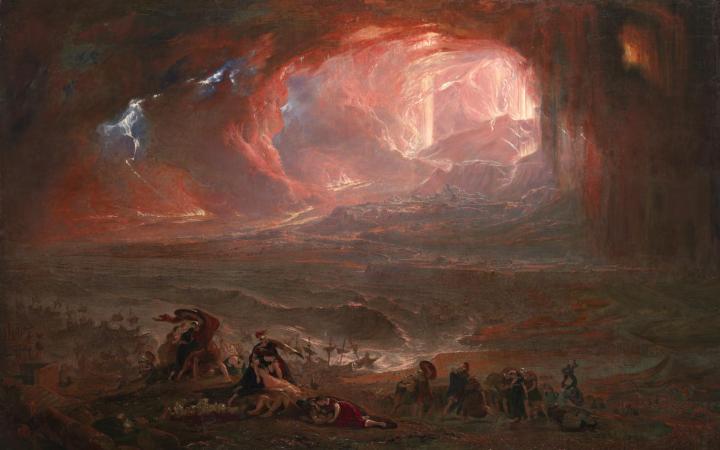
John Martin, The Destruction of Pompeii and Herculaneum, 1822
(London: Tate)
◊ ◊ ◊ ◊ ◊
From the conference website:
Imagining Apocalypse
Radcliffe Humanities Building, University of Oxford, 18 June 2016
Organised in collaboration with Dr Catherine Redford, the theme of this year’s RECSO conference is Imagining Apocalypse and will be held on 18th June. 2016 is a key anniversary for scholars studying long eighteenth-century depictions of apocalypse as it marks two hundred years since the famous ‘year without a summer’ of 1816, when the skies went dark and there was widespread speculation that the end of the world was nigh. This conference will allow a varied group of scholars working in the field of long eighteenth-century apocalypse studies to share their current research, giving them the chance to consider collaboratively current trends and research in apocalypse studies and to look forward to future projects. The project will ultimately encourage a more interdisciplinary approach to apocalypse studies.
Bringing together academics from across English, History, History of Art, Modern Languages, and Theology, the conference will introduce participants to the richness of apocalypse studies across a range of disciplines, both enhancing their research and laying the foundations for future projects, publications, and collaborations. A plenary lecture will be given by Professor Fiona Stafford (Professor of English Language and Literature, University of Oxford). Following the conference, a showcase of musical and literary performances will take place at St George’s Crypt, Oxford Castle. Registration is now open; see the conference website for further details.
Romanticism and Eighteenth-Century Studies Oxford (RECSO) is a graduate-led initiative for scholars across the Humanities Division. Our aim is to provide a platform for graduates and academics from various disciplines to discuss and share their research into the long eighteenth century. It also facilitates the development of projects, workshops and larger events, as well as providing a physical meeting space for RECSO’s growing body of members.
◊ ◊ ◊ ◊ ◊
P R O G R A M M E
9.30 Registration
10.15 Welcome and introduction by Catherine Redford and Emily Knight, University of Oxford
10.30 Morning Session
Panel A: The Eighteenth-Century Apocalyptic Imagination: The Interpretative Landscape
Chair: Amelia Greene
• Jonathan Downing, University of Bristol: ‘The Commentators’ Apocalypse: The Interpretation of Biblical Eschatology in Eighteenth-Century Popular Commentaries’
• Stephen Bygrave, University of Southampton: ‘Improvement and Apocalypse: Joseph Priestley’s Rhetoric in the 1790s’
Panel B: The Last Man
Chair: Eva-Charlotta Mebius
• Claire Sheridan, University of Greenwich: ‘Apocalypse as Domestic Melodrama: Dibdin Pitt’s The Last Man; or, the Miser of Eltham Green’
• Audrey Borowski, University of Oxford: ‘The Strange Indetermination of Cousin de Grainville’s “Last Man”’
• Adrian Tait, Independent Scholar: ‘Intimations of Apocalypse: From Mary Shelley’s The Last Man to M. P. Shiel’s The Purple Cloud’
12.00 Lunch
12.45 Afternoon Session, Part I
Panel A: Revelation/Revelations
Chair: Christian Zolles
• Natasha O’Hear, University of St Andrews: ‘Four Become One: The Preoccupation with the Fourth Horseman of the Apocalypse in the Eighteenth Century’
• Joanna Raisbeck, University of Oxford: ‘The Post-Kantian Apocalypse: Revelatory Visions in Jean Paul and Karoline von Günderrode’
• Randall Reinhard, University of Edinburgh: ‘The Revelation of Edward Irving: The Apocalypse as Social Criticism’
Panel B: Secular Apocalypse: Nature and the Human
Chair: TBC
• Amelia Greene, City University of New York: ‘Uncovered Earth: Scaled Apocalypse in John Clare’
• Lucia Scigliano, Durham University: ‘“What faith is crushed, what empires bleed”: Apocalypse and Nature in Percy Bysshe Shelley’s Hellas’
• Adam D. J. Laity, University of the West of England: ‘The Last Man, the Rückenfigur and Mad Max: Romantic Subjectivism and “the human” within the Apocalyptic Sublime Landscape’
2.15 Tea and coffee
2.45 Afternoon Session, Part II
Panel A: Ruin and Catastrophe
Chair: Audrey Borowski
• Jessica Stacey, King’s College London: ‘Apocalypse of Meaning: Catastrophes of Language in Eighteenth-Century France’
• Thomas Moynihan, University of Oxford: ‘Human Extinction and Romanticism: The Intellectual Discovery of the End of Thought’
• Helen Slaney, University of Oxford: ‘Original Ruins’
Panel B: Apocalyptic Afterlives
Chair: TBC
• Christian Zolles, University of Vienna: ‘Modern Apocalypse in Reverse: Edgar Allan Poe’s Dialogue The Conversation of Eiros and Charmion (1839)’
• Tom Bromwell, University of York: ‘A Sublime Armageddon: First World War Artists and the Burkean Sublime’
• Catherine Redford, University of Oxford: ‘From Mary Shelley to H. G. Wells: The Romantic Last Man Reimagined’
4.15 Plenary lecture
• Fiona Stafford, University of Oxford: ‘Barkless, branchless, blighted: Alpine Apocalypse in 1816’
5.15 Closing remarks; walk to Oxford Castle
6.15 Showcase in St. George’s Crypt, Oxford Castle: A selection of musical and literary imaginings of the Last Man on earth from the Romantic period.
7.00 Dinner
Exhibition | Classical Splendor: Painted Furniture
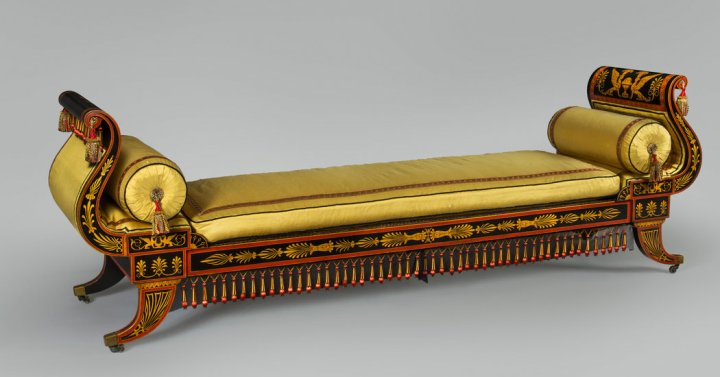
Sofa, designed by Benjamin Henry Latrobe, decorated by George Bridport
(Philadelphia Museum of Art, 1986-126-2a-c).
◊ ◊ ◊ ◊ ◊
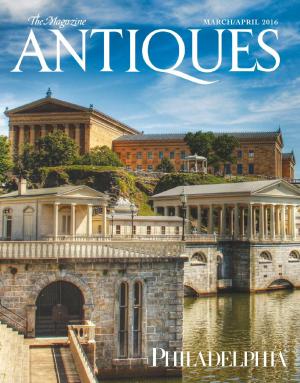
Writing for The Magazine Antiques, Alexandra Kirtley previews the exhibition Classical Splendor: Painted Furniture for a Grand Philadelphia House, which opens this fall in Philadelphia.
Alexandra Alevizatos Kirtley, “Superfluity & Excess: Quaker Philadelphia Falls for Classical Splendor,” The Magazine Antiques (March/April 2016).
The fruits of extensive research on Benjamin Henry Latrobe’s 1808 house and furniture for William and Mary Waln begin with their impact on the aesthetic of the city itself.
 By the middle of the eighteenth century the “greene Country Towne” founded by William Penn in 1682 was bustling with commercial and social activity. Colonists from Europe and the British Isles who spoke a variety of languages and practiced a number of religions filled the city. Although the aura of the British and European Quakers who had followed Penn to Philadelphia was still palpable, ambitious merchants had begun to create New World versions of aristocratic styles and customs quite at odds with Quaker comportment . . .
Despite this atmosphere of admonishment against hierarchical social customs and “Superfluity & Excess in Buildings and Furniture,” many Philadelphia Quaker and non-Quaker artisans and their patrons did embrace the luxury of contemporary European and Asian styles. . . . The taste for aristocratic style persisted in the city’s public and private spheres even after the Revolution. . . .
By 1805 the city was no longer the nation’s capital, but it was about to witness the creation of its most innovative, resplendent, and potent interior—the work of a team of artisans commissioned by a Quaker merchant and his socially adept Episcopalian wife. British-born architect Benjamin Henry Latrobe—known as Henry—had arrived in the city in early spring 1798 and had already completed several commissions: the Bank of Pennsylvania in the plain Greek revival style; the domed Pump House for the Centre Square Water Works (completed in 1801, demolished in 1829);4 and a Gothic-style country house in Fairmount Park for the merchant William Cramond called Sedgeley (completed in 1802, demolished around 1857). Latrobe had also established himself in Philadelphia society by marrying Mary Elizabeth Hazlehurst (1771–1841), the daughter of Isaac and Johanna Purviance Hazlehurst—a prominent couple with family, commercial, and political ties in Philadelphia, Baltimore, and Salem, New Jersey.
Philadelphia merchant William Waln, the son of the Quaker preacher Nicholas Waln (1742–1813), had made a bold departure from his faith when he was married by Episcopal Bishop William White to Mary Wilcocks on March 14, 1805, at Christ Church, Philadelphia. But what the couple did next in commissioning Henry Latrobe to design and oversee the building of their magnificent house and its furnishings was even bolder: they unleashed Latrobe to design for them furniture that directly imitated ancient furniture, moving once and for all beyond the restrained bounds of mere references to classical art, and transforming Philadelphia’s—and indeed America’s—interpretation of classical art . . . .
The full article is available here»
◊ ◊ ◊ ◊ ◊
Press Release from the Philadelphia Museum of Art:
Classical Splendor: Painted Furniture for a Grand Philadelphia House
Philadelphia Museum of Art, 3 September 2016 — 1 January 2017
Curated by Alexandra Alevizatos Kirtley and Peggy Olley

Card Table, designed by Benjamin Henry Latrobe, decorated by George Bridport (Philadelphia Museum of Art, photograph by Gavin Ashworth)
This exhibition will showcase a set of furniture designed by architect Benjamin Henry Latrobe (1764–1820) and made in Philadelphia in 1808 for William and Mary Wilcocks Waln. The Museum’s ten surviving pieces of furniture from the Walns’ original set will be shown in a new light, reimagined after a comprehensive five-year curatorial study and conservation treatment.The exhibition will highlight the team of makers—the designer (Latrobe), the maker (John Aitken, d. 1839), the painter (George Bridport, 1783–1819), and the upholsterer (John Rea, 1774–1871)—and the fashion for classical art that the furniture ushered into American interiors. The Walns’ drawing rooms and their furniture provided a setting imitating the art and culture of ancient Greece. The exhibition will consider Latrobe’s groundbreaking ‘Klismos’ chair design, and reveal the London-trained Bridport as the visionary artist who translated Latrobe’s design for the walls into classical designs for the painted furniture and whose work is represented today only by the surviving Waln furniture. The Walns’ extraordinary house, which stood at the southeast corner of Seventh and Chestnut Streets in Philadelphia, was torn down in 1847. Through the use of large-scale computer renderings and various other interactive technologies, visitors will be able to explore the way the two drawing rooms were furnished how they interacted with the rest of the house and the gardens, which were also designed by Latrobe.
◊ ◊ ◊ ◊ ◊
From Yale UP:
Alexandra Alevizatos Kirtley and Peggy Olley, with an essay by Jeffrey Cohen, Classical Splendor: Painted Furniture for a Grand Philadelphia House (New Haven: Yale University Press, 2016), 160 pages, ISBN: 978-0300221718, $35.
 This handsome book explores in depth a group of stunning painted and gilded furniture designed by the architect Benjamin Henry Latrobe (1764–1820), best known for originating the plans for the United States Capitol. The furniture was made in Philadelphia for one of the city’s finest houses—the home of William and Mary Wilcocks Waln, which Latrobe also designed. Drawing on a multiyear conservation and research project, Classical Splendor reveals new insights into the patrons, makers, and history behind these extraordinary pieces. In addition to extensively documenting each item, the book attests to Latrobe’s significant contributions to American furniture design—his pieces for the Waln house introduced, and served as exemplars of, a classical style rooted in ancient Greek and Roman design.
Alexandra Alevizatos Kirtley is the Montgomery-Garvan Curator of American Decorative Arts and Peggy A. Olley is the associate conservator of furniture and woodwork, both at the Philadelphia Museum of Art. Jeffrey A. Cohen is senior lecturer and chair of the Growth and Structure of Cities Program at Bryn Mawr College.
Exhibition | Global by Design: Chinese Ceramics
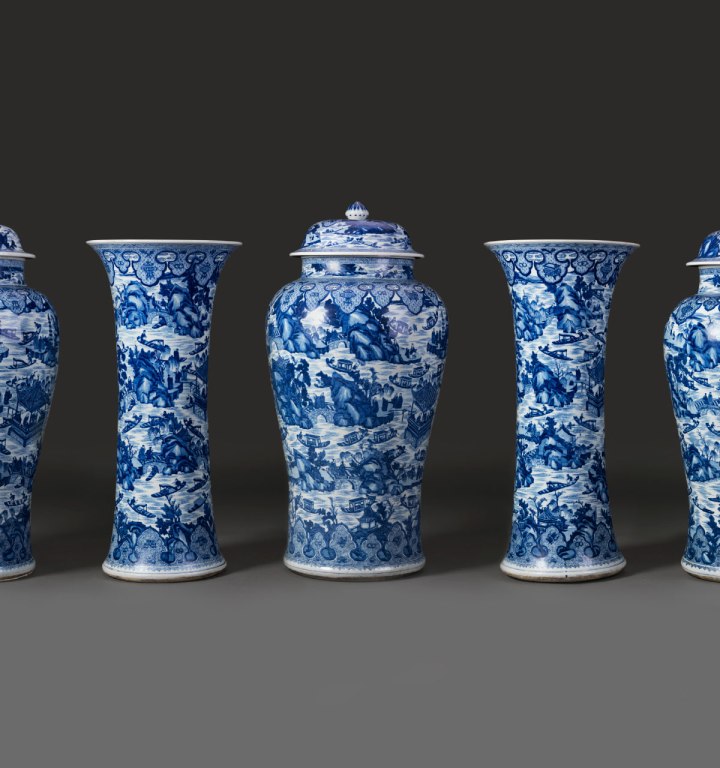
Garniture with Scenes of West Lake, ca. 1700. China, Qing dynasty (1644–1911). Porcelain painted with cobalt blue under a transparent glaze; Jars, H. 40 3/4 in., Vases, H. 35 5/8 in. (R. Albuquerque Collection)
◊ ◊ ◊ ◊ ◊
Press release (25 April 2016) for the exhibition now on view at The Met:
Global by Design: Chinese Ceramics from the R. Albuquerque Collection
The Metropolitan Museum of Art, New York, 25 April — 7 August 2016
Curated by Jeffrey Munger and Denise Patry Leidy
An international loan exhibition of 60 exquisite and unusual Chinese ceramics drawn from a Brazilian private collection—never before exhibited publicly—is now on view at The Metropolitan Museum of Art through August 7. Global by Design: Chinese Ceramics from the R. Albuquerque Collection focuses on the period—from the late 16th to the 18th century—when Chinese porcelain became a global luxury, transforming both the European ceramic industry and styles of dining and drinking.
The introduction of porcelain to Europe can be traced to the period between the late 15th and early 16th centuries known as the ‘Age of Exploration’. This period includes both the discovery by Vasco da Gama (1460–1524) in 1498 of a maritime route around the Cape of Good Hope in Africa to South and East Asia, and the slightly earlier travels of Christopher Columbus (1451–1506) that led to the discovery of the Americas. Supported by Portuguese and Spanish courts, both explorers were searching for a sea route that would provide quicker access to coveted Asian luxuries, including tea, spices, silk, and porcelain.
When the Portuguese first reached China in the 16th century, the extensive kiln complex at Jingdezhen in Jiangxi Province in the southeast dominated porcelain production. (China and, to a lesser extent, Korea were the only places in the world making porcelain at that time.) Portuguese rulers were the first Europeans to commission works from China, and these early-commissioned objects are among the rarest works on view in the exhibition. They include pieces with royal designs, such as a flattened bottle with a coat of arms, and Catholic imagery, such as a delicate bowl with the opening lines of the Hail Mary.
By this time, porcelain had long been treasured in inner-Asian trade, particularly with the Islamic world, and shapes and designs from the Middle East, which had been incorporated into the porcelain industry, were also transmitted to Europe. In the exhibition, a rare example of a kraak dish (ca. 1628–1642) depicting two Persian figures and made for either the Islamic world or Europe provides one example of these complicated interchanges. (The term kraak derives from the Portuguese word for ‘ship’ and is often used in Western sources to define Chinese porcelains made specifically for export in the late 16th and early 17th centuries.) In addition, an unusual bowl with pierced decoration and the Islamic profession of faith has European gilt mounts, indicating its fascinating journey from China to the Islamic world and, ultimately, Europe.
In the early 17th century, after the Dutch auctioned porcelain from two captured Portuguese ships and overtook the Portuguese and Spanish maritime routes, porcelain became widespread throughout northern Europe. By the late 17th and 18th centuries, with the ongoing exchange of shapes and designs, a global artistic language in porcelain making was fully developed. One of the most compelling examples in the exhibition is a monumental set of five vessels; produced for display in a European home, it depicts scenes from West Lake in southern China. In addition, tureens—including a delightful piece in the form of a crab with movable eyes, another in the shape of the historical Chinese Buddhist monk Budai, and a third, based on European silver, with lush patterns incorporating Western and Eastern imagery—exemplify the innovation and experimentation that characterized the Chinese porcelain industry in the 18th century.
The exhibition includes three generous gifts to the Museum from the R. Albuquerque Collection. The exhibition is organized by Jeffrey Munger, Curator, Department of European Sculpture and Decorative Arts, and Denise Patry Leidy, Brooke Russell Astor Curator of Chinese Art, Department of Asian Art. In conjunction with the exhibition, the Museum will offer education programs, including gallery talks and, on June 5, a Sunday at The Met program focusing on trade in Chinese ceramics and their continuous and complicated impact on global traditions.
◊ ◊ ◊ ◊ ◊
Published by Jorge Welsh, the catalogue is available from The Met:
Denise Patry Leidy with catalogue entries by Maria Antónia Pinto de Matos, Global by Design: Chinese Ceramics from the R. Albuquerque Collection (London: Jorge Welsh Research & Publishing, 2016), 240 pages, ISBN: 978-0993506802 (hardcover), £40 / ISBN: 978-0993506819 (softcover), £30 / $40.
 The companion catalogue to The Met exhibition, this beautifully illustrated volume explores the period from the late sixteenth to the eighteenth century when Chinese porcelain became a global luxury, and in doing so, transformed both the European ceramic industry and fashionable styles of dining and drinking. Featuring exquisite and unusual pieces from an important Brazilian private collection, it challenges the long-standing tradition of cataloguing Chinese ceramics as domestic or trade items.
In addition to exploring the trade in Chinese ceramics within Asia, this new book looks at the development of ceramic shapes and designs that reflect the long history of exchange between China and the Islamic world, as well as the period in the late sixteenth century when works reflecting both Chinese and Islamic decorative traditions were introduced and incorporated into Europe and the Americas.
Denise Patry Leidy is the Brooke Russel Astor Curator of Chinese Art at The Metropolitan Museum of Art. Maria Antónia Pinto de Matos is director of the Tile Museum in Lisbon.
Exhibition | Unfinished: Thoughts Left Visible

Benjamin West, American Commissioners of the Preliminary Peace Negotiations with Great Britain, begun in 1783, oil on canvas, 72.3 × 92.7 cm. (Winterthur 1957.856)
◊ ◊ ◊ ◊ ◊
With nearly 200 objects, The Met Breuer’s inaugural exhibition includes a handful of striking eighteenth-century paintings and prints. From the press release:
Unfinished: Thoughts Left Visible
The Met Breuer, New York, 18 March — 4 September 2016
Curated by Andrea Bayer, Kelly Baum, Nicholas Cullinan, and Sheena Wagstaff
Unfinished: Thoughts Left Visible examines a subject that is critical to artistic practice: the question of when a work of art is finished. Opening March 18, 2016, this landmark exhibition inaugurates The Met Breuer, ushering in a new phase for The Met’s expanded engagement with modern and contemporary art, presented in Marcel Breuer’s iconic building on Madison Avenue. With over 190 works dating from the Renaissance to the present—nearly forty percent of which are drawn from The Met’s collection, supplemented with major national and international loans—the exhibition demonstrates the type of groundbreaking show that can result when the Museum mines its vast collection and curatorial resources to present modern and contemporary art within a deep historical context.
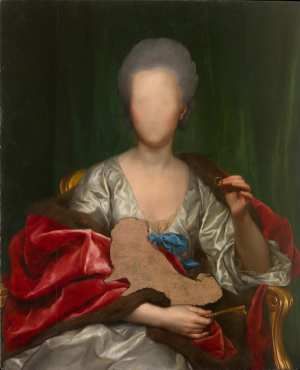
Anton Raphael Mengs, Portrait of Mariana de Silva y Sarmiento, duquesa de Huescar, 1775 (Mr. and Mrs. Otto Naumann, New York)
The exhibition examines the term ‘unfinished’ across the visual arts in the broadest possible way; it includes works left incomplete by their makers, a result that often provides insight into the artists’ creative process, as well as works that engage a non finito—intentionally unfinished—aesthetic that embraces the unresolved and open-ended. Featured artists who explored such an aesthetic include some of history’s greatest practitioners, among them Titian, Rembrandt, Turner, and Cézanne, as well as modern and contemporary artists, including Janine Antoni, Lygia Clark, Jackson Pollock, and Robert Rauschenberg, who have taken the unfinished in entirely new directions, alternately blurring the distinction between making and un-making, extending the boundaries of art into both space and time, and recruiting viewers to complete the objects they had begun.
The accompanying catalogue expands the subject to include the unfinished in literature and film as well as the role of the conservator in elucidating a deeper understanding of artistic thought on the subject of the unfinished.
“Unfinished is a cornerstone of The Met Breuer’s inaugural program and a great example of The Met’s approach to presenting the art of today,” said Thomas P. Campbell, Director and CEO of The Met. “Stretching across history and geography, the exhibition is the result of a cross-departmental collaboration, drawing on the expertise of The Met’s outstanding faculty of curators. We hope the exhibition inspires audiences to reconsider the artistic process as they connect to experiences shared by artists over centuries.”
Sheena Wagstaff, Leonard A. Lauder Chairman of Modern and Contemporary Art, added: “It is rare that an exhibition covering such a broad time span can trace a theme as intimate and essential to the creative process. This sweep of art history throws into sharp focus the ongoing concern of artists about the ‘finishedness’ of their work—which, in the 20th century, they co-opt as a radical tool that changes our understanding of Modernism.”
Using works of art as well as the words of artists and critics as a guide, Unfinished: Thoughts Left Visible strives to answer four questions: When is a work of art finished? To what extent does an artist have latitude in making this decision? During which periods in the history of art since the Renaissance have artists experimented most boldly with the idea of the unfinished or non finito? What impact has this long trajectory had on modern and contemporary art?
The exhibition features works that fall into two categories. The first includes works of art that are literally unfinished—those whose completion was interrupted, usually because of an accident, such as the artist’s death. In some instances, notably Jan van Eyck’s Saint Barbara (1437), there is still debate about whether the artist meant the work to be a finished drawing, which would have been considered unusual at the time, or if it was meant to be a preparation for a painting. Because such works often leave visible the underlying skeleton and many changes normally effaced in the act of completion, they are prized for providing access to the artist’s thoughts, as well as to his or her working process.
The second category includes works that appear unfinished—open-ended, unresolved, imperfect—at the volition of the artist, such as Janine Antoni’s Lick and Lather (1993–1994). Antoni used a mold to create a series of self-portrait busts, half from chocolate and half from soap, fragile materials that tend to age quickly. After finishing the busts, she set to work unfinishing them, licking those in chocolate and bathing with those in soap, stopping once she had arrived at her distinctive physiognomy. The unfinishedness of objects in this second category has been debated and appreciated at definite times, in definite places. Unlike the historical art presented in the exhibition, which includes a significant number of truly unfinished objects, art from the mid-to-late 20th and 21st centuries is represented almost entirely through the lens of non finito.
The exhibition is organized chronologically, spanning the third and fourth floors of The Met Breuer. The works are subdivided thematically, with each group representing a specific case-study in unfinishedness—corresponding to specific times (such as the Renaissance, Baroque, and Modern periods), media (prints and sculpture), artists (including Turner, Cézanne, and Picasso), and genres (most importantly portraiture).
A new, light-based installation by Tatsuo Miyajima, created especially for Unfinished, will be on view in the Tony and Amie James Gallery in the lobby of The Met Breuer (late April through mid-October).
Unfinished: Thoughts Left Visible is curated by Andrea Bayer, Jayne Wrightsman Curator in the Department of European Paintings; Kelly Baum, Curator of Postwar and Contemporary Art in the Department of Modern and Contemporary Art, both at The Metropolitan Museum of Art; and Nicholas Cullinan, former curator in The Met’s Department of Modern and Contemporary Art and current Director of the National Portrait Gallery in London, all working under the direction of Sheena Wagstaff, Leonard A. Lauder Chairman of Modern and Contemporary Art at The Metropolitan Museum of Art. Many curators, conservators, fellows, and research assistants at The Met contributed to this exhibition and its accompanying catalogue, including experts from the Museum’s departments of American Paintings and Sculpture, Drawings and Prints, European Paintings, European Sculpture and Decorative Arts, Paintings Conservation, and Modern and Contemporary Art.
A series of experimental films made by many of the 20th and 21st century’s most innovative filmmakers are being shown in conjunction with the exhibition. Organized by Thomas Beard, founder and director of Light Industry, a venue for film and electronic art in Brooklyn, these screenings, which take place on The Met Breuer’s second floor, address the unfinished in cinematic terms. Details on screening times will be available at a later date.
In collaboration with The Met, The Orchestra Now (TŌN) will present The Unfinished, a performance at Carnegie Hall of two unfinished works: Schoenberg’s Chamber Symphony No. 2 and Mozart’s Great Mass in C minor. The concert will include a panel discussion with the Museum’s Sheena Wagstaff and Andrea Bayer; TŌN’s music director Leon Botstein; Columbia University’s Elaine Sisman, Anne Parsons Bender Professor of Music; and others. Friday, May 13, 2016, 7:30–9:45 pm; tickets start at $25.
Related programs include a Sunday at The Met on May 8 that considers the idea of the unfinished in relation to works across times and cultures and a lecture series on June 20 presenting new scholarship on the subject.
Kelly Baum, Andrea Bayer, and Sheena Wagstaff, Unfinished: Thoughts Left Visible (New York: The Metropolitan Museum of Art, 2016), 336 pages, ISBN: 978-1588395863, $65.
The exhibition is accompanied by a 336-page fully illustrated catalogue that constitutes the most exploratory, yet also comprehensive, introduction to date of the long history of the unfinished in the visual arts, film, and literature. The book is divided into two main sections that roughly correspond to the periods 1435–1900 and 1900–2015. It contains essays by 13 curators, scholars, and a conservator on a range of artists and subjects related to the theme of the unfinished. The catalogue also features interviews with five contemporary artists—Vija Celmins, Marlene Dumas, Brice Marden, Luc Tuymans, and Rebecca Warren—whose work is represented in the exhibition; and a section of brief catalogue entries on each of the objects featured in the exhibition that explores the significance of the work, with an emphasis on its place in the broader narrative and, frequently, an account of its reception. The catalogue is published by The Met and distributed by Yale University Press. The catalogue is made possible by the Samuel I. Newhouse Foundation, Inc. and the Roswell L. Gilpatric Publications Fund.
Exhibition | Bishop, Emperor, Everyman: 200 Years of Salzburg History

August Franz Heinrich von Naumann, Map of the Princely Residence City of Salzburg, paper, ink, watercolour, gold addition, 1788–89 (Paris: Bibliothèque Nationale de France)
◊ ◊ ◊ ◊ ◊
From the Salzburg Museum:
Bishop, Emperor, Everyman: 200 Years of Salzburg in Austria
Bischof, Kaiser, Jedermann: 200 Jahre Salzburg bei Österreich
Salzburg Museum, Neue Residenz, 30 April — 30 October 2016
To mark the 200th anniversary of Salzburg’s incorporation into Austria, a trio of exhibitions offers an in-depth view into the eventful history of Salzburg—from the rich princely archbishopric, through wars and fluctuating power relations.
Treasure House Salzburg
 Over the centuries, the Salzburg prince archbishops collected a voluminous treasury of paintings and the graphic arts, furniture and porcelain, minerals, weapons and coins, books and sculptures. Much of this was created especially for Salzburg. The Salzburg prince archbishops assigned renowned artists with commissions for ivory carvings, rock crystal and ibex horn artefacts, goldsmith’s art and paintings—all these objects belonged to the inventory of the court treasure chamber and enhanced prestige. The rulers of the time naturally saw themselves as personal owners of these riches; thus, it frequently occurred in case of war that all treasures were conveyed to the next residence. The exhibits tell their own stories and raise questions: what significance did they originally have, what was their origin, or how did they end up in Salzburg? The exhibition Treasure House Salzburg in the Kunsthalle in the basement of the Neue Residenz is designed to awaken in visitors a historical awareness for the former riches and status of Salzburg within Europe.
◊ ◊ ◊ ◊ ◊
Tell Me about Salzburg!
The special exhibition Tell Me about Salzburg! spotlights events and people from two centuries and, in doing so, gives visitors insights into the history of art and culture in Salzburg. While the stories are anchored in the two centuries between 1816 and 2016, they reach far back into the past or had far-reaching consequences for the future. Visitors wandering from room to room and from theme to theme will be given the opportunity to take a closer look at Salzburg and its history from unusual perspectives and in differing narratives.
Twelve Themes
• True Fables! The Fabulous World of Salzburg Sagas and Their Relationship to History
• Quest into the Past – Salzburg Unearths Its History
• “Silent Night! Holy Night!” What a Carol Tells Us, and What It Can Reveal about Its Time
• On the Trail of Haydn and Mozart: “Reports” on the History of Music in Salzburg
• Under the Patronage of the Dowager Empress Caroline Augusta: Salzburg Tells Its History in Its Own Museum
• Time Windows 1866 and 1916: Images of Change
• Back to the Future: Salzburg Utopias in the Years between the Wars
• Salzburg and National Socialism: The Oppressive Legacy of History
• Wotruba and Thorak: A Salzburg Summit of a Unique Kind
• Art under the Banner of the Cold War – or how the “Nuclear Bomb of Cultural Bolshevism” was Ignited in Salzburg
• “Two Days Facing the Cloud-Kitchen Mountain” (Peter Handke) – Literary Images of Salzburg
• Lisl Ponger: The Museum in the Museum

Johann Matthias Wurzer, based on Hieronymus Allgeyer, Mirabellplatz before the 1818 Fire, oil on cardboard, 1810–16 (Salzburg Museum, inv. no. 96-25)
◊ ◊ ◊ ◊ ◊
On the Scene
The period from 1797 to 1816 in relation to the actual history of Salzburg is mostly an imageless era. There are scarcely any depictions of events, fights and battles in the city’s environs, or of the multiple occupations of the Land by foreign troops. Places that were the scenes of important events during this epoch in Salzburg are today no longer of any relevance for Salzburg: their significance for Salzburg’s history fell into oblivion. For the special exhibition On the Scene, contemporary photographic artists from the Fotohof gallery set off to eight selected locations and, in the form of video animations and installations, bring them into the Land exhibition.
Eight Locations
• Villa Manin stands for the Treaty of Campo Formio (1797) which for the first time officially codified the end of the autonomous archiepiscopal foundation of Salzburg.
• The Battle of Walserfeld in 1800 heralded an epoch of occupation, looting and ever-changing rulers.
• Mirabell Palace is exemplary as a location that was given a new function for each change in historical circumstances.
• The town of Mühldorf am Inn belonged to Salzburg for centuries but in 1802/1803 was the first territory to be separated from the former archiepiscopal foundation.
• The Alte Residenz was not only the residence of the prince archbishop but also old Salzburg’s centre of power for centuries.
• Schönbrunn Palace was the scene of the contract (Treaty of Pressburg) signed by Napoleon that ceded Salzburg to Austria in 1805, but in 1809 also saw Salzburg’s cession as defined in the Treaty of Schönbrunn.
• In 1809, Salzburg gunners fought at Pass Lueg against Bavarian and French troops, but were successful only at the start of fighting.
• And in June 1816 on today’s Hildmannplatz in front of the Neutor, the residents of the City of Salzburg received the new ruler Emperor Francis I of Austria.










 Enfilade
leave a comment