TEFAF Maastricht 2017 Opens March 10
TEFAF Maastricht
Maastricht, 10–19 March 2017
The 30th edition of TEFAF Maastricht welcomes 270 internationally renowned exhibitors to the Fair including five young and recently established dealers to TEFAF Showcase. As the world’s leading fine art and antiques Fair, TEFAF Maastricht provides an unrivaled meeting place for the best dealers in the world, attracting major international private and institutional collectors. Through the careful selection of its exhibitors, TEFAF enables visitors to make unexpected connections across disciplines creating a marketplace for the highest level of collecting at all of its Fairs. TEFAF Maastricht 2017 takes place March 10–19 at the MECC (Maastricht Exhibition and Congress Centre), Maastricht in The Netherlands.
TEFAF Maastricht is divided into nine sections (TEFAF Antiques, TEFAF Classical Antiquities, TEFAF Curated, TEFAF Design, TEFAF Haute Joaillerie, TEFAF Modern, TEFAF Paintings, TEFAF Paper, TEFAF Showcase) with the selected dealers presenting over 7,000 years of art history under one roof. The Fair looks forward to welcoming 18 new exhibitors in 2017, who will both strengthen and extend the range of objects being shown at the Fair.
More information is available here»
◊ ◊ ◊ ◊ ◊
From a press release (27 February) from Tomasso Brothers Fine Art:
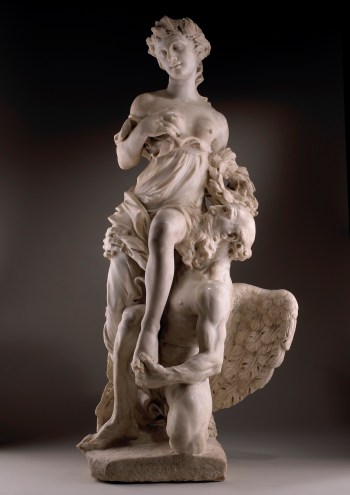
Paul Heermann (1673–1732), Saturn and Ops, white marble; 139.5cm (55in) high, 66cm (26in) wide, 53cm (21in) deep.
Among the highlights offered by Tomasso Brothers Fine Art is a remarkable Saturn and Ops by Paul Heermann (1673–1732), the German late Baroque sculptor to the Courts of Bohemia and Saxony. Ops, the Roman goddess of abundance and fertility, is depicted with her consort Saturn, the early Roman god of agriculture, forming an allegorical representation of Summer and Winter. Related works by Heerman include two busts of Winter: one in the Staatliche Kunstsammlungen Dresden and another at the J. Paul Getty Museum in Los Angeles.
Working with his uncle Johann Georg Heermann, the Electoral Saxon sculptor, Paul Heermann executed his most important, late seventeenth-century project, the spectacular grand staircase on the external façade of the Troja Castle in Prague, where another depiction of Saturn is prominently positioned. The present sculptural group was recorded at the historically important Schloss and estate of Rittergut Lucklum, Germany, by 1806, where it remained in situ until the late twentieth century. It will be offered with a price in the region of €2million.
The gallery’s essay on Saturn and Ops is available as
a PDF file here»
New Book | The Fabric of Creativity in the Dutch Republic, 1580–1800
Distributed by The University of Chicago Press:
Claartje Rasterhoff, The Fabric of Creativity in the Dutch Republic, 1580–1800 (Amsterdam: Amsterdam University Press, 2017), 352 pages, ISBN: 978 90896 47023, $149.
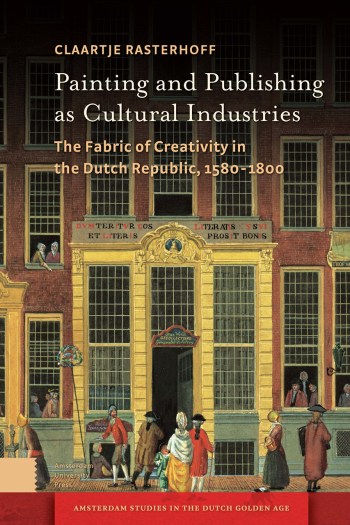 The Dutch Republic was a cultural powerhouse in the modern era, producing lasting masterpieces in painting and publishing—in the process transforming those fields from modest trades to booming industries. This book asks the question of how such a small nation could become such a major player in those fields. Claartje Rasterhoff shows how industrial organizations played a role in shaping patterns of growth and innovation—as early modern Dutch cultural industries were concentrated geographically, highly networked, and institutionally embedded, they were able to reduce uncertainty in the marketplace and stimulate the commercial and creative potential of painters and publishers—though those successes eventually came up against the limits of a saturated domestic market and an aversion to risk on the part of producers that ultimately brought an end to the boom.
Claartje Rasterhoff is a postdoctoral researcher and lecturer in arts and culture studies at Erasmus University, Rotterdam.
New Book | Merian, Metamorphosis insectorum Surinamensium
From Lannoo, with more information available here:
Maria Sibylla Merian, Metamorphosis insectorum Surinamensium Verandering der Surinaamsche insecten / Transformation of the Surinamese Insects, edited by Marieke van Delft (Tielt: Lannoo Publishers, 2017), 200 pages, ISBN: 978 94014 33785, $145 / €99.
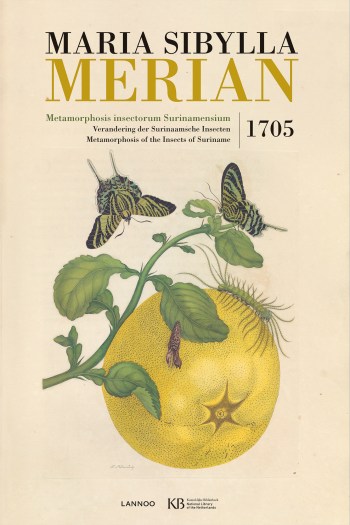 Maria Sibylla Merian (1647–1717) was a German naturalist and scientific illustrator. She is considered to be among the most significant contributors to the field of entomology because of her careful observations and documentation of the metamorphosis of the butterfly. In 1705, Merian published Metamorphosis Insectorum Surinamensium, for which she became famous. No more than 30 copies of this masterwork are left worldwide. In 2017, it will be 300 years since Maria Sibylla Merian’s death. To mark the occasion, a facsimile of Merian’s highly successful book will be released. Modern readers will at last be able to see with their own eyes how detailed and colourful Merian’s magnificent work was. The book includes a comprehensive introduction and background information by renowned historians and biologists.
Included is a foreword by Merian specialist Redmond O’Hanlon and a biographical introduction by art historian Ella Reitsman. Kay Etheridge, professor biology at Gettysburg College, discusses the meaning of Merian’s work for biology, and Bert van de Roemer talks about the historical context.
Marieke van Delft is Curator of Early Printed Collections at the Koninklijke Bibliotheek, National Library of the Netherlands, in The Hague. She studied history and book history at the universities of Amsterdam and Leiden and gained her doctorate in cultural studies at the KU Leuven. Van Delft has published on many aspects of the history of the printed book in the Netherlands. In collaboration with Uitgeverij Lannoo she has created real-size facsimile editions of major books from the collections of the Koninklijke Bibliotheek: Atlas De Wit (2012), Nozeman & Sepp, Nederlandsche vogelen (2014), and Merian’s Metamorphosis insectorum Surinamensium (2016).
New Book | The Botany of Empire in the Long Eighteenth Century
From Harvard UP:
Yota Batsaki, Sarah Burke Cahalan, and Anatole Tchikine, eds., The Botany of Empire in the Long Eighteenth Century, Dumbarton Oaks Symposia and Colloquia (Cambridge: Harvard University Press, 2017), 406 pages, ISBN: 978 08840 24163, $90 / £67 / €81.
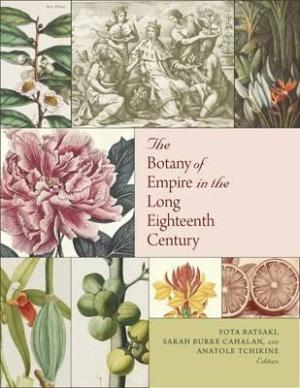 This book brings together an international body of scholars working on eighteenth-century botany within the context of imperial expansion. The eighteenth century saw widespread exploration, a tremendous increase in the traffic in botanical specimens, taxonomic breakthroughs, and horticultural experimentation. The contributors to this volume compare the impact of new developments and discoveries across several regions, broadening the geographical scope of their inquiries to encompass imperial powers that did not have overseas colonial possessions—such as the Russian, Ottoman, and Qing empires and the Tokugawa shogunate—as well as politically borderline regions such as South Africa, Yemen, and New Zealand. Essays examine the botanical ambitions of eighteenth-century empires; the figure of the botanical explorer; the links between imperial ambition and the impulse to survey, map, and collect botanical specimens in ‘new’ territories; and the relationships among botanical knowledge, self-representation, and material culture.
Yota Batsaki is Executive Director of Dumbarton Oaks.
Sarah Burke Cahalan is Director of the Marian Library, University of Dayton.
Anatole Tchikine is Assistant Director of Garden and Landscape Studies, Dumbarton Oaks.
New Book | Gardens of Court and Country: English Design, 1630–1730
From Yale UP:
David Jacques, Gardens of Court and Country: English Design, 1630–1730 (London: Paul Mellon Centre for Studies in British Art, 2017), 416 pages, ISBN: 978 0300 222012, £45 / $75.
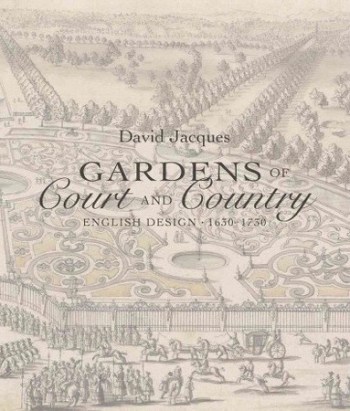 Gardens of Court and Country provides the first comprehensive overview of the development of the English formal garden from 1630 to 1730. Often overshadowed by the English landscape garden that became fashionable later in the 18th century, English formal gardens of the 17th century displayed important design innovations that reflected a broad rethinking of how gardens functioned within society. With insights into how the Protestant nobility planned and used their formal gardens, the domestication of the lawn, and the transformation of gardens into large rustic parks, David Jacques explores the ways forecourts, flower gardens, bowling greens, cascades, and more were created and reimagined over time. This handsome volume includes 300 illustrations—including plans, engravings, and paintings—that bring lost and forgotten gardens back to life.
David Jacques is an independent scholar and a consultant in historic landscapes, parks, and gardens.
Call for Papers | CAA in Los Angeles, 2018

From CAA News (27 February 2017) . . .
106th Annual Conference of the College Art Association
Los Angeles, 21–24 February 2018
Proposals due by 17 or 24 April 2017 (depending upon type of proposal)
CAA’s Annual Conference Committee invites proposals of interest to its members and varied audiences. Submissions that cover the breadth of current thought and research in art and art practice, art and architectural history, theory and criticism, studio art, pedagogical issues, museum and curatorial practice, conservation, design, new media, and developments in technology are encouraged.
To submit a proposal, individuals must be current CAA members. All session participants, including presenters, chairs, moderators, and discussants, must also be current individual CAA members. Please have your CAA Member ID handy as well as the member IDs of any and all participants as this is a required field on the submission form. Please note that institutional member IDs cannot be used to submit proposals. If you are not a current individual member, please renew your membership or join CAA.
All session participants must also register for the conference. Online registration for CAA 2018 will begin October 2, 2017. Early conference registration will end December 15, 2017 and advance conference registration will end on February 7, 2018. Early and advance conference registration fees will not change from CAA 2017, New York.
The Annual Conference Committee will accept the following proposals for review: Complete Sessions, Sessions Soliciting Contributors, and Individual Paper/Project proposals. All sessions will be 90 minutes in length at CAA 2018. Please plan accordingly. For full details on the submission process for the conference, please review the information below and on the individual submission pages.
P R O P O S A L S U B M I S S I O N T Y P E S
Session Soliciting Contributors
Proposals due by 17 April 2017
The Session Soliciting Contributors option allows a submission for a full session (90 minutes in length) with yet-to-be identified speakers and papers/projects. If selected, such sessions will be included in the call for participation (CFP) which opens June 30.
Individual Paper/Project
Proposals due by 17 April 2017
Individual Paper/Project proposals (15 minutes in presentation length) may be submitted for review. No specific theme is required. The Annual Conference Committee will review and select paper/project proposals based on merit and group approved submissions into Composed Sessions of up to four participants. A liaison from the Annual Conference Committee will be identified for each Composed Session to assist with the format and to help identify a session chair or moderator.
Complete Session
Proposals due by 24 April 2017
The Complete Session option allows a submission for a complete panel (90 minutes in length) pre-formed with participants and papers/projects chosen in advance by session chairs. This session requires advance planning and information gathering by the chair(s).
Affiliated Societies
Proposals due by 24 April 2017
Each Affiliated Society may submit either one Complete Session proposal (90 minutes in length) pre-formed with participants and papers/projects chosen in advance or one Session Soliciting Contributors proposal (90 minutes in length) to be included in the CFP which opens June 30. A note of approval from the Affiliated Society chair must accompany the submission. This session will be guaranteed and will be identified as an Affiliated Society session in all CAA publications. Subsequent proposals by Affiliated Society members may be submitted separately by individuals, but are subject to peer review by the Annual Conference Committee and must be submitted via the Complete Session, Session Soliciting Contributors, or Individual Paper/Project submissions forms described above. These submissions are not guaranteed and, if selected, will not be labeled or identified as Affiliated Society sessions in CAA publications.
CAA PIPS Committees
Proposals due by 24 April 2017
CAA PIPS [Professional Interests, Practices, and Standards] committees may submit either one Complete Session proposal (90 minutes in length) pre-formed with participants and papers/projects chosen in advance or one Session Soliciting Contributors proposal (90 minutes in length) to be included in the CFP which opens June 30. A note of approval from the committee chair must accompany the submission. This session will be identified as a committee session in all CAA publications. Subsequent proposals by committee members may be submitted separately by individuals, but are subject to peer review by the Annual Conference Committee and must be submitted via the Complete Session, Session Soliciting Contributors, or Individual Paper/Project submissions forms described above. These submissions are not guaranteed and, if selected, will not be labeled or identified as committee sessions in CAA publications.
Rare Book School Offerings
Rare Book School offers five-day, intensive courses in several locations focused on the history of manuscript, print, and digital materials. Our courses this spring and summer will be held at the University of Virginia, Yale University, the University of Pennsylvania, and Indiana University, Bloomington.
Among our more than thirty courses on the history of books and printing, we are pleased to offer courses of interest to those in the fields of art history and eighteenth-century studies. The following is a sample of the breadth of classes offered:
• I-10 The History of Printed Book Illustration in the West, taught by Erin C. Blake (Folger Shakespeare Library)
• H-100 The Eighteenth-Century Book, taught by Mark Dimunation (Library of Congress) and Michael F. Suarez, S.J. (University of Virginia & Rare Book School)
• H-30 The Printed Book in the West to 1800, taught by Martin Antonetti (Northwestern University)
Applications are now open on a rolling admissions basis. Visit our website for course details.
A 2016 RBS student remarked, “I will never look at a book—any book—the same way again,” and so we hope you will join us at an RBS course this year and learn to see books in a new way as well!
With kindest regards,
The RBS Programs Team
Research Lunch | Isabelle Baudino on Samuel Wale’s Book Illustrations
From the Paul Mellon Centre:
Isabelle Baudino, Samuel Wale’s Book Illustrations:
Designing Historical Panoramas in Georgian London
Paul Mellon Centre, London, 31 March 2017
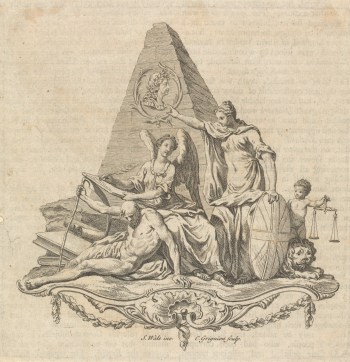
Charles Grignion, after Samuel Wale, Britannia Allegory, between 1743 and 1747, Line engraving and etching; letterpress on verso on medium, slightly textured, cream laid paper (page in book) (Yale Center for British Art, Yale Art Gallery Collection).
Despite being a founding member of the Royal Academy of Arts, Samuel Wale (1721?–1786) has remained quite an elusive figure. Most of his easel paintings have disappeared and the greater part of his decorative works has been damaged or destroyed. Although he was apprenticed as an engraver, he started his career as a painter, attending classes at St Martin’s Lane Academy, decorating the Foundling Hospital and assisting Francis Hayman. While being consistently involved in the academic movement that led to the foundation of the Royal Academy, Wale also became one of the most prolific book illustrators of the day, designing hundreds of plates that contributed to the growing popularity of pictorial histories. Over the course of his forty-year career, he established a formulaic, full-page framed historical scene offering an unprecedented visualisation of British history. Indeed, building on his first selection of historical events, and drawing inspiration from the theatre, other books or paintings, Wale established a sequence of landmarks that gave an overview of Britain’s history from its ancient origins until modern times. He thus contributed to the visual perception of historical chronology and created images of national history that were emulated, adapted and appropriated. Friday, 31 March 2017, from 12:30 to 2:00pm. Registration information is available here.
I will argue that despite their low aesthetic and commercial value, the images that composed Wale’s historical panorama proved remarkably persistent because they brought together history, nationhood and iconography, thus transforming the understanding of history and fostering a new engagement with the past and its traces in the eighteenth-century present.
Isabelle Baudino is Senior Lecturer at the ENS in Lyons and has been a Visiting Fellow at Magdalene College, Cambridge, over the past academic year. Her work focuses on eighteenth-century British art with particular interest in history painting and the Royal Academy, taken individually, but also studied together in the context of the institutionalization of the arts in eighteenth-century Britain. Her study on Samuel Wale is part of a project which is generously supported by a mid-career fellowship from the Paul Mellon Centre for Studies in British Art.
Exhibition | Volcanoes

Sir William Hamilton’s volcano archive includes paintings he commissioned (Oxford: Bodleian).
◊ ◊ ◊ ◊ ◊
From the press release (16 January 2017) for the exhibition:
Volcanoes
Weston Library, Bodleian, Oxford, 10 February 2017 — 21 May 2017
Curated by David Pyle
A new exhibition at the Bodleian Libraries uses a spectacular selection of eye witness accounts, scientific observations, and artwork to chart how our understanding of volcanoes has evolved over the past two millennia. The exhibition examines some of the world’s most spectacular volcanoes including the 79 AD eruption of Vesuvius—one of the most catastrophic eruptions in European history—and the 19th-century eruptions of Krakatoa and Santorini, two of the first volcanic eruptions to be intensely studied by modern scientists.
Today, satellites monitor volcanic activity and anyone with internet access can watch volcanic eruptions live in real time. In the past, volcanic eruptions were described in letters, manuscript accounts, and early printed books and illustrated through sketches, woodcuts, and engravings. Many of these fascinating accounts are preserved in the Bodleian’s historic collections and will be on display in Volcanoes at the Weston Library.
The human encounters with volcanoes that are traced in the exhibition range from Pliny the Younger’s account of the dramatic eruption of Vesuvius in 79 CE to early Renaissance explorers who reported strange sightings of mountains that spewed fire and stones. Also explored is how scientific understanding of volcanoes and the Earth’s interior have developed over time, from classical mythology and early concepts of subterranean fires to the emergence of modern volcano science, or volcanology, in the 19th century. The exhibition brings together science and society, art, and history and will delight visitors of all ages.
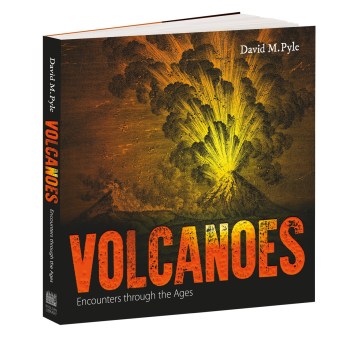 The exhibition is curated by David M. Pyle, Professor of Earth Sciences at the University of Oxford, whose research uses historical sources to improve our knowledge of past volcanic activity and to shed light on what might happen in the future at young or active volcanoes. It will feature treasures from the Bodleian Libraries, some of which have never been on public display before. In addition, the exhibition will feature items on loan from the Natural History Museum in London and from the University of Oxford’s Museum of Natural History, the Museum of the History of Science, and Magdalen College. Highlights of Volcanoes include:
• Fragments of ‘burnt’ papyrus scrolls from the ancient Roman town of Herculaneum, which were buried during the 79 AD eruption of Vesuvius
• The earliest known manuscript illustration of a volcano, found in the margin of a 14th-century account of the voyage of St Brendan, an Irish monk who travelled across the north Atlantic in the 6th century
• A stunning illustration of the Earth’s subterranean fires from Athanasius Kircher’s Mundus Subterraneus, an influential 17th-century work which proposed that volcanoes were created where the Earth’s internal fires escaped at the surface
• Spectacular 18th-century studies of Vesuvius by Scottish diplomat and early volcanologist William Hamilton who wrote one of the first descriptive monographs of an active volcano
• 18th- and 19th-century weather diaries and paintings that capture the distant effects and freak weather conditions caused by major volcanic eruptions in Iceland and Indonesia
• ‘Infographics’ from 19th-century natural historians Alexander von Humboldt and Charles Daubeny whose work has contributed greatly to our current understanding of volcanoes
• Lava and rock samples, maps, lecture notes, and scientific equipment from 19th-century volcanologists and explorers
The exhibition curator David Pyle said: “Humans have lived with volcanoes for millions of years yet scientists are still grappling with questions about how they work. This exhibition features historical representations and ideas about volcanoes that are captivating and dramatic but most importantly these works provide scientists today with valuable insights into how these enigmatic phenomena behave. Looking back at history can help us learn valuable lessons about how best to reduce the effects of future volcanic disasters.”
Richard Ovenden, Bodley’s Librarian said: “Volcanoes are one of the most extraordinary marvels of the natural world and have fascinated us for millennia. This exhibition draws on both the rich collections held at the Bodleian and cutting edge scientific research to demonstrate the power and fascination of volcanoes through time.”
David Pyle, Volcanoes (Oxford Bodleian Libraries, 2017), 224 pages, ISBN: ISBN: 978 18512 44591, £20.










 Enfilade
leave a comment