Conference | Fashion and Textiles between France and England
From the conference website:
Moving Beyond Paris and London: Influences, Circulation, and Rivalries
in Fashion and Textiles between France and England, 1700–1914
IHTP and Musée Cognacq Jay, Paris, 13–14 October 2017
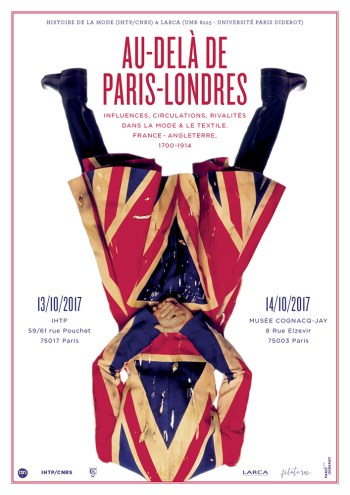 Co-organised by the LARCA/ Paris Diderot, the IHTP-CNRS and the Musée Cognacq Jay, the conference will take place in the IHTP 59/61 rue Pouchet, 75017 on the 13th and in the Musée Cognacq Jay, 8 rue Elzevir 75003 Paris on the 14th.
The keynote addresses will be given by Lesley Miller (Head of Textile and Dress at the V&A, London) and Zara Anishanslin (History, University of Delaware). The event is free and open to all, but registration is compulsory.
F R I D A Y , 1 3 O C T O B E R 2 0 1 7
9.00 Welcome and Coffee
9.30 Mapping Cross-Channel Textile Rivalries
• Fabrice Bensimon, Lace makers between Nottingham and Calais, 1816–1860
• Luc Rojas, Observer la fabrique de Coventry: Les rubaniers stéphanois à la recherche d’information
• Courtney Wilder, Band Apart: Printing ‘Rainbow’ Designs for Walls and Wardrobes in Alsace and Northern England, 1819–1851
11.00 Coffee Break
11.30 Keynote Address
• Lesley Miller (conservatrice en chef des collections mode et textiles au Victoria & Albert Museum, Londres), Lyon in London: Seduction by Silk at the End of the Seven Years War
12.30 Lunch
14.00 Entente cordiale ? Aesthetic and Economic Circulations of Embroidery
• Tabitha Baker, From Lyon and Paris to London: Commercial Networks within the French Embroidery Trade and the Role of the English Gentleman Consumer, 1748–1785
• Isa Fleischman-Heck, Manly French Style Versus Feminine English Taste: Pictorial Embroideries in France and England at the End of the 18th Century
15.00 Coffee Break
15.15 Competing for Cotton
• Jessica Barker, Toile de Jouy / Cloth of England: Copperplate Textile Printing in England and France, 1752–1820
• Ariane Fennetaux, Franco-British Cotton Rivalries: Empire, Trade, and Technology in the 18th Century
S A T U R D A Y , 1 4 O C T O B E R 2 0 1 7
9.30 Welcome and Coffee
9.50 Opening Remarks by Rose-Marie Mousseaux (Directrice du Musée Cognacq-Jay)
10.00 Business Means Business: Fashion Trades and Commercial Strategies
• Pierre-Henri Biger, Eventails et éventaillistes entre la France et l’Angleterre aux XVIII et XIXe siècles
• Audrey Millet, Protéger les dessins textiles: L’invention de la propriété industrielle comme négation du processus créatif, une compétition France-Angleterre (XVIIe–XIXe siècles)
• Véronique Pouillard and Waleria Dorogova, Couture Limited: The Short Lived Britanisation of French Fashion
11.30 Coffee Break
12.00 Keynote Address
• Zara Anishanslin (University of Delaware), An English and Even a Female Hand: Anna Maria Garthwaite, Anglo-French Rivalry, and the Gendered Politics of Flowered Silk
13.00 Lunch
14.30 Embodying Fashion Rivalries
• Elise Urbain Ruano, Une figure pré-romantique? La duchesse d’Orléans et la mode anglaise à la veille de la Révolution française
• César Imbert, Une garde-robe au service de l’Empire: l’influence vestimentaire d’Eugénie en Angleterre
• Matthew Keagle, More than Red and White: Franco-British Reform and Military Dress in the Late Ancien Régime
16.30 Guided Tour of the Cognacq-Jay Collections with Director Rose-Marie Mousseaux
Exhibition | Exchanging Gazes: Between China and Europe

Chinese Ladies Playing a Board Game, Qing Dynasty, Qianlong Period (1736–1795), 2nd half of the 18th century, watercolour and opaque watercolour on silk (Museum für Völkerkunde Hamburg)
◊ ◊ ◊ ◊ ◊
Press release from the Berlin State Museums:
Exchanging Gazes: Between China and Europe, 1669–1907
Kunstbibliothek, Staatliche Museen zu Berlin, 29 September 2017 — 7 January 2018
China and Europe are linked by a long tradition of reciprocal cultural exchange. These transactions were particularly intensive during the Qing Dynasty (1644–1911), which is regarded as one of the key phases of Chinese cultural and political history. Exquisite gifts were exchanged. European envoys attempted to establish official trade relations with China. But their efforts were in vain, as the Chinese established trade barriers, with the exception of the port of Canton—although they were very much interested in European science, art, and culture.
The exhibition illustrates the richly varied nature of this mutual fascination in objects ranging in date between 1669 and 1907. Many of the almost one hundred pieces could be classified as Chinoiserie or so-called Europerie: they provide us with information about early modern European images of China and also allow us to trace the predominant images of Europe in China. Highlights of the exhibition include impressive paintings, exquisite porcelain objects, a door from a wood-paneled room, as well as large-format photographs and copper engravings. The photographs and engravings show the ‘European palaces’ which Emperor Qianlong, who reigned from 1736 to 1795, had built in one of his parks. Today, only their ruins exist: British and French troops burned down the palaces and destroyed the extensive gardens during their 1860 Chinese campaign. Surprisingly, however, in this way they created a visual subject that was much-loved by European photographers after 1870.
 Until now, the reciprocity—and sheer variety—of cultural exchange between China and Europe has hardly been appreciated or shown in an exhibition setting. The chosen objects offer impressive testimony to a long- lived and mutual interest between the two cultures. In addition, they can help us understand how Europe’s conception of China and China’s conception of Europe changed over the course of 250 years.
Particularly in the 18th century, it was not only Europe looking to China’s art production but also China looking to that of Europe. The fact that these exchanging gazes are to be taken quite literally and that they were cast back and forth now and again is demonstrated by the Chinese production of porcelain: around 1700, European missionaries living at the imperial court contributed to the development of the so-called foreign colours (yangcai). The chinaware that was subsequently decorated with the new shades of red and pink (famille rose) became so popular that it developed into an export hit and hence also had a lasting impact on European dining culture.
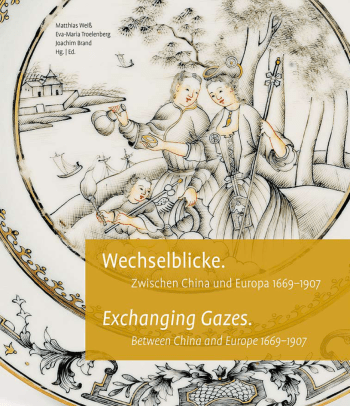
An exported plate, which was produced in China and shows two pilgrims on their way to Cythera, the island of love, allows the term ‘exchange of gazes’ to be connected more closely to the 18th century. In the European love discourse of that time, this term is connected with the concept of the love of souls. This type of love enables an encounter between lovers at eye level; yet it also involves the danger of unilateral self-reflection. Certainly this metaphor of love cannot be transferred unmitigatedly to the cooperation of cultures. Nevertheless, it points at two contradictory foundations of cultural exchange: such an exchange is only possible if, apart from differences, common features are recognized, for instance in the characteristics of systems of rule or in courtly cultures. At the same time, ‘exchange of gazes’ can allude to the fact that it is first and foremost one’s own self-interest that is respected in these constellations.
Due to political and economic changes, China and Europe had to repeatedly reconsider themselves, which means they had to come to a kind of self-understanding as well as set themselves in relation to each other. This becomes particularly evident when looking at objects called Chinoiseries, as they reflect the European image of China prevalent throughout the 18th century. Chinoiseries can be juxtaposed with the so-called Europeries, which were produced in China and give insight into the Chinese image of Europe. In order to present the foreign as alien, it had to be at least partially adapted to the familiar, which is why the objects exhibited here can be aesthetically classed in-between China and Europe. Many objects can additionally be found ‘between’ China and Europe because they circulated as export goods, diplomatic gifts or as possessions acquired abroad, all in order to develop an altered effect in their respective new repositories. It is furthermore evident that motifs and techniques migrated not only between these cultures but also between genres and materials. Prints, for example, became built architecture and vice versa. The exhibition, moreover, offers the rare occasion to simultaneously view Chinoseries and Europeries, which are usually stored in different collections. This therefore allows the gaze to wander back and forth and, in so doing, to comprehend that China and Europe share a common history.
Even though there are hardly definite dates that mark the history of exchange between China and Europe, the years in the exhibition’s title indicate two important stages in the European production of images of China. In 1669, Johan Nieuhof’s travelogue was published. Nieuhof had joined the first Dutch delegation of the United East India Company travelling to China in order to intensify the trade relationship with the empire that increasingly isolated itself—a venture which failed. From a historic point of view, the journey’s true success was Nieuhof’s richly illustrated travelogue that was published in large numbers and became one of the most important sources for European knowledge about China.
1907, on the other hand, marks the creation of four architectural photographs by Ernst Boerschmann, who travelled China as an architectural historian and re-established Western knowledge on Chinese architecture. This had become possible only because the major European powers had gradually forced the opening of China beginning in the second half of the 19th century. The objects exhibited here render not only the changing relationship between China and Europe from the late 17th to the early 20th century comprehensible—how and why it shifted in the direction of colonial policy—but also the traditional tendencies which persisted through these changes. Boerschmann, for instance, perpetuated the myth that porcelain was used as construction material, even though this was not his personal view.
A special exhibition of the Kunstbibliothek – Staatliche Museen zu Berlin, in cooperation with the Max Planck Research Group ‘Objects in the Contact Zone: The Cross-Cultural Lives of Things’ at the Kunsthistorisches Institut in Florence – Max Planck Institute.
Curatorial concept: Professor Dr. Matthias Weiß
From Michael Imhof Verlag:
Matthias Weiß, Eva-Maria Troelenberg, and Joachim Brand, eds., Wechselblicke: Zwischen China und Europa 1669–1907 / Exchanging Gazes: Between China and Europe 1669–1907 (Petersberg: Michael Imhof Verlag, 2017), 352 pages, ISBN: 9783731905738, $70.
Conference | Landscape Now
From the Paul Mellon Centre:
Landscape Now
Paul Mellon Centre for Studies in British Art, London, 30 November – 1 December 2017

Spreading Oak with Seated Figure, Unknown (British) 1850s (New York: The Metropolitan Museum of Art, Gift of Hans P. Kraus Jr., 2007).
The pictorial representation of the landscape has long played an important role in the history of British art. It has been central to writers from Gilpin and Ruskin onwards, and was the subject of sustained scholarly attention in the 1980s and 1990s with the emergence of a social history of art. Writers such as John Barrell, Anne Bermingham, Stephen Daniels, Christiana Payne, Michael Rosenthal and David Solkin not only helped transform interpretations of British landscape painting, but made the study of such imagery seem essential to a proper understanding of British art itself.
Over the past two decades the centre of gravity of British art studies has shifted. An imperial turn has characterized some of the most ambitious scholarship in the field; a raft of powerful new voices have shifted attention to the Victorian and modern periods, and to the imagery of urban life; and there has been a dramatic growth of interest in such topics as print culture, exhibition culture, and the material culture of the work of art. With these developments, existing approaches to the study of landscape pictures lost some of their urgency and relevance.
However, this same period has seen the growth of a broader interest in landscape images in adjacent disciplines, driven in part by political and environmental imperatives. A newly energised category of ‘nature writing’, associated with authors such as Robert Mcfarlane and Helen MacDonald, has gained widespread currency beyond the purely academic arena. Cultural geographers such as David Matless and film-makers such as Patrick Keillor have offered nuanced investigations of the British landscape in their work, asking us to think afresh about its relationship to national identity, memory and post-imperial decline. And while many scholars in the humanities, in an age of globalisation and deepening ecological concern, have felt compelled to think about landscape on a vastly expanded basis, others have been driven to offer a new and suggestive focus on the local.
The moment thus seems ripe for a major art-historical reassessment of the image of the British landscape, taking account these and other emergent concerns. This international conference, the third in an annual series organised collaboratively by the Paul Mellon Centre, the Yale Center for British Art, and the Huntington Library, Art Collections, and Botanical Gardens, is designed to offer an opportunity for such a reassessment.
£20 Concession Rate (students and 60+) for 30 Nov and 1 Dec (ID is required on the day). £35 Standard Rate for 30 Nov and 1 Dec. NB: We are not selling tickets to individual days.
T H U R S D A Y , 3 0 N O V E M B E R 2 0 1 7
9.30 Registration
10.00 Introduction and Welcome – Mark Hallett (Director of Studies, Paul Mellon Centre), Amy Meyers (Director, Yale Center for British Art), and Steven Hindle (W.M. Keck Foundation Director of Research, The Huntington Library)
10.30 Panel 1 | Local Landscapes
Chaired by Martin Postle (Deputy Director for Grants & Publications, Paul Mellon Centre)
• Anna Reid (PhD candidate, University of Northumbria), ‘The Nest of Wild Stones: Paul Nash’s Geological Realism’
• Anna Falcini (Associate Lecturer in Contemporary Art Practice, Bath Spa University; Ph.D. Candidate in Fine Art Practice, University of the Creative Arts, Canterbury), ‘Re-illuminating the Landscape of the Hoo Peninsula through the Media of Film (the Porousness of Past & Present)’
11.30 Coffee Break
12.00 Panel 2 | Colonial Landscapes
Chaired by Sarah Victoria Turner (Deputy Director for Research, Paul Mellon Centre)
• Julia Lum (Doctoral Candidate, History of Art, Yale University), ‘Fire-stick Picturesque: Colonial Landscape Art in Tasmania’
• Rosie Ibbotson (Lecturer in Art History and Theory, Te Whare Wānanga o Waitaha University of Canterbury, New Zealand), ‘The Image in the Imperial Anthropocene: Landscape Aesthetics and Environmental Violence in Colonial Aotearoa New Zealand’
13.00 Lunch at the Paul Mellon Centre
14.30 Panel 3 | Liquid Landscapes
Chaired by Steve Hindle (The Huntington Library)
• Stephen Daniels (Professor Emertitus of Cultural Geography, University of Nottingham), ‘Liquid Landscape’
• Kelly Presutti (Fellow at Dumbarton Oaks), ‘Strategic Seascapes: John Thomas Serres and the Royal Navy’
• Gill Perry (Emeritus Professor of Art History, The Open University), ‘Landscaping Islands in Contemporary British Art: Floating Identities and Changing Climates’
16.00 Tea Break
16.30 Panel 4 | Landscape and the Anthropocene
Chaired by Martin Myrone (Lead Curator, British Art to 1800, Tate Britain)
• David Matless (Professor of Cultural Geography, University of Nottingham), ‘The Anthroposcenic: Landscape Imagery in Erosion Time’
• Mark A. Cheetham (Professor of art history, University of Toronto), ‘Outside In: Reflections of British Landscape in the Long Anthropocene’
17.30 Drinks Reception at the Paul Mellon Centre
F R I D A Y , 1 D E C E M B E R 2 0 1 7
10.00 Keynote Lecture
Chaired by Mark Hallett (Paul Mellon Centre)
• Tim Barringer (Chair and Paul Mellon Professor of the History of Art, Yale University), ‘Thomas Cole and the White Atlantic’
11.30 Coffee Break
12.00 Panel 5 | Anglo-American Landscapes
Chaired by Scott Wilcox (Deputy Director for Collections, Yale Center for British Art)
• Matthew Hunter (Associate Professor, Department of Art History and Communication Studies McGill University), ‘Drawing By Numbers: Anglo-American Landscape and the Actuarial Imagination’
• Julia Sienkewicz (Assistant Professor of Art History, Roanoke College in Salem), ‘On Place and Displacement: Benjamin Henry Latrobe and the Immigrant Landscape’
13.00 Lunch at the Paul Mellon Centre
14.15 Panel 6 | Re-Making Landscapes
Chaired by Hammad Nasar (Senior Fellow, Paul Mellon Centre)
• Val Williams (Professor of the History and Culture of Photography and Director of Photography and the Archive Research Centre (PARC), University of the Arts London, London College of Communication) and Corinne Silva (Research Fellow, PARC, University of the Arts London, London College of Communication), ‘The Re-making of the English Landscape: In the Footsteps of W.G. Hoskins and F.L. Attenborough’
• Terry Perk (Interim Director of Research, Students, Associate Head of School of Fine Art and Photography, and Reader in Fine Art, University for the Creative Arts) and Julian Rowe (MA, visual artist), ‘Mapping the Apocalypse: Jonah Shepherd and the Kentish Landscape’
13.15 Break
15.30 Panel 7 | Exhibiting Landscape
Chaired by Martina Droth (Deputy Director of Research and Curator of Sculpture, Yale Center for British Art)
• Gregory Smith (Senior Research Fellow at the Paul Mellon Centre), The ‘Connoisseur’s Panorama’: Thomas Girtin’s Eidometroplis and a New Iconography for the City’
• Nick Alfrey (Honorary Research Associate, Department of History of Art, University of Nottingham), ‘1973 and the Future of Landscape’
16.30 Tea Break
17.00 Panel 8 | Landscape Now?
• Mark Hallett (Paul Mellon Centre) Tim Barringer (Yale University)
• Sarah Monks (Lecturer in Art History, Director of Admissions for School of Art, Media and American Studies, University of East Anglia)
• Alexandra Harris (Professorial Fellow, Department of English, University of Birmingham)
• Amy Concannon (Assistant Curator, British Art, 1790-1850, Tate Britain and Doctoral Candidate, University of Nottingham)
Lecture | Tracy Ehrlich on Carlo Marchionni and the Art of Conversation
From the flyer:
Tracy Ehrlich, Carlo Marchionni and the Art of Conversation:
Architectural Drawing and Social Space in Eighteenth-Century Rome
Cooper Hewitt, Smithsonian Design Museum, New York, 3 November 2017

Carlo Marchionni, Design for a Doorway in the Villa Albani, Rome, 1755–56; pen and brown ink, brush with brown and grey wash, graphite on cream laid paper, 417 × 289 mm (Cooper Hewitt, Smithsonian Museum; photo by Matt Flynn).
In the 1750s the Roman architect Carlo Marchionni (1702–1786) produced a set of highly finished drawings for the villa of the noted collector Cardinal Alessandro Albani. Marchionni’s renderings feature sophisticated figures in fashionable dress conversing and gesticulating at the thresholds of the grand gallery. The figures yield little if any technical information; yet in these drawings the bodies are as architectonic and expressive as the building itself, perhaps even more so. Marchionni’s work diverged from contemporary conventions for architectural drawings, offering his patron not simply a design for a pleasure casino but a distinctive cultural argument that may be traced to models of civility. An eloquence of the body, a sociable kind of living, in short, the art of civil conversation, marks the drawings of Carlo Marchionni.
Tracy Ehrlich, Faculty member, MA in the History of Design & Curatorial Studies Parsons School of Design, The New School, and Smithsonian Institution, Senior Fellow, 2016–17
3 November 2017 at 1:00pm, Lower Level Lecture Hall, Cooper Hewitt, Smithsonian Design Museum
Call for Papers | Artist Immigrants to the Baltic Sea Area, 1554–1721
From H-ArtHist:
Successful Immigrants: Artist Immigrants
to the Baltic Sea Area in Times of the Nordic Wars, 1554–1721
Leibniz Institut für die Geschichte und Kultur des östlichen Europas, 8–9 February 2018
Proposals due by 31 October 2017
Movement and mobility have always been important engines for innovation and development in the arts. Together with artists, also new ideas, concepts, styles, and techniques traverse boundaries and mix up with traditional and constricted habits at their place of arrival. Long hikes to foreign countries implied a high risk in early modern times since knowledge about far regions was limited and traveling arduous. Nevertheless, a surprisingly high activity of migration can be observed in artistic professions. This workshop seeks to explore the latter phenomenon in the Baltic Sea area.
The Baltic Sea in early modern times wasn’t only a barrier as which it was observed in the further course of history, but also a contact zone. Its neighbouring countries were intertwined in various forms of relations—trade, diplomacy, and also wars gave rise to more exchange and thus encouraged migration movements. This workshop aims to shape a more differentiated picture about the dynamics of artistic transfer processes and labour conditions in the Baltic region. The workshop will focus not only on major cities like Gdansk, which had a special appeal on artists, or Dutch artists and craftsmen, which represented the largest group of immigrants to the Baltic region. Rather, the workshop will target different groups and individuals as well as the entire Baltic Sea area: the Kingdoms of Poland, Denmark and Sweden (including its Baltic provinces), the Duchy of Courland, and cities like Stockholm, Riga, and Reval.
The following questions can serve as opening questions: What reasons motivated the artists to migrate and what goals did they pursue? What made a place attractive for the arrivals? Did the artists stay in their new domains, did they return home or did they continue traveling? How did the artistic development proceeded and how did they integrate in their new home places? Any project that concerns individual artist careers, rewarded with success or failed, will be of interest for the workshop. The workshop also welcomes papers offering an overview, focusing on protagonists, cities, or routes. Furthermore, proposals concerning traveling writers may be included as possible comparison group. Please send your one-page proposal and short CV to Agnieszka Gąsior at agnieszka.gasior@leibniz-gwzo.de by October 31st 2017.
Organized by Agnieszka Gąsior, Leibniz-Instituts für Geschichte und Kultur des östlichen Europa (GWZO)
Erfolgreiche Einwanderer: Künstlerimmigration im Ostseeraum während der Nordischen Kriege, 1554–1721
AAMC Foundation Engagement Program for International Curators
From the Association of Art Museum Curators:
AAMC Foundation Engagement Program for International Curators
Applications due by 20 October 2017
The AAMC Foundation Engagement Program for International Curators, made possible with major support from the Terra Foundation for American Art, is a two-year Program for three non-US based curators and three US Liaisons working on or having worked within exhibitions and projects that explore historic American Art (c. 1500–1980), including painting; sculpture; works on paper, including prints, drawing and photography; decorative arts; and excluding architecture; design; and performance. The Program offers numerous benefits for Awardees, including travel funding.
Through fostering international relationships between curators, the Program aims to not only provide opportunities for professional development and exchange, but also to expand and strengthen the international curatorial community and give primacy to the curatorial voice in the international dialogue between museum professionals.The Program will be an active part of building international partnerships, leading cross-border conversations, and spearheading international representation within AAMC’s membership & AAMC Foundation’s efforts.
Program Goals
• Form new international relationships and partnerships through the interaction of each International Awardee with their US Liaison and the larger AAMC community of members & supporters
• Provide opportunities for International Awardee to engage with US museum networks and professional development opportunities through AAMC membership benefits, including travel funding to the AAMC Annual Conference; Program-specific webinars and access to past AAMC webinars; AAMC Committee or Task Force participation; an Annual Alumni reception; visit to US Liaison’s institution, and more
• Foster awareness of the concerns and needs of curators working outside the US within AAMC’s membership and within the AAMC Foundation programming
• Establish a long lasting relationship between AAMC, AAMC Foundation, the International Awardees, and community of international scholars
• Bring an international voice to AAMC’s leadership through engagement with the organization’s donor groups and involvement on an AAMC Committee
Additional information, including details for International Curators and US Liaisons, is available here»
New Book | The Mercantile Effect
Distributed by The University of Chicago Press:
Sussan Babaie and Melanie Gibson, eds., The Mercantile Effect: Art and Exchange in the Islamicate World during the 17th and 18th Centuries (London: Ginko Library, 2017), 160 pages, ISBN: 978 190994 2103, $60.
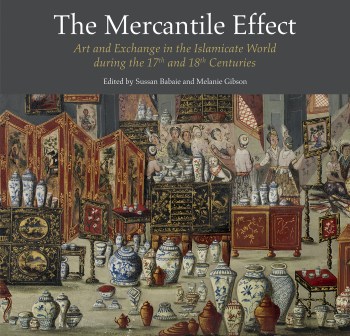 With Contributions by Anna Ballian, Nicole Kancal Ferrari, Frederica Gigante, Francesco Gusella, Negar Habibi, Sinem Erdoğan Işkorkutan, Gul Kale, Dipti Khera, William Kynan-Wilson, Suet May Lam, Amy Landau, George Manginis, Zaheen Maqbool, Christos Merantzas, Alexandra Roy, and Nancy Um
This lavishly illustrated book collects papers delivered at the third Gingko conference The Mercantile Effect: On Art and Exchange in the Islamicate World During 17th–18th Centuries. Held in Berlin, this meeting brought together a group of established and early-career scholars to discuss how the movement of Armenian, Indian, Chinese, Persian, Turkish, and European merchants and their trade goods spread new ideas and new technologies across Western Asia in the early modern era. Through the newly-established Dutch, English, and French East India companies, as well as much older mercantile networks, prestigious exotic commodities—silk, ivory, books, glazed porcelains—were transported east and west. The collected essays in this volume introduce a fascinating array of not only trade objects but also customs and traditions that bring this period of intense cultural interplay to life.
Sussan Babaie is the Andrew W. Mellon Reader in the Arts of Iran and Islam at the Courtauld Institute of Art, University of London. Melanie Gibson is the senior editor of the Gingko Library Arts Series.
Exhibition | European Old Masters: 16th–19th Centuries
Press release for the exhibition:
European Old Masters: 16th–19th Centuries
Hazelhurst Regional Gallery and Arts Centre, Gymea (Sydney), 28 September — 3 December 2017

Jean-Marc Nattier, Portrait of Madame de La Porte, 1754; oil on canvas, 82 × 65.5 cm (Art Gallery of New South Wales, gift of William Bowmore, OBE 1992).
New South Wales’s most important European old masters including magnificent works by some of the leading Italian, French, and British artists of the High Renaissance, Baroque, Rococo, and Romantic periods are on loan from the Art Gallery of New South Wales to Hazelhurst Regional Gallery for the exhibition European Old Masters: 16th–19th Century.
Michael Brand, director of the Art Gallery of New South Wales said the exhibition is the first occasion so many of these important European paintings have been shown together outside the Art Gallery of New South Wales. “We are delighted to collaborate with Hazelhurst Regional Gallery to share some of the finest European works in our collection with their audiences in the Sutherland Shire and further afield,” Brand said. “The Gallery’s early ambitions to display paintings by the masters can be seen in the roll-call of European greats inscribed on the building’s façade, and I applaud Hazelhurst Regional Gallery for showing works from this glorious tradition that is still relevant today,” Brand added.
Belinda Hanrahan, director, Hazelhurst Regional Gallery said leading artists in the exhibition include Thomas Gainsborough, William Hogarth, Sir Joshua Reynolds, Bernardo Strozzi, and Frans Snyders. “Hazelhurst Gallery is thrilled that Michael Brand as director of the Art Gallery of New South Wales has given us this opportunity for people to encounter the state’s finest European old masters. Paintings such as these remind us of what is constant in human experience and emotion while offering an insight into ages and cultures so different to our own,” Belinda said.
Sutherland Shire Mayor and Hazelhurst Gallery Board member, Carmelo Pesce said this exhibition is another example of our commitment to a culturally rich community. The Sutherland Shire community is the first to see the collection outside its home and showcases Council’s commitment to strengthen its community connections through shared cultural experiences.
Despite its early ambitions to collect works by the European masters, The Art Gallery of New South Wales did not in fact start collecting old masters until the 1950s. AGNSW curator European prints, drawings and watercolours, Peter Raissis said prior to that time the great masters of the past could be experienced only through copies intended for educational purposes due to the Gallery’s earlier focus on acquiring works by living artists. “Between 1951 and 1976, the Gallery acquired an outstanding group of English 18th-century portraits, including works by three of the leading painters of the age: William Hogarth, Thomas Gainsborough, and Joshua Reynolds. During these years the Gallery also purchased landscapes and subject pictures representative of British Neo-Classicism and Romanticism by artists such as Richard Wilson, John Glover, Richard Westall, William Hamilton, and Francis Danby. “Although accessions of non-British painting were rare, three powerful and imposing figural compositions by the Baroque painters Bernardo Strozzi, Jan van Bijlert, and Matthias Stomer expanded the scope and ambition of the collection,” Raissis said.
The extraordinary donation by James Fairfax AC during the 1990s significantly enriched the Gallery’s holdings of European old masters, particularly in the area of 18th-century French and Italian art such as the works by Nicolas de Largillierre and Canaletto. The collection has continued to develop with the acquisition of major Italian Renaissance and Baroque works such as the work of Giulio Cesare Procaccini, also exhibited in European Old Masters: 16th–19th Century.
Journée d’étude | Jacques-François Blondel
From the conference flyer:
Jacques-François Blondel et l’enseignement de l’architecture:
La dernière leçon de l’architecture « à la française »
Cité de l’architecture et du patrimoine, Paris, 14 December 2017

Gabriel de Saint-Aubin, Blondel démontrant des machines dans l’académie d’architecture, 1770, Recueil de poésies de Sedaine, 1770 (Chantilly, Musée Condé).
Dernier héraut de l’architecture à la française, Jacques-François Blondel (1708/9–1774) a formé dans son école privée et à l’Académie royale d’architecture parmi les architectes les plus renommés de la seconde moi é du XVIIIe siècle et du début du siècle suivant : Claude-Nicolas Ledoux, Étienne-Louis Boullée, Alexandre Brongniart ou William Chambers… La pédagogie révolutionnaire qu’il développa dans l’enseignement de l’architecture tout au long de sa carrière a connu une ample diffusion en France, en Europe et même, outre-Atlantique, jusqu’au Québec. Si certains architectes l’appliquèrent à la lettre, d’autres s’en affranchirent et allèrent au-delà des leçons professées par le maître.
Organisée en partenariat avec la Ville de Metz et l’École na onale supérieure d’architecture de Nancy, cette journée d’étude internationale est centrée sur le rôle de Jacques-François Blondel dans l’enseignement de l’architecture. Elle annonce l’exposition monographique Blondel, architecte des Lumières qui sera présentée à Metz, à l’Arsenal, du 13 avril au 13 juillet 2018 et l’exposition-dossier que la Cité de l’architecture et du patrimoine lui consacrera la même année. Cette rencontre se propose de revenir sur les idées ainsi que les méthodes pédagogiques dispensées par J.-F. Blondel, et de relire, au travers d’un prisme neuf, les fondamentaux de son enseignement. La participation à cette journée est gratuite; inscription en ligne obligatoire. Contact: jean-marc.hofman@citedelarchitecture.fr.
◊ ◊ ◊ ◊ ◊
9.00 Accueil
9.20 Ouverture de la journée d’étude
• Corinne Bélier (Directrice du musée des Monuments français)
• Lorenzo Diez (Directeur de l’École nationale supérieure d’architecture de Nancy)
• Dominique Gros (Maire de Metz)
9.45 Jacques-François Blondel : état de la recherche, Aurélien Davrius (Maître-assistant à l’École nationale supérieure d’architecture de Paris-Malaquais, Laboratoire LIAT)
10.15 Jacques-François Blondel, un professeur innovant à l’Académie royale d’architecture ?, Hélène Rousteau-Chambon (Professeur d’histoire de l’art moderne à l’université de Nantes)
10.45 Blondel et les Mansart : une leçon particulière, Philippe Cachau (Docteur en histoire de l’art)
11.15 Pause-café
11.45 Les savoirs théoriques et techniques transmis par Blondel au travers de l’exemple du matériau plâtre, Christelle Inizan (Chargée d’études et de recherches, Médiathèque de l’architecture et du patrimoine, Centre de recherches sur les Monuments historiques)
12.15 L’influence de J.-F. Blondel sur le cours d’architecture de l’École des Ponts et Chaussées, Théodore Guuinec (Architecte DE-HNOMNP, historien du patrimoine)
12.45 Questions ouvertes aux intervenants
13.00 Pause-déjeune
14.30 L’enseignement de l’expérience architecturale chez Blondel et ses collègues anglais, Sigrid de Jong (Chercheur à l’université de Leyde, Pays-Bas)
15.00 « Como ha hecho el Sieur Blondel, en Francia… » Réflexions sur l’influence de la théorie architecturale française autour de Jacques-François Blondel en Espagne, 1750–1800, Adrián Almoguera (Doctorant contractuel en histoire de l’architecture Université de Paris Sorbonne / Centre André Chastel)
15.30 Le Précis d’architecture (1828) de l’abbé Jérôme Demers et le prolongement de l’enseignement de Blondel au Canada au XIXe siècle, Marc Grignon (Professeur d’Histoire de l’art à l’Université Laval) et Pierre-Édouard Latouche (Professeur au département d’histoire de l’art à l’Université du Québec à Montréal)
16.15 Pause
16.30 L’École des arts de Jacques-François Blondel ou l’invention d’une pédagogie des relations entre architecture, sculpture et peinture, Laure Chabanne (Conservateur du patrimoine, musée et domaine nationaux du palais de Compiègne)
17.00 « Le Grand Blondel », Jean-Marie Pérouse de Montclos (Directeur de recherche honoraire au CNRS)
17.30 Vers une conception « évolutionnaire » de l’architecture : Jacques-François Blondel et la question du jugement professionnel dans la théorie de Peter Collins, Denis Bilodeau (Professeur tulaire à l’École d’architecture de l’Université de Montréal)
18.00 Questions ouvertes aux intervenants
18.20 Conclusion de la journée, Pierre Caye (Directeur de recherche au CNRS)
19.30 Visite de la galerie des moulages
Exhibition | Canova, Hayez, and Cicognara: The Last Glory of Venice
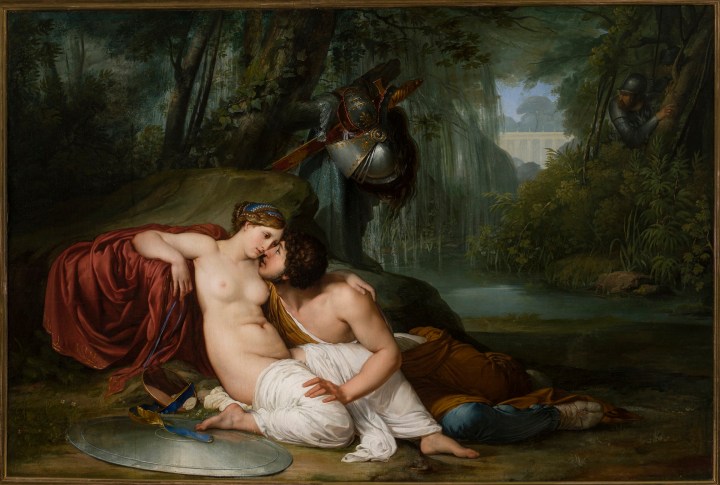
Francesco Hayez, Rinaldo and Armida, 1812–13, oil on canvas
(Venice: Museo Nazionale Gallerie dell’Accademia)
◊ ◊ ◊ ◊ ◊
From Et Electa:
Canova, Hayez, and Cicognara: The Last Glory of Venice
Gallerie dell’Accademia, Venice, 29 September 2017 — 2 April 2018
Curated by Paola Marini, Fernando Mazzocca, and Roberto De Feo
In the year of the bicentennial celebrations of the opening of the Gallerie dell’Accademia—an international institution first founded to compensate for the loss of so many masterpieces removed during the suppression of schools and religious institutions—the exhibition Canova, Hayez, Cicognara: L’ultima gloria di Venezia pays homage to a unique moment in the artistic history of the Serenissima, its cultural revival initiated in 1815 when the Four Horses of Saint Mark, the iconic symbol of the city, were returned from Paris.
The acknowledged leader of this revival was the intellectual Count Leopoldo Cicognara, President of the Accademia di Belle Arti, who together with his friend Antonio Canova, the guiding spirit of the project, and Francesco Hayez, worked to create a museum on an international scale, a worthy setting for Venice’s unrivaled art heritage, yet one also suitable for promoting contemporary art.
The exhibition includes 100 major works, arranged in nine thematic sections, including a series of artefacts known as ‘The Homage of the Venetian Provinces’ sent to the imperial court of Vienna in 1818 to mark the fourth marriage of Emperor Francis I, reunited and returning to their native city for the first time in 200 years.
Highlights of the exhibition also include the opening section dedicated to the return of the Four Horses of St Mark and the cameo depicting Jupiter the Shield Bearer, a masterpiece whose beauty was hymned by Canova, and further on the commemoration of the acquisition of a series of drawings by Leonardo da Vinci and Raphael from Canova and Cicognara’s mutual friend Giuseppe Bossi, a purchase which significantly enriched the Academy’s collection.
Fernando Mazzocca et al., Canova, Hayez, Cicognara: L’ultima Gloria di Venezia (Venice: Marsilio, 2017), 352 pages, ISBN: 9788831728225, $65.










 Enfilade
leave a comment