Symposium | Garnitures: Vases in Interiors
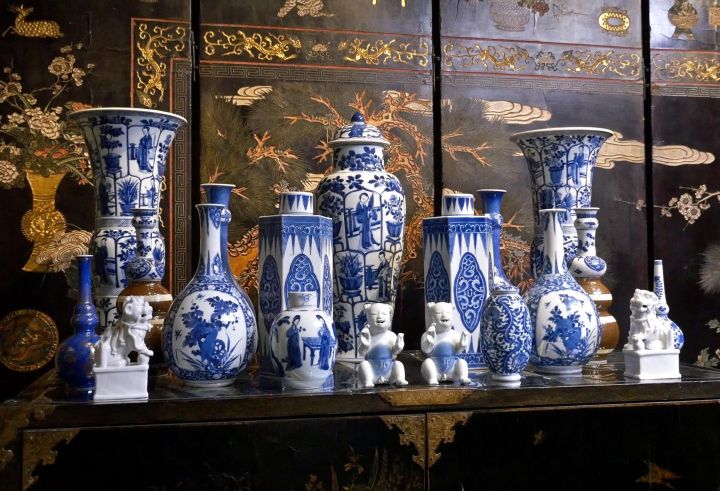
Assembled garniture, porcelain from Jingdezhen and Dehua, China, 1650–1720, on an English japanned cabinet, ca. 1680, in the British Galleries at the Victoria and Albert Museum, London (Photo: Peter Kelleher).
◊ ◊ ◊ ◊ ◊
Garnitures: Vases in Interiors
Victoria and Albert Museum, London, 17 March 2017
Organized by Matilda Pye, Patricia Ferguson, and Reino Liefkes
The focus of this one-day symposium is the garniture, assembled or matched sets of primarily ceramic vessels, displayed in European interiors from 1620 and 2017. It will contextualize and enhance the ground-breaking Garnitures: Vase Sets from National Trust Houses, a temporary display in the Ceramics Gallery at the Victoria and Albert Museum, on view until 30 April 2017, and curated by Patricia Ferguson, Honorary Adviser on Ceramics to the National Trust, with Reino Liefkes, Senior Curator, Victoria and Albert Museum. The Headley Trust has generously supported the display, a publication of the same title and this symposium.
Many of the leading international ceramic specialists and contemporary makers will explore national differences in how European tastemakers and followers used garnitures to ornament and enliven interiors in the Netherlands, France, Saxony, and Britain. These displays were typically dictated by innovative architectural features in elite interiors, such as the development of the chimneypiece in France in the mid-seventeenth century, as well as the furniture types associated with these cultures and available materials: Asian porcelain, Dutch delftware, French faience, silver, and European porcelain. The papers will cover the use of the vase in China, its adaptation and collection in the West, the impact on the potteries in Japan and Delft and at porcelain manufactories in Germany at Meissen, and in France at Sevres, in addition to the revival of interest among collectors in the nineteenth century.
As evidence that artists and ceramicists are still fascinated by the idea of the series and repetition in forms, colours, and pattern, the day will conclude with papers by artists Edmund de Waal and Matt Smith—both well known for their site-specific ceramic work in museums, galleries, and historic houses—who will share their own personal responses to this interior phenomenon. Other speakers will include Dr. Yu-ping Luk, curator, Chinese collections, Asian Department, V&A; Patricia Ferguson; Suzanne Lambooy, curator applied arts, Gemeentemuseum, The Hague, Netherlands; Dr. Julia Weber, director, Porzellansammlung, Staatliche Kunstsammlungen, Dresden, Germany; Dame Rosalind Savill, DBE, FSA, FBA, President of the French Porcelain Society, and former Director of the Wallace Collection; Tamara Préaud, the former Archivist, Manufacture Nationale de Sèvres, France, Selma Schwartz, Associate Curator, Waddesdon Manor, The National Trust. The conference will be of interest to students and scholars of Asian, European and Contemporary ceramics, silver, the country house, the history of the interior, collecting, and taste. The day will conclude with a lively round table discussion.
The full conference fee is £25; concessions available. To book, please follow this link.
P R O G R A M M E
10.00 Registration
10.30 Matilda Pye (Learning Academy, V&A), Welcome
10.35 Patricia Ferguson (Curator, Vase Sets from National Trust Houses), Introduction
11.00 Suzanne Lambooy (Gemeentemuseum, The Hague), Delft Garnitures in the Dutch Interior
11.25 Yu-ping Luk (V&A), The Vase in China
11.45 Ros Savill (Former Director Wallace Collection), Vincennes and Sevres Garnitures
12.15 Tamara Preaud (Former Archivist Sèvres, Cité de la céramique , Musée National de Sèvres), Evidence of Biscuit Figures in Sevres Garnitures
12.30 Discussion
12.45 Lunch Break
13.45 Selma Schwartz (Waddesdon Manor, National Trust), Collecting in the 19th Century: Sevres Garnitures at Waddesdon Manor
14.05 Julia Weber (Porzellansammlung, Staatliche Kunstsammlungen, Dresden), Meissen and Garnitures in the Collection of Augustus the Strong
14.30 Refreshments
15.00 Edmund de Waal and Matt Smith, Contemporary Perspectives
Fellowships | James Loeb Fellowship for the Classical Tradition
From H-ArtHist:
James Loeb Fellowship for the Classical Tradition in Art and Architecture
Zentralinstitut für Kunstgeschichte, Munich, 3 months, starting either in June or September 2017
Applications due by 15 March 2017
The Zentralinstitut für Kunstgeschichte will award two James Loeb Fellowships for the Classical Tradition in Art and Architecture. The fellowship commemorates James Loeb (1867 New York – 1933 München), graduate of Harvard University, initiator of the Loeb Classical Library project, and art collector. The fellowship is intended to support research that reflects Loeb’s central interests. The fellowship is intended for doctoral students and postdoctoral scholars who have graduated within the last five years and who are working on a project related to the classical tradition in art and architecture, from the Middle Ages to the present. Fellows are expected to partake in the activities of the ZI and to present the fellowship project. The fellowship lasts three months, starting either on June 1, 2017 or on September 1, 2017. In addition to a monthly stipend of 1.500€, lodging will be provided in a form of an apartment. Individuals applying from outside of Germany may be awarded a one-time travel subvention.
Please submit a CV and a project description (no more than 3000 characters) and the contact information of two potential referees. Please send your application in electronic form by March 15, 2017 to fellowships@zikg.eu. For further information, please contact Sonja Nakagawa, Zentralinstitut für Kunstgeschichte, Katharina-von-Bora-Str. 10, 80333 München: fellowships@zikg.eu.
Display | Two Busts by Rysbrack
From the DIA press release (19 January 2017). . .
Two Busts of John Barnard by John Michael Rysbrack
Detroit Institute of Arts, January 2017 — Summer 2018
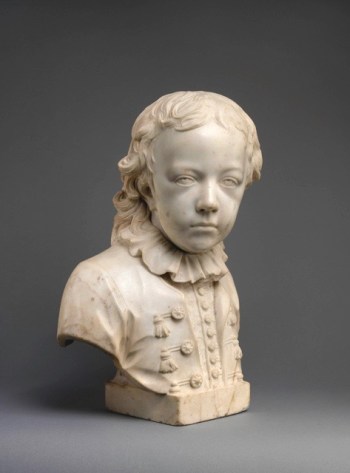
John Michael Rysbrack, Portrait of John Barnard, 1744, marble (New York: The Metropolitan Museum of Art, 1976.330).
The Detroit Institute of Arts welcomes two new ‘guests of honor’: a terracotta model and a marble bust of a young boy, John Barnard, by John Michael Rysbrack. The model is on loan from a private collector and the bust is on loan from The Metropolitan Museum of Art, New York. Shown together for the first time, these immaculately preserved portraits provide a rare glimpse of Rysbrack’s creative process. The sculptures, both of which the artist signed and dated, showcase both Rysbrack’s mastery of modeling terracotta and his exceptional skill as a marble carver. They will be on view through summer 2018.
Born and trained in Antwerp, Rysbrack moved to London in 1720 and quickly became one of the leading sculptors working in 18th-century England. Along with his fellow expatriate sculptor Louis François Roubiliac, whose arresting bust of the architect Isaac Ware stands as a major highlight of the DIA’s British portrait collection, Rysbrack was instrumental in elevating the popularity of the sculpted portrait bust above that of more conventional painted portraits in England.
While Rysbrack was highly sought after for his psychologically dynamic portraits, only a handful of his surviving works represent children. On the back of the marble bust, Rysbrack inscribed the name of his young sitter, John Barnard, the son of a British clergyman. The boy is fashionably outfitted in a Hussar’s costume, the uniform of a Hungarian cavalryman. Deriving from England’s sympathy for Hungary and Vienna during the War of the Austrian Succession (1740–48), the fad for the Hussar’s uniform appeared often throughout the 1740s in portraits of children and adults alike.
The livelier expression on the boy’s face in the hand-modeled terracotta contrasts with his graver yet youthful appearance in the marble, suggesting that the portrait was intended as a posthumous tribute to a child who died at a young age. Viewing the Metropolitan Museum’s marble bust alongside its corresponding terracotta model presents a unique opportunity to appreciate Rysbrack’s ability to transform keen observation of youthful vitality into an enduring memorial portrait. The two works are on display in the third floor British portrait gallery.
Sweden Nationalmuseum Acquires Oil Studies by Valenciennes and Denis

Pierre Henri de Valenciennes, View of the Roman Campagna near Subiaco, ca.1782
(Stockholm: Nationalmuseum, 7359)
◊ ◊ ◊ ◊ ◊
Press release (January 2017) from Sweden’s Nationalmuseum:
Sweden’s Nationalmuseum has acquired three landscape studies from Italy in oil by Pierre Henri de Valenciennes and Simon Denis. Views of Rome and the surrounding countryside have a distinguished pedigree. For a long time, they remained true to the 17th-century landscape ideal and were painted in the studio. Valenciennes and Denis broke new ground by making sketches in oil, often on paper, on location. The light and weather conditions were as important as the subject, so the works were produced quickly. Despite being preparatory studies, these oil sketches laid the foundations for much of the 19th-century’s plein air painting.

Simon Denis, Study of the Roman Campagna, ca. 1800 (Stockholm: Nationalmuseum, 7336).
Pierre Henri de Valenciennes (1750–1819) is considered a pioneer who had a major influence on French art as both a theorist and a teacher. He was elected to the academy of fine arts in Paris in 1787, and served as professor of perspective theory from 1812 onward. Élémens de perspective pratique à l’usage des artistes (1800), his treatise on practical landscape painting with a focus on perspective, was particularly significant. Eventually his efforts led the academy to establish a dedicated prize for historical landscape painting. The recently acquired View of the Roman Campagna near Subiaco shows Valenciennes’s skill in capturing the lighting conditions and cloud shadows through brushwork that is both sensitive and vivid. The painting depicts the movement of the wind and its effects rather more than the landscape itself. Oil sketches of this kind, painted on location, differ radically from the works Valenciennes created in his studio. The latter portray an idealised version of nature, with scenes from classical mythology, but thanks to the introduction of oil sketches to the process, the lighting and colouring are markedly different from those seen in 17th-century landscape painting.

Simon Denis, The Waterfall in Neptune’s Grotto at Tivoli, ca. 1790 (Stockholm: Nationalmuseum, 7358).
Simon Denis (1755–1813), a native of Antwerp, travelled via Paris to Italy, where he stayed for the rest of his life. Long overlooked, Denis was rediscovered in 1992 when a large number of his oil sketches were put up for sale. These had been passed down through generations of the artist’s descendants, so had stayed out of the public eye. His technique is reminiscent of Valenciennes, with similarly economical brushwork and a focus on the lighting and weather conditions. Unlike the idealised landscapes, the oil sketches portray nature as changeable, which the recently acquired pieces exemplify superbly. The view of the Roman Campagna, in particular, shows Denis’s skill in capturing atmospheric phenomena with great simplicity. The results are magnificent and the effect almost illusory. The smaller oil sketch depicts Neptune’s Grotto at Tivoli. With masterful simplicity, Denis captures the play of light in the waterfall and the foliage in the foreground contrasted with the dark cliff. The work appears to have been painted in haste, with thinly applied colours that dried rapidly, allowing the artist to move on to the next layer. A crouching figure at lower right serves to illustrate the scale of the subject.
When Nationalmuseum reopens after renovations, these three new acquisitions will enable the museum to better chart the beginnings of plein air painting. This would not have been possible without the generous support of the Wiros Fund, the Sophia Giesecke Fund, and the Hedda and N D Qvist Memorial Fund. Nationalmuseum has no budget of its own for new acquisitions, but relies on gifting and financial support from private funds and foundations to enhance its collections of fine art and craft.
The NEH and NEA Are National Treasures: Save Them
My standard for publishing posts with advocacy ambitions is relatively high: namely I need to be convinced that the matter at hand will potentially inflict significant blows to the work of academics and museum professionals as related to the eighteenth century, or that some important material inheritance related to the eighteenth century is endangered. Threats to the NEH and the NEA are hardly new, but given the now entirely extraordinary context of American politics, such threats could be realized. As the National Humanities Alliance notes, there’s nothing inherently partisan about this issue, and coalitions of Republicans and Democrats care deeply about these organizations. Now is the time to vocalize how important we believe the NEH and NEA to be for the common good of the United States. –Craig Hanson
From the NHA (19 January 2017). . .
 News broke this morning that the in-coming Trump Administration has a budget blueprint that proposes the elimination of NEH, along with other cultural agencies, and a major downsizing of others. This news has elicited great concern from the humanities community, and it is undoubtedly time to rally support for the National Endowment for the Humanities. That said, this blueprint is not an official proposal. The Trump Administration will be shaping its budget request over the coming months with broad input and we look forward to an opportunity to demonstrate the value of federal funding for NEH.
We are also heartened by Republican support in Congress, which has been strong over the past few years. Indeed, Republican-controlled appropriations committees have supported increases for both NEA and NEH for the past two fiscal years. More broadly, many Republicans have opposed far more minor cuts to the agency.
Consistently, Members of Congress have been compelled by advocacy that points out that:
• Through a rigorous peer-review process, NEH funds cutting-edge research, museum exhibits that reach all parts of the country, and cultural preservation of local heritage that would otherwise be lost.
• NEH’s Standing Together initiative funds reading groups for veterans that help them process their experiences through discussions on the literature of war; writing programs for veterans suffering from PTSD; and training for Veterans Affairs staff to help them better serve veterans.
• NEH grants catalyze private investment. Small organizations leverage NEH grants to attract additional private, local support. NEH’s Challenge Grant program has leveraged federal funds at a 3:1 ratio to enable organizations to raise more than $3 billion in private support. State Humanities Councils, meanwhile, leverage $5 for every dollar of federal investment. Grants through the Public Programs division have leveraged more than $16 billion in non-federal support, an 8:1 ratio.
We ask you now to send a message to your Members of Congress and the President-Elect to make clear that you, as a constituent, value the humanities.
Going Forward
Going forward, we will call on you again as the Congressional appropriations process for FY 2018 begins. We also encourage you to join us for our Annual Meeting and Humanities Advocacy Day on March 13th and 14th. Our goal is for constituents to visit Members of Congress from all 50 states to ensure that Congress serves as a stopgap to any efforts to defund NEH. Finally, we encourage you to spread word on social media. The more advocates receiving our alerts, the stronger our collective impact!
Note (added 20 January, 7am EST) — Jennifer Germann usefully notes this petition related to upcoming NEA funding.
New Book | Tudor Place: America’s Story Lives Here

The north facade and back gardens of Tudor Place, Washington, D.C. (Georgetown). The house was built in 1816–17 by Thomas and Martha Parke Custis Peter with William Thornton (Photo: Wikimedia Commons, December 2011).
◊ ◊ ◊ ◊ ◊
From The White House Historical Association:
Leslie Buhler, ed., with photography by Bruce White, Tudor Place: America’s Story Lives Here (Washington, D.C., The White House Historical Association, 2016), 304 pages, ISBN: 978 1931 917568 $50.
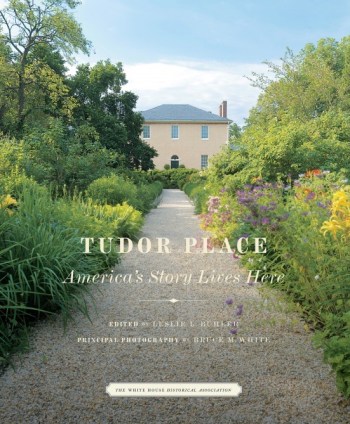 Released to mark the bicentennial of Tudor Place, this new title is the first comprehensive record of this important National Historic Landmark in the Georgetown neighborhood of Washington, D.C. Two grand houses were under construction in the young Federal City in 1816: one the President’s House, reconstructed after it was burned by the British in 1814, and the other Tudor Place, an elegant mansion rising on the heights above Georgetown. The connection between these two houses is more than temporal, as they were connected through lineage and politics for generations. The builders of Tudor Place were Thomas and Martha Parke Custis Peter, Martha Washington’s granddaughter. In the 1790s George Washington had been a frequent guest at the Peters’ townhouse when he was in the nascent Federal City, attending to its planning and selecting sites for the U.S. Capitol and the President’s House. In 1817, when President James Monroe moved back into the reconstructed President’s House following the fire of 1814, the Peters were completing their own grand home, Tudor Place, designed in concert with their friend, Dr. William Thornton, architect for the first U.S. Capitol Building. The White House and Tudor Place each represent the spirit and aspirations of the early Republic. Little more than two miles apart, each survives as a national architectural landmark. While the White House is perhaps the most well known building in the world, Tudor Place remained a family home until 1983 and very private, although the Peters welcomed some of the nation’s foremost leaders as their guests and were themselves guests at the White House.
Now a historic house and garden museum (open to the public since 1988), the house remains as the Peters lived in it, preserving spaces and belongings of many eras while adapting their home and landscape to contemporary fashion and functions. This year, as Tudor Place turns 200, this lavishly illustrated book—the first definitive history of the house and its collection—takes us into the house to explore its rooms, gardens, archival collections, and such rare artifacts as one of only three surviving letters from George to Martha Washington.
Leslie L. Buhler served as Executive Director of Tudor Place for 15 years, retiring in 2015.
◊ ◊ ◊ ◊ ◊
C O N T E N T S
• Joseph Ellis, Introduction
• Leslie Buhler, The Custis-Peter Family of Georgetown
• William C. Allen, An Architectural History of Tudor Place
• Patricia Marie O’Donnell, The Landscape of Tudor Place
• Erin Kuykenall and Leslie Buhler, Living at Tudor Place
New Book | Black Georgetown Remembered
From Georgetown UP:
Kathleen Menzie Lesko, Valerie Babb, and Carroll R. Gibbs, Black Georgetown Remembered: A History of Its Black Community from the Founding of ‘The Town of George’ in 1751 to the Present Day (Washington, D.C.: Georgetown University Press, 2016), 232 pages, ISBN: 978 1626 163263, $28.
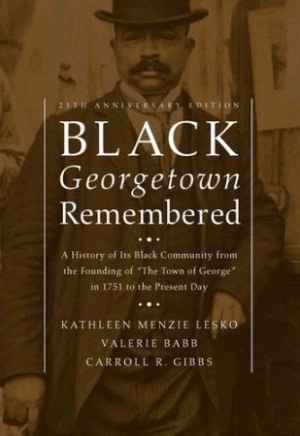 First published in 1991, Black Georgetown Remembered chronicles and celebrates the rich but little-known history of the Georgetown black community from the colonial period to the present. Drawing on primary sources, including oral interviews with past and current residents and extensive research in church and historical society archives, the authors record the hopes, dreams, disappointments, and successes of a vibrant neighborhood as it persevered through slavery and segregation, war and peace, prosperity and depression.
This 25th anniversary edition of Black Georgetown Remembered—with a new introduction by Kathleen Menzie Lesko and a foreword by Maurice Jackson—is completely redesigned and features high-quality scans of more than two hundred illustrations, including portraits of prominent community leaders, sketches, maps, and nineteenth-century and contemporary photographs. Kathleen Menzie Lesko’s new introduction describes the impact of this book.
Black Georgetown Remembered is a compelling and inspiring journey through more than two hundred years of history. It invites readers to share in the lives, dreams, aspirations, struggles, and triumphs of real people, to join them in their churches, at home, and on the street, and to consider how the unique heritage of this neighborhood intersects and contributes to broader themes in African American and Washington, DC, history and urban studies.
Kathleen Menzie Lesko is a former scholar-in-residence at the Folger Shakespeare Library and current research scholar at the Huntington Library in San Marino, California.
Valerie Babb is the Franklin Professor of English and director of the Institute for African American Studies at the University of Georgia.
Carroll R. Gibbs is a professional historian, lecturer, and author of numerous works on African American history.
New Book | Les progrès de l’industrie perfectionnée
This collection of essays grows out of the conference 2014, Workshops and Manufactures in the Years between the French Revolution and the Napoleonic Empire, 1789–1815. From PUM:
Natacha Coquery, Jörg Ebeling, Anne Perrin Khelissa, Philippe Sénéchal, eds., «Les progrès de l’industrie perfectionnée»: Luxe, arts décoratifs et innovation de la Révolution française au Premier Empire (Toulouse: Presses Universitaires du Midi, 2017), 200 pages, ISBN: 978 28107 04835, 22€.
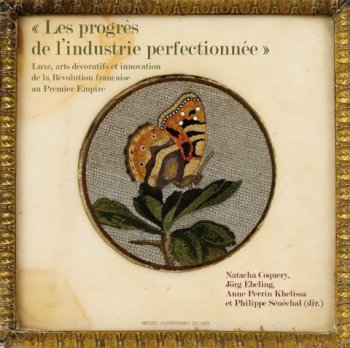 À la charnière entre les XVIIIe et XIXe siècles, entre la réunion des États généraux et la fin du Premier Empire, vingt-cinq ans s’écoulent pendant lesquels bouleversements politiques, économiques, sociaux et culturels créent un contexte d’instabilité pour le secteur du luxe et du demi-luxe français. Les ateliers et les manufactures sont confrontés à des conditions matérielles et organisationnelles difficiles. Le manque de matières premières, la détérioration des finances et la diminution du personnel en raison du départ des jeunes hommes aux armées ont un impact négatif sur la production artisanale. L’incertitude générale que représente cette période d’instabilité politique et de conflits armés n’empêche pourtant pas l’émergence de modes. De nouveaux marchés s’ouvrent et offrent de riches opportunités aux artistes et artisans pour diversifier et élargir leurs créations.
Souvent considérée comme un temps de rupture, en particulier dans le domaine du luxe dont elle remet en cause les fondements, la Révolution française apparaît au contraire comme le ferment d’une évolution vers l’innovation et l’industrialisation. Pluridisciplinaire, croisant l’histoire de l’art, l’histoire sociale, l’histoire économique, l’histoire culturelle et l’histoire des techniques, le présent ouvrage explore les conditions du changement et offre une approche plurielle des arts du décor.
T A B L E D E S M A T I È R E S
Remerciements
Introduction générale, Jean-François Belhoste, Philippe Bordes, Natacha Coquery, Jörg Ebeling, Anne Perrin Khelissa et Philippe Sénéchal
Partie I | L’État: Rôle et intervention
• Thomas Le Roux, La chimie, support du développement de l’industrie perfectionnée sous la Révolution et l’Empire
• Christiane Demeulenaere-Douyère, Le luxe sous l’Empire, ou la question des matières premières « indigènes »
• Camilla Murgia, The Crafty Link: Fine Arts and Industrial Exhibitions under the Consulate and the Empire
• Justin Beaugrand-Fortunel, Le mobilier de campagne de Napoléon ier: L’artisanat au service de l’Empereur
Partie II | Les secteurs de production: Organisation et fonctionnement
• Marie-Agnès Dequidt, L’horlogerie parisienne pendant la Révolution et l’Empire: Continuer à tourner dans un monde en bouleversement
• Élodie Voillot, Des canons aux statuettes: Les fabricants de bronze parisiens au début du xixe siècle
• David Celetti, Filer le luxe. Travail domestique, manufactures et usines dans la France révolutionnaire
• Stéphane Piques, L’organisation de la production dans l’industrie céramique sous la Révolution et l’Empire: La nébuleuse faïencière de Martres-Tolosane (Haute-Garonne)
Partie III | Les œuvres et les décors: Création et aménagement
• Bernard Jacqué, Des décors de luxe en papier peint pendant la Révolution française
• Valeria Mirra, Labor omnia vincit: La manufacture Piranesi de vases et ornements en terre cuite de Mortefontaine
• Iris Moon, Immutable Décor: Post-Revolutionary Luxury in the Platinum Cabinet at Aranjuez
• Ludmila Budrina, Lapidaires parisiens au service de Nicolas Demidoff: La collection d’objets en bronze doré et malachite avec mosaïques en relief de pierres dures réalisés par Thomire (d’après des documents inédits et les collections européennes)
• Hans Ottomeyer, Innovation by Design as Strategy for Luxury Goods
Index général
Bibliographie
Présentation des auteurs
Call for Papers | Fashion and Textiles between France and England


Matthew Darly, The Flower Garden, etching and engraving with watercolor, London, 1 May 1777 (New York: The Metropolitan Museum of Art); and wool sampler embroidered with silk, by Elizabeth Hawkins, Miss Powell’s Boarding School, Plymouth, England, 1797 (London: V&A).
◊ ◊ ◊ ◊ ◊
From the conference website:
Moving Beyond Paris and London: Influences, Circulation, and Rivalries
in Fashion and Textiles between France and England, 1700–1914
Au-delà de Paris – Londres: influences, circulations, rivalités
dans la mode et le textile. France-Angleterre, 1700–1914
Paris, 13–14 October 2017
Proposals due by 28 February 2017
The Séminaire Histoire de la mode (IHTP/CNRS) and the LARCA (Université Paris Diderot) are organizing a joint international conference in Paris, 13–14 October 2017: Moving Beyond Paris-London: Circulation and Exchange in Fashion and Textiles between France and England, 1700–1914. This conference is the latest in a series on cultural exchanges in fashion, which have included Haute Couture: Fashion and Consumption, France and England, 1947–1957 (11 April 2014), Franco-American Exchanges in Fashion (15 April 2016), and Franco-German Exchanges in Fashion (10–12 October 2016).
By looking closely at the relationship—at times friendly, at times not—between France and England through fashion and textiles between 1700 and 1914, this conference will touch on a number of topics, including: the circulation (lawful or illicit) of knowledge, individuals, and objects; the diffusion—and cross-fertilization—of design models between the two countries via press, engravings, or fashion dolls; the importation of textiles and clothing; the phenomena of copying, espionage, and counterfeits; the pursuit of protectionist policies which aimed to limit imports from the rival nation. Particular attention will be given to the different temporalities of industrialization of the two countries as a way to understand innovation and the progressive organization of professions in each. The comparison between the evolution of the two countries will also take into account examples of transfers across them such as with Charles Frederick Worth, the British designer who came to France in 1858 to open a couture house that rapidly became the symbol of haute couture in Paris.
These questions seek to examine the myriad ways in which fashion and textiles strengthened or frayed the political, economic, commercial, industrial, and cultural ties between the two countries. The conference also aims to shed new light on the geography of fashion by looking at capitals and production centers (Paris-London / Manchester-Rouen/ Lyon-Spitalfields), as well as by considering the more global context at a time of intense colonial rivalry between the two countries. Please send your paper proposals (200 words and a short biography) before February 28, 2017 to FrancoBritishFashion@gmail.com.
Scientific Committee / Comité Scientifique
Dr. Maude Bass-Krueger (Associated Researcher, IHTP/CNRS)
Dr. Ariane Fennetaux (MCF, LARCA [UMR 8225], Université Paris Diderot)
Dr. Sophie Kurkdjian (Associated Researcher, IHTP/CNRS)
Images: Matthew Darly, The Flower Garden, etching and engraving with watercolor, London, 1 May 1777 (New York: The Metropolitan Museum of Art); and wool sampler embroidered with silk, by Elizabeth Hawkins, Miss Powell’s Boarding School, Plymouth, England, 1797 (London: V&A).
Warm Thanks to the Fall 2016 Intern, Rebecca Woodruff
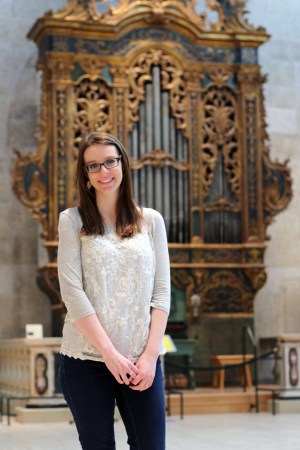 As Enfilade’s readership continues to grow, I receive more and more items to post. I wouldn’t want it any other way (and please keep the news coming), but it does mean that interns have become an increasingly helpful part of managing the site. I’ve therefore been most grateful for all Rebecca Woodruff has done to keep the ship afloat over the past six months! Rebecca is one of my students, and I had the good fortune of getting to know her better during a May interim course based in Stockholm, looking particularly at country houses and palaces (it was with Rebecca and a handful of other students I first visited Gustav III’s Museum of Antiquities, one of the really extraordinary museum spaces of the eighteenth century). As an aside, I’m also pleased to report that Rebecca will be presenting a paper for the undergraduate panel at the meeting of this year’s Midwest Art History Society (in April, at Cleveland and Oberlin)! She’s done a fabulous job as an intern.
Many thanks, Becca!
–Craig Hanson










 Enfilade
leave a comment