Exhibition | Paris on Display: 18th-Century Boutiques
Opening this spring at the Stewart Museum in Montreal:
Paris on Display: 18th-Century Boutiques / Paris en Vitrine: Les boutiques au 18e siècle
Musée Stewart, Montréal, 25 April 2018 — 24 March 2019

Stores of the Louvre, drawing, France, 18th century (Montreal: Stewart Museum).
Presenting a consumer society in the making, Paris on Display invites visitors to consider the City of Light as it was in the 18th century, exploring the boutiques in three districts known for their commercial bustle: la Cité, la Ville, and l’Université. Browsing through shops with excerpts from 18th-century urban chronicles and travel guides, visitors will meet the merchants of the Quai de l’Horloge and the haberdashers of Saint-Honoré. More than 300 artefacts from the Stewart Museum’s rich collection will evoke the activities of boutiques with such poetic names as “À l’Olivier, À la Sphère” and “Au Chagrin de Turquie.”
Exhibition | Rome!
Opening in April at La Boverie:
Rome!
La Boverie, Liège, Belgium, 24 April — 26 August 2018
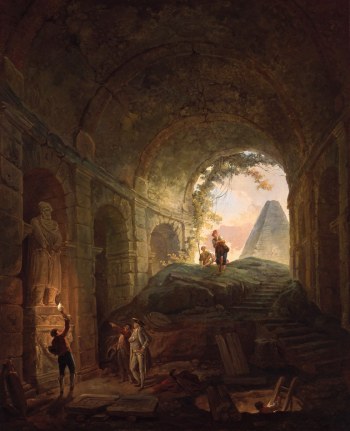
Hubert Robert, Les Découvreurs d’antiques (Musée de Valence).
En partenariat avec le musée du Louvre. Le propos général de l’exposition est d’expliciter les raisons du voyage et de décrire le séjour à Rome des artistes européens et des adeptes, généralement anglais et fortunés, du Grand Tour. L’exposition s’intéresse particulièrement à la vie quotidienne des Romains scrutée dans ses détails par ceux qui les ont peints du 17e au 20e siècle, et évoque bien entendu les emblèmes monumentaux de la cité, raison majeure du voyage des « Touristes » et obsession des artistes. Les liens entre les artistes eux-mêmes, leurs relations de camaraderie ou d’amitié, les lieux où ils se rencontraient (cafés, auberges ou Villas institutionnelles) sont également évoqués. Le ton général de l’exposition se veut explicatif, allant chercher « derrière l’oeuvre » la narration particulière et souvent étonnante, scientifiquement avérée, propre à intéresser tous les publics.
Exhibition | Drawn to Greatness
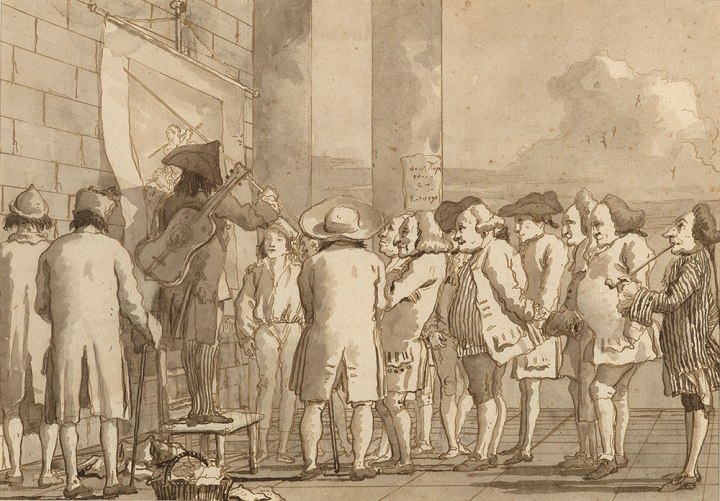
Giovanni Domenico Tiepolo, Scene of Contemporary Life: The Picture Show, 1791; pen and brown and black ink and wash over black chalk on paper, 11 5/16 × 16 5/16 inches (New York: Morgan Library & Museum, 2017.253)
◊ ◊ ◊ ◊ ◊
Press release (15 December 2017) for the exhibition now on view at The Clark:
Drawn to Greatness: Master Drawings from the Thaw Collection
The Morgan Library & Museum, New York, 29 September 2017 — 7 January 2018
The Sterling and Francine Clark Art Institute, Williamstown, MA, 3 February — 22 April 2018
Curated by Jennifer Tonkovich and Jay Clarke
Over the past fifty years, New York art dealer and philanthropist Eugene V. Thaw assembled one of the world’s finest private collections of drawings. The collection, known for its breadth and exceptional quality, charts the high points of drawing from the Renaissance through the twentieth century and features works made by pivotal artists at key moments in the history of the art form. Mr. Thaw donated his collection of more than 400 drawings to the Morgan Library & Museum, New York, which celebrated the gift with the September 2017 opening of Drawn to Greatness: Master Drawings from the Thaw Collection, an exhibition that has drawn critical acclaim for the diversity and quality of the works presented. In recognition of Mr. Thaw’s longstanding interest in the Clark Art Institute, Drawn to Greatness will travel to Williamstown for an exclusive presentation at the Clark from February 3 through April 22, 2018. Featuring 150 drawings that tell the story of a visionary collector, the exhibition examines five centuries of western drawing. Sketchbooks belonging to Jackson Pollock, Francisco de Goya, Edgar Degas, and Paul Cézanne and illustrated letters from Vincent van Gogh are among the works exhibited.
“It is an honor for the Clark to have the opportunity to show this exquisite collection in our galleries,” said Olivier Meslay, the Felda and Dena Hardymon Director of the Clark. “The works in this exhibition provide an incredibly rich and remarkable opportunity to consider the art form as practiced by generations of masters. It is one of the most important and impressive drawing exhibitions that has been assembled in decades.”
The exhibition is organized in a series of chronological sections that illustrate key moments in the history of draftsmanship while also highlighting the work of artists whom the Thaws collected in depth, among them Rembrandt van Rijn, Francisco de Goya, Odilon Redon, and Edgar Degas.
“These exceptional drawings, watercolors, and collages exemplify both the eternal power of the drawn line and the innovative genius of the artists who have explored the medium over five centuries,” said Jay A Clarke, Manton Curator of Prints, Drawings, and Photographs. “It is a truly spectacular collection of works and I am thrilled to be able to work in collaboration with the Morgan’s curatorial team to bring this show to the Clark.”
The exhibition extends the Institute’s relationship to Mr. Thaw who, in 2016, made a generous gift to create the Eugene V. Thaw Gallery for Works on Paper in the Clark’s Manton Research Center. Drawn to Greatness: Master Drawings from the Thaw Collection is organized by the Morgan Library & Museum, New York. The curator of the exhibition at the Morgan is Jennifer Tonkovich, Eugene and Clare Thaw Curator of Drawings and Prints; the curator at the Clark is Jay A. Clarke, Manton Curator of Prints, Drawings, and Photographs. Presentation of Drawn to Greatness at the Clark is made possible by the Eugene V. and Clare E. Thaw Charitable Trust. Major support is provided by the Fernleigh Foundation in memory of Clare Thaw. This exhibition is supported by an indemnity from the Federal Council on the Arts and the Humanities.
An exhibition checklist is available here»
Jennifer Tonkovich, ed., Drawn to Greatness: Master Drawings from the Thaw Collection (New York: The Morgan Library & Museum, 2017), 295 pages, ISBN: 978-0875981826, $40.
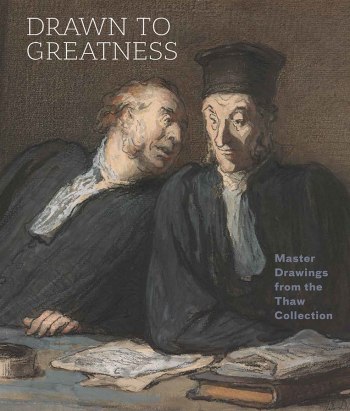 The catalogue features a series of essays by leading scholars devoted to pivotal moments in the history of drawing. Authors include Jane Shoaf Turner, Head of Rijksprentenkabinet, Amsterdam; Andrew Robison, former Head of Drawings, Prints, and Photographs at the National Gallery of Art; Matthew Hargraves, Chief Curator of Art Collections, Yale Center for British Art; Richard R. Brettell, Chair of Art and Aesthetic Studies, University of Texas at Dallas; Jay A. Clarke, Manton Curator of Prints, Drawings, and Photographs, Clark Art Institute; and, of the Morgan Library & Museum, Colin B. Bailey, Director; John Marciari, Curator and Department Head of Drawings and Prints; and Jennifer Tonkovich, Eugene and Clare Thaw Curator.
A selection of programming:
Jennifer Tonkovich | French Artists and Their Models
Sunday, 11 February 2018, 3:00pm
Jennifer Tonkovich, Eugene and Clare Thaw Curator of Drawings at the Morgan Library & Museum, explores how French artists worked with models during the eighteenth and early nineteenth centuries. Where did they find their models? What role did the models play in the creative process? How does an individual artist’s approach to the model reveal their broader outlook? A close look at studies by Watteau, Fragonard, Prud’hon, Gericault, Ingres, and Delacroix illuminates the challenges inherent in working from the model.
Matthew Hargraves | Visionaries: Romantic Drawings from the Thaw Collection
Sunday, 15 April 2018, 3:00pm
Drawn to Greatness includes some of Eugene Thaw’s finest Romantic drawings, among them outstanding works of art by William Blake, Caspar David Friedrich, and J.M.W. Turner. This lecture by Matthew Hargraves, chief curator of art collections and head of college information and access at the Yale Center for British Art, focuses on the visionary qualities of these Romantic artists and explores how they abandoned the simple imitation of the natural world to capture truths beyond the reach of the human eye.
Lectures at The Clark, Spring 2018
A selection of lectures this spring at The Clark in Williamstown, MA (in addition to those associated with the exhibition Drawn to Greatness: Master Drawings from the Thaw Collection). . .
Lauren Cannady | Rococo Thought Patterns
13 February 2018, 5:30pm
If eighteenth-century curiosity cabinets were repositories for the dead and ossified, the garden was a parallel cabinet that provided a space for the viable, for living curiosities. Given that the organizing principle of the garden parterre was applied not only to plants, but equally to naturalia in the cabinet, this lecture will map the ways in which pattern and design within these different spaces served as one model in early modern empirical thinking and knowledge transmission.
Lauren R. Cannady is assistant director of the Research and Academic Program and Manton Research Fellow at the Clark Art Institute. She was previously a fellow at the Metropolitan Museum of Art, the Deutsches Forum für Kunstgeschichte in Paris, and the Columbia University/NYU Consortium for Intellectual and Cultural History. She has published on eighteenth-century aesthetic philosophy and systems of the decorative and is preparing a book manuscript titled Natural Seduction: Thinking through the Early Modern French Garden. Her second project considers artisanal practice, collaboration, and exploitation in the global eighteenth century.
Nina Dubin | Master of the World
17 April 2018, 5:30pm
In the wake of the world’s first international financial crisis, Cupid claimed pride of place in French eighteenth-century art. The naked, winged infant deity personified not only the folly of love, but also the forces of inconstancy, mutability, and flightiness that were viewed as hallmarks of a modernizing credit economy.
Nina Dubin is associate professor of art history at the University of Illinois at Chicago and the author of Futures & Ruins: Eighteenth-Century Paris and the Art of Hubert Robert (Los Angeles: Getty Research Institute, 2010; 2012). Her work has been supported by institutions including the Getty Research Institute and the Center for Advanced Study in the Visual Arts at the National Gallery of Art, where she was a Samuel H. Kress Senior Fellow from 2013 to 2014. A specialist in European art since 1700, she is currently writing a book on love letter pictures in eighteenth-century France.
New Book | Colouring the Caribbean
From Manchester UP:
Mia Bagneris, Colouring the Caribbean: Race and the Art of Agostino Brunias (Manchester: Manchester University Press, 2017), 272 pages, ISBN: 978-15261-20458, £75 / $115.
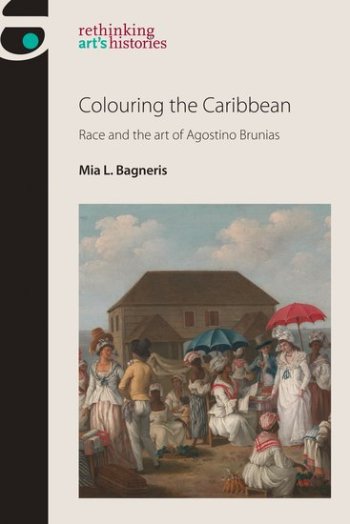 Colouring the Caribbean offers the first comprehensive study of Agostino Brunias’s intriguing pictures of colonial West Indians of colour—so called ‘Red’ and ‘Black’ Caribs, dark-skinned Africans and Afro-Creoles, and people of mixed race—made for colonial officials and plantocratic elites during the late-eighteenth century. Although Brunias’s paintings have often been understood as straightforward documents of visual ethnography that functioned as field guides for reading race, this book investigates how the images both reflected and refracted ideas about race commonly held by eighteenth-century Britons, helping to construct racial categories while simultaneously exposing their constructedness and underscoring their contradictions. The book offers provocative new insights about Brunias’s work gleaned from a broad survey of his paintings, many of which are reproduced here for the first time.
Mia L. Bagneris is Jesse Poesch Junior Professor of Art History at Tulane University.
C O N T E N T S
Introduction
1 Brunias’s Tarred Brush, or Painting Indians Black: Race-ing the Carib Divide
2 Merry and Contented Slaves and Other Island Myths: Representing Africans and Afro-Creoles in the Anglo-American World
3 Brown-Skinned Booty, or Colonising Diana: Mixed-Race Venuses and Vixens as the Fruits of Imperial Enterprise
4 Can You Find the White Woman in This Picture? Agostino Brunias’s ‘Ladies’ of Ambiguous Race
Coda: Pushing Brunias’s Buttons, or Re-Branding the Plantocracy’s Painter: The Afterlife of Brunias’s Imagery
Index
Exhibition | Cathedral of Cloth: Ebley Mill
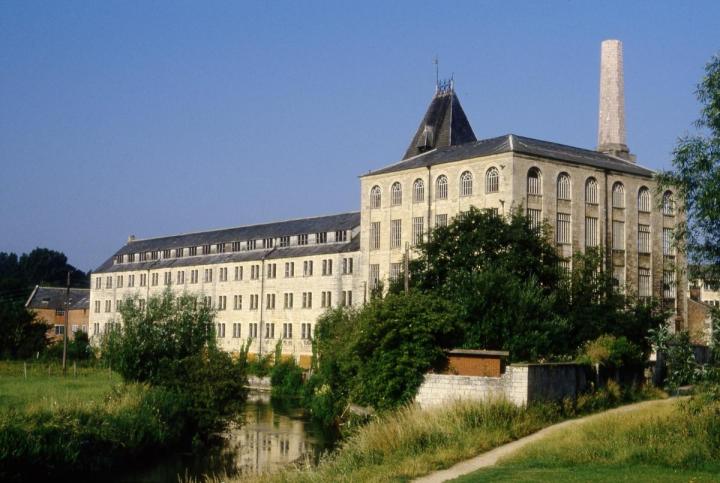
The long range of Ebley Mill was begun in 1818; in 1862, G. F. Bodley added the wing at the end.
◊ ◊ ◊ ◊ ◊
While this is predominantly a nineteenth-century exhibition, Stroud is certainly replete with eighteenth-century significance. From the Museum in the Park:
Cathedral of Cloth: Life and Times at Ebley Mill
Museum in the Park, Stroud, Gloucestershire, 3 February — 4 March 2018
In 2018 Ebley Mill celebrates the building of the Long Block at Ebley 200 years ago. The story of the Mill reaches back to the early 1400s. It was owned by a fashionable man about town before Samuel Marling made it into the powerhouse of the Stroud Valleys. The finest cloth for Victorian gentlemen was made there, but also materials for 1960s dolly birds and racing car drivers. This fascinating exhibition reveals the stories of the famous people and the ordinary workers connected to the Mill and includes many rarely seen items.
Presented by Stroudwater Textile Trust in partnership with the Museum in the Park.
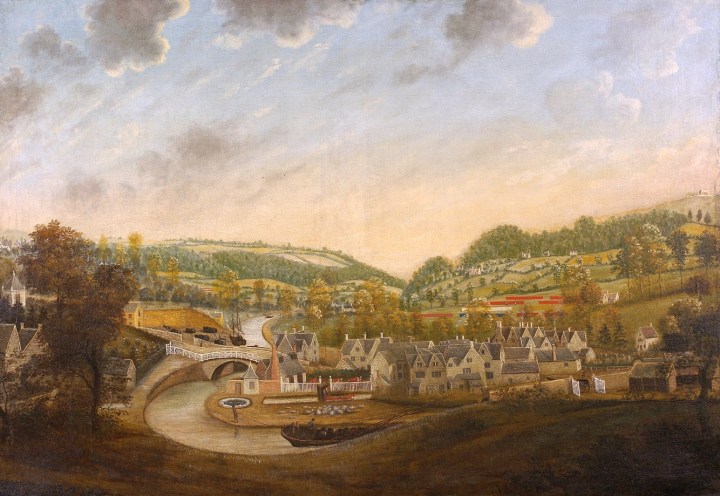
Unidentified artist, View of Wallbridge, Stroud in Gloucestershire, ca. 1790 (Stroud: Museum in the Park). The painting shows “Stroud at a time when spinners and weavers worked at home in their cottages. These were the days before large machinery was housed in huge mills such as Ebley Mill” (from the Museum in the Park’s website).
Exhibition | Power and Beauty in China’s Last Dynasty

Press release (12 October 2017) from Mia:
Power and Beauty in China’s Last Dynasty: Concept and Design by Robert Wilson
Minneapolis Institute of Art, 3 February — 27 May 2018
Curated by Liu Yang
The Minneapolis Institute of Art (Mia) is collaborating with celebrated theater artist Robert Wilson to organize a first-of-its-kind exhibition highlighting the drama, rituals, and opulence of the Qing Empire, the last imperial dynasty of China. The exhibition will present objects from Mia’s renowned collection of Chinese art, including rare court costumes, jades, lacquers, paintings, and sculpture, to be displayed in an immersive, experiential environment conceived of by Wilson. Power and Beauty in China’s Last Dynasty: Concept and Design by Robert Wilson, curated by Liu Yang, Mia’s Curator of Chinese Art, will be on view February 3 through May 27, 2018.

Manchu Emperor’s Ceremonial 12-Symbol jifu Court Robe, 1723–35, Qing Dynasty, silk tapestry (kesi) (Minneapolis Institute of Art, 42.8.11).
“The staging and storytelling involved in this exhibition speak to Mia’s belief in art’s ability to inspire wonder and fuel curiosity,” said Matthew Welch, Mia’s Deputy Director and Chief Curator. “Through the use of the theatrical elements of lighting, sound, and progression, we examine the layers of imperial life—from the external presentation of the court to the internal, private life of the emperor. We want the visitor to feel as though they are part of this otherworldly, intoxicating, and sometimes even dangerous world.”
During the Qing (pronounced ‘ch’ing’) court’s reign (1644–1912), the arts flourished—rivaling that of Europe’s great kingdoms. This backdrop of opulence served to affirm imperial power and prestige, and acted as stagecraft to enhance the emperor’s leading role as the ‘son of heaven’. Court costume, for example, was heavily embroidered or woven with symbolic designs to represent cosmological order. Roiling waves and faceted rocks around the hem evoke the earth’s oceans and mountains. Stylized clouds hover above, indicating the heavens. Dragons, a longstanding symbol of imperial authority and might, cavort in the clouds, suggesting the emperor’s rule of heaven and earth.
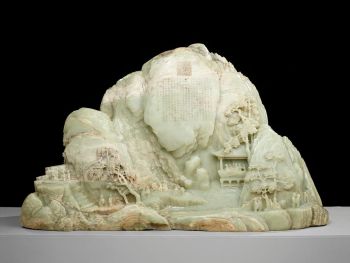
Jade Mountain Illustrating the Gathering of Poets at the Lan T’ing Pavilion, 1790, Qianlong Period (1736–95), Qing Dynasty, light green jade (Minneapolis Institute of Art).
“Mia has one of the world’s great collections of Chinese art outside of China,” said Liu Yang, Mia’s curator of Chinese Art and head of China, South, and Southeast Asian Art. “Our collection of Qing dynasty textiles is one of the most comprehensive in the West, and we have many other important objects associated with the Qing emperors and their courts. It is personally very exciting for me to be able to highlight these objects in an unexpected and fresh manner by working with Robert Wilson.”
“Mia could not be more delighted to work with Robert Wilson on the creation of this exhibition,” said Kaywin Feldman, Mia’s Nivin and Duncan MacMillan Director and President. “His unique approach to exhibition design and his willingness to push the boundaries make him an ideal collaborator. His style often involves dramatic contrasts—brightness and darkness, fullness and emptiness—which bring a new perspective to these historic objects.”
The exhibition progresses through a series of galleries that lead visitors from the performative, external world of the imperial court to the intimate, interior world of the emperor. Each gallery will also feature an original soundscape created by Wilson.
Objects highlights include
• a ceremonial twelve-symbol jifu court robe worn by the emperor
• a formal court robe worn by the empress
• a 640-pound jade mountain commissioned by the Qianlong emperor
• a multi-color lacquered and carved imperial throne
• a meditating Buddha carved from white jade enthroned within a Tibetan-style stupa of green jade
• an imperial portrait of prince Duo Lou
• a carved lacquer box adorned with nine auspicious dragons and bearing the Qianlong emperor’s seal
◊ ◊ ◊ ◊ ◊
Born in Waco, Texas, Robert Wilson is among the world’s foremost theater and visual artists. His works for the stage unconventionally integrate a wide variety of artistic media, including dance, movement, lighting, sculpture, music, and text. His images are aesthetically striking and emotionally charged, and his productions have earned the acclaim of audiences and critics worldwide. After being educated at the University of Texas and Brooklyn’s Pratt Institute, Wilson founded the New York–based performance collective “The Byrd Hoffman School of Byrds” in the mid‐1960s, and developed his first signature works, including Deafman Glance (1970) and A Letter for Queen Victoria (1974–75). With Philip Glass he wrote the seminal opera Einstein on the Beach (1976). Wilson’s artistic collaborators include many writers and musicians, such as Heiner Müller, Tom Waits, Susan Sontag, Laurie Anderson, William Burroughs, Lou Reed, and Jessye Norman. He has also left his imprint on masterworks such as Beckett’s Krapp’s Last Tape, Brecht/Weill’s Threepenny Opera, Debussy’s Pelléas et Melisande, Goethe’s Faust, Homer’s Odyssey, Jean de la Fontaine’s Fables, Puccini’s Madama Butterfly, and Verdi’s La Traviata. Wilson’s drawings, paintings, and sculptures have been presented around the world in hundreds of solo and group showings, and his works are held in private collections and museums throughout the world. Wilson has been honored with numerous awards for excellence, including a Pulitzer Prize nomination, two Premio Ubu awards, the Golden Lion of the Venice Biennale, and an Olivier Award. He was elected to the American Academy of Arts and Letters, as well as the German Academy of the Arts, and holds eight Honorary Doctorate degrees. France pronounced him Commander of the Order of Arts and Letters (2003) and Officer of the Legion of Honor (2014); and Germany awarded him the Officer’s Cross of the Order of Merit (2014). Wilson is the founder and Artistic Director of The Watermill Center, a laboratory for the arts in Water Mill, New York.
After completing his PhD at the School of Oriental and African Studies at the University of London in 1997, Liu Yang served as the curator of Chinese art at the Art Gallery of New South Wales. There he mounted an impressive number of major exhibitions, including shows on Chinese painting, Buddhist sculpture, jades, bronzes, calligraphy, modern prints, and Daoist art. Since joining Mia in 2011, Liu has curated exhibitions on the contemporary ink painter Liu Dan as well as on ancient ritual bronzes and treasures associated with China’s first emperor, Qin Shi Huang.

Imperial Throne, Qianlong Period (1736–95), Qing Dynasty, polychrome lacquer over softwood frame (Minneapolis Institute of Art, 93.32a-d).
Exhibition | Ragnar Kjartansson: The Sky in a Room
From the National Museum Cardiff:
Ragnar Kjartansson: The Sky in a Room
National Museum Cardiff, 3 February — 11 March 2018
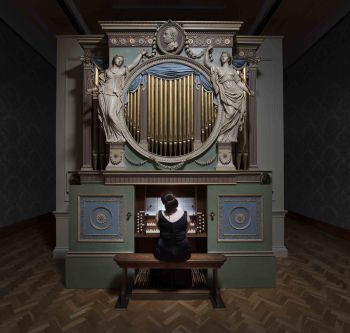
Chamber Organ, 1774, commissioned by Sir Watkins Williams Wynn for his London town house in St James’s Square. The case was designed by Robert Adam (National Museum Cardiff).
Icelandic artist Ragnar Kjartansson will return to Wales to present a brand-new site-specific performance piece, The Sky in a Room, co-commissioned by Artes Mundi and Amgueddfa Cymru – National Museum Wales. The performance will see a series of organists performing the 1959 hit song “Il Cielo In Una Stanza” (“The Sky in a Room”) on the 1774 Sir Watkins Williams Wynn organ, and it will run from 3 February to 11 March at National Museum Cardiff.
Developed after Kjartansson’s participation in Artes Mundi 6 in 2015, the exhibition is made possible by the Derek Williams Trust Purchase Prize, which enables Amgueddfa Cymru to purchase work by Artes Mundi shortlisted artists. It is also the first performance piece acquired by the Museum.
As part of the work, all of the paintings, objects and decorative furniture from the Museum’s Art in Britain 1700–1800 gallery have been removed. In the centre of the empty gallery is a solo performer, seated at a chamber organ originally commissioned by the Welsh patron of the arts Sir Watkins Williams Wynn in 1774. Throughout the day, across the five-week duration of the performance, the organist sings and plays “Il Cielo In Una Stanza,” a famous Italian love song written by Gino Paoli in 1959. The lyrics of this song recall the power of love to disappear walls into forests and ceilings into sky. Kjartansson’s work similarly transforms the Museum, dissolving space and time through the hypnotic repetition of the song.
Ragnar Kjartansson was born in Iceland in 1976. Live performance and music are central to his practice which also incorporates film, installation and painting. His film installation The Visitors featured in Artes Mundi 6.
Artes Mundi brings exceptional and challenging international artists to Wales, generating unique opportunities to engage creatively with the urgent issues of our time. Artes Mundi 8 takes place at National Museum Cardiff, 26 October 2018 – 24 February 2019.
The winner of the prestigious £40,000 Artes Mundi prize will be announced in January 2019 following a four-month exhibition of works by the shortlisted artists. The shortlist was selected from over 450 nominations spanning 86 countries and comprises five of the world’s most celebrated contemporary artists, whose works explore what it means to be human. They are: Anna Boghiguian, Bouchra Khalili, Otobong Nkanga, Trevor Paglen and Apichatpong Weerasethakul.
New Book | Pretty Gentleman
From Yale UP:
Peter McNeil, Pretty Gentleman: Macaroni Men and the Eighteenth-Century Fashion World (New Haven: Yale University Press, 2018), 256 pages, ISBN: 978 03002 17469, $45.
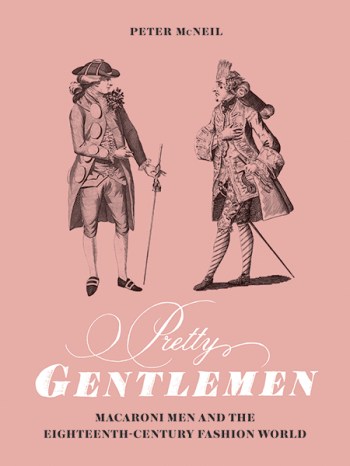 The term ‘macaroni’ was once as familiar a label as ‘punk’ or ‘hipster’ is today. In this handsomely illustrated book devoted to notable 18th-century British male fashion, award-winning author and fashion historian Peter McNeil brings together dress, biography, and historical events with the broader visual and material culture of the late 18th century. For thirty years, macaroni was a highly topical word, yielding a complex set of social, sexual, and cultural associations. Pretty Gentlemen is grounded in surviving dress, archival documents, and art spanning hierarchies and genres, from scurrilous caricature to respectful portrait painting. Celebrities hailed and mocked as macaroni include politician Charles James Fox, painter Richard Cosway, freed slave Julius ‘Soubise’, and criminal parson Reverend Dodd. The style also rapidly spread to neighboring countries in cross-cultural exchange, while Horace Walpole, George III, and Queen Charlotte were active critics and observers of these foppish men.
Peter McNeil is distinguished professor at University of Technology Sydney and Aalto University, Helsinki.
Exhibition | Classic Beauties
Looking ahead to the summer, from the Hermitage Amsterdam:
Classic Beauties: Artists, Italy, and the Aesthetic Ideals of the 18th Century
Hermitage Amsterdam, 16 June 2018 — 13 January 2019

Antonio Canova, The Three Graces, 1813–16.
The human body has fascinated artist throughout centuries. In the mid-eighteenth century this topic in art was been given a new lease on life due to spectacular archaeological discoveries in Italy. Artists like Canova, Thorvaldsen, Mengs, Kauffmann, and Batoni pursue ultimate perfection: even more perfect then the (aesthetic) ideal of the Greeks and the Romans. Many artists and elite youths set off for Italy, to see the sources of inspiration themselves. In the exhibition the visitor makes a grand tour along the finest examples of neoclassical art from the Hermitage. The exhibition Classic Beauties will offer a delightful journey through European Neoclassicism, including the unrivalled Canova collection with The Three Graces.
More information is available here»
The catalogue is published by W Books:
Thera Coppens and Arnon Grunberg, eds., Classic Beauties: Artists, Italy, and the Aesthetic Ideals of the 18th Century (Zwolle: W Books, 2018), 224 pages, ISBN: 978-9078653745, 30€.
Around the middle of the eighteenth century, Europe was enthralled by the archaeological excavations then taking place in Italy. Artists and young aristocrats from across the continent travelled there to see the country’s classical Roman and trendsetting contemporary art for themselves. The Grand Tour often lasted many months. Among those who made it were Goethe and the ‘Count and Countess of the North’ (the later Russian Tsar Paul I and his wife). In Rome, they met renowned artists like Pompeo Batoni, Anton Raphael Mengs, Hubert Robert, Angelica Kauffmann, and—most famous of all—Antonio Canova. In short, all the great names of eighteenth-century Neoclassicism. Classic Beauties allows readers to share the adventures of the Grand Tourists and meet the leading Neoclassical artists of the day. Their accounts and the book’s many illustrations—both of works of art and of contemporary tourist attractions—paint a vivid picture of a period in which the quest for classical beauty and the ideal nude was at the forefront of people’s minds.
Note (added 18 June 2018) — The posting was updated to include catalogue information.










 Enfilade
leave a comment