Exhibition | The Chocolate Girl by Liotard
On view this fall at the Zwinger in Dresden:
‘The Most Beautiful Pastel Ever Seen’: The Chocolate Girl by Jean-Étienne Liotard
Zwinger, Staatliche Kunstsammlungen Dresden, 28 September 2018 — 6 January 2019

Jean-Étienne Liotard, The Chocolate Girl, ca. 1744–45 (Dresden: SKD, Gemäldegalerie Alte Meister).
The exhibition focuses on one of the most famous works in the collection of the Dresden Gemäldegalerie, The Chocolate Girl by the Swiss artist Jean-Étienne Liotard (1702–1789). Liotard enjoyed enormous success as a pastel painter; even Rosalba Carriera, whose mastery of the medium had helped transform it into a serious and highly-admired art form, declared The Chocolate Girl to be “the most beautiful pastel ever seen.”
It was thanks to the art dealer Count Francesco Algarotti, who purchased the picture in Venice in 1745, buying it directly from the artist for the Dresden collection of Augustus III, that the gallery first began to show works by contemporary artists. The pastel medium suited the Rococo taste for lifelike, brilliant portraits and allowed Liotard to create flawless, porcelain-smooth surfaces. The great popularity of the picture, however, also rests on the fact that it depicts a simple, unidentified housemaid, a hitherto rare motif. The clear-eyed precision of Liotard’s observation anticipated not only the art of the Enlightenment but also nineteenth-century Realism.
Equally worthy of mention are the countless adaptations and appropriations of the motif for other, often trivial purposes. Of no less interest is the eccentric painter himself. A true cosmopolitan, he travelled far and wide, sported a luxuriant beard, exotic clothing and a turban and called himself ‘Le peintre turc’. The exhibition’s epilogue showcases Hann Trier’s take on Liotard’s masterpiece. Painted in 1991, Trier’s three-part sequence La Tasse au chocolat, reinterpreted The Chocolate Girl for the twentieth century.
Stephan Koja and Roland Enke, eds., ‘The Most Beautiful Pastel Ever Seen’: The Chocolate Girl by Jean-Étienne Liotard in the Dresden Gemäldegalerie (Munich: Hirmer Verlag, 2018), 272 pages, ISBN: 978-3777431369, $42.
A full press release is available via Art Daily.
◊ ◊ ◊ ◊ ◊
Note (added 28 September 2018) — The posting was updated to include details of the catalogue and a link to the press release.
Exhibition | The Grand Cure, 1738–1740
From the exhibition flyer:
The Grand Cure, 1738–1740: A Disabled Saxon Prince and His Tour of Italy
Die Grande Kur, 1738–1740: Prinz Friedrich Christian Von Sachsen auf der Suche Nach Heilung und Kultur in Italien
Grünes Gewölbe / Green Vault, Residenzschloss, Staatliche Kunstsammlungen Dresden, 9 May — 19 August 2018
Curated by Maureen Cassidy-Geiger
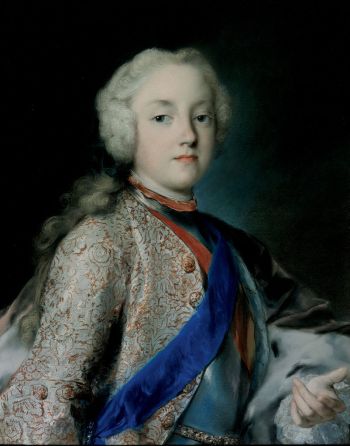
Rosalba Carriera, Crown Prince Friedrich Christian of Saxony, 1740, pastel on paper, 63.5 × 51.5 cm (Dresden, SKD, Gemäldegalerie Alte Meister; photo by Hans Peter Klut/Elke Estel).
This is the first exhibition to be devoted to Elector Friedrich Christian of Saxony (1722—1763), who succeeded King August III in 1763 for just 74 days. Given his brief reign, few are aware of the prince’s profound physical disabilities, akin to cerebral palsy, which prevented him from standing or walking without assistance and made simple tasks like eating and dressing difficult. The marriage of his sister Maria Amalia to the King of Naples in May 1738 inspired their parents to send the fifteen-year-old heir to the throne on an impromptu journey to Italy, for life-saving medical treatments. This exceptional two-year adventure was amply documented, allowing us to precisely reconstruct the prince’s route and daily experiences as he travelled from Dresden to Naples, Rome, Florence, Milan, and Venice. Like the able-bodied Grand Tourists he met along the way, he also travelled incognito with an entourage, enjoyed celebrity status, and collected art, relics, books, and ephemera for shipment home. Some of the Italian gifts and souvenirs have been identified in museums, archives and libraries and are presented in the intimate setting of the Sponselraum.
August the Strong and August III both made Grand Tours as teenagers, with the court of Louis XIV and carnival in Venice as their primary targets. Friedrich Christian, by contrast, went to Italy as a medical tourist. Although he would never be cured, the mineral baths and holistic treatments administered abroad did soothe and strengthen the prince’s atrophied limbs, allowing him to regain the use of his left hand, bear his own bodyweight and walk short distances with two canes. Of necessity, however, he was mostly carried around Italy in a porte-chaise (sedan chair), even ascending the Leaning Tower of Pisa in this manner. Since there was no precedent for portraying a disabled heir to the throne, the Crown Prince was chronicled and painted conventionally, as able-bodied, and even thought of himself as such. A glimpse of his handicap is shown in the view of his arrival at Venice in 1739, but it was not until 1761, while in exile in Munich during the Seven Years’ War, that he was portrayed in a wheelchair. With his premature death from smallpox at the age of 41, however, the Elector’s great promise went unfulfilled.
Maureen Cassidy-Geiger, Die Grande Kur, 1738–1740: Prinz Friedrich Christian Von Sachsen auf der Suche Nach Heilung und Kultur in Italien / The Grand Cure, 1738–1740: A Disabled Saxon Prince and His Tour of Italy (Dresden: Staatliche Kunstsammlungen Dresden, 2018), 52 pages, ISBN: 978-3000596810 (German and English text).
Note (added 26 June 2018) — The posting was updated to include details for the booklet accompanying the exhibition.
Conference | Collage, Montage, Assemblage, 1700–Present
From the conference website:
Collage, Montage, Assemblage: Collected and Composite Forms, 1700–Present
University of Edinburgh, 17–19 April 2018
Organized by Cole Collins and Freya Gowrley
T U E S D A Y , 1 7 A P R I L 2 0 1 8
14.00 Registration and Coffee
14.15 Exhibiting Collage
In Conversation: FREYA GOWRLEY and PATRICK ELLIOT
15.00 Collage in the Museum and Archive
ALLAN MADDEN (The University of Edinburgh), Piecing Together the Narrative: Une semaine de bonté in the library, the archive and the gallery
BRIDGET MOYNIHAN (The University of Edinburgh), Scrappy Contexts: Archival and Digital Interventions on the Edwin Morgan Scrapbooks
15.45 Collage and Subjecthood
TOM DAY (The University of Edinburgh), Jeff Keen, Pop Film Collagist
COLE COLLINS (The University of Edinburgh), Collage as Feminist Strategy and Methodology
17.00 Wine Reception
W E D N E S D A Y , 1 8 A P R I L 2 0 1 8
9.00 Registration and Coffee
9.35 Keynote
LUCY PELTZ (National Portrait Gallery, London), Facing the Text: An Introduction to Extra- Illustration in Britain from the Eighteenth to the Twentieth Century
10.40 Panel 1 | Publications
KAREN DI FRANCO (University of Reading and Tate Britain), The alchemical, the instruction, and the cut up: The performance of collage in the writing of Ithell Colquhoun, Carolee Scheemann, and Kathy Acker
HANNAH VINTER (Kings College London), Historical engagement as textual collage in Ursula Krechel’s Landgericht
ALISON HORGAN (University of Sheffield), ‘Gaudy colours’ and ‘disfigur’d shapes’: The patchwork and Thomas Percy’s Reliques of Ancient English Poetry (1765)
TOBIAS VOGT (Freie Universität, Berlin), Collage avant la lettre: Printed materials in drawings before 1900
10.40 Panel 2 | Bodies
LISA LEE (Emory University), Primal Gestures: Thomas Hirschhorn’s Ur-Collages
GRÁINNE RICE (The University of Edinburgh), ‘I can’t see the joins’: Collage and cut-up bodies in the work of Steven Campbell (1953–2007)
KATHERINE ISELIN (University of Missouri- Columbia), Erotic Aesthetics in Collage Inspired by Giulio Romano’s I Modi
KATIE ANANIA (Harvard University and Hunter College New York), Wheat Paste and Poor Taste: Carolee Schneemann’s Paper Performances, 1966–68
12.25 Lunch
13.25 Panel 3 | Materialities
CATRIONA MACLEOD (University of Pennsylvania), Writing with Scissors: Romantic Collage Poetics
LUCIE WHITMORE (University of Glasgow), Chic rag-and-tatter modes’: Remnant Fashions 1914–18
STEPHANIE KOSCAK (Wake Forest University), A Royal Tête-a-Tête: Decorating (and Decorating with) Engraved Pictures of Kings and Queens in Eighteenth-Century England
EKATERINA KOCHETKOVA (Lomonosov Moscow State University), Assemblage as Method of Garden-Making: The Case of Ian Hamilton Finlay
13.25 Panel 4 | Intimacies, Collaborations, and Emotions
BETHAN BIDE (Middlesex University), Stitching yourself back together: Finding memory, emotion, and creativity in the composite garments made under the ‘Make Do and Mend’ scheme in WW2 Britain
ROGER ROTHMAN (Bucknell University), Topographie Anecdotée du Hasard: A Multi-Authored Literary Collage
MAYA WASSELL SMITH (Cardiff University and National Maritime Museum), Cigarette Cards and the Sentimental: Sailor Collage in the Long Nineteenth Century
MADELEINE PELLING (University of York), ‘Your Affectionate Queen’: Queen Charlotte, Mary Delany, and the Art of Friendship
15.05 Coffee
15.35 Panel 5 | Legacies and Influences
FREYA GOWRLEY (Institute of Advanced Studies, Edinburgh), Reflective and Reflexive Forms: Intimacy and Medium Specificity in British and American Sentimental Albums, 1780–1850
IRENA KOSSOWSKA (Copernicus University in Torun and Polish Academy of Sciences in Warsaw), Modernist Synethesia and a Dialog with the Old Masters: Polish Photo-Collage and Photomontage of the 1930s
TALIA KWARTLER (The Museum of Modern Art, New York), Suzanne Duchamp’s Dada Collages, 1916–21
REBECA ACOSTA (Humboldt Universität, Berlin), ‘Composite Johnson’: Renderings of Samuel Johnson by John Hawkins and Vladimir Nabokov
15.35 Panel 6 | Technologies and Digitality
LUCY WHITEHEAD (Cardiff University), ‘Inlaid’ and ‘Intercalated’: Victorian Biography as Collage Form
BROOKE LEETON (University of Georgia), Meaning and/in Digital Collage
CRAIG BUCKLEY (Yale University), An Architecture of Clippings: Reyner Banham and the Redefinition of Collage
CAITLIN WOOLSEY (Yale University), Imaging Orality in the Sound and Visual Collages of Henri Chopin
17.30 Performance
FLORIAN KAPLICK, Kurt / ANNA \ Paul
A recital collage using texts from Kurt Schwitters and Paul Auster
18.30 Wine Reception
T H U R S D A Y , 1 9 A P R I L 2 0 1 8
9.00 Registration and Coffee
9.15 Panel 7 | Identities
RACHEL MIDDLEMAN (California State University, Chico), Collage as a Feminist Strategy in the Work of Anita Steckel
SUSAN LAXTON (University of California, Riverside), Psicofotógrafa: Grete Stern and the Administration of the Unconscious
KATE SCHNEIDER (University of Cambridge), A Short History of Postwar Reconstruction via Humphrey Jennings’s Swiss Roll Collages
BEATRIZ MANTEIGAS (University of Lisbon), Collage on the Life and Work of R.B. Kitaj
9.15 Panel 8 | Intermedialities
PATRICIA ZAKRESKI (University of Exeter), A Patchwork Novel: Tessellation and Women’s Writing in the 1870s
FLORIAN KAPLICK (Musician and Speech Performance Artist), Composing collages with texts and collaging compositions with music
CHRISTINA MICHELON (University of Minnesota, Twin Cities), Printcraft: Reclaiming and Renaming Early Collage Practices
DAVID NELSON (University of Pennsylvania), City of Paper: The Materiality of Montage in Alfred Döblin’s Berlin Alexanderplatz
10.55 Coffee
11.25 Panel 9 | Ethnographies and Geographies
ORLA FITZPATRICK (National Museum of Ireland), From the medieval to the modern: Decoration, collage, and photography in the album work of Lady Louisa Tenison (1819–1882)
MOLLY DUGGINS (National Art School, Sydney), Crafting the Colonial Environment through Album Assemblage
JOANNA PAWLIK (University of Sussex), Collaging Surrealism in Ted Joans’ The Hipsters (1961)
DEBRA HANSON (Virginia Commonwealth University in Qatar), Interventions: Collage, Black Bodies, and a New History of Modernism
13.10 Lunch
14.15 Panel 10 | Display and Dissemination
COLE COLLINS (The University of Edinburgh), Loss of Texture: Displaying the Collages of Kurt Schwitters
ROCÍO ROBLES TARDÍO (Universidad Complutense de Madrid), Mies van der Rohe: Working with Collage, Thinking about Replicas, 1939–43
KAYLEE ALEXANDER (Duke University), Cut, Copy, Paste: A Truthful Picture of the Paris Catacombs
14.15 Panel 11 | Historiographies
JESSICA BARNESS and STEVEN MCCARTHY (Kent State University and University of Minnesota, Twin Cities), Coding and Decoding: Collage as Communication Design Scholarship
ZOE KINSLEY (Liverpool Hope University), Coherence and Customisation in the Scrapbooks of Dorothy Richardson (1748–1819)
MATTHEW BOWMAN (University of Suffolk), Collage as Model
SAMUEL BIBBY (Art History), ‘How to present your ideas effectively and make them stick’: Historiography as Collage
16.00 Keynote
ADRIAN SUDHALTER (Art Historian and Curator, New York), The Museum of Modern Art’s 1948 Collage Exhibition
17.00 Closing Remarks
Reading and Conference | Walpole’s ‘The Mysterious Mother’
Presented by the Lewis Walpole Library and the YCBA:
Horace Walpole’s The Mysterious Mother: A Staged Reading
Yale Center for British Art, New Haven, 2 May 2018
 As part of the year-long celebrations of the tercentenary of Horace Walpole’s birth, the Lewis Walpole Library and the Yale Center for British Art are collaborating to present a staged reading of The Mysterious Mother—abridged by David Worrall (Emeritus Professor of English at Nottingham Trent University) and directed by Misty G. Anderson (ReLindsay Young Professor of English, University of Tennessee). Completed just a few years after Walpole’s celebrated gothic novel The Castle of Otranto (1764), this under-appreciated tale of incest and intrigue was initially circulated only among the author’s friends. Walpole never permitted it to be performed during his lifetime except as a private theatrical. Following the reading there will be a talk-back session moderated by Catherine Sheehy (Professor of the Practice of Dramaturgy and Dramatic Criticism, Yale University). This event is free and open to the public. Wednesday, 2 May 2018, 5:30pm, Yale Center for British Art.
◊ ◊ ◊ ◊ ◊
Horace Walpole’s The Mysterious Mother: A Mini-Conference
Yale Center for British Art, New Haven, 3 May 2018
Organized by Jill Campbell and Cynthia Roman

Diana Beauclerk (1724–1808), The Mysterious Mother, Act 3d, Scene 3, 1776 (The Lewis Walpole Library, Yale University).
10:00 Reading The Mysterious Mother
Chair: Jill Campbell, Professor of English, Yale University
• Nicole Garret, Lecturer, Department of English, SUNY Stony Brook
• Cheryl Nixon, Associate Provost, Associate Professor, Department of English, University of Massachusetts, Boston
•Matthew Reeve, Associate Professor Art History, Queen’s University
• Dale Townshend, Professor of Gothic Literature, Manchester Metropolitan University
• Nicole Wright, Assistant Professor, University of Colorado, Boulder
12:00 Lunch
1:15 Breakout session with Cynthia Roman, Curator of Prints, Drawings, and Paintings, The Lewis Walpole Library, to view Diana Beauclerk’s drawings of The Mysterious Mother. Attendance is limited, and advance registration is required.
2:00 Staging The Mysterious Mother
Chair: Misty Anderson, Lindsay Young Professor of English, University of Tennessee
• Al Coppola, Associate Professor of English, John Jay College, CUNY
• Marcie Frank, Professor of English, Concordia University
• Judith Hawley, Professor of English, Royal Holloway, University of London
• Jean Marsden, Professor of English, University of Connecticut
• David Worrall, Professor Emeritus, Nottingham Trent University
New Book | Poetry and the Idea of Progress, 1760–1790
From Anthem Press:
John Regan, Poetry and the Idea of Progress, 1760–1790 (London: Anthem Press, 2018), 222 pages, ISBN 9781783087723, £70 / $115.
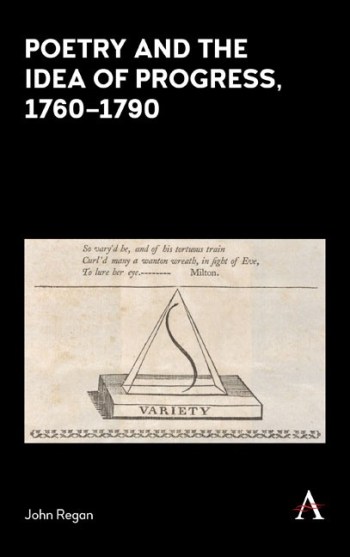 Poetry and the Idea of Progress, 1760–1790 explores under-examined relationships between poetry and historiography in the eighteenth century, deepening our understanding of the relationship between poetry and ideas of progress with sustained attention to aesthetic, historical, antiquarian, and prosodic texts from the period. Its central contention is that the historians and theorists of the time did not merely instrumentalize verse in the construction of narratives of human progress, but that the aesthetics of verse had a kind of agency—it determined the character of—historical knowledge of the period. With numerous examples from poems and writing on poetics, Poetry and the Idea of Progress, 1760–1790 shows how the poetic line became a site at which one could make assertions about human development even as one experienced the expressive effects of metred language.
John Regan is a research fellow in English literature at the University of Cambridge. His research interests centre on the cultural dialogue between poetics and historical writing in the long eighteenth century.
C O N T E N T S
List of Figures
Acknowledgements
Introduction
1 Progress by Prescription
2 Thomas Sheridan and the Divine Harmony of Progress
3 ‘There Is a Natural Propensity in the Human Mind to Apply Number and Measure to Every Thing We Hear’: Monboddo, Steele and Prosody as Rhythm
4 ‘[C]ut into, distorted, twisted’: Thomas Percy, Editing and the Idea of Progress
5 ‘Manners’ and ‘Marked Prosody’: Hugh Blair and Henry Home, Lord Kames
Afterword: Rude Manners, ‘Stately’ Measures: Byron and the Idea of Progress in the New Century
Conclusion
Notes
Bibliography
Index
Exhibition | Chippendale’s Director
Press release (9 February 2018) from The Met:
Chippendale’s Director: The Designs and Legacy of a Furniture Maker
The Metropolitan Museum of Art, New York, 14 May 2018 — 9 January 2019
Curated by Femke Speelberg and Alyce Englund
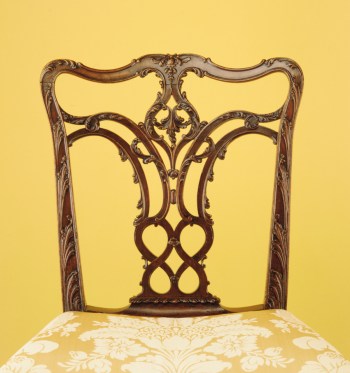
Attributed to Benjamin Randolph and possibly carved by Hercules Courtenay, side chair (detail), ca. 1769, made in Philadelphia, mahogany, northern white cedar, modern upholstery (New York: The Metropolitan Museum of Art, 1974.325).
Thomas Chippendale (1718–1779) has been a household name in the furniture world since the mid-18th century. He is remembered today for the furniture produced by his successful London workshop as well as his influential book of furniture designs, The Gentleman and Cabinet-Maker’s Director. To celebrate the 300th anniversary of Chippendale’s birth, the exhibition Chippendale’s Director: The Designs and Legacy of a Furniture Maker will open at The Metropolitan Museum of Art on May 14 and look closely at how the unprecedented publication cemented Chippendale’s name as England’s most famous cabinetmaker and also endured to inspire furniture design up to the present day. Built around works in The Met collection, the exhibition will combine the original preparatory drawings from the Chippendale workshop with a selection of British and American furniture inspired by Chippendale’s designs and aesthetic. The legacy of Chippendale will be presented through representations in portrait painting and revival pieces from the 19th and 20th centuries. The Chippendale-inspired chair, designed in 1984 by the architects Robert Venturi and Denise Scott Brown, will be one of the highlights.
Born and trained in the north of England, Thomas Chippendale had moved to London to start his own workshop by 1748. One of many cabinetmakers in the thriving metropolis, he devised an innovative business plan to market his furniture by creating a book of design, issued in 1754 as The Gentleman and Cabinet Maker’s Director. The book had a dual function: to show prospective clients what he could design and make, and to inform the tastes of both ‘gentlemen’ and his colleagues. With 160 designs for seating, beds, tables, cabinets, shelves, and other furnishings in a wide variety of styles, from Rococo and Chinoiserie to Gothic-Revival, the Director was the most extensive publication of its kind. Copies of the book quickly appeared beyond the British market in the American Colonies, where those in the aspiring mercantile class sought to fill their homes with furnishings in the latest fashion.
The exhibition will be arranged thematically in two adjoining rooms (galleries 751 and 752, on the second floor of The American Wing). The exhibition will open with the first edition of Chippendale’s Director paired with three chairs signifying the geographic and continuing reach of his work—one made in Chippendale’s London workshop; one made around 1769 for General Cadwalader’s posh townhouse by Philadelphia craftsmen; and one designed by Venturi and Brown as a modern reflection on the Chippendale chair. The gallery will also feature printed works illustrating the context in which Chippendale conceived his book, including popular publications by furniture designers on the European continent, such as Daniel Marot and François Cuvillies, and the few English publications that preceded Chippendale’s work. Alongside the Director, publications of the works of Inigo Jones and Sir Christopher Wren will denote how England embraced print culture as a way to celebrate its own artistic achievements, and how artists and craftsmen used the medium as a promotional tool. The works in this gallery will stand against the backdrop of the permanently installed Rococo-style architectural woodwork and wallpaper from the Great Hall of the Van Rensselaer House, allowing the visitor a direct window into the early impact of European print culture in America.
For the unique occasion of this exhibition, the second gallery will feature a selection of original drawings dismounted temporarily from The Met’s two Chippendale albums for the first time since their acquisition. Approximately 20 of a total of 200 drawings will be on view, and images of the complete collection of The Met’s Chippendale drawings will be digitally projected in the gallery. The drawings provide an intimate behind-the-scenes view of the creation of the Director and highlight aspects of the drawing techniques, variety in forms and decorations, and the practical information Chippendale incorporated into his furniture designs. The drawings will be accompanied by groupings of furniture and paintings that focus on the different styles in which Chippendale worked, new forms of furniture that emerged during his lifetime, and the ways in which Chippendale’s designs were absorbed by furniture makers in various regions and at different moments in time.
The exhibition is organized by Femke Speelberg, Associate Curator, Drawings and Prints, and Alyce Englund, Assistant Curator, The American Wing.
The exhibition will be featured on The Met website and on Facebook and Twitter and the special Chippendale300 website. Blog posts for the “Now at The Met” section of the website will be written by the exhibition’s curators. An issue of The Metropolitan Museum of Art Bulletin on Chippendale’s Director, by Morrison H. Heckscher, Curator Emeritus of The American Wing, will be published in concert with the exhibition. The Met’s quarterly Bulletin program is supported in part by the Lila Acheson Wallace Fund for The Metropolitan Museum of Art, established by the cofounder of Reader’s Digest. This Bulletin made possible by the William Cullen Bryant Fellows of The Metropolitan Museum of Art.
Exhibition | Visitors to Versailles

An earlier posting included information for the exhibition at Versailles, but here’s information for the exhibition at The Met, including details for the English edition catalogue, distributed by Yale UP:
Visitors to Versailles: From Louis XIV to the French Revolution
Château de Versailles, 24 October 2017 — 25 February 2018
The Metropolitan Museum of Art, New York, 16 April — 29 July 2018
Curated by Bertrand Rondot and Daniëlle Kisluk-Grosheide
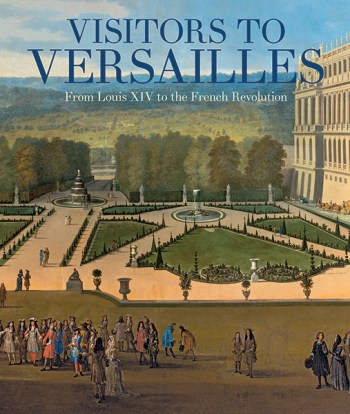 The palace of Versailles and its gardens have attracted travelers ever since it was transformed under the direction of the Sun King, Louis XIV, from a simple hunting lodge into one of the most magnificent and public courts of Europe. French and foreign travelers, including royalty, ambassadors, artists, musicians, writers, scientists, grand tourists, and day-trippers, all flocked to the royal palace surrounded by its extensive formal gardens. Versailles was always a truly international setting, and not only drew visitors from Europe and America, but also hosted dignitaries from as far away as Thailand, India, and Tunisia. Their official receptions at Versailles and gift exchanges with the king were among the attractions widely recorded in tourists’ diaries and court gazettes.
Bringing together works from The Met, the Château de Versailles, and over 50 lenders, this exhibition will highlight the experiences of travelers from 1682, when Louis XIV moved his court to Versailles, to 1789, when the royal family was forced to leave the palace and return to Paris. Through paintings, portraits, furniture, tapestries, carpets, costumes, porcelain, sculpture, arms and armor, and guidebooks, the exhibition will illustrate what visitors encountered at court, what kind of welcome and access to the palace they received, and, most importantly, what impressions, gifts, and souvenirs they took home with them.
Daniëlle O. Kisluk-Grosheide and Bertrand Rondot, eds., Visitors to Versailles: From Louis XIV to the French Revolution (New York: The Metropolitan Museum of Art, 2018), 392 pages, ISBN: 9781588396228, $65.
New Book | Picturing War in France
From Yale UP:
Katie Hornstein, Picturing War in France, 1792–1856 (New Haven: Yale University Press, 2018), 208 pages, ISBN: 9780300228267, $70.
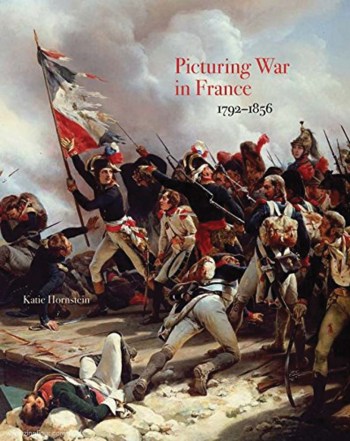 From the walls of the Salon to the pages of weekly newspapers, war imagery was immensely popular in postrevolutionary France. This fascinating book studies representations of contemporary conflict in the first half of the 19th century and explores how these pictures provided citizens with an imaginative stake in wars being waged in their name. As she traces the evolution of images of war from a visual form that had previously been intended for mostly elite audiences to one that was enjoyed by a much broader public over the course of the 19th century, Katie Hornstein carefully considers the influence of emergent technologies and popular media, such as lithography, photography, and panoramas, on both artistic style and public taste. With close readings and handsome reproductions in various media, from monumental battle paintings to popular prints, Picturing War in France, 1792–1856 draws on contemporary art criticism, war reporting, and the burgeoning illustrated press to reveal the crucial role such images played in shaping modern understandings of conflict.
Katie Hornstein is assistant professor of art history at Dartmouth College.
Exhibition | France, Between Enlightenment and Gallantry
From the Städtischen Museen Freiburg:
La France, Zwischen Aufklärung und Galanterie: Meisterwerke der Druckgraphik
La France au siècle des Lumières et de la galanterie: Chefs-d’œuvre de la gravure
La France, Between Enlightenment and Gallantry: Masterworks of Graphic Reproduction
Augustinermuseum, Freiburg, 24 February — 3 June 2018
 Das französische Bürgertum des 18. Jahrhunderts liebte gute Unterhaltung: galant und charmant, mit Witz und scharfem Verstand. Reich bebilderte Bücher erfreuten sich größter Beliebtheit. Die Verlage druckten Romane, Gedichte und Theaterstücke mit Illustrationen und gaben Graphikserien heraus, gestochen nach Gemälden des Rokoko.
Angespornt durch die große Nachfrage schufen die Künstler der Zeit wahre druckgraphische Meisterwerke. Das Haus der Graphischen Sammlung zeigt Zeichnungen, Graphiken und illustrierte Ausgaben galanter Literatur, satirischer Romane und moralischer Fabeln aus der Schenkung des Freiburger Sammlers Josef Lienhart, darunter Radierungen von François Boucher und Bilderfindungen Antoine Watteaus.
Hélène Iehl and Felix Reusse, eds., La France—Zwischen Aufklärung und Galanterie: Meisterwerke der Druckgraphik aus der Zeit Watteaus (Petersberg: Michael Imhof Verlag, 2018), 192 pages, ISBN: 9783731906339, $53. [French and German Text]
Portrait by Nicolas de Largillierre Returns to Hillwood
Press release via Art Daily:
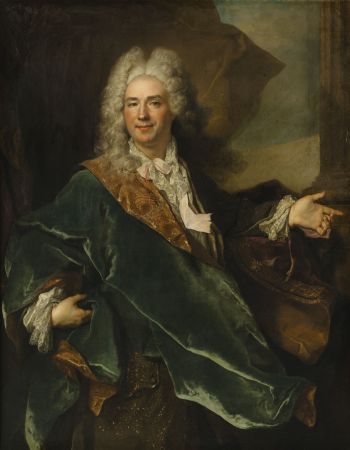
Nicolas de Largillierre, Portrait of Monsieur de Puysegur, likely Jacques-François de Chastenet, Marquis de Puysegur, oil on canvas, 136 × 105.5 cm (Washington, D.C.: Hillwood Estate, Museum & Gardens). The painting was purchased at Sotheby’s in Paris in December 2017 for 345,000€, surpassing its high estimate of 80,000€ (Lot 609 of sale PF1730).
Hillwood Estate, Museum & Gardens in Washington, D.C. announces the acquisition of the painting Portrait of Monsieur de Puysegur, likely Jacques-François de Chastenet, Marquis de Puysegur, by Nicolas de Largillierre (1656–1746) from Sotheby’s sale of the collection of Eleanor Post Close (1909–2006), Marjorie Merriweather Post’s daughter, and her son Antal Post de Bekessy (1943–2015) in December 2017. The 54 × 42 inch oil on canvas painting, lot 609 of the auction, is a three-quarter length portrait of Monsieur de Puysegur, likely Jacques-François de Chastenet, Marquis de Puysegur.
“Like her mother, Eleanor Post Close was a discerning collector of remarkable objects,” said Hillwood executive director Kate Markert. “The sale of her collection, and this work in particular, presented a rare opportunity for Hillwood to acquire an excellent example of French portraiture, particularly because of its alignment with Hillwood’s collection and particularly because it was once in Marjorie Post’s collection.” Marjorie Merriweather Post was the founder of Hillwood, who left her Washington, D.C. home as a museum to benefit future generations.
Born in France, Largillierre was trained in Peter Lely’s atelier in England and became a renowned portraitist. Upon his return to Paris in 1679, he served as First Painter to King Louis XIV and depicted many royals and members of the European and French aristocracy, among them the Marquis de Puysegur. The sitter, framed by a classical column, is depicted wearing abundant drapery of shimmering fabrics while elegantly gesturing to his left, a testament to Largillierre’s technique and virtuosity.
First documented in France in 1902, the portrait was acquired at auction by Marjorie Post-Hutton in New York in 1922. In 1937, the portrait was recorded in the draft catalogue of Post’s art collection. It was first displayed in Post’s library in New York, then in the entrance hall at Tregaron, her first home in Washington, D.C., and finally in the second floor hall at Hillwood.
In 1964, Post sent the portrait to her daughter, Eleanor Close Barzin, in Paris, in exchange for the return of Nattier’s Portrait of the Duchess of Parma (acc. no. 51.4), which Marjorie had presented to Eleanor as a wedding present. In June 1984, Hillwood’s curator, Katrina V. H. Taylor, stated about the portrait of Monsieur de Puysegur that “the return of this painting would add to the interest of the collection at Hillwood.”
Thanks to the persistence and generosity of Ellen Charles, Post’s grand-daughter and president emerita at Hillwood, who attended the sale in person and memorably surpassed Hillwood’s maximum bid, the painting will return to Hillwood for good. “It was no surprise that this important portrait exceeded the estimated auction price,” said Charles. “I am thrilled and honored that I could be there in person and contribute to Hillwood’s important acquisition. I just felt that I had to bring it home.”
The painting will go through moderate conservation work, after which it will be displayed in the entry hall at Hillwood.










 Enfilade
leave a comment