Carlo Orsi-Trinity Fine Art at TEFAF 2019
From the press release:
Carlo Orsi-Trinity Fine Art at TEFAF
Maastricht, 16–24 March 2019
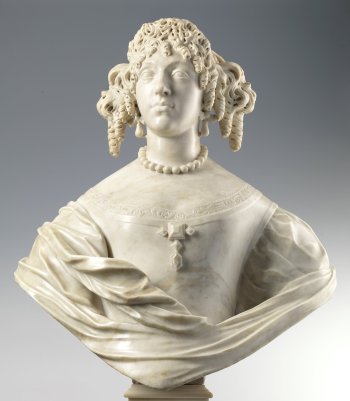
Giovanni Battista Foggini, Portrait of Marguerite Louise d’Orléans, 1687, marble, 77 cm.
This 1687 marble portrait bust portrays Marguerite Louise of Orléans, wife of Cosimo III de’ Medici, the enfant terrible of the Medici dynasty. A free-spirited woman, Marguerite Louise, although she bore Cosimo three heirs, never submitted emotionally to the marriage, came to despise her husband, his family and the Court in Florence, and made Cosimo’s life miserable. Eventually she obtained a separation, returned to France, and lived as she pleased, bringing even her cousin King Louis XIV to despair at her outrageous behaviour.
The marble bust is offered by Carlo Orsi-Trinity Fine Art, at TEFAF Maastricht with several fresh discoveries: previously unpublished documents clarifying that it was commissioned by the Medici; that it is a fully autograph work by Giovanni Battista Foggini (1652–1725), a contention borne out by specific payments made to the sculptor; and that it was carved at an earlier date than formerly suggested.
It is a one of a series of eight masterful busts that celebrates the family of Ferdinando II of Florence, including his Cardinal brothers and his son Cosimo and the future Grand Duchess Marguerite. This is the last bust from the group to remain on the market, as all of the others are now with European and American public collections, including the Louvre, the Metropolitan Museum of Art, and the Victoria & Albert Museum.
Regarding its commission and original location, the bust is mentioned along with the other pieces in the group in inventories of the Villa di Lappeggi, the country residence of Cardinal Francesco Maria de’ Medici, brother to Ferdinand II, immediately after his death in 1711. Research by Carlo Orsi-Trinity Fine Art has found the record of payments to the artist Foggini, showing that the busts were executed between August 1681 and 15 December 1687. The final bust to be delivered was that of Marguerite, who by then had been living back in France for 12 years. Its likeness was probably taken by Foggini from existing images of the Grand Duchess already in the family collections; in fact it is highly likely to be a carved version of a now lost portrait of Marguerite Louise by court portraitist Justus Sustermans, known to us thanks to an engraving by Adriaen Haelwegh.
The group dates to a time when Foggini was heavy influenced by Bernini, the artist previously believed to be the author of these pieces. Among the notable owners of the present bust is the famous 19th-century collector and dealer Stefano Bardini, whose clients included Isabella Gardner Stewart and John Pierpont Morgan. Most recently the bust became the prized possession of Alessandro Contini Bonaccossi, whose collection is now a public museum in Florence. The bust will be offered at TEFAF Maastricht by Carlo Orsi-Trinity Fine Art for an asking price in the region of €3,000,000.
Note (added 23 March 2019) — A second press release (available via Art Daily) notes the sale of the bust: “Carlo Orsi confirmed the sale to a new private European client for a seven-figure sum after it received substantial interest from collectors and museums world-wide.”
◊ ◊ ◊ ◊ ◊
From TEFAF:
TEFAF Maastricht to Host Highlights from Staatliche Kunstsammlungen Dresden ahead of Museum Openings Later This Year
TEFAF will host 23 highlights from both the Paraderäume (State Apartments) of Dresden’s Residenzschloss (Royal Palace) and the Semperbau (Semper Building), home to the Gemäldegalerie (Old Masters Picture Gallery) and Skulpturensammlung (Sculpture Collection) all of which form part of the Staatliche Kunstsammlungen Dresden (Dresden State Art Collections), in the loan exhibition hosted within TEFAF Paper at TEFAF Maastricht 2019. The exhibition will be a prelude to both the opening of the Paraderäume in September 2019 and the reopening of the Semperbau in December 2019 . . .
More information is available here»
Exhibition | Panorama: London’s Lost View
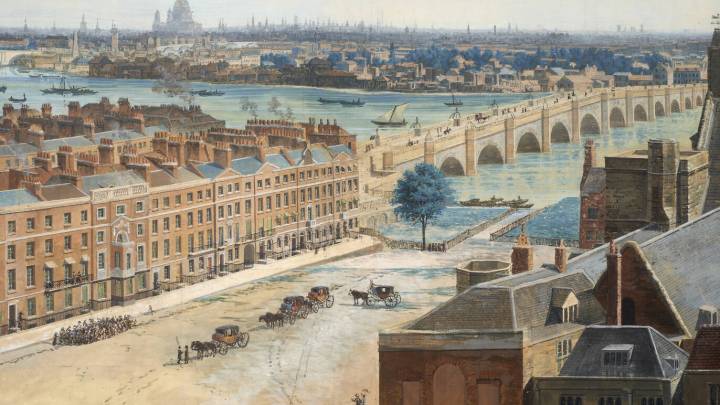
Pierre Prévost, A Panoramic View of London from the Tower of St. Margaret’s Church, Westminster, detail, ca. 1815
(Museum of London)
◊ ◊ ◊ ◊ ◊
From Time Out London:
Panorama: London’s Lost View
Museum of London, Smithfield, 15 March — 30 September 2019
In 1815, French artist Pierre Prévost climbed the tower of St Margaret’s Church in Westminster and started sketching. His specialty was panoramas—epically long landscape paintings, displayed in a rotunda to show a 360-degree view—and this time he was painting London. Prevost’s 100-foot panorama of the capital was exhibited in Paris, and then lost. But the 20-foot painting he made as a dry run survived. It was bought last year by the Museum of London for £250,000 and is on public display from March to September 2019. Prévost’s painting will be mounted flat on the floor, letting visitors walk its length to check out the skyline of Regency London. You’ll see the old Palace of Westminster (destroyed in a fire 19 years later), the original Westminster Bridge, St Paul’s, horse-drawn carriages in Parliament Square, and even cows grazing in St James’s Park.
The catalogue entry from the Sotheby’s Sale (4 July 2018) is available here»
The press release for the acquisition (11 July 2018) is available here»
The press release for the exhibition is available here»
Exhibition | Slavery, Culture, and Collecting
From the Museum of London:
Slavery, Culture, and Collecting
Museum of London Docklands, 15 September 2018 — 15 September 2019
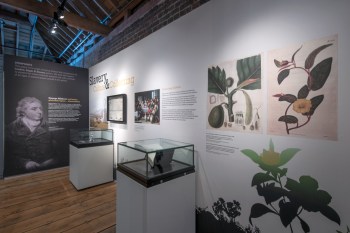 The latest display in the London, Sugar and Slavery gallery at the Museum of London Docklands highlights the connection to slavery of some of Britain’s oldest cultural organisations. Slavery, Culture, and Collecting follows slave owner and art collector George Hibbert (1757–1837), a prominent member of a large subsection of British society which derived its wealth directly from the slave economy. These figures were often active philanthropists, and are commemorated in memorials for their associations with charitable causes, while their connections to slavery are invisible even today. Hibbert was instrumental in building the West India Docks which now house the Museum of London Docklands. This connection positions the museum as an important place to think about the relationship between slavery and cultural heritage.
The wealth generated by slavery was used to create cultural institutions such as museums, universities, art galleries and charities. Advocates of slavery would then use culture in their arguments for the continuing use of enslaved labour, on the grounds that Africans needed the ‘civilising influence’ of Europe. The display contains a short film, as well as objects from the collection to encourage further debate around this challenging issue.
Slavery, Culture, and Collecting is delivered with the support of the Antislavery Usable Past project at the University of Nottingham.
More information about the display is available here»
Lecture | Charles Peterson on Africana Identity in Curatorial Spaces
From the Bard Graduate Center:
Charles F. Peterson, The Colored Museum: Notes on Africana Identity, Power, and Culture in Curatorial Spaces
Bard Graduate Center, New York, 9 April 2019
Charles F. Peterson will present at the Museum Conversations Seminar on Tuesday, April 9, at 6 pm. His talk is entitled “The Colored Museum: Notes on Africana Identity, Power, and Culture in Curatorial Spaces.” Peterson will examine the use of the museum space in the 2018 film Black Panther (Dir. Ryan Coogler), the 2018 documentary on author Toni Morrison’s 2006 curation in The Louvre, The Foreigner’s Home (Dirs. Rian Brown, Jonathan Demme, and Geoff Pingree), and that same year’s music video release by Beyoncé and Jay-Z, “Apeshit.” These performances will be read as (African) Diasporic and intertextual interventions in hegemonic curatorial spaces, revealing the seen and unseen, hidden and obvious messages of identity, power, and culture therein.
Charles F. Peterson, a native of Gary, Indiana, earned a BA in Philosophy from Morehouse College (1992). He earned his MA and PhD in Philosophy, Interpretation and Culture from Binghamton University (1995, 2000). He has taught at Florida International University, Temple University, and The College of Wooster, and is presently Associate Professor of Africana Studies at Oberlin College. He is a co-editor of De-Colonizing the Academy: African Diaspora Studies (African World Press, 2003), and author of DuBois, Fanon, Cabral: The Margins of Elite Anti-Colonial Leadership (Lexington Books, 2007). He has published in the fields of Africana Philosophy, Africana Political Theory, and Aesthetics. He teaches courses in Africana Philosophy, Africana American Politics, Black Nationalism, and Marxism.
Conference | Art Institutions and Race in the Atlantic World
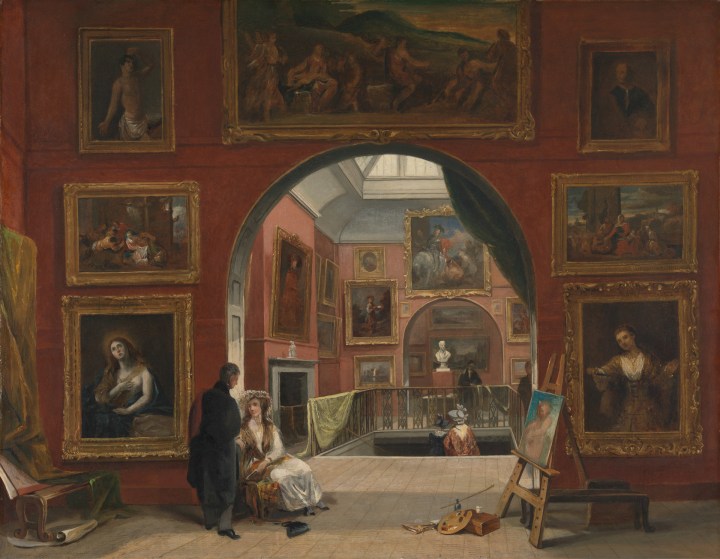
Alfred Joseph Woolmer, Interior of the British Institution (Old Master Exhibition, Summer 1832), 1833, Oil on canvas (New Haven: Yale Center for British Art, Paul Mellon Collection).
◊ ◊ ◊ ◊ ◊
From The Courtauld:
Art Institutions and Race in the Atlantic World, 1750–1850
The Centre for American Art at The Courtauld Institute of Art, London 24–25 May 2019
Organized by Nika Elder and Catherine Roach
The long eighteenth century gave rise to a host of art institutions throughout the Atlantic world, including the Royal Academy of Arts in London, the Academia de San Carlos in Mexico City, and the Academia Imperial de Belas Artes in Rio de Janeiro. Vibrant markets for paintings, sculpture, decorative arts, and prints developed alongside and beyond these established institutions, creating networks of cross-cultural exchange that mirrored the economic ties among Great Britain, Africa, the Caribbean, and the Americas during this period. These cultural developments were inextricably linked with the profits and the cultural logics of colonialism and slavery. Building on important recent work on the visual culture of slavery and abolition, this conference examines the reciprocal relationship between the fine arts and racial ideologies during the apogee and decline of the transatlantic slave trade. The talks will consider sites of artistic production from throughout the Atlantic world, including Brazil, Britain, Jamaica, Massachusetts, and Mexico, and cover a wide variety of topics, including museum collections, artists’ models, the hierarchy of genres, print culture, and exhibitions of images and human beings. In sum, this two-day gathering examines how theories of race informed the production, circulation, collection, and display of art, and how those processes in turn solidified and promulgated understandings of race.
Booking information is available here»
F R I D A Y , 2 4 M A Y 2 0 1 9
10:00 Opening remarks
10:30 Panel 1
• Ray Hernández-Durán (Associate Professor of Early Modern Ibero-American Colonial Arts and Architecture, University of New Mexico), From Novohispanic Castas to Mexican Citizens: Colonialism, Race, and the Academy of San Carlos in Mexico City
• Geoffrey Quilley (Professor of Art History, University of Sussex), India in the City: The Ambiguous Place of East India House and the India Museum
11:45 Coffee
12:00 Panel 2
• Esther Chadwick (Lecturer in Early Modern Art History, The Courtauld Institute of Art), ‘This she looking black, this Molly dressed thing of a man’: Mai and Thayendanegea at the Royal Academy in 1776
• Sadiah Qureshi (Senior Lecturer in Modern History, University of Birmingham), ‘A Peep at the Natives’: Exhibitions, Empire, and the Natural History of Race in Nineteenth-Century Britain
1:15 Lunch
3:00 Event for the Speakers: British Museum Print Study
S A T U R D A Y , 2 5 M A Y 2 0 1 9
10:00 Panel 3
• Nika Elder (Assistant Professor of Art History, American University), Fugitive Pigments: Painting and Race in the British Atlantic
• Cheryl Finley (Associate Professor of Art History, Cornell University), Mapping the Slave Trade
11:15 Coffee
11:30 Panel 4
• Rachel Grace Newman (A.W. Mellon Postdoctoral Fellow, Center for Advanced Study in the Visual Arts), Framing the Plantation: The Plantocracy, Artists, and Image Production of the Early Nineteenth Century
• Sarah Thomas (Lecturer in Museum Studies and History of Art, Birkbeck College, University of London), Slavery, Patronage and the Love of Art: Slave-ownership and the Politics of Collecting in Early Nineteenth-Century Britain
12:45 Lunch
1:45 Panel 5
• Catherine Roach (Associate Professor of Art History, Virginia Commonwealth University), Hybrid Exhibits: Race, Empire, and Genre at the British Institution in 1806
• Nicholas Robbins (Doctoral Candidate, History of Art, Yale University), Constable’s Whiteness
3:00 Coffee
3:15 Panel 6
• Caitlin Beach (Assistant Professor of Art History, Fordham University), Ira Aldridge and the Performed Persona
• Daryle Williams (Associate Professor of History and Associate Dean for Faculty Affairs, College of Arts and Humanities, University of Maryland), The Brazilian Imperial Academy of Fine Arts and the Transatlantic Slave Trade
4:30 Closing Discussion
Call for Papers | Embodying Romanticism

From the conference website:
Embodying Romanticism: Romantic Studies Association of Australia 2019 Conference
University of New South Wales Canberra, 21–23 November 2019
Proposals due by 30 June 2019
Although the body has preoccupied literary scholarship for some time, there has been a renewed attention in Romantic studies to the complex ways in which literature encodes and reproduces our awareness of embodied experience. Challenging views of Romanticism as bounded by visionary and idealist expression, such work reflects a reorientation of criticism around the materiality of Romantic culture, whether configured as part of the age of sensibility or in relation to the era’s natural and social sciences. The Romantic period was, moreover, a time when control of the body emerged as a key political issue in workshops, homes, battlefields and colonies, when bodies were subject to rapidly evolving ideas of gender, class and race, while new bodies of knowledge and corporate political bodies emerged to regulate the affairs of nations and empires. This was a period when bodies were subject to ever more intensive modes of analysis and management, at the same time that bodies imposed their transgressive physicality through new understandings of environments, vitalism, trauma, slavery, disease and taste. Attentive to such developments, Romantic studies in turn dovetails with a broader materialist emphasis that explores how bodies are shaped in relation to affect, biopolitics, speculative realism, post-humanism and eco-criticism. Alain Badiou has recently proposed that our modern, liberal ideology can today only perceive two objects: bodies and language. Aligning itself at the conjuncture of these two terms, this conference invites papers that broadly consider how embodiment was evoked, challenged and understood in Romantic cultural life.
We invite proposals for 20-minute papers on any aspects of Romanticism and embodiment. Proposals may be for individual papers or for panels of 3–4 papers. Papers might consider such topics as:
• Affects and embodied emotions
• Sensibility and materialist epistemologies
• Materials, objects, things
• Life, organicism, vitality
• Theatre, bodies on stage, celebrities
• Spaces, environments, atmospheres
• Architecture, buildings and the body
• Medicine, surgery
• Slavery and transportation
• Biopolitics/biopower and the body politic
• Labour, work, maternity
• Sexuality and gender
• Corpses, death, graves
• Race, empire, colonialism
• Disabled bodies, monsters, illness
• Planetary bodies, heavenly bodies, cosmology
• Texts and paratexts
• Bodies of knowledge
• Animals and humans
• Organisations and institutions
Abstracts of approximately 250 words are due by 30 June 2019. Please send abstracts to the conference convenor, Neil Ramsey, at n.ramsey@unsw.edu.au. Postgraduate bursaries are available. See the conference website for details.
Colonial Williamsburg Acquires Seven Years’ War Portrait
Press release (5 March 2019) from Colonial Williamsburg:

Joseph Wright of Derby, Portrait of Captain Richard Bayly, 1760–61; oil on canvas (Colonial Williamsburg Foundation).
The Colonial Williamsburg Foundation has recently acquired its first portrait by the well-known, eighteenth-century British landscape and portrait painter Joseph Wright of Derby (1734–1797). Equally compelling is its subject matter as it is rare to be able to show the faces of those who were involved in events that led to the American Revolution and especially those who spent time in the Williamsburg area. Captain Richard Bayly (d. 1764), an Irishman who served in America with the 44th Regiment during the French and Indian War, sat for this portrait circa 1760 after his return to Britain, in the uniform he wore in America.
“The faces of early America’s military officers are largely lost to time,” said Ghislain d’Humières, Colonial Williamsburg’s executive director and senior vice president, core operations. “At Colonial Williamsburg, we are proud to be able to include their likenesses within our collections and humanize their stories for our visitors in an accessible, visual manner.”
Acquiring the Bayly portrait within months after the portrait of Major Patrick Campbell (a Scottish officer who served in the British lines at the Siege of Yorktown) came into the Colonial Williamsburg collection presented an exciting opportunity to the curators there. To be able to show the people behind the series of events that led to the Revolution and to better tell the story of the French and Indian War is compelling to further the Foundation’s mission of authentically telling America’s enduring history.
Laura Pass Barry, Juli Grainger curator of paintings, drawings, and sculpture, added, “We have an extraordinary opportunity to visually bookend the two most important events in early American military history—the French and Indian War and the Revolutionary War—with this painting and the Campbell portrait and tell a very full and personal story of the acts that transpired on American soil.”
According to Erik Goldstein, senior curator of mechanical arts and numismatics, Richard Bayly was commissioned a lieutenant in the 35th Regiment in October 1745 and transferred to the 44th Regiment in April 1750. He sailed from Cork with that regiment to America in January 1755 and disembarked at Hampton, Virginia, in late February 1755 where he spent a few weeks between Hampton and Williamsburg, likely preparing his men for war. In the famed ‘Braddock’s Defeat’, fought outside of today’s Pittsburgh on July 9, 1755, Bayly’s regiment suffered severely, with seven officers killed and nine wounded. Bayly and George Washington were among the few unwounded Anglo-American officers who fought in the disastrous event. Bayly was promoted to captain of the 44th Regiment in July 1757 and served in American until late 1760. When he returned to the British Isles, he sat for this portrait by Joseph Wright of Derby. To commemorate his North American service, he chose to wear his silver-laced ‘red coat’ uniform of the 44th Regiment with its dark yellow lapels, cuffs, and waistcoat. A beautiful silver shoulder knot, called an aiguillette, hangs from his right shoulder, and his cocked hat is tucked under his left arm.
The painting was owned by the subject’s sister and inscribed as such on the reverse of the stretcher: “B. Bayly Jan.r Picture of her/Brother Richard Bayly Oct.r 1764.”
While the subject matter and his American service initially attracted the attention of the Colonial Williamsburg curators, the added incentive to acquire the painting was that it was well-documented by a noteworthy and significant painter. The artist’s account book lists a “Capt. Bailey. £6. 6s” among sitters at Derby circa 1760. Despite the misspelling of the subject’s surname, the curators at Colonial Williamsburg believe it is highly likely this is the same person given Bayly’s promotion to the rank of captain in 1757. Bayly held that rank in the 44th Foot when he returned home to Britain. He became major of the 108th regiment about a year later and served with that unit until his death in 1764.
Wright of Derby is best known for a series of works of industrial and scientific subjects. Today he is celebrated as one of the most accomplished British artists of the eighteenth century. This portrait was made relatively early in the artist’s career during a short period of time that he spent in the Midlands, several years after his training in London with the celebrated portraitist Thomas Hudson. Wright of Derby later gained a reputation for his nocturnal works experimenting with unusual lighting effects and also his portrayal of contemporary scientific subjects, canvases of which he exhibited and made available to a wider audience by employing engravers to reproduce.
The portrait was purchased through the generosity of The Friends of Colonial Williamsburg Collection Funds.
Kimbell Acquires Still Life by Anne Vallayer-Coster

Anne Vallayer-Coster, Still Life with Mackerel, 1787, oil on canvas, 20 × 24 inches (Fort Worth: Kimbell Art Museum, Gift of Sid R. Bass in honor of Kay and Ben Fortson).
◊ ◊ ◊ ◊ ◊
Press release (7 March 2019) from the Kimbell:
The Kimbell Art Museum announced today the acquisition of Anne Vallayer-Coster’s 1787 painting Still Life with Mackerel. This striking work is among the most beautiful and innovative by one of the foremost still-life painters of 18th-century France. Vallayer-Coster (1744–1818) was esteemed for the vigor of her compositions, her magical ability to imitate nature, her fluid and varied brushwork and her remarkable skills as a colorist. The painting is a gift from Sid R. Bass in honor of Kay and Ben Fortson, long-time leaders of the Kimbell Art Foundation’s board of directors. Still Life with Mackerel is on view Friday, March 8, in celebration of International Women’s Day, in the Kimbell’s Louis I. Kahn Building. Admission to view the museum’s collection is always free.
“Anne Vallayer-Coster is one of the very few female artists who managed to negotiate the powerful authority of the Royal Academy in Paris and to exhibit their work at the Salon,” commented Eric M. Lee, director of the Kimbell Art Museum. “Her recognition as a leading painter of still life paralleled her contemporary Elizabeth Vigée Le Brun’s fame as a portraitist—both were favorites of Queen Marie-Antoinette. We are thrilled that Vallayer-Coster’s Still Life with Mackerel will join Vigée Le Brun’s Self Portrait as a highlight in the Kimbell’s collection.”
The Kimbell’s painting is undoubtedly one of the most refined pictures produced by the artist. Still lifes of fish were rare in 18th-century France, where images of meat, fruits or flowers were more abundant. Vallayer-Coster’s charming, original composition celebrates the arrival of mackerel in Paris in springtime, when wealthy Parisians enjoyed the freshest specimens of this delectable fish. Arranged on a stone parapet covered by a linen cloth are a silver oil and vinegar cruet stand, a silver verrière (wine glass cooler) filled with crystal stemware, a lemon, a sprig of orange blossoms and a brioche (a rich pastry). The still life whets the viewer’s appetite for a simple but sumptuous feast with accoutrements that evoke an elegant, restrained opulence that marks the end of the century.
Vallayer-Coster’s virtuosity and sophistication as a colorist is evident throughout the work. The round and undulating forms of the composition are tempered by its prevailing cool, silvery tonality. The artist explores how these tones vary according to material and reflections of light—from glass and metal to the mutable skin of the plump fish, dazzlingly rendered with unblended strokes of brilliant vermilion and ocher near the gills, indicating its freshness. The reflections are sensitively observed—a lemon half seen again in the curving silver container takes on an unexpected double shape—and the white napkin or tablecloth likewise partakes in the nuances of light, all suggested with the painter’s delicacy of touch. The damask cloth cleverly mimics the type of linen the artist would have maintained in her own household: the initials V and C are embroidered in tiny red cross-stitch, along with the figure 6, an inventory number for the accounts of the painter’s housekeeper.
Anne Vallayer-Coster
Born in Paris in 1744, Anne Vallayer (later Vallayer-Coster, upon her marriage in 1781) was the daughter of a goldsmith employed by the royal Gobelins Manufactory who later opened a shop near the Louvre and Tuileries Palace. Through her family, Vallayer-Coster came into contact with various eminent persons in both the artistic community and aristocratic circles. Little is known about her training, and it is likely that she was largely self-taught. By the age of 26, she was received and accepted as a member of the Académie Royale de Peinture et de Sculpture (French Royal Academy of Painting and Sculpture). Very few women had previously achieved this distinction.
Although many women in 18th-century France were, in fact, practicing artists, their peremptory exclusion from the official, sanctioned and prestigious institution of the Academy limited their opportunities for training, public exposure and patronage. It also prevented them from engaging in the genres considered to be most valued—above all history painting, which was rooted in the study of the human figure. For reasons of propriety, women were excluded from life-drawing classes after the nude model, and thus effectively shunted to the so-called lesser genres, especially portraiture and still life.
Upon her first exhibition at the Salon, Vallayer-Coster’s superior skills as a still-life painter were resoundingly commended. Her first two finished canvases exhibited—Attributes of Painting, Sculpture, and Architecture and Attributes of Music (1769 and 1770, Musée du Louvre), were highly accomplished works demonstrating her virtuosity in rendering textures and brilliant color and evident homages to the pre-eminent still-life painter Chardin’s similar grand allegories of 1765. Likewise, her Still Life with Mackerel could be compared with the simple kitchen still lifes that Chardin produced in the last years of his career. These intimate paintings contrast with the floral compositions for which Vallayer was renowned.
The roster of patrons that Vallayer-Coster cultivated includes numerous aristocrats at the French court, most notably Queen Marie Antoinette. Her career came to a pause with the outbreak of the French Revolution in 1789, and she took temporary refuge on the outskirts of Paris. Despite her royalist loyalties, Vallayer-Coster maintained her practice. Whereas her circumstances as a woman and a royalist may have limited Vallayer-Coster’s career, her flower pieces and still lifes were still held in high esteem. Her exceptional refinement, range of invention and sophistication as a painter were acclaimed in her own day, as they are progressively acknowledged in our own.
Liebieghaus Acquires Major Collection of Ivory Sculptures

Furienmeister (active around 1600‒1625), Fury on a Charging Horse, 1610; ivory, wood, and bone; 41 cm high (Frankfurt am Main: Liebieghaus Skulpturensammlung, Reiner Winkler Collection).
◊ ◊ ◊ ◊ ◊
From the press release (7 March 2019). . .
White Wedding: The Ivory Collection of Reiner Winkler Now in the Liebieghaus. Forever
Liebieghaus Skulpturensammlung, Frankfurt am Main, from 27 March 2019
Curated by Maraike Bückling
The Liebieghaus Skulpturensammlung is to be enriched by a magnificent addition. The Ernst von Siemens Kunststiftung, the Städelscher Museums-Verein, and the Städel Museum, with the support of the Kulturstiftung der Länder and the Hessische Kulturstiftung, have acquired for the Liebieghaus Skulpturensammlung a collection of over 200 valuable ivory sculptures owned by Reiner Winkler. With this acquisition, made possible through the generous gift of a large part of the collection by Reiner Winkler, the Liebieghaus has achieved the most important expansion of its own holdings in the history of the museum. From 27 March 2019, some 190 artworks will be shown on view in the exhibition White Wedding: The Ivory Collection of Reiner Winkler Now in the Liebieghaus. Forever. The ivory works from the Middle Ages and the Baroque and Rococo periods will be presented in theme-based chapters.
Over the decades, the collector and patron Reiner Winkler (b. 1925) has assembled a legendary private collection of ivory sculptures with a focus on Baroque masterpieces. One outstanding work is, for example, Fury on a Charging Horse (1610). Further masterpieces in the collection are The Fall of the Rebel Angels (first third of the 18th century) from Southern Italy/Sicily, The Three Parcae (ca. 1670) by Joachim Henne (1629‒ca. 1707), and Francis van Bossuit’s (1635–1692) Mercury, Argus and Io (ca. 1670/75?), as well as important sculptural works by Johann Caspar Schenck (ca. 1620‒1674), Balthasar Grießmann (ca. 1620–1706), and Matthias Steinl (1643/44–1727). The unique compilation of works provides the Liebieghaus Skulpturensammlung with the opportunity to expand its own internationally important collection at the very highest level. The acquisition also establishes European ivory art as a central focus of the collection in the Baroque and Rococo department at the Liebieghaus—a focus which, in the future, will be the subject of in-depth academic research and education.
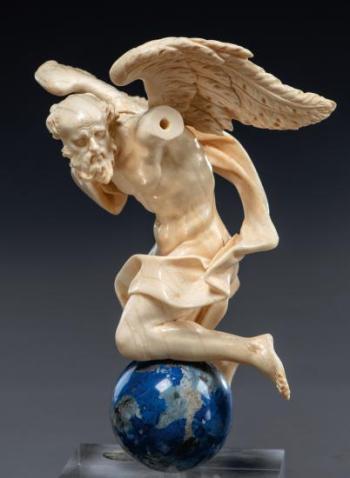
Matthias Steinl, Chronos on the Globe, ca. 1720‒1725, ivory (Frankfurt am Main: Liebieghaus Skulpturensammlung, Reiner Winkler Collection).
“Reiner Winkler’s collection is not only the world’s largest private collection of ivory sculptures; it is also unique for its particular art-historical significance. We are delighted and immensely grateful to Mr. Winkler that his collection will now find a new home in the Liebieghaus Skulpturensammlung—in the very place that Reiner Winkler had long imagined for his artworks. The patron’s assignment of the collection at an extremely generous price is tantamount to the gift of most of the pieces and has made this most important addition to the holdings in the history of the museum possible. With the collection of Reiner Winkler, the Liebieghaus has been granted not only a new area of focus within the collection, but also the opportunity to considerably expand the international significance and profile of the Liebieghaus,” explained Philipp Demandt, Director of the Liebieghaus Skulpturensammlung and the Städel Museum.
Reiner Winkler has been building up his collection continuously since 1962. After several years of collecting sculptures of various materials and periods, he soon decided to concentrate on ivory sculptures of the 17th and 18th centuries, and as well as, to a considerably lesser extent, the early 19th century. Winkler has maintained a close relationship with the Liebieghaus Skulpturensammlung for many years. On a number of occasions in the past he has generously provided the museum with loans for exhibitions.
Winkler commented on the transfer of his collection to the museum: “I am very happy that my collection will find a new and permanent home in the Liebieghaus and will therefore continue to exist as a ‘Gesamtkunstwerk.’ I have been pursuing this idea for many years now, since I am convinced that, in this way, it will be possible to achieve a wonderful symbiosis. The framework is ideal, as regards both the setting and art history. Then there is the perfect manner in which the areas of focus of the collection blend with the academic expertise of the museum, the proximity to our home town of Wiesbaden and, last but not least, the enthusiasm and the wonderful commitment of all those involved. This has strengthened my conviction that every single work will find a superb new home here and that there cannot be a better permanent place for my collection than the Liebieghaus. I am proud and delighted that uniting the existing collection of Baroque and Rococo art in the Liebieghaus with my collection will now transform the museum into a place where internationally important sculptures will be made accessible to the public as in no other location, and I hope that many visitors will experience great pleasure in viewing the exhibits.”
The acquisition was made possible by the Ernst von Siemens Kunststiftung, the Städelscher Museums-Verein, and the Städel Museum with the support of the Kulturstiftung der Länder and the Hessische Kulturstiftung.
The President of the Städelscher Museums-Verein, Sylvia von Metzler, is delighted “that the Städelscher Museums-Verein as an important patron of the acquisitions for the Städel Museum and the Liebieghaus Skulpturensammlung was able to make a significant contribution towards the acquisition of this unique collection.”
“Our support for the acquisition of the exquisite Winkler ivory collection is the largest financial sponsorship which the Ernst von Siemens Kunststiftung has undertaken in recent years, since the foundation covered almost half of the philanthropic purchase price. Our founder was a businessman and patron of the arts, and he would have appreciated the hands-on manner in which the enthusiastic and generous collector and the Liebieghaus have taken advantage of this unique opportunity to bring about a substantial expansion of the collection,” observed Dr. Martin Hoernes, Secretary General of the Ernst von Siemens Kunststiftung.
Eva Claudia Scholtz, Managing Director of the Hessische Kulturstiftung, confirmed: “The Hessische Kulturstiftung is delighted that, through its involvement, one of the most remarkable collections of Baroque sculptures in private ownership can now be made permanently accessible to an audience from Germany and abroad in the Liebieghaus in Frankfurt.”
As a first step, the Kulturstiftung der Länder supported the acquisition of the Fury on a Charging Horse. Additional support for the entire collection is subject to the approval of the next meeting of the Board of Trustees of the Kulturstiftung der Länder. Prof. Dr. Markus Hilgert, Secretary General of the Kulturstiftung der Länder: “It is most fortunate that a museum such as the Liebieghaus is able to acquire a collection as complete as this one and at the same time to come across an collector whose expertise and passion for art is linked to the conviction that such magnificent treasures should remain accessible to the public. It was a similar conviction which, in the past, led to the founding of the Kulturstiftung der Länder, which is why we are delighted to support this acquisition.”
The Collection
The Reiner Winkler Collection concentrates on works from the 17th and 18th centuries, the golden age of the art of ivory carving. It contains a large number of English, French, Italian, German, Spanish, Austrian, Dutch, and Flemish ivory sculptures, as well as two works from India and China. They include statuettes, groups of figures, reliefs, medallions, and a small number of tankards and ceremonial vessels. “With the works from the Reiner Winkler Collection, visitors to the Liebieghaus can appreciate fine and top-quality artworks of European sculpture during the Baroque and Rococo periods that cover a truly remarkable range,” observed Dr. Maraike Bückling, Head of Collections in the Renaissance to Classicism department and curator of the exhibition. The works in the extensive collection provide an impressive overview of the history of Baroque ivory art. In addition, the various features of ivory carving within Europe are shown in an impressive manner. In some areas, the collection of the Liebieghaus and the Reiner Winkler Collection complement each other, as for example in the works by the artists of the Schenck family. The Liebieghaus owns an ivory relief, The Archangel Michael Fighting the Devil (1683) by Christoph Daniel Schenck (1633–1691). The Reiner Winkler Collection boasts several outstanding works by this family of artists, including an exquisite Allegory of Summer (ca. 1666), created by an older relative of Christoph Daniel, Johann Caspar Schenck (ca. 1620–1674). While the Liebieghaus possesses a small ivory relief identified as belonging to the circle of the Netherlandish artist Gérard van Opstal (1594/97–1668), the Reiner Winkler Collection now adds two further works from his vicinity, one of which may have belonged to King Louis XIV. One of the most important artists of the 17th and 18th centuries was the Austrian Matthias Steinl (1643/44–1727). The holdings of the museum include an unusual wooden statue of Maria Immaculata (1688), while the Reiner Winkler Collection contains Steinl’s small, masterfully worked ivory statuette Chronos on the Globe (ca. 1720/1725?). Masterpieces by famous sculptors such as Adam Lenckhardt (1610–1661), Balthasar Grießmann (ca. 1620–1706), Thomas Schwanthaler (1634–1707), Francis van Bossuit (1635–1692), David Le Marchand (1674–1726), Jean Cavalier (ca. 1650/60‒1698/99), Joachim Henne (1629‒ca. 1707), Theophilus Wilhelm Freese (1696–1763), Johann Christoph Ludwig Lücke (ca. 1703‒1780), and Simon Troger (1693–1768) will be finding their way into the Liebieghaus Sculpture Collection following the acquisition of the Reiner Winkler Collection.
The Exhibition
With the exhibition White Wedding: The Ivory Collection of Reiner Winkler Now in the Liebieghaus. Forever, the Liebieghaus Skulpturensammlung presents almost all the pieces from the Reiner Winkler Collection, thereby demonstrating their artistic range. The works within the collection enter into a dialogue with objects from the museum’s own collection. Ivory works from the Liebieghaus are juxtaposed with those from the Reiner Winkler Collection, and museum exhibits by the same artists but made of other materials are also on view. Some 190 exhibits trace the history of small sculpture in the Baroque and Rococo ages. Certain masterpieces from the Reiner Winkler Collection are the subject of a special focus within the exhibition. These include, for example, Fury on a Charging Horse (1610) by the so-called Master of the Furies (active ca. 1600–1625), a central work from the Reiner Winkler Collection. Also on view are The Three Parcae (ca. 1670) by Joachim Hennes, Francis van Bossuit’s Mercury, Argus and Io (ca. 1670/75?), the relief panels carved by an unknown Augsburg sculptor Minerva introducing Sculpture and Painting to the seven Free Arts (second half of the 17th century), as well as the Depiction of eight Cardinal Virtues (second half of the 17th century), together with Matthias Steinl’s Chronos on the Globe (ca. 1720/25?), the Allegory of Damnation in Hell (1736) by Johann Christoph Ludwig Lücke, and the Fall of the Rebel Angels (first third of the 18th century), carved by an unknown ivory artist from southern Italy or Sicily. Germany and Austria played an important role in ivory art, as can be clearly seen in the Reiner Winkler Collection. Therefore, important artists such as Leonhard Kern (1588‒1662), Georg Pfründt (1603‒1663), Jacob Dobbermann (1682–1745), the Lücke family, and the Schencks are awarded their own chapters within the exhibition. A special section unites medieval works, representations of saints, and works that convey Biblical content, which are combined to form a group. Works dedicated to themes from antiquity and those which were created by court sculptors or Kammerbildhauer are also displayed as an ensemble. Three art regions are presented: the Netherlands, Southern Italy/Sicily, and Dieppe.
Exhibition | Perfect Poses?

Now on view at the Glyptotek:
Perfect Poses?
Museo Calouste Gulbenkian, Lisbon, 26 October 2018 — 4 February 2019
Ny Carlsberg Glyptotek, Copenhagen, 1 March — 16 June 2019
The exhibition Perfect Poses? is a sculptural odyssey through the period between the French Revolution of 1789 and the beginning of the First World War in 1914—a period also known as ‘the long 19th century’. French sculpture of the 19th century was a deeply felt passion both with Carl Jacobsen, founder of the Glyptotek, and Calouste Gulbenkian, founder of the museum in Lisbon. The exhibition Perfect Poses? presents works of both collectors from a new angle—working from the poses of the sculptures. Thus the exhibition is at once a unique encounter between two collections and an updated look at a period in sculptural history that has long languished in the shadow of 20th-century modern art.
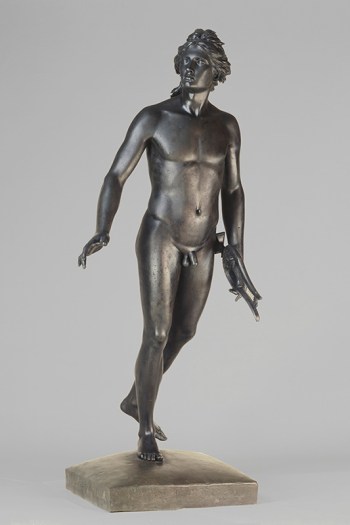
Jean-Antoine Houdon, ‘Apollo’, 1790, bronze (Lisbon: Calouste Gulbenkian Museum, inv. 552).
The human body has been the sculptor’s favourite motif from as far back as antiquity right up to the 20th century when sculpture also became abstract and experimental in relation to motif and form. It is specifically the body in sculpture which has, since antiquity, been the pivotal point for the feelings and narratives the artists have wanted to express concerning the great universal themes of human life. The art history of sculpture can, therefore, also be seen and related through the way the artists through the various ages have let body language, movement, and, not least, pose speak about such themes as love, life, and death.
The exhibition’s focus on the poses of sculpture emphasises the body language of the works whereby their universal messages, common to all, become clearer to us through the pose. This quality in figurative sculpture was something that lay behind the Glyptotek’s founder, Carl Jacobsen’s fascination with both ancient classical sculpture and the figurative French sculpture of his own era. He believed that the three-dimensional representation of the human body is the way to come closest to expressing the basic human condition in art in an intuitive, understandable manner. Figurative sculpture is something which can be experienced and understood without having an art historical background. Here we rediscover his passion—with a focus on the significance of pose in this context.
This exhibition has been realised through a unique collaboration between the Glyptotek and the Museo Calouste Gulbenkian in Lisbon. The two museums have much in common; each was founded by a passionate collector with a great love for figurative sculpture and its capacity to relate the great human stories. The exhibition is curated in collaboration between Classical Archaeologist Rune Frederiksen, Head of Collections at the Glyptotek, and the art historians of the Gulbenkian.
In Lisbon, the show was entitled Pose and Variations: Sculptures in Paris in the Age of Rodin; more information is available here.










 Enfilade
leave a comment