New Book | Hellenomania
From Routledge:
Katherine Harloe, Nicoletta Momigliano, and Alexandre Farnoux, eds., Hellenomania (New York: Routledge, 2018), 332 pages, ISBN: 978-1138243248, $150.
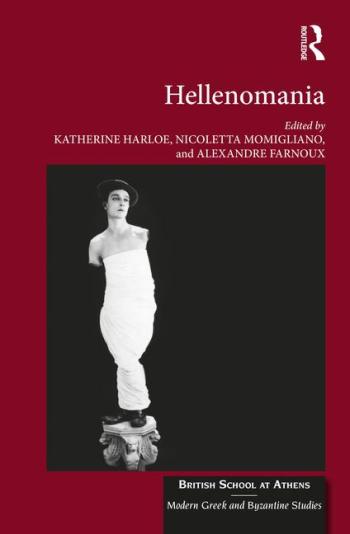 Hellenomania, the second volume in the MANIA series, presents a wide-ranging, multi-disciplinary exploration of the modern reception of ancient Greek material culture in cultural practices ranging from literature to architecture, stage and costume design, painting, sculpture, cinema, and the performing arts. It examines both canonical and less familiar responses to both real and imagined Greek antiquities from the seventeenth century to the present, across various national contexts. Encompassing examples from Inigo Jones to the contemporary art exhibition documenta 14, and from Thessaloniki and Delphi to Nashville, the contributions examine attempted reconstructions of an ‘authentic’ ancient Greece alongside imaginative and utopian efforts to revive the Greek spirit using modern technologies, new media, and experimental practices of the body. Also explored are the political resonances of Hellenomaniac fascinations, and tensions within them between the ideal and the real, the past, present, and future.
Part I examines the sources and derivations of Hellenomania from the Baroque and pre-Romantic periods to the early twentieth century. While covering more canonical material than the following sections, it also casts spotlights on less familiar figures and sets the scene for the illustrations of successive waves of Hellenomania explored in subsequent chapters. Part II focuses on responses, uses, and appropriations of ancient Greek material culture in the built environment—mostly architecture—but also extends to painting and even gymnastics; it examines in particular how a certain idealisation of ancient Greek architecture affected its modern applications. Part III explores challenges to the idealisation of ancient Greece, through the transformative power of colour, movement, and of reliving the past in the present human body, especially female. Part IV looks at how the fascination with the material culture of ancient Greece can move beyond the obsession with Greece and Greekness.
Katherine Harloe is Associate Professor of Classics and Intellectual History at the University of Reading. Her research specialisms are the history of classical scholarship and the reception of Greek and Roman antiquity in European (especially German) culture from the mid-eighteenth to the mid-twentieth centuries. In addition to numerous articles, she is author of Winckelmann and the Invention of Antiquity: History and Aesthetics in the Age of Altertumswissenschaft (2013) and co-editor of Thucydides and the Modern World: Reception, Reinterpretation, and Influence from the Renaissance to Today (2012).
Nicoletta Momigliano is Professor of Aegean Studies at the University of Bristol, specialising in Minoan archaeology and its reception. She has directed and co-directed several archaeological projects in Crete and Turkey, and has published many articles and book on Aegean subjects, including Cretomania: Modern Desires for the Minoan Past (2017, co-edited with Alexandre Farnoux) and Archaeology and European Modernity: Producing and Consuming the Minoans (2006, co-edited with Yannis Hamilakis).
Alexandre Farnoux is Professor of Archaeology and History of Art at the University of Paris IV (Sorbonne) and, since 2011, has been Director of the French School in Athens. He is an expert on the archaeology of Delos and especially of Crete, where he has directed excavations at Malia and Dreros. He has published many works on Greek and Aegean topics, including Cnossos, l’archéologie d’un rêve (1993) and Homère, le prince des poètes (2010).
C O N T E N T S
Hellenomanias from Early Modern to Modernism
1 Fiona Macintosh, Modern Stage Design and Greek Antiquity: Inigo Jones and His Greek Models
2 Katherine Harloe, Winckelmania: Hellenomania between Ideal and Experience
3 Richard Jenkyns, The British Reception of Greek Visual Culture in the Nineteenth and Twentieth Centuries
Ideal and Real Structures of Hellenomania
4 Frank Salmon, The Ideal and the Real in British Hellenomania, 1751–1851
5 Athena Leoussi, Making Everyone Greek: Citizens, Athletes, and Ideals of Nationhood in Nineteenth-Century Britain, France and, Germany
6 Lena Lambrinou, The Parthenon from the Greek Revival to the Modern Movement
7 David Watkin, The Greek Spirit: Current Architecture and Sculpture in England
Hellenomania Comes to Life: Colour, Movement, and the Body
8 Charlotte Ribeyrol, From Galatea to Tanagra: Victorian Translations of the Controversial Colours of Greek Sculpture
9 Pantelis Michelakis, ‘Grecian Dances’ and the Transformations of Corporeality in the Age of Moving Images
10 Artemis Leontis, Fashioning a Modern Self in Greek Dress: The Case of Eva Palmer Sikelianos
11 Eleni Sikelianou, From Delphi, 1927
12 Martin Winkler, Aphroditê kinêmatographikê: Venus’ Varieties and Vicissitudes
Beyond Hellenomania?
13 Esther Solomon and Styliana Galiniki, Las Incantadas of Salonica: Searching for ‘Enchantment’ in a City’s Exiled Heritage
14 Eleana Yalouri, Afterword: Hellenomanias Past, Present, and Future
Index
Exhibition | Canova and the Antique

Now on view in Naples at the MANN:
Canova and the Antique
Museo Archeologico Nazionale di Napoli, Naples, 28 March — 30 June 2019
Curated by Giuseppe Pavanello
The magnificent art of Antonio Canova (1757–1822) has rightly earned him praise as “the last of the ancients and the first of the moderns.” This exhibition focuses on Canova’s constant, intense, and fruitful relationship with classical antiquity, which made him known as “the new Phidias” among his contemporaries. Throughout the course of his artistic activity, Canova followed Winckelmann’s call “to imitate but not to copy the ancients” in order to “become inimitable.”

Antonio Canova, Dancer with Hands on Hips, 1811–12 (Saint Petersburg: State Hermitage Museum).
The exhibition is organised on two floors and displays over 110 works by Canova, including drawings, sketches, paintings, plaster casts, and marble sculptures. It showcases some of Canova’s greatest masterpieces, such as the famous group of The Graces on loan from the Hermitage State Museum in Saint Petersburg. The National Archaeological Museum of Naples is in a uniquely privileged position to present this complex and fascinating dialogue between Canova’s works and the great works of antiquity, with stunning pieces that can delight the modern spectator as thoroughly as they did Canova’s contemporaries.
The two installations dedicated to Canova in the entrance hall of the Museum are hosted in theatre-like round structures with a six-metre diameter. The visual journey takes the visitor through virtual imagery and scientific study, going from a single detail to a bird’s eye view, from the butterfly of Cupid and Psyche, to Hercules hurling Lichas, the great myths sculpted in marble and the polychrome paintings on a dark background, dedicated to dance. Adriano Giannini’s voice and the original soundtrack by the cello-player Giovanni Sollima contribute to a show that mixes deep emotion and accurate knowledge.
Canova visited Naples in 1780 to admire the beauties of the city and the antiquities of Herculaneum and Paestum. In his second Quaderno di Viaggio he writes about Naples: “everywhere is like Heaven.” He also reports of his visits to the Sansevero Chapel—where he appreciated the Dead Christ (Veiled Christ) by Giuseppe Sammartino—to the Gallery of Capodimonte, and to the Museum of Portici, where all the antiquities from the Vesuvian area had been gathered. Among the bronzes from the Villa of Papyri of Herculaneum he praises the Seated Mercury for “its wonderful beauty.” Canova obtained permission to draw the nude at the Academy (of Fine Arts), then in the area of San Carlo alle Mortelle. Today, in the Academy’s Gipsoteca, it is possible to admire some of Canova’s plaster models. The master returned to Naples in 1787 and carved for Francesco Maria Berio the marble group Venus and Adonis, to be placed in a little temple in the garden of the marquis’ palace, along via Toledo. The work, inscribed in the genre “delicate and gentle,” is today in Geneva. For the Neapolitan Onorato Caetani he sculpted the group Hercules and Lichas, classified in the genre “strong” or “fierce,” taking inspiration from the ideal model of the Farnese Hercules and from the composition of Hector and Troilus—both on display at the MANN. The Herm of a Vestal, commissioned by the count Paolo Marulli d’Ascoli, would leave Naples for Switzerland first and for the Getty Museum of Los Angeles later. After the short life of the Parthenopean Republic, the Bourbon king Ferdinand IV asked Canova to sculpt for him a portrait-statue. In 1821, as suggested by the master himself, it was placed in the niche of the monumental staircase of the Royal Bourbon Museum, today Museo Archeologico Nazionale. During the French decade Canova carved the marble busts, today lost, of Caroline and Joachim Murat, known through their plaster models. In the same period, the king Joseph Bonaparte and his successor Joachim Murat commission an Equestrian Monument to Napoleon, but, with the French domination coming to an end, the work was never completed. When the Bourbon king of Naples Ferdinand I regained the throne as king of the two Sicilies, he asked Canova to complete the piece with the statue of his father, Charles III. The monument can be admired today in Piazza Plebiscito.
Blasco Pisapia and Valentina Moscon, Canova e l’Antico (Milan: Electa, 2019), 360 pages, ISBN: 978-8891825063.
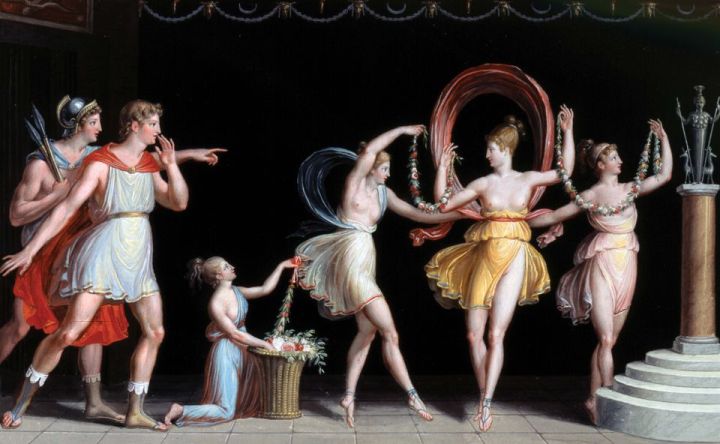
Antonio Canova, Theseus and Pirithous in the Temple of Diana Ortia See Diana Dancing, between Two Dancers, in Front of the Figure of Artemis of Ephesus (Abduction of Helen), 1799, tempera (Possagno: Gypsotheca e Museo Antonio Canova). The painting is one of 34 works inspired by Pompeiian wall paintings.
Call for Papers | Un-Fair Trades
From the Call for Papers:
Un-Fair Trades: Artistic Intersections with Social and Environmental Injustices in the Atlantic World, 1500–Present
The Graduate Center, CUNY, New York, 10–11 October 2019
Hosted by the Art History Department, The Graduate Center, CUNY
Proposals due by 15 May 2019
Artists have engaged with issues of oppression and exploitation—byproducts of colonialist and capitalist systems—throughout the history of transatlantic encounters: from slavery and resource extraction; to exploitative labor practices and the environmental consequences of industrialization; and human rights movements and climate change anxieties of the past century. This conference will examine a multitude of artistic responses to increasing global connections, which could include plantation scenes, images of the Middle Passage, social reform photography, industrialized cityscapes, and images of workers and employment. When examined through the lens of our contemporary social and environmental concerns, artworks whose motifs intersect with these imbalances of power compel us to analyze the visualizations of oppression and environmental degradation from a new perspective. Amid the 21st-century activist revival (with movements like Occupy Wall Street, #BlackLivesMatter, #NODAPL, and #MeToo) it is more prescient than ever to acknowledge, examine, and reflect upon both historic and perpetuating inequalities.
Un-Fair Trades seeks to establish a forum for intersectionality, Pan-American approaches, and transnational perspectives. We welcome paper abstracts that utilize an array of theoretical approaches to the visual culture of the Americas, Europe, and Africa and intersect with the issues of equity, equality, and environmentalism. We invite proposals for papers that critically engage with, but are not limited to, depictions of
• Native artists and indigenous populations amid forced migration and assimilation
• Harvested land and the plantation economy.
• Forced labor, the Middle Passage, and the Triangle trade
• The visual, economic, and social treatment of minority populations
• Scientific expeditions, expansionism, and extractive industries in the American West
• Exploitative labor practices, trades, and environmental damage caused by the Industrial Revolution
• Women’s work, expanding economic independence, and the suffrage movement
• Immigration, xenophobia, and the ‘melting pot’
• African Diaspora, the Harlem Renaissance, and Pan-Africanism
• Social Reform initiatives
Keynote Speakers: Dr. Alan C. Braddock and Dr. Charmaine A. Nelson
Proposals should be submitted to Caroline L. Gillaspie and Alice J. Walkiewicz at unfairtradesconference@gmail.com by 15 May 2019. Please include a 300-word abstract and a current CV. Applicants will be notified of acceptance by mid-June.
Call for Papers | Goldsmiths and Bankers as Collectors
From the Call for Papers:
Goldsmiths and Bankers as Collectors
Goldsmiths’ Hall, London, 28 October 2019
Proposals due by 10 May 2019

Francis Harding and Michael Dahl, Portrait of Henry Hoare I (1677–1725), oil on canvas (National Trust, Stourhead).
2019 will see the return to Osterley Park of one of the many remarkable Old Master paintings acquired by the Child family in the throes of Britain’s late 17th-century financial revolution. The Childs are part of a long line of goldsmiths and bankers who have collected and patronised the fine and decorative arts, from the Medici in Florence to the present-day Rothschilds who continue to be highly active across the cultural sphere. As these financial dynasties interacted and integrated with ruling elites, collecting and associated displays of taste, sophistication and magnificence became a much favoured and often extremely effective route to social and cultural distinction. Financiers may be most obviously associated with an urban context, from the medieval livery company to the modern hedge fund, but the country house was and is an important venue for the display of their patronage and collecting. Among the holdings of the National Trust alone examples of estates with connections to goldsmithing and banking abound including, in addition to Osterley, Chirk Castle, Erddig, Trelissick, Stourhead, Mottisfont, Studley Royal, Waddesdon, and Ascott.
This conference will bring together academics and curators to seek patterns of patronage across this influential and diverse social grouping. It will identify the range of social, economic and political motivations for their participation in high material culture and explore case studies of particular individuals, objects and places to illustrate the sheer variety of manifestations of the goldsmith and banker as collector and patron. Papers are invited on, but by no means limited to, the following topics:
• Goldsmiths and bankers as collectors and their collections from medieval to modern
• Trends in collecting and patronage amongst goldsmiths and bankers
• Case studies of individual patrons, collectors, makers, or suppliers
• Case studies of individual objects or places
• Comparisons with collectors from other social or economic groupings
• Consumption and social mobility in banking and goldsmithing dynasties
• Perspectives of modern collectors
The conference programme will be comprised of a keynote address and a series of 20-minute papers. Proposals for panels will be accepted. We hope to publish a selection of revised conference papers in a peer-reviewed journal or as an edited collection after the conference. Please send abstracts of between 200 and 300 words along with short biographies to richard.ashbourne@nationaltrust.org.uk by Friday, 10th May 2019.
This conference is organised by the National Trust with support from the Goldsmiths’ Company. Conference convenors: James Rothwell, NT Adviser on Silver; Lucy Porten, NT Curator for Osterley; John Chu, NT Assistant Curator of Pictures & Sculpture; Pippa Shirley, Head of Collections, Waddesdon Manor (Rothschild Foundation).
Find out more about the National Trust’s research strategy here. Click here for more information about Osterley Park.
New Book | Livery Halls of the City of London
Published by Merrell in association with the Worshipful Company of Chartered Architects:
Anya Lucas and Henry Russell, with photographs by Andreas von Einsiedel, Livery Halls of the City of London (London: Merrell, 2018), 280 pages, ISBN: 978-1858946702, £45 / $80.
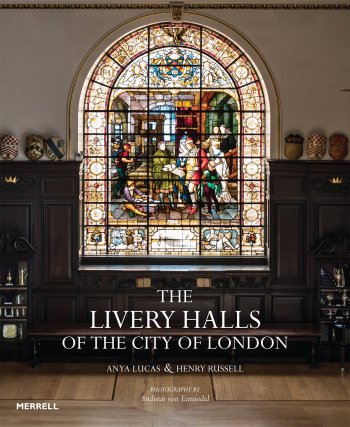 For some 800 years, Livery Companies have played a leading role in commercial activities and social and political life in the City of London. These trade associations, each representing a particular craft or profession, were originally responsible for controlling, for example, wages and working conditions. Their headquarters—the Livery Halls—evolved from large medieval town houses to become an identifiable building type paralleled only by the guild houses of northern European mercantile cities and the Venetian scuole. This beautiful book is the first major exploration of these architecturally significant buildings. Dr Anya Lucas, who has studied the Halls in depth, provides an introduction and an illustrated history of the buildings that have been lost over the centuries, while Henry Russell surveys each of the 40 present-day Halls, from HQS Wellington, the headquarters of the Master Mariners, in the west to the Proof House, the home of the Gunmakers’ Company, in the east. The existing Livery Halls have been photographed especially for the project by the renowned interiors photographer Andreas von Einsiedel, making this a truly outstanding publication.
Anya Lucas (née Matthews) is an art and architectural historian specializing in 17th- and 18th-century Britain. Her PhD (2015) at the Courtauld Institute of Art, London, examined the architecture and political uses of London’s Livery Halls in the early modern period. She has written about the Livery Halls for Country Life magazine and the Georgian Group Journal, and contributed a chapter on the subject to the book Court, Country, City: British Art and Architecture, 1660–1735 (Yale University Press, 2016). She currently works as Research Curator for the Painted Hall at the Old Royal Naval College in Greenwich, London, where a major conservation project on Sir James Thornhill’s vast baroque scheme is under way.
Call for Papers | At CAA 2020, Historic Libraries & Art Historiography
Dr. Musto plans to submit this proposal to CAA as a fully-formed, ‘complete session’, and she welcomes eighteenth-century submissions:
Historic Libraries and Art Historiography
College Art Association Conference, Hilton Chicago, 12–15 February 2020
Organized by Jeanne-Marie Musto
Proposals due by 22 April 2019
Currently seeking papers for a session exploring the potential of historic libraries to deepen and broaden our understanding of art historiography and its relationship to social, intellectual and geo-political currents. Such libraries include those not specifically intended for the study of art. This session will build on a theme introduced at CAA 2019, where a wide range of art-historical themes emerged from diverse libraries. These libraries range from early modern through twentieth century, across several continents, and survive intact or through inventories. Xu Bo’s library inventory, for example, offers a view into the role of art history in Ming dynasty regionalism, while the history of an individual Mexican codex within the National Library of Spain tells of the shifting winds of colonial and post-colonial cultural authority. But these libraries also tell of more than geopolitical concerns. They underline efforts to define the inchoate discipline of art history through a wide spectrum of materials. At the same time, they demonstrate active participation in art historical debates, and connections with artists and arts administrators. Papers that examine any aspect of the historiography of art emerging from the analysis of historic libraries will be welcomed. Please send proposals for a paper including title, abstract (250 words) and CV to Dr. Jeanne-Marie Musto, musto.jeannemarie@gmail.com. Additional information concerning the 2020 conference is available here.
Exhibition | Éloge du sentiment et de la sensibilité
From the Musée des Beaux-Arts de Rennes:
Éloge du sentiment et de la sensibilité: Peintures françaises du xviiie siècle des collections de Bretagne
Musée des Beaux-Arts de Rennes et le Musée d’Arts de Nantes, 15 February — 12 May 2019
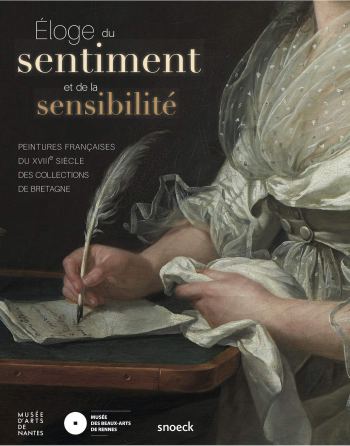 Dans le cadre des collaborations entre musées du Grand-Ouest, le Musée des Beaux-Arts de Rennes et le Musée d’Arts de Nantes présentent de février à mai 2019 une exposition en coproduction intitulée Éloge du sentiment et de la sensibilité: Peintures françaises du xviiie siècle des collections de Bretagne. Cet événement présente l’originalité de se dérouler simultanément dans les deux institutions avec un catalogue commun.
Le propos général de l’exposition est une découverte de l’ensemble de la production picturale du Siècle des Lumières à travers le prisme du sentiment et de la sensibilité. Dans la seconde moitié de ce siècle, littérature et peinture reflètent une nouvelle vision de l’Homme et de son environnement. Sentiment et sensibilité deviennent de nouvelles qualités de l’âme, donnant une liberté inédite de ressentir le monde. Diderot s’interroge sur le sentiment dans la peinture et au théâtre, Rousseau porte aux nues la sensibilité dans la Nouvelle Héloïse et théorise une nouvelle forme d’éducation dans l’Émile, Voltaire s’émerveille de l’impact de la nature sur ses sens et son âme… La peinture offre un écho enthousiaste et inspiré à ces préoccupations inédites.
Le choix des oeuvres a été réalisé essentiellement dans les riches collections conservées aux musées de Brest, Nantes, Quimper et Rennes avec des compléments apportés par les collections publiques (musées, églises, bâtiments municipaux) de Morlaix et de Lamballe. La réunion de ces collections permet de représenter l’ensemble des grands artistes du siècle tels qu’Antoine Watteau, François Boucher, Carle Vanloo, Charles Joseph Natoire, Jean Siméon Chardin, Hubert Robert, Jean-Baptiste Greuze ou Jean Honoré Fragonard.
L’exposition en deux parties organisée à Rennes et à Nantes, Éloge du sentiment et Éloge de la sensibilité, permet d’embrasser l’évolution de la peinture française sur un siècle, depuis Antoine Watteau jusqu’au début du xixe siècle. À Rennes s’expose la grande histoire, antique, religieuse et mythologique. Nantes met à l’honneur les différents genres, du grand portrait d’apparat aux sensibles natures mortes. Ce partage des oeuvres s’appuie sur une division ancienne bien connue, que les hasards des collections semblent avoir reproduite dans nos musées : Rennes conserve davantage de peintures d’histoire que Nantes, qui s’illustre plus dans la peinture de genres.
Un premier ensemble d’environ 70 tableaux, réuni à Rennes autour de la notion de sentiment, évoquera en quatre sections l’évolution de la peinture à sujet historique (biblique, mythologique, antique et contemporaine).
Un second ensemble d’environ 70 oeuvres présente en six sections au Musée d’arts de Nantes un parcours autour de la notion de sensibilité à travers la peinture de genre (portraits, scènes galantes, paysage, natures mortes…).
Cet événement inédit fait suite à l’organisation en 2013, par les musées de Quimper et de Rennes, de l’exposition De Véronèse à Casanova, qui, selon le même principe faisait le bilan des richesses des musées bretons dans le domaine de la peinture italienne. Les restaurations et les recherches menées à l’occasion de cet événement ont permis d’apporter un éclairage nouveau sur de nombreuses oeuvres et quelques découvertes importantes dans les réserves de certains musées.
Guillaume Kazerouni and Adeline Collange-Perugi, Éloge du sentiment et de la sensibilité: Peintures françaises du xviiie siècle des collections de Bretagne (Paris: Snoeck, 2019), 367 pages, ISBN: 978-9461615138, 35€.
Exhibition | Bernard Picart (1673–1723)
Now on view at the Musée National de Port-Royal des Champs, near Versailles:
Bernard Picart (1673–1723), Dessinateur, de Paris à Amsterdam
Musée National de Port-Royal des Champs, Magny-les-Hameaux, 21 March — 23 June 2019
Curated by Corentin Dury and Philippe Luez
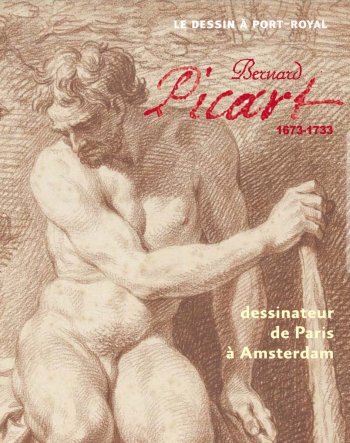 Bernard Picart (1673–1723), issu d’une famille janséniste, s’installe à Amsterdam en 1710 et y occupe une place majeure dans l’édition hollandaise illustrée. Mais on le connaît moins comme dessinateur. La présente exposition permet de découvrir ce pan inconnu de son activité et lui rend sa place parmi les grands dessinateurs des débuts du règne de Louis XV.
En collaboration avec le Salon international du dessin de Paris et avec la participation du Rijksmuseum d’Amsterdam
Commissaires
Corentin Dury, conservateur du patrimoine, musée des Beaux-arts d’Orléan, et Philippe Luez, conservateur général du patrimoine, directeur du musée national de Port-Royal des Champs
Corentin Dury and Philippe Luez, Bernard Picart (1673–1723), Dessinateur, de Paris à Amsterdam (Paris: Snoeck, 2019), 175 pages, ISBN: 978-9461615459, €25.
Williamsburg Acquires Its First Judaica Objects

Torah Pointer (Yad), Birmingham, England, 1843–44, silver and gold (gilding) (Courtesy of the Colonial Williamsburg Foundation, Museum Purchase and Hugh Trumbull Adams Fund, 2018-326).
◊ ◊ ◊ ◊ ◊
Press release (2 April 2019) from Colonial Williamsburg:
The Colonial Williamsburg Foundation has recently added several important objects of Judaica to its collections: a sterling silver and gold Kiddush cup and a silver and gold yad (or Torah pointer). These mark the first such objects in the Foundation’s holdings and exemplify the concerted efforts in recent years by the curators to acquire objects and address the stories of all early Americans while remaining true to their long-standing strength in British and American decorative arts. Additionally, objects that represent the early Anglo-American experience have also been acquired. These include an alphabet sampler created by a Jewish schoolgirl that is unique both for who made it and where it was created, as well as Chinese porcelain pieces that were owned by prominent London Jewish families.
“The Colonial Williamsburg Foundation sees the objects in its collections as documents of the people, places, and events of the past,” said Ronald L. Hurst, the Foundation’s Carlisle Humelsine Chief Curator and Vice President for Collections, Conservation, and Museums. “Because we use these objects to tell the compelling stories of early Americans, we seek to acquire things that speak to the full range of their experiences, whatever their race, religion, gender, age, or cultural ethnicity may have been. These latest acquisitions mark important steps toward that goal.”
The silver objects are noteworthy additions to the collections as they represent a faith that was more prevalent in early America than most people realize today. They also span the realms of public and private worship in the Jewish religion. Kiddush cups are used both as part of family worship at home and as part of congregational worship, while the yad is used in congregational worship in a synagogue. The Colonial Williamsburg curators know that these specific examples are representative of what was owned and used in early America.

Kiddush Cup, probably by William Harrison I (active ca. 1758–81), London, ca. 1775, silver (sterling) and gold (Courtesy of the Colonial Williamsburg Foundation, Museum Purchase, The Antique Collectors’ Guild, 2016-1).
The Kiddush cup, which is used while reciting the blessing over wine (the Kiddush), is part of the commandment from the Torah to sanctify the Sabbath (Shabbat). Before the Friday night meal on the eve of Shabbat, the tradition dictates that a family’s Kiddush cup is filled with wine and held as the blessing is spoken, usually by the head of the household. Few ceremonial Jewish objects from the early Anglo-American world are known today. This Kiddush cup, probably made by William Harrison I (active ca. 1758–1781) in London about 1775, was the first piece of silver Judaica to be added to the Colonial Williamsburg collection. It is an elegant example with a circular stepped foot and a tapered stem that supports an egg-shaped cup with a gilded interior. It is engraved with three lines of Hebrew, “Remember the Sabbath day, and sanctify it,” within a shield suspended from a bow-knot and flanked by slender foliate sprays.
The yad, which literally means “hand,” can be interpreted as a representation of the hand of God and is used as a pointer during Torah readings, which allows the rabbi to follow the text without physically touching the sacred scrolls. The chain on the yad was used to suspend it from the Torah scrolls when not in use. This example, made in Birmingham, England, between 1843 and 1844, is made of silver with gilding, which was the predominant material used to make yads since the early 1600s. It features a long wand of quadrangular shape that is engine-turned and engraved with foliage and has a media band also flanked by foliage. One end of the yad has a foliate-engraved knop with a suspension ring and hanging chain. The other end has an applied cast hand with an extended index finger wearing a ring. There are traces of gilding on the hand.
Also providing a glimpse into the Jewish experience in the early Anglo-American world, are a recently acquired schoolgirl sampler and Chinese porcelain objects:

Stand, Jingdezhen, ca. 1795, hard-paste porcelain (Courtesy of the Colonial Williamsburg Foundation, Museum Purchase, The Buddy Taub Foundation, Dennis A. Roach and Jill Roach Directors, 2016-116).
The alphabet sampler by Rachel Cole (1854–1922) is an important addition to the textile collections. The most significant facet of this unique object’s story is its maker. Rachel Cole, who was born on August 18, 1854, in Chicago, was the daughter of one of the city’s earliest Jewish families. Her mother, Sarah Frank, was an immigrant from Germany, her father, Samuel Cole, was an immigrant from Austria who was a co-founder of the Kehilath Anshe Ma’ariv (K.A.M.) congregation, which became Chicago’s first Jewish synagogue. Samuel Cole was also the president of the congregation for approximately one year. The sampler, which Rachel may have made at the K.A.M. school where she studied after graduating from one of Chicago’s public schools, is also unique as it is the only identified sampler marked “Chicago,” and one of just a handful of known samplers created by Jewish schoolgirls. The colorful sampler is marked with the place name of Chicago, Illinois, and with the date 1868. Few, if any, samplers from Chicago are known to survive, probably because of the Great Chicago Fire of 1871, which destroyed much of the city. Ms. Cole lived within just blocks of the approximately 3.3 miles of area consumed by the conflagration.
The prominent Sephardic Jewish D’Aguilar family were London merchants and sugar planters in the eighteenth century. This hard-paste porcelain stand, made in Jingdezhen, China, around 1795, is decorated with the family’s crest and is from just one of several armorial services that was ordered by the family. Most likely it was owned by Solomon, the fifth son of Don Diego D’Aguilar.
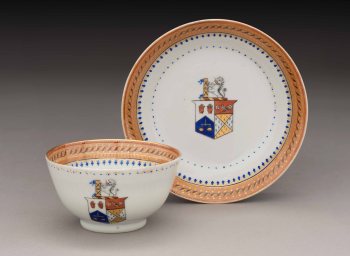
Cup and Saucer, Jingdezhen, ca. 1805, hard-paste porcelain (Courtesy of the Colonial Williamsburg Foundation, Museum Purchase, The Buddy Taub Foundation, Dennis A. Roach and Jill Roach Directors, 2016-117, A&B).
Also made in Jingdezhen, China, around 1805, is this hard-paste porcelain cup and saucer, decorated with the coat of arms of Neilson impaling Goldsmid. Aaron Goldsmid was a merchant in Hamburg and left there in 1765 to settle in London and establish the firm of Aaron Goldsmid & Son. Aaron’s second son, Asher, helped establish Mocatta & Goldsmid, which was a bullion-brokerage firm to the Bank of England. The Goldsmid family was known for its philanthropy and financier endeavors throughout the eighteenth and nineteenth centuries. It is most likely that this cup and saucer were made for a daughter or niece of Asher Goldsmid.
The Kiddush cup was purchased with funds from The Antique Collectors’ Guild. The yad was purchased through the generosity of the Hugh Trumbull Adams Fund. The Chinese porcelain objects were acquired with funds from The Buddy Taub Foundation, Dennis A. Roach and Jill Roach Directors.
Call for Panel Chair(s) | HECAA at ASECS, 2020
HECAA New Scholars Session at ASECS 2020
American Society for Eighteenth-Century Studies Conference, St. Louis, 24–28 March 2020
Chair nominations due by 20 April 2019
As part of its long-standing commitment to supporting the work of graduate students and younger scholars, HECAA has for many years used its panel at ASECS as a New Scholars Session. Since 2013, the session has been named in honor of Anne Schroder (1954–2010), a former HECAA president who was especially known for the interest she took in graduate students’ research. As we continue the tradition into 2020, the HECAA panel committee invites nominations (including self-nominations) for someone to chair the session (co-chairs are welcome). Please send a note of interest and a CV to Michael Yonan, convener of the HECAA panel committee, at yonanm@missouri.edu, by 20 April 2019. Questions may be directed to either Michael or Amelia Rauser at arauser@fandm.edu.










 Enfilade
leave a comment