At Sotheby’s | MFA, Boston Acquires Two Pairs of Torah Finials
Press release (via Art Daily, 11 June 2019) . . .
Important Judaica Featuring the Serque Collection (Sale N10086)
Sotheby’s, New York, 5 June 2019

Jurgen Richels, German parcel-gilt silver Torah finials, made in Hamburg, ca. 1688–89, acquired by the MFA, Boston.
Driven by demand from private collectors and cultural institutions, Sotheby’s Important Judaica auction (Sale N10086) totaled $2.7 million in New York. From ceremonial silver to important manuscripts and fine art, exceptional items drove these results.
The Museum of Fine Arts, Boston acquired two of sale’s top offerings of silver: a pair of German parcel-gilt silver Torah finials (lot 79) from Hamburg ca. 1688–89 sold for $500,000, and a pair of large English parcel-gilt silver Torah finials (lot 3) from 1764 by British silversmith Edward Aldridge sold for $187,500. Both pair of finials stand out for their exceptional rarity and notable provenance, the latter of which were sold to benefit the Central Synagogue, London and were formerly in the famed collection of Philip Salomons—brother of the first Jewish Lord Mayor of London—who was one of the first collectors of antique Judaica in England.

Edward Aldridge, English parcel-gilt silver Torah finials, made in London, 1764, acquired by the MFA, Boston.
Isidor Kaufmann’s sensitive Portrait of a Rabbi with a Young Pupil (lot 43) achieved $375,000 (estimate $300,000–500,000). Renowned for his ravishing detail, Kaufmann gained wide recognition in Vienna during his lifetime. This double portrait reflects the deep spirituality of a centuries-old tradition that the artist witnessed during his summer trips to Galicia and Eastern Poland.
After much pre-sale excitement, the collection of nearly 300 postcards from American Jewish hotels and resorts from the 20th century (lot 29) sold for $8,750 (estimate $7,000–10,000). Assembled over the course of 20+ years by a private collector, the selection provides a panoramic view of Jewish leisure culture in America, depicting the grounds and amenities available at reports frequented by Jews not only the Catskill Mountains, but also in various vacation spots in Connecticut, Florida, Maine, Massachusetts, Michigan, New Hampshire, New Jersey, and North Carolina.
The pre-sale press release is available here»
Call for Submissions | Metropolitan Museum Journal
Metropolitan Museum Journal 55 (2020)
Submissions due by 15 September 2019
The Editorial Board of the peer-reviewed Metropolitan Museum Journal invites submissions of original research on works of art in the Museum’s collection. There are two sections: Articles and Research Notes. Articles contribute extensive and thoroughly argued scholarship. Research Notes typically present a concise, neatly bounded aspect of ongoing investigation, such as a new acquisition or attribution, or a specific, resonant finding from technical analysis. All texts must take works of art in the Museum’s collection as the point of departure.
As of 2019, the process of peer review is double-blind. Manuscripts are reviewed by the Journal Editorial Board, composed of members of the curatorial, conservation, and scientific departments, as well as scholars from the broader academic community. Articles and Research Notes in the Journal appear both in print and online, and are accessible via MetPublications and the Journal’s home page on the University of Chicago Press website.
The deadline for submissions for volume 55 (2020) is September 15, 2019. Submission guidelines are available here. Please send materials to journalsubmissions@metmuseum.org.
Book Launch | Art and Race
This evening at The Courtauld:
An Evening about Art and Race, Launching L’Art et la Race: L’Africain (tout) contre l’oeil des Lumières
The Courtauld Institute of Art, King’s Cross, London, 11 June 2019
Organized by Katie Scott and Esther Chadwick
 The Courtauld Institute invites you to a round-table discussion to celebrate the publication of Anne Lafont’s major new book L’Art et la Race: L’Africain (tout) contre l’oeil des Lumières (2019) and to mark the exhibition Le Modèle noir at the Musée d’Orsay, Paris. The book will be launched by Dr Mechthild Fend (UCL) and Dr Esther Chadwick (Courtauld), followed by conversation between Professor Lafont (EHESS), Professor David Bindman (UCL), and Sam McGuire (Tate) about the staging of the exhibition. Drinks reception to follow.
Tuesday, 11 June 2019, 5:00–6:30pm; Research Forum Seminar Room, The Courtauld Institute of Art, Vernon Square Campus, Penton Rise, London. Free and open to all. Registration details are available here.
Call for Papers | 2020 Wallace Seminars on Collections and Collecting
From the Call for Papers:
2020 Wallace Collection Seminars on the History of Collections and Collecting
The Wallace Collection, London, last Monday of the Month
Proposals due by 6 September 2019
The seminar series was established as part of the Wallace Collection’s commitment to the research and study of the history of collections and collecting, especially in the eighteenth and nineteenth centuries in Paris and London. We are keen to encourage contributions covering all aspects of the history of collecting, including:
• Formation and dispersal of collections
• Dealers, auctioneers and the art market
• Collectors
• Museums
• Inventory work
• Research resources
The seminars, which are normally held on the last Monday of every month during the calendar year, excluding August and December, act as a forum for the presentation and discussion of new research into the history of collecting. Seminars are open to curators, academics, historians, archivists and all those with an interest in the subject. Papers are generally 45–60 minutes long, and all the seminars take place at the Wallace Collection between 5.30 and 7pm.
If interested, please send a short text (500–750 words) and a brief CV, indicating any months when you would not be available to speak, by Friday 6 September 2019. For more information and to submit a proposal, please contact collection@wallacecollection.org. Please note that we are able to contribute up to the following sums towards speakers’ travelling expenses on submission of receipts:
• Speakers within the UK – £80
• Speakers from Continental Europe – £160
• Speakers from outside Europe – £250
Conference | Minor Forms: Politics of Smallness around 1800
From ArtHist.net:
Minor Forms: Politics of Smallness around 1800
Ludwig-Maximilians-Universität, Institute of Art History, Munich, 14 June 2019
Organized by Léa Kuhn
The period around 1800 is typically characterised by scholars through concepts such as the heroic, the pathetic or the sublime. Accordingly, notions like ‘magnitude’ (Großheit), ‘oneness’ (Einheit), and ‘totality’ (Totalität) are recurrent terms within the art theory at the time in order to meet the contemporary desire for ‘major’ aesthetic concepts. Even the nascent art historical discourse in the contemporary moment testifies a pronounced interest in totalisations: Attempts to grasp the history of art in its totality are legion. In opposition to these tendencies, this workshop focuses on small and marginalised instances of artistic production and their potentialities.
Minor forms may concern a wide range of aspects, such as scale (especially miniatures and miniaturisation), genre hierarchies (the combination of low subjects with consonant formal decisions), questions of materiality (the use of supposedly worthless material), and the state of elaboration (the draft, the unfinished etc.). Indeed, minor forms is a relational term, a concept that is defined through its relation to a major form.
The aim of the workshop is to examine precisely the potential for critical commentary on hegemonic forms of art and knowledge and to chart the shape, contours, potentialities, and possibilities of minor forms. The conference is organized by Léa Kuhn, lea.kuhn@lmu.de.
P R O G R A M M E
2.00 Coffee
2.30 Introduction by Léa Kuhn
2.45 Smallness and Discursive Framings
Chair: Johanna-Charlotte Horst (Munich)
• Jan Von Brevern (Berlin), Denner’s Disgusting Details
• Christian Drobe (Halle-Wittenberg), Ruins and the Private: Smallness as a Flexible Discourse for the Emergence of Modern Archeology and the Bourgeoisie
4.15 Coffee break
4.45 Small Forms and Objects
Chair: Ulrike Keuper (Munich)
• Michelle Moseley-Christian (Blacksburg, Virginia), Miniature and Microscopy: Collecting ‘the Small’ in the Long Eighteenth-Century Netherlands
• Etienne Wismer (Bern), Having the World at Home: Politics of Wallpapers
6.30 Keynote Address
• Hannah Williams (Paris/London), A Pair of Spectacles and an Account Book: The Lives of Little Things in the Paris Art World
Conference | Recycling Luxury

From ArtHist.net:
Recycling Luxury
Christie’s Education, 42 Portland Place, London, 5 July 2019
Organized by Jacqui Ansell and Marie Tavinor
The concept of luxury is associated with ideas of excess (luxus) or even worse immodesty (luxure). An infamous example involving Cleopatra dissolving a priceless pearl and swallowing it encapsulates some common associations between luxury and immorality, or luxury as intrinsically linked to the idea of waste. The Christie’s Education Recycling Luxury Conference intends to go beyond the common connotations attached to the concept of luxury, and challenge them. It will posit that luxury cannot be seen entirely in the light of dissipation. Rather it will explore the links between luxury and the idea of recycling i.e. the re-using, repurposing, remaking, reshaping of luxury materials and objects across time and place, hence giving more space for discussion to this understudied historical phenomenon.
Designed to coincide with Classic Week at Christie’s London, the conference is organised by Jacqui Ansell and Dr. Marie Tavinor. To attend, please register here.
P R O G R A M M E
9.15 Coffee and registration
9.45 Welcome
10.00 Panel 1: The Circular Economy
• Sarah Fergusson (McTear’s Auctioneers), The Virtue of Auction Houses
• Levi Higgs and Dianne Batista (David Webb Archives), Lady’s Own Stones: Refashioning Gems of Yesterday into Jewels of Today
• Joy McCall (Christie’s), Re-appropriate in the Making of Late 20th-Century Furniture
11.00 Panel 2: Thrifty Opulence
• Isabella Campagnol (Istituto Marangoni), ‘Broken and Useless’: Notes on Fashion and Textile Recycling and Repurposing in 18th-Century Venice
• Jennifer Halton (Imperial College), Luxury as Spectacle: Making Festivals in Early Modern Florence
• Rosamund Weatherall (National Trust), Re-birth: The Spangled Bed from Knole
• Rachel Perry (University of Haifa), Rags to Riches: Jean Dubuffet’s Rehabilitiation of Mud
12.15 Discussion
12.30 Lunch break
13.30 Panel 3: Symbolic (Re-)Appropriation
• Ian Cockburn (Independent Scholar), Crossing Religious Boundaries: Luxury Islamic Silks and Ivories from al-Andalus
• Susan Jaques (Author and Journalist), ‘This Heavy Thing’: Catherine the Great’s Coronation Crown
• Uta Coburger (State Palaces and Gardens of Baden-Wuerttemberg), Pretty in Pink: The Re-Use of Mannheim Court Fashion by the Jesuits in the 18th Century
14.30 Panel 4: Provenance as a form of Recycling?
• Diana Davis (Independent Researcher), Recycled, Redecorated, Renewed: A Porcelain Inkstand by Edward Holmes Baldock
• Isabelle Cartier-Stone (Christie’s), The Rothschilds and Renaissance Jewellery
• Gil Darby (Independent Scholar), Pearls and La Peregrina
15.20 Discussion
15.40 Tea
16.00 Panel 5: The Afterlife of Luxury
• Pascal Bertrand (Université Bordeaux Montaigne), The Case Study of a ‘Tinkered’ Tapestry
• Catrin Jones (Holburne Museum), ‘Aux Plaisirs des Dames’: A Meissen Bourdaloue Transformed
• Caroline McCaffrey-Howarth (V&A / University of Leeds), Is a Vase Really a Vase When It Used to Be a Chamberpot?
• Joseph Robson (Christie’s), Italian Archeological Jewellery: From Antiquity to the Antiquarian
• Benjamin Wild (Independent Scholar), Liminal Luxury: The Cost and Value of Fancy Dress Costume
17.15 Discussion
17:35 Closing remarks by Jonathan Faiers (University of Southampton)
17:45 Wine reception
Conference | Keywords of Mobility
From ArtHist.net:
Keywords of Mobility: Paradigms of Movement in Premodern Material Culture
The Norwegian Institute in Rome, 6–7 June 2019
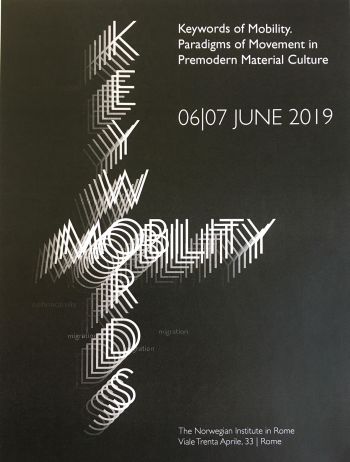 The history of art has been engaged with mobility for centuries. Movement, with its limits and potentials, constitutes in several ways a founding principle of the discipline, and its fascination or rejection stands at the core of much of its narrative. But the recent (re)turn to mobility is rapidly reframing many assumptions about the discourses and practice of the discipline itself. How has art history and, more generally, the study of material cultures, absorbed and reacted to the mobility turn? What kind of theoretical frameworks has, does, and will the discipline, in its broader acceptance, foster and promote? How is mobility—whose intangible nature makes it a rather elusive object of study—embraced and developed in art historical projects?
More than a decade after Sheller and Urry’s call for a ‘mobility turn’, this workshop invites scholars of the premodern period to reconsider the role of art history and material studies in a de-sedentarized, mobile world. Our scope is to reflect and redefine a set of critical terms, whose use (and sometimes abuse) is central to current debates. In doing so, we do not intend to propose a ‘grand narrative’ of mobility, but rather to explore a new set of questions, theoretical approaches, and ideas, in order to understand practices, meanings, forces, and impacts of movement in premodern art.
T H U R S D A Y , 6 J U N E 2 0 1 9
9.30 Registration
9.45 Welcome by Christopher Prescott (Director of The Norwegian Institute in Rome)
10.00 Morning Talks
• Mattia Biffis (Oslo), Mobility What? Viewing Movement Tridimensionally
• Yannis Hadjinicolaou (Hamburg), Flying: Falconry as an Image Vehicle
• Bronwen Wilson (Los Angeles), The Itinerary, the Line, and the Limits of the Page
• Hagi Kenaan (Tel Aviv), Visual Network: The Case of Graffiti
13.00 Lunch break
14.30 Afternoon Talks
• Janina Wellmann (Lüneburg), Rhythm: A New Episteme around 1800
• Meha Priyadarshini (Edinburgh), Boats, Bales, and Ballads: The Material and Culture Practice of Transportation in the Early Modern Period
• Piers Baker-Bates (London), Travelling between the Viceroyalties: The Cosmopolitanism of Works of Art within the 16th-Century Hispanic World
• Stefan Neuner (Berlin), The Ferryman and the Obsessed: Connectivity in Urban and Social Space in Venice around 1500 according to Vittore Carpaccio
18.00 Aperitivo
20.00 Dinner
F R I D A Y , 7 J U N E 2 0 1 9
9.50 Welcome by Sam Hardy (The Norwegian Institute in Rome)
10.15 Morning Talks
• Miriana Carbonara (East Anglia), Art and Borders: A Methodology
• Federico Zuliani (Turin), Migrant Bibles: Relocating Objects and Beliefs in Early Modern Europe
• Aron Vinegar (Oslo), On Habit’s Remainder and the Subject Matter of Inertia
13.00 Lunch break
14.30 Afternoon Talks
• Peter Gillgren (Stockholm), Siting: Mobility and Materiality
• Ivo Van der Graaff (New Hampshire), The Architecture of Departure and Arrival in the Early Roman Empire
• Tiffany Racco (Washington DC), The Performance of Speed: Luca Giordano’s Recurring Role as the Fast Painter
17.00 Concluding Remarks
17.30 Visit to the Fontana dell’Acqua Paola
20.00 Dinner
New Book | Inventing Boston
From Yale UP:
Edward S. Cooke, Inventing Boston: Design, Production, and Consumption, 1680–1720 (New Haven: Yale University Press, 2019), 232 pages, ISBN: 978-0300232110, $60.
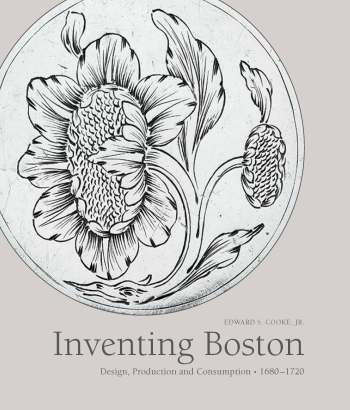 During the late 17th and early 18th centuries, Boston was both a colonial capital and the third most important port in the British empire, trailing only London and Bristol. Boston was also an independent entity that pursued its own interests and articulated its own identity while selectively appropriating British culture and fashion. This revelatory book examines period dwellings, gravestones, furniture, textiles, ceramics, and silver, revealing through material culture how the inhabitants of Boston were colonial, provincial, metropolitan, and global, all at the same time. Edward Cooke’s detailed account of materials and furnishing practices demonstrates that Bostonians actively filtered ideas and goods from a variety of sources, combined them with local materials and preferences, and constructed a distinct sense of local identity, a process of hybridization that exhibited a conscious desire to shape a culture as a means to resist a distant, dominant power.
Edward S. Cooke, Jr. is the Charles F. Montgomery Professor of the History of Art at Yale University.
More information about the book is available from the Paul Mellon Centre.
Exhibition | Printing the Pastoral

Jean-Baptiste Huet, Activities on the Farm, ca.1795, copperplate-printed cotton, 89 × 72 inches
(Saint Louis Art Museum)
◊ ◊ ◊ ◊ ◊
Press release (15 May 2019) for the exhibition:
Printing the Pastoral: Visions of the Countryside in 18th-Century Europe
Saint Louis Art Museum, 24 May — 1 December 2019
Curated by Genevieve Cortinovis and Heather Hughes
The Saint Louis Art Museum presents Printing the Pastoral: Visions of the Countryside in 18th-Century Europe, a free exhibition examining the early development of one of the most recognizable textile genres: copperplate-printed cotton, popularly known as toile.

Nicolaes Berchem, ‘The Shepherd Playing the Flute’, etching; sheet: 8 × 6 inches (Saint Louis Art Museum).
Toile has remained popular since its inception more than 250 years ago, when technological advances allowed textile printers to exploit the type of copperplates long used by artists to print on paper. Artisans were then able to create nuanced, intricate designs, and their creativity flourished. The emergence of copperplate-printed textiles coincided with the taste for scenes of country life and other pastoral imagery in Europe. Middle- and upper-class audiences clamored for fabrics patterned with idyllic scenes of shepherds, ladies on swings, amorous couples, and village celebrations. Textile printers responded, drawing inspiration from a wide variety of sources.
This exhibition reveals the nostalgia for pastoral themes common to 18th-century textile consumers and art collectors by pairing furnishing fabrics, ceramics, and paintings with prints by—or after—Rembrandt van Rijn, Nicolaes Berchem, Paulus Potter, Jean-Honoré Fragonard, and François Boucher. A reconstructed bed, complete with coverlet and curtains, illustrates the visual impact of these innovative fabrics in the 18th-century home. Printing the Pastoral includes a number of textiles never before exhibited at the museum, including a recent gift of printed cottons from Richard and Suellen Meyer and a loan from the Missouri History Museum of an important early English copperplate-printed textile.
The exhibition is curated by Genevieve Cortinovis, Andrew W. Mellon Foundation Assistant Curator of Decorative Arts and Design, and Heather Hughes, senior research assistant and manager of the Study Room for Prints, Drawings and Photographs.

Associate textile conservator Miriam Murphy installs Printing the Pastoral: Visions of the Countryside in 18th-Century Europe at SLAM.
Gwendolyn DuBois Shaw Named Director of History at NPG in DC
From the press release (23 May 2019) . . .
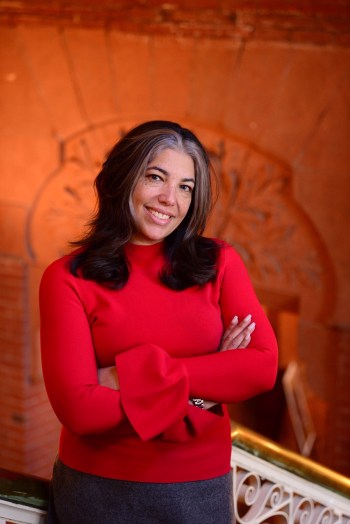 The Smithsonian’s National Portrait Gallery has appointed Gwendolyn DuBois Shaw, undergraduate chair and associate professor of history of art at the University of Pennsylvania, as the museum’s new director of history, research and scholarship / senior historian. Shaw will work with the History, Curatorial, and Audience Engagement departments to strengthen the museum’s scholarly programs and be a thought leader on the connections between portraiture, biography and identity in America. Shaw is the first woman to hold this senior position at the National Portrait Gallery.
“I have long admired Gwendolyn’s scholarship and her particular focus on looking at contemporary issues through the lens of both history and portraiture,” said Kim Sajet, director of the National Portrait Gallery. “Her research has spanned chronologies from the 17th century through today, merging interests in fine arts with those of popular culture. I am looking forward to having Gwendolyn help us think in fresh ways about our nation’s history as we reinstall our galleries in conjunction with a major upgrade to our lighting systems, and I know she will introduce audiences to larger social, historical, economic, and political topics of conversation and debate.”
Shaw is already well known to the National Portrait Gallery. She is a current member of the PORTAL = Portraiture + Analysis advisory board, the museum’s scholarship and research arm; and in 2016 she served as the senior fellow and host scholar of the museum’s Richardson Symposium: Racial Masquerade in American Art and Culture. Recent books published by the Portrait Gallery feature her writing. For example, her essay “‘Interesting Characters by the Lines of Their Faces’: Moses Williams’s Profile Portrait Silhouettes of Native Americans” was written in 2018 for the exhibition catalogue Blackout: Silhouettes Then and Now, and she also penned “Portraiture in the Age of the Selfie,” the lead essay for the catalogue that accompanied the 2016 Outwin Boochever Portrait Competition.
Shaw, who received her doctorate in art history from Stanford University, has focused for more than two decades on race, gender, sexuality, and class in the art of the U.S., Latin America, and the Caribbean. In 2000, she was appointed assistant professor of history of art and African and African American studies at Harvard University, and in 2005, she began teaching at the University of Pennsylvania. Since 2012, she has served as the chair of the undergraduate program in the History of Art Department. Shaw has published extensively, and her most widely read titles include Seeing the Unspeakable: The Art of Kara Walker (2004) and Portraits of a People: Picturing African Americans in the Nineteenth Century. She has curated several major exhibitions, notably Represent: 200 Years of African American Art for the Philadelphia Museum of Art (2015) and Kara Walker: Virginia’s Lynch Mob and Other Works, for the Montclair Art Museum in New Jersey (2018).










 Enfilade
leave a comment