At Bonhams | Fine European Ceramics
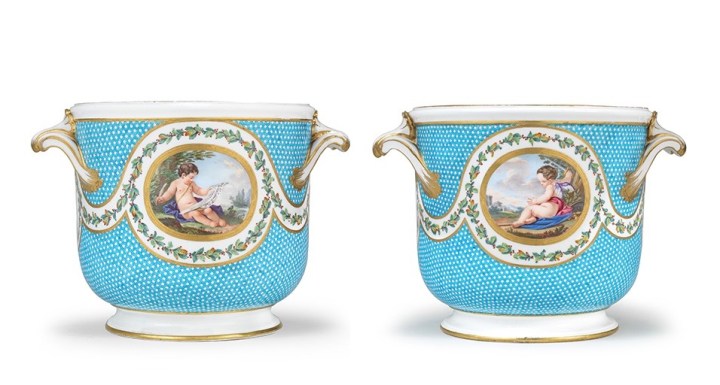
Pair of Sèvres bottle coolers (Seaux à bouteille) from a service for Madame du Barry, ca. 1770, each side reserved with a gilt-edged circular medallion depicting a seated putto in a landscape with attributes of Music, Poetry, War, and Peace–with the putto emblematic of Poetry holding a scroll with the inscription “Ode sur le mariage de M le Dauphin. le 16 May 1770” (Ode on the marriage of the Dauphin. the 16 May 1770).
◊ ◊ ◊ ◊ ◊
Press release, via Art Daily, for the sale at Bonhams:
Fine European Ceramics
Bonhams, London, 4 December 2019
An exceptionally rare pair of Sèvres bottle coolers from a service commissioned by Madame du Barry, the final maîtresse-en-titre of Louis XV, will be offered at Bonhams Fine European Ceramics sale in London on Wednesday, 4 December (lot 114). The pair is estimated at £60,000–80,000.
Madame du Barry (1743–1793) rose from humble origins as the illegitimate daughter of a seamstress to become the last, and with Madame de Pompadour, the greatest of the maîtresses-en-titre of Louis XV (The title refers to the chief mistress of the French Kings who enjoyed a semi-official position at court). Famed for her beauty among the ranks of high society courtesans, she caught the eye of Louis XV in 1768. The King procured a title for her through an arranged marriage with Comte Guillaume du Barry, and in 1769 she was officially presented to the court of Versailles. From then on she was regarded as the maîtresse-en-titre. Louis installed her in the Château de Louveciennes and in a suite of apartments directly below his own in Versailles itself. He also took the unusual step of including her in the private family gathering on the eve of the wedding of his son, the Dauphin and future Louis XVI, to Marie Antoinette.
The service was purchased by Madame du Barry in September 1770. Consisting of only 39 expensive and opulent pieces it was clearly intended as a status symbol, its use confined to intimate suppers with influential figures at court. An ode to the marriage of the Dauphin to Marie Antoinette inscribed on the coolers, can be interpreted as an attempt to curry favour and further cement her position at court. On Louis XV’s death in May 1774, du Barry was banished from court—Marie Antoinette famously disapproved of her, and for many years refused to acknowledge her presence. She eventually returned to Louveciennes, where she lived until her arrest in 1793 during the French Revolution. She was executed in December that year.
Bonhams Head of European Ceramics, Nette Megens said, “Pieces from this very select service made for Madame du Barry hardly ever appear on the market. There were only three bottle coolers in the service, and this pair offers collectors with a once in a lifetime opportunity.”

Lot 42 — Meissen silver-gilt mounted tankard with Chinoiserie decoration, ca. 1723–24.
Other highlights in the sale include:
• Lot 117 — A large Berlin porcelain vase given to Sir Andrew Buchanan by the King of Prussia, ca. 1859 (estimate £25,000–30,000). Distinguished 19th-century Scottish diplomat Sir Andrew Buchanan had an unusually wide-ranging career, and earned the gratitude not only of the British government, but also of the nations in which he served. The King of Prussia presented him with the magnificent Berlin vase; and the Danish king Frederick VII gave him a service of 18 plates by the Royal Copenhagen factory, with scenes after famous designs by Berthel Thorvaldsen. These are also in the sale (lot 121) , estimated at £10,000–15,000.
• Lot 42 — A rare Meissen silver-gilt mounted tankard with Chinoiserie decoration, ca. 1723–24 (estimate £20,000–30,000). This piece is from private European collection and shows the very best of chinoiserie painting and gilding on early Meissen porcelain.
• Lot 105 — A Nymphenburg Commedia dell’Arte figure of Mezzetin dressed as a Harlequin, ca. 1760–65 (estimate: £30,000–50,000). This figure is traditionally paired with another Commedia dell’Arte figure, Lalage, who holds a bowl and a spoon, ready to feed the ‘infant’ in Mezzetin’s arms (actually a monkey dressed as a baby).
New Book | The Mobility of People and Things
From Routledge:
Elisabeth A. Fraser, ed., The Mobility of People and Things in the Early Modern Mediterranean: The Art of Travel (New York: Routledge, 2019), 160 pages, ISBN: 978-1138488083, $150.
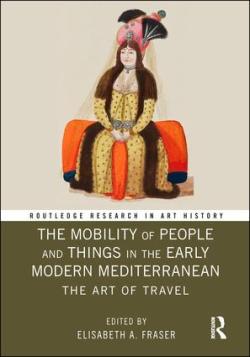 For centuries artists, diplomats, and merchants served as cultural intermediaries in the Mediterranean. Stationed in port cities and other entrepôts of the Mediterranean, these go-betweens forged intercultural connections even as they negotiated and sometimes promoted cultural misunderstandings. They also moved objects of all kinds across time and space. This volume considers how the mobility of art and material culture is intertwined with greater Mediterranean networks from 1580 to 1880. Contributors see the movement of people and objects as transformational, emphasizing the trajectory of objects over single points of origin, multiplicity over unity, and mutability over stasis.
Elisabeth A. Fraser is Professor of Art History at the University of South Florida, Tampa.
C O N T E N T S
List of figures
List of Plates
Chapter Abstracts
Elisabeth Fraser, Introduction
1 Sylvia Houghteling, ‘From Scorching Spain and Freezing Muscovy’: English Embroidery and Early Modern Mediterranean Trade
2 Meredith Martin and Gillian Weiss, A Tale of Two Guns: Maritime Weaponry between France and Algiers
3 Julia Landweber, Furnishing the Taste for Coffee in Early Modern France
4 Ashley Dimmig, Substitutes and Souvenirs: Reliving Polish Victory in ‘Turkish’ Tents
5 Elisabeth Fraser, The Ottoman Costume Album as Mobile Object and Agent of Contact
6 Leyla Belkaïd-Neri, Entangled Styles: Mediterranean Migration and Dress in Pre-Modern Algiers
7 Michèle Hannoosh, The Art of Wandering: Alexander Svoboda and Photography in the Nineteenth-Century Mediterranean
Contributor Biographies
Index
Exhibition | The Golden Age of English Painting
Press release for the exhibition:
The Golden Age of English Painting: From Reynolds to Turner
L’âge d’or de la peinture anglaise: De Reynolds à Turner
Musée du Luxembourg, Paris, 11 September 2019 — 16 February 2020
Curated by Martin Myrone and Cécile Maisonneuve
This exhibition, showing a selection of masterpieces from Tate Britain, highlights a key period in the history of painting in England, from the 1760s to around 1820, capturing the originality and diversity of the period. It takes visitors from the founding of the Royal Academy, with artists such as Reynolds and Gainsborough, to the turning point in the early 19th century, notably with Turner. The public will rediscover the great classics of British art here, all too rarely exhibited in France.
 The reign of George III was preponderant for British art, with the founding of the Royal Academy of Arts, of which Joshua Reynolds (1723–1792), was the first president at the height of his career. This period also saw Thomas Gainsborough (1727–1788) join the Academy. In their own ways, Reynolds and Gainsborough, both masters of portraiture, brought novel visual and intellectual innovations to the genre, honouring the great masters while reinventing the wheel. With signs of an artistic golden age booming, this movement was also supported by major players in trade and industry, and then by the king himself.
The exhibition tackles the confrontation of the two portrait painters, through full-length paintings and intimate studies of members of the royal family or personalities of the day. Reynolds’s intellectual ambitions contrast with Gainsborough’s pictorial ease. Redefining British art alone, they raised the next generation to new heights. A selection of major portraits by their competitors and/or followers, such as John Hopper, William Beechey, and Thomas Lawrence, recall the influence of these two precursors. The exhibition also addresses the themes of lineage, family, and home with the genre painting that gave birth to a new approach to childhood. Reynolds’s extraordinary portrait The Archers puts the concept of wilderness at the service of a heroic representation of the British ruling class, while Gainsborough, George Stubbs, and George Morland focus their attention on the picturesque, through paintings depicting everyday life, especially in rural areas.
With the political and commercial exploitation of overseas territories as the basis for artistic progress, part of the exhibition addresses the presence of Great Britain in India and the Caribbean. Another section discusses the tremendous growth of watercolour, which allowed many artists to stand out by meeting the needs of a new amateur society. The last part of the exhibition shows how British artists such as Henri Fuseli, John Martin, P.J. de Loutherbourg, and J.M.W. Turner sublimated narrative figuration, paving the way for a new conception of art as a support for the imaginary.
Amandine Rabier, L’âge d’or de la peinture anglaise (Paris: Gallimard / Réunion des musées nationaux, 2019), 56 pages, ISBN: 978-2072859595, 10€.
Call for Papers | Ordering Colours
From ArtHist.net:
Ordering Colours in 18th- and Early 19th-Century Europe
Technische Universität Berlin, Chair for the History of Science, 13–14 March 2020
Proposals due by 30 November 2019
The question of how to order colours reaches far back, but in the 18th century, particularly in its second half, we see a steeply increasing number of studies that indicates a broad and urgent interest in classifying colour. Quite diverse contributions from the sciences, arts, crafts, and trade created a diverse field of colour order research in the 18th century. The workshop will explore, examine, and discuss those efforts and hereby contribute to the history of color in 18th- and early 19th-century Europe. Proposals from other epochs are welcome when focussing on or crossing substantially the 18th or early 19th centuries; for instance the revival of antique knowledge/ ideas. While focussing on Europe, the workshop also welcomes studies of other cultural regions. The workshop will be opened by a keynote talk by Jose Luis Caivano (Buenos Aires).
According to the multidisciplinary historical approaches, we invite contributions from the history of arts, artisanry, economy, technology, science as well as scholars from restoration, cultural, and material studies. Work in progress contributions are as welcome as finalized results. There might be detailed case studies, but also comparative, long-term and cross-sectional studies on the history of materials, objects, practices, theories, or ideas. Through all the bewildering variety of colour research of that period, the focus of the workshop will be on the attempts of ordering or even systematizing colours.
Topics might include, among others
• Colour samples, colour ordered objects, colour selections, colour collections, and colour atlases
• Colour diagrams: illustrations, papertools
• Colour codes, colour nomenclatures, colour references, and colour systems
• Colour experiments
• Early colour print and the trichromatic idea
• Discussion about colour primaries
• Natural history and colour
• Mining, chemistry, and colour knowledge
• Colour materials: porcelain, dyes, Indian / inks
• Commercial and theoretical interest in colour orders: developers, producers, traders
• Exchange of colour knowledge and objects in Europe: networks, connectors, translators, hotspots, and peripheries.
Please send your proposal in English (up to 350 words) before 30th November 2019 to tanja.kleinwaechter@tu-berlin.de. Notification of acceptance will be given by 22nd December.
Conference | Cardinal Alessandro Albani
From ArtHist.net:
Cardinal Alessandro Albani: Collecting, Dealing, and Diplomacy in Grand Tour Europe
Collezionismo, diplomazia ed il mercato nell’Europa del Grand Tour
British School at Rome / Biblioteca Nazionale Centrale, 11–13 December 2019
Organised by Clare Hornsby and Mario Bevilacqua
The British School at Rome and the Centro di Studi sulla Cultura e l’Immagine di Roma present Cardinal Alessandro Albani: Collecting, Dealing, and Diplomacy in Grand Tour Europe. Exploring the multifaceted life and career of Cardinal Alessandro Albani (1692–1779), the conference will bring together an international range of art historians alongside scholars of related humanistic disciplines to open a new chapter on the multifaceted life and career of the ‘Father of the Grand Tour’.
The two keynote lectures on Wednesday evening, 11th December at BSR, will be given by the noted senior scholars Carlo Gasparri and Salvatore Settis, curators of The Torlonia Marbles: Collecting Masterpieces, the spring 2020 exhibition of antique sculpture from the famed collections of the Torlonia family in Rome who own the Villa Albani Torlonia and the antiquities collected there by Cardinal Alessandro Albani.
The conference has groups of papers on different themes relating to Alessandro Albani’s life and career including his private life, his association with scholars and artists—particularly Johann Joachim Winckelmann and Giovanni Battista Piranesi, his diplomatic and political associations, his dealing and networking in the European art market and of course his antiquities collections—both those he sold and his third collection which remains largely intact at Villa Albani Torlonia in Rome. His particular connection with the British—both as Grand Tourists in Rome and politically as allies of the papacy —is a focus of this conference, notably the sale of his vast drawings collection including the Cassiano del Pozzo ‘Paper Museum’ to the English King George III through the dealing efforts of the architect brothers Robert and James Adam. His commission to the architect Carlo Marchionni for the new Villa outside the northern walls of Rome to house his collection and as a location to host parties for foreign dignitaries is also examined.
This conference is taking place only a few months before the long-awaited exhibition of the private Torlonia collection opens in Rome—a collection where many Albani objects have been kept—no doubt this gathering of researchers including both established and younger scholars from a variety of disciplines and international backgrounds will provide a valuable focus for discussion of the future directions for study and research on this most important figure of the Roman 18th century.
On Thursday 12th at BSR there will be a presentation by Adriano Aymonino and Colin Thom introducing the Adam letters digital publication project and a display of Albani-related rare books and early photographs of Villa Albani from the BSR library and archive collections alongside the volumes of The Paper Museum of Cassiano del Pozzo: A Catalogue Raisonné, published by the Royal Collection Trust.
The conference is open to all without charge; registration is welcome though not obligatory: albaniconvegno@gmail.com. An edited and expanded volume of essays based on the conference papers is planned. The conference is generously sponsored by The Paul Mellon Centre for Studies in British Art and we thank our partners the Biblioteca Nazionale Centrale di Roma, the Fondazione Torlonia, and the Royal Collection Trust.
Conference Coordination
Mario Bevilacqua, Direttore, Centro di Studi sulla Cultura e l’Immagine di Roma
Clare Hornsby, Research Fellow, British School at Rome
Honorary Committee
Elisa Debenedetti, Andrea De Pasquale, Marcello Fagiolo, Carlo Gasparri, Barbara Jatta,
Tim Knox, Maria Vittoria Marini Clarelli, Stephen Milner, Martin Postle.
Scientific Committee
Mario Bevilacqua, Amanda Claridge, Clare Hornsby, Ian Jenkins, Harriet O’Neill,
Susanna Pasquali, Jonny Yarker
W E D N E S D A Y , 1 1 D E C E M B E R 2 0 1 9
British School at Rome
18.00 Stephen Milner (Director BSR), Welcome
18.15 Keynote Address
• Carlo Gasparri, La collezione di sculture antiche in Villa Albani a Roma: Una storia ancora da scrivere
18.40 Keynote Address
• Salvatore Settis, Lo specchio dei principi: Fra Villa Albani e il Museo Torlonia
T H U R S D A Y , 1 2 D E C E M B E R 2 0 1 9
British School at Rome
9.30 Social and Cultural History
Chair: Adriano Aymonino
• Angela Cipriani, Il cardinale Alessandro Albani nei manoscritti del Diario di Romannella Biblioteca Casanatense, 1762–73
• Heather Hyde Minor, Winckelmann and Albani: Text and Pretext
• Ginevra Odone, Rivalità e gelosie tra antiquari: Il Conte di Caylus, il cardinale Alessandro Albani e i loro intermediari
• Brigitte Kuhn-Forte, Alessandro Albani e Winckelmann
10.45 Discussion and coffee break
11.30 Art and Diplomacy
Chair: Susanna Pasquali
• Maëlig Chauvin, Il cardinale Alessandro Albani e i regali diplomatici: l’arte al servizio della politica
• Susanne Mueller-Bechtel, Il principe ereditario di Sassonia Federico Cristiano, Alessandro Albani e le arti
• Matteo Borchia, I vantaggi della diplomazia: Alessandro Albani protettore di artisti tra Roma e l’Europa
12.15 Discussion followed by a lunch break
14.00 Art and Collecting: Museo Cartaceo
Chair: Clare Hornsby
• Adriano Aymonino and Colin Thom, Introducing the Adam Letters Project
• Lisa Beaven, Fashioning a New Classical Aesthetic: Camillo Massimo, Alessandro Albani, and the Palace at the Quattro Fontane
• Francesca Favaro, Il privilegio di copiare: Apprendere l’architettura nella biblioteca di Alessandro Albani. Le copie prodotte da B.A. Vittone (1704–1770)
• Rea Alexandratos, Albani Drawings and Prints in the British Royal Collection: George III’s Purchase of 1762
15.15 Discussion and coffee break
16.00 Painting
Chair: Maria Celeste Cola
• Robin Simon, The Significance of Alessandro Albani’s Patronage of Richard Wilson
• Steffi Roettgen, ‘Noi non siamo venuti che per vedere il Parnasso di Mengs’: Note sul complesso rapporto del pittore sassone con il cardinale Albani
17.00 Discussion and close
F R I D A Y , 1 3 D E C E M B E R 2 0 1 9
Biblioteca Nazionale Centrale
9.30 Archives, Library, and Literature
Chair: Andrea de Pasquale
• Andrea de Pasquale, Introduction to the session
• Alviera Bussotti, Alessandro Albani mecenate delle lettere
• Brunella Paolini, Alessandro Albani nell’archivio di famiglia di Villa Imperiale a Pesaro
• Antonio Becchi, Bibliotheca Albana Romana: Documenti inediti e prospettive di ricerca
10.30 Discussion and coffee break
11.15 Architecture: Villa and Architect
Chair: Marcello Fagiolo
• Susanna Pasquali, Phases of Construction at Villa Albani: What We Know So Far
• Patricia Baker and Giacomo Savani, ‘Contriv’d according to the strictest Rules of Art’: The Reception of Roman Baths and Gardens at Villa Albani
• Elisa Debenedetti, ‘Studi sul Settecento Romano’: Villa Albani nei Taccuini di Carlo Marchionni
• Alessandro Spila, Carlo Marchionni a villa Albani: Una possibile evoluzione progettuale
12.30 Discussion followed by a lunch break
14.00 Archaeology and Antiquarianism
Chair: Carlo Gasparri
• Eloisa Dodero, Da Palazzo Albani alle Quattro Fontane al Museo Capitolino: La nuova vita della collezione del cardinale Alessandro
• Caroline Barron, The Epigraphic Collection of Cardinal Alessandro Albani
• Elizabeth Bartman, Alessandro Albani as Restorer
• Christoph Frank, Drawing the Albani Collection: Giovanni Battista Piranesi and Some of His Contemporaries
16.30 Discussion and close
Exhibition | The Torlonia Marbles
From the Fondazione Torlonia . . . (In 1866 the Torlonia family bought the Villa Albani and its collection):
The Torlonia Marbles: Collecting Masterpieces
Musei Capitolini at Palazzo Caffarelli, Rome, 25 March 2020 — 10 January 2021
Curated by Carlo Gasparri and Salvatore Settis
From 25 March 2020 to 10 January 2021, ninety-six marbles from the Torlonia Collection will be on view to the public at a major show in Rome, in the new exhibition venue of the Musei Capitolini at Palazzo Caffarelli. The exhibition The Torlonia Marbles: Collecting Masterpieces is the first step of the agreement signed the 15th of March 2016 between the Ministry for the Cultural Heritage Activities and Tourism and the Torlonia Foundation, and is a result of the institutional agreement signed by the Directorate General for Archaeology, Fine Arts and Landscape and the Special Superintendency of Rome with the Torlonia Foundation itself. The scientific project for enhancing the collection is entrusted to Salvatore Settis, who is curating the exhibition with Carlo Gasparri; both are archaeologists and academics of the Accademia dei Lincei. The exhibition is organized by Electa, publisher of the catalog. The sculptures selected have been restored thanks to the contribution of Bvlgari.
This will be the opportunity to inaugurate the new prestigious exhibition venue in Roma Capitale of the Musei Capitolini at Palazzo Caffarelli. The choice of the location was dictated by the intention to focus the exhibition on the history of collecting. In this respect, the history of the Torlonia Museum at the Lungara (founded by Prince Alessandro Torlonia in 1875), with its 620 catalogued works of art, appears of outstanding importance. This collection is the result of a long series of acquisitions and some significant shift of sculptures between the various residences of the family. We can even say that the Torlonia Marbles constitute a collection of collections or rather a highly representative and privileged cross-section of the history of the collecting of antiquities in Rome from the 15th to the 19th centuries. The items on display are not only outstanding examples of ancient sculpture (busts, reliefs, statues, sarcophagi, and decorative elements), but also a reflection of a cultural process—the beginnings of the collecting of antiquities and the crucially important transition from the collection to the Museum, a process where Rome and Italy have had an indisputable primacy. In this way the exhibition traces the formation of the Torlonia Collection. The last of its five sections eloquently relates to the adjacent exedra of bronzes and the statue of Marcus Aurelius in the Musei Capitolini, bringing out the ties between the beginnings of private collecting of antiquities and the significance of the donation of the Lateran bronzes to the city of Rome by Sixtus IV in 1471.
The project to organize the exhibition of the Torlonia Collection in the renovated spaces of the new venue of the Musei Capitolini at Palazzo Caffarelli, restored to life by David Chipperfield Architects Milan. The March 2020 event is the first stage of a traveling exhibition, for which agreements are in progress with major international museums and which will conclude with the identification of permanent exhibition spaces for the opening of a new Torlonia Museum.
Also see the article by Elisabetta Povoledo from The New York Times (28 October 2019).
Nationalmuseum Acquires Two Self-portraits by Joseph Ducreux

Press release (8 November 2019) from Sweden’s Nationalmuseum:
Nationalmuseum has acquired two physiognomic self-portraits painted by the French artist, Joseph Ducreux, one of the foremost artists at the court of Louis XVI. Ducreux’s portraiture exhibits strong influences of naturalism and is characterized by the artist’s ability to capture a specific facial expression or emotional state. He shares this ability with the Austrian artist, Franz Xaver Messerschmidt.
Joseph Ducreux (1735–1802) was likely a student of Maurice Quentin de la Tour (1704–1788). The real launch of Ducreux’s career came when he was commissioned to paint a portrait of Marie Antoinette (1755–1793). In order to discover how the future French crown princess looked, the artist was sent to Vienna in 1769 with a commission to depict her. The result was so successful that Ducreux was subsequently made a baron and was given the title of ‘premier peintre de la reine‘.

Joseph Ducreux, ‘Self-Portrait, Silence’, 1790s, oil on canvas (Stockholm: Nationalmuseum, 7495; photo by Anna Danielsson).
Because of this closeness to the royal family, and more particularly, the queen, Ducreux found himself in a perilous situation in the years immediately following the start of the French Revolution in 1789. He therefore took up residence in London during a period some time in 1791. There are few facts about Ducreux’s activities during this brief period, but we know that he exhibited portraits and self-portraits at the Royal Academy of Arts, including two that were called Surprise mixte [sic] with Terror and Surprise, respectively. Most likely, one of the portraits that Nationalmuseum has now acquired was a later version of the first of the two aforementioned works that had been exhibited in London. The facial expression of the artist is permeated with exaggerated surprise mixed with terror, as shown in his large eyes, gaping mouth and dramatically extended right hand. There is no doubt that these works are self-portraits, but their titles, which describe emotions, such as surprise, show that they were also intended to focus on physiognomy as a phenomenon, in itself.
The fact that Ducreux could return to Paris so soon, was most likely due to his acquaintance with Jacques-Louis David (1748–1825), the foremost artist of the Revolution. By August 1791, he once again exhibited his work in the Salon in Paris. One example is a work that the catalogue calls Silence, which is currently in the collection of the Spencer Museum of Art in Kansas. Ducreux’s expressive oil portraits, however, were met with both praise and scorn, but regardless garnered a great deal of notoriety, which, in turn, increased the demand for additional works of this sort. Nationalmuseum’s Silence is probably a later version by Ducreux of the work exhibited at the Salon. The artist is portrayed with a powdered wig, a top hat and a brown coat. As often was the case, some of the powder is seen on the artist’s shoulders and coat collar. The portrait depicts his upper body in profile, but the head is turned to the viewer. His right index finger is lifted to his mouth to clearly communicate the need to keep silent.
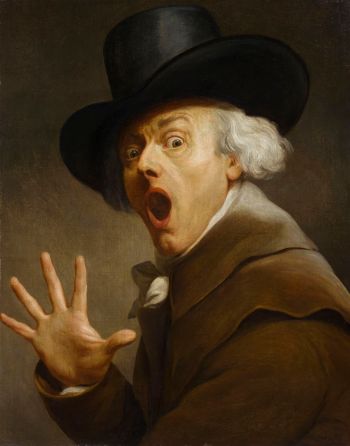
Joseph Ducreux, ‘Self-Portrait, Surprise’, 1790s, oil on canvas (Stockholm: Nationalmuseum, 7496; photo by Anna Danielsson).
Ducreux’s interest in physiognomy reflects his time and can more generally be indicative of the favourite scientific theme of the Enlightenment. By combining an expressly physiognomic perspective with a self-portrait, this work may well be viewed as having laid the foundation for new directions in portraiture. This is in no way any kind of caricature, but neither does it any longer have anything of the formal and serious nature of traditional portraiture. Ducreux has attempted to capture in himself, facial expressions that we can see every day, on people, in general. It is perhaps not at all surprising that one of Ducreux’s self-portraits of this type has now become a popular on-line meme, which, in itself, shows this artist’s timeless playfulness and desire to experiment
“Nationalmuseum is happy to have been able to acquire these exceptional works, which are so characteristic of Joseph Ducreux’s self-portraits,” declares Daniel Prytz, curator at Nationalmuseum.
The newly acquired portraits by Ducreux can now be viewed, in the Museum’s presentation of its collections in one of the recently remodelled small rooms with 18th-century art, which now includes portraits from the period of the French Revolution.
Nationalmuseum receives no state funding with which to acquire design, applied art and artwork; instead the collections are enriched through donations and gifts from private foundations and funds. The acquisition has been made possible through a contribution by the Sophia Giesecke Foundation.
Call for Essays | Thomas Aquinas and His Images
Thomas Aquinas and His Images
Edited by Claire Rousseau and Émilie Roffidal
Proposals due by 15 June 2020

Michel Serre (1658–1733), Thomas Aquinas Trampling Heresy, Basilica of Mary Magdalene, Saint-Maximin-la-Sainte-Baume, Var.
On the occasion of the double centennial of Thomas Aquinas (1225–1274)—with 2023 marking the 7th centennial of his canonization and 2025 the 8th centennial of his birth—and in parallel with events pertaining to the philosophical and theological approach of the ‘angelic doctor’, this publication aims at questioning pictorial representations of the saint. Thomas Aquinas’s innovative work is a link in the transmission of ancient philosophy and early theology’s heritage and has marked European intellectual thought throughout the centuries (with the Summa Theologiae and Summa contra Gentiles, to name just the most famous of his works). The numerous depictions of this extraordinary Dominican answer various purposes: glorification of the Order founded by Saint Dominic through one of its most remarkable figures, hagiographic processes, bringing the devotion of the Blessed Sacrament to the fore via the composer of the Roman office of Corpus Christi, particular devotions, etc.
The proposed publication addresses three themes:
• the doctor: the figure of the intellectual, of the theologian
• the depiction of his virtues
• his canonization
We expect papers offering cross-cutting approaches as well as case studies (paintings, sculptures, or engravings) highlighting the specific features of the iconography proper to Thomas Aquinas, or on the contrary its inscription in traditional schemes of representation (inspired writer, ecstatic saint, etc.). The envisioned chronology covers the long period stretching from the 15th to the 20th century, as well as areas as diverse as Europe or South America (and more).
Schedule
• 15th of June 2020 at the latest: proposals due with title, summary, and bio-bibliographical presentation of the author.
• November 2021: final essays due (35,000 characters at most, 3/4 free of rights photos). The text can be written in French, English, or Italian.
Proposals are to be sent to: Claire Rousseau ParisIV-Sorbonne (maison.seilhan@gmail.com) and Émilie Roffidal CNRS-UT2J (emilie.roffidal@univ-tlse2.fr)
Publisher: Angelicum University Press Roma
Fellowships | Morgan Drawing Institute

From The Morgan:
Morgan Drawing Institute Fellowships
The Morgan Library & Museum, New York, 2020–21
Applications due by 19 November 2019
We would like to remind you of our annual fellowships in the Morgan Drawing Institute. This year we are offering three fellowships: the Samuel H. Kress Predoctoral Fellowship, the Postdoctoral Fellowship, and the Morgan-Menil Fellowship. Fellowship information and applications can be found on the Call for Applications page. All application materials must be submitted online.
Samuel H. Kress Predoctoral Fellowship
The Drawing Institute will award one nine-month Samuel H. Kress Predoctoral Fellowship to an advanced-level graduate student who has completed all course work and exams and is currently engaged in carrying out research leading to the completion of a doctoral dissertation in the history of art, some component of which pertains to the history, theory, collecting, function or interpretation of old master and/or modern drawings.
The Drawing Institute will award one nine-month Postdoctoral Fellowship to a scholar in the first decade of their career following the completion of the Ph.D. or equivalent advanced degree. The Postdoctoral Fellowship supports work on an independent research project relating to some aspect of the history, theory, collecting, function or interpretation of old master and/or modern drawings.
The Drawing Institute and the Menil Drawing Institute, Houston, will award one fellowship of four to six months to support research projects on some aspect of the history, theory, interpretation, or cultural meaning of drawing throughout the history of art. Preference will be given to projects that would benefit from the resources of the Morgan Library & Museum and the Menil Collection.
Belle da Costa Greene Curatorial Fellowships
From The Morgan:
Belle da Costa Greene Curatorial Fellowships
The Morgan Library & Museum, New York
Applications due by 31 December 2019
The Morgan Library & Museum announces the creation of two new two-year curatorial fellowships, the Belle da Costa Greene Curatorial Fellowships, to be awarded to promising scholars from communities historically underrepresented in the curatorial and special collections fields. Named for the Morgan’s first director, one of the most prominent American librarians and cultural leaders of the first half of the twentieth century and a woman of color, this full-time program will equip Fellows with a strong working knowledge of museum and special collections library operations and will provide Fellows with resources and mentorship to support them in their professional careers.
The Morgan seeks candidates who are interested in working on specific projects as outlined below. The program will provide Fellows with experience in a variety of core curatorial activities, such as exhibition and publications planning, research on the collection and on potential acquisitions, the creation of public programs, and donor relations. Fellows will also have the opportunity to propose and curate their own installation in the museum. Fellows will join all departmental meetings as well as the Morgan’s Curatorial Forum, a monthly gathering of all curators and conservators. Regular interaction with colleagues in other departments, including the Thaw Conservation Center, will give each Fellow a good grounding in the key functional areas of a museum and special collections library. Travel funds will support Fellows’ professional development.
Graduate degree in relevant field or equivalent professional experience required. General qualifications include experience conducting archival research using primary sources, deep intellectual curiosity and versatility, and a demonstrated ability to work independently, collaboratively, and efficiently. Candidates should have excellent writing and public speaking skills.
Fellows will be selected on a competitive basis via an application process. All application materials must be in English. Applications consisting of the following elements are due by December 31, 2019. The Morgan will notify successful candidates of their selection in March 2020.
Applicants for the fellowship should describe their specific interests in, and qualifications for one or more possible departments:
Drawings and Prints
The Department of Drawings and Prints seeks a Fellow to work on one of a number of future exhibitions, depending upon the potential Fellow’s expertise: Claude Gillot and eighteenth-century French art; the drawings of Pierre-Auguste Renoir; a project focusing on art in seventeenth-century Rome; or a project looking at the work of Hendrick Goltzius and other northern artists around the year 1600. The Fellow would also take part in the research on the permanent collection and/or potential acquisitions and would have the opportunity to mount a small installation based on the Fellow’s specialty. Candidates should hold or be in pursuit of an advanced degree in the history of art (PhD preferred). Other qualifications include superior research skills and a documented interest in works on paper.
Information on other departments’ needs and details for applying are available here»










 Enfilade
leave a comment