Print Quarterly, December 2019
The eighteenth century in the current issue of Print Quarterly:
Print Quarterly 36.4 (December 2019)

Étienne Fessard and Augustin de Saint-Aubin, after Charles Natoire, Gaetano Brunetti, and Paolo Antonio Brunetti, Perspective View of the Chapel of Enfants Trouvés in Paris, 1759, etching and engraving, sheet (trimmed) 80 × 59 cm (New York, Metropolitan Museum of Art).
A R T I C L E S
Rena M. Hoisington, “Étienne Fessard’s Prints of the Chapel of the Hôpital des Enfants Trouvés in Paris,” pp. 404–25.
Soon after Charles Natoire (1700–1777) completed his cycle of paintings for the Chapel of the Hôpital des Enfants Trouvés in Paris, Fessard announced a subscription plan for a series of prints reproducing them. Often addressed merely for their documentary value, these prints are here analysed as objects in themselves. The article explores their complex publication history and assesses them in the context of Fessard’s career. Also analysed is the series’ repercussion on the reputation of the artists involved in their realization, Natoire included.
N O T E S A N D R E V I E W S
Colin Harrison, Review of Peter Whitfield, Oxford in Prints: 1675–1900 (Bodleian Library, 2016), p. 448.
The book explores how Oxford has been pictured between 1675 and 1922 by illustrating a selection of volumes in the collection of the Bodleian Library. The largest group consists of almanacks printed by the University, which took their definitive format of a topographical headpiece with a calendar beneath in the early eighteenth century.
Jean Michel Massing, Review of Cheryl Finley, Committed to Memory: The Art of the Slave Ship Icon (Princeton University Press, 2018), p. 484–88.
The book “focuses on the life, and afterlife, of famous anti-slavery icon,” the 1788 engraved Plan of an African Ship’s lower Deck with Negroes in the proportion of only one to a Ton (484). Part One “considers abolitionist slave ship prints from the period 1788 to 1900; the remainder of the book is devoted to their stature as an icon reappropriated by twentieth-century African American, British and African artists” (488).
P U B L I C A T I O N S R E C E I V E D
Mungo Campbell and Nathan Flis, eds., William Hunter and the Anatomy of the Modern Museum, exhibition catalogue (Yale Center for British Art, and The Hunterian, University of Glasgow, in association with Yale University Press, 2018), p. 472.
Exhibition | Portraying Pregnancy
From the press release for the exhibition:
Portraying Pregnancy: From Holbein to Social Media
The Foundling Museum, London, 24 January — 26 April 2020
Curated by Karen Hearn
Th e Foundling Museum is proud to present the first major exhibition to explore representations of the pregnant female body through portraits from the past 500 years, Portraying Pregnancy: From Holbein to Social Media, which opens on 24 January 2020.
Until the twentieth century, many women spent most of their adult years pregnant. Despite this, pregnancies are seldom made apparent in surviving portraits. This exhibition brings together images of women—mainly British—who were depicted at a time when they were expecting (whether visibly so or not). Through paintings, prints, photographs, objects, and clothing from the fifteenth century to the present day, Portraying Pregnancy explores the different ways in which pregnancy was, or was not, represented; how shifting social attitudes have impacted on depictions of pregnant women; how the possibility of death in childbirth brought additional tension to such representations; and how more recent images, which often reflect increased female agency and empowerment, still remain highly charged. This exhibition is the first of its kind and provides an exceptional opportunity to situate contemporary issues of women’s equality and autonomy in a 500-year context.
The earliest portrait featured in the exhibition—and a major highlight—is Hans Holbein II’s beautiful drawing of Sir Thomas More’s daughter, Cicely Heron, made in 1526–27, lent by Her Majesty The Queen from the Royal Collection. Sketched from life, it is a rare, clear-eyed, observation of a pregnant woman. In many pre-twentieth-century works in the exhibition, however, the sitter’s pregnancy has been edited out. The mezzotint made after Sir Joshua Reynolds’s full-length portrait of Theresa Parker, for example, shows no visible sign of her pregnancy, in line with conventions of the time, despite rich documentary evidence that by her second sitting in February 1772, Theresa was heavily pregnant.
Today, women with access to birth control can expect to plan if, or when, they become pregnant. Prior to the 1960s, many women would have experienced, between marriage and menopause, a number of pregnancies—and their daily lives might alter little for most of the gestation period. This is exemplified in a portrait of the celebrated eighteenth-century actress, Sarah Siddons, shown in the role of Lady Macbeth, which she famously played up until the final weeks of pregnancy.
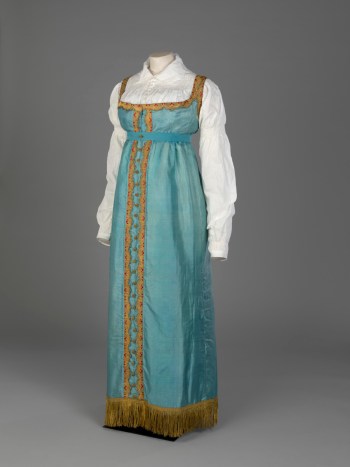
Russian style dress belonging to Princess Charlotte, ca. 1817, silk, gold, metallic and silk lace, gold metallic fringe (Royal Collection Trust, 74709).
Fear of dying in childbirth was very real, and often justified. Until the early twentieth century, most births took place at home, often attended by family members, and consequently many women witnessed death in childbirth. Elizabethan and Jacobean portraits of visibly pregnant women, such as Marcus Gheeraerts II’s portrait of a heavily-pregnant unknown woman, dated 1620, appeared in the same era as the ‘mother’s legacy’ text—in which a woman wrote a ‘letter’ for the benefit of her unborn child, in case she should not survive her confinement. An example is the manuscript that the well-educated Elizabeth Joscelin wrote in 1622 for the child that she was carrying. Maternal mortality is also powerfully represented by George Dawe’s 1817 portrait of the pregnant Princess Charlotte, the heir to the British throne, wearing a fashionable loose ‘sarafan’ dress, as well as by the actual surviving garment, lent by Her Majesty The Queen from the Royal Collection, which will be displayed alongside it. Charlotte died in childbirth, in November that year.
While Christianity played a central role in everyday life, conceiving a baby (or not), was seen as a gift from God. Historically, the New Testament story of The Visitation—the meeting of the pregnant Virgin Mary and her cousin, Elizabeth—was a particularly inspiring and comforting one for pregnant women. Images of it had been widespread in England prior to the sixteenth- century Reformation, and reappeared in the late nineteenth and early twentieth centuries. The Pre-Raphaelite artists’ doctrine of absolute realism saw them model their depictions of it on pregnant women among their own social circle.
Augustus John’s ca. 1901 full-length portrait of his wife, Ida, must have seemed astonishingly transgressive to viewers at the time, as it clearly depicts her as pregnant. It was not until the later twentieth century that pregnancy stopped being ‘airbrushed out’ of portraits. In 1984, the British painter, Ghislaine Howard, produced a powerful self-portrait of herself as heavily pregnant. However, the watershed moment occurred internationally in August 1991, when Annie Leibovitz’s photographic portrait of the actress, Demi Moore, naked and seven months pregnant, appeared on the cover of Vanity Fair magazine. This image was considered so shocking that some retailers refused to stock the issue. Nevertheless, it marked a culture shift and initiated the trend for more visible celebrations of pregnant bodies—especially nude ones. In 2017, Leibovitz returned to the theme, photographing the pregnant tennis champion, Serena Williams, naked, for Vanity Fair’s August cover.
The final photograph in the exhibition, by Awol Erizku, was commissioned by the singer, Beyoncé Knowles, who posted it on Instagram on 1 February 2017. Erizku’s iconographically complex portrait of Beyoncé, pregnant with twins, veiled and kneeling in front of a screen of flowers, became the most liked Instagram post of that year. Beyoncé’s image powerfully demonstrates how some women have succeeded in taking ownership not just of representations of their pregnant bodies, but also the distribution of their portraits.
This exhibition, curated by Professor Karen Hearn FSA, previously the curator of sixteenth- and seventeenth-century British art at Tate Britain (1992–2012) and now Honorary Professor at University College London, is the first of its kind and provides an exceptional opportunity to situate contemporary issues of women’s equality and autonomy in a 500-year context; it forms part of the Foundling Museum’s ongoing programme of exhibiting art that reflects its mission to celebrate the power of individuals and the arts to change lives. The exhibition is supported by the Drapers’ Company, Norland College and the 1739 Club.
Karen Hearn, Portraying Pregnancy: Holbein to Social Media (London: Paul Holberton, 2020), 112 pages, ISBN: 978-1911300809, £18.
Blake’s ‘Ancient of Days’ on St. Paul’s Dome

A reproduction of William Blake’s The Ancient of Days from 1827 projected by Tate Britain onto St Paul’s Cathedral in London, 2019
(Photo by Alex Wojcik for Tate)
◊ ◊ ◊ ◊ ◊
There’s one more night to see Blake’s Ancient of Days projected onto the London skyline; the Tate Britain exhibition is on view until February 2; from the Tate press release (28 November 2019). . .
William Blake’s final masterpiece will illuminate the iconic dome of St Paul’s Cathedral to celebrate the artist’s birthday. The dramatic illustration The Ancient of Days (1827) was described by Blake as “the best I have ever finished” and will be visible across London this weekend. Tate Britain is currently staging the UK’s largest survey of works by Blake for a generation and has collaborated with St Paul’s Cathedral—home to the most visited Blake memorial in the UK—to recreate his vision on a monumental scale
Now renowned as a poet, Blake also had grand ambitions as a visual artist, proposing vast frescos that were never realised. Living and working in London for most of his life, the artist imagined adorning the walls of churches and public buildings in the city. The cityscape of London, dominated by St Paul’s Cathedral, inspired Blake’s powerful artworks and writing. His well-known poem Holy Thursday 1789 refers to “the high dome of Pauls.” Created as a frontispiece for the 1794 prophetic book Europe a Prophecy, The Ancient of Days is on loan to the exhibition at Tate Britain from the collection of the Whitworth, The University of Manchester and has become one of Blake’s best-known images. Through projections, Tate Britain will re-envision the small yet imposing illustration on an awe-inspiring scale, more than two centuries later.
Shaped by his personal struggles in a period of political terror and oppression, Blake’s radical beliefs meant he received little recognition in his own lifetime. November 28, 2019 would have been his 262nd birthday. In the almost two centuries since his death, Blake has become one of Britain’s most beloved artists and an inspiration to generations of musicians, writers, artists, and performers worldwide. Buried in relative obscurity in a common grave, the memorial to William Blake now installed in the crypt of St Paul’s Cathedral is visited by thousands each year.
Martin Myrone, Senior Curator, pre-1800 British Art, said: “Blake was an artist of gigantic imagination and vision, who has fired the creative ambition of generations. Seeing Blake’s work on a huge scale on this iconic building restores a sense of his towering presence in British culture.”
Paula Gooder, Chancellor of St Paul’s Cathedral, said: “St Paul’s Cathedral is delighted to continue our partnership with Tate by hosting this projection of The Ancient of Days onto the dome of the Cathedral. This collaboration is made even more special because of the memorial in our Crypt to William Blake. We hope that the projection of this iconic image will be an inspiration to all who see it.”
The projections will run from 28 November until 1 December 2019, from 16.30 until 21.00 each evening. The project has been realised by Tate in collaboration with St Paul’s Cathedral, projection partners EMF Technology Ltd, and with the kind support of the Whitworth Art Gallery, The City of London, City of London School, and animation director Sam Gainsborough. The exhibition William Blake at Tate Britain is curated by Martin Myrone, Senior Curator, pre-1800 British Art, and Amy Concannon, Curator, British Art 1790–1850.










 Enfilade
leave a comment