New Book | The Man of the People
From UP of Kansas:
Nathaniel Green, The Man of the People: Political Dissent and the Making of the American Presidency (Lawrence: University Press of Kansas: 2020), 408 pages, ISBN: 978-0700629954, $50.
 Donald Trump’s election has forced the United States to reckon with not only the political power of the presidency, but also how he and his supporters have used the office to advance their shared vision of America: one that is avowedly nationalist, and unrepentantly rooted in nativism and white supremacy. It might be easy to attribute this dark vision, and the presidency’s immense power to reflect and reinforce it, to the singular character of one particular president—but to do so, this book tells us, would be to ignore the critical role the American public played in making the president ‘the man of the people’ in the nation’s earliest decades.
Beginning with the public debate over whether to ratify the Constitution in 1787 and concluding with Andrew Jackson’s own contentious presidency, Nathaniel Green traces the origins of our conception of the president as the ultimate American: the exemplar of our collective national values, morals, and ‘character’. The public divisiveness over the presidency in these earliest years, he contends, forged the office into an incomparable symbol of an emerging American nationalism that cast white Americans as dissenters—lovers of liberty who were willing to mobilize against tyranny in all its forms, from foreign governments to black ‘enemies’ and Indian ‘savages’—even as it fomented partisan division that belied the promise of unity the presidency symbolized. With testimony from private letters, diaries, newspapers, and bills, Green documents the shaping of the disturbingly nationalistic vision that has given the presidency its symbolic power.
This argument is about a different time than our own. And yet it shows how this time, so often revered as a mythic ‘founding era’ from which America has precipitously declined, was in fact the birthplace of the president-centered nationalism that still defines the contours of politics to this day. The lessons of The Man of the People contextualize the political turmoil surrounding the presidency today. Never in modern US history have those lessons been more badly needed.
Nathaniel C. Green is professor of history at Northern Virginia Community College.
New Book | Aristocratic Education
From UNC Press:
Mark Boonshoft, Aristocratic Education and the Making of the American Republic (Chapel Hill: The University of North Carolina Press, 2020), 296 pages, ISBN: 978-1-469659541 (ebook), $23 / ISBN: 978-1469661360 (paperback), $30 / ISBN: 978-1469659534 (hardcover), $95.
 Following the American Revolution, it was a cliché that the new republic’s future depended on widespread, informed citizenship. However, instead of immediately creating the common schools–accessible, elementary education—that seemed necessary to create such a citizenry, the Federalists in power founded one of the most ubiquitous but forgotten institutions of early American life: academies, privately run but state-chartered secondary schools that offered European-style education primarily for elites. By 1800, academies had become the most widely incorporated institutions besides churches and transportation projects in nearly every state.
In this book, Mark Boonshoft shows how many Americans saw the academy as a caricature of aristocratic European education and how their political reaction against the academy led to a first era of school reform in the United States, helping transform education from a tool of elite privilege into a key component of self-government. And yet the very anti-aristocratic critique that propelled democratic education was conspicuously silent on the persistence of racial and gender inequality in public schooling. By tracing the history of academies in the revolutionary era, Boonshoft offers a new understanding of political power and the origins of public education and segregation in the United States.
Mark Boonshoft is assistant professor of history at Duquesne University.
C O N T E N T S
List of Figure and Tables
Acknowledgments
Introduction: Why Academies?: Aristocratic Education in Revolutionary America
Part I. From Denominational Schools to Nationalist Institutions, 1730–1787
1 The Emergence of Academies: The Great Awakening and Colonial Elite Formation
2 The Academy Effect: Civic Education and the American Revolution
3 Rebuilding Academies: Education and Politics in the Confederation Era
Part II. The Culture of Academies, 1780–1800
4 Defining Merit: Academies and Inequality
5 Diplomacy and Dance: The Geopolitics of Ornamental Education
Part III. From Aristocratic Education to Reform, 1787–1830
6 Creating Consensus: The Politics of State Support for Academies
7 The First Era of School Reform: War, Panic, and Popular Education
Epilogue: The Legacy of Aristocratic Education
Appendix
Notes
Bibliography
HECAA Emerging Scholars Showcase

George Lambert, Classical Landscape, 1745, oil on canvas, 41 × 46 inches
(London: Tate)
◊ ◊ ◊ ◊ ◊
HECAA Emerging Scholars Showcase
Online, Saturday, 7 November 2020, 2:00–3:30pm (EST)
Please mark your calendars for the first HECAA Emerging Scholars Showcase on Saturday, November 7, from 2:00 to 3:30pm EST. We will hear from our first seven emerging scholars present their research in 3– to 5–minute presentations, after which we will open up the floor to questions and comments. The intention of these showcases is to create networking opportunities, and we look forward to your audience participation in support of our emerging scholars.
We received an overwhelming number of applications, ranging geographically from China, India, and Australia, to Brazil, Europe, and across the USA. The topics likewise range in their geographical origin, theoretical approach, materials, techniques, and methods. We will also hold two additional showcases on 6 February 2021 and 17 April 2021.
Registration is not required. A Zoom link will be sent out to all HECAA members the week before November 7. If you have any questions or concerns, please contact Dani Ezor (dezor@smu.edu). Thank you!
Print Quarterly, September 2020

Johann Jakob Mettenleiter, Double Portrait of Johann Elias Haid and Johann Jakob Mettenleiter, ca. 1778–84, oil on copper, 31 × 38 cm (image courtesy Boris Wilnitsky Fine Arts, Vienna).
◊ ◊ ◊ ◊ ◊
The eighteenth-century in the latest issue of Print Quarterly (with apologies for being so slow! -Craig).
Print Quarterly 37.3 (September 2020)
A R T I C L E S
Julie Mellby, “Audubon’s Copperplates for Birds of America”, pp. 283–93.
After a brief introduction to John James Audubon’s (1785–1851) life and the publication history of his famous Birds of America, this article explores the afterlife of the copperplates. Partly damaged during a fire and later sold as used copper, some of these objects were eventually acquired and restored by William E. Dodge II (1832–1903). Their history interestingly overlaps with the history of important American institutions, such as the Metropolitan Museum of Art and the Princeton University Art Museum.
Marianne A. Yule, “A Friendship Portrait of J. J. Mettenleiter and J. E. Haid”, pp. 294–99.
This piece focuses on a newly discovered painting and its related mezzotint, the only known collaborative work between the printmaker John Elias Haid (1739–1809) and the painter Johann Jakob Mettenleiter (1750–1825). It explores the history of the image and identifies all the prints depicted therein.
N O T E S A N D R E V I E W S
Peter Van Der Coelen, Review of Henk van Nierop, The Life of Romeyn de Hooghe 1645–1708: Prints, Pamphlets, and Politics in the Dutch Golden Age (2018), pp. 314–16.
The note, as the book it reviews, sheds light on the lesser known, yet extremely prolific Romeyn de Hooghe (1645–1708), a printmaker operating between the Netherlands and Paris. His prints depict the political events of the day, such as the French invasion of Holland, as well as fashionable pastimes, as exemplified by his illustrations for a treatise on wrestling. De Hooghe’s life and work attest to the rising dominance of France all over Europe in the age of Louis XIV, both politically and artistically.
Domenico Pino, Review of Xavier F. Salomon, Andrea Tomezzoli and Denis Ton, Tiepolo in Milan: The Lost Frescoes of Palazzo Archinto (2019), pp. 319–21.
The catalogue under review reconstructs a cycle of frescoes commissioned for an aristocratic Milanese palace and destroyed during World War II. The note focuses on one chapter in particular, analysing Giambattista Tiepolo’s (1697–1770) early career as a book illustrator in Verona and Milan in the 1720s and ’30s, reading it in the context of the cultural fervour that spread all over Italy following the war of Spanish succession.
Domenico Pino, Review of Canaletto & Venezia (2019), pp. 321–22.
The note offers an overview of eighteenth-century Venice and the cultural fervour it hosted. The exhibition catalogue explores in detail the artistic career of Canaletto (1697–1768), Giambattista Tiepolo (1697–1770) and Giambattista Piazzetta (1682–1754), and discusses the developments of artistic trends in furniture, glass, porcelain and architecture in Venice throughout the century up to the fall of the Republic in 1797.
Elizabeth Rudy, Review of Aude Prigot, La Réception de Rembrandt à traversles estampes en France au XVIIIe siècle (2018), pp. 322–25.
The note explores the impact Rembrandt had on artists from the eighteenth through to the twenty-first century. In particular it focuses on the practice of collecting his prints in eighteenth-century France and that of copying his composition in the later part of the century. The main case studies are five French artists, among them Claude-Henri Watelet (1718–86) and Dominique Vivant-Denon (1747–1825).
New Book | Where Caciques and Mapmakers Met
From UNC Press:
Jeffrey Alan Erbig, Where Caciques and Mapmakers Met: Border Making in Eighteenth-Century South America (Chapel Hill: The University of North Carolina Press, 2020), 280 pages, ISBN: 978-1469655055 (ebook), $20 / ISBN: 978-1469655048 (paperback), $25 / ISBN: 978-1469655031 (hardcover), $90.
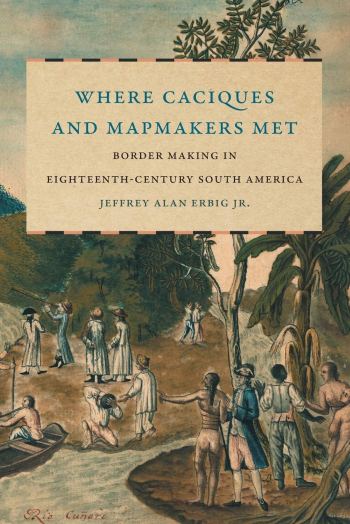 During the late eighteenth century, Portugal and Spain sent joint mapping expeditions to draw a nearly 10,000-mile border between Brazil and Spanish South America. These boundary commissions were the largest ever sent to the Americas and coincided with broader imperial reforms enacted throughout the hemisphere. Where Caciques and Mapmakers Met considers what these efforts meant to Indigenous peoples whose lands the border crossed. Moving beyond common frameworks that assess mapped borders strictly via colonial law or Native sovereignty, it examines the interplay between imperial and Indigenous spatial imaginaries. What results is an intricate spatial history of border making in southeastern South America (present-day Argentina, Brazil, and Uruguay) with global implications.
Drawing upon manuscripts from over two dozen archives in seven countries, Jeffrey Erbig traces on-the-ground interactions between Ibero-American colonists, Jesuit and Guaraní mission-dwellers, and autonomous Indigenous peoples as they responded to ever-changing notions of territorial possession. It reveals that Native agents shaped when and where the border was drawn, and fused it to their own territorial claims. While mapmakers’ assertions of Indigenous disappearance or subjugation shaped historiographical imaginations thereafter, Erbig reveals that the formation of a border was contingent upon Native engagement and authority.
Published with support provided by the William P. Clements Center for Southwest Studies at Southern Methodist University in Dallas, Texas.
Jeffrey Alan Erbig Jr. is assistant professor of Latin American and Latino studies at the University of California, Santa Cruz.
C O N T E N T S
List of Figures, Maps, and Tables
Acknowledgments
Abbreviations
Introduction
1 An Archipelago of Settlements and Tolderías
2 Projecting Possession
3 Mapping the Tolderías’ Mansion
4 Simultaneous Sovereignties
5 Where the Lines End
Conclusion
Notes
Bibliography










 Enfilade
leave a comment