Trinity Fine Art Offers Ricci’s Lapiths and Centaurs at TEFAF
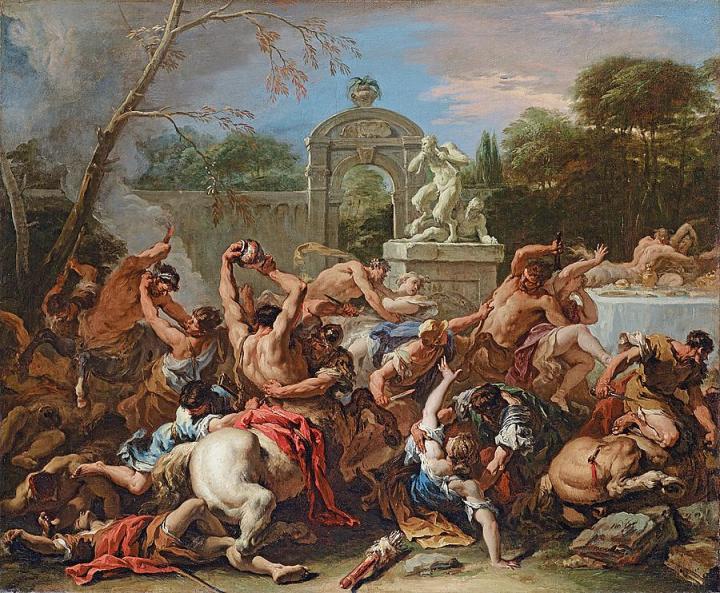
Sebastiano Ricci, The Battle of the Lapiths and the Centaurs, early eighteenth century, oil on canvas, 63 × 76 cm (Offered at TEFAF Maastricht 2020 by Trinity Fine Art for approximately one million euros).
◊ ◊ ◊ ◊ ◊
From the press release, via Art Daily (28 February 2020). . .
One of the highlights of TEFAF Maastricht 2020 (7–15 March) will be an extremely rare work by Sebastiano Ricci: The Battle of the Lapiths and the Centaurs, which has been rediscovered after being lost for 60 years. Sebastiano Ricci (1659–1734) revitalised Venetian painting at the beginning of the eighteenth century, and his work marked the transition between the Baroque and Rococo styles. He took the rich colours and luminosity of Veronese and further transformed it by his looser, more airy and spontaneously decorative style always shot through with a clear Venetian light, all traits he passed down in turn to Tiepolo. Ricci was widely travelled, since as one of the main exponents of the Rococo style he was called to many European courts that wished to draw on his talents. He was in France—where he became a close friend of Watteau—in Austria—where he was summoned by Emperor Joseph I to decorate the palace of Schönbrunn, and in England—where he executed a series of large canvases for the newly constructed Burlington House and also sold works to King George III.
Ricci’s work is exceptionally rare on the art market, since his best paintings—allegorical and biblical paintings and frescos of significant dimensions—are already contained in public collections, many of them since the eighteenth century. The works he made for Lord Burlington are now in the Royal Academy, London, and those acquired by King George III are at the Royal Collection, London. Those in the Hermitage have been there since the eighteenth century as have those in the Liechtenstein collection, acquired in 1819; and then there are the many frescos and ceilings in Italian palazzi and churches.
The present monumental work can be dated to the early eighteenth century at which time Ricci’s work displayed a close affinity with that of the Genoese painter, Alessandro Magnasco. It shows Ricci at the height of his powers of composition and as a colourist in this depiction of the story of the Lapiths and Centaurs taken from Ovid’s Metamorphoses, which was a popular choice from the Renaissance onwards for both artists and their humanist patrons since it symbolised both the victory of civilisation over barbarity and intellect triumphing over lust. It also has the added interest of being a collaborative work between Sebastiano and Marco Ricci, the former’s nephew, who is credited with executing many of the background details such as architectural elements and trees.
This work is to be offered by Trinity Fine Art at TEFAF Maastricht 2020, with an asking price of around one million euros. Established in 1984, Trinity Fine Art has earned a reputation as a leading dealer and consultant, offering exceptional works of art and specialising in master paintings, sculpture, and works of art from the Renaissance to the nineteenth century. Its clients include many of the world’s major museums as well as most leading private collections.
New Book | Les foyers artistiques à la fin du règne de Louis XIV
From Brepols:
Anne-Madeleine Goulet, Rémy Campos, Mathieu da Vinha, and Jean Duron, eds., Les foyers artistiques à la fin du règne de Louis XIV (1682–1715): Musique et spectacles (Turnhout: Brepols, 2019), 446 pages, ISBN: 978-2503586199, 65€.
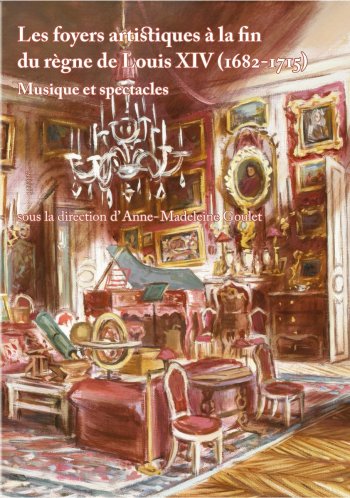 Grâce à la notion de «foyer», une série d’études pluridisciplinaires porte un regard nouveau sur les productions musicales et théâtrales en dehors de la cour de Versailles à la fin du règne de Louis XIV.
Les demeures aristocratiques de Paris et d’Île-de-France ont généralement été perçues comme des lieux périphériques, pâles reflets de la cour de Versailles. En réalité, les hôtels particuliers du Marais, où dominaient les sociabilités féminines, la résidence de Philippe d’Orléans au Palais-Royal, celle de la princesse de Conti à Versailles, les pavillons de plaisance bâtis entre Versailles et Paris, les demeures du duc et de la duchesse du Maine à Sceaux ou encore du roi d’Angleterre en exil à Saint-Germain-en-Laye, s’imposaient comme autant de foyers artistiques fort dynamiques, ouverts au théâtre et à la musique.
Le présent ouvrage, qui prend en considération ces différents lieux d’activité artistique comme un ensemble à la fois complémentaire et concurrent, enquête sur leur hiérarchie, leur fonctionnement concret ainsi que sur les relations qu’ils entretenaient avec la cour. Il met en lumière la tension entre le modèle versaillais, toujours prompt à imposer une norme artistique, et le développement d’autres espaces de création entre 1682 et 1715.
En illustrant la faculté des musiciens provinciaux à s’insérer dans les milieux artistiques de la capitale, en cernant l’identité de ceux qui façonnaient les goûts de leur époque et en considérant aussi les stratégies discursives et politiques qui visaient à constituer en foyers certains lieux de production et de performance alternatifs à la Cour, il propose une image plus complète de la vie musicale et spectaculaire de la France à la fin du règne de Louis XIV.
Direction de l’ouvrage
Anne-Madeleine Goulet, chercheuse en Arts du spectacle au CNRS (CESR).
En collaboration avec
Rémy Campos, professeur d’histoire de la musique au Conservatoire de Paris et responsable de la recherche de la Haute école de musique de Genève.
Mathieu da Vinha, directeur scientifique du Centre de recherche du château de Versailles et spécialiste de la cour de France aux XVIIe et XVIIIe siècles.
Jean Duron, fondateur et directeur (1989–2007) de l’Atelier d’études sur la musique française des XVIIe & XVIIIe siècles du CMBV, et spécialiste de la musique à l’époque de Louis XIV.
C O N T E N T S
• Rémy Campos et Anne-Madeleine Goulet — De la pertinence de la notion de foyer pour l’étude de la musique et des formes spectaculaires à Paris et à Versailles, 1682–1715
La Cour, les cours
• David Hennebelle — « La grande dépense et le fracas ». Recherches sur l’économie matérielle des patronages artistiques de l’aristocratie au tournant des XVIIe et XVIIIe siècles
• Don Fader — Monsieur and Philippe II d’Orléans: A Cultural Influence Beyond their Residences
• Tarek Berrada — La musique dans les appartements : Mlle de Guise, le roi et les princes de Condé
• Thomas Vernet — Musique et théâtre dans la « maison de ville » de Marie-Anne de Bourbon Conti à Versailles
• Catherine Cessac — Les Nuits de Sceaux : derniers feux du Grand Siècle ?
• Laurent Lemarchand — Les arts entre Paris et Versailles: le Palais-Royal de Philippe II d’Orléans ou l’absolutisme rénové
Des musiciens en partage
• Jean Duron — Composer pour les nouveaux foyers : la « fureur » des musiciens d’église au crépuscule du Grand Siècle
• Marie Demeilliez — Les collèges, des foyers pour la musique et la danse de théâtre
• Thomas Leconte — De la cour à la ville : les musiciens du roi face à l’émergence de nouveaux foyers cuturels
• Catherine Massip — Amateurs, professionnels : foyers et professionnalisation progressive des artistes, 1680–1715
Un esprit nouveau
• Christian Biet — Foyers, chaufooirs, chaleur et hétérogénéité des publics au theatre. La séance comme contre-pouvoir ?
• Thierry Favier — Foyers et dynamique des genres musicaux à la fin du règne de Louis XIV
• Nathalie Berton — Le Mercure galant, un révélateur et un passeur de répertoire : l’exemple du petit opéra
• Guy Spielmann — Le « théâtre de société », foyer de création ( ?)
• Louis Delpech — « Abends zu einer Concert de Musique eingeladen » : aspects musicaux du séjour parisien de Friedrich August II de Saxe, 1714–1715
Foyers réels, foyers imaginaires
• Mathieu da Vinha — Fêtes privées entre Versailles et Paris : éléments pour une typologie
• Anne Piéjus — Une galanterie très politique : l’image des foyers artistiques dans le Mercure galant
• Laura Naudeix — Foyers et territoire: l’espace de la musique dans la Comparaison de la musique italienne et de la musique française de Le Cerf de la Viéville
• Barbara Nestola — L’art d’assembler, le choix de partager : la collection de musique italienne des Stuart en France, 1689–1718
• Tatiana Senkevitch — The Making of Taste: Rembrandt and French Painting in the End of the Reign of Louis XIV
• Rebekah Ahrendt — L’activité des foyers musicaux et théâtraux en Europe vers 1700. Une enquête en coulisses
Perspectives
• Jean Boutier — Pour continuer l’enquête
Index des noms propres
Call for Papers | Georgian London Revisited
From The Georgian Group:
2020 Georgian Group Symposium: Georgian London Revisited
Society of Antiquaries, Burlington House, London, 7 November 2020
Proposals due by 20 March 2020
The Georgian Group is organising a day-long symposium on ‘Georgian London Revisited’, to be held at the Society of Antiquaries at Burlington House, London, on Saturday, 7 November 2020. Following the successful conferences run by the Group in previous years on Women and Architecture, and on the architecture of James Gibbs and the Adam brothers, the symposium will highlight changing perspectives and new research on the architecture of London during the ‘long 18th century’ (c.1660–1830) undertaken since the publication of the 1988 edition of Sir John Summerson’s seminal Georgian London (reissued with amendments by Sir Howard Colvin, 2003). Topics may include, but are not limited to, the following:
• Housing and estate development
• Public and commercial buildings
• ‘Improvement’: infrastructure, streets, open spaces, bridges, etc
• Places of entertainment
With this in mind, proposals are invited for 15-minute papers based on original research. Please send abstracts of no more than 200 words and a copy of your CV to Dr Geoffrey Tyack (education@georgiangroup.org.uk) by 20 March 2020. Any questions regarding the symposium should be sent to the same address. Further details will be made available, and tickets will go on sale, in the Spring.
Call for Papers | Cultural Dimensions of Dutch Overseas Expansion
From ArtHist.net:
The Cultural Dimension of Dutch Overseas Expansion
Utrecht University, 28 August 2020
Proposals due by 15 March 2020
“It is only money and not knowledge that our people are seeking [in the East Indies], which is to be lamented”, complained the Amsterdam mayor and VOC governor, Nicolaes Witsen, in 1712. The Dutch trading companies may have been associated with various qualities, but an interest in culture was not one of them. None of the VOC officials even noted the presence of the world’s biggest Buddhist temple, the Borobudur, on the island of Java, leaving its re-discovery to the British in 1814. No Dutch writer tried to emulate the epic celebration of the Portuguese maritime empire by Luís de Camões. Dutch expansion had an obvious impact on the sciences and medicine, as demonstrated in Harold Cook’s Matters of Exchange: Commerce, Medicine, and Science in the Dutch Golden Age (2007). But what, if any, was its impact on culture and the humanities?
Here there is, in fact, a fruitful scholarly field that largely remains to be explored. For example, Dutch lust for money set in motion the first transfer of culture on a truly global scale, when 40 million pieces of Chinese porcelain were shipped from East Asia to Europe and the Americas. ‘Indies shops’ in different Dutch cities sold curiosities from six continents. Travelogues—even when ordered by the VOC and predominantly mercantile in outlook—offered a wealth of ethnographic knowledge for the attentive reader. Scholarly-minded individuals could break the commercial pattern, resulting in the first Western translations of a work in Sanskrit (by Abraham Rogerius, 1651), a work of Hindu iconography (by Philips Angel, 1657), and the main work of Confucius (by Pieter van Hoorn, 1675). They must have relied on the expertise of local native speakers; non-Western perspectives come into even clearer focus with at least three Chinese men who visited the Netherlands and with the Africans who sat for Amsterdam painters.
This conference brings together historians of culture, art, literature, language, philosophy, science, and religion to arrive at a fuller picture of the cultural dimensions of Dutch overseas expansion. The keynote lectures will be given by Dr. Roelof van Gelder and Dr. Mariana Françozo (Leiden University).
Possible themes include:
• Cultural topics (art, literature, language, music, mythology, religion) addressed in travelogues
• Non-Western themes in Dutch literature and drama (from ‘Moortje’ to ‘Zungchin’)
• Representations of the world’s peoples, including enslaved persons and non-Western visitors to the Low Countries
• Trade, consumption, interpretation, and imitation of non-Western material culture
• Translations, dictionaries, and grammars
• Cultural industries (print shops, painting studios, artisan’s workshops) established overseas
• Cultural education in the context of the VOC and WIC
• The impact on culture of cross-cultural encounters, slavery, servitude, and colonialism
• Challenges posed by historiographies, religions, and philosophies from beyond Europe
Working group De Zeventiende Eeuw invites all interested in this topic to send in an abstract (max. 300 words) and curriculum (max. 100 words) for a paper (in English or Dutch) of 20 minutes. Proposals for sessions, consisting of three papers, are also welcome. Deadline for abstracts: 15 March 2020, to Jaap de Haan (j.dehaan@uu.nl).
Organizing Committee: Marjolijn Bol, Surekha Davis, Jaap de Haan, Cora van de Poppe, and Thijs Weststeijn
Call for Papers | Ma thèse en histoire de l’art en 180 secondes
From ArtHist.net:
Ma thèse en histoire de l’art en 180 secondes
Festival de l’histoire de l’art, Fontainebleau, 5–7 June 2020
Proposals due by 15 March 2020
La 10e édition du Festival de l’histoire de l’art aura lieu à Fontainebleau les vendredi 5, samedi 6 et dimanche 7 juin 2020 avec le Japon comme pays invité. Le thème fédérateur choisi cette année est le Plaisir. Dans le cadre de cette édition, il est proposé aux doctorants de participer au concours « Ma thèse d’histoire de l’art en 180 secondes ».
Chaque candidat disposera de trois minutes (180 secondes) pour réaliser un exposé clair et concis de son projet de recherche. Les présentations réalisées par les candidats retenus devront convaincre deux jurys composés d’historiens de l’art et de professionnels. A l’issue du concours, trois prix seront attribués aux trois meilleurs orateurs.
Premier prix: 1000€
Deuxième prix: 500€
Troisième prix: 500€
Les frais de transport et d’hébergement des participants hors région parisienne seront pris en charge sur présentation de justificatifs (jusqu’à 150€).
Call for Papers | Critical Perspectives on Image and Text
From ArtHist.net:
Perlego: Critical Perspectives on Image and Text
University of Oxford, 3–4 July 2020
Proposals due by 1 April 2020
From writings that explore the textuality of images to the use of images in the illumination of texts, the signifying systems of image and word rub up against one another in various ways, making the meeting of text and image a long-standing area of scholarly fascination. The PERLEGO conference takes a critical approach to text-image scholarship, bringing together early career scholars working across different disciplines to explore methodological issues arising at the interface of textual and visual analysis.
With a view to initiating productive conversations about methodology, PERLEGO seeks to draw out strands of critical approaches from across research areas, time periods, and genres, to consider how integrated approaches to image and text analysis can construct robust and polyphonic histories of meaning, production, and interpretation. Hosted in July 2020 at the University of Oxford, this two-day conference unfolds as a series of panels, roundtable discussions, keynote lectures, and a hands-on session at the Ashmolean Museum.
PERLEGO invites abstracts for critical perspectives on image and text in areas including but not limited to the following:
• Visual strategies in texts
• ‘Textual’ strategies in works of art
• The idea of ‘genre’ across text and image
• The graphic act
• Hierarchies of signification
• Disciplinary hierarchies and structures of power
• Historical reconstruction and the period eye
• Text and image in colonial and postcolonial contexts
• Museum labels and taxonomies
We welcome abstracts from researchers and practitioners working in all fields, including (but not limited to): English and Comparative Literature, Art History, Modern Languages, History, Media Studies, Design Studies, and Museum Studies. Please send a 350-word abstract and a short academic bio by 1 April 2020 to perlego2020@gmail.com.
Organisers: Rebecca Bowen (Oxford), Vittoria Fallanca (Oxford), Anna Espinola Lynn (Oxford), and Sophie Koenig (Hamburg). This Conference is generously supported by the AHRC-TORCH Graduate Fund.
The Burlington Magazine, February 2020
The eighteenth century in The Burlington:
The Burlington Magazine 162 (February 2020) — Northern European Art

Anton von Maron, Portrait of Johann Joachim Winckelmann, 1767, oil on canvas, 136 × 99 cm (Weimar: Stadtschloss).
E D I T O R I A L
• “The National Trust at 125,” p. 87.
A R T I C L E S
• Gauvin Alexander Bailey, “A Bavarian Pilgrimage Shrine in Seventeenth-Century Paraguay,” pp. 115–25. The Jesuit priest Anton Sepp was one of the first Germanic missionaries to be admitted to the Spanish territories in South America. Arriving in 1691, he brought with him a copy of the miracle-working sculpture of the Virgin of Altötting in Bavaria, and in 1697 he emphasised the German character of his mission by commissioning a version of the octagonal chapel in which the original was housed.
• Clare Hornsby, “J. J. Winckelmann and the Society of Antiquaries of London: New Documents,” pp. 126–35. Three new documents in the archive of the Society of Antiquaries, published here for the first time, provide evidence about Winckelmann’s aspirations for promoting his works in antiquarian circles in England. They include the first statement in English of his theory of art history, written in 1761.
R E V I E W S
• Arthur Wheelock, Review of the exhibition De Wind is Op!: Climate, Culture and Innovation in Dutch Maritime Painting (New Bedford Whaling Museum, 2019–20), pp. 150–52.
• Olivier Bonfait, Review of Gaëtane Maës, De l’expertise artistique à la vulgarisation au siècle des Lumières: Jean-Baptiste Descamps (1715–1791) et la peinture flamande, hollandaise et allemande (Brepols, 2016), pp. 171–72.
• Anna Arabindan Kesson, Review of Sarah Thomas, Witnessing Slavery: Art and Travel in the Age of Abolition (Yale University Press, 2019), pp. 172–74.
Exhibition | De Wind is Op!
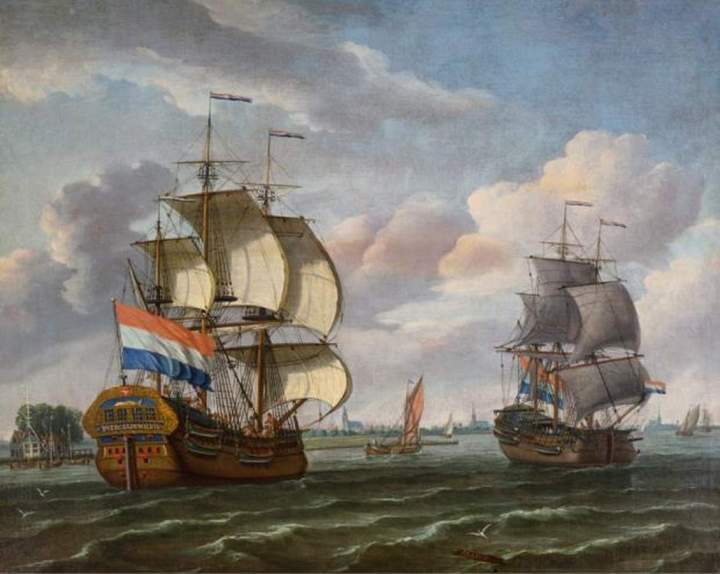
Johanes de Blaauw, Whaleship D’Vergulde Walvis (‘The Golden Whale’) Passing the Tollhouse at Buiksloot on the IJ River, North of Amsterdam, 1759, oil on canvas, 55 × 68 cm (New Bedford Whaling Museum, Kendall Whaling Museum Collection, 2001.100.4604).
◊ ◊ ◊ ◊ ◊
Now on view at the New Bedford Whaling Museum:
De Wind is Op! Climate, Culture and Innovation in Dutch Maritime Painting
New Bedford Whaling Museum, 2 July 2019 — 15 May 2020
Curated by Christina Connett Brophy and Roger Mandle
De Wind is OP! explores our extraordinary collections of Golden Age Dutch and Flemish paintings through a fresh lens. These works interpret around the themes of wind, climate, and sea as the drivers behind a uniquely Dutch national identity represented in maritime works of art of this period. Dutch artists arguably invented seascape painting, and were the first to specialize in this genre. Their influence reverberates in all that followed, from the work of J.M.W. Turner to Winslow Homer to New Bedford artists William Bradford and Albert Pinkham Ryder. The exhibition includes up to 50 paintings, prints, and other related artifacts drawn from the Museum’s Dutch collections, one of the largest and important of this genre outside of the Netherlands. There will also be a complementary exhibition in the fall of 2019 of European and American prints, paintings, and charts related to wind and climate themes.
The sea and seafaring shaped the Dutch collective identity. They were a political entity without precedence, and the art world followed the new cultural and societal models unique to the newly formed Dutch Republic. The Dutch were a dominant superpower in all things maritime, including worldwide trade, military strength, and whaling. They were a world emporium, trading timber, grain, salt, cloth, luxury materials throughout the global waterways. This was a time of great artistic production to keep up with a high demand for collecting, when a baker was as likely to have fine artwork in his home as a banker. Popular taste was for greatly refined compositions, exquisiteness of detail, and plausible reality. Dutch openness to innovation allowed them to manipulate their own watery landscapes with dams and wind power and to design ship modifications that maximized successful access to the Northern seas and the dramatic fluctuating climate during the Little Ice Age. Vulnerability to tidal deluge and to tempests at sea carried moral and nationalistic themes in paintings from this era. These themes and others are the foundation of the exhibition.
This exhibition was timed to coincide with the inaugural Summer Winds 2019 run by the New Bedford group Design Art Technology Massachusetts (DATMA), a creative and educational city-wide platform for discussion and exploration of wind energy. Multiple partners in the cultural sector contributed programs, exhibitions, and educational events to this initiative throughout the summer. De Wind is Op! is a major contribution to the Summer Winds project and serves as a cornerstone of summer programming events. The Museum partnered with the Museum of Fine Arts, Boston (MFA), Harvard Art Museums, and the Dutch Culture USA Program of the Consulate General of the Kingdom of the Netherlands to collaborate on a major symposium in fall 2019 to examine Dutch maritime artwork in accordance with the major exhibition themes.
Curators
Dr. Christina Connett Brophy, The Douglas and Cynthia Crocker Endowed Chair for the Chief Curator
Dr. Roger Mandle, Co-Founder of Design Art Technology Massachusetts (DATMA); Former Deputy Director and Chief Curator of the National Gallery of Art; and former President of the Rhode Island School of Design
A 41-page catalogue is available as a PDF file from the museum website.
At Sotheby’s | 1794 Charter for America’s First African Free School
Press release, via Art Daily (27 February 2020). . .
 Sotheby’s announced today that the Books & Manuscripts department will offer the 1794 land indenture for the use and benefit of New York City’s African Free School—founded by Founding Fathers Alexander Hamilton, John Jay, and others—marking the establishment of the first such school in America. Making its auction debut at Sotheby’s 24 June Books & Manuscripts sale in New York, the document is estimated to achieve between $250,000 and $350,000. The indenture will be on public view at Sotheby’s New York galleries through 29 February, coinciding with the final week of Black History Month and showcase this integral piece of American civil rights history to the public.
Richard Austin, Head of Sotheby’s Books & Manuscripts Department in New York, commented: “We are thrilled to offer such a unique and historically important document in our upcoming June sale. The African Free School was an amazing symbol of the liberal democratic principles espoused by the country’s framers, and was a truly progressive institution at the time. To highlight the unprecedented achievement of the school and display the document in our galleries during Black History Month is an honor and we hope it will inspire others to reflect on the course of American history and social equality.”
Established by the New York Manumission Society—which was formed in 1785 by some of New York’s most elite and influential citizens, including John Jay and Alexander Hamilton—the African Free School was created with the aim, as they perceived it, of educating black children so that they might take their place as equals to white American citizens. As the present indenture states, the school was formed “for the humane and charitable purpose of Educating negro Children to the end that they may become good and useful Citizens of the State.” The mission of the Manumission Society in forming the school was to validate the tenet set forth in the Declaration of Independence just a few years before that “all men are created equal.” The Society also felt that education was an essential element in creating a populace capable of sustaining and furthering a democracy.
In addition to Hamilton and Jay, the New York Manumission Society counted luminaries as George Clinton, John Murray, Melancton Smith, and James Duane among its founding members. At a time when slavery was integral to the economic expansion in New York and America, these Founding Fathers and others began their mission of abolishing slavery in the state of New York by protesting the relatively common practice of kidnapping black New Yorkers—slaves and free men and women alike—in order to sell them into servitude elsewhere. The Society also provided legal assistance to free and enslaved blacks who were being abused, and in 1785 successfully lobbied for a law prohibiting the sale of imported slaves in the state of New York—before the state passed a gradual emancipation law in 1799. Slavery was officially abolished in New York State on July 4, 1827.
The African Free School was instituted on 2 November 1787, but was not built until 22 July 1794. Upon the land documented in the present indenture, a single-room schoolhouse was erected in lower Manhattan that would house around forty students, the majority of whom were the children of slaves. The members of the Manumission Society raised funds—or, in many instances, provided the funds themselves—for teachers’ salaries, supplies, and, eventually, for the creation of new buildings required to house the growing student population. In 1809, the trustees of the school hired Charles Andrews, and under his ardent leadership the school experienced significant expansion, with enrollment reaching 700 students by the end of his tenure.
By 1835, the African Free School model proved so successful that a total of seven schools were established throughout the city, which were then absorbed into the New York City public school system. By that time, the African Free School of New York had educated thousands of children, many of whom went on to become prominent abolitionists, artists, and entrepreneurs.
Call for Papers | Inside the Temporary Exhibition
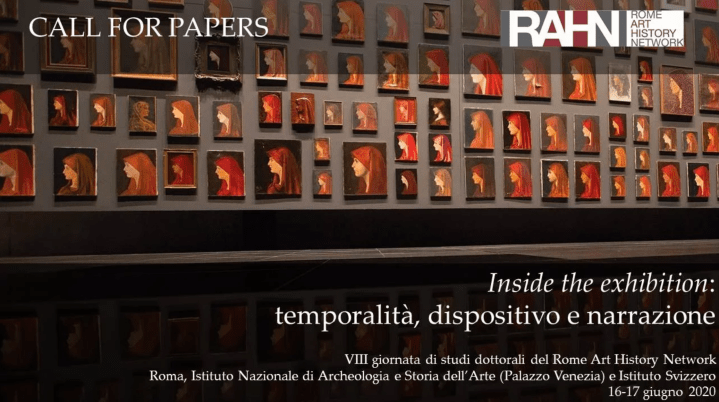
From the Call for Papers for this graduate student symposium, the full version of which includes Italian and French versions, via ArtHist.net:
Inside the Exhibition: Temporalità, Dispositivo e Narrazione
Swiss Institute and Istituto Nazionale di Archeologia e Storia dell’Arte (Palazzo Venezia), Rome, 16–17 June 2020
Proposals due by 19 April 2020
Now more than ever, temporary art exhibitions saturate museum spaces worldwide, shaping the discourse between public institutions and academia, and implicating an ever-growing and ever-changing international audience. The eighth doctoral study day organised by RAHN intends to reflect on the research opportunities afforded by the temporary display of artworks, from the early modern period to present day (15th–21st century).
In this wide time frame, temporary exhibitions have acquired multifarious meanings, shaping art-historical discourse. For example, the first public displays of paintings organised in the pronaos of the Pantheon, or in the cloisters of Roman churches for the festivals of patron saints, were tied to the religious context in which they took place. However, these displays were also key in the development of another ‘cult’, that of the artist, favouring the commercial interests of private collectors or of ante litteram curators, such as Giuseppe Ghezzi (1634–1721). With the formation of modern states, public exhibitions’ narratives were informed by different ideological programmes, which were inspired by, and in turn influenced contemporary art-historical debate. In this light, the temporary display of artworks offers an insight into the exhibition’s producing culture itself, and a unique opportunity for research.
The study day intends to focus on the ephemerality of art exhibitions, following a diachronic and interdisciplinary methodological approach inspired by Francis Haskell’s pioneering work on the subject (2000). When an artwork is put on display, its physical shift corresponds to a process of intellectual de- and re-contextualisation, through which the object acquires new meaning(s), imparted by the other objects with which it is put in dialogue, the space in which it is placed, and its audiences. With this in mind, we invite applicants to consider the following questions:
What affects such processes of de- and re-contextualisation? What happens when an art work is placed on temporary display? How does this influence the intellectual discourse surrounding the object and / or the exhibition? What interests are at stake in the organisation of artistic displays? What are their audiences, intended message and reception?
We welcome papers engaging with such questions, including, but not limited to the following contexts:
• the origins of art exhibitions and their cultural context (public, private, religious, secular, etc.)
• the artwork, its display, and fruition in the museum space
• the relationship between artistic historiography and exhibitions
• the art market: galleries, art fairs, and their exhibition spaces
• reception and critical discourses, the exhibition’s audiences and ‘verbal contexts’ (Pomian, 1986)
The application is open to doctoral students in the history of art and architecture enrolled in Italian and international institutions. We welcome 20-minute long papers focusing on methodological questions through a specific case study or proposing a theoretical approach to the subject. The proposals can be submitted in Italian, English, or French. To apply, please send a 250-word abstract and a 1-page academic CV by 19 April 2020 to the organisers: giornatadottorale.rahn@gmail.com.
Essential Bibliography
• Francis Haskell, The Ephemeral Museum: Old Master Paintings and the Rise of the Art Exhibition (New Haven: Yale University Press, 2000).
• Krzysztof Pomian, “Pour une histoire des semiophores. À propos des vases des Médicis,” Le Genre humain 14 (1986): 17–36.










 Enfilade
leave a comment