Exhibition | Tables of Power: A History of Prestigious Meals

Jacques Roëttiers, Ornamental Centerpiece, Surtout de table, 1736 (Paris: Musée du Louvre). Additional information and exceptional details are available here.
◊ ◊ ◊ ◊ ◊
Comprised of five sections, the exhibition traces the history of elite dining conventions from ancient Mesopotamia and Egypt to the present. The fourth section focuses on eighteenth-century France.
Les tables du pouvoir: Une histoire des repas de prestige
Musée du Louvre-Lens, 19 May — 26 July 2021
Organized by Zeev Gourarier with Michèle Bimbenet-Privat, Hélène Bouillon, Alexandre Estaquet-Legrand, Christine Germain-Donnat, and Marie Lavandier
Chapitre 4 : du service à la française au service à la russe
 Le 18e inaugure de nouvelles manières d’envisager les plaisirs de la table. La forme trop protocolaire du Grand Couvert laisse si peu de place à la convivialité que, pour y échapper, on invente au sein des « petits appartements » à Versailles et dans les résidences privées du roi, la salle à manger puis la table à manger, de forme ronde. Dans le cadre des Soupers fins, on peut alors s’adonner en toute liberté et en bonne compagnie aux plaisirs d’une gastronomie en pleine effervescence. Le service offert par l’Impératrice Marie-Thérèse d’Autriche à Madame Geoffrin, qui tient l’un des plus célèbres salons artistiques et littéraires parisiens d’alors, rappelle l’atmosphère raffinée des repas consommés dans les toutes premières salles à manger au temps des Lumières.
À partir de 1740, la fabrique de Vincennes—transférée à Sèvres en 1756—met au point un procédé complexe de double cuisson qui permet d’obtenir une pâte onctueuse et translucide, la porcelaine tendre. L’exposition présente l’un des premiers services de table réalisés, à fond bleu céleste et décor de fleurs, offert à Louis XV. Ces pièces exceptionnelles font la renommée de la France dans toute l’Europe et créent une véritable diplomatie des services de Sèvres, abondamment offerts en cadeaux par le roi. Dès son instauration en 1804, le Premier Empire en devient un commanditaire majeur. Le Service Olympique fait partie des premiers services en porcelaine livrés à Napoléon. Il décore la table de fête au palais des Tuileries à l’occasion du mariage de son frère, Jérôme Bonaparte. La table du Cardinal Fesch, oncle de Napoléon, se déploie également au milieu du parcours. Sur un fond bleu lapis, imitant la pierre dure, le décor de portraits d’empereurs antiques à la manière des camées est un hommage subtil à Napoléon lui-même, qui lui offre ce service.
Au gré des régimes, la Manufacture de Sèvres habille les tables du pouvoir. À l’instar de la Présidence de la République, les ministères d’État disposent de leur propre vaisselle, passant commande aujourd’hui encore. Une table en miroir fait ainsi dialoguer le service des Départements (19e siècle) et son décor floral, au service Diane du ministère de la Culture, conçu vers 1960 et dont le décor est renouvelé en 2007 par l’artiste Fabrice Hyber.
 À sa création à la fin du 18e siècle, la manufacture royale du Danemark rejoint la prestigieuse compétition que se livrent les différentes manufactures de porcelaine d’Europe. Elle réalise l’un des plus surprenants et opulents services de table de cette époque, le Flora Danica. Composé de plus de 1800 pièces à l’origine, il aurait été initialement destiné à l’impératrice de Russie Catherine II, grande amatrice de porcelaine, mais n’est jamais livré. Les motifs s’inspirent directement des planches illustrées du Flora Danica (« Flore du Danemark »), et forment comme un grand atlas botanique, avec plantes, champignons et autres lichens. Le service est aujourd’hui encore utilisé à la cour du Danemark lors des grandes occasions.
Dans le cadre de la pièce désormais réservée aux repas, la salle à manger, l’ordonnance du repas continue d’évoluer pour aboutir en un siècle à notre service actuel, dit « service à la russe ». Ce nouveau dispositif témoigne des transformations des modes de vie et de la culture alimentaire au début du 19e siècle. Il implique un nouvel ordonnancement des mets. Les plats ne sont plus présentés de manière harmonieuse et foisonnante en services successifs, mais sont désormais servis individuellement, simultanément à tous les convives. Ces dispositions permettent notamment à tous de manger chaud et réduisent le nombre de domestiques autour de la table. Les verres se multiplient et ne sont plus disposés sur des dessertes mais sur la table, et les couverts individuels s’alignent autour de l’assiette—tels que nous les connaissons aujourd’hui.
Zeev Gourarier, ed., Les tables du pouvoir: Une histoire des repas de prestige (Paris: Réunion des musées nationaux, 2021), 320 pages, ISBN: 978-2711878635, 40€.
A list of contents is available here»
Online Conference | The Evolving House Museum
From ArtHist.net and The Society for the History of Collecting:
The Evolving House Museum: Art Collectors and Their Residences, Then and Now
Online, The Society for the History of Collecting, 18–19 June 2021
Organized by Margaret Iacono and Esmée Quodbach
House museums are founded for a variety of reasons, from preserving architecturally significant structures to safeguarding the former homes of historically or culturally noteworthy men and women and their legacies. In other cases esteemed art collectors, such as Henry Clay Frick or Albert C. Barnes, established museums in their former residences to house their collections in perpetuity rather than donating them to preexisting institutions. While many successful examples like the Isabella Stewart Gardner Museum continue to thrive, other lesser-known house museums do not attract enough support to remain operational. House museums, it seems, must evolve in order to remain relevant and to continue to attract visitors.
This conference explores a variety of themes relating to art collectors as founders of house museums. Among these are discussions about the motivates that encouraged collectors to establish private house museums instead of donating their collections to preexisting institutions; how collectors’ original intention have manifested themselves in their museums; how house museums’ collections or buildings have evolved over time; and how museums have reinterpreted their collections to remain relevant to contemporary and diverse audiences. Other issues concern how major historic events like the 2008 financial crisis or the recent COVID-19 pandemic have impacted house museums. To attend the event, please register at events@societyhistorycollecting.org.
All times are given in Eastern Daylight Time (EDT)
F R I D A Y , 1 8 J U N E 2 0 2 1
11.00 Welcome and Introductory Remarks
11.15 Keynote Address
• Inge Reist (Director Emerita of the Center for the History of Collecting, The Frick Collection, New York), Whose House Is It Anyway?
11.45 Early Beginnings, the Gilded Age, and Beyond
• Anne Nellis Richter (Independent Scholar and Adjunct Faculty, Smith College, Northampton, Massachusetts), Cleveland House as Art Museum: ‘The Louvre of London’ (1806)
• Evelien de Visser (Curator of Fine Arts from 1750 and Information Specialist Van Gogh Worldwide, RKD—Netherlands Institute for Art History, The Hague), The Mesdag Collection in The Hague: The Lasting Legacy of Hendrik Willem Mesdag and Sientje van Houten
12.25 Q & A, followed by break
12.45 Early Beginnings, the Gilded Age, and Beyond, continued
• Mia Laufer (Associate Curator, Minnesota Museum of American Art, St. Paul), A Tale of Two Museums: The Legacies of the Parisian Collectors Isaac and Moïse de Camondo
• Lynne Ambrosini (Deputy Director/Chief Curator Emerita, Taft Museum of Art, Cincinnati, Ohio), The Evolution of Charles and Anna Taft’s Art Museum: Display, Space, Audience, and Acquisitions
• Martha Easton (Assistant Professor of Art History, St. Joseph’s University, Philadelphia), Medievalism, Museums, and Modern Audiences: The Case of the Hammond Castle Museum in Gloucester, Massachusetts
1.45 Q & A
S A T U R D A Y , 1 9 J U N E 2 0 2 1
11.00 Looking Back, Looking Forward: The Evolving House Museum over the Past Century
• Welcome and Introductory Remarks
• Marissa Hershon (Curator of Ca’ d’Zan and Decorative Arts, The John & Mable Ringling Museum of Art, Sarasota, Florida), The Ringling Museum’s Ca’ d’Zan: Its Evolution from Winter Residence to Historic House Museum
• Anne Hilker (Independent Scholar, New York), The Fortunes of War: The Brief Life of the Jules S. Bache House Museum in New York, 1937–1943
• Rebecca Tilles (Associate Curator of 18th-Century French & Western European Fine and Decorative Arts, Hillwood Estate, Museum & Gardens, Washington, DC), Marjorie Merriweather Post’s Hillwood and the Vision from a Private Collection to Public Museum
12.15 Q & A, followed by break
12.35 Looking Back, Looking Forward: The Evolving House Museum over the Past Century, continued
• Chih-En Chen (PhD Candidate, History of Art and Archaeology, SOAS, University of London), Hung’s Art Gallery: Shaping the History of Collecting in Taiwan in the New Millennium
• Georgina Walker (Honorary Research Fellow, University of Melbourne), A New Type of House Museum: Lyon Housemuseum, Melbourne (2009)
• Julie Codell (Professor, Art History, Arizona State University, Tempe), Ecologies of House Museums: Some Final Thoughts
1.40 Q & A
Online Conference | Reproductive Prints in the 18th and 19th Centuries
From ArtHist.net (8 June) and the programme (as a PDF file) . . .
La Storie dell’Arte Illustrata e la Stampa di Traduzione, 18 e 19 Secolo
Online, Università di Chieti Gabriele d’Annunzio, Chieti, 10–11 June 2021
La storia dell’arte illustrata e la stampa di traduzione tra XVIII e XIX secolo
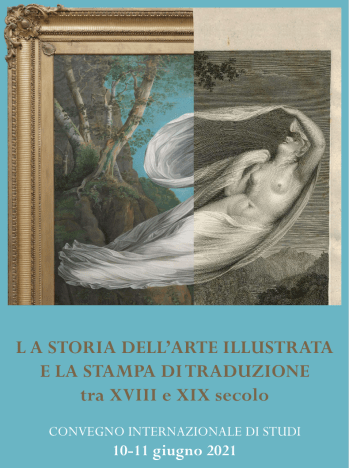 «Un coup d’oeil sur l’objet ou sur sa représentation en dit plus qu’une page de discours». Così scrive Diderot nel 1751 nell’Encyclopédie, introducendo un concetto rivoluzionario nella metodologia storico-artistica, che dalla descrizione letteraria passava all’analisi dei monumenti attraverso la loro riproduzione o supposta «replica». Nel XVIII secolo si assiste infatti alla «difficile nascita del libro d’arte» (F. Haskell) che segnerà un punto di non ritorno nella storiografia artistica. Prima dell’avvento della fotografia, infatti, è la stampa di traduzione, spesso al semplice contorno lineare ed eseguita rigorosamente al cospetto dell’opera, a essere la protagonista indiscussa della nuova storia dell’arte.
La cattedra di “Storia della Critica d’arte” del Dipartimento di Lettere, Arti e Scienze Sociali dell’Università degli Studi di Chieti-Pescara “G. D’Annunzio” organizza un convegno internazionale di studi dedicato a quel particolare momento aureo della stampa di traduzione come parte integrante della produzione storico-artistica tra XVIII e XIX secolo, indagandone i vari aspetti metodologici e i molteplici apporti nazionali e internazionali.
Le giornate di studio si svolgeranno in modalità online, sulla piattaforma Microsoft Teams. Per partecipare e registrarsi inviare una mail a lastoriadellarteillustrata@gmail.com. Si rilasciano attestati di frequenza su richiesta.
Responsabilità scientifica
Ilaria Miarelli Mariani con Valentina Fraticelli, Tiziano Casola, Vanda Lisanti
Segreteria organizzativa
Laura Palombaro, lastoriadellarteillustrata@gmail.com
T H U R S D A Y , 1 0 J U N E 2 0 2 1
9:45 Apertura del collegamento e introduzione
10.00 Sezione 1 | LA STAMPA DI TRADUZIONE TRA RIFLESSIONE E DIBATTITO
Chair: Ilaria Miarelli Mariani (Università degli Studi di Chieti-Pescara “G. D’Annunzio”)
• Stefano Ferrari (Accademia Roveretana degli Agiati), I “Monumenti antichi inediti” di Winckelmann e la riproducibilità dell’opera d’arte
• Paolo Pastres (Deputazione di Storia Patria per il Friuli), Tradurre o tradire? Il dibattito sulle stampe di traduzione in Italia nella seconda metà del Settecento
• Sara Concilio (Università degli Studi di Torino), Giovanni Gaetano Bottari e il libro illustrato: «un’opera utilissima e immortale»
• Susanne A. Meyer (Università degli Studi di Macerata), Una storia dell’arte da leggere in biblioteca: la “Geschichte der zeicnenden Künste” (1796–1821) di J. D. Fiorillo
11.15 Sessione 2 | STORIOGRAFIA E IMPRESE EDITORIALI
Chair: Gaetano Curzi (Università degli Studi di Chieti-Pescara “G. D’Annunzio”)
• Chiara Lo Giudice (Università degli Studi di Padova), Stampe di traduzione come modelli: il caso della calcografia Wagner
• Tomáš Valeš Masaryk (University, Brno; The Czech Academy of Sciences, Praha), Between Original and Reproduction: Jakob Matthias Schmutzer as a Reproductive Engraver
• Antonella Bellin (ricercatrice indipendente) / Elena Catra (Università Ca’ Foscari di Venezia), “Quaranta quadri fra i più celebri della scuola veneziana”. Il progetto di Leopoldo Cicognara per la conoscenza del patrimonio pittorico veneziano
• Valentina Borniotto (Università di Genova), Pittura stampata. Scelte iconografiche nella “Storia della Pittura Italiana” di Giovanni Rosini: il caso genovese
• Raffaella Fontanarossa (ricercatrice indipendente), «Di queste pitture ne disegnai un riparto che il fu Gio. Rosini pose nelle tavole della sua Storia della Pittura»: il contributo di Santo Varni alla storia dell’arte illustrata
• Luca Mattedi (Fondazione Federico Zeri), Bologna, “Un grand nombre de productions des maîtres les plus célèbres, ignorées depuis longues années”: una panoramica sui dipinti di epoca rinascimentale della Recueil di Jean-Baptiste-Pierre Lebrun
12.45 Discussione
14.30 Sessione 3 | LA STAMPA DI TRADUZIONE OLTRE I CONFINI STORIOGRAFICI
Chair: Francesco Leone (Università degli Studi di Chieti-Pescara “G. D’Annunzio”)
• Jessica Calipari (Università degli Studi di Chieti-Pescara “G. D’Annunzio”), Il racconto biografico tradotto nella pubblicistica romana della prima metà dell’Ottocento
• Giuliano Colicino (Università degli Studi di Salerno), Illustrare la storia dell’arte per le famiglie: il “Poliorama Pittoresco” (1836–1846)
• Ilenia Falbo (Università della Calabria), I giornali eruditi dell’ultima Roma papalina (1846-1870). Illustrazioni e cronache d’arte
• Fernando González Moreno / Alejandro Jaquero Esparcia (Universidad de Castilla-La Mancha), Guido Reni’s Pietà and Edgar A. Poe’s “The Assignation”: A Singular Case of Reception in 19th-Century North American Literature through the Reproductive Print
15.45 Sessione 4 | MUSEI E COLLEZIONISMO
Chair: Paolo Coen (Università degli Studi di Teramo)
• Martina Lerda (Università di Pisa), Le pinacoteche illustrate. L’uso delle riproduzioni in cataloghi e guide delle raccolte pittoriche italiane nel corso dell’Ottocento
• Francesco Paolo Campione (Università degli Studi di Messina), Le “Dipinture scelte del Morrealese” di Agostino Gallo (1821): stampa di traduzione e divulgazione artistica nella Sicilia del primo Ottocento
• Sandra Condorelli (Università di Catania), La “Descrizione de’ principali quadri esistenti nelle pinacoteche di Catania” di Agatino Longo
• Antonella Gioli (Università di Pisa), Circolazione e fortuna delle “Vedute del Museo Pio Clementino” (1791–1796)
• Ilaria Arcangeli (Università di Roma Sapienza), I “Disegni litografici dei Quadri Classici della Galleria di S. S. R. M. il Re di Sardegna”: un’impresa associativa promossa da Carlo Felice (1825–1840)
• Vanda Lisanti (Università degli Studi di Chieti-Pescara “G. d’Annunzio”), I cataloghi illustrati del Museo Capitolino nell’Ottocento e l’équipe di artisti per la “Descrizione del Campidoglio” di Pietro Righetti (1833–1836)
• Elisa Acanfora (Università della Basilicata) I rapporti tra centro e periferie: la diffusione delle stampe di traduzione nell’Italia meridionale nel Settecento
17.30 Discussione
F R I D A Y , 1 1 J U N E 2 0 2 1
9.30 Apertura collegamento
9.45 Sessione 5 | RIPRODURRE LE GLORIE LOCALI TRA MEDIOEVO E PRIMO RINASCIMENTO
Chair: Alessandro Tomei (Università degli Studi di Chieti-Pescara “G. D’Annunzio”)
• Paolo Delorenzi (Università Ca’ Foscari, Venezia), «Ces morceaux viennent d’être gravés pour la première fois». L’arte quattrocentesca nell’incisione veneta del XVIII secolo
• Manuela Gianandrea (Università di Roma Sapienza), Illustrare la storia della scultura romana dei bassi tempi: Ferdinando Mazzanti e il suo corpus di disegni
• Daniel Crespo Delgado (Universidad Complutense de Madrid), Tradurre un’architettura eterodossa. Sessanta stampe e poche parole per le “Antigüedades Árabes de España” (1787–1804)
• Elena Dodi (Università degli studi di Chieti-Pescara “G. d’Annunzio”), La diffusione e ricezione europea degli affreschi del Camposanto di Pisa attraverso le incisioni di Carlo Lasinio
11.00 Sessione 6 | LE STAMPE CHE IMITANO I DISEGNI
Chair: Tiziano Casola (Università degli studi di Chieti-Pescara “G. d’Annunzio”)
• Benedetta Spadaccini (Veneranda Biblioteca Ambrosiana), Le stampe che imitano i disegni dal XVII al XIX secolo
• Francesca Guglielmini (The British Museum, Prints and Drawings Department), Giovanni Antonio Armano and the Publication of Zanetti’s Parmigianino Drawings
• Laura Palombaro (Università degli Studi di Chieti-Pescara “G. d’Annunzio”), La Raccolta di incisioni di Francesco La Marra e la fortuna della pittura barocca napoletana nella stampa del Settecento
• Hannah Lyons (Birkbeck College University of London, with the Victoria & Albert Museum), Imitations, Impressions, and Female Industry: Maria Cosway (1760–1838) and the British Print Market
• Gennaro Rubbo (Università degli Studi di Chieti-Pescara “G. d’Annunzio”), La stampa di traduzione nel collezionismo inglese tra la fine del Settecento e gli inizi dell’Ottocento. Il caso di Francesco Bartolozzi: un italiano a Londra nel fondo Douce
12.15 Discussione
14.30 Sessione 7 | TRADURRE I GRANDI MAESTRI
Chair: Carla Mazzarelli (Università della Svizzera italiana)
• Anna Cerboni Baiardi (Università degli Studi di Urbino), Raffaello e i testi illustrati tra Sette e Ottocento
• Elena Petracca (Università degli Studi di Firenze), L’eredità romana di Robert van Audenaerde e Nicolas Dorigny nel Settecento.
• Francesca Cocchiara (Fondazione Centro Studi Tiziano e Cadore, Pieve di Cadore), Tiziano nelle stampe di traduzione tra XVIII e XIX secolo
• Ilaria Fiumi Sermattei (Istituto Centrale per la Grafica), La fortuna critica e visiva del Sassoferrato nella committenza della Calcografia Camerale negli anni della Restaurazione pontificia
• Michela Gianfranceschi (Università di Roma Sapienza), La sfida della pittura caravaggesca alla cultura classicista. Recueils di stampe e fogli sciolti tra XVIII e XIX secolo
• Alessio Costarelli (Università degli Studi di Bologna), Antonio Canova, gli Inglesi e la circolazione delle immagini
• Angelo Maria Monaco (Università Ca’ Foscari, Venezia), Veronese e i monumenti dei Dogi nelle incisioni di Giacomo Barri. Episodi singolari e precursori nel collezionismo veneziano nella seconda metà del Seicento
16.30 Sessione 8 | LE TECNICHE E IL COLORE
Chair: Valentina Fraticelli (Università degli Studi di Chieti-Pescara “G. D’Annunzio”)
• Chiara Piva (Università Ca’ Foscari, Venezia), Stampare a colori nel Settecento: sperimentazioni e dibattito critico
• Teresa Montefusco (Università della Svizzera Italiana), «La vera idea di quel magico incanto dei colori»: l’incisione e la traduzione del colorito nella pubblicistica romana (XVIII–XIX secolo)
• Maria Beatrice Failla (Università degli Studi di Torino), La litografia e la sfida del colore nel XIX secolo
• Alessandro Botta (Università degli Studi di Udine), Pittura divisionista e stampa di traduzione
17.30 Discussione
New Book | Visualising Protestant Monarchy
From Boydell and Brewer:
Julie Farguson, Visualising Protestant Monarchy: Ceremony, Art, and Politics after the Glorious Revolution, 1689–1714 (London: Boydell Press, 2021), 402 pages, ISBN: 978-1783275441 (hardcover), £75 / $99 and ISBN: 978-1787448179 (ebook) £20 / $25.
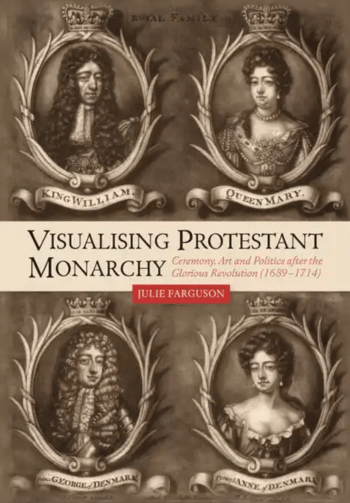 The first comprehensive, comparative study of the visual culture of monarchy in the reigns of William and Mary and Queen Anne
This book provides the first comprehensive, comparative study of the visual culture of monarchy in the reigns of William and Mary and Queen Anne. It makes innovative use of material evidence and new primary sources to re-evaluatethe practice of kingship and queenship to produce an original interpretation of the British monarchy during a period of vital transformation. The quarter century between the Glorious Revolution and the Georgian era witnessed prolonged military conflict with France and the birth of what we now call Great Britain. This book argues that a new style of monarchy likewise emerged in this period and that its survival largely depended on the efforts of the royal family: two English queens, a Dutch king, and a Danish prince.
Through a study of art and material culture (paintings, prints, the decorative arts, architecture, dress, and royal insignia) within the broader political context, the book explores how the English people were persuaded to transfer their loyalties from a traditional style of kingship, centred on ideas of divinely appointed rule and hereditary right, to one rooted in Protestantism and Parliament. The book argues that both ceremony and art played a vital role in the way the monarchy functioned after the Glorious Revolution. Crucially, it examines not only the production of images and use of ceremony but also the ways in which they were received by audiences, both in England and abroad. The book sets the on-going changes in the ideology of British monarchy within the wider context of royal politicking in Europe and pays close attention to gender and the practice of queenship as well as the ways in which military conflict shaped royal representational culture. Using a method that is centred on the visual—ceremonies and art—and on visuality, the study makes an original and important contribution to our understanding not only of the monarchy but also the political culture of the post-Glorious Revolution era.
Julie Farguson is College Lecturer in History at St Hilda’s College, Oxford.
C O N T E N T S
Introduction
• Establishing an Anglo-Dutch Royal Image, 1689–90: The Beginning of Stuart-Orange Kingship
• Anglo-Dutch Kingship and War, 1690–94: The Stuart-Orange Partnership in Action
• The Royal Image, 1695–1702: From Stuart Monarch to Orange King
• Transforming the Royal Image, 1702: Establishing Stuart-Oldenburg Kingship
• Military Affiliations, 1702–08: Stuart-Oldenburg Kingship and War
• The Royal Image, 1709–14: The Rise of Anna Augusta
Conclusion
Bibliography
New Book | Pots, Prints, and Politics
From Oxbow Books:
Patricia Ferguson, ed., Pots, Prints, and Politics: Ceramics with an Agenda, from the 14th to the 20th Century (London: The British Museum Press, 2021), 196 pages, ISBN: 978-0861592296, £40 / $80.
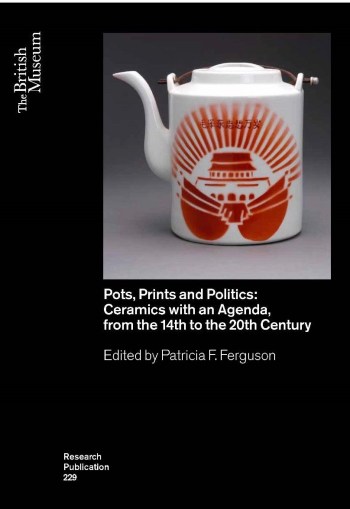 In this lavishly illustrated publication, 15 leading scholars challenge and interrogate a mixture of Asian and European ceramic objects—from teapots to chamber pots—bringing to light new meanings and agendas that are just as provocative now, as when they were made. The medium behind these messages are graphic sources. From Chinese woodblock prints to Japanese kyōka surimono (‘printed things’), and European copperplate engravings to chromolithographs, prints circulated ideas. Potters across time and cultures adapted these images into ceramic bodies or covered their surfaces with hand-painted or transfer-printed representations, giving expression to serious political and social issues: propaganda, self-promotion, piety, race, gender, national, and regional identities. Driven by commercial gain, altruism or imperial dictate, ceramic artists and manufacturers often risked their livelihoods, if not their lives, articulating their convictions.
The authors in this volume have explored these narratives on a variety of wares employing the British Museum’s world-renowned print collection as a base, as well as studying visual culture for material references. Pots, Prints and Politics invites us to look at ceramics as social objects, deciphering their many critical debates masquerading as mere ornament.
This publication has been generously supported by Ceramica-Stiftung Basel.
Patricia F. Ferguson was Project Curator in the Britain, Europe and Prehistory Department at the British Museum from 2017 until 2020, focusing on European ceramics and print sources. Between 2006 and 2017, she was a consulting curator in the Asian and Ceramics Departments of the Victoria and Albert Museum. As Honorary Adviser on Ceramics to the National Trust, she published Ceramics: 400 Years of British Collecting in 100 Masterpieces (2016) and Garnitures: Vase Sets from National Trust Houses (2016).
C O N T E N T S
Introduction, Patricia Ferguson
1 Luk Yu-ping (The British Museum), Pots, Prints, and Politics in China? Some Examples from the 14th to 17th Centuries
2 Elaine Buck (SOAS), A 14th-Century Longquan Pot with a Dual Purpose
3 Wenyuan Xin (The British Museum), Illustrated Hagiographies and Figure Production in Late Ming Fujian
4 Dora Thornton (Curator, Goldsmith’s Company), ‘Take Note’: The Construction of Political Allegories of the Sack of Rome (1527) on Italian Renaissance Maiolica in the British Museum
5 Elisa Paola Sani (The Courtauld Gallery), War on a Plate: The Battle of Mühlberg on a Maiolica Dish at the Wallace Collection, London
6 Claire Blakey (Burrell Collection) and Rachel King (British Museum), Prints and Post-Palissian Ceramics
7 Helen Glaister (Victoria and Albert Museum), Exotic Self-Reflections: Fashioning Chinese Porcelain for European Eyes
8 Catrin Jones (V&A Wedgwood Collection), ‘Aux plaisirs des dames’: Designing and Redesigning a Meissen Bourdalone
9 Patricia Ferguson (Hon. Adviser on Ceramics, The National Trust), Myth and Materiality: Admiral Anson’s Chinese Armorial Dinner Service at Shugborough Hall, Staffordshire
10 Alessandro Biancalana (Independent art historian and author), From stampa and riporto to giochi di bambini: Transfer Printing and Iconographic Sources at Carlo Ginori’s Porcelain Manufactory at Doccia
11 Sheila O’Connell (The British Museum), Jefferyes Hamett O’Neale (act. 1750–1801): Porcelain Painter and Print Designer
12 Caroline McCaffrey-Howarth (Victorian and Albert Museum), Propaganda on Pots: ‘King Louis’s Last Interview with his Family’ on a Creamware Mug, 1793–95
13 Mary Redfern (Chester Beatty Library), Pots for Poets: Ceramics Up-Close in Japanese Prints, Including Hokusai’s Everything Concerning Horses
14 Ronald W. Fuchs II (Reeves Center, Washington and Lee University) and Patricia Ferguson (Hon. Adviser on Ceramics, The National Trust), ‘Remember them that are in Bonds’: A Plate Made for the Abolition Movement
15 Mary Ginsberg (The British Museum), Appropriated Heroes: Prints, Pots, and Political Symbols in Revolutionary China
Bibliography
Call for Articles | Raconter / Narrative(s)
From the Call for Papers (English and French) . . .
Raconter / Narrative(s), Edited by Marine Kisiel and Matthieu Léglise
Special Issue of Perspective: actualité en histoire de l’art, no. 2022 – 2
Proposals due by 1 July 2021, with completed articles due by 15 December 2021
The journal Perspective’s thematic issue 2022 – 2 will explore the relationships between narration, art and art history. From the stories that inspire images and art objects, to those (re)constituted by its viewers, to the ‘story-telling’ of art historians, this issue is intended to make use of the act of narrating as a productively destabilizing heuristic tool. Even in the absence of figured diegetic content, the image and the art object narrate, if only as witnesses of an era or practices, as vehicles of narrativity. The resulting visual narratives in turn generate other narratives: fictions or legends, scholarly articles or fanciful ramblings, dialogues between artworks or viewers’ monologues. And art historical narratives as well, given that art historians continuously recount the process performatively, with its multiple mises en abyme and comings and goings in the grey areas between fact and fiction, expression and narration, description, analysis, and projection.
The historical place of the terminology of narrative within the field of literary studies also calls for examining the relationship between a narrative in images and its possible written sources. Does representing a story in images amount to imitating the textual narrative or faithfully reproducing its dramaturgy for the eye? What are the possibilities of visual narrativity relative to those of verbal language? The debt of figurative representation to its source has prompted a variety of responses from researchers in art history, some of whom posit the primacy of the written over the visual. Here, the concept of figurative thought (Pierre Francastel, La figure et le lieu : l’ordre visuel du Quattrocento, Paris, Gallimard, 1967) permits a distinction between two equally valid conceptual domains, where each narrative medium has its own logic. This dialectical approach, which connects the narrative image to its cultural environment, then opens the way to multiple interactions and reformulations, in particular through orality and a dialogue between the collective imaginary, individual imaginaries, and visual culture (Hans Belting, An Anthropology of Images: Picture, Medium, Body [2001], Princeton / Oxford, Princeton University Press, 2011). In methodological terms, the emergence of narratology within French literary theory in the 1970s (Gérard Genette, Figures III [1972], selections translated as Narrative Discourse, An Essay in Method, Ithaca, NY, Cornell University Press, 1980) provided a body of conceptual tools for renewing the study of the internal mechanisms of the literary narrative, in particular through the distinction between histoire (story), récit (narrative text) and narration (narrating act). The possible influence, or not, of this approach on the theoretical frameworks used in art history to analyze the narrative elements of the artwork or the image merits further consideration. And the same is true for the connections between visual, linguistic, and semiotic studies.
The figured narrative calls on a wide variety of visual means for shaping and spatializing narrative content through still and moving images (analog or digital), architecture, fashion, or art objects. Each work produced—monument, dress, painting, sculpture, film, book, digital interface, art object—requires a match between the narrative in images and its medium, dimensions and volume so as to fashion its visual effectiveness and reception by judiciously condensing or expanding it. Giving visual form to the narrative is also a means of fashioning or recounting its time In sum, this issue of Perspective seeks to take into account all the narrative dimensions, specificities, and potentialities of art objects and works and explore the way(s) the narrativity of the visual is rooted in a lengthy process of legitimization and empowerment.
If the image and the art object narrate, art historians in turn continuously provide a dialogical account of this multifaceted relationship as a kind of story within the story. The history of art, rooted in the works of Giorgio Vasari and Karel van Mander (considered as its modern founders), is based on a narrative exercise, from the ekphrasis of Antiquity to the epic narratives of modernist autonomy, but also anecdotes and biographical legends. The way art historians have forged their discipline by freeing themselves from a willfully mythical literary practice and gradually adopting, fashioning, and discussing ‘scientific’ methods bears witness to a complex relationship with the narrative and narration—otherwise stated, a kind of fiction. Some recent historiographical studies have focused on the question of these close ties between the writing of history and that of fiction. Mark Ledbury, in the collective work Fictions of Art History (Williamstown, Mass., Sterling and Francine Clark Art Institute / Yale University Press, 2013), Ivan Jablonka with History Is a Contemporary Literature: Manifesto for the Social Sciences [2014] (Ithaca, NY, Cornell University Press, 2018), and more recently, Myriam Métayer and Adriana Sotropa, the editors of Le récit de l’histoire de l’art. Mots et rhétoriques d’une discipline (Le Kremlin-Bicêtre, Éditions Esthétique du divers, 2017), for example, have offered fruitful insights. Is it possible to write history without telling stories? From the point of view of the images and art objects or that of the viewers, can—or should—we forego any narrative process? Can we communicate without narrating (or narrating ourselves)? If this is not the case, what epistemological conclusions can be drawn about the way we consider our practice—our writing—of art history? In the era of ‘alternative facts’ and storytelling, when the question of the relative nature of narratives is both a considerable risk and an opportunity, raising question about the making of narrative, the way that art and art history narrate (and narrate themselves), ultimately implies a return to teleological issues: what has meaning, what gives meaning, what creates meaning?
The appearance of an image, be it figurative, aniconic, material, or mental, gives rise to a story and a way of arranging it into a narrative. But does the absence of figuration signify the absence of narrative? For in the same way, the appearance of the image, be it material or mental, figurative or aniconic, gives rise to a desire to narrate. While no one will deny that the image and the narrative act go hand in hand, the precedence of one over the other remains an eternal subject of debate, as are the relaying and embedding processes that engender them, from the time of the paragone to modernist discourse predicting the end of narrative artworks. For the upcoming thematic issue, these different oppositions and complex transmission phenomena can be approached from a variety of vantage points, provided that the analysis is situated within a historiographical perspective addressing the narrative processes at work in the creation and reception of art from the origins to the present day, from symbolic Paleolithic expressions to contemporary cinema. For this reason, specific case studies bearing on iconographic analyses will not be accepted unless they raise broader critical questions.
Proposals involving one or several of the following approaches will be particularly welcome:
• Artists telling stories
• Artists telling their own stories (authorized accounts, etc.)
• Historians recounting the life of the artist (from Vasari to Ernst Kriz and Otto Kurz)
• Historians telling the story of visual narratives (iconography, iconology, interpretation, etc.)
• Synchronic narratives of art history (the ‘great’ movements, the ‘master’ narratives)
• Counter-narratives and re-narrated art historical narratives (historiography, fictionalization)
• The place and possibility of a collective and/or participatory narrative within the discipline
• The socio-political consequences and echos of art-historical narratives and counter-narratives (activism, societal debates)
Published by the Institut national d’histoire de l’art (INHA) since 2006, Perspective is a biannual journal which aims to bring out the diversity of current research in art history through a constantly evolving approach that is explicitly aware of itself and its own historicity and articulations. It bears witness to the historiographical debates within the field, while remaining in continuous relation with the images and works of art themselves, updating their interpretations, and thus fostering global, intra- and interdisciplinary reflection. The journal publishes scholarly texts which offer innovative perspectives on a given theme. These may be situated within a wide range, yet without ever losing sight of their larger objective: going beyond any given case study in order to interrogate the discipline, its methods, history and limitations, while relating these questions to topical issues from art history and neighboring disciplines that speak to each of us as citizens.
Perspective invites contributors to update their historiographical material and the theoretical questionings from which they draw their work, to think from and around the starting point of a precise question, an assessment that will be considered an epistemological tool rather than a goal in itself. Each article thus calls for a new approach creating links with the great societal and intellectual debates of our time. Perspective is conceived as a disciplinary crossroads aiming to encourage dialogue between art history and other fields of research, the humanities in particular, and put into action the ‘law of the good neighbor’ developed by Aby Warburg. All geographical areas, periods, and media are welcome.
Narrative(s), no. 2022 – 2
Editors: Marine Kisiel (INHA) and Matthieu Léglise (INHA)
Issue coordinated with Anne-Orange Poilpré (université Paris 1 – Panthéon-Sorbonne)
Please send your submissions (an abstract of 2,000 to 3,000 characters / 350 to 500 words, a provisional title, a short bibliography on the subject, and a biography of a few lines) to the editorial office (revue-perspective@inha.fr) before July 1st, 2021. Proposals will be examined by the issue’s editorial committee regardless of language (articles accepted for publication will be translated by Perspective). The authors of the pre-selected proposals will be informed of the committee’s decision by the end of July 2021. The complete articles (25,000 or 45,000 characters/ 4,500 or 7,500 words depending on the project) must be submitted by December 15th, 2021. These will be definitively accepted after the journal’s anonymous peer-review process.
Translated from French by Miriam Rosen
At Christie’s | Women in Art
From the press release, via Art Daily (3 May 2021) for the upcoming sale . . .
Women in Art, Sale 19614
Christie’s, Paris, 16 June 2021
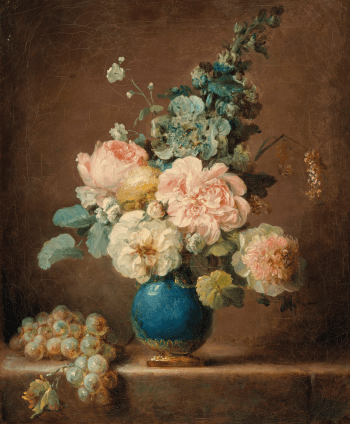
Lot 10: Anne Vallayer-Coster, Vase of Flowers and Grapes on a Stone Ledge, 1781, oil on canvas, unlined, 18 × 15 inches. Estimate: 150,000–250,000€.
For the first time, Christie’s in France will hold a sale dedicated to women artists, covering all mediums—paintings, sculptures, books and autographed letters, photographs, engravings, design, jewels, and fashion (Sale 19614). The panorama will pay tribute to women artists working over five centuries, of different nationalities, all of whom have marked art history, from the 16th to the 21st century.
Alice Chevrier, specialist in the Rare Books and Manuscripts Department, and Bérénice Verdier, specialist in the Old Master Paintings Department, are in charge of the sale and note: “We are very proud to organise in France the first sale dedicated to women artists. In recent months, we have watched as events devoted to women artists were held by museums, including the exhibition Peintres femmes, 1780–1830 at the Musée du Luxembourg; the upcoming exhibition at the Centre Pompidou, Elles font l’abstraction; and the MOOC (Massive Open Online Courses), Female Artistic Creation, created by the Centre Pompidou and the Musée d’Orsay through their collaboration with the Aware association. It seemed therefore a good moment for Christie’s Paris to organize a sale with this focus for the art market and we have had great support from consignors and colleagues. We have been able to assemble an impressive selection of works from different periods and mediums, which should widen the appeal to many collectors, with estimates ranging from 200 to 300,000 Euros. We hope that the sale will throw light on the careers of these women artists, some of whom have remained in the shadow for too long!”
This sale focuses on artists from the 16th, 17th, and 18th centuries who have often been treated unequally in art history. In the Old Master Paintings section is a beautiful painting by Louise Moillon (1610–1696), Still Life (1636), the highlight of the sale, estimated at €300,000–500,000. A leader in the genre of fruit still lifes, Moillon is one of the few female painters from 17th-century France whose work is now well identified. Still LIfe is dated and signed, allowing scholars to situate it precisely in a body of work with only sixty-nine works attributed with certainty to the artist. The meticulous realism of Moillon’s works, the precise touch, full colors, and the rendering of the velvetiness or transparency of the fruits are a testament to the painter’s mastery of her craft, inherited from Flemish art and acquired by her familiarity with the work of a group of Dutch painters working in Saint-Germain.
Further highlights include a delicate autumnal composition by Anne Vallayer-Coster (1744–1818), Vase of Flowers and Grapes on Entablature (estimate: €150,000–250,000), executed in 1781 during the artist’s mature period, after her admission to the Royal Academy of Painting and Sculpture. In an excellent state of conservation, the work has never been presented at auction and has not been exhibited since its last appearance at an exhibition in London in 1954. An artist of great modernity recognized by her peers, Vallayer-Coster inspired the Impressionists, notably Fantin La Tour.
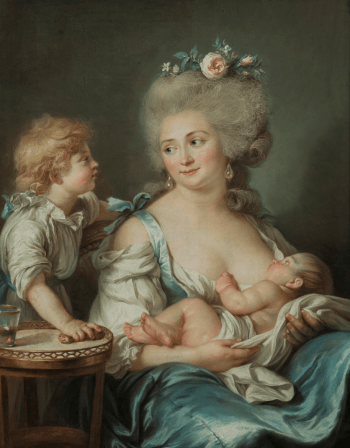
Lot 104: Adélaïde Labille-Guiard, Madame Charles Mitoire, née Christine-Geneviève Bron (1760–1842), avec ses enfants, allaitant l’un d’eux, 1783, pastel on paper laid down on canvas, 36 × 26 inches. Estimate: 150,000–250,000€.
Another important work in the section is a beautiful Portrait of a Woman by Elisabeth Vigée Le Brun (1755–1842). Counted among the greatest portraitists of her time, the artist was successively the painter of the Court of France, the Kingdom of Naples, the Court of the Emperor of Vienna, and finally the Emperor of Russia. This is a rediscovery, as the work has never been published or offered for sale (estimate: €80,000–120,000). Collectors should be seduced by this beautiful testimony of the artist’s Parisian period.
Lavinia Fontana (1552–1614), an Italian painter who imposed her talent and erudition in the 16th century as the first woman artist elected to the Academy of Fine Arts in Rome, offers here in full-length a portrait of a young boy with a dog (1585–90) a fine example of her art. A preparatory drawing for this painting is in the Uffizi Museum in Florence. The portrait is estimated at €60,000–100,000.
The sale, which will also feature a section devoted to decorative arts, includes a refined marquetry tray made by Rosalie Duvinage (Veuve ‘Widow’ Duvinage). It is one of the most original productions of the 1870s. Influenced by Japanese art, both in its technique and its iconography, it testifies by its forms to the eclecticism characteristic of the late 19th century.
The Rare Books and Manuscripts Department will offer a magnificent eight-page letter by George Sand (1804–1876) addressed to Gustave Flaubert, estimated at €6,000–8,000. The writer changed her name to that of a man to ensure her work was more widely read. This letter-confession is one of the most beautiful and moving of Sand’s correspondence: “Your letters fall on me like a rain that wets, and makes what is in germ in the ground grow right away. . . .” Collectors will also be able to purchase a letter which has never been published from Edith Piaf (1915–1963) to her lover, the Italian-French actor Yves Montand (estimate: €2,000–3,000), which she wrote to him while on tour in the North of France. She announced their breakup, after receiving a telegram from Montand, saying, “You may be right—I am too young for you— Wishing you with all my heart the happiness you deserve.”
In the field of science, women have also worked in a revolutionary way, and Marie Curie (1867–1934) is perhaps one of the most important figures, especially thanks to her 1903 thesis devoted to radioactivity, for which she was awarded the Nobel Prize in Physics, six months after its publication. Scientific bibliophiles will certainly be aware of the historical value of the book, offered in its first edition and signed by her hand (estimate: €10,000–15,000).
Dorothea Tanning (1910–2012) is represented in this sale through her engraved masterpiece: The 7 Spectral Perils (€25,000–35,000). Produced in 1950, these seven surrealist lithographs in exceptional condition will be presented in their original portfolio. The edition includes only 50 copies, some of which are already in the collections of the greatest international museums (including MoMA, Reina Sofia, Smithsonian American Art Museum).
Other important figures of the 20th century include Niki de Saint Phalle (1930–2002), Sarah Morris (b. 1967), Dora Maar (1907–1997), Sheila Hicks (b. 1934), and Maria Helena Vieira da Silva (1908–1992). The latter’s work La ville, la nuit, estimated at €30,000–50,000, is one of the highlights of the 20th-century section. This work comes from the collection of Max-Pol Fouchet, a renowned man of culture, who was a poet, novelist, art historian, literary and music critic. This work was a gift from the artist to Max-Pol Fouchet after their meeting on the shooting of a documentary dedicated to the artist.
Fashion will also be represented with a few pieces by the daring avant-garde couturier Elsa Schiaparelli, from her personal archives and recorded by her granddaughter Marisa Berenson, as well as a few dresses by the famous Madame Grès, including a draped dress from the 1930s that was exhibited in the major retrospective La couture à l’œuvre at the Bourdelle Museum in 2011. The art of jewelry will also be present with a splendid necklace, made by the surrealist artist Leonor Fini, estimated at €10,000–15,000. It is a true sculpture-necklace stylizing ‘Horns’ in yellow gold, wearable as a head jewel or a torque necklace.
Finally, Christie’s will give carte blanche to Inès Longevial (b. 1990) who will occupy an exhibition space in parallel with the pre-sale exhibition. Longevial executes drawings and paintings in resonance with impressions, feelings, sensations from which she naturally extracts the palette. The artist approaches her memories in color and gives form to candid and absorbed faces. If, in the artist’s work, faces often become the site of whimsical ornamentation, finding their roots in a patchwork of bright colors through, this new series tends towards a greater simplicity and plays above all on chromatic variations. The silent attitude of this woman, declined in several ranges of colors and caught in a convoluted set of arms is inspired by several women artists such as Dorothea Tanning, Leonor Fini. The exhibition is created in collaboration with the Ketabi Projects gallery.
Artists and writers presented in the sale: Carole Benzaken, Claude Cahun, Anne Vallayer-Coster, Marie Curie, Dadamaino, Sonia Delaunay, Veuve Duvinage, Lavinia Fontana, Leonor Fini, Sarah Morris, Maria Lai, Marie Laurencin, Vernon Lee, Suzette Lemaire, Dora Maar, Louyse Moillon, Berthe Morisot, Meret Oppenheim, Alice Paalen, Alicia Penalba, Maria Pergay, Edith Piaf, Jiang Qiong Er, Bettina Rheims, Ayako Rokkaku, Niki de Saint Phalle, George Sand, Claire Stansfi, Dorothea Tanning, Boi Tran, Elisabeth Louise Vigée Le Brun, Renée Vivien.
Sweden Nationalmuseum Acquires Two Portraits by J. E. Alphen
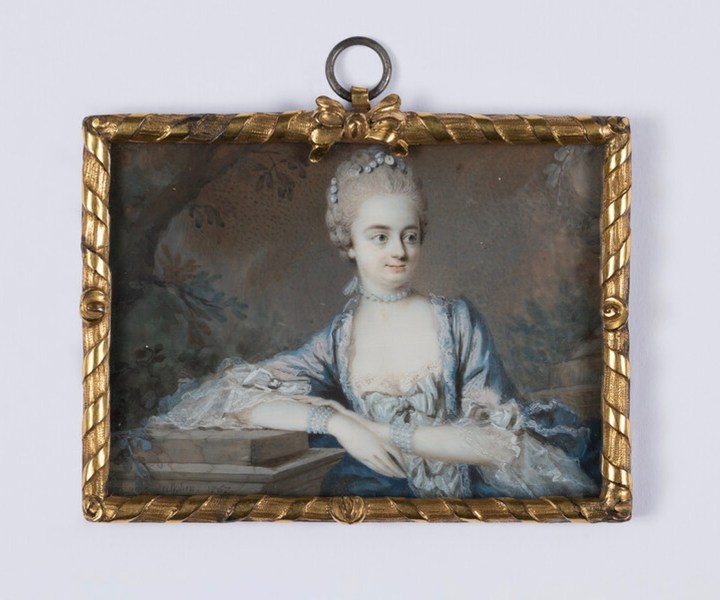
Johann Eusebius Alphen, Portrait of a Lady in a Blue Dress, 1767, watercolour and gouache on ivory
(Stockholm: Nationalmuseum, photo by Anna Danielsson)
◊ ◊ ◊ ◊ ◊
Press release (2 June 2021) from Sweden’s Nationalmuseum in Stockholm:
Nationalmuseum has acquired two portraits of women created by the Austrian court miniaturist Johann Eusebius Alphen in 1767. The portrayals of the models are unusually vivid, and the artist has even been carefully rendering the setting. The two portraits are unique because few signed works by Alphen have survived, as the artist was just 31 years old when he died.
In the mid-18th century, if a young artist wanted to further educate himself in miniature painting, Paris was one of the most interesting places to be. The city’s leading name was Jean-Baptiste Massé, a member of the academy and royal court painter. He revitalised miniature painting with his loose and unconventional brush technique. By this time Massé was no longer active as an artist, because he had started to have problems with his eyesight around 1740 and therefore declined to take on any more royal commissions.
Although Massé had essentially ceased painting, he would continue to play an important role as a teacher. In February 1764, the Austrian Johann Eusebius Alphen (1741–1772) came to Paris and was introduced to the French miniaturist. Yet Alphen was not the only student who quickly rose to favour. That same year, he faced competition from the Dane Cornelius Høyer, who also became a lodger with Massé until the master’s death in 1767. The two young artists, who were even the same age, each acquired the same technique of using loose brushwork. Alphen in particular became a virtuoso, as evidenced by the two recently acquired portraits of women. On their faces, he has combined a refined line and dot technique with a fluid brushstroke to depict clothing and other accessories. White highlights reinforce the sense of materiality and illusionism. This approach is reminiscent of pastel painting, in which Alphen was also skilled. As with his teacher Massé, the red and yellow dyes have faded into carnation, contributing to the unusually bright, powdered look of the faces. Only blue and grey halftones remain.
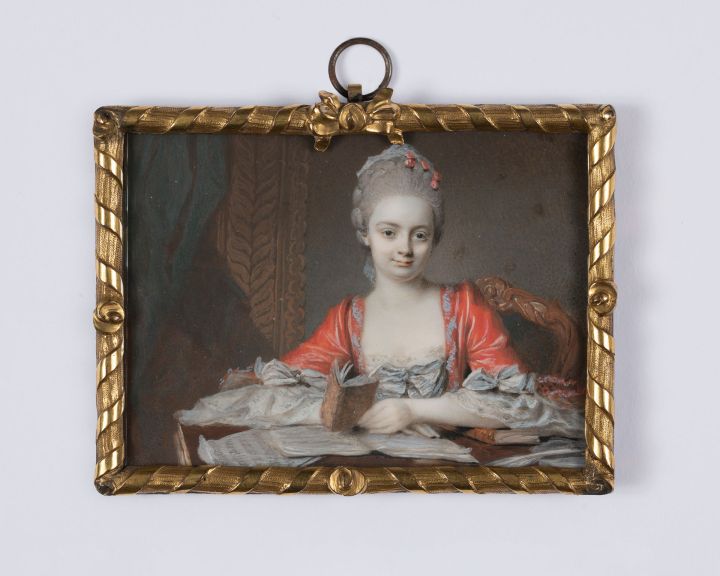
Johann Eusebius Alphen, Portrait of Countess van Lebel, 1767, watercolour and gouache on ivory
(Stockholm: Nationalmuseum, photo by Anna Danielsson)
◊ ◊ ◊ ◊ ◊
Both portraits are signed and dated “Peint par Alphen 1767.” It is unclear whether they were painted while the artist was still in Paris or recently after his arrival in Vienna. The younger lady, dressed in red, sits at a table with notes and a pen in front of her, as well as a book in one hand. The Canadian Mozart specialist Cliff Eisen of King’s College London has floated the theory that this young woman is Wolfgang Amadeus Mozart’s sister Maria Anna, nicknamed Nannerl, who was five years older than the composer. Alphen’s portrait has a direct counterpart in a Swiss private collection. This preliminary study purportedly has ownership-related links to other Mozart portraits. Even if this were not the case, Alphen met the Mozart family on several occasions. The first time was in Brussels in 1763, then three years later in Paris, and finally in Vienna in 1767–68. Their last encounter was in Milan in 1771, where Alphen had a one-on-one rendezvous with Mozart, who mentions their meeting in a letter to his sister Nannerl.
So who is this young woman in red? It is undoubtedly the same model as in the sketch, but is she Maria Anna Mozart? The portrait acquired by Nationalmuseum bears the signature “Comtesse von Lebel.” No countess with this name is known to have lived, but could the name could be a euphemism for the Baroness Berchtold von Sonnenburg, the real Nannerl? In truth, this woman bears little resemblance to other famous representations of Mozart’s sister from around the same time. While this little mystery may never be answered, we can still appreciate the fact that Alphen’s two portraits are unusual examples of the artist’s great virtuosity as a miniaturist.
Nationalmuseum receives no public funding for the acquisition of artworks but relies on donations and gifts from private individuals and foundations to enrich its collections. The acquisition has been made possible by generous contributions from Hjalmar and Anna Wicander’s donation funds.
Print Quarterly, June 2021
The eighteenth century in the latest issue of Print Quarterly:
Print Quarterly 38.2 (June 2021)

Jeanne-Elisabeth Chaudet, Portrait of a Young Girl, traditionally Identified as Madame Villot, née Barbier, Carrying Her Father’s Sabre, oil on canvas, likely shown at the Salon in 1817 (Private Collection).
A R T I C L E S
Claire Brisby, “Orthodox Prints in the Samokov Painter’s Archive”
Addressing the distinctive category of religious prints produced for the Orthodox Christian market from 1698 to 1864, Brisby’s article focuses on prints that once formed the image archive of the painter Christo Dimitrov and his son and other family members in Samokov, Bulgaria—prints that have received limited scholarly attention. The article discusses various sites of print production and explores the use of prints in workshops as models for frescoes and paintings.
N O T E S
F. Carlo Schmid, “Prints after the Antique up to 1869”
The exhibition catalogue Phönix aus der Asche: Bildwerdung der Antike – Druckgrafiken bis 1869 / L’Araba Fenice: L’Antico Visualizzato nella Grafica a Stampa fino al 1869, reviewed here by F. Carlo Schmid, explores the development of printed images concerning architecture, sculpture, and objects of everyday life of classical antiquity. The prints date from the fifteenth to the second half of the nineteenth century and relate to works from, but not limited to, Egypt, Greece, and the Roman Empire. Of particular interest to eighteenth-century scholars, Schmid highlights that the original project out of which the exhibition and catalogue grew concerned Hadrian’s Villa at Tivoli as a “space of artistic interaction” in the eighteenth and nineteenth centuries.
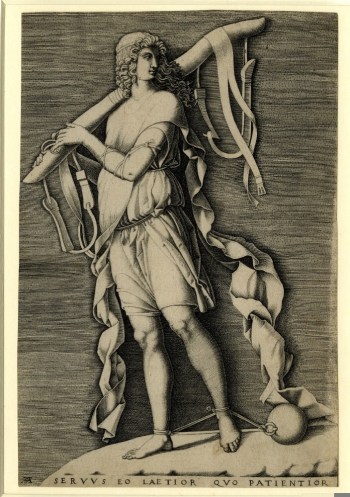
Adamo Scultori (Ghisi), Young Prisoner, 1566–80, engraving.
Francisco J. R. Chaparro, “Spanish Drawing Books”
A note on the exhibition catalogue El Maestro de Papel reviewed here by Francisco J. R. Chaparro, presents a comprehensive review of the scholarly attention directed towards Spanish drawing books. Chaparro makes reference to the Matías de Irala 1731 work and mentions the poor survival of the books. Chaparro tracks the appearance and reappearance of Jusepe Ribera’s etchings dated 1622 to highlight the further issue of cross-reference in these works. The note provides a critique of the exhibition while firmly situating it as a cornerstone for further research on the field of Spanish prints and drawings.
Ellis Tinios, “Surimono from the Virginia Shawan Drosten and Patrick Kenadjian Collection”
A laudatory note by Ellis Tinios on the catalogue The Private World of Surimino presents a brief analysis of surimono prints and notes, for instance, the importance of adequate lighting in revealing the complexities of blind printing and reflective inks.
David Ekserdijan, “A Portrait by Jeanne-Elisabeth Chaudet and Its Source”
David Ekserdijan presents the unusual artistic inspiration behind Jeanne-Elisabeth Chaudet’s painting A Portrait of a Young Girl of 1817, which sold in a 2006 Sotheby’s auction. The note features a side-by-side comparison with Adamo Scultori’s Young Prisoner or An Allegory of Servitude of 1566–80.
At Auction | Vase Designed by Thomas Hope

Gilt bronze-mounted patinated copper two-handled vase (detail) by Alexis Decaix, designed by Thomas Hope for his Duchess Street Mansion in London, ca. 1802–03, 26 × 13 × 12 inches (65 × 34 × 31 cm). Heritage Auctions, 18 June 2021, Sale 8046, Lot #61046, estimate: $40,000 to $60,000.
◊ ◊ ◊ ◊ ◊
From the press release, via Art Daily:
An extraordinarily rare and important early 19th-century urn, thought lost to history, was recently discovered by Heritage Auctions and is set to go to auction June 18 in Dallas, Texas (Sale 8046, Lot 61046). Designed by Thomas Hope, the urn was found in Tulsa, Oklahoma, in the collection of David D. Denham, where it had been modified into a side table. Heritage has set a conservative pre-auction estimate of $40,000 to $60,000 on the rare bronze. According to research, the urn’s mate resides in London’s Victoria and Albert Museum (M.33-1983), the world’s largest museum of applied and decorative arts and design.
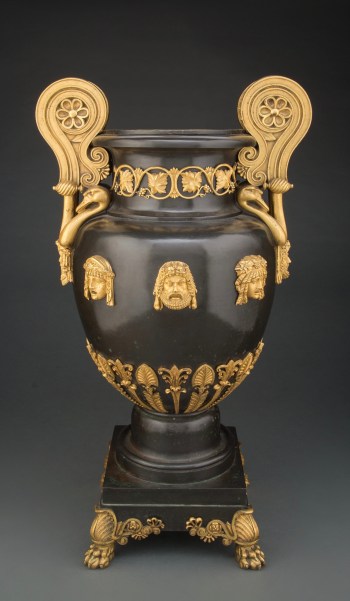
Gilt bronze-mounted patinated copper two-handled vase by Alexis Decaix, designed by Thomas Hope for his Duchess Street Mansion in London, ca. 1802–03.
“This important discovery was a remarkable surprise,” said Karen Rigdon, Director of Fine & Decorative Art at Heritage Auctions. “No one knew where the urn was for decades until we recognized it during a house call.”
Hope commissioned the vase, decorated with ormolu (gilt-bronze) mounts, for the dining room of his mansion located on Duchess Street in London. It was made by acclaimed French artist Alexis Decaix based on Hope’s design, which mirrored a classical volute krater (an ancient Greek vase with two handles which was used for mixing wine and water). Hope likely commissioned the one-of-a-kind pair of bronze urns directly from Decaix. Experts working with Heritage matched the urn’s historical background with telltale details confirming the vase is the pair to the one at the V&A. The newly-discovered vase’s specific placement of the mask mounts at the obverse and reverse matched the vase in the museum’s collection, as does the placement of specific notches and scratches made to each vase.
Hope, the scion of a wealthy banking family, made his London home into an outstanding example of Neo-classical design. In 1807, Hope published in London an illustrated account of the house and its furnishings in a book titled Household Furniture and Interior Decoration. The book had a considerable influence on other architects and designers working in the Greek Revival style.
“The appearance of this second example confirms Hope clearly took great care to ensure the vases would be displayed in perfect harmony, which supports what is known about his incredibly meticulous nature and approach to collecting,” according to Hope experts Philip Hewat-Jaboor and William Iselin, who worked with Heritage to confirm the vase’s authenticity.
Heritage experts discovered the urn in Tulsa in the collection of the late David Denham. “Denham was a well-known social figure in the area and admired for his collector’s eye and meticulous attention to detail,” Rigdon said. “The estate is unsure when the vase first entered Denham’s collection or when it was made into a side table,” she added. “But its discovery closes a chapter on the unknown history of this important artwork.”










 Enfilade
leave a comment