New Book | Letters to Camondo
From Macmillan:
Edmund de Waal, Letters to Camondo (New York: Farrar, Straus and Giroux, 2021), 192 pages, ISBN: 978-0374603489, $28.
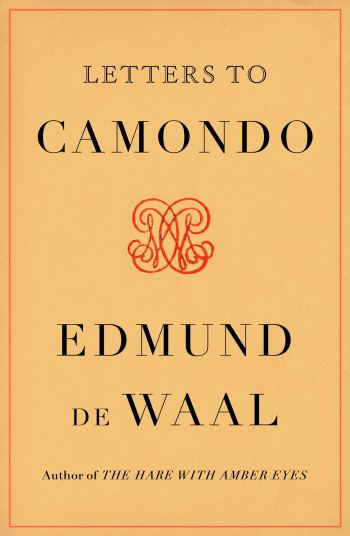 A tragic family history told in a collection of imaginary letters to a famed collector, Moise de Camondo
Letters to Camondo is a collection of imaginary letters from Edmund de Waal to Moise de Camondo (1860–1935), the banker and art collector who created a spectacular house in Paris, now the Musée Nissim de Camondo, and filled it with the greatest private collection of French eighteenth-century art.
The Camondos were a Jewish family from Constantinople, ‘the Rothschilds of the East’, who made their home in Paris in the 1870s and became philanthropists, art collectors, and fixtures of Belle Époque high society, as well as being targets of antisemitism—much like de Waal’s relations, the Ephrussi family, to whom they were connected. Moise de Camondo created a spectacular house and filled it with art for his son, Nissim; after Nissim was killed in the First World War, the house was bequeathed to the French state. Eventually, the Camondos were murdered by the Nazis.
After de Waal, one of the world’s great ceramic artists, was invited to make an exhibition in the Camondo house, he began to write letters to Moise de Camondo. These fifty letters are deeply personal reflections on assimilation, melancholy, family, art, the vicissitudes of history, and the value of memory.
Edmund de Waal is an artist who has exhibited in museums and galleries around the world. His bestselling memoir, The Hare with Amber Eyes, has won many prizes and has been translated into twenty-nine languages. The White Road, a journey into the history of porcelain, was published in 2015. He lives in London with his family.
New Book | The House of Fragile Things
From Yale UP:
James McAuley, The House of Fragile Things: Jewish Art Collectors and the Fall of France (New Haven: Yale University Press, 2021), 320 pages, ISBN: 978-0300233377, $30.
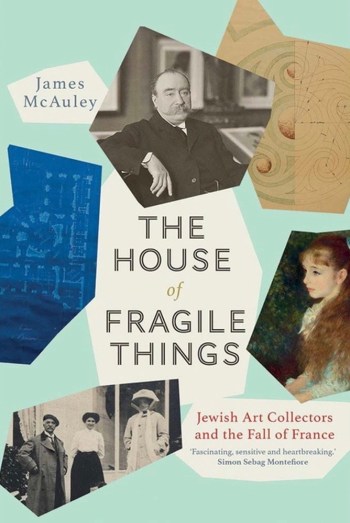 In the dramatic years between 1870 and the end of World War II, a number of prominent French Jews—pillars of an embattled community—invested their fortunes in France’s cultural artifacts, sacrificed their sons to the country’s army, and were ultimately rewarded by seeing their collections plundered and their families deported to Nazi concentration camps.
In this rich, evocative account, James McAuley explores the central role that art and material culture played in the assimilation and identity of French Jews in the fin-de-siècle. Weaving together narratives of various figures, some familiar from the works of Marcel Proust and the diaries of Jules and Edmond Goncourt—the Camondos, the Rothschilds, the Ephrussis, the Cahens d’Anvers—McAuley shows how Jewish art collectors contended with a powerful strain of anti-Semitism: they were often accused of ‘invading’ France’s cultural patrimony. The collections these families left behind—many ultimately donated to the French state—were their response, tragic attempts to celebrate a nation that later betrayed them.
James McAuley is the Paris correspondent for The Washington Post and a contributor to The New York Review of Books. He recently received his doctorate in French history at Oxford.
Call for Papers | Rethinking Race and Representation in the Francosphere
From ArtHist.net (10 July 2021) . . .
Rethinking Race and Representation in Art History and Material Culture of the Eighteenth- and Nineteenth-Century Francosphere
H-France Salon
Abstracts due by 15 August 2021, with accepted papers due by 1 February 2022
H-France Salon invites contributions for a Salon series addressing the theme of “Rethinking Race and Representation in Art History and Material Culture of the Eighteenth- and Nineteenth-Century Francosphere.” This Salon builds on the H-France Salons Series entitled “Race, Racism, and the Study of France and the Francophone World Today” [H-France Salon 11.2 (2019)] and seeks to offer new ways and tools for thinking specifically about constructions of race in history, art history, and material culture in the eighteenth and nineteenth centuries.
The editors are open to many directions, but possible angles may include:
• What overlooked artists or artwork should we include to shift our understanding–or what well-known works should we reconsider in the light of new narratives and questions? We welcome essays that focus either on one artist or representation, or on a set.
• What approaches are particularly thought-provoking or effective pedagogically?
• What methods can help us recover the agency of the people who modeled for, or were depicted in, artworks?
• How can we use objects or aspects of material culture?
• How do choices for representing eighteenth and nineteenth century works, i.e. museum displays and curation, renaming or questioning the titles of artworks, decisions about where and how art is displayed in urban and national settings, etc, shape our understanding of those works?
• How do modern ways of representing the eighteenth and nineteenth centuries (from graphic histories to public murals to video ) affect our understanding of the past?
• How do we engage contemporary debates, like French debates around race as an ‘American’ category?
Interested contributors should e-mail an abstract (max.1000 words) and CV to the editors Jennifer Heuer (heuer@history.umass.edu), Gülru Çakmak (gcakmak@umass.edu), and Robin Mitchell (robin.mitchell@csuci.edu) by August 15, 2021. Papers (2500–4000 words) will be submitted by February 1, 2022.
As H-France Salon supports multi-media resources, we welcome possibilities that take advantage of the platform. Please contact us with any questions or ideas!
Online Lecture | David Adshead on Pompeii and Neoclassicism
From the Attingham Summer Lecture Series:
David Adshead, Pompeii and All That: Reimagining Ancient Worlds
Online, Wednesday, 14 July 2021, 6.00pm (BST)

Wilhelm Zahn, Die schönsten Ornamente und merkwürdigsten Gemälde aus Pompeji, Herculanum und Stabiae (Berlin, 1828).
David Adshead, Co-Director of the Attingham Summer School and Director of the London House Course, will look at the cultural impact of the discovery of Herculaneum and Pompeii. News of the excavation of these ancient Neopolitan cities sent an electric shock of excitement across Europe and beyond and served as a stimulus to the nascent Neoclassical movement. Grand Tourists, artists, and architects flocked to see the statuary, wall paintings, and other artefacts that emerged unscathed from their volcanic overburden. Illustrated publications followed. These cities also caught the attention of philhellenes at a time before travel to Greece and, modern day, Turkey was common, for they had been Greek colonies before they were Roman. The discovery at Pompeii of a temple dedicated to the goddess Isis, decades before Napoleon’s invasion of Egypt, also triggered a fascination in all things Egyptian. Aspects of collecting, design, and decoration were all directly or indirectly influenced as a result.
Registration is available here»
Online Talk | Pushing Boundaries of Photo-Based Work

Kyungmi Shin, Lunch on the Grass, 2020. The work layers an image of a picnic from 1960s Korea (an image which includes Shin’s father, a Protestant pastor) on top of an image of François Boucher’s Chinese Garden from around 1742. The oil painting by Boucher is in the Musée des Beaux-Arts et d’Archéologie de Besançon. For more information on Shin, see Susan Stamberg’s piece for NPR, “An Artist Explores What ‘Crosses the Ocean’ in Porcelain and Painted Collage,” (12 November 2020), produced in response to the exhibition Kyungmi Shin: Father Crosses the Ocean on view at the Orange County Museum of Art in Santa Ana, California from 24 September 2020 until 21 February 2021.
◊ ◊ ◊ ◊ ◊
From The Getty:
Mercedes Dorame, Kori Newkirk, and Kyungmi Shin
Beyond the Frame: Pushing Boundaries of Photo-Based Work
Online, The Getty, Tuesday, 20 July 2021, 5pm (Pacific Time)
In this conversation, multidisciplinary artists Mercedes Dorame, Kori Newkirk, and Kyungmi Shin discuss how their approaches to art making and activism push the boundaries of photography, transforming it beyond its perceived objectivity and conventional format. Their work is featured in the exhibition Photo Flux: Unshuttering LA, which disrupts the privileging of white narratives in photography by celebrating the diverse, dynamic practices of contemporary Los Angeles artists. The event is free, though advance sign-up is required.
Christie’s Two Classic Week Evening Sales Top £64million

Lot 9: Bernardo Bellotto, View of Verona with the Ponte delle Navi, 1745-47, oil on canvas, 53 × 93 inches (133 × 235 cm). The lot essay for the painting suggests that “this justly-celebrated picture and its erstwhile companion, Verona from the Ponte Nuova looking upstream with the Castel San Pietro (Powis Castle, the National Trust), are the supreme masterpieces of Bellotto’s early career.” On 8 July 2021 the painting sold at Christie’s for over £10.5million. Slightly below its low estimate of £12million, the price was nevertheless an auction record for Bellotto.
◊ ◊ ◊ ◊ ◊
Christie’s press release, via Art Daily (9 July 2021) . . .
On 8 July 2021, the wealth of works offered across Christie’s two Classic Week Evening sales—the Exceptional Sale [with 30 lots] and the Old Masters Evening Sale [with 46 lots]—realised a combined total of £64.6million ($89 / €75million). Welcoming registered bidders from 102 countries across four continents, the top lot of the evening was Bernardo Bellotto’s View of Verona with the Ponte delle Navi, which achieved £10.6million ($14.6 / €12.3million) (estimate: £12–18million). Bringing the running total for Classic Week sales to date to £70,214,250 / $96,723,68 / €81,867,274. The auctions continue until 15 July, and with estimates starting from £500 to £18 million, this marquee week presents rare opportunities for new and established collectors across price levels.
Exceptional Sale
Christie’s, London, 8 July 2021
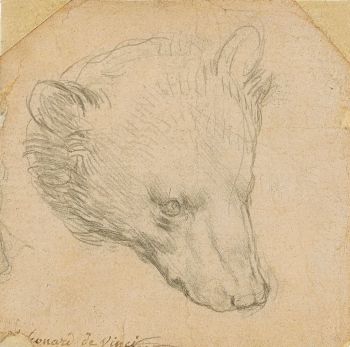
Lot 20: Leonardo da Vinci, Head of a Bear, silverpoint on pink-beige prepared paper, top corners cut, 3 × 3 inches (7 × 7 cm). The earliest provenance of the small drawing places it in the possession of Sir Thomas Lawrence.
Christie’s Exceptional Sale (No. 19443) realised £19,537,500 / $26,903,138 / €22,780,725, selling 77% by lot and 85% by value. The top lot of the sale was Head of a Bear by Leonardo da Vinci, which set a new world auction record for a drawing by the artist, achieving £8,857,500 / $12,196,778/ €10,327,845.
Stijn Alsteens, International Head of the Department of Old Master Drawings at Christie’s, comments: “Christie’s is greatly honoured to have brought this small but magnificent Old Master drawing to the market in the Exceptional Sale this evening in London. The drawing attracted attention from all around the world, and I was confident that the great quality and rarity of the work would lead to an exceptional result—the fifth highest price ever achieved for an Old Master drawing at auction.”
Giles Forster, Head of the Exceptional Sale, noted: “The breadth and depth of bidding across periods and categories in this sale is notable, highlighted by the top lots spanning Old Master drawings, decorative arts, and manuscripts. In addition to the stellar result for the record breaking top lot by Leonardo da Vinci, the price realised for the remarkable Charles I inkstand attributed to silversmith Christiaen van Vianen of £1.9million ($2.7 / €2.3million) (estimate: £1–1.5million) reflects the museum quality nature of this work, which was previously on long term loan to the Victoria and Albert Museum. The new auction record established for an Isaac Newton manuscript £1,702,500 / $2,344,343 / €1,985,115 (estimate: £600,000–900,000) highlights that autograph scientific manuscripts by Newton are of the greatest rarity on the market. We are also pleased to have established new auction records for a meteorite and for furniture by the bronzier Ferdinand Barbedienne with the remarkable ‘Japonisme’ aquarium, which show the unique ability of the Exceptional Sale to bring record prices for ‘wow factor’ works of art.”
Old Masters Evening Sale
Christie’s, London, 8 July 2021

Lot 14: Angelica Kauffman, R.A., Group Portrait of Lady Elizabeth Smith-Stanley, Countess of Derby, with Her Infant Son Edward, later 13th Earl of Derby and Her Half-Sister, Lady Augusta Campbell, Playing the Harp, oil on canvas, 50 × 40 inches (127 × 102 cm). The painting sold for £562,500, just above it its low estimate. The lot essay acknowledges Bettina Baumgärtel and Wendy Wassyng Roworth for their help in cataloguing the painting.
The Old Masters Evening Sale (No. 20053) realised £45,083,250 / $62,079,635/ €52,567,070, selling 94% by value and 78% by lot. The top lot of the sale was Bernardo Bellotto’s View of Verona with the Ponte delle Navi, which achieved £10,575,000 / $14,561,775 / €12,330,450 (estimate: £12–18million).
Clementine Sinclair, Head of the Old Masters Evening Sale, comments: “We are thrilled with the results of this Old Masters sale, which at £45million was the strongest evening sale since July 2016. Only two evening sales have exceeded this total over the past ten years. The prices realised for Bellotto’s majestic view of Verona and George de La Tour’s arresting image of Saint Andrew set new record prices for the artists at auction. The wealth of fresh material prompted competitive bidding with the exquisite cabinet picture by Frans van Mieris making more than four times the low estimate. All three works by female artists in the sale [Artemisia Gentileschi, Michaelina Wautier, and Angelica Kauffman] sold successfully, with two more than tripling their original low estimates. This evening was a real boost for the Old Masters market and underlines the continued demand for great works that are fresh to the market with exceptional provenance.”
FPS Online Lecture | Angiviller, Rambouillet, and ‘Etruscan’ Taste
From The French Porcelain Society:
Gabriel Wick and John Whitehead | Angiviller, Rambouillet, and ‘Etruscan’ Taste
Sir Geoffrey de Bellaigue Memorial Lecture
FPS, Online, Sunday, 11 July 2021, 18.00 (BST)
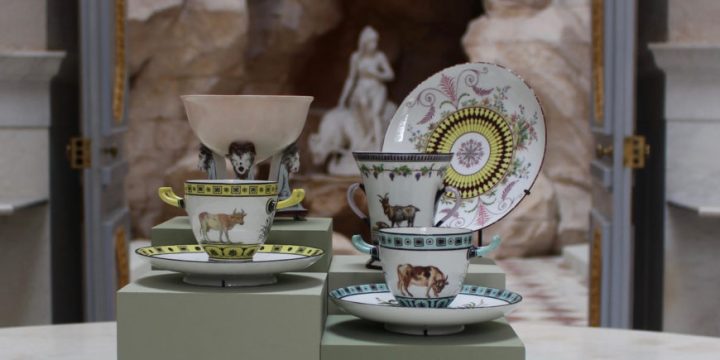
The French Porcelain Society is delighted to host the Sir Geoffrey de Bellaigue Memorial Lecture with Gabriel Wick, curator of the exhibition Vivre à l’Antique, who will explore the fascinating history of Rambouillet, a château associated with the avant-garde ‘Etruscan’ taste championed by the comte d’Angiviller. John Whitehead will discuss the Sèvres-porcelain service created for its dairy. We hope you can join us!
FPS members will receive an email invitation with instructions on how to join the online lecture. If you want to join, please contact us for more details on FPSenquiries@gmail.com. This will be the last Living Room Lecture until Sunday, 5 September 2021.
Rambouillet, 30-miles southwest of Paris, is the most recent and the least-known of France’s royal palaces. Acquired by Louis XVI as a domaine privé only six-years before the Revolution, it served successive sovereigns and presidents as a hunting lodge and rustic retreat until 2009, when it was entrusted to the care of the Centre des Monuments Nationaux and opened to the public. In the second half of the 1780s, the king’s de facto minister of the arts, the comte d’Angiviller, developed a number of remarkable projects for the domain—a proposal for the reconstruction of the château à l’antique, a model farm, extensive plantations of American trees, and the menagerie and dairy. The last of these, conceived as a theatrical evocation of the arts and rituals of the Etruscans, benefitted from contributions by Hubert Robert, Jean-Jacques Lagrenée, Georges Jacob, and the Sèvres manufacture (which Angiviller directed since 1783).
Exhibition | Vivre à l’antique: From Marie-Antoinette to Napoléon
The catalogue for the exhibition is published by Éditions Monelle Hayot:
Vivre à l’antique: de Marie-Antoinette à Napoléon 1er
Château de Rambouillet, 19 June — 9 August 2021
Curated by Gabriel Wick
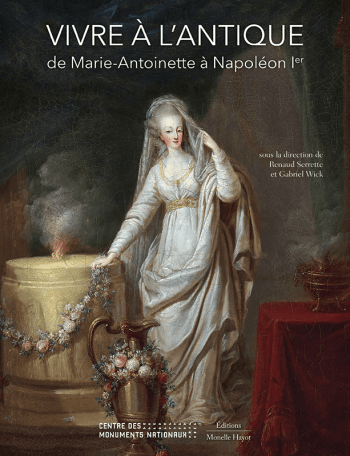 In the last three decades of the 18th century, the elites of Europe were enthralled by the constant flow of discoveries issuing forth from the excavations of buried cities, Etruscan tombs, and imperial villas in Italy. The distant past suddenly surged into the present, and architecture, furniture, and the accessories of daily life were re-imagined in its image. Nowhere in France could recount this aesthetic and cultural revolution more aptly than Rambouillet, the hunting estate and intimate retreat of the courts of Louis XVI and Napoléon I. Over the course of three months, the staterooms, intimate apartments, and dairy of Rambouillet will once again be filled with artifacts, models, and drawings from the Grand Tour and the Italian excavations, paintings by Hubert Robert, 18th– and 19th-century furnishings and decors by Jacob and Percier, and precious ceramics by Sèvres and Wedgwood. Through loans from the château of Versailles, the cité de la céramique de Sèvres, the École nationale supérieure des Beaux-Arts, the Bibliothèque des Arts décoratifs, and a number of private collections, the exhibition will explore how and why at the threshold of the modern era, distant antiquity so completely captured the imagination of the sovereigns and their courts.
Renaud Serrette and Gabriel Wick, eds., Vivre à l’antique, de Marie-Antoinette à Napoléon 1er (Saint-Remy-en-l’Eau: Éditions d’art Monelle Hayot, 2021), 200 pages, ISBN: 979-1096561315, 39€.
Online Roundtable | New Approaches to Piranesi
From the program flyer:
New Approaches to Piranesi: A Virtual Roundtable
Online, Friday, 16 July 2021
Organized by Jeanne Britton and Zoe Langer
 Join us for a roundtable of lightning talks on interdisciplinary approaches to the works of Giovanni Battista Piranesi (1720–1778). Recent scholarship by Heather Hyde Minor, Carolyn Yerkes, and Susan Dixon, as well as the current bestselling novel Piranesi by Susanna Clarke, have started to open the field of Piranesi Studies to new avenues of research and potentially wider audiences. This roundtable consists of two panels of short presentations of 5–7 minutes followed by ample time for discussion. Papers engage with a wide range of disciplinary fields and methods including globalism, reception, collecting, virtual reality, exhibition curation, book history, archaeology, history of design, and architecture. We hope the themes and format of the roundtable will encourage lively conversation and prompt new critical perspectives that will continue to broaden the interpretation of Piranesi’s works.
Organized by Jeanne Britton and Zoe Langer, Digital Piranesi, Irvin Department of Rare Books and Special Collections, University of South Carolina
Sponsored by Historians of Eighteenth Century Art and Architecture (HECAA)
Panel 1: 10.00–11.30am (EST)
• Hélène Bremer (Art Historian and Independent Curator), For the Love of the Master, 25 Artists Fascinated by Piranesi
• Erik Herrmann (Ohio State University), Another Campo Marzio
• Mireille Linck (Museum Boijmans Van Beuningen), Watermark Research: The Beginning of a Research Tool
• Ari Lipkis (Tyler School of Art & Architecture), Imprisoned in the Fold: Piranesi and the Video Artist
• Jason Porter (University of South Carolina), The Virtual Piranesi: New Methods of Immersive Literacy
• Carla Scagliosi (Galleria Nazionale dell’Umbria), Exploring ‘the Dark Brain of Piranesi’
Panel 2: 1.00–2.30pm (EST)
• George Dodds (University of Tennessee), Giambattista Piranesi, Modernity, and the Continuous Avant-Garde
• Sara Hayat (School of the Art Institute of Chicago), What We Can Learn from 18th-Century Global Histories of Architecture
• Helen Marodin (University of South Carolina), The Magnificence of Rome in the Carceri: Flashes of Light into Piranesi’s Shadowy Prisons
• Thomas Mical (India), Scanning for Duration and Intensity in Piranesi’s Carceri
• Aleksander Musial (Princeton University), Beyond the Capriccio: Piranesi’s Candelabra, Classical Transgression, and their Reception in Warsaw and St. Petersburg
• Kate Retford (Birkbeck, University of London), Piranesi and the Print Room
• Betsey Robinson (Vanderbilt University), Tunnel Visions: Rendering Conventions and Process at the Alban Lake
New Book | Monument’s of St Paul’s Cathedral, 1796–1916
From Scala:
Jason Edwards, Amy Harris, and Greg Sullivan, Monument’s of St Paul’s Cathedral, 1796–1916 (London: Scala, 2021), 48 pages, ISBN: 978-1785513602, £8 / $10.
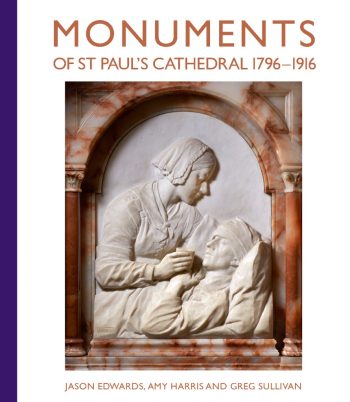 St Paul’s Cathedral is home to some of the finest sculptures by the foremost artists of the long nineteenth century. Memorials around the Cathedral represent giants of the arts, political and military figures and a range of other men and women of national importance, from Nelson to Florence Nightingale. Their memorials echo the tenor of their lives, some dramatic and impressive, others quieter and more reflective, but each story unique. The monuments of St Paul’s are also a record of 19th-century nationalist attitudes, giving this guide particular piquancy in light of current conversations about national identity and values.
Jason Edwards is a Professor of Art History at the University of York and a specialist in the global contexts of British sculpture from 1760 to 1914. Amy Harris is a sculptural historian who specialises in long-19th-century national collections of British sculpture. Greg Sullivan is a sculpture historian and co-author of the Biographical Dictionary of Sculptors in Britain 1660–1851.










 Enfilade
leave a comment