Online Talks | Rubens Series

Peter Paul Rubens, The Rainbow Landscape (detail), ca. 1636
(London: The Wallace Collection)
◊ ◊ ◊ ◊ ◊
The last three talks in the series address the eighteenth- and nineteenth-century reception of Rubens. From The Wallace Collection:
Rubens Talk Series
Online, The Wallace Collection, 9 June — 21 July 2021
To accompany The Wallace Collection’s new exhibition Rubens: Reuniting the Great Landscapes, this series of seven talks will explore different aspects of Rubens’s extraordinary life and achievements, the fascinating social, cultural and economic circumstances of his age, and his enduring artistic legacy.
Series talks will be presented through Zoom Webinar. Each talk duration is 1 hour, including time for Q&A with the speaker. Tickets can be purchased for individual talks or the entire series. Ticket holders will receive their Zoom link, Webinar ID, and Passcode 24 hours in advance of each talk. Series talks, excluding 21 July, will be recorded. Following each talk, ticket holders will be emailed a link to view the recording, which will be available for one week only.
◊ ◊ ◊ ◊ ◊
John Chu | ‘Equal to the Great Masters’: Landscapes by Gainsborough and Rubens
Wednesday, 7 July 2021, 19.00 BST
Thomas Gainsborough (1727–1788) had a lifelong love of Netherlandish landscape art. As his career developed so too did the range and depth of his appreciation for the ‘Great Masters’ of the Low Countries—prominent in this pantheon was Peter Paul Rubens (1577–1640). In this talk, John Chu will consider the transformative influence of Rubens’s landscapes on Gainsborough’s art, examining what he learned from his predecessor and why these paintings became such an important model. Looking more broadly, he will also explore the reputation of Rubens’s landscapes in 18th-century Britain and establish the social and artistic conditions that shaped, and made possible, Gainsborough’s fruitful encounter with the works of the Flemish master.
Dr John Chu is Senior Curator of Pictures and Sculpture at the National Trust. He has taught and published widely on 18th-century British and French painting and specialises in the art of Thomas Gainsborough and Joshua Reynolds.
◊ ◊ ◊ ◊ ◊
Christoph Vogtherr | Flemish Painting in 18th-Century French Collections
Wednesday, 14 July 2021, 19.00 BST
Flemish painting rose to a prominent role in Parisian collections only in the late 17th century. Even Rubens started to be regarded as one of the major European painters considerably later than in territories of the German Empire or in Italy. This change in perception and taste went hand in hand with new modes of picture displays. In the first decades of the 18th century, the comparison of schools and painters became the guiding principle of art presentation. Flemish painting was introduced into Parisian collections in this context of emulation and competition between the schools. In the process, Flemish and French painting gained a prominence comparable to Italian art. In this talk, Christoph Vogtherr will trace the rise of Flemish and Dutch painting in Parisian collections, its important position in picture displays and art theory, as well as its role in the formation of French 18th-century painting.
Dr Christoph Martin Vogtherr is General Director of the Stiftung Preußische Schlösser und Gärten Berlin-Brandenburg. His main research interests are the history of the Prussian Royal palaces, French 18th-century painting, and the history of art collecting in the 18th and 19th centuries. He was previously Director of the Hamburger Kunsthalle (2016–19), and before that, Curator of paintings and then Director of the Wallace Collection from 2011 to 2016. He has published widely on 18th-century French painting.
◊ ◊ ◊ ◊ ◊
Tim Barringer | British Painters and Rubens’s Poetic Pastorals
Wednesday, 21 July 2021, 19.00 BST
Tim Barringer will explore the character of Rubens’s landscapes, which blend the legacies of classical poetry with the rough and tumble of rural life in the 17th century. Erudite references mix with rustic pastimes. While Rubens’s grand historical and religious paintings, like his portraits, commanded admiration across Europe, British artists and collectors found a special affinity with his pastoral works. Painters such as Constable, Turner, and Bonington were indelibly affected by the experience of seeing Rubens’s paintings and drawings, allowing them to see the natural world anew.
Dr Tim Barringer is Paul Mellon Professor and Chair of the Department of the History of Art at Yale University. He contributed to Rubens and his Legacy, the RA’s exhibition catalogue, and has co-curated exhibitions including American Sublime: Opulence and Anxiety; Pre-Raphaelites: Victorian Avant-Garde; Picturesque and Sublime: Thomas Cole’s Trans-Atlantic Inheritance; Unto This Last: Two Hundred Years of John Ruskin; and Victorian Radicals: From the Pre-Raphaelites to the Arts & Crafts Movement.
Exhibition | Flags and Founding Documents

13-star flag featuring a ‘Great Star’ pattern, ca. 1800–25, one of the earliest American flags known to survive
(Jeff Bridgman, American Antiques)
◊ ◊ ◊ ◊ ◊
Now on view at the Museum of the American Revolution:
Flags and Founding Documents, 1776–Today
Museum of the American Revolution, Philadelphia, 11 June — 6 September 2021
The summer exhibition Flags and Founding Documents, 1776–Today showcases dozens of rare American flags alongside historic early state constitutions and the first printing of the proposed U.S. Constitution of 1787.
The flags—many of which have never been exhibited before—trace the evolution of the Stars and Stripes through the addition and subtraction of stars as new states joined the Union and the nation battled through the Civil War. The flags serve as a visual narrative of America’s national story. The flags are showcased alongside historic documents including early printings of more than 16 different state constitutions and the Choctaw Nation Constitution of 1838 to shed light on the triumphs and tensions that the United States faced as it expanded and worked toward creating a ‘more perfect Union’. By telling stories from the nation’s revolutionary roots to its continuing struggle over equal rights, Flags and Founding Documents, 1776–Today encourages visitors to consider their role in the ongoing effort to fulfill the promise of the American Revolution.
The collection of historic flags is on loan from Jeff R. Bridgman, a leading dealer of antique flags and political textiles. The documents are on loan from the Dorothy Tapper Goldman Foundation following their presentation at the New-York Historical Society in the exhibition Colonists, Citizens, Constitutions: Creating the American Republic (February 2020 — Mary 2021), curated by Dr. James F. Hrdlicka.
James Hrdlicka, with Robert McD. Parker and a foreword by Ruth Bader Ginsburg, Colonists, Citizens, Constitutions: Creating the American Republic (London: Scala Arts Publishers, 2020), 208 pages, ISBN: 978-1785512070, $45.
Commodore Collection Now Preserved in Maryland
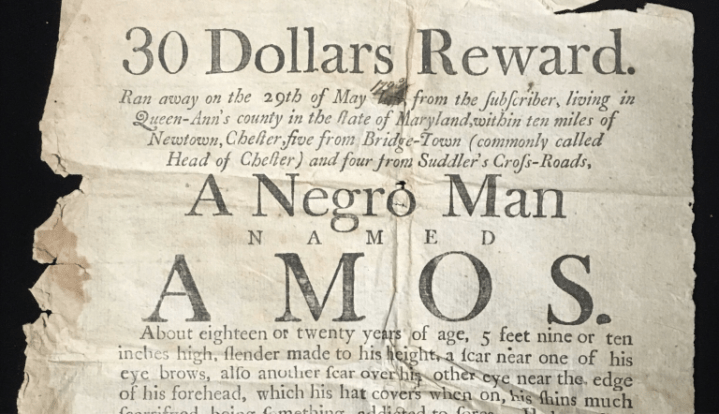
’30 Dollars Reward’ broadside for a man named Amos, detail, 11 February 1793 (Chesterton, Maryland: Commodore Collection). The full document with more information is available here.
◊ ◊ ◊ ◊ ◊
From The Washington Post:
Michael E. Ruane, “A Maryland attic hid a priceless trove of Black history. Historians and activists saved it from auction,” The Washington Post (28 June 2021). Among the artifacts is an account of escape from enslavement that is among the oldest ever found.
The 200-year-old document was torn and wrinkled. It had stains here and there. And it was sitting on a plastic table in the storeroom of an auction house near the Chester River hamlet of Crumpton, on Maryland’s Eastern Shore. Historian Adam Goodheart had seen it before, but only in a blurry website photo. Now, here it was in a simple framed box—a wanted poster for “A Negro Man named Amos” who had fled from his enslaver in Queen Anne’s County.
It was chilling. There, on cheap rag paper, was the story of American slavery. Amos was “a smart fellow,” about 20, who might be headed for his mother in Philadelphia. But in 1793 he was the property of one William Price, who wanted him caught.
The poster, or ‘broadside’, was one of hundreds of rare documents discovered earlier this year in the attic of an old house on the Eastern Shore and saved from the auction block by a group of Washington College historians and local Black activists. And the reward poster turned out to be one of the oldest known, said Goodheart, director of the college’s Starr Center for the Study of the American Experience in Chestertown, Maryland . . . .
The full article is available here»
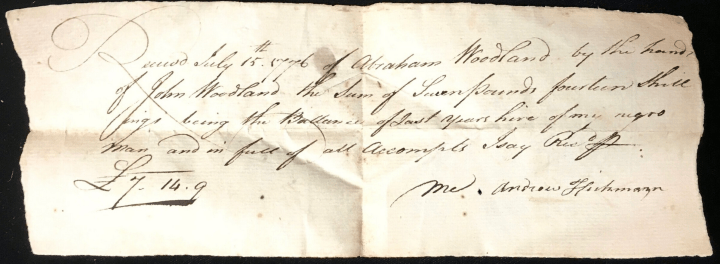
Receipt for the ‘hire’ of an enslaved man, 15 July 1776 (Chesterton, Maryland: Commodore Collection). More information is available here.
◊ ◊ ◊ ◊ ◊
From Sumner Hall:
Sumner Hall is proud to share with our supporters the successful effort to rescue and preserve a significant collection of local records.
“The Commodore Collection of original historical documents on the early experiences of African Americans in Kent and Queen Anne’s counties is a rare find,” according to Dr. Ruth Shoge, First Vice President of Sumner Hall. “The documents, which are intellectually enriching, also evoke an emotional response to the harsh reality of the lives of enslaved and freed Black people in 17th- and 18th-century America,” she continued. “It is very important to Sumner Hall that this collection has been given to us in perpetuity. The ownership of this collection is an honor and, in a special way, a homecoming for the memories of our ancestors. This collection supports our mission of promoting an understanding of the African American experience within the overall context of American history and culture.”
Thanks to the efforts of local Black residents and the Starr Center for the Study of the American Experience at Washington College, approximately 2,000 pages of documents were purchased from Dixon’s Crumpton Auction this spring. The collection, named after Washington College’s first local Black alumnus, Norris Commodore ’73, will belong to Sumner Hall but is being conserved and archived at the school’s Miller Library. Mr. Commodore, who has deep roots here, gave generously toward the acquisition cost and was joined by the Hedgelawn Foundation, the Kent Cultural Alliance and the Andrew W. Mellon Foundation. The papers are being digitized as a part of the Chesapeake Heartland Project, and several can already be viewed online here.
President of Sumner Hall’s Board of Directors, Larry Wilson, says, “The Commodore Collection is a very meaningful record of African American life and survival. I believe that it is very important to know our history and to learn from the lives of our ancestors as we work together for equal rights, justice and freedom in this county and across the country. We look forward to having exhibits at Sumner Hall based on these materials soon.”
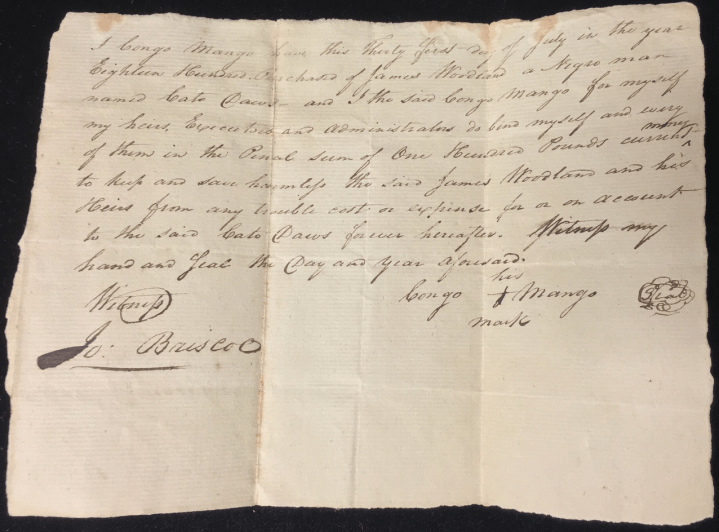
Congo Mango’s bond on behalf of Cato Daws, 31 July 1800. Mango (later known as Congo Mander), a free Black man, purchased Daws in order to grant his freedom (Chesterton, Maryland: Commodore Collection). As noted in the document description, “This small piece of paper opens a window into the life story of a man who was born in Africa, enslaved in Maryland, gained his freedom, and helped others become free. He gave rise to a Black family that can be traced to the present day.” More information is available here.
◊ ◊ ◊ ◊ ◊
Sumner Hall, located in historic Chestertown on Maryland’s Eastern Shore, is one of two existing African American Grand Army of the Republic buildings still standing in the United States. Built circa 1908 and fully restored in 2014, it serves today as a museum, educational site, performance stage, social hall, and gallery. Sumner Hall is a registered 501(c)(3) nonprofit corporation, funded by donations and memberships.
New Book | Colonial Complexions
First published in 2018, Colonial Complexions has just been released in paperback; from Penn Press:
Sharon Block, Colonial Complexions: Race and Bodies in Eighteenth-Century America (Philadelphia: University of Pennsylvania Press, 2018), 232 pages, ISBN 978-0812250060 (cloth), $45 / ISBN 978-0812224924 (paperback), $23.
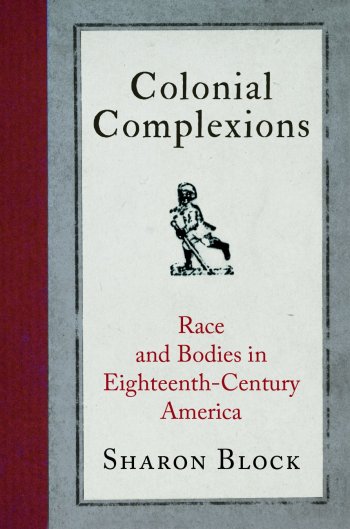 In Colonial Complexions, historian Sharon Block examines how Anglo-Americans built racial ideologies out of descriptions of physical appearance. By analyzing more than 4,000 advertisements for fugitive servants and slaves in colonial newspapers alongside scores of transatlantic sources, she reveals how colonists transformed observable characteristics into racist reality. Building on her expertise in digital humanities, Block repurposes these well-known historical sources to newly highlight how daily language called race and identity into being before the rise of scientific racism.
In the eighteenth century, a multitude of characteristics beyond skin color factored into racial assumptions, and complexion did not have a stable or singular meaning. Colonists justified a race-based slave labor system not by opposing black and white but by accumulating differences in the bodies they described: racism was made real by marking variation from a norm on some bodies, and variation as the norm on others. Such subtle systemizations of racism naturalized enslavement into bodily description, erased Native American heritage, and privileged life history as a crucial marker of free status only for people of European-based identities. Colonial Complexions suggests alternative possibilities to modern formulations of racial identities and offers a precise historical analysis of the beliefs behind evolving notions of race-based differences in North American history.
Sharon Block is Professor of History at the University of California, Irvine.
C O N T E N T S
Introduction
1 Complicating Humors and Rethinking Complexion
2 Shaping Bodies in Print: Labor and Health
3 Coloring Bodies: Naturalized Incompatibilities
4 Categorizing Bodies: Race, Place, and the Pursuit of Freedom
5 Written by and on the Body: Racialization of Affects and Effects
Epilogue
Appendices
1 Advertisements for Runaways: Sources and Methodology
2 Graphic Overview of Advertisements for Runaways
3 Newspapers with Advertisements for Runaways, 1750–75
Notes
Index
Acknowledgments
New Book | Philadelphia Stories
From Penn Press:
C. Dallett Hemphill, edited by Rodney Hessinger and Daniel Richter, Philadelphia Stories: People and Their Places in Early America (Philadelphia: University of Pennsylvania Press, 2021), 392 pages, ISBN 978-0812253184, $35 / £27.
 For the average tourist, the history of Philadelphia can be like a leisurely carriage ride through Old City. The Liberty Bell. Independence Hall. Benjamin Franklin. The grooves in the cobblestone are so familiar, one barely notices the ride. Yet there are other paths to travel, and the ride can be bumpy. Beyond the famed founders, other Americans walked the streets of Philadelphia whose lives were, in their own ways, just as emblematic of the promises and perils of the new nation.
Philadelphia Stories chronicles twelve of these lives to explore the city’s people and places from the colonial era to the years before the Civil War. This collective portrait includes men and women, Black and white Americans, immigrants and native born. If mostly forgotten today, banker Stephen Girard was one of the wealthiest men ever to have lived, and his material legacy can be seen by visiting sites such as Girard College. In a different register, but equally impressive, were the accomplishments of Sarah Thorn Tyndale. In a few short years as a widow she made enough money on her porcelain business to retire to a life as a reformer. Others faced frustration. Take, for example, Grace Growden Galloway. Born to an important family, she saw her home invaded and her property confiscated by patriot forces. Or consider the life of Francis Johnson, a Black bandleader and composer who often performed at the Musical Fund Hall, which still stands today. And yet he was barred from joining its Society. Philadelphia Stories examines their rich lives, as well as those of others who shaped the city’s past.
Many of the places inhabited by these people survive to this day. In the pages of this book and on the streets of the city, one can visit both the people and places of Philadelphia’s rich history.
C. Dallett Hemphill (1959–2015) was Professor of History at Ursinus College. Rodney Hessinger is Professor of History at John Carroll University. Daniel K. Richter is Roy F. and Jeannette P. Nichols Professor of American History at the University of Pennsylvania.
C O N T E N T S
Foreword, Daniel Richter
Introduction: Places and People, completed by Rodney Hessinger
Part I. For the Love of God: Three Colonial Men of Faith
Prologue, Daniel Richter
1 Anthony Benezet, completed by Jean Soderlund
2 Henry Muhlenberg, completed by Lisa Minardi
3 William White, completed by Sarah Barringer Gordon
Part II. Declaring Independence: Three Revolutionary Wives
Prologue, C. Dallett Hemphill
4 Grace Growden Galloway, completed by Judith Van Buskirk
5 Anne Shippen Livingston, completed by Susan Branson
6 Deborah Norris Logan, completed by Rodney Hessinger
Part III. Striving to Succeed: Three ‘Self-Made Men’ in the New Nation
Prologue, Rodney Hessinger
7 Charles Willson Peale, completed by Nenette Luarca-Shoaf
8 Stephen Girard, completed by Brenna O’Rourke Holland
9 Joseph Hemphill, completed by Sarah Rodriguez
Part IV. Pursuing an Inclusive America: Three Aspiring Antebellum Lives
Prologue, Rodney Hessinger
10 Francis Johnson, completed by Richard Newman
11 Sarah Thorn Tyndale, completed by Susan Klepp
12 William Darrah Kelley, completed by Andrew Shankman
Notes
Index
Acknowledgments
New Book | Boston’s Oldest Buildings and Where to Find Them
Distributed by The University of Chicago Press:
Joseph Bagley, Boston’s Oldest Buildings and Where to Find Them (Waltham, MA: Brandeis University Press, 2021), 248 pages, ISBN: 978-1684580392, $30.
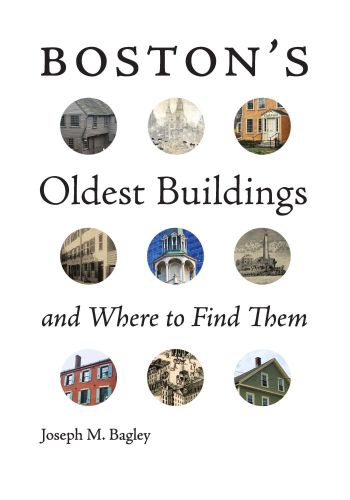 As Boston approaches its four-hundredth anniversary, it is remarkable that it still maintains its historic character despite constant development. The fifty buildings featured in this book all pre-date 1800 and illustrate Boston’s early history. This is the first book to survey Boston’s fifty oldest buildings and does so through an approachable narrative which will appeal to nonarchitects and those new to historic preservation. Beginning with a map of the buildings’ locations and an overview of the historic preservation movement in Boston, the book looks at the fifty buildings in order from oldest to most recent. Geographically, the majority of the buildings are located within the downtown area of Boston along the Freedom Trail and within easy walking distance from the core of the city. This makes the book an ideal guide for tourists, and residents of the city will also find it interesting as it includes numerous properties in the surrounding neighborhoods. The buildings span multiple uses from homes to churches and warehouses to restaurants. Each chapter features a building, a narrative focusing on its historical significance, and the efforts made to preserve it over time. Full color photos and historical drawings illustrate each building and area. Boston’s Oldest Buildings and Where to Find Them presents the ideals of historic preservation in an approachable and easy-to-read manner appropriate for the broadest audience.
Joseph M. Bagley is the city archaeologist of Boston, a historic preservationist, and a staff member of the Boston Landmarks Commission. He has worked for multiple local and state historic preservation offices, including the Maine Historic Preservation Commission and the Massachusetts Historical Commission.










 Enfilade
leave a comment