Call for Articles | Féminismes en Europe, 1789–1820
From the Call for Papers:
Féminismes en Europe, 1789–1820
Speical Issue of Annales historiques de la Révolution française, 2023
Proposals due by 15 September 2021
Dans le cadre d’un numéro spécial des Annales historiques de la Révolution française, nous sollicitons des contributions sur le thème suivant: « Féminismes en Europe »
Si le terme « féminisme(s) » n’est pas encore en vigueur à l’époque, la période allant de 1789 aux années 1820 est témoin de nombreuses prises de position en faveur des droits des femmes, appelant notamment à leur émancipation et/ou à leur intégration dans les conceptions de la citoyenneté qui s’imposent alors. On peut y inclure les discours sur l’éducation, sur la domination des hommes, sur l’égalité des sexualités, sur les moyens de remédier à la dépendance économique des femmes, sur la critique du mariage, c’est-à-dire le militantisme sous ses différentes formes mais aussi les prises de position contre-révolutionnaires ou anti-modernes dès lors qu’elles sont reliées, par les auteurs et autrices, à la question de l’émancipation des femmes. Malgré une historiographie abondante et en constante évolution sur le sujet depuis les années 1990, nous pensons qu’il est nécessaire de dresser un nouvel état des lieux de la question, en décalant notre regard de la seule scène française afin d’inclure les échanges et influences étrangères au sein du monde transatlantique (incluant l’Europe, ses colonies et ex-colonies).
Le fait est que si l’on documente et identifie bien, désormais, les prises de position des grandes figures qui, en France, ont pris la défense des femmes pour réclamer l’égalité des droits civils ou politiques — telles que Condorcet, Olympe de Gouges, Romme ou Guyomar ; si l’on commence à s’intéresser à des voix égalitaristes plus mineures comme, toujours en France, celle de Pons de Verdun (Lumbroso, 2021) ; si l’on connaît grâce aux travaux de Dominique Godineau (1989), Suzanne Desan (2002), Martine Lapied (2006) ou encore Laura Talamante (2017), l’engagement politique des « citoyennes tricoteuses » et « Amazones » dans le processus de démocratisation populaire, que ce soit à Paris ou à Marseille ; si l’on sait le rôle joué par certaines figures féminines comme Théroigne de Méricourt (Desan, 2020) ou Mary Wollstonecraft dans la diffusion et la réception des idées favorables à l’émancipation des femmes (Bour, 2013 par exemple) ; si l’on a mesuré l’importance des pétitions de femmes dans le processus de démocratisation de la société française à l’époque de la Révolution (Fauré, 2006) ; si le débat fut vif autour des raisons qui ont exclu (ou pas inclus) les femmes du droit de vote (Verjus, 2014) ; si on a commencé à s’intéresser avec sérieux à l’action politique des femmes engagées dans la contre-révolution (Mabo, 2017) ; enfin, si l’on connaît le niveau d’éducation extrêmement sophistiqué, parfois directement inspiré des écrits de Wollstonecraft, que certains hommes politiques américains ont fait donner à leur fille (par exemple, Theodosia fille d’Aaron Burr) ; si l’on a, par conséquent, amplement répondu à la question que posait Perrot en 1984 : une histoire des femmes est-elle possible ?, en la prolongeant d’interrogations menées à partir du point de vue plus englobant et conceptuel qu’adoptent les études de genre, plus rares sont les tentatives de dégager des visions d’ensemble des réseaux et des circulations d’idées sur la situation et l’émancipation des femmes au niveau européen dans les années 1790–1820, de l’ordre de celle qu’avait esquissée Margaret McFadden (1999) pour tout le XIXe, ou de celle qu’ont plus récemment tentée les coordinatrices de Transatlantic Feminisms in the Age of Revolutions (2012). S’il convient donc d’interroger l’engagement « féministe » des auteurs et autrices européens, à la suite, par exemple, des travaux consacrés aux Allemand·es Hippel (Gray, 1990) ou Sophie von La Roche (Joeres, 1986), aux Anglais comme Lawrence (Verjus, 2019), Holcroft (Binhammer, 2011), ou Godwin (Philp, 2020), ou encore aux Polonaises engagées dans les débats de la « Grande Diète » (Wisniewska, 2021), nous retiendrons aussi les nouvelles perspectives historiographiques sur des figures, des échanges, ou des mouvements moins connus. Nous accueillerons aussi les propositions qui se concentrent sur les réseaux comme, par exemple, les travaux sur le rôle des cercles masculins dans la construction d’un féminisme anglais dans les années 1790, dans la lignée de ce qu’a fait Chernock (2009). L’effort remarquable engagé par l’EHNE en faveur d’une histoire européenne n’oublie jamais, lorsqu’il s’agit d’interroger la source des féminismes du XIXème siècle, de mentionner la Révolution française ou les quelques noms qui ont fait la pensée émancipatrice hors des frontières de la France. Nous voudrions, dans la lignée et suivant l’exemple de cette approche résolument européenne, nous pencher sur ce qui a constitué l’armature de la pensée en faveur d’une émancipation des femmes à l’aube du XIXème siècle.
Vos propositions d’articles, d’une longueur maximale de 50 000 signes en français et 40 000 en anglais devront nous être adressées avant le 15 septembre 2021 à heuer@history.umass.edu, francoise.orazi@univ-lyon2.fr et anne.verjus@ens-lyon.fr. Idéalement, nous souhaiterions organiser une rencontre entre les autrices et auteurs retenu.es, aux alentours du printemps 2022. En présentiel si possible, en distanciel s’il le faut (ou les deux si c’est préférable). Le numéro paraîtra dans le troisième numéro de l’année 2023. Il sera d’abord publié entièrement en français, mais nous nous réservons la possibilité d’en avoir une version entièrement en anglais en ligne. Vos propositions, acceptées en français et en anglais, seront traduites par nos soins, sous votre contrôle.
Références citées dans le texte
• Binhammer, Katherine. « The Political Novel and the Seduction Plot: Thomas Holcroft’s Anna St. Ives ». Eighteenth-Century Fiction 11.2 (1999): 205–22.
• Bour, Isabelle. « A New Wollstonecraft: The Reception of the Vindication of the Rights of Woman and of The Wrongs of Woman in Revolutionary France ». Journal for Eighteenth-Century Studies 36.4 (2013): 575–87.
• Chernock, Arianne. Men and the Making of Modern British Feminism. Stanford: Stanford University Press, 2009.
• Desan, Suzanne. « Théroigne de Méricourt, Gender, and International Politics in Revolutionary Europe ». Journal of Modern History 92.2 (2020): 274–310.
• Desan, Suzanne. « Constitutional Amazons: Jacobin Women’s Clubs in the French Revolution » in B. T. Ragan Jr. and E. A. Williams (eds.), Re-Creating Authority in Revolutionary France (1992): 11–35.
• Fauré, Christine. « Doléances, déclarations et pétitions, trois formes de la parole publique des femmes sous la Révolution ». Annales historiques de la Révolution française 344 (1 juin 2006): 5–25.
• Godineau, Dominique. Citoyennes tricoteuses : les femmes du peuple à Paris pendant la Révolution française. Aix-en-Provence: Alinéa, 1988.
• Gray, Marion W. « Radical Feminism and a Changing Concept of Marriage : Prussia’s Theodor Gottlieb Von Hippel ». In Donald Horward and John Horgan (eds.), The Consortium on Revolutionary Europe, 1750–1850: Proceedings, 1989 to Commemorate the Bicentennial of the French Revolution, 807–14. Tallahassee: Institute on Napoleon and the French Revolution, Florida State University, 1990.
• Joeres, Ruth Ellen B. « “That girl is an entirely different character!” Yes, but is she a feminist? Observations on Sophia von La Roche’s Geschichte des Fräulein von Sternheim ». In German Women in the Eighteenth and Nineteenth Centuries: A Social and Literary History, par Ruth-Ellen B. Joeres et Mary Jo Maynes, 137–56. Bloomington: Indiana University Press, 1986.
• Lapied, Martine. « Parole publique des femmes et conflictualité pendant la Révolution, dans le Sud-Est de la France ». Annales historiques de la Révolution française 344 (1 juin 2006): 47–62.
• Lumbroso, Nicolas. « Pons de Verdun et l’égalité des droits en faveur des femmes. L’aspiration d’un Conventionnel à une plus grande égalité des sexes ». Annales historiques de la Révolution française, (2021, à paraître).
• Mabo, Solenn. « Femmes engagées dans la chouannerie : motivations, modalités d’actions et processus de reconnaissance (1794–1830) ». Genre & Histoire 19 (25 août 2017).
• McFadden, Margaret. Golden Cables of Sympathy: The Transatlantic Sources of Nineteenth-Century Feminism. Lexington: The University Press of Kentucky, 1999.
• Philp, Mark. Radical Conduct: History of Ideas and Intellectual History. Oxford: Oxford University Press, 2020.
• Talamante, Laura. « Political Divisions, Gender, and Politics: The Case of Revolutionary Marseille ». French History 31.1 (2017): 63–84.
• Verjus, Anne. « La citoyenneté politique au prisme du genre. Droits et représentation des individus entre famille et classe de sexe (XVIIIème–XXIème siècles) ». HDR, Ecole Normale Supérieure de Paris – ENS Paris, 2014.
• Verjus, Anne. « Une Société sans Pères Peut-Elle Être Féministe ? L’empire Des Nairs de James H. Lawrence ». French Historical Studies 42.3 (2019): 359–89.
• Wiśniewska, Dorota. « In the Shadow of a Mild Revolution: Polish Women’s Political Attitudes during the Great Sejm (1788−1792) ». Gender & History 33.1 (2021): 75–93.
Cecilia Zhou, Nattier Makeup Tutorial
From the Instagram account of the Metropolitan Museum of Art’s European Paintings Department:
Cecilia Zhou, Nattier Makeup Tutorial
21 April 2021
 Get your powder and rouge ready—we’re thrilled to introduce Cecilia Zhou’s makeup tutorial for Jean Marc Nattier’s Portrait of a Woman! In this tutorial, Cecilia provides us with an opportunity for close looking through the application of makeup, as she calls it, ”a kind of painterly reverse engineering.”
Jean Marc Nattier had enormous success portraying French aristocratic women: his innumerable portraits represent contrasting powdered skin and bright blush set against warm landscapes. Follow along as Cecilia explores the relationship between makeup, identity, and beauty in 18th-century France.
Jean Marc Nattier, Portrait of a Woman, 1753, oil on canvas (New York: The Metropolitan Museum of Art, 1982.60.42). More information on the painting is available here»
The Burlington Magazine, March 2021
The eighteenth century in The Burlington (I’m catching up, gradually!) . . . –CH
The Burlington Magazine 163 (March 2021)
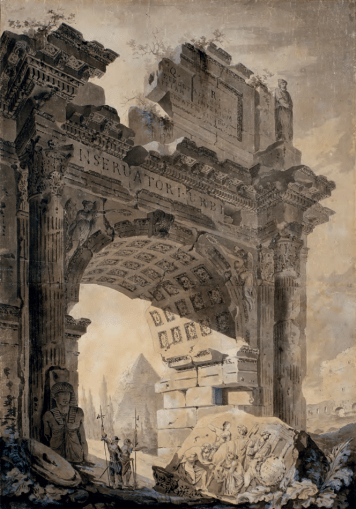
Hubert Robert, Arch of Septimius Severus, 1756; pen with grey and beige washes, 73 × 52 cm (Musée de Valence).
A R T I C L E S
• Pedro Luengo, “Spatial Rhetoric: Echoes of Madrid’s Alcázar in Palaces Overseas,” pp. 236–43.
Several key features of the Alcazar in Madrid—including the twin-courtyard plan, double staircase, and layout of the royal chapel—were replicated in royal palaces in Spain and elsewhere and in the viceregal palaces in Spain’s American empire as part of a desire to project a unified imperial image.
• Yuriko Jackall and Kari Rayner, “Becoming Hubert Robert: Some New Suggestions,” pp. 244–53.
The thin documentation of Hubert Robert’s early years makes it difficult to understand how the largely untrained student who went to Rome in 1754 emerged as a leading talent in Paris in the mid 1760s. Close examination of his art suggests that his rapid development was due to a rigorous course of study of perspective and life drawing, probably in response to criticisms of his abilities by the secretary of the Académie Royale, Charles-Nicolas Cochin.
R E V I E W S
 • Michael Hall, Review of Matthew Reeve, Gothic Architecture and Sexuality in the Circle of Horace Walpole (Pennsylvania State University Press, 2020), pp. 264–69.
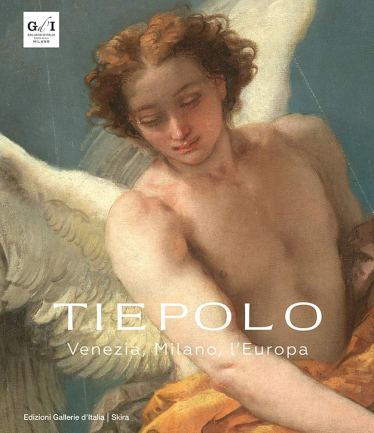
• Antonio Mazzotta, Review of the exhibition Tiepolo: Venezia, Milano, l’Europa (Milan: Gallerie d’Italia, 2020–21), pp. 273–75.
• Christoph Stiegemann, Review of the exhibition Passion, Leidenschaft: Die Kunst der großen Gefühle (Münster: LWL-Museum für Kunst und Kultur, 2020–21), pp. 275–78.
• Stephen Leach, Review of Matthew Craske, Joseph Wright of Derby: Painter of Darkness (Paul Mellon Centre for Studies in British Art, 2020), pp. 297–98.
• Philippe Malgouyres, Review of Suzanne Higgott, ‘The Most Fortunate Man of his Day’: Sir Richard Wallace: Connoisseur, Collector, and Philanthropist (Wallace Collection, 2018), pp. 298–99.
• Elena Almirall Arnal, Review of Carolina Naya Franco, El joyero de la Virgen del Pilar: Historia de una colección de alhajas europeas y americanas (Institución Fernando El Católico, 2019), pp. 302–03.
• Gauvin Alexander Bailey, Review of Laura Windisch, Kunst, Macht, Image: Anna Maria Luisa de’ Medici (1667–1743) im Spiegel ihrer Bildnisse und Herrschaftsräume (Böhlau Verlag, 2019), p. 303.
O B I T U A R I E S
• Peter Cherry, Obituary of Carmen Garrido (1947–2020), pp. 305–06.
Director of the Gabinete de Documentación Técnica at the Prado for thirty years, Carmen Garrido made major contributions to the technical study of Spanish painting, in particular with her publications on Diego Velázquez.
• Ger Luijten, Obituary of David Scrase (1949–2020), pp. 306–08.
In a career spent almost entirely at the Fitzwilliam Museum, Cambridge, David Scrase was responsible for numerous significant acquisitions and exhibitions. His magnum opus his his catalogue for the museum’s Italian drawings, published in 2011.
Panel Discussion | Enduring Versailles

Adam Perelle, Veue et Perspective du Chasteau de Versailles, avec le parterre d’eau du costé du Jardin, detail, 1680s.
◊ ◊ ◊ ◊ ◊
From Eventbrite:
Panel Discussion: Enduring Versailles
Online, Wednesday, 28 April 2021, 18.30–20.00 (EST)
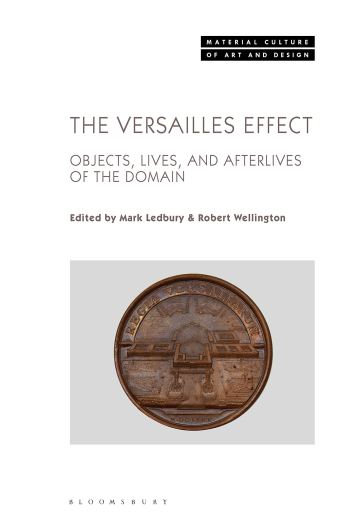
To celebrate the launch of the new book edited by Mark Ledbury and Robert Wellington, The Versailles Effect: Objects, Lives, and Afterlives of the Domaine (Bloomsbury Academic, 2020), we invite you to join us for a panel discussion on the place of the château de Versailles, the Trianons, and the domaine in the history of art today. As symbol, system and ecology, the Château and Domain of Versailles has long held a central but complex place in the history of Western art and in the global imaginary. The panel—hosted by the Historians of Eighteenth-Century Art & Architecture— will discuss how and why Versailles still remains at the center of long-eighteenth-century studies today. How does the monument to the Bourbon regime fare in the era of recuperative histories of gender, race, and class? Why bother with Versailles?
This is an online event; a Zoom link will be sent, one day prior, to those who have registered (via Eventbrite).
 Conveners
• Mark Ledbury—Power Professor of Art and Visual Culture, The University of Sydney
• Robert Wellington—Senior Lecturer, Centre for Art History and Art Theory, Australian National University
Panellists
• Basile Baudez—Assistant Professor in Architectural History, Department of Art and Archeology, Princeton
• Sarah Grandin—The Clark-Getty Paper Project Curatorial Fellow, Clark Art Institute
• Junko Takeda—Professor of History, Maxwell School of Citizenship and Public Affairs, Syracuse University
• Aaron Wile—Associate Curator, Department of French Paintings, National Gallery of Art, Washington, D.C.
US/UK/France
Wednesday, 28 April 2021
15.30–17.00 (PDT)
18.30–20.00 (EST)
23.30–01.00 (GMT)
00.30–02.00 (CEST)
Australia/New Zealand
Thursday, 29 April 2021
08.30–10.00 (AEST)
10.30–12.00 (NZST)
Should you wish to order a copy of The Versailles Effect, we invite you to take advantage of a 30% discount by entering the code AAH21 at the Bloomsbury website.
New Book | Surroundings
From the 1790s to today (Earth Day); from The University of Chicago Press:
Etienne Benson, Surroundings: A History of Environments and Environmentalisms (Chicago: The University of Chicago Press, 2020), 296 pages, ISBN: 978-0226706153 (hardcover), $83 / ISBN: 978-0226706290 (paperback), $28.
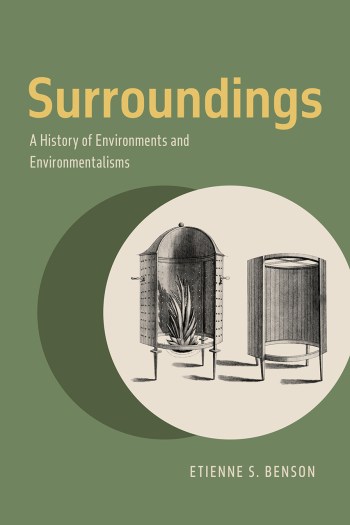 Given the ubiquity of environmental rhetoric in the modern world, it’s easy to think that the meaning of the terms environment and environmentalism are and always have been self-evident. But in Surroundings, we learn that the environmental past is much more complex than it seems at first glance. In this wide-ranging history of the concept, Etienne S. Benson uncovers the diversity of forms that environmentalism has taken over the last two centuries and opens our eyes to the promising new varieties of environmentalism that are emerging today. Through a series of richly contextualized case studies, Benson shows us how and why particular groups of people—from naturalists in Napoleonic France in the 1790s to global climate change activists today—adopted the concept of environment and adapted it to their specific needs and challenges. Bold and deeply researched, Surroundings challenges much of what we think we know about what an environment is, why we should care about it, and how we can protect it.
Etienne S. Benson is associate professor in the Department of History and Sociology of Science at the University of Pennsylvania. He is the author of Wired Wilderness: Technologies of Tracking and the Making of Modern Wildlife.
C O N T E N T S
Introduction: What Was an Environment?
1 The World in the Museum: Natural History and the Invention of Organisms and Environments in Post-Revolutionary Paris
2 Environments of Empire: Disease, Race, and Statistics in the British Caribbean
3 The Urban Milieu: Evolutionary Theory and Social Reform in Progressive Chicago
4 The Biosphere as Battlefield: Strategic Materials and Systems Theories in a World at War
5 The Evolution of Risk: Toxicology, Consumption, and the US Environmental Movement
6 The Human Planet: Globalization, Climate Change, and the Future of Civilization on Earth
Conclusion: What Might the Environment Become?
Acknowledgments
Notes
Index
New Book | The Usufructuary Ethos: Power, Politics, and Environment
Forthcoming from the University of Virginia Press:
Erin Drew, The Usufructuary Ethos: Power, Politics, and Environment in the Long Eighteenth Century (2021), 232 pages, ISBN: 978-0813945798 (cloth), $85 / ISBN: 978-0813945804 (paper), $40 / ISBN: 978-0813945811 (ebook), $30.
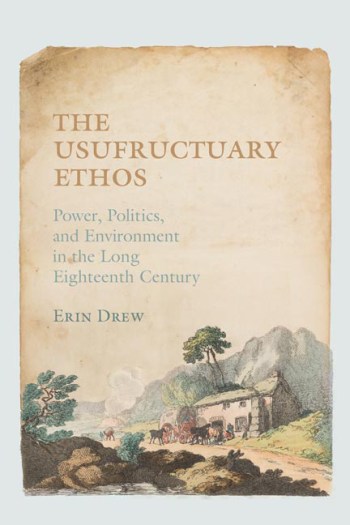 Who has the right to decide how nature is used, and in what ways? Recovering an overlooked thread of seventeenth- and eighteenth-century environmental thought, Erin Drew shows that English writers of the period commonly believed that human beings had only the ‘usufruct’ of the earth—the ‘right of temporary possession, use, or enjoyment of the advantages of property belonging to another, so far as may be had without causing damage or prejudice’. The belief that human beings had only temporary and accountable possession of the world, which Drew labels the ‘usufructuary ethos’, had profound ethical implications for the ways in which the English conceived of the ethics of power and use. Drew’s book traces the usufructuary ethos from the religious and legal writings of the seventeenth century through mid-eighteenth-century poems of colonial commerce, attending to the particular political, economic, and environmental pressures that shaped, transformed, and ultimately sidelined it. Although a study of past ideas, The Usufructuary Ethos resonates with contemporary debates about our human responsibilities to the natural world in the face of climate change and mass extinction.
Erin Drew is Associate Professor of English at the University of Mississippi.
Online Talk | Imagining the Etruscans: Modern European Perceptions
The keynote talk for this year’s New York Workshop of Etruscan Art, given by Maurizio Harari, addresses reception history, including the eighteenth century:
Maurizio Harari, Imagining the Etruscans: Modern European Perceptions of an Ancient Italian Civilization
Online, Thursday, 29 April 2021, noon (ET)
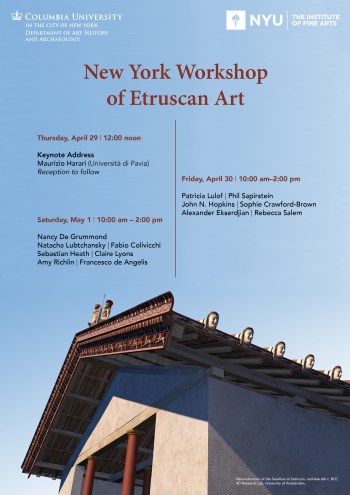 Since the late rise of humanism and through a real crescendo in the 18th to 20th centuries, the Etruscans, an ancient people of pre-Roman Italy, became (and remain) a subject of lively discussions among scholars, as they saw a wide popularity in pseudo-scientific exploration and publication. This lecture aims to explore the ideological features of the foundation process of a highly specialized, but often self-referential discipline, so-called ‘Etruscology’, which only saw its real scholarly development in the first half of the 20th century. In that context, this major branch of scholarship was created with its roots in the rather complicated connections between the Italian territorial situation of Etruscan civilization and the European dimension of its reception and popularization.
Maurizio Harari is Professor of Etruscan and Italic Archaeology and Director of the Archaeological Museum at the University of Pavia, Italy. Author of over 200 publications, his reach focuses on Etruscan and Italic art and archaeology, especially issues of image making and meaning, wall painting, Etruscans of the Po-River region, and the sacred and political institutions of Etruscan cities. Co-Director of excavations at the Italian site of Verucchio since 2011, he is also a specialist in the historiography of Etruscology and its situation within the archaeological disciplines of Europe and the Mediterranean. He has collaborated widely across Europe, including with the European Research Council and on publication of the Enciclopedia dell’arte antica classica e orientale and the Lexicon Iconographicum Mythologiae Classicae, and he is fellow and member of multiple institutions, including the Istituto Nazionale di Studi Etruschi ed Italici.
The New York Workshop of Etruscan Art is an initiative promoted jointly by Columbia University and New York University. The ambition of the workshop is to advance our understanding of the artistic and visual dimensions of pre-Roman Italy by promoting discussion and sustained reflection on their role within the field of Etruscan studies, but it does not prescribe a specific intellectual agenda. This year, the workshop will: advance discussion of buildings, their roofs and decoration and the avenues they provide to investigate production processes, networks of interaction and creation, the sacred image and the porousness of Italic arts; reflect on the impact of 3D-modeling and reconstructions on our understanding of Etruscan aesthetics; present new findings from the Corpus Speculorum Etruscorum; present unpublished bronze figurines of subordinate characters; explore the relation with comedy of the imagery of Praenestine cistae.
Please join us for the keynote talk of this year’s New York Workshop of Etruscan Art given by Maurizio Harari. The event will be live-streamed; RSVP to receive the webinar link.
Online Talk | Helen Jacobsen on the Château de Bagatelle

François-Joseph Bélanger, Château de Bagatelle, 1777, Bois de Boulogne, Paris.
◊ ◊ ◊ ◊ ◊
This upcoming talk is the final installment of the Attingham Trust Spring Lecture Series. Annabel Westman—after more than 40 years of being involved with Attingham—recently announced that she is retiring from her position as executive director, to be succeeded by Helen Jacobsen. (You’re able to stage a virtual passing of the baton by watching a recording of Annabel’s March 8 talk for the lecture series— “What tone is salmon-coloured? Interpreting documentation in historic textile furnishing schemes” —just before you tune in for Helen’s.)
Helen Jacobsen, The Château of Bagatelle: The Story of a Remarkable House and Its Collections
Online, Wednesday, 28 April 2021, 6pm (BST)
Helen Jacobsen, the Director of the Attingham French Eighteenth-Century Studies course, looks at the absorbing story of the Château of Bagatelle, the former hunting lodge in the Bois de Boulogne that was transformed into a jewel of French neoclassicism as the result of a bet between Marie-Antoinette and her brother-in-law, the Comte d’Artois. Much more than a plaything, Bagatelle survived the Revolution and became the much-loved home of two more of the greatest patrons of French art, the 4th Marquess of Hertford and Sir Richard Wallace. Helen, who is also the Curator of French 18th-century decorative art at the Wallace Collection, will chart the life of the house under all three owners, and investigate the continuing connections between Bagatelle and Hertford House.
Call for Papers | Palaces for Rent: Real Estate in 18th-Century Lisbon

Palacio dos Condes de Aveiro, ca. 1742
(Lisbon: Biblioteca Nacional de Portugal)
◊ ◊ ◊ ◊ ◊
From the Call for Papers (which includes the Spanish version):
3rd International Conference Palaces for Rent: Real Estate in 18th-Century Lisbon
Palacios en alquiler: Patrimonio inmobiliario en la Lisboa del siglo XVIII
Universidad Nacional de Educación a Distancia, Madrid, 15 November 2021*
Proposals due by 30 June 2021
This conference is the third in a series dedicated to palaces in eighteenth-century European cities. Following the first conference focused on Rome (UNED, 2019) and the second on Madrid (UNED, 2020), the third and last edition is dedicated to the palatial heritage of the city of Lisbon. We seek to explore the particular case of Lisbon during the eighteenth century, including the cataclysmic earthquake of 1755, which effectively presents us with two cities: Lisbon before and Lisbon after the earthquake. This third conference aims to gather specialists with different areas of expertise in order to delve into the uses and practices of housing in Lisbon during the period, taking into account the social and urban transformations of the city and the changes in the uses of domestic space in palaces, introduced either by long-term residents (the nobility, bourgeoisie, or higher public state officials) or by short-term residents during diplomatic, political, and economic missions (diplomats, travellers, businessmen, agents, etc.).
Potential topics for discussion could include but are not limited to:
• Joanine Palaces versus post 1755 palaces, architectural and artistic aspects
• Internal organization of palaces, spaces and etiquette, from theory to practice
• The palace as the place of courtly sociability and courtly society
• Supply and demand in the housing market, sales, or rentals
• Decoration and interior design of noble residences
• Structure of noble households in Lisbon, servants, duties, etc.
• Ambassadors, legates, cardinals and other representatives and their Madrid residences
• Topographies of noble and diplomatic power
We invite scholars at all stages of their careers to propose 20-minute presentations in any of the main European languages. Candidates are invited to submit their proposals by 30 June 2021 to both scientific directors Pilar Diez del Corral Corredoira (diezdelcorral@geo.uned.es) and Milton Pedro Dias Pacheco (miltonpacheco@fcsh.unl.pt), and they should include title, an abstract (up to 500 words), and a brief CV (max. 1 page). Unfortunately, it will not be possible to cover travel and accommodation costs for participants. Applicants will be notified of the final selection by 15 July 2021.
Scientific direction
• Pilar Diez del Corral Corredoira | UNED | Madrid
• Milton Pacheco, CHAM | Lisboa
Scientific committee
• Alexandra Gago da Câmara | Universidade Aberta | Lisboa
• António Filipe Pimentel | Fundação Calouste Gulbenkian | Lisboa
• Nuno Senos | Universidade Nova de Lisboa | Lisboa
• Pilar Diez del Corral Corredoira | UNED | Madrid
• Milton Pedro Dias Pacheco | CHAM | Lisboa
* The date could be subject to change in the following months due to COVID-19 crisis and the subsequent health regulations. In the event of travel restrictions, conference organizers would provide adequate solutions to allow speakers to present remotely.
Call for Papers | SECAC 2021, Lexington
Noted below are several sessions at this year’s SECAC conference that might of be of interest to Enfilade readers; from the Call for Papers:
SECAC 2021
Hilton Lexington, Kentucky, 10–13 November 2021
Proposals due by 4 May 2021
The School of Art and Visual Studies at the University of Kentucky is pleased to be hosting the 77th annual meeting of SECAC (formerly the Southeastern College Art Conference) in Lexington, KY, November 10–13, 2021. As its theme, the conference will engage in conversations centered around the social responsibilities of artists, designers, and academics in higher education. We hope the conference addresses at many levels the struggle against racism. We want to promote scholarship and artistic practices that work toward a more just and ethical world. In addition to a return to what we hope will be a normal in-person conference, with panels, round-table sessions, exhibitions, and so on, conference attendees will be able to take advantage of the conference hotel’s central location in a vital downtown Lexington, which is also just a ten-minute walk from the UK campus.
All proposals and supporting documentation must be submitted through the secure submission platform. Proposals sent to session chairs directly will not be considered for inclusion in the conference program. You may submit up to two paper proposals, though please note that you may present only one paper. If two proposals from one applicant are selected, then the session chairs, in consultation with the Conference Director and his committee, will decide which proposal will be accepted and presented at the conference. You may chair one session in addition to giving one paper in your own session or in another session. All proposals must be submitted by 11:59 pm EDT on 4 May 2021. If selected to participate in the annual conference, current SECAC membership and conference registration are required for all presenters. Notifications will be made to applicants on or about 24 June 2021. Questions may be directed to 2021 Conference Director Rob Jensen (secac2021@uky.edu). For logistical assistance, contact SECAC Administrator Christine Tate (admin@secac.org).
◊ ◊ ◊ ◊ ◊
Gender and the Visual Arts in the Long Eighteenth Century
Chairs: Laura Winn (Jacksonville University) and Amanda Strasik (Eastern Kentucky University)
This session seeks papers that explore themes and issues related to the intersection of the visual arts and gender during the long eighteenth century (1688–1815) in an effort to support new approaches and scholarship in what remains an understudied field of art history and visual studies. The session is intended to offer a forum for papers that consider global perspectives, critical approaches to identity, patronage, and representation or occlusion to highlight the multifaceted relationships between gender, the visual arts, and systems of power during the Enlightenment.
◊ ◊ ◊ ◊ ◊
Plants, Gardens, and (Un)Natural Visions
Chairs: Alice Christ (University of Kentucky) and Judy Bullington (Watkins College of Art, Belmont University)
Gardens and the plants they sustain and display have served a wide range of cultural purposes in human civilization, rarely if ever limited to simple subsistence horticulture. People have collected, transplanted, represented, classified and actually genetically modified plants themselves in cultivation. Gardens too are a human manipulation of natural materials, perhaps intended as improvements on, escapes from, appropriations of, or substitutions for natural landscapes or ecosystems. Gardens and plants have been used, for example, to reproduce specific places, to construct utopias, or to manifest images of a supernatural world. Analysis of plants, gardens and their representations can illuminate ideologies of divine and human creation, uncultivated nature and civilization, the native and the exotic implicated, for example, in the colonial enterprise. This session presents studies of any aspect of historical manipulation and representation of plants or design of gardens as symbolic spaces or places revealing social, political or religious values of the cultures that produced them. We invite topics anywhere from ‘botanical decolonization’ in ‘native plants’ gardening today to Marie Antoinette’s potato flower hair ornaments to Zen gardens of stone; the milpa as cosmogram to the medieval closed garden; Persian paradise to Victorian plant prospecting, among a host of possibilities.
◊ ◊ ◊ ◊ ◊
Eighteenth-Century Art: Looking Ahead
Chair: Boris Zakić (Georgetown College)
This open session calls for papers on eighteenth-century art. From the latest newswire of the Dresden’s Green Vault heist of the eighteenth-century state treasures to the Hamilton-mania in the US to the premiere of the Céline Sciamma’s Portrait of a Lady on Fire in Cannes, France, the elements of the late baroque find their way into our cultural values (and politics) in innumerable ways. This session aims at reviving issues that may prove instructive to our moment.
◊ ◊ ◊ ◊ ◊
Undergraduate Art History Session
Chair: Amy Frederick (Centre College)
This session welcomes papers on any subject in the fine arts and art history by undergraduate students. The student’s proposal must be accompanied by a faculty member’s letter of support attesting to the validity of the research and also stating the faculty member’s willingness to assist the student in preparing the paper for presentation. Please email faculty support letter and résumé to amy.frederick@centre.edu.










 Enfilade
leave a comment