Exhibition | La Ménagerie de Chantilly
Now on view at the Château de Chantilly:
La Ménagerie de Chantilly
Château de Chantilly, 8 September 2021 — 3 January 2022
Curated by Florent Picouleau
 Archive material, books, plans, prints, and drawings provide a glimpse into a less well-known aspect of the history of the Château de Chantilly. The remarkable menagerie at Chantilly, with its collection of exotic animals, was one of the largest of its kind in the 17th and 18th centuries, rivaled only by that of Versailles.
À partir du Moyen Âge, posséder des animaux étrangers est un marqueur de richesse auquel prétendent, dès la Renaissance, les seigneurs de Chantilly. De la fin du XVIe siècle à celle du XVIIIe, le domaine appartient aux familles des Montmorency et des Bourbon-Condé. Pour se divertir et satisfaire leur curiosité, ils introduisent, d’abord dans le parc du château, puis dans l’une des plus extraordinaires ménageries du royaume, des animaux exotiques ou autochtones qui embellissent les jardins et valorisent l’image des propriétaires.
Les cheptels s’accroissent à tel point qu’à la fin du XVIIe siècle il apparaît indispensable de leur construire un lieu spécifique, une ménagerie au moins digne de celle de Louis XIV à Versailles. Point de convergence de la zoologie, de l’architecture animalière, de l’art, de la curiosité scientifique, elle s’inscrit pleinement, jusqu’à sa disparition amorcée en 1792, dans la vie culturelle et mondaine des XVIIe et XVIIIe siècles.
Dans le prolongement de l’exposition sur l’Orangerie de Chantilly proposée en 2017, le service des archives ressuscite désormais, au croisement de l’histoire, de l’histoire naturelle et de l’architecture, une autre partie du parc qui a, elle aussi, grandement contribué à la renommée du château et de ses propriétaires du XVIe au XVIIIe siècle.
Les visiteurs découvrent ainsi des documents rares ou inédits issus des archives et de la bibliothèque de Chantilly, du musée Condé, ou prêtés par la Bibliothèque de l’Institut de France et le Muséum national d’histoire naturelle. L’exposition leur dévoile les multiples sources du travail historique et la difficulté de la reconstitution.
Commissariat
Florent Picouleau, Chargé d’archives au musée Condé
The press packet (in French) is available as a PDF file here»
Florent Picouleau, La Ménagerie de Chantilly, XVIe–XIXe siècles (Dijon: Éditions Faton, 2021), 160 pages, ISBN: 978-2878443059, €35.
Exhibition | The King’s Animals

Now on view at Versailles:
Les Animaux du Roi / The King’s Animals
Château de Versailles, 12 October 2021 — 13 February 2022
Curated by Alexandre Maral and Nicolas Milovanovic
From its location in the heart of a vast forest in the Île-de-France region, the Palace of Versailles has always fostered a dynamic relationship with the animal kingdom. From animals as objects to be studied or collected to those used as political attributes and symbols of power, the exhibition explores the bond between the court of Versailles and animals—whether ‘companion animals’ (primarily dogs, cats, and birds), exotic beasts, or ‘wild’ creatures. It also brings two long-lost areas of the estate back to life: the Royal Menagerie and the Maze. Once the pride and joy of Louis XIV’s gardens, they can still be admired today in drawings, paintings and testimonies from the period.
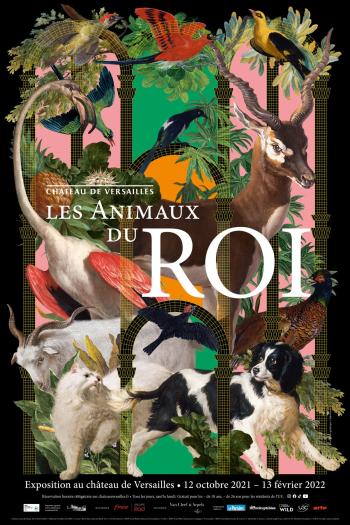 The Royal Menagerie, which the Sun King had installed close to the Grand Canal, was home to the rarest and most exotic animals—from coatis to quaggas, cassowaries to black-crowned cranes (nicknamed the ‘royal bird’)—constituting an extraordinary collection in which the king took ever greater pride. The animals in the menagerie were also a great source of inspiration for the artists of the time: they helped Claude Perrault with his Histoire naturelle, as well as serving the Royal Academy of Sciences as subjects for dissections and, later, Louis XV and Louis XVI, in their naturalism pursuits.
In addition to decorative items from the interior of the menagerie—particularly the paintings by Nicasius Bernaerts—on display are well-known garden sculptures, such as those in the Latona Fountain and the Maze. The latter comprised no fewer than 300 animals made from lead, arranged into a scene from Aesop’s fables and depicting a vision of the world in which animals make political, often moralising, always educational, pronouncements. In all, 37 sculptures recovered from the erstwhile grove will be on display.
More information about the Labyrinth (in French) is available here»
As well as the actual animals that were collected and studied, animal symbolism was used to represent power. The exhibition illustrates the link between the establishment of Versailles as a seat of power—from the construction of the palace itself on the site of Louis XIII’s old hunting lodge—and animal symbolism. Part of the exhibition is devoted to the daily hunt—a key activity pursued by warrior kings in times of peace as a form of training and demonstration of power. The hunt, consequently, features prominently in royal iconography.
 The animals themselves will return in droves to Versailles, because they never disappeared completely. They live on in the work of the king’s top painters; from Bernaerts, Boel and Le Brun, to Desportes and Oudry, many artists produced portraits of these exotic, wild and more familiar animals. As well as paintings, on view are portraits woven by the Gobelins Manufactory plus animals that were dissected, engraved, then preserved at the Academy of Sciences and in the King’s Garden, which is now the National Museum of Natural History. The exhibition also includes the skin of the Asian elephant gifted to Louis XV, which was donated to the Pavia Museum by Napoleon, and the skeleton of the very first elephant at Versailles, which was presented to Louis XIV by the king of Portugal and lived at Versailles for 13 years.
Finally, the exhibition addresses the role at court of companion animals for both the royal family and courtiers. As is evident from many portraits, companion animals were present everywhere, enlivening the royal apartments and brightening up the daily lives of children and adults alike. Many of the sovereigns, such as Marie Lesczcynska, wife of Louis XV, chose to surround themselves with their favourite animals. The court’s interest in the animal world led to greater sensitivity towards animals, in direct contrast to the Cartesian theory of animal-machines. Madame Palatine and, later, Madame de Pompadour, were particularly passionate about them.
Exhibition Curators
• Alexandre Maral, Curator General, Head of the Sculpture Department of the Musée National des Châteaux de Versailles et de Trianon
• Nicolas Milovanovic, Head Curator of the Paintings Department of the Louvre Museum
Alexandre Maral and Nicolas Milovanovic, eds., Les Animaux du Roi (Paris: Lienart éditions / musée national des châteaux de Versailles et de Trianon, 2021), 464 pages, ISBN: 978-2359063455, 49€.
Exhibition | Le Portrait Animal aux XVIIe et XVIIIe Siècles
Now on view at the Museum of Hunting and Nature:
Le Portrait Animal aux XVIIe et XVIIIe Siècles
Musée de la chasse et de la nature, Paris, 11 October 2021 — 20 March 2022
Curated by Karen Chastagnol
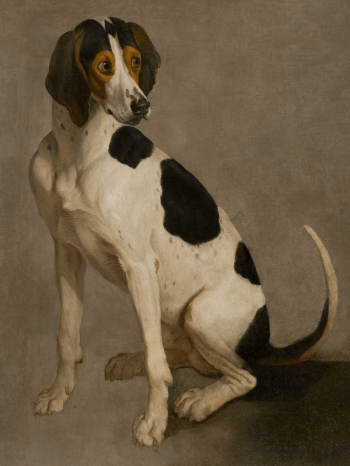
François Desportes, Étude pour mémoire du portrait de Pompée, ca. 1739, 94 × 72 cm (Dépôt de la Manufacture nationale de Sèvres).
Le Musée de la Chasse et de la Nature présente un parcours sur le portrait animalier en écho à l’exposition consacrée aux Animaux du roi au Château de Versailles. A travers différentes salles, cet accrochage retrace les caractéristiques de la représentation animale sous l’Ancien Régime.
Portraituré depuis la Renaissance, l’animal devient véritablement sujet à la cour comme à la ville depuis les commandes des portraits de ses chiens favoris que Louis XIV fit à François Desportes. En envisageant l’animal comme sujet iconographique et comme modèle, isolé ou non, les artistes nordiques et français des XVIIe et XVIIIe siècles développent largement ce genre pictural. Commande ou étude de travail, en pied, en tête, ou à travers des détails choisis, les animaux sont observés, analysés, et mis en image, seuls ou accompagnés, mais toujours montrés pour eux-mêmes, dans toute leur singularité. Entre esquisses et portraits, ces œuvres éclairent les différents aspects et enjeux du portrait animalier au moment où l’on passe d’une approche cartésienne de la nature animale à une évolution, au siècle des Lumières, du statut de l’animal qui est désormais de plus en plus perçu comme le miroir de l’homme.
A list of the twenty-one works in the exhibition (including links with more information) is available here»
Karen Chastagnol, Le portrait animal aux XVIIe et XVIIIe siècles dans les collections du musée de la Chasse et de la Nature (Paris: Fondation François Sommer, 2021), 60 pages, ISBN: 978-2957954827, €3.
New Book | Le prince et les animaux
From Lavoisier:
Joan Pieragnoli, Le prince et les animaux: Une histoire zoologique de la cour de Versailles au siècle des Lumières, 1715–1792 (Brussels: Éditions de l’Université de Bruxelles, 2021), 295 pages, ISBN: 978-2800417615, €27.
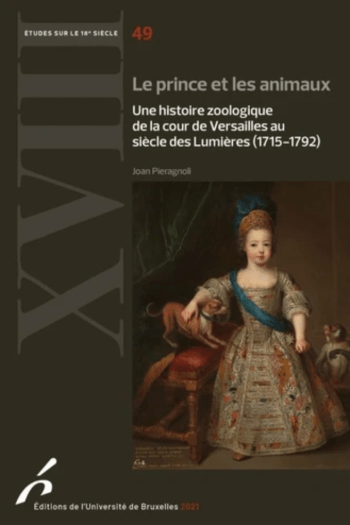 Entre utile et futile, les animaux accompagnent l’existence quotidienne du prince dont les chiens et les chevaux réclament de monumentaux bâtiments à Versailles. Mais au siècle des Lumières les animaux favorisent aussi l’apparition d’un Versailles intime à travers l’artisanat du luxe et de multiples constructions zoologiques de fantaisie.
Durant le règne de Louis XIV, les animaux contribuent à ériger Versailles en véritable monument à la gloire du prince, car ils sont des symboles de pouvoir et deviennent le prétexte de bâtiments grandioses. Cependant, au XVIIIe siècle, les derniers Bourbons délaissent ostensiblement leur principale demeure.
L’histoire zoologique proposée ici, en considérant les pratiques de chasse et la gestion des populations animales qu’elles impliquent, prétend d’abord expliquer cette désaffection. Elle invite également à évoquer un Versailles méconnu, où l’architecture zoologique de fantaisie consacre l’apparition d’une demeure intime au sein de la résidence officielle. Moins qu’à la magnificence, les animaux se trouvent désormais associés à la quête de l’existence privée confortable privilégiée par le roi et son entourage. À travers l’artisanat, l’industrie du luxe et la gastronomie les bêtes participent d’une consommation somptuaire qui définit l’art de vivre des Lumières. Mais l’opinion, indisposée par le coût des ménageries et celui des équipages, juge sévèrement des dépenses qui permettent aux princes de se comporter comme de simples particuliers. Le faste équestre et cynégétique, notamment, joue un rôle prépondérant dans l’effondrement de la monarchie, car les réformes destinées à limiter le nombre de chiens et de chevaux nécessaires au service de la cour interviennent trop tard. Déjà, la Révolution éclate et conduit à des choix autrement plus radicaux.
Docteur en histoire, Joan Pieragnoli s’est spécialisé dans l’étude des animaux durant la période moderne et a consacré plusieurs articles et ouvrages à la Ménagerie de Versailles. Il a récemment collaboré au Dictionnaire Louis XIV (Robert Laffont, 2015) dont il a signé les notices dédiées aux animaux et a publié La cour de France et ses animaux, XVIe–XVIIe siècles (PUF, 2016).
S O M M A I R E
Les animaux : un « habitus du prince » ?
Le cadre social Le cadre administratif et architectural • Le contexte anthropologique
I | Les animaux et le retour de la cour à Versailles
1 Les animaux et la Maison du roi
Les équipages de vénerie • Les équipages de fauconnerie • Les équipages et les animaux de la Chambre • Les écuries du roi
2 Les temps retrouvés de la chasse
Les saisons et les chasses • Les séquences de la chasse • L’économie de la chasse
3 Repeupler la Ménagerie
Protagonistes de l’approvisionnement et itinéraires • Les animaux : peuplement et transport • Les grandes étapes de l’approvisionnement
II | Les animaux et la privatisation des plaisirs royaux
4 L’architecture royale : bâtiments zoologiques et vie sociale
Situation et fonction des constructions royales • Les animaux et la distribution du corps de logis • Les basses-cours et les autres dépendances d’utilité
5 La société des chasses royales
Les chiens et les membres des équipages • La maison régnante • Les courtisans
6 Le renouveau de l’alimentation carnée
L’approvisionnement de la viande et du poisson • La redistribution de la viande sur les tables de la cour • La structure de la consommation
III | Les animaux au crépuscule de Versailles
7 Des animaux de bonne compagnie
L’animal aimé : les témoignages artistiques • Le bestiaire de l’intime • Le soin et la nourriture
8 La Ménagerie : abandon et renouveau d’une institution royale
La Ménagerie : une institution obsolète ? • Le renouveau du peuplement de la Ménagerie • Le fonctionnement quotidien
9 Les animaux à l’heure des réformes
L’héritage du règne de Louis XV et les premières mesures de Louis XVI • Les grandes réformes • Le fonctionnement quotidien
Conclusion générale
Online Workshop | Antiquitatum Thesaurus
From the BBAW:
Antiquitatum Thesaurus: Antiken in den Wissensspeichern der Frühen Neuzeit und heute
Online, Berlin-Brandenburgische Akademie der Wissenschaften, 10 November 2021, 8pm
Registration due by 9 November 2021
Please join us for the inaugural online event of the Antiquitatum Thesaurus project, a long-term project initiated at the beginning of 2021 at the Berlin-Brandenburg Academy of Sciences and Humanities and devoted to documenting the tradition of antique material culture in visual sources from the 17th and 18th centuries. Under the direction of Elisabeth Décultot, Arnold Nesselrath, and Ulrich Pfisterer, the project aims to study a large corpus of diverse source material ranging from printed books to drawing collections and culminating in Bernard de Montfaucon’s L’Antiquités expliquée et représentée en figures in order to contribute to our understanding of the early modern views of the remains of Antiquity throughout Europe and the Mediterranean by identifying and cataloguing objects that—beyond ancient literary texts—served as reference points for antiquarians. All the information gathered in the process will be stored in a digital research platform that will illustrate and visualize the complex relationships between objects, sources, places, and people over time.
Register here»
P R O G R A M M
Grußworte
• Christoph Markschies (Akademiepräsident)
• Tonio Sebastian Richter (Sprecher des Zentrums Grundlagenforschung Alte Welt Akademiemitglied, Freie Universität Berlin)
Der Antiquitatum Thesaurus
• Elisabeth Décultot (Projektleitung, Martin-Luther-Universität Halle-Wittenberg)
• Arnold Nesselrath (Projektleitung, Rom / Berlin)
• Ulrich Pfisterer (Projektleitung, Ludwig-Maximilians-Universität München Zentralinstitut für Kunstgeschichte)
Investigating Cassiano dal Pozzo’s ‘Paper Museum’: Lights and Shadows
• Eloisa Dodero (Musei Capitolini, Rom)
Thesauri antiquitatum: storie e sfide
• Elena Vaiani (Pisa)
Paris–Province (XVIIIe–XIXe siècle): à chacun son Antiquité?
• Véronique Krings (Université de Toulouse – Jean Jaurès)
Antiquitatum Thesaurus – Fallstudie und digitale Strategie
• Cristina Ruggero (BBAW)
• Timo Strauch (BBAW)
Research Project | Antiquitatum Thesaurus

Cabinet de Peiresc, Paris, Bibliothèque nationale de France, département Estampes et photographie, RESERVE FOL-AA-54, fol. 71r – Source: gallica.bnf.fr / BnF
◊ ◊ ◊ ◊ ◊
From the Berlin-Brandenburg Academy of Sciences and Humanities:
Antiquitatum Thesaurus: Antiquities in European Visual Sources from the Seventeenth and Eighteenth Centuries / Antiken in den europäischen Bildquellen des 17. und 18. Jahrhunderts
Berlin-Brandenburgische Akademie der Wissenschaften
Directed by Elisabeth Décultot, Arnold Nesselrath, and Ulrich Pfisterer
The project investigates drawings and prints of the seventeenth and eighteenth century based on artefacts from antiquity, and links them with the ancient objects that they document as well as with other evidence of their reception in a digital repository.
The aim of the research is to make extensive visual material available to scholars of various disciplines—first and foremost of the archaeologies of Europe and the Mediterranean, of art history and history, of ancient and early modern philology, as well as of the history of knowledge and of the Humanities. It includes nearly 7,200 drawings and other unique graphic works as well as roughly 15,000 printed reproductions, which along with the ancient objects, whether preserved or lost, that are documented in them will be processed to create approximately 35,000 datasets. With its focus on the seventeenth and eighteenth centuries, the project closes a gap that is currently found in the foundational research on the reception of ancient works of art and architecture in the early modern period. Not only did the amount of visual material explode during this period; what also emerged were processes of pluralisation and historicisation, which, particularly due to their different reference to the ancient past, are of central importance from the perspective of both politics and society and the history of scholarship.
All the drawings and printed reproductions will be compiled as such and catalogued systematically based on the ancient artefacts depicted in them. The information about ancient monuments and their documentation in images and texts in the early modern period is fed into an—internally and externally—highly integrated online database. With its pivotal broadening of the material basis for research on ancient artefacts in the early modern period, the project contributes to differentiating the concepts of antiquity, arts, and aesthetics in the modern period, and thus opens up new research perspectives. It sheds light in particular on the transformation of knowledge of antiquity in the modern era and provides a new basis for a decisive, shared formative stage for the later disciplines of archaeology and art history.
The Academy research project Antiquitatum Thesaurus: Antiquities in European Visual Sources from the Seventeenth and Eighteenth Centuries is part of the Academies Programme, a research funding programme co-financed by the German federal government and individual federal states. Coordinated by the Union of the German Academies of Sciences and Humanities, the Programme intends to retrieve and explore our cultural heritage, to make it accessible and highlight its relevance to the present, as well as to preserve it for the future.
Online Symposium | Hidden Hands: Untold Stories of the Object

Plate 419, Silver-plating in L’Enclopédie, ou Dictionnaire Raisonné des Sciences, des Arts et des Métiers by Denis Diderot.
◊ ◊ ◊ ◊ ◊
From the MFAH:
Hidden Hands: Untold Stories of the Object
Rienzi Biennial Symposium
Online, Rienzi, The Museum of Fine Arts, Houston, 6 November 2021
Geographic exploration and colonial expansion led to the introduction of new materials and technological innovation in the early modern period. These developments created an increased demand for goods made of ceramics, glass, exotic woods, textiles, and metals. The refining of raw materials and the production of these goods depended upon a diverse labor force made up of men, women, and children from across the globe. Despite the integral roles played by these workers in all of these varied enterprises, their names and contributions have often been lost to history. Who were these people? How did they interact and engage with these new materials and goods? What social, political, and economic forces contributed to the exclusion of their narratives? The symposium invites scholars to reconsider established ideas of craftsmanship and artistic authorship through the telling of these ‘hidden’ stories.
The symposium will be held in conjunction with the exhibition Hidden Hands: Invisible Workers in Industrial England, on view at Rienzi from 1 September 2021 to 3 January 2022.
Registration for the symposium is available here»
P R O G R A M M E
10.00 Session 1: Industry and Craft
• Misty Flores (Assistant Curator, Rienzi), Hidden Hands: Invisible Workers in Industrial England
• Javier Fernández Vázquez (PhD Candidate, Universidad Autónoma de Madrid), All the Names: Recovering the Ignored Authorship of Metal-Casting Patterns
• Daichi Shigemoto (PhD Student, The University of Texas at Austin), Hidden Hands for Frank Lloyd Wright’s Imperial Hotel in Tokyo
• Q&A
11.10 Break
11.40 Session 2: Cultural Exchanges in the Americas
• Alfredo A. Ortega-Ordaz (Conservator, National Museum of Anthropology, Mexico City), Lightweight Sculpting: About Admiration and Exclusion
• Marco Díaz-Güemez (Research Professor, Escuela Superior de Artes de Yucatán), The Yucatan Hammock as a Product of Mayan Women: Tradition, Adaptation, and Resistance
• Philippe Halbert (PhD Candidate, Yale University), A Toilette in Their Fashion: Indigenizing the Dressing Table in the French Atlantic World
• Q&A
12.55 Break
1.05 Session 3: Movement of People and Ideas
• Lindsay Alberts (Professor, SCAD), Mustafa di Ramadano: Slavery Hidden in the Hardstones of the Cappella dei Principi
• Jordan Smith (Assistant Professor, Widener University), The Caribbean Origins of European Craftsmanship: A Case Study in Rum
• Bindy Barclay (Freelance Writer and Researcher), Unraveling Cook’s Voyage: Repopulating the Colonial Exotic
• Q&A
Exhibition | Hidden Hands: Invisible Workers in Industrial England

Worcester Porcelain Manufactory, gilding attributed to Charlotte Hampton, Covered Dessert Tureen and Ladle from the ‘Bostock’ Service, ca. 1785–90, soft-paste porcelain (Museum of Fine Arts, Houston, the Rienzi Collection, Museum purchase funded by Mr. and Mrs. Harris Masterson III).
◊ ◊ ◊ ◊ ◊
Now on view at Rienzi:
Hidden Hands: Invisible Workers in Industrial England
Rienzi, The Museum of Fine Arts, Houston, 1 September 2021– 2 January 2022
The introduction of new materials and technological innovation in the 18th century sparked an increased demand for luxury objects and useful wares made of ceramics, glass, and metals. These technologies and techniques allowed manufacturers to create wares to appeal to a broader and more diverse audience. The Industrial Revolution affected not only how objects were made but also the organization of labor in workshops and factories. Behind famous names such as Josiah Wedgwood and Worcester Porcelain was a diverse, yet mostly unseen and nameless workforce composed of large numbers of women and children who were involved in various aspects of production and manufacture. Hidden Hands: Invisible Workers in Industrial England focuses on the many hands involved in the production of these wares. The exhibition also challenges established ideas about craftsmanship and artistic authorship.
Rienzi, the MFAH house museum for European decorative arts, presents special exhibitions twice a year.
Opinion | Time to Rethink Chinoiserie

Thomas Chippendale, Chinese Chairs, 1753; black ink, gray ink, and gray wash (New York: The Metropolitan Museum of Art, 20.40.1.23). From The Met’s online description: “Preparatory drawing for Thomas Chippendale’s Gentleman and Cabinet Maker’s Director. Published in reverse as plate XXIII in the 1754 and 1755 editions. The plate is reworked and renumbered as plate XXVII in the 1762 edition. In the new version the arm chair on the right (left in the print) is left unaltered, while the chair back of the chair in the middle is changed and the chair on the left (right in the print) is changed completely.”
◊ ◊ ◊ ◊ ◊
The following op-ed was published online at Elle Decor in May with a version also appearing in the October issue of the print magazine. It’s the sort of essay that I’ve been hoping to find for a few years now, one that bridges the scholarship of the past two decades with contemporary design practice, particularly as promoted by shelter magazines. I suspect that it could be useful pedagogically as a way to connect the historical origins of the material to present-day decorating trends. –CH
Aileen Kwun, “Opinion: It’s Time to Rethink Chinoiserie,” Elle Decor (27 May 2021). From pagoda motifs to floral wallpaper, chinoiserie has always openly borrowed from Asian visual culture. But is it harmful? A design writer and reporter asks the AAPI design community to weigh in.
Foo dogs. Ginger jars. Yin-yang tables. Pagoda motifs, fiery dragons, and bamboo stalks. See it in architecture, gardens, interiors, furnishings, products, graphic motifs, and at just about every scale of design. Chinoiserie, a genre of reproduction design dating back to 17th- and 18th-century Western Europe, has had a long history. From Louis XIV’s decor at Versailles to Ettore Sottsass’s pagoda-topped postmodern shelving, Westernized versions of Asian motifs have long been a mainstay of interior design. . . .
As a style of decor, chinoiserie is ubiquitous, even beautiful. But as an Asian American, chinoiserie has never sat well with me—as a motif or as a word—and, to varying degrees, I’m not the only one. “My reading of chinoiserie is that it’s ‘Asian’ in facsimile,” the architect Michael K. Chen says. “The way that chinoiserie is deployed in interiors is something that I am a little reflexively allergic to. As a component of a ‘traditional’ interior, it seems to highlight the question: Whose tradition are we talking about?” . . .
The full essay is available here»
Call for Papers | Water / Landscapes: Ecologies of the Fluid
From the posting at ArtHist.net (which includes the German version) . . .
Water / Landscapes: Ecologies of the Fluid, circa 1800
Wasser / Landschaften: Ökologien des Fluiden um 1800
A Conference of the Rhine-Main-Universities Initiative Romantische Ökologien
7–9 July 2022, Research Center, Bad Homburg
Proposals due by 30 November 2021
Wherever literary, pictorial, musical, or even horticultural depictions of the landscape are to be found in the Romantic period, there too, is the element of water: whether in sweeping and meandering streams or artfully arranged ponds and waterfalls within landscape gardens; mirror-smooth coastal and lake-surfaces reflecting the sun- or moonlight (either with summer brightness or in eerier shades); from wind-whipped sea tides and ocean waves; whispering brooks brimming with whimsical trout, or rivers like the Rhine, Main, Neckar, Thames, Seine, or Nile, welcome-beacons to all prospective barge- and ship-farers and invitations to imagine, paint, and compose poetry. Water-surfaces, water elements, and water spectacles are constitutive to a Romantic understanding of ‘landscape’.
Through these waterscapes of Romanticism—and more generally, those from the years around 1800—a (proto-)ecological understanding of the interplay between inorganic and organic entities in locally defined spaces comes into view and is first articulated. The connection nonetheless remains to be investigated further. To be sure, the Environmental Humanities have recognized the literature, philosophy, and science around 1800 as originators of modern ecological theorems and environmental consciousness. Nonetheless, the role that can be attributed to water—to the biotopes and conditions of existence attached to it—is still unclear. This is all the more astonishing as discussions and imaginations of the significance of water for life and the living in general, and specifically for the reciprocal, developmental, and transformative relationships between organisms and water (and hydrogen), was certainly encouraged by both the natural sciences (physics, geology, and in philosophy/ies of nature) as well as in literature and the arts around 1800 more generally. In particular, the realization that life and living forms not only consolidate in water, but that medial approaches are simultaneously necessary to make these interdependencies and interrelationships visible is decisive—Andersen’s fairy tale of water drops (Danish: Vanddraaben, 1847) beneath the magnifying glass brings this into view in a particularly impressive way.
Moreover, water landscapes help bring together the constantly interwoven levels of the semiotic and the material, of sonic and the phonetic (linguistic), and of literal and metaphorical meaning: Within landscape poems, the splash, bubble, spring, flood, flow, rush, and surge are not only the acts of waterworks and water surfaces; rather, diverse actors, their distinct modes of being and movement, become entangled and affected by each other, as they converge, mingle, and disperse again. Animals, plants, air, soil, and light make up an ensemble, which is brought into contact and co-constituted by water. Its activity and vitality, much like any form of landscape, is made possible only through water. More pointedly, the period from about 1750 to 1850 launches epistemological and aesthetic formations which recognize that without water, landscapes and living forms are unthinkable and unrepresentable.
The conference explores the ecological dimensions of the fluid in the period around 1800, taking the concept ‘water|landscapes’ as its point of departure. The focus will consist of various ‘water sites’, ranging from rain-bearing cloud formations to water puddles and bogs to river courses and marine spaces. It will bring into play extremely heterogenous aesthetic programs (e.g., the sublime or the locus amoenus), genres (idylls, river and seafaring ballads, garden poems, landscape prose and landscape painting discourse, nature essays, etc.) places (national and international, fantastic and realistic etc.), times, and traditions (Greek and Germanic mythology, Middle Ages). The basic thesis of the conference is that Romantic literatures and images stage, reflect, and negotiate the interplay of (living) elements and beings around/in water.
We are interested in contributions that inquire into historical knowledges about and aesthetic approaches to water, aquatic habitats, and habitats in the period around 1800, especially as relating to theories, figures of thought, and forms of representation of the ecological. Points of departure and catalysts for research can be found not only in the field of Romantic Ecocriticism but also in Hydro-Criticism and the Blue Humanities. European and International Romanticism is thereby an important, though not exclusive, reference point. Our interest is in the diversity of representations and theories surrounding water and its proto-ecological dimensions around 1800; all proposals that focus on water|scapes in text, as image, or as a jumping-off point for discussions between 1750 and 1850 are welcome.
Please send your abstract (max. 500 words) for a 25-minute talk and short bio and bibliographical notes in one single document to all three organisers (borgards@lingua.uni-frankfurt.de; middelhoff@em.uni-frankfurt.de; thums@uni-mainz.de) until 30 November 2021. A publication of selected talks is planned. The conference is scheduled as an in-presence event at the Research Center’s Villa Reimers in Bad Homburg. Travel and accommodation costs can—if needed—be reimbursed.
Organisers
Prof. Dr. Roland Borgards (Goethe-University Frankfurt)
Prof. Dr. Frederike Middelhoff (Goethe-University Frankfurt)
Prof. Dr. Barbara Thums (Johannes Gutenberg-University Mainz)
Contact
Frederike Middelhoff (W1-Professur für Neuere Deutsche Literatur mit dem Schwerpunkt Romantikforschung)
Goethe-Universität Frankfurt
Institut für deutsche Literatur und ihre Didaktik
Campus Westend // IG-Farben-Haus // Postfach 17
Norbert-Wollheim-Platz 1
60323 Frankfurt am Main
middelhoff@em.uni-frankfurt.de
Selected Bibliography
Alaimo, Stacy. “Oceanic Origins, Plastic Activism, and New Materialism at Sea.” In Material Ecocriticism, ed. Serenella Iovino, Serpil Oppermann. Bloomington 2014, pp. 186–203.
Böhme, Hartmut (ed.). Kulturgeschichte des Wassers. Frankfurt am Main 1988.
Böhme, Hartmut. “Wolken, Wasser, Stein. Zur Ästhetik der Landschaft, in: semina rerum (1999), pp. 1–7.
Briški, Javor und Irna Marija Samide (eds.). The Meeting of Waters: Fluide Räume in Literatur und Kultur. Munich 2015.
Bunzel, Wolfgang (ed.). Romantik an Rhein und Main: Eine Topographie. Darmstadt 2014.
Costlow, Jan, Yrjö Haila, Arja Rosenholm (eds.). Water in Social Imagination: From Technological Optimism to Contemporary Environmentalism. Ann Arbor 2017.
Cohen, Margaret and Killian Quigley (eds.). The Aesthetics of the Undersea. London, New York 2019.
Davies, Jeremy. “Romantic Ecocriticism: History and Prospects.” In Literature Compass (2018), pp. 1–15.
Deloughrey, Elisabeth. “Towards a Critical Ocean Studies for the Anthropocene.” In English Language Notes 57:1 (2019), pp. 22–36.
Detering, Heinrich. “Der Weiher als Ökosystem.” In: id.: Holzfrevel und Heilsverlust: Die ökologische Dichtung der Annette von Droste-Hülshoff. Göttingen 2021, pp. 46–60.
Goodbody, Axel and Berbeli Wanning (ed.). Wasser – Kultur – Ökologie: Beiträge zum Wandel mit dem Wasser und zu seiner literarischen Imagination. Göttingen 2008.
Garde-Hansen, Joanne. Media and Water: Communication, Culture, and Perception. London, 2021.
Görner, Rüdiger. “‘Hörst du das Alphorn überm blauen See?’ Aquafine Zeichen in der Lyrik Anette von Droste-Hülshoffs.” In Jahrbuch des Franz-Michael-Felder Archivs 20 (2019), pp. 16–29.
Häusler, Wolfgang. “Zwischen Naturwissenschaft, Heiliger Schrift und Historie. Beobachtungen zur Funktion des Wassers im Wer Adalbert Stifters.” In Jahrbuch des Adalbert-Stifter-Instituts 16 (2009), pp. 101–114.
Honold, Alexander. “Zwischen Wasser und Poesie. Brentanos Stromkreislauf.” In Gabe, Tausch, Verwandlung. Übertragungsökonomien im Werk Clemens Brentanos, ed. Ulrike Landfester. Würzburg 2009, pp. 127–141.
Jacobs, Mary. Romantic Things: A Tree, a Rock, a Cloud. Chicago 2012.
Jue, Melody. Wild Blue Media: Thinking through Seawater. Durham 2020.
Kramer, Anke. “Hydrographie der Zeit. Erlebte Zeit bei Annette von Droste-Hülshoff, Henri Bergson und Johannes Müller.” In ZwischenZeiten. Zur Poetik der Zeitlichkeit in der Literatur der Annette von Droste-Hülshoff und der ‚Biedermeier‘-Epoche, ed. Cornelia Blasberg and Jochen Grywatsch. Hannover 2013, pp. 189–209.
Kramer, Anke. “Elementargeister und die Grenzen des Menschlichen. Agierende Materie in Fouqués Undine.” In: Mensch – Maschine – Tier: Entwürfe posthumaner Interaktionen (= Beiheft PhiN 10/2016), ed. Christa Grewe-Volpp, Evi Zemanek, pp. 104–124. http://web.fu-berlin.de/phin/beiheft10/b10t08.pdf.
Kraß, Andreas. Meerjungfrauen: Geschichten einer unmöglichen Liebe. Frankfurt am Main 2010.
McKusick, James. Green Writing: Romanticism and Ecology. Basingstoke 2000.
Pape, Walter (ed.). Romantische Metaphorik des Fließens: Körper, Seele, Poesie. Tübingen 2007.
Ritson, Katie. “The View from the Sea: The Power of a Blue Comparative Literature.” In Humanities 9/3/68 (2020) https://doi.org/10.3390/h9030068.
Ritson, Katie. The Shifting Sands of the North Sea Lowlands: Literary and Historical Imaginaries. London 2018.
Robbins, Nicholas. “Ruskin, Whistler, and the Climate of Art in 1884.” In Ruskin’s Ecologies: Figures of Relation from Modern Painters to the Storm-Cloud, ed. Kelly Freeman Thomas Hughes. London 2021, pp. 203–223.










 Enfilade
leave a comment