Exhibition | Materials of Empire: Colonial Narratives, 1700–1860
Now on view at Rienzi:
Materials of Empire: Colonial Narratives, 1700–1860
Rienzi, The Museum of Fine Arts, Houston, 15 January — 31 July 2022

Portuguese, Earrings from a Parure, ca. 1780–1820, emeralds, diamonds, and yellow gold with silver overlay (Museum of Fine Arts, Houston, the Rienzi Collection).
Materials of Empire: Colonial Narratives 1700–1860 explores objects from the Rienzi Collection that shed light on the links between Europe, Africa, the Americas, and India. This small exhibition examines the stories objects reveal as well as conceal, and places them within the context of entangled legacies and experiences of empire.
Exploration, war, scientific expeditions, and religious missions feature prominently in the history of Europe during the 18th and 19th centuries. These factors fueled an age of discovery in which thousands of ships transported explorers, merchants, and migrants from Europe to far-reaching destinations.
Vessels bound back to Europe carried cargo such as gold, silver, sugar, and tobacco. The ships also transported millions of enslaved men, women, and children from Africa to points across the empires to serve as labor in the cultivation of the new materials. Every crossing brought new encounters and confrontations between people and ways of life, resulting in a complex cultural landscape.
Rienzi, the MFAH house museum for European decorative arts, presents special exhibitions twice a year.
Online Seminar Series | Neoclassicism, Race, and Empire

From TORCH:
Neoclassicism, Race, and Empire
Online, The Oxford Research Centre in the Humanities, March 2022
Charmaine Nelson (NSCAD University)
Wednesday, 2 March, 4.00–5.30pm GMT (11am EST), register here»
Anne Lafont (L’École des Hautes Études en Sciences Sociales)
Wednesday, 16 March, 4.00–5.30pm GMT (12pm EST), register here»
Louis Nelson (University of Virginia)
Wednesday, 30 March, 4.00–5.30pm BST (11am EST), register here»
This three-part series examines the intersection between neoclassicism and questions of race, colonisation, empire-building, and national identity. With a focus on the British and French Atlantic worlds from the eighteenth century onwards, but with attention to a broader geographical field, we will ask how classical ideas and forms were invoked in art, architecture, and aesthetics in ways that intersected with colonial expansion, the assertion of imperial power, and the development of racial ideologies. Through a series of seminars led by pioneering scholars in this field—Charmaine Nelson, Anne Lafont, and Louis Nelson—we will explore the stylistic phenomenon of ‘neoclassicism’ within its broadest political and cultural contexts, while discussing the longer historiographical legacy of self-consciously classical art made in the modern age of empire. Registration is required for each online talk.
Please note that in the USA and Canada, the session on 16 March starts an hour later than the others, because the clocks go forward on different dates.
The Stories a House Can Tell
In my mind, I’ve returned repeatedly over the past few weeks to this recent story from The Washington Post. Fascinating material for conceiving of history as a recovery process of things lost (or purposely obscured) and material culture as a means of making sense of where past and present meet. It was my first introduction to Jobie Hill’s Saving Slave Houses project. -CH
Joe Heim, “An Old Virginia Plantation, a New Owner, and a Family Legacy Unveiled,” The Washington Post (22 January 2022).

Sharswood in Gretna, Va., was built in the middle of the 19th century and at one point was the hub of a sprawling plantation. The Pittsylvania County property now consists of 10½ acres. Out of the frame behind the large tree at right is a cabin that may have been used by enslaved people as a kitchen and laundry for the main house as well as a residence. (Heather Rousseau for The Washington Post)
. . . It wasn’t until after Fredrick Miller bought Sharswood in May 2020 that its past started coming into focus. That’s when his sister, Karen Dixon-Rexroth and their cousins Sonya Womack-Miranda and Dexter Miller doubled down on researching their family history.
What neither Fredrick Miller nor his sister knew at the time was that the property had once been a 2,000-acre plantation, whose owners before and during the Civil War were Charles Edwin Miller and Nathaniel Crenshaw Miller.
Miller. . . .
As the puzzle pieces connected, a clearer picture emerged. Sarah Miller, great-grandmother to Fredrick, Karen and Dexter, and great-great-grandmother to Sonya, died in 1949 at 81. From her death certificate, they learned that Sarah’s parents were Violet and David Miller.
The 1860 Census does not list enslaved people by name, only by gender and age. In the 1870 Census, however, Violet and David Miller lived just a short distance from Sharswood. Between the many documents that the descendants of Sarah Miller have obtained, the fragments of family oral history they’ve sewn together and the proximity of the family to the plantation, they are certain that Violet and David Miller were among those enslaved at Sharswood. . . .
For Fredrick Miller, the 10.5-acre-estate he’d purchased for $225,000 ended up not being just a future gathering spot for the family, but also its first traceable point in the United States—an astonishing revelation for him. It also left him thinking about family history and the absence of that history for many people like him. . . .
There were 12 houses for enslaved people on the plantation, determined Doug Sanford, a retired professor of historic preservation at the University of Mary Washington, who has been documenting former homes of the enslaved across Virginia with Dennis Pogue, an associate research professor at the University of Maryland and retired archaeologist. . . .
The dilapidated cabin behind the main house at Sharswood isn’t visible from the road. A humble structure with a central chimney dividing two rooms, it feels almost hidden. But Sarah Miller’s descendants have focused their attention on it.
What the family learned from ongoing research by Sanford and Pogue and by Jobie Hill, a preservation architect who started the Saving Slave Houses project in 2012, is that the cabin was built before 1800, probably as the main house on the property, and then was divided into a duplex before 1820. From then on, they said, it probably served as a kitchen and laundry for the main house and a living space for some who were enslaved at Sharswood. . . .
The full article is available here»
Exhibition | Flesh and Bones: The Art of Anatomy
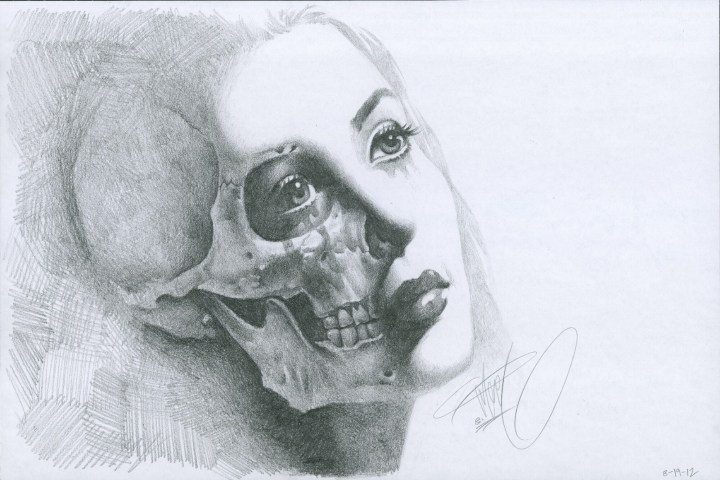
Love & Hate, 19 August 2012, OG Abel (Abel Izaguirre), graphite on paper, 12 1/2 × 19 1/2 × 3 inches (Los Angeles: Getty Research Institute, 2013.M.8. Gift of Ed and Brandy Sweeney © OG Abel).
◊ ◊ ◊ ◊ ◊
From the press release for the exhibition opening this month at The Getty:
Flesh and Bones: The Art of Anatomy
Getty Research Institute, Getty Center, 22 February — 10 July 2022
Curated by Monique Kornell
Featuring works of art from the 16th century to today, the Getty Research Institute exhibition Flesh and Bones: The Art of Anatomy explores the theme of anatomy and art and the impact of anatomy on the study of art.
“Flesh and Bones celebrates the connection between art and science and the role of art in learning,” said Mary Miller, director of the Getty Research Institute. “This exhibition draws on the Getty Research Institute’s rich and varied holdings to tell the story of two disciplines that have long been intertwined. I believe visitors will find meaningful connections with the way artists and scientists have inspired one another for centuries.”
 From spectacular life-size illustrations to delicate paper flaps that lift to reveal the body’s interior, the body is represented through a range of media. In Europe, the first printed anatomical atlases, introduced during the Renaissance, provided new visual maps to the body, often composed of striking images. Landmarks of anatomical illustration such as the revolutionary publications of Vesalius in the 16th century and Albinus in the 18th century are represented as well as little-known rarities such as a pocket-size book of anatomy for artists from over 200 years ago. The exhibition, which explores important trends in the depiction of human anatomy and reflects the shared interest in the structure of human body by medical practitioners and artists, is organized by six themes: Anatomy for Artists; Anatomy and the Antique; Lifesize; Surface Anatomy; Three Dimensionality; and The Living Dead. The last looks at the motif of the representation of the dead as living, with skeletons and anatomized cadavers capable of motion rather than inert on a dissecting table.
“Artists not only helped create these images but were part of the market for them, as anatomy was a basic component of artistic training for centuries,” said exhibition curator Monique Kornell. “Featuring selections from the GRI’s impressive collection of anatomy books for artists as well as prints, drawings, and other works, this exhibition looks at the shared vocabulary of anatomical images and at the different methods used to reveal the body through a wide range of media, from woodcut to neon.”
For artists of the modern era, anatomy is often a medium of expression and a signifier of the body itself, rather than purely an object of study. Robert Rauschenberg’s Booster (1967) and Tavares Strachan’s Robert (2018) are two life-size anatomical portraits as well as symbols of the passing nature of life. Echoing the composite prints of Antonio Cattani’s remarkable life-size anatomical figures from the 1700s in the exhibition, Booster is a fractured self-portrait based on X-rays of the artist that have been joined together.
Strachan’s Robert is not an exact likeness of the man it immortalizes, Major Robert Henry Lawrence Jr., the first African American astronaut, who tragically died in a training accident. In choosing to represent the hidden interior of the body in neon and glass, Strachan, a former GRI artist in residence, makes visible the unique history of Lawrence, while demonstrating an inner structure that equalizes all people.
Anatomists and artists have approached the problem of how best to describe the body’s complex and invisible interior with a variety of representational strategies, ranging from the graphic to the sculptural and, recently, the virtual. From paper-flap constructions that allow viewers to lift and peer under layers of flesh to stereoscopic photographs that mimic binocular perception and project anatomical structures into space, three-dimensionality was inventively pursued in the pre-digital age to cultivate an understanding of anatomy as a synthetic whole.
The exhibition is curated by Monique Kornell, guest curator; guest assistant professor, Program in the History of Medicine, Cedars-Sinai Hospital, Los Angeles, and is accompanied by a richly illustrated publication.
Monique Kornell, with contributions by Thisbe Gensler, Naoko Takahatake, and Erin Travers, Flesh and Bones: The Art of Anatomy (Los Angeles: Getty Research Institute, 2022), 249 pages, ISBN 978-1606067697, $50.
Exhibition | Grand Design: 17th-Century French Drawings
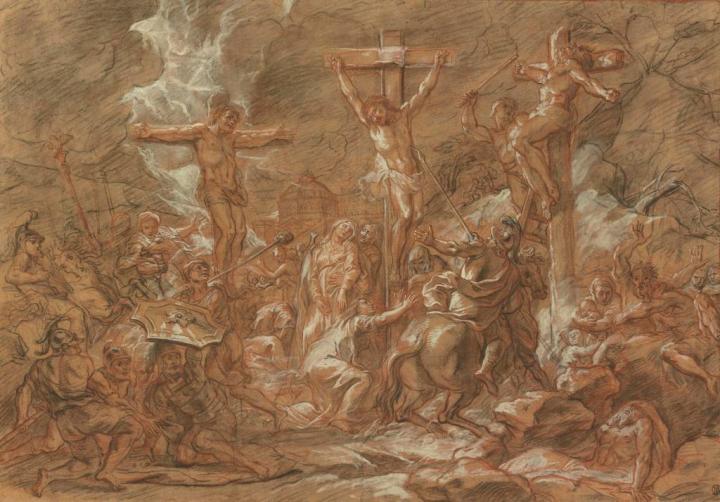
Antoine Coypel, The Crucifixion, 1692, red and black chalk with white gouache heightening on beige paper, 41 × 58 cm
(Los Angeles: The J. Paul Getty Museum, 88.GB.41)
◊ ◊ ◊ ◊ ◊
From the press release for the exhibition now on view at The Getty:
Grand Design: 17th-Century French Drawings
Getty Center, Los Anageles, 8 February — 1 May 2022
Curated by Emily Beeny
Presenting the Getty Museum’s collection of 17th-century French drawings in its entirety for the first time, Grand Design: 17th-Century French Drawings addresses the emergence of a distinctly French school of art and explores the role that drawing played in the process.
“Today we recognize drawings by Nicolas Poussin and Claude Lorrain as landmark achievements of 17th-century European art,” says Timothy Potts, Maria Hummer-Tuttle and Robert Tuttle Director of the J. Paul Getty Museum. “But in fact, drawing lay at the heart of all artmaking in 17th-century France, from the decoration of palaces and churches to the illustration of books. Drawing was where it began.”
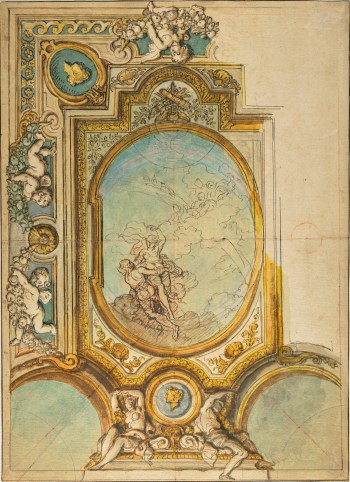
Charles de la Fosse, Studies for a Ceiling Decoration with the Apotheosis of Psyche (detail), ca. 1680, pen and black ink and brush and watercolor over red chalk on paper, 26 × 36 cm (Los Angeles: The J. Paul Getty Museum, 2001.47).
French art came into its own during the 17th century, often called the Grand Siècle, or Great Age, of France. This period witnessed a series of violent political upheavals at home, the first stages of colonial expansion overseas, and the rise of authoritarian absolute monarchy. This turbulent century fostered artistic activity on a scale previously unimagined. Expatriate French artists achieved fame in Rome; a Royal Academy of Painting and Sculpture was founded in Paris; and vast building projects—most notably, the Palace of Versailles—employed whole generations of artists.
This exhibition includes drawings made by Jacques Callot, Simon Vouet, Nicolas Poussin, Claude Lorrain, Charles Le Brun, Hyacinthe Rigaud, and many others. These artists made drawings for many different purposes: designs for ceiling paintings, altarpieces, sculptures, and prints; landscape sketches made outdoors; and nude studies drawn in the studio.
“Drawing helped 17th-century French artists make sense of the world around them, think through compositional ideas, and prepare finished works,” explains Emily Beeny, curator of the exhibition. “Each of these sheets invites us into its author’s creative process, whether observing nature, capturing a portrait likeness, designing a print, or preparing a painting.”
Grand Design: 17th-Century French Drawings is curated by Emily Beeny, curator in charge of European paintings at the Fine Arts Museums of San Francisco, and former associate curator of drawings at the Getty Museum. This exhibition is presented concurrently with another exhibition focused on 17th-century French art: Poussin and the Dance.
The checklist is available as a PDF file here»
Installation | In Dialogue
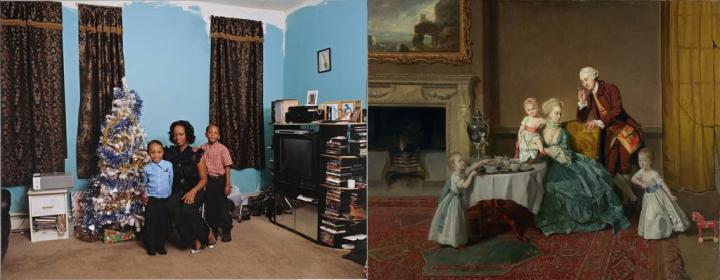
Left: Coulson Family, 2008, by Deana Lawson, pigment print, 33 × 43 inches (Getty Museum, 2021.53.2. © Deana Lawson). Right: John, Fourteenth Lord Willoughby de Broke, and His Family, ca. 1766, by Johann Zoffany, oil on canvas, 40 × 50 inches (Getty Museum, 96.PA.312).
◊ ◊ ◊ ◊ ◊
Closing this weekend at The Getty:
In Dialogue
Getty Center, Los Angeles, 9 November 2021 — 13 February 2022
In Dialogue is a series of temporary installations in the Museum’s permanent collection galleries. This presentation places photographs made during the past fifty years by five women from Japan, Mexico, and the United States in conversation with European paintings, decorative arts, and sculptures created predominantly by men before 1900. Through compelling and sometimes unexpected juxtapositions, these installations invite visitors to engage with diverse perspectives and recurring themes across different media, styles, cultures, and time periods. Look for photographs by Diane Arbus, Chris Enos, Deana Lawson, Asako Narahashi, and Daniela Rossell, in the North, East, and South Pavilions.

Left: Pink Roses, 1980, by Chris Enos, Polaroid dye diffusion print, 24 × 21 inches (Getty Museum, 84.XP.465. © Chris Enos). Right: Vase of Flowers, 1722, by Jan van Huysum, oil on panel, 32 × 24 inches (Getty Museum, 82.PB.70).
New Book | Masculinity and Danger on the Grand Tour
Distributed by The University of Chicago Press:
Sarah Goldsmith, Masculinity and Danger on the Eighteenth-Century Grand Tour (London: University of London Press, 2021), 200 pages, ISBN: 978-1912702213 (cloth), $55 / ISBN: 978-1912702220 (paper), $35.
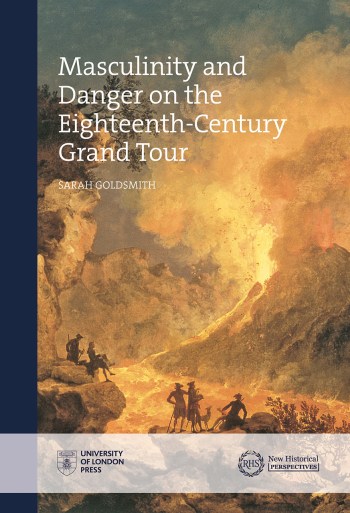 The Grand Tour, a customary trip through Europe undertaken by British nobility and wealthy landed gentry during the seventeenth and eighteenth centuries, played an important role in the formation of contemporary notions of elite masculinity. Through an examination of testimonies written by Grand Tourists, tutors, and their families, Sarah Goldsmith argues that the Grand Tour educated young men in a wide variety of skills, virtues, and vices that extended well beyond polite society.
Goldsmith demonstrates that the Grand Tour was a means of constructing Britain’s next generation of leaders. Influenced by aristocratic concepts of honor and inspired by military-style leadership, elite society viewed experiences of danger and hardship as powerfully transformative and therefore as central to constructing masculinity. Scaling mountains, volcanoes, and glaciers, and even encountering war and disease, Grand Tourists willingly tackled a variety of perils. Through her study of these dangers, Goldsmith offers a bold revision of eighteenth-century elite masculine culture and the critical role the Grand Tour played within it.
Sarah Goldsmith is a lecturer in urban and material culture history at the University of Edinburgh, having previously held a Leverhulme Early Career Research Fellowship at the University of Leicester.
C O N T E N T S
Acknowledgements
Introduction
1 Hazarding Chance: A History of Eighteenth-Century Danger
2 Military Mad: War and the Grand Tour
3 Wholesome Dangers and a Stock of Health: Exercise, Sport, and the Hardships of the Road
4 Fire and Ice: Mountains, Glaciers, and Volcanoes
5 Dogs, Servants, and Masculinities: Writing about Danger and Emotion on the Grand Tour
Conclusion
Appendix
Bibliography
Index
Call for Papers | Making Masculinities: Material Culture and Gender
From ArtHist.net:
Making Masculinities: Material Culture and Gender in the Seventeenth and Eighteenth Centuries
University of Edinburgh, 6 May 2022
Proposals due by 1 March 2022
Research into the intersection of material culture and masculinity has steadily increased as scholars across disciplines choose to use material culture as a conceptual point of departure. The Material and Visual Culture in the Seventeenth and Eighteenth Centuries Research Cluster at the University of Edinburgh aims to provide a space to continue the conversation. The cluster will host a one-day workshop fostering interdisciplinary discussion on the material approaches to historic ideas about gender through material culture. This workshop is spread over a series of formats to diversify how participants may interrogate this material. The day will include several presentations from PhD and Early Career Researchers, a keynote and a workshop for attendees led by Dr Sarah Goldsmith (University of Edinburgh).
To that end, we seek proposals for 10-minute papers that explore how material culture manifest various, competing, and complementary, expressions and definitions of masculinity during the seventeenth and eighteenth centuries. We are particularly interested in the myriad relationships between people and things, interrogating issues of making, consumption, exchange, and agency. We welcome contributions from researchers and museum professionals from fields, including but not limited to Art History, History, Literature, and Anthropology, English Literature, Archaeology.
Please submit a title and abstract of no more than 250 words, with a short biography (max 100 words) to materialcultureresearcheca@ed.ac.uk by the 1 March. Some travel bursaries will be available to assist speaker attendance. Please inquire for further information.
The workshop is kindly supported by ECA and History of Gender and Sexualities Research Group (Edinburgh).
New Book | The Art and Science of Mark Catesby
From Yale UP:
Henrietta McBurney, The Art and Science of Mark Catesby (London: Paul Mellon Centre, 2021), 384 pages, ISBN: 978-1913107192, $50.
 The life and art of the 18th-century naturalist Mark Catesby, and his pioneering work depicting the flora and fauna of North America, are explored in vibrant detail
This book explores the life and work of the celebrated eighteenth-century English naturalist, explorer, artist and author Mark Catesby (1683–1749). During Catesby’s lifetime, science was poised to shift from a world of amateur virtuosi to one of professional experts. Working against a backdrop of global travel that incorporated collecting and direct observation of nature, Catesby spent two prolonged periods in the New World—in Virginia (1712–19) and South Carolina and the Bahamas (1722–6). In his majestic two-volume Natural History of Carolina, Florida and the Bahama Islands (1731–43), esteemed by his contemporary John Bartram as “an ornament for the finest library in the world,” he reflected the excitement, drama, and beauty of the natural world. Interweaving elements of art history, history of science, natural history illustration, painting materials, book history, paper studies, garden history and colonial history, this meticulously researched volume brings together a wealth of unpublished images as well as newly discovered letters by Catesby, which, with their first-hand accounts of his collecting and encounters in the wild, bring the story of this extraordinary pioneer naturalist vividly to life.
Henrietta McBurney is a freelance curator and art historian. She was previously curator in the Royal Library, Windsor Castle. Her publications include studies on the florilegium of Alexander Marshal and the natural history drawings for Cassiano dal Pozzo’s Paper Museum.
New Book | The Doctor’s Garden
From Yale UP:
Clare Hickman, The Doctor’s Garden: Medicine, Science, and Horticulture in Britain (New Haven: Yale University Press, 2021), 288 pages, ISBN: 978-0300236101, $40.
 A richly illustrated exploration of how late Georgian gardens associated with medical practitioners advanced science, education, and agricultural experimentation
As Britain grew into an ever-expanding empire during the late eighteenth and early nineteenth centuries, new and exotic botanical specimens began to arrive within the nation’s public and private spaces. Gardens became sites not just of leisure, sport, and aesthetic enjoyment, but also of scientific inquiry and knowledge dissemination. Medical practitioners used their botanical training to capitalize on the growing fashion for botanical collecting and agricultural experimentation in institutional, semipublic, and private gardens across Britain. This book highlights the role of these medical practitioners in the changing use of gardens in the late Georgian period, marked by a fluidity among the ideas of farm, laboratory, museum, and garden. Placing these activities within a wider framework of fashionable, scientific, and economic interests of the time, historian Clare Hickman argues that gardens shifted from predominately static places of enjoyment to key gathering places for improvement, knowledge sharing, and scientific exploration.
Clare Hickman is a senior lecturer in history at Newcastle University. She lives in Whitley Bay, United Kingdom.
C O N T E N T S
Acknowledgments
Quick Guide to the Key Medical Practitioners and Their Gardens
Introduction, Illuminating the Doctor’s Garden
1 Educating the Senses: The Botanic Garden as a Teaching and Research Center
2 Creating a Perpetual Spring: Tracing Private Botanic Collectors and Their Networks
3 For ‘Curiosity and Instruction’: Visiting the Botanic Garden
4 ‘Hints or Directions’: Reading the Doctor’s Garden
5 For Dulce and Utile: The Garden as Both Ornament and Farm
6 This ‘Terrestrial Elysium’: Sociability and the Garden
Epilogue, The Stories We Tell: Bridging the Gap between Research and Practice
Notes
Selected Bibliography
Index










 Enfilade
leave a comment