Exhibition | Canova: Sketching in Clay
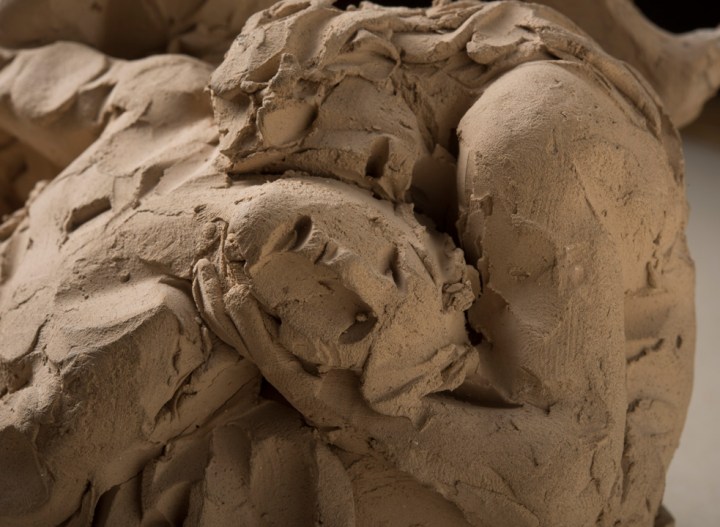
Antonio Canova, Adam and Eve Mourning the Dead Abel, detail of Eve and Abel, ca. 1818–22, terracotta
(Possagno: Museo Gypsotheca Antonio Canova; photograph by Tony Sigel)
◊ ◊ ◊ ◊ ◊
Antonio Canova, at age 64, died on this day (13 October) 200 years ago; his clay models are the subject of a major exhibition opening in June. From the NGA:
Canova: Sketching in Clay
National Gallery of Art, Washington, DC, 11 June — 9 October 2023
Art Institute of Chicago, 19 November 2023 — 18 March 2024
Curated by C. D. Dickerson and Emerson Bowyer
How does a sculptor turn an initial idea into a finished work of marble? For Antonio Canova (1757–1822), the most famous artist of Europe’s revolutionary period, the answer was with clay. Working with his hands and small tools, Canova produced dazzling sketch models in clay, which helped him plan his designs for his large statues in marble. Imprinted with the fire of his imagination, these sketches were boldly executed in mere minutes. Canova also made more finished models, sensuous in their details, that he showed to patrons or used as guides for carving. Approximately 40 of the some 60 of his surviving models reveal the artist’s extraordinary working process—a process that led to the creation of some of the most iconic works in the history of sculpture.
Canova: Sketching in Clay is organized by the National Gallery of Art, Washington and The Art Institute of Chicago. The exhibition is curated by C. D. Dickerson, curator and head of sculpture and decorative arts, National Gallery of Art, and Emerson Bowyer, Searle Curator, Painting and Sculpture of Europe, The Art Institute of Chicago.
C. D. Dickerson and Emerson Bowyer, with contributions by Anthony Sigel and Elyse Nelson, Canova: Sketching in Clay (New Haven: Yale University Press, 2023), 280 pages, ISBN: 978-0300269758, $65.
◊ ◊ ◊ ◊ ◊
Note (added 12 June 2023) — The original posting was updated to include information on the catalogue, which was published 6 June 2023.
Call for Papers | Evoking the Incommensurable: Painting the Sublime
From ArtHist.net:
Evoking the Incommensurable — Painting the Sublime
Friedrich Schiller University, Jena, 26–28 July 2023
Organized by Johannes Grave, Sonja Scherbaum, and Arno Schubbach
Proposals due by 15 December 2022
In the 18th century, the concept of the sublime constitutes a genuine novelty and a driving force for advancements in philosophy, theoretical reflection on the arts, and painterly practice. From its beginnings, this novelty was not limited to one country alone, but covered the whole of Europe. A first step was Nicolas Boileau’s French translation of Pseudo-Longinus’ Traité sur le sublime in 1674. Further decisive steps were Edmund Burke’s A Philosophical Inquiry into the Origin of Our Ideas of the Sublime and Beautiful from 1757 and Immanuel Kant’s Critique of the Power of Judgment from 1790. Thus, a discourse concerning the sublime could develop that extended across European languages and traditions, a discourse which, at least at first glance, is characterized much more strongly by its diversity than by a common conceptual basis or homogeneous philosophical framework.
Moreover, the sublime was not merely the subject of philosophical discourse; it was also embraced by the theoretical reflection on the arts, such as literature and painting. In this context, the sublime constitutes a challenge not only due to the fact that Burke and Kant distinguished it sharply from the beautiful, i.e., the traditional organizing subject of treatises on painting and literature. The sublime also raises questions because, according to Burke and Kant, the sublime breaks with classical standards of pictorial or literary representation; its excessive strain on the senses, its incommensurability with any measure, and its irreducibility to any bounded shape serve as a harsh contrast to the beautiful and the aesthetic values associated therewith. The attempt to incorporate this concept into aesthetic reflection not only gave rise to tensions but also offered an opportunity to establish new approaches. It is therefore no coincidence that the concept of the sublime was readily taken up by treatises on landscape painting in order to foster this newly reappraised pictorial genre.
Finally, the sublime was also a challenge to artistic practice. Theoretical discourse concerning the sublime often referred much more directly to our experience of nature than to our experience of artistic works. Particularly in the case of Kant, it was not evident that the arts are at all able to evoke anything sublime. Furthermore, the specific characteristics of the sublime do not make it seem to be a suitable subject for painting. It was by no means evident that it would be possible to represent the boundless greatness of sublime nature within the limited frame of a picture. Nevertheless, various attempts to paint the sublime can be seen in the genre of landscape painting and its many European varieties. And there are good reasons to assume that such attempts can also be found in other genres, whether in figurative representations, in ruin paintings and architectural representations, or even in book illustrations. The sublime challenged artists to push the limits of painting and to explore its capabilities anew. To evoke the incommensurable and paint the sublime requires, we would suggest, purposefully exploring and exploiting these capabilities in relation to the reception of the painting and, above all, the limits of the viewer’s perceptual capacities.
The international conference Evoking the Incommensurable — Painting the Sublime thus discusses the conception of the sublime as an innovative force on a Europe-wide scale, both in respect to the formation of the aesthetic discourses pertaining to it and in reference to the practice of painting and its exploration of the capability of pictures to evoke the incommensurable in their reception. The conference will be held in English. Conference presentations should be 30 minutes long. We will reimburse travel and accommodation costs.
We warmly welcome papers from doctoral, postdoctoral, and senior scholars. Please submit your abstract (250 words) along with a short biography, in English, to paintingthesublime@uni-jena.de by 15 December 2022. Speakers will be notified by 31 January 2023.
Seminar Session | Clémence Fort on ‘Porcelaines des Sauvages’
This month’s session from the GRHS series on the circulation of knowledge, with information on other GRHS seminar series available here:
Clémence Fort | ‘Porcelaines des Sauvages’
Circulation, appropriation et représentation d’un objet emblème en France au XVIIIe siècle
Diffusion, circulation et appropriation des savoirs – Séminaire du Groupe de Recherche en Histoire des Sociabilités
In-person and online, Université du Québec, Montréal, 21 October 2022, 12.30pm
Avec l’essor du projet colonial en Amérique du Nord au 18e siècle, les « porcelaines des Sauvages » en provenance de Nouvelle-France et issues de la collecte apparaissent dans les collections françaises. Leur circulation engendre des représentations qui documentent les nombreux imprimés de cette époque allant des récits de voyages aux atlas historiques. Naturalistes et amateurs s’intéressent aussi à la manière dont les objets sont fabriqués et imités. Ils les incluent alors dans une culture visuelle scientifique et esthétique nouvelle. Cette présentation examinera la manière dont « les porcelaines des Sauvages » invitent à repenser la géopolitique du collectionnisme à partir des enjeux artistiques, scientifiques et économiques. Nous étudierons la façon dont les « porcelaines des Sauvages » participent à la diffusion esthétique, historique et scientifique de l’entreprise coloniale de la Nouvelle-France au 18e siècle.
Le séminaire privilégiera les circuits et les transmissions de l’imprimé sous toutes ses formes, sans pour autant exclure les autres productions (et marchandises) de la connaissance. Les séances se tiendront en comodal, au local R-4215 à l’UQAM et par visioconférence.
Clémence Fort est actuellement doctorante contractuelle en deuxième année au sein de l’université PSL (ENS) à Paris. Sa thèse intitulée : « Collecter les Americana : la Nouvelle-France dans les cultures visuelles et l’art des Lumières (v. 1700–1763) » est dirigée par Charlotte Guichard. Les recherches de Clémence s’inscrivent au croisement d’une histoire de l’art renouvelée par l’histoire de la collecte, des collections et des cultures visuelles et matérielles.
Seminar Session | Ersy Contogouris on Vigée-LeBrun’s Self-Portraits
This month’s session from the GRHS series on women’s self-portraits, with information on other GRHS seminar series available here:
Ersy Contogouris | Les autoportraits d’Élisabeth Vigée-LeBrun au Salon de 1787
Autoportraits au féminin (XVIe–XVIIIe siècle) –Séminaire du Groupe de Recherche en Histoire des Sociabilités
Université du Québec, Montréal, Thursday, 13 October 2022, 2.00pm
Cette conférence étudiera l’autoportrait qu’Élisabeth Vigée-LeBrun expose au Salon de 1787. Vigée-LeBrun avait été admise à l’Académie royale de peinture et de sculpture en 1783 aux côtés d’Adélaïde Labille-Guiard, portant ainsi à quatre le nombre de femmes membres de l’Académie pour la première fois depuis sa fondation en 1648, et à quinze le nombre total de femmes y ayant été admises. Cette présence féminine à l’Académie n’étant pas appréciée de tous, les années 1780 et les Salons bisannuels de 1783, 1785 et 1787 furent marqué·es par de nombreux débats portant sur la place des femmes dans le plus important espace artistique français. L’autoportrait de Vigée-LeBrun, dans lequel elle se représente avec sa fille Julie, sera mis en dialogue avec les autres œuvres présentées par Vigée-LeBrun à ce Salon afin de réfléchir à ce groupe de tableaux comme une sorte d’autoreprésentation de l’artiste en 1787.
Symposium | Richard Castle

From Russborough House:
Richard Castle Symposium
Russborough House, Blessington, County Wicklow, 4 November 2022
Richard Castle was the pre-eminent architect and landscape designer in Ireland from 1733 until his death in 1750. Yet there is still much to learn about his origins, training, office practice, and engagement with craft practitioners. His commissions included the principal town and country houses of the period and public buildings in the capital and the provinces. His surviving domestic works include Powerscourt, Hazelwood, Iveagh House, Tyrone House, Westport House, Carton, Leinster House, Newman House (85 St Stephen’s Green), Belvedere House, and Russborough, together with public projects such as Knockbreda Church and the Rotunda Hospital.
This one-day symposium draws together new and existing scholarship on Castle’s output and considers his legacy in terms of architecture, decoration, and landscape. The first such event dedicated to Richard Castle, it includes speakers from Ireland, Europe, and Britain and takes place in one of the architect’s finest and best-preserved buildings, Russborough House in County Wicklow. Tickets can be purchased here: €55 / €25 Student (includes lunch and refreshments).
P R O G R A M M E
9.30 Registration
10.00 Morning Session
• Christine Casey (Trinity College Dublin) — Richard Castle, Architect: What We Know and What We Need to Know
• Barbara Freitag (Dublin City University) — The Troubled Life of Richard Castle
• Simon Lincoln (Irish Architectural Archive) — Drawings by Richard Castle at the Irish Architectural Archive
• Nele Luttmann (Trinity College Dublin) — Richard Castle and 18th-Century Woodworking Crafts
• Andrew Tierney (Trinity College Dublin) — Staircases and Stair Halls in the Work of Richard Castle: A Study in 18th-Century Craftsmanship
1.00 Lunch
2.00 Afternoon Session
• Melanie Hayes (Trinity College Dublin) — Craft Practice in Richard Castle’s Early Country Houses
• Steven Brindle (English Heritage) — Richard Castle in the Context of British 18th-Century Architecture
• Finola O’Kane Crimmins (University College Dublin) — Richard Castle’s Landscapes: Design Challenges and Opportunities
• Christopher Gallagher (Historic landscape consultant) — Richard Castle and the Early Designed Landscape at Russborough
New Book | Dublin Castle: From Fortress to Palace
From Wordwell Books:
Seán Duffy, John Montague, Kevin Mulligan, and Michael O’Neill, Dublin Castle: From Fortress to Palace, Volume 1: Vikings to Victorians, A History of Dublin Castle to 1850 (Dublin: Wordwell Books, 2022), 320 pages, ISBN: 978-1446880715, €50 / $70.
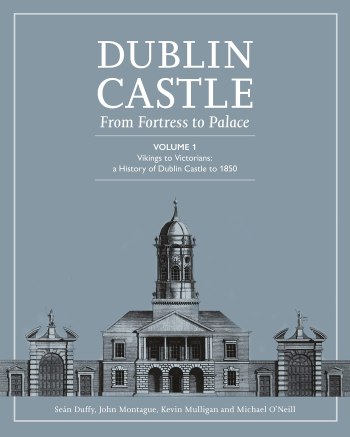 This is the first of a three-volume series dedicated to Dublin Castle and the archaeological excavations carried out there. Volume 1 presents a history of Dublin Castle, covering the period from the first Viking settlement in the ninth century to 1850. The castle was the centre of English (and later British) royal government in Ireland from the 1170s until it was handed over to the Provisional Government of Ireland in 1922. A large early thirteenth-century castle, built on the orders of King John, stood on the site until it was gradually replaced between the 1680s and the 1770s by the present quadrangle of palatial buildings. The only intact portion of the medieval castle to survive this rebuilding is the large, circular south-east corner tower, known today as the Record Tower. It is the first substantial history of the castle to be published and is intended to provide a comprehensive historical background to the results of archaeological excavations undertaken between 1961 and 1987.
Conference | Rereading Constable
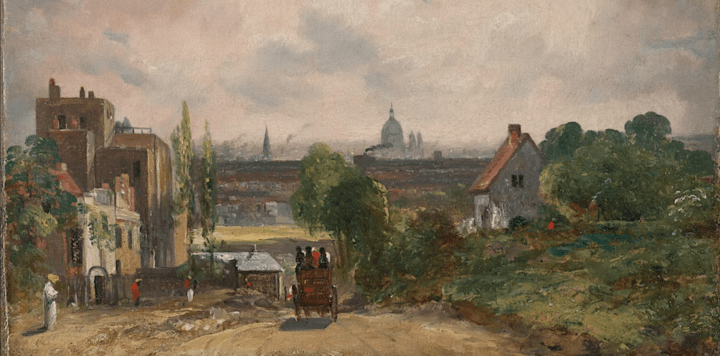
John Constable, Sir Richard Steele’s Cottage, Hampstead, 1831–32, oil on canvas, 21 × 29 cm
(New Haven: Yale Center for British Art, Paul Mellon Collection, B2001.2.25)
◊ ◊ ◊ ◊ ◊
From PMC:
Rereading Constable: Letters, Life, and Art
In-person and online, Paul Mellon Centre, London, 2 December 2022
Organized by Stephen Daniels and Mark Hallett
How do artists’ letters articulate professional and personal affiliations, embody networks, and forge allegiances? What role has letter writing played in artistic self-fashioning? In what ways do letters serve as a form of art-historical evidence, and help us understand works of art themselves?
R.B. Beckett’s multi-volume edition of Constable’s correspondence, published in six volumes by the Suffolk Records Society (1962–68), has long been recognised as an invaluable source for scholars working on the artist, and for all those interested in British art and culture in the late Georgian period. The published correspondence shows the painter to have been a shrewd, skilled writer, versed in a variety of literary, scientific, and biblical texts. His correspondents were, in turn, often highly articulate writers, including many family members, and many more with very different characters and backgrounds. Often utilised by art historians, the correspondence has more recently attracted the interest of scholars interested in the literary character and rhetorical conventions of nineteenth-century correspondence, who have subjected Constable’s letters to new kinds of critical scrutiny. This event will build on this important work, exploring Romantic art, culture, and society through the prism provided by the landscape painter’s correspondence.
The central structuring concept of this interdisciplinary conference is that speakers will focus on a single letter written by the artist, his correspondents, or other contemporary figures whose work, life, or letters can be understood in productive relation to Constable himself. These individual letters will be used to open up new questions and arguments about Constable’s life, practice, and identity as a painter, and about the wider artistic, literary, religious, and political cultures of his era.
Rereading Constable: Letters, Life, and Art has been organised as part of the PMC’s Generation Landscape research project. The conference is being convened by Stephen Daniels and Mark Hallett. Book tickets here.
We are offering up to five bursaries to support individuals who may not otherwise be able to attend the conference. Bursaries will cover the ticket price, travel, and some expenses, including childcare. If you would like to be considered for a bursary please email events@paul-mellon-centre.ac.uk with Rereading Constable Bursary in the subject field, outlining your request for a supported place by 10am, Friday, 4 November 2022.
P R O G R A M M E
9.30 Introduction by Mark Hallett (Paul Mellon Centre) and Stephen Daniels (University of Nottingham)
10.00 Session 1 | Chair: Stephen Daniels
• Alexandra Harris (University of Birmingham), New Friends, New Scenes: Constable in the Arun Valley
• Amy Concannon (University of York and Tate Britain), Strengthening Ties and Gaining Esteem: Constable Writes to Wordsworth, 15 June 1836
11.00 Tea and Coffee Break
11.30 Session 2 | Chair: Martin Postle (Paul Mellon Centre)
• Emma Roodhouse (Art Curator and Researcher), An Evening’s Amusement: Portraits, Writing, and Other Oddments from the Mason Family Album
• Sarah Cove (The Constable Research Project), A Regency ‘Nip-and-Tuck’: Constable’s Treslove Portraits Rediscovered
12.30 Lunch (provided by PMC)
Constable material available to view in the Public Study Room
1.30 Session 3 | Chair: Mark Hallett
• Morna O’Neill (Wake Forest University), John Constable, David Lucas, and Artistic Identity
• Katharine Martin (V&A and the University of Sussex), Translations and Fraught Relations: English Landscape and the Language of Collaboration
2.30 Break
2.45 Session 4 | Chair: Sarah Victoria Turner (Paul Mellon Centre)
• Gillian Forrester (Independent Scholar), ‘Solemnity, Not Gaiety’: Language and the Production of Meaning in Constable’s English Landscape Scenery
• Elenor Ling (The Fitzwilliam Museum), The ‘Definition of our Book’: John Constable, David Lucas, and their English Landscape
3.45 Tea and Coffee Break
4.15 Session 5 | Chair: Sria Chatterjee (Paul Mellon Centre)
• Rhian Addison McCreanor (University of York and Tate Britain), Repairing the House with a Thorough Painting: Reimagining 63 Charlotte Street
• Nicholas Robbins (University College London), The Life Academy and the Origins of Landscape
5.15 Panel Discussion
Stephen Daniels (University of Nottingham), Martin Myrone (Paul Mellon Centre), Trev Broughton (University of York), and Timothy Wilcox (Independent Scholar)
5.55 Closing Remarks by Mark Hallett
6.00 Drinks Reception
Exhibition | Maria Hadfield Cosway
Now on view at the Fondazione Maria Cosway in Lodi, in the nineteenth-century rooms of the Collegio delle Grazie, the girls’ school that Cosway founded in 1812 (with additional information available here) . . .
Maria Hadfield Cosway
Fondazione Maria Cosway, Lodi, 23 September — 27 November 2022
Curated by Monja Faraoni and Laura Facchin with Massimiliano Ferrario and Maria Cristina Loi
 Oltre cinquanta opere tra dipinti, lettere, spartititi musicali e sculture che ripercorrono la vita di Maria Hadfield Cosway (1760–1838) sono esposti a Lodi nella mostra a lei dedicata visitabile fino al 27 novembre.
Il visitatore sarà accompagnato nel percorso da pannelli esplicativi e didascalie che mettono in luce le fasi essenziali della biografia dell’artista e filantropa, nonché i personaggi e gli eventi della “Grande Storia” che segnarono le diverse fasi della sua vita. L’artista e donna di cultura è molto nota sia a Londra che negli Stati Uniti d’America per la sua amicizia con Thomas Jefferson, terzo Presidente USA. Un periodo della sua vita lo trascorse anche a Lodi, dove morì nel 1838.
La sua profonda convinzione nell’importanza dell’educazione per i giovani portò Maria Cosway ad aprire proprio a Lodi, nella sede dell’ex convento dei padri Minimi, il collegio della Beata Vergine Maria delle Grazie, destinato alle bambine dai 6 ai 12 anni, che ospiterà anche Vittoria Manzoni.
La mostra è stata organizzata dalla Fondazione Maria Cosway e vede la collaborazione di diverse realtà locali tra cui due istituti lodigiani, il liceo artistico Callisto Piazza e la Fondazione Luigi Clerici. Studenti ed insegnanti sono stati coinvolti nella creazione del catalogo e dell’allestimento delle diverse tappe dell’esposizione, visitabile presso la sede della Fondazione di via Paolo Gorini 10.
Monja Faraoni, Laura Facchin, Massimiliano Ferrario, and Maria Cristina Loi, eds., Maria Hadfield Cosway (Lodi: Fondazione Maria Cosway, 2022), 444 pages, ISBN: 979-1280950208.
S O M M A R I O
Presentazioni istituizionali
Maria Cosway tra Firenze, Londra, Parigi e Lodi: Le Ragioni della Mostra
• L’educazione in età napoleonica — Mario Riberi
• Maria Cosway in London, 1780–1790 and 1794–1801 — Stephen Lloyd
• ‘I am susceptible and everything that surrounds me has great power to magnetise me’: Maria Cosway e l’ambiente romantico — Massimiliano Ferrario
• Maria Cosway et l’ambiente artistico-letterario femminile fra la fine dell’Antico Regime e la Restaurazione — Laura Facchin
• Maria Cosway, Leonardo e Giuseppe Bossi: fra teorie artistiche e appunti figurativi — Rosalba Antonelli
• La musica nella vita e nel progetto educativo di Maria Cosway — Patrizia Fiorio
• Una storia ancora da raccontare: la biblioteca della Fondazione Maria Cosway — Francesco Laghezza e Beatrice Porchera
• La moda nella Parigi et nella Milano di Maria Cosway — Silvia Mira
• La vita di Blevio — Laura Facchin e Massimiliano Ferrario
• Un titolo nobitare per Maria Cosway — Luca Marcarini
• Gaetano Manfredini: ‘volente scultore pei quale l’ingiusta sorte non ha benigni sorris!’ e l’eterno volto di Maria Cosway — Beatrice Bolandrini
Catalogolo delle opere
Maria Cosway et gli Stati Uniti, a cura di Maria Cristina Loi
• ‘But that immense sea, makes it a great distance’: note sui carteggio Maria Cosway–Thomas Jefferson — Maria Cristina Loi
• Thomas Jefferson and Maria Cosway in Paris: art and affection — Susan R. Stein
Catalogo delle opere
L’allestimento della mostra Maria Hadfield Cosway — Elena Amoriello, Luca Armigero, Annalisa Aversa, Maria Teresa Carossa, Chiara Lupi, Susanna Marinoni e Angela Mento
Bibliografia
Indice dei nomi
Credit fotografici
Exhibition | Canaletto: A Venetian’s View

Canaletto, View of the Grand Canal Looking East from Palazzo Bembo to Palazzo Vendramin-Calergi, mid 1730s, oil on canvas, 47 × 80 cm
(Woburn Abbey Collection, Bedfordshire)
◊ ◊ ◊ ◊ ◊
Now on view at Worcester City Art Gallery:
Canaletto: A Venetian’s View
Worcester City Art Gallery and Museum, 1 October 2022 — 7 January 2023
Curated by Deborah Fox
Celebrating the work of Canaletto, particularly paintings commissioned by the 4th Duke of Bedford in the 1730s, the exhibition features stunning paintings from the Woburn Abbey Collection alongside artworks from Worcester’s Fine Art Collection and loans from Birmingham Museums, Tate, and Compton Verney.
Born in Venice, Giovanni Antonio Canal (1697–1768), commonly known as Canaletto, was an important member of the 18th-century Venetian school. He became very popular with English collectors and visited England repeatedly between 1746 and 1756. Canaletto revolutionised the use of colour, ground, and canvas and pioneered the technique of painting from life, sitting in front of the subject outdoors as opposed to his contemporaries who completed paintings in the studio. Canaletto: A Venetian’s View explores the painter’s work and the impact he had on the generations of artists who followed him.
It is extremely rare for this hugely significant collection to leave Woburn Abbey, and this is the first time the paintings have been united with other examples of Canaletto’s work from Birmingham Museums and Compton Verney. The paintings on display comprise the largest set of paintings Canaletto produced for a single patron, John Russell, the 4th Duke of Bedford, who commissioned the works in the 1730s. They are considered the absolute best of Canaletto’s paintings of Venice. The exhibition is being described as the most ambitious in the history of Worcester City Art Gallery & Museum.

William Marlow, View on the Thames, ca. 1775, oil on canvas, 49 × 79 cm (London: Tate, T00930).
Deborah Fox, Senior Curator at the Art Gallery and Museum commented: “We are committed to bringing great art and artists to the region and through bringing Canaletto to Worcester we are offering a once in a generation opportunity to see these incredible artworks ‘on your doorstep’ as well as creating an opportunity to showcase and reinterpret important works in our own collection. We see this exhibition as a wonderful opportunity not only to bring world class art to the gallery, but also to examine its influence on some of Worcester’s best-loved artworks.”
The twenty paintings of Venice on loan from the Woburn Abbey Collection are accompanied by three other works by Canaletto—two views of Warwick Castle on loan from Birmingham Museums and a view of Vauxhall Gardens that normally hangs at Compton Verney—as well as by a wonderful work from Tate painted by William Marlow considered to be Canaletto’s natural heir. Canaletto’s influence is further explored through Worcester City Art Gallery and Museum’s own collection including a beautiful view of Worcester Cathedral by Marlow and works by Paul Sandby, Samuel Prout, and Samuel Rowlandson—all of whom were heavily influenced by Canaletto. Worcester’s most famous artist, B.W. Leader, is represented in the exhibition through the inclusion of one of his most famous works, February Fill Dyke (1881), also on loan from Birmingham Museums.
◊ ◊ ◊ ◊ ◊
Matthew Hirst, Canaletto in Context
Worcester City Art Gallery and Museum, Thursday, 13 October 2022, 6pm
Matthew Hirst, Curator at Woburn Abbey, will discuss the fascinating paintings by Canaletto currently on display at Worcester City Art Gallery and Museum, exploring their context in wider fine and decorative arts in the collections at Woburn Abbey in Bedfordshire. Tickets include exhibition entry, a drink, and the talk.
Lecture | David Cannadine on How to Study Country Houses Now
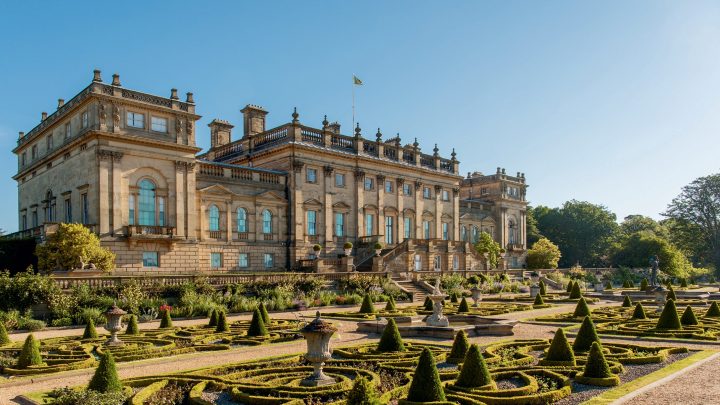
Harewood House, West Yorkshire, designed by John Carr and Robert Adam, and built between 1759 and 1771.
◊ ◊ ◊ ◊ ◊
From The Attingham Trust:
Sir David Cannadine, How Do We Study the Country House Now?
In-person (and recorded), Sotheby’s, London, Tuesday, 8 November 2022
The Attingham Trust has been championing the study of historic houses and their collections for seven decades, aiming to broaden the understanding of the artistic, social and cultural legacies they offer. In this lecture, David Cannadine will look afresh at these buildings and tease out some of the many complex and sometimes challenging narratives to which they bear witness, illustrating how the study of the country house has evolved and how much still remains for us to learn.
5.45pm Drinks on arrival
6.30pm Lecture
Tickets for both in-person attendance and to receive the recording (available for a limited time) can be purchased here. For queries about this event, please contact rebecca.parker@attinghamtrust.org.
Professor Sir David Cannadine is Dodge Professor of History at Princeton University and a visiting professor of history at Oxford University. He has written extensively on the economic, social, political, and cultural history of modern Britain and its empire, on collecting and philanthropy, and on the history of history. In 2018 he co-edited, with Jeremy Musson, The Country House: Past, Present, and Future, exploring how the idea of the country house has changed over the last forty years. Previously Chair of the Trustees at the National Portrait Gallery, President of the British Academy, and on the board of the Royal Oak Foundation, he is a fellow of the Royal Historical Society, the Royal Society for Literature, the Society of Antiquaries, the Historical Association, and the British Academy. He is a patron of The Attingham Trust.










 Enfilade
leave a comment