Call for Papers | Art beyond Placeness

Attributed to François Bunel the Younger, The Confiscation of the Contents of an Art Dealer’s Gallery, 1590, oil on panel, 28 × 47 cm
(The Hague: Mauritshuis, 875)
◊ ◊ ◊ ◊ ◊
From ArtHist.net:
Art beyond Placeness: Narratives of Movement in the Early Modern Period
Norwegian Institute in Rome, 31 May — 1 June 2023
Proposals due by 1 November 2022
In recent years, the new importance attributed to the biographies of objects and their global circulation has drawn new attention to the phenomenon of their physical transportation—in other words, to the complex set and modes of actions required to move an object from the point of creation to its final destination. Inspired by the growing body of scholarship, this workshop aims to develop new instruments to perceive, measure, and interpret the movement of things, by looking specifically at the way physical transportation has been described, inspected, and dissected in early modern sources. The materials under scrutiny here may take different forms, from diaries, letters, and other prosopographical accounts recording movement in its making; to archival materials that track unusual patterns of transportation and physical delivery; to letters, treatises, and even guides or handbooks reporting ex post facto descriptions of mobility. This workshop intends to probe this vast collection of sources in order to tease out how mobility was described and conceptualized, surveyed, and explored in the long early modern period (approximately from 1350 to 1800), before the rise of modern logistics. In short, it addresses from all angles the narrative potential of mobility: how describing movement ‘makes a good story’.
Potential topics include, but are not limited to
• Episodes of transportation recorded in archival materials, with special regard to the logistical demands and expenses encountered by artists in moving objects from the artistic workshop to the final destination
• Diaries and letters of artists and patrons describing physical transportation of objects
• Written sources that emphasize the miraculous, divine components of transportation
• 18th-century popularization of movement in the so-called ‘circulation narrative’ or ‘IT narratives’, which tell the story of inanimate objects exchanged and moved from place to place
• Treatises and technical accounts describing the logistical operations of transportation
The workshop will take place on May 31st and June 1st 2023 at the Norwegian Institute in Rome. ECRs are especially invited to present their research for discussion. Please submit an abstract of no more than 300 words, along with your CV to mattia.biffis@roma.uio.no by 1 November 2022. Travel expenses and participation will be covered.
Call for Papers | Rococo across Borders: Designers and Makers
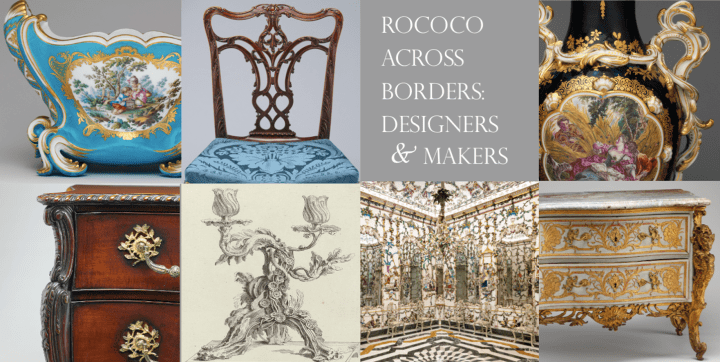
From the Call for Papers:
Rococo across Borders: Designers and Makers
London, venue TBC, 24–25 March 2023
Organized by the Furniture History Society and the French Porcelain Society
Proposals due by 4 November 2022
We are delighted to announce that the Furniture History Society and the French Porcelain Society will be joining forces in Spring 2023 to hold a two-day symposium on the theme of Rococo across Borders: Designers and Makers. Using the Versailles exhibition Louis XV, Passion d’un roi / Passions of a King as our starting point, the symposium will broaden out to discuss the geographical spread of the style, the interaction between designers and makers, and the significant roles played by print culture and the evolving art market in disseminating the Rococo across Europe.
This symposium calls for papers that go beyond the traditional geographical, chronological, and conceptual fields of Rococo design to explore how it evolved throughout the eighteenth and nineteenth centuries. In particular, it aims to open up wider discussions about the historical contexts for Rococo ceramics and furniture, the place of the ‘Rococo’ in museums and art historical scholarship today, and its impact on contemporary makers. We invite submissions for 30-minute conference papers. Topics for consideration may include, but are not limited to the following:
• ‘Beyond Rococo’: ceramics, furniture, and decorative schemes outside France
• Networks: makers, designers, and consumers across borders
• Case studies of individual interiors or objects
• Changing reception: scholastic and the art market
Please submit an abstract of 250–300 words and a short biography to diana_davis@hotmail.co.uk and events@furniturehistorysociety.org by Friday, 4 November 2022. Please email events@furniturehistorysociety.org with any queries.
Organizing Committee
Diana Davis, Patricia Ferguson, Beatrice Goddard, Caroline McCaffrey-Howarth, David Oakey, and Adriana Turpin
◊ ◊ ◊ ◊ ◊
Picture Credits: Top left to bottom right, Flower vase (cuvette Mahon), probably designed by Jean-Claude Duplessis, Sèvres Manufactory, soft-paste porcelain, ca. 1757–60 (Metropolitan Museum of Art, 1974.356.592); Side chair, attributed to Benjamin Randolph, Philadelphia, mahogany, ca. 1769 (Metropolitan Museum of Art, 1974.325); Vase, Chelsea factory, soft-paste porcelain, ca. 1762 (Metropolitan Museum of Art, 1970.313.2a); Commode attributed to William Vile and John Cobb, mahogany, pine, gilt-bronze, ca. 1760 (Metropolitan Museum of Art, 64.101.1142); Girandolle à branche de porcelaine garnie d’Or, from Oeuvres de Juste-Aurèle Meissonnier, engraved by Gabriel Huquier, French, 1738–49 (Cooper-Hewitt, Smithsonian Design Museum, 1921-6-212-29-b); Porcelain Room designed by Giuseppe Gricci, Real Fábrica de Porcelana del Buen Retiro, installed in the Palace of Aranjuez, 1763–65; Commode designed by Jean-François Cuvilliés, the Elder, pine partially painted and gilded, ca. 1735–40 (Metropolitan Museum of Art, 28.154).
Exhibition | Louis XV: Passions of a King
Opening this month at Versailles:
Louis XV: Passions of a King / Passion d’un roi
Château de Versailles, 18 October 2022 — 19 February 2023
Curated by Yves Carlier and Hélène Delalex
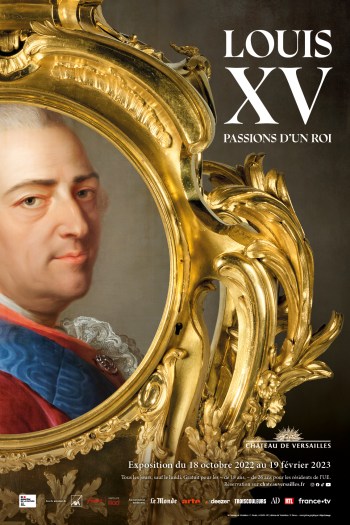 For the 300th anniversary of King Louis XV’s coronation, Palace of Versailles is paying homage with an exceptional exhibition. Through more than 400 works, visitors can discover Louis XV (1710–1774) beyond his function as monarch, learning more about his passions, his family life, and his influence on the arts of his time.
Born in 1710 in Versailles, Louis XV was the son of the Duke of Burgundy and Marie-Adélaïde of Savoy, as well as the great-grandson of Louis XIV. Heir apparent after the death of his father, he became king at the tender age of five after the death of the Sun King on 1 September 1715.
A Private Man
The exhibition opens with an introduction to Louis XV as a man, looking back on his relations with his family and his entourage. His childhood, marked by grief, contrasts with his later life with his large family, where he delighted in his role as a father. Women also occupied a central place in the King’s life, such as his wife Marie Leszczynska, not to mention his many mistresses (some of whom made their mark on the period). The exhibition also explores Louis XV’s discreet, melancholy nature, a man who preferred the intimacy of his private apartments. There, he received his inner circle, who enjoyed his every confidence.
The King’s Tastes and Passions
The tour continues with the Louis XV’s passion for sciences, botany, and hunting, as well as his love of buildings, and the influence of all these fields on his reign. His curiosity and insatiable thirst for knowledge drove him to fund long sea voyages, transform Trianon into a garden full of botanical experiments, commission cutting-edge scientific tools, and order the mapping of the kingdom.
Louis XV and the Arts of His Time
The final section of the exhibition shows how the arts flourished during the reign of the ‘Well-Beloved’ (Bien-Aimé). Multiple masterpieces of rococo art introduced the public to the foundations of this style, which, free of symmetry and formal rules, shook up artistic creation in the 18th century.
Meet the Favourites
For this exhibition, the apartment of Madame de Pompadour, as well as that of Madame du Barry, freshly restored after eighteen months of work, will be opened to the public for guided tours, offering a unique experience at the heart of Louis XV’s private Versailles.
The exhibition is curated by Yves Carlier, Chief Heritage Curator at the Musée National des Châteaux de Versailles et de Trianon; and Hélène Delalex, Heritage Curator at the Musée National des Châteaux de Versailles et de Trianon.
Yves Carlier and Hélène Delalex, eds., Louis XV: Passion d’un roi (Château de Versailles / In Fine éditions d’art, 2022), 496 pages, ISBN: 978-2382030769, 49€.
S O M M A I R E
Introduction
Louis XV
L’Homme Privé
Une enfance de cimetière. Louis XV et la mort
Louis XV aux Tuileries, 1715–1722
1722, le retour à Versailles
Le sacre de Louis XV
Le mariage de Louis XV
Louis XV et ses enfants
Amis et amies du roi : les intimes
Les sœurs Mailly-Nesle ou la guerre des Nattier
Madame de Pompadour : l’amie nécessaire
Jeanne du Barry et le roi : une conspiration du silence
Les soupers des cabinets
Louis XV et la religion
Le Parc aux Cerfs : mythe révolutionnaire ou réalité historique ?
L’attentat de Damiens
Gôuts et Passions du Roi
L’esprit des livres : les bibliothèques personnelles de Louis XV
Louis XV, les livres et la reliure : la naissance de la bibliophilie moderne ?
Les expériences d’électricité sous le règne de Louis XV : un succès foudroyant
Le cabinet de Physique et d’Optique de Louis XV au château de La Muette 222
Louis XV « dans son particulier » : les tours du roi
Louis XV et la chasse
Louis XV et le théâtre
Louis XV et l’architecture
Les Arts sous le Règne de Louis XV
Rocaille : la forme et la force
Pour un art de cour ? Louis XV face aux arts de son temps
Boîtes et tabatières à la cour de France sous Louis XV
La Saxe en or moulu. Le goût pour les porcelaines de Meissen montées à la cour de Louis XV
L’importance des Gobelins et de la Savonnerie
Louis XV et la manufacture de porcelaine de Vincennes-Sèvres
Louis XV : une peinture pour le quotidien
Louis XV et la sculpture
La marquise de Pompadour et les arts : une « Apologie du luxe »
Madame Du Barry à la cour : l’affirmation d’un goût
Le Roi se meurt
« Qui nous délivrera de Louis XV et de son perpétuel recommencement ? » Le retour des lignes rocaille dans les arts décoratifs français du XIXe siècle
Bibliographie
New Book | La Découverte de l’île Frivole: A Bilingual Edition
From MHRA, with the table of contents available via JStor:
Jean-Alexandre Perras, ed., La Découverte de l’île Frivole by Gabriel-François Coyer, A Bilingual Edition (Cambridge: Modern Humanities Research Association, 2022), 128 pages, ISBN: 978-1781888872, £15 / $20.
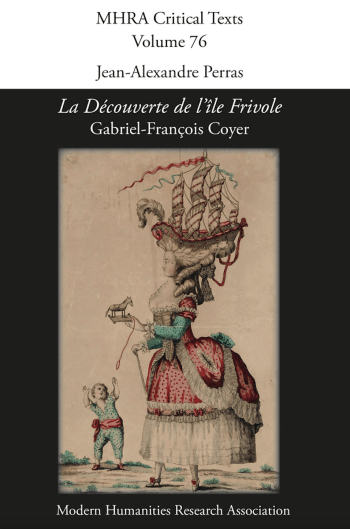 La Découverte de l’Ile Frivole (1751) is presented as a supplement to George Anson’s Voyage Round the World, and recounts the adventures of the English admiral and his crew on a strange island whose inhabitants, the Frivolians, are devoted to fashion, hairstyles, novels, and fancy desserts. This tale is at once both playful and cynical, and its biting irony spares neither the reputation of France nor that of England. It resonates with the most critical attacks by Jean-Jacques Rousseau against luxury and refinement, or those of Voltaire against his compatriots. This volume provides the first bilingual critical edition of a text that, in its time, caused a stir both in France and in England.
Jean-Alexandre Perras is Marie Skłodowska-Curie research fellow at the European University Institute in Florence.
C O N T E N T S
Présentation
1 Gabriel-François Coyer, moraliste et économiste
2 Présentation du texte
La Découverte de l’île Frivole
Presentation
1 Gabriel-François Coyer, moralist and economist
2 About the text
A Supplement to Lord Anson’s Voyage Round the World. Containing a Discovery and Description of the Island of Frivola
Bibliography
Call for Applications | Printmaking for Curators and Scholars
From ArtHist.net:
Printmaking for Curators and Scholars
Highpoint Center for Printmaking, Minneapolis Institute of Art, 24–28 July 2023
Proposals due by 1 November 2022
The Association of Print Scholars (APS) is currently accepting applications for the second of its two-part series of intensive hands-on printmaking workshops for emerging scholars and curators, which is generously funded by The Getty Foundation’s initiative, The Paper Project: Prints and Drawings Curatorship in the 21st Century. This five-day workshop will be dedicated to intaglio techniques (etching, drypoint, engraving) and will be hosted in Minneapolis, MN, in partnership with the Highpoint Center for Printmaking and the Minneapolis Institute of Art.
A thorough comprehension of various printmaking methods is critical to producing scholarship and exhibitions on these media. Yet, many early-career print curators and scholars lack such practical experience as they embark on their careers due to competing professional and academic demands that make it difficult to enroll in a semester-long printmaking course. With the technical intricacies of printmaking difficult to grasp through text alone, an intensive workshop provides an invaluable technical and material knowledge of printmaking that will not only contribute to, but also enhance, a print curator and scholar’s understanding of a work’s content, intention, and aesthetic. The aim of this workshop is to further prepare participants to better communicate these complex techniques in an accessible language to a general museum audience and contribute new personal insight to the field.
Ten early-career curators and scholars will be selected to participate in the workshop, which will be held between July 24 and July 28, 2023. The intensive program will include a visit to MIA’s Herschel V. Jones Print Study Room to examine a selection of intaglio prints from the museum’s collection. Participants will also engage in hands-on work in drypoint, engraving, and etching at the Highpoint Center studio as well as explore the Highpoint’s facilities, library, galleries, and print room. A day will be devoted to print identification, including a second visit to MIA’s Study Room to scrutinize variant intaglio techniques (aquatint, mezzotint, etc.). The workshop will conclude with Highpoint staff leading demonstrations of other intaglio techniques as informed by participant projects and a final seminar and reflection led by APS organizers. The workshop will be organized and led by current APS President, Dr. Elisa Germán, and APS Workshop Coordinator, Dr. Sarah Bane.
Applications to the workshop are open to candidates who have a graduate degree (or equivalent experience), but must be within 10 years of receiving their terminal degree. Preference will be given to early-career curatorial professionals (curators, curatorial or research assistants/associates, postdoctoral fellows), although advanced graduate students and independent scholars with a long-held demonstrated interest in printmaking and curatorial practice will also be considered. APS is committed to supporting the professional development of a diverse and inclusive community within the field of print scholarship and strongly encourages candidates from underrepresented groups to apply.
Travel, accommodation, and meal expenses will be covered.
To apply, please submit the following documents via an online application form that requires
• A brief statement (500 words max.) describing your research and how it would be enriched by a workshop on intaglio techniques
• A current CV or resume
• One letter of reference, sent directly to workshops@printscholars.org
Please note that for full consideration, all materials, including the reference letter, must be received by the workshop organizers no later than 1 November 2022. Successful applicants will be notified by 1 December 2022.
The Association of Print Scholars (APS) is a non-profit organization that encourages innovative and interdisciplinary approaches to the history and practice of printmaking. It aims to promote the dissemination of print scholarship and to facilitate dialogue and community among its members. It sponsors collaboration and publication grants, as well as article prizes for emerging scholars, and hosts public programs on printmaking throughout the year. APS hopes to bring together the diverse print community of curators, collectors, academics, artists, conservators, critics, independent scholars, dealers, and graduate students. Membership is open to anyone.
The Getty Foundation fulfills the philanthropic mission of the Getty Trust by supporting individuals and institutions committed to advancing the greater understanding and preservation of the visual arts in Los Angeles and throughout the world. Through strategic grants initiatives, it strengthens art history as a global discipline, promotes the interdisciplinary practice of conservation, increases access to museum and archival collections, and develops current and future leaders in the visual arts. The Getty Foundation carries out its work in collaboration with the other Getty Programs to ensure that they individually and collectively achieve maximum effect.
Online Lecture | Andrew Rudd on Print Philanthropy

Jonas Hanway, Thoughts on the Plan for a Magdalen-House for Repentant Prostitutes, second edition (London, 1759). The first edition was published anonymously in 1758.
◊ ◊ ◊ ◊ ◊
From Yale’s Lewis Walpole Library, in connection with the exhibition From ‘Knight Errant of the Distressed’: Horace Walpole and Philanthropy in Eighteenth-Century London:
Andrew Rudd | Print Philanthropy in the Age of Horace Walpole
Online, 28 October 2022, 12.00pm EST
Eighteenth-century England witnessed a remarkable flowering of philanthropic activity as society wrestled with problems such as poverty, disease, mental illness, vice, and suffering caused by war. Walpole boasted in 1760 of what he called “our noble national charity.” While many aspects of philanthropy remain similar today, this lecture will explore how the print culture of Walpole’s era was central in driving charitable behaviour, particularly in terms of creating philanthropic networks and framing relationships between donors and beneficiaries. The talk will showcase the sheer range of printed text and images—fundraising prospectuses, sermons, topographical views of hospitals, tickets to benefit concerts and dinners, and celebratory odes—mobilised in service of good causes during this period, as well as highlight examples of Walpole’s own support for, and portrayals of, philanthropic causes during his lifetime.
Andrew Rudd is Senior Lecturer in the English Department at the University of Exeter. He researches and teaches British literature of the eighteenth century and Romantic period. His monograph Sympathy and India in British Literature 1770–1830 (Palgrave Macmillan) was published in 2011, and he is currently writing a cultural history of charity in the eighteenth century. This builds on experience he acquired as Parliamentary Manager at the Charity Commission for England and Wales before joining Exeter in 2013. Dr. Rudd holds a PhD from the University of Cambridge, and he has studied at the University of Durham, Trinity College, Cambridge, and Yale University. He has held numerous fellowships—most recently at Yale’s Lewis Walpole Library and the School of Advanced Studies in English, University of Jadavpur. Since 2015, he has been a member of the Arts and Humanities Research Council’s Peer Review College.
HECAA Zoom Event | Transporting Culture
Transporting Culture
HECAA Zoom Event, Thursday, 20 October 2022
Please join us for our next HECAA Zoom Event, Transporting Culture. It’s open to HECAA members and non-members alike. Please register in advance here.
P R O G R A M M E
Welcome 12.00 (EST) / 17.00 (BST)
12.15 Panel One
Moderator: Lorne Darnell (Courtauld Institute)
• Practicalities of Bearing Diplomatic Gifts from Versailles to Isfahan in 1705 — Samantha Happe (Graduate Research Teaching Fellow and Postgraduate Student, University of Melbourne, and Research Officer, Australian National University)
• Crates, Boxes, and Cases: The Transport of Works of Sculpture and Silver between Rome and Lisbon in the 18th Century — Teresa Leonor M. Vale (Senior Assistant Professor School of Arts and Humanities and Researcher of the ARTIS-Institute of History of Art, University of Lisbon)
• Transporting America: The Politics of Import and Export in the New Indies Gobelins Tapestry Set — Carole Nataf (PhD Candidate, Courtauld Institute)
1.45 Break
2.00 Panel Two
Moderator: Harvey Shepherd (Courtauld Institute)
• ‘Fortuna favet Fortibus!’ Early Modern Art Insurance — Avigail Moss (Lecturer, American University of Paris)
• A Thumb on the Scale: Examining the Control of Art in Comanche Trade Networks — Carlos Littles (Johns Hopkins University, Alumni)
• ‘Truly Chinese’: Transporting Chinese Objects to Germany in the 19th Century — Emily Teo (Postdoctoral Researcher, Gotha Research Centre of the University of Erfurt)
Call for Papers | HECAA Emerging Scholar Showcase
HECAA Emerging Scholar Showcase
Online, Monday, 28 November 2022
Proposals due by 9 October 2022
The Historians of Eighteenth-Century Art and Architecture is pleased to invite Emerging Scholars studying the art, architecture, and visual culture of the long eighteenth century around the globe to participate in a virtual showcase once again. Our hope is to provide a platform for early career scholars to promote their own research, as well as a forum for networking and ongoing community building.
Each scholar will be given 3–5 minutes to present their work, followed by an open question and answer session. This year’s Emerging Scholars Showcase will be held on Monday, November 28 in the late afternoon/early evening. This shift is in response to the widespread preference for non-weekend events expressed by members who responded to the survey. As last year, an additional Spring showcase may be added if there is sufficient interest, so we encourage you to apply even if you are unable to present on November 28.
To apply, please fill out this form. Applications are due by Sunday, 9 October 2022 at midnight (EST). Please direct any questions to Daniella Berman: daniella.berman@nyu.edu.
Emerging Scholars do not need to be current HECAA members and may be current graduate students, and those who have received their degrees in the past five years; so please circulate this call to your networks as appropriate. If you are interested in volunteering (to help with tech-issues and help moderate the Q&A) for the Emerging Scholars Showcase, please reach out to Daniella.
Daniella Berman
HECAA Board Member At-Large; Graduate Student & Emerging Scholar Representative
Exhibition | Elegance, Drama, and Nature

Marie-Gabrielle Capet, Studio Scene (Adélaïde Labille-Guiard Portrays Joseph-Marie Vien), exhibited at the Salon of 1808
(Munich: Bayerische Staatsgemäldesammlungen)
◊ ◊ ◊ ◊ ◊
From the Alte Pinakothek:
Elegance, Drama, and Nature / Eleganz, Schauspiel und Natur
Alte Pinakothek, Munich, 7 May — 23 October 2022
The presentation of 18th-century painting at the Alte Pinakothek consists above all of pictures by French and Venetian artists such as François Boucher, Canaletto, Francesco Guardi, and Giovanni Battista Tiepolo whose work was already much in demand throughout Europe during the artists’ lifetime. Paintings by Nicolas Lancret and Jean-Baptiste Pater, meanwhile, testify to the influence of Antoine Watteau. The extraordinary wealth and diversity of 18th-century European art, however, becomes clear only when we look beyond France and Venice. In the current collection presentation, rarely shown works by German and Dutch artists enter into an intriguing dialogue with paintings from France and Italy.
The current exhibition focuses on three themes that offer insights into the conditions governing artistic production and the evolving discourse and cultural climate of the Age of Enlightenment:
• Portraiture, especially self-portraits
• Festivities and themes of love
• City and landscape views
The sustained engagement with the idea of humankind’s rational and emotional competence, personal freedoms and the relationship to society, a new awareness of history, the rediscovery of the natural world, and exploration of the laws of nature—all these aspects shaped the 18th century and are reflected in the paintings shown here. As part of a collection accumulated over a long period of time, they vividly convey the parallelism of the numerous, sometimes contradictory approaches that characterised European 18th-century art.
More information about each section of the exhibition is available here»
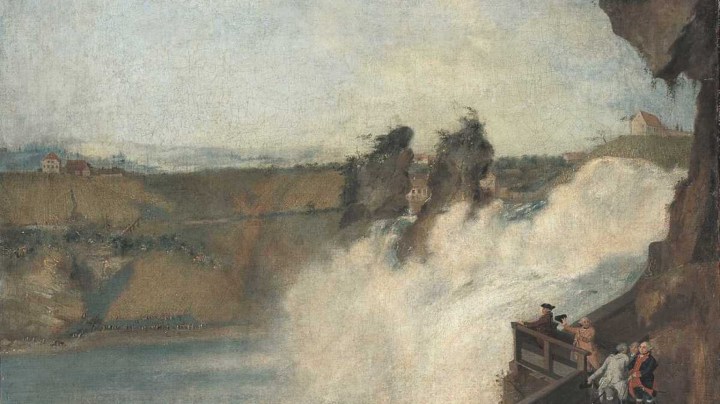
Philipp Hieronymus Brinckmann, The Rhine Falls near Schaffhausen, with Elector Karl Theodor of the Palatinate and Entourage, ca. 1759
(Munich: Bayerische Staatsgemäldesammlungen)
Exhibition | Vive le Pastel!
On view for a few more weeks at the Alte Pinakothek:
Vive le Pastel! Pastel Painting from Vivien to La Tour / Pastellmalerei von Vivien bis La Tour
Alte Pinakothek, Munich, 7 May — 23 October 2022
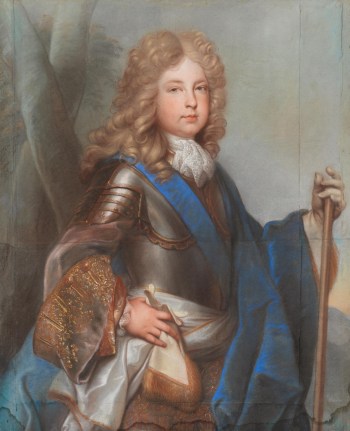
Joseph Vivien, Portrait of Charles, Duke of Berry (1686–1714), 1700, pastel on paper, 100 × 81 cm (Staatsgalerie im Neuen Schloss Schleißheim).
Often seen in art galleries or palaces, in magnificent ornamental frames and behind glass, their powdery surface making them seem as delicate as they are exquisite: pastels. They enjoyed considerable popularity in the 18th century when many works were created, especially in France. The colours are applied dry, using pastel sticks and covering the whole surface. The pastel painting technique was frequently used for lively, sensitively composed portraits in particular. But what are the reasons for the technique’s blossoming at the time? What advantages did pastels have over oil paintings? Who had their portraits painted in pastel? And how exactly were pastels created? These questions are explored in this special exhibition presented by the Bayerische Staatsgemäldesammlungen at the Alte Pinakothek.
The focus is on the two collections’ own holdings, in which such important names as Joseph Vivien, Maurice Quentin de La Tour, Rosalba Carriera, and Jean-Étienne Liotard are represented. For the first time pastel paintings from the Alte Pinakothek are shown together with those from the state gallery in Neues Schloss Schleißheim. In addition, some rarely displayed works from the depot by anonymous artists, as well as a few selected loans are also exhibited. This unique combination of works makes it possible to compare artists and their approaches and invites visitors to discover the variety of different effects realised in these works.
 There are two further reasons for this exhibition. Generous support provided by the Corona Fund of the Ernst von Siemens Kunststiftung has made it possible for urgently needed conservation and restoration work to be carried out on the Schleißheim pastels by a specialist. As a result, and due to examinations being carried out as part of a current research project on the French paintings, the works are temporarily in Munich. Before their return to the gallery in Schleißheim the opportunity is being taken to exhibit them in the Alte Pinakothek and, as such, within a larger context. At the same time, the presentation also celebrates a new acquisition—Portrait of Jean-Baptiste Philippe by Maurice Quentin de La Tour—donated by Mr Fritz Lehnhoff as a loan from the Museumsstiftung zur Förderung der Staatlichen Bayerischen Museen, that entered the collection in 2021.
A guide to the collection, covering the complete holdings of pastels from the late 17th and 18th centuries in the Bayerische Staatsgemäldesammlungen, accompanies the exhibition.
Elisabeth Hipp, ed., with an introduction by Bernhard Maaz and contributions by Bernd Ebert, Ulrike Fischer, Elisabeth Hipp, Xavier Salmon, and Herbert Rott, Pastellmalerei vor 1800 in den Bayerischen Staatsgemäldesammlungen (Berlin: Deutscher Kunstverlag, 2022), 136 pages, ISBN: 978-3422989009, 15€.










 Enfilade
leave a comment