New Book | Teaching the Eighteenth Century Now
From De Gruyter:
Kate Parker and Miriam Wallace, eds., Teaching the Eighteenth Century Now: Pedagogy as Ethical Engagement (Lewisburg, PA: Bucknell University Press, 2024), 196 pages, ISBN: 978-1684485048 (hardcover) / ISBN: 978-1684485031 (paperback), $38.
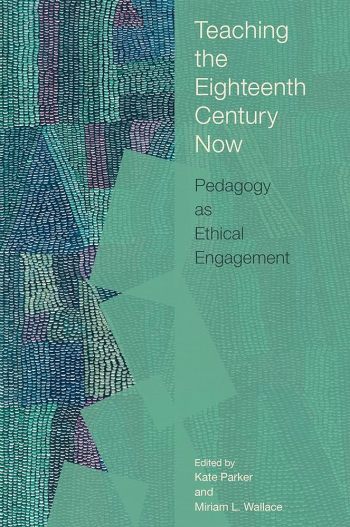 In this timely collection, teacher-scholars of ‘the long eighteenth century’, a Eurocentric time frame from about 1680 to 1832, consider what teaching means in this historical moment: one of attacks on education, a global contagion, and a reckoning with centuries of trauma experienced by Black, Indigenous, and immigrant peoples. Taking up this challenge, each essay highlights the intellectual labor of the classroom, linking textual and cultural materials that fascinate us as researchers with pedagogical approaches that engage contemporary students. Some essays offer practical models for teaching through editing, sensory experience, dialogue, or collaborative projects. Others reframe familiar texts and topics through contemporary approaches, such as the health humanities, disability studies, and decolonial teaching. Throughout, authors reflect on what it is that we do when we teach—how our pedagogies can be more meaningful, more impactful, and more relevant.
Kate Parker, professor and chair of English, teaches pre-1800 English and European cultural studies and feminism and sexuality studies at the University of Wisconsin–La Crosse, a regional comprehensive university in the University of Wisconsin System.
Miriam L. Wallace, formerly professor of English and gender studies at New College of Florida, is dean of the College of Liberal Arts and Social Sciences at the University of Illinois-Springfield.
c o n t e n t s
Introduction: Situating Teaching in/about/around the Eighteenth Century — Kate Parker and Miriam L. Wallace
1 Creating Teaching Editions, Teaching through Editing — Tiffany Potter
2 Performing against History: Teaching Behn’s The Widdow Ranter — Ziona Kocher
3 Let’s Talk about (Early Modern) Sex . . . Online — Kate Parker
4 The Chocolate Project: Recontextualizing Eighteenth-Century Studies in a Time of Downsizing — Teri Doerksen
5 Enlightened Exchanges: An Interdisciplinary Approach to Teaching the Scottish Enlightenment — Christine D. Myers
6 Design, Pedagogy, and Pandemic Teaching Tools in an Interdisciplinary History of Science Course — Diana Epelbaum
7 It Was Sickness and Poverty Together: Teaching Inequality and Health Humanities in Austen’s Emma — Matthew L. Reznicek
8 Teaching Hurts — Travis Chi Wing Lau
9 Anticolonial Approaches to Teaching Colonial Art Histories — Emily C. Casey
Coda: Teaching (in) the Eighteenth(-)Century Now — Eugenia Zuroski
Acknowledgments
Bibliography
Notes on Contributors
Index
New Book | Pen, Print, and Communication in the Eighteenth Century
Newly available in paperback from Liverpool UP:
Caroline Archer-Parré and Malcolm Dick, eds., Pen, Print, and Communication in the Eighteenth Century (Liverpool: Liverpool University Press, 2020), 256 pages, ISBN: 978-1789622300 (hardcover), $150 / ISBN: 978-1802078800 (paperback), $50.
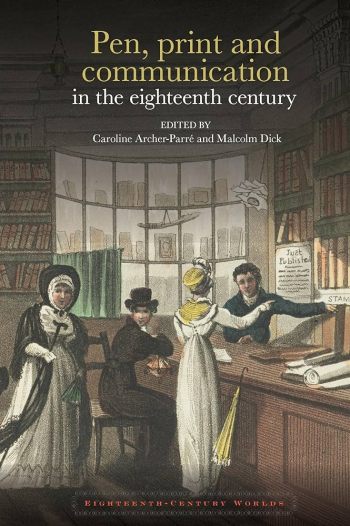 During the eighteenth century there was a growing interest in recording, listing, and documenting the world, whether for personal interest and private consumption, or general record and the greater good. Such documentation was done through both the written and printed word. Each genre had its own material conventions and spawned industries which supported these practices. This volume considers writing and printing in parallel: it highlights the intersections between the two methods of communication; discusses the medium and materiality of the message; considers how writing and printing were deployed in the construction of personal and cultural identities; and explores the different dimensions surrounding the production, distribution, and consumption of private and public letters, words, and texts during the eighteenth-century. In combination the chapters in this volume consider how the processes of both writing and printing contributed to the creation of cultural identity and taste, assisted in the spread of knowledge and furthered personal, political, economic, social, and cultural change in Britain and the wider-world. This volume provides an original narrative on the nature of communication and brings a fresh perspective on printing history, print culture, and the literate society of the Enlightenment.
Caroline Archer-Parré is Professor of Typography at Birmingham City University, Director of the Centre for Printing History & Culture, and Chairman of the Baskerville Society. She is the author of The Kynoch Press, 1876–1982: The Anatomy of a Printing House (British Library, 2000); Paris Underground (MBP, 2004); and Tart Cards: London’s Illicit Advertising Art (MBP, 2003). Caroline is currently co-investigator on the AHRC-funded project Letterpress Printing: Past, Present, Future.
Malcolm Dick is Director of the Centre for West Midlands History at the University of Birmingham. He directed two history projects in Birmingham between 2000 and 2004: the Millennibrum Project, which created a multi-media archive of post-1945 Birmingham history, and Revolutionary Players, which produced an online resource of the history of the West Midlands region. Malcolm has published books on Joseph Priestley, Matthew Boulton, and the history of Birmingham. He co-directs the Centre for Printing History & Culture.
c o n t e n t s
List of Illustrations
Acknowledgements
Introduction — Caroline Archer-Parré and Malcolm Dick
1 The Growth of Copperplate Script: Joseph Champion and The Universal Penman — Nicolas Barker
2 Authorship in Script and Print: The Example of Engraved Handwriting Manuals of the Eighteenth Century — Giles Bergel
3 Writing and the Preservation of Cultural Identity: The Penmanship Manuals of Zaharija Orfelin — Persida Lazarević Di Giacomo
4 ‘The Most Beautiful Hand’: John Byrom and the Aesthetics of Shorthand — Timothy Underhill
5 An Archaeology of the Letter Writing: The Correspondence of Aristocratic Women in Late Eighteenth- and Early Nineteenth-Century England — Ruth Larsen
6 Private Pleasures and Portable Presses: Do-It-Yourself Printers in the Eighteenth Century — Caroline Archer-Parré
7 Performance and Print Culture: Two Eighteenth-Century Actresses and Their Image Control — Joanna Jarvis
8 Script, Print, and the Public/Private Divide: Sir David Ochterlony’s Dying Words — Callie Wilkinson
9 Identity, Enigma, Assemblage: John Baskerville’s Vocabulary, or Pocket Dictionary — Lynda Muggleston
10 Marigolds Not Manufacturing: Plants, Print, and Commerce in Eighteenth-Century Birmingham — Elaine Mitchell
11 Tourist Experience and the Manufacturing Town: James Bisset’s Magnificent Directory of Birmingham — Jenni Dixon
12 Forging an Identity on the Periphery of the Enlightenment: Malta in Print in the Eighteenth-Century — Robert Thake
13 Perceptions of England: The Production and Reception of English Theatrical Publications in Germany and the Netherlands during the Eighteenth Century — Emil Rybczak
14 Print Culture and Distribution: Circulating the Federalist Papers in Post-Revolutionary America — Peter Pellizzari
15 The Serif-less Letters of John Soane — Jon Melton
Notes on the Contributors
Index
New Book | Female Printmakers, Printsellers, and Print Publishers
From Cambridge UP:
Cristina Martinez and Cynthia Roman, eds., Female Printmakers, Printsellers, and Print Publishers in the Eighteenth Century: The Imprint of Women, c. 1700–1830 (Cambridge: Cambridge University Press, 2024), 292, pages, ISBN: 978-1108844772 (hardcover), $110 / ISBN: 978-1108953535 (online).
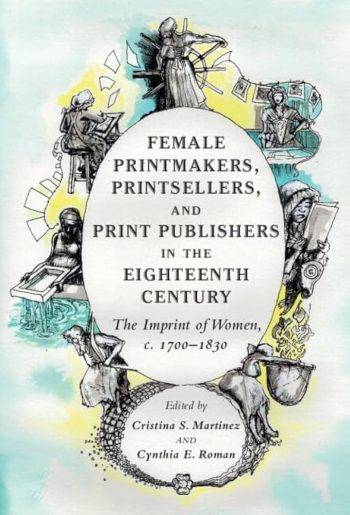 A ground-breaking contribution that broadens our understanding of the history of prints, this edited volume assembles international senior and rising scholars and showcases an array of exciting new research that reassesses the history of women in the graphic arts c. 1700 to 1830. Sixteen essays present archival findings and insightful analyses that tell compelling stories about women across social classes and nations who persevered against the obstacles of their gender to make vital contributions as creative and skilled graphic artists, astute entrepreneurs, and savvy negotiators of copyright law in Britain, France, Germany, Holland, Italy, and the United States. The book is a valuable resource for both students and instructors, offers important new perspectives for print scholars and aims to provide impetus for further research. This title is part of the Flip it Open Programme and may also be available Open Access. Check our website Cambridge Core for details.
Cristina S. Martinez is an art historian at the University of Ottawa, specialising in British eighteenth-century art and copyright history. She is the author of the entry on Jane Hogarth in the Oxford Dictionary of National Biography and has received several awards including a Bodleian Library fellowship.
Cynthia E. Roman is Curator of Prints, Drawings and Paintings at the Lewis Walpole Library, Yale University. She is an active and widely published scholar of British art of the eighteenth century. Her work focuses on the history of prints and print collecting, and the work of women and amateur artists.
c o n t e n t s
List of Figures
List of Contributors
Acknowledgments
Frontispiece Figure
Introduction: Hidden Legacies — Cristina S. Martinez and Cynthia E. Roman
Part I | Self-Presentation and Self-Promotion
1 Show-offs: Women’s Self-Portrait Prints, c. 1700 — Madeleine C. Viljoen
2 Maria Hadfield Cosway’s ‘Genius’ for Print: A Didactic, Commercial, and Professional Path — Paris A. Spies-Gans
3 Caroline Watson and the Theatre of Printmaking — Heather McPherson
4 ‘Talent and Untiring Diligence’: The Print Legacy of Angelika Kauffmann, Marie Ellenrieder, and Maria Katharina Prestel — F. Carlo Schmid
Part II | Spaces of Production
5 ‘Living in the Bosom of a Numerous and Worthy Family’: Women Printmakers Learning to Engrave in Late Eighteenth-Century London — Hannah Lyons
6 Divine Secrets of a Printmaking Sisterhood: The Professional and Familial Networks of the Horthemels and Hémery Sisters — Kelsey. D. Martin
7 Yielding an Impression of Women Printmakers in Eighteenth-Century France — Rena M. Hoisington
8 Laura Piranesi ‘Incise’: A Woman Printmaker Following in Her Father’s Footsteps — Rita Bernini
9 Etchings by Ladies, ‘Not Artists’ — Cynthia E. Roman
Part III | Competing in the Market: Acumen in Business and Law
10 Mary Darly, Fun Merchant and Caricaturist — Sheila O’Connell
11 A Changing Industry: Women Publishing and Selling Prints in London, 1740–1800 — Amy Torbert
12 Jane Hogarth: A Printseller’s Imprint on Copyright Law — Cristina S. Martinez
13 Shells to Satire: The Career of Hannah Humphrey (1750–1818) — Tim Clayton
14 Encouraging Rowlandson – The Women Who Mattered — Nicholas JS Knowles
15 Female Printmakers and Printsellers in the Early American Republic: Eliza Cox Akin and Mary Graham Charles — Allison M. Stagg
Index
Book Cover Image: Lou McKeever, 2023, inspired by the title page from Darly’s Comic-Prints of Characters, Caricatures, Macaronies, &c, 1776.
Curatorial Fellowship | Drawings and Prints at The Morgan
From The Morgan:
Moore Curatorial Fellowship in the Department of Drawings and Prints
The Morgan Library & Museum, New York, 2024–26
Applications due by 24 March 2024
The Morgan Library & Museum seeks applications for the Moore Curatorial Fellowship in the Department of Drawings and Prints. This one-year appointment, eligible for a one-year renewal, provides the opportunity to gain firsthand experience and professional training in curatorial work and in the study and connoisseurship of old master and nineteenth-century drawings. The Moore Curatorial Fellow will be a fully integrated member of the department, with duties and responsibilities comparable to those of a curatorial assistant or assistant curator. The Fellow will have the opportunity to conduct research on the Morgan’s collection of European drawings before 1900—one of the finest in the country—and to contribute significantly to all phases of exhibition planning, organization, and installation; museum education; publications; and other departmental activities.
The Moore Fellowship is intended to offer a varied and practical training in all areas of curatorial work to those interested in pursuing a career as a museum curator, particularly in the field of drawings.
Qualifications
• Doctoral work beyond the MA in the history of art, with preference given to those having recently completed a PhD
• A demonstrated commitment to scholarship in the field of drawings
• Proficiency in at least one European language
• Excellent writing and public speaking skills, together with the ability to interpret exhibitions for a wide audience
• An interest in and enthusiasm for museum work, and the ability to work collaboratively and to approach a broad range of tasks with a positive outlook
Compensation and Benefits: $54,000 annually beginning in September 2024; excellent benefits. Fellows will also have a travel budget of $2000 per year for research and activities supporting their professional development.
To apply: Please submit electronically, in a single PDF document: a letter addressing your interest in, and qualifications for, the Fellowship; a complete curriculum vitae including language proficiencies; and names of three references to drawingsadmin@themorgan.org with the subject heading “Moore Fellow Application.”
Qualified candidates of diverse backgrounds are encouraged to apply for the position using the e-mail address indicated above.
Deadline for applications: March 24, 2024. Incomplete or late applications will not be considered. The Morgan will notify successful candidates of their selection by May 2022.
Workshop | Touched / Retouched: Paper across Time, 1400–1800
From the Call for Applications at the Bibliotheca Hertziana:
Touched / Retouched: Paper across Time, 1400–1800
Rome, 11–16 November 2024
Applications due by 20 March 2024
The Lise Meitner Group at the Bibliotheca Hertziana – Max Planck Institute for Art History and the Istituto Centrale per la Grafica in Rome invite applications for an intensive one-week, hands-on workshop for early career specialists in the field of prints and drawings. This is made possible with support from Getty through The Paper Project initiative.
The goal of the workshop is to provide object-based training to the next generation of curators in the graphic arts, with a focus on premodern practices of retouching. We take an expansive approach to the term ‘retouching’ to encompass any discernible alterations carried out on drawings, prints, or their support after completion. Once identified, such alterations carry important repercussions: they change the way an object is cataloged, interpreted, and presented to the public; they influence choices about acquisition or deaccessioning; they shape decisions about conservation, affecting storage and treatment needs. Among drawing specialists, detecting and dating traces of retouching is considered to be largely a matter of tacit knowledge. The reconstruction of the chronological sequence of interventions via close looking or the help of diagnostic technologies is carried out on a daily basis in collections worldwide, yet this practice is often virtually inaccessible to outsiders.
This workshop is designed to provide a source of technical and material knowledge that will prove essential for drawing and print curators entering the field. By focusing on retouching and its interpretation, we intend to advance a materially layered understanding of paper objects that builds on recent scholarly literature while exploring a fundamental point of intersection between academic, curatorial, and conservation practices. The Hertziana leads (Francesca Borgo, Camilla Colzani, Alice Ottazzi) and ICG co-leads (Giorgio Marini and Gabriella Pace) will be joined by keynote speakers Carmen Bambach and Antony Griffiths and senior discussants Jonathan Bober, Hugo Chapman, and Catherine Goguel, among others.
During the first, virtual phase of the program, participants will present their own preliminary research on a selected drawing from the BHMPI’s collections. This will lay the groundwork for the second, central segment: a week-long, in-person workshop in Rome, with senior experts from prominent European and North American graphic arts collections joining the cohort of instructors. Hands-on examination of works on paper both pre- and post-treatment, viewing exercises, and practical paper-marking experiences will take place at the BHMPI’s and ICG’s study rooms, at the Diagnostic Lab and Paper Conservation Department, at local archives, and in Fabriano, the largest paper production center of premodern Europe. Dedicated presentations on the most common forms of manipulation will cover collector’s marks, highlighting and overdrawing, pricking and pouncing, framing and binding, hand-coloring, conservation decisions, and archiving and filing. The week will be followed by a remote capstone session and presentation of individual projects.
During the week in Rome, accommodation and travel expenses will be covered for all participants. Shared meals and a per diem will also be provided.
This project is aimed at early career curators and academics with demonstrable interest and experience in the field of graphic art. Eligible candidates for application should hold a doctoral degree (earned within the past 10 years), be enrolled in a doctoral program, or possess a solid curatorial experience in graphic arts collections. A background in conservation is not a prerequisite. An active museum affiliation is preferable but not required. The working language is English. Knowledge of Italian is advantageous but not essential.
Applications to participate in the workshop must be submitted via the online application portal before 20 March 2024, 11.59pm CEST.
More information is available here»
Lecture | Iris Moon on Stubbs and Wedgwood
Wednesday’s Research Semainar, from the Mellon Centre:
Iris Moon | A Body for Stubbs
Online and in-person, Paul Mellon Centre, London, 6 March 20224, 5.00–7.00pm
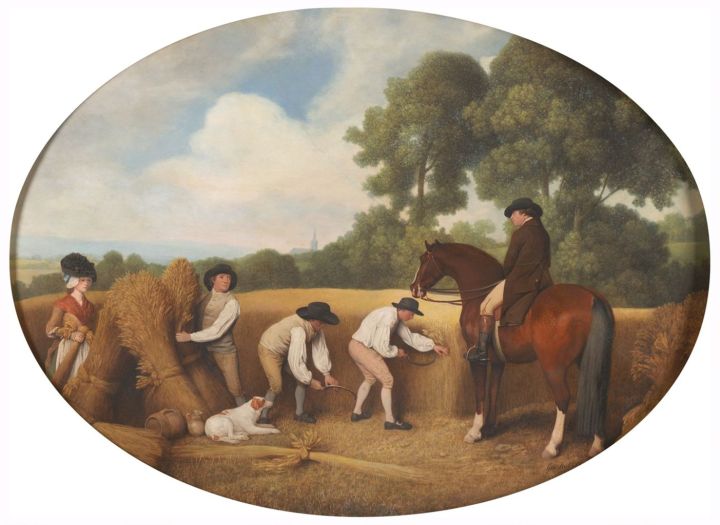
This talk focuses on the relationship between the painter George Stubbs and the potter and entrepreneur Josiah Wedgwood, and the work Reapers (1795). Alongside his commercial work making horse pictures for the landed gentry, Stubbs set out to create pictures of a more experimental nature executed on atypical surfaces, among them the oval ceramic tablets that Wedgwood created for him on demand. These were of an unusually large size, equally difficult to paint on, and fire in the kiln. Why was the horse painter drawn to the potter’s platters? Based on new material from Melancholy Wedgwood (MIT Press, 2024), this talk questions traditional readings of Wedgwood and the heritage paintings of Stubbs and, more broadly, notions of the eighteenth century as a foundational moment in Britain’s rise as a global commercial, financial, and industrial power. At the centre of this revisionist story is capitalism, empire, and exploitation. Found there too are babies, women, animals, and ceramics, among other lost figures not usually at the centre of eighteenth-century British art. Stubbs and Wedgwood take on new meanings when seen through the twisted prism of our own moment, amidst the ruins of late capitalist modernity.
Registration is available here»
Iris Moon is associate curator in the European Sculpture and Decorative Arts Department at the Metropolitan Museum of Art, where she is responsible for European ceramics and glass. At the Met, she participated in the reinstallation of the British Galleries, and she is currently planning an exhibition on Chinoiserie, women, and the porcelain imaginary that will open in 2025. She is the author of Luxury after the Terror, and co-editor with Richard Taws of Time, Media, and Visuality in Post-Revolutionary France. A new book on Wedgwood, generously supported by a publication grant from the Paul Mellon Centre, will be published next year with MIT Press. In addition to curatorial work, she teaches at Cooper Union.
Image: George Stubbs, Reapers, 1795, enamel on Wedgwood biscuit earthenware (New Haven: Yale Center for British Art, Paul Mellon Collection, B1981.25.618).
Call for Papers | Eating or Not Eating Animals: Sociability and Ethics

A glutonous man thinking about the food and drink he will consume at Christmas! From The Comic Almanack for 1839: An Ephemeris in Jest and Earnest, Containing ‘All Things Fitting for Such a Work’ by Rigdum Funnidos, Gent, with illustrations by George Cruikshank (London: Charles Tilt, 1838).
◊ ◊ ◊ ◊ ◊
From the Call for Papers (the PDF of which includes the French), via GIS Sociabilités:
Eating or Not Eating Animals: Sociability and Ethics around the Table
Manger ou ne pas manger la chair: Sociabilité et éthique autour de la table
Université Rennes 2, 6 June 2024
Organized by Florence Magnot-Ogilvy and Sophie Mesplède
Proposals due by 15 March 2024
Since the non-human turn of the early 21st century, numerous critical works have examined the animal question in the 18th century, a time when humanity’s place in the world, the relationship between human beings and non-human animals, the latter’s sensibility, and debates on the sensory soul were at the heart of the reflections of philosophers, physicians, naturalists, and educationalists.[1]
Few studies, however, have explored the question of meat- and non-meat-eating patterns specifically from the point of view of sociability.[2] Yet the issue formed one of the dividing lines in sociability, between men and women, young and old, people from different backgrounds, but also, in a new way, between humans and non-humans, in a century in which pets were playing an increasingly important role in human sociability.[3] As more and more human beings developed unique emotional relationships with cats, dogs, monkeys, and birds—to name but a few companion species—the question arose as to whether or not the bodies of animals credited with sensibility should be consumed. Some naturalists and writers, such as the Englishman Lord Monboddo and the hunter-philosopher Charles Georges Leroy, author of Lettres sur les animaux, recognized the ability of these animals to aggregate into communities that they felt were close to human societies. The tradition of the metempsychosis narrative, revived by the vogue for Orientalism, was then articulated in an unprecedented way with reflections on point of view, sensibility, and individuality.
In the 18th century, the abstinence from meat practiced for religious reasons[4] along with that driven by medical concerns (in George Cheyne’s writings, for example, where the question of diet was also linked to an imagination of power) was joined by that born of ethical considerations regarding the duties of humans towards other animals. The latter would profoundly question the dividing line between humanity and animality in European cultures won over by the imperatives of sensibility. The philosophical writings of Voltaire, Diderot, Condillac, and Rousseau on the nature of this boundary and the consequences to be drawn from it in terms of food were to be read throughout Europe. Meanwhile, their fictions were supported by a food imaginary weighed down by moral and political values, from Zadig’s supper to the gendered eating habits of Clarens as set out by Saint-Preux in one of the letters of La Nouvelle Héloïse. Across the Channel, it was often men of faith who spoke out against the cruelty inflicted on other species, and called for reflection on the modalities of their killing as much as on its finality. If the barbaric treatment of certain animals jeopardized the moral fiber of human beings, as William Hogarth’s series of engravings entitled The Four Stages of Cruelty (1751) helped to bring to light for a large English audience, what about the consumption of their flesh? “Vegetarianism,” term that did not appear until the middle of the 19th century, seemed to an increasing number of men and women to be a virtuous option that, although not always practiced, provided a subject for reflection and discussion in the context of enlightened sociability.
This study day, devoted to the debates surrounding the consumption of animals during the Enlightenment and the reconfiguration of positions that took place at the time, invites us to examine the question of a meat-eating habits insofar as these intersected with the emergence of new forms of sociability in Europe. It will look at how discussions about the ontological status of non-human animals helped redefine European sociability, where flesh-eating was a regular practice encouraged by the commercial adventures of the long 18th century.
Current debates around vegetarianism, veganism, anthropocentrism, and the gendered nature of food invite us to go back to the origins of modernity and to re-interrogate the Enlightenment on the place and role of non-human animals in what constitutes society. With this in mind, we will look at the many representations, both textual and pictorial, evoking the consumption of animal bodies in various social and literary contexts:
• In the visual arts — iconographic representations of animals killed or fattened for human consumption (hunting pictures, portraits of livestock, still-life paintings), animal carcasses, culinary preparations that visibly include them, market stalls and kitchen tables, the presence of animals in banqueting scenes, scenes of animals being fed, visual associations between femininity and animal flesh, caricatures and satirical representations, illustrations for fables, educational texts or scientific publications, etc.
• In literature — the representation of discussions about food and drink (table discussions, the material conditions of debates on the issue, the modalities of conversations, arguments and debates), hygiene-related considerations about children’s diets, the influence of flesh consumption on human morals, the link between what people ate and who they were, whether and how this type of discourse was influenced by the different literary genres, etc.
• In the periodical press, essays, political writings, and pamphlets — how and when the issue was used to support a particular argument.
• In scientific writings (naturalist, veterinary, and medical writings) — the extent to which they took the ongoing changes in morals and attitudes towards animals into account
Papers may be presented in French or English. Proposals (with a provisional title, a 250-word summary, and a brief biography of the author) should be sent before 15 March 2024 to:
Florence Magnot-Ogilvy, florence.magnot-ogilvy@univ-rennes2.fr
Sophie Mesplède, sophie.mesplede@univ-rennes2.fr
This event is supported by the GIS Sociabilités.
i n d i c a t i v e b i b l i o g r a p h y
Arena, Francesca, Yasmina Foehr-Janssens, Irini Papaikonomou et Francesca Prescendi (eds.), Allaitement entre humains et animaux : représentations et pratiques de l’Antiquité à aujourd’hui, Anthropozoologica 52/1, 2017.
Berchtold, Jacques, “Julie et l’âme des poissons du Léman dans La Nouvelle Héloïse de Rousseau”, De l’animal-machine à l’âme des machines : querelles biomécaniques de l’âme XVIe–XXIe siècles, Paris, éditions de la Sorbonne, 2010.
Berchtold Jacques et Jean-Luc Guichet (ed.), « L’animal des Lumières », Dix-huitième siècle 42, 2010.
Blackwell, Mark, The Secret Life of Things: Animals, Objects, and It-Narratives in Eighteenth-Century England (Bucknell University Press, 2007).
Burgat, Florence, L’humanité carnivore (Seuil, 2017).
Gregory, James, “Vegetable Fictions in the Kingdom of Roast Beef: Representing the Vegetarian in Victorian Literature”, in Tamara S. Wagner and Narin Hassan (dir.), Consuming Culture in the Long Nineteenth Century: Narratives of Consumption, 1700–1900 (Lexington Books, 2007): 17–34.
Guerrini, Anita, “A Diet for a Sensitive Soul: Vegetarianism in Eighteenth-Century Britain.” Eighteenth-Century Life 23.2, May 1999: 34–42.
Guichet, Jean-Luc, Rousseau, l’animal et l’homme. L’animalité dans l’horizon anthropologique des Lumières (Cerf, 2006).
Guichet, Jean-Luc (ed.), De l’animal-machine à l’âme des machines : querelles biomécaniques de l’âme XVIe–XXIe siècles, Paris, éditions de la Sorbonne, 2010.
Larue, Renan, Le Végétarisme des Lumières. L’abstinence de viande dans la France du XVIIIème siècle (Garnier, 2019).
Magnot-Ogilvy, Florence, « Instabilité énonciative et hiérarchie des valeurs dans l’Histoire véritable : l’effet-personnage et la projection sensorielle chez Montesquieu », Montesquieu et la fiction : autour des Lettres persanes, Aurélia Gaillard (dir.), Lumières, 2022: 145–159.
Morton, Timothy, “Joseph Ritson, Percy Shelley, and the Making of Romantic Vegetarianism”, Romanticism 12.1, 2006: 52–61.
Page-Jones, Kimberley, “From Buffon to Coleridge: Sociability and Humanity in Eighteenth- and Nineteenth-Century Comparative Anatomy”, Literature & History 32(2), 2023: 110–128.
Puskar-Pasewicz, Margaret, Cultural Encyclopedia of Vegetarianism (Greenwood, 2010).
Richardot, Anne (dir.), Bestiaire des Lumières, Revue des sciences humaines 296, 2009.
Serna, Pierre, L’Animal en République (Anarchasis, 2016).
Serna, Pierre, Comme des bêtes (Fayard, 2017).
Spencer, Colin, The Heretic’s Feast: A History of Vegetarianism (UPNE, 1996).
Strivay, Lucienne, « Manger juste. Les droits de l’animal dans les encyclopédies de 1750 à 1800. De l’éthique au politique », in Bodson, Liliane, Le Statut éthique de l’animal : conceptions anciennes et nouvelles (Université de Liège, 1995): 61–99.
Stockhorst, Stefanie, Jürgen Overhoff and Penelope J. Corfield, Human-Animal Interactions in the Eighteenth Century: From Pests and Predators to Pets, Poems, and Philosophy (Brill, 2021).
Wolloch, Nathaniel, Subjugated Animals: Animals and Anthropocentrism in Early Modern European Culture (Humanity Books, 2006).
Scientific Committee
• Jacques Berchtold (Sorbonne Université/ Fondation Bodmer)
• Valérie Capdeville (Rennes 2)
• Émilie Dardenne (Rennes 2/ IUF)
• Jean-Luc Guichet (Université de Picardie)
• David Mc Callam (University of Sheffield)
• Florence Magnot-Ogilvy (Rennes 2)
• Sophie Mesplède (Rennes 2)
• Kimberley Page-Jones (UBO)
• Sophie Vasset (Université Paul Valéry)
• Phil Withington (University of Sheffield)
n o t e s
1. See in particular L’animal des Lumières, Jacques Berchtold and Jean-Luc Guichet (eds.), DHS n°42, 2010; Bestiaire des Lumières, Anne Richardot (ed.), Revue des sciences humaines 296, 2009; Figures animales, Annie Duprat (ed.), Sociétés et représentations 27, 2009; Jean-Luc Guichet, Rousseau, l’animal et l’homme, l’animalité dans l’horizon anthropologique des Lumières (Cerf, 2006) ; as well as the works of Pierre Serna, L’Animal en République (Anarchasis, 2016) and Comme des bêtes (Fayard, 2017).
2. With the notable exception of Le Végétarisme des Lumières. L’abstinence de viande dans la France du XVIIIème siècle by Renan Larue (Garnier, 2019), which sets out to explore the roots of vegan and vegetarian thought in the writings of the Enlightenment. Renan Larue founded a vegan studies programme at the University of California where he teaches, broadening the perspective to current debates on vegetarianism and eating patterns as political stances.
3. See the PhD thesis recently defended in 2023 by Tomohiro Kaibara under the supervision of Antoine Lilti: “Le Grand sacre des chats: l’invention d’un animal de compagnie en France (1670–1830).”
4. The case of Thomas Tryon springs to mind, as do the dietary prohibitions of all religions, which attracted the attention of philosophers such as Voltaire in France.
New Book | The Wealth of a Nation
Part of the Princeton Economic History of the Western World, from Princeton UP:
Geoffrey Hodgson, The Wealth of a Nation: Institutional Foundations of English Capitalism (Princeton: Princeton University Press, 2023), 304 pages, ISBN: 978-0691247014, £35 / $40.
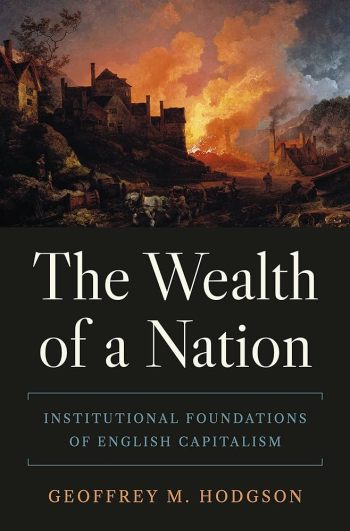 How the development of legal and financial institutions transformed Britain into the world’s first capitalist country
Modern capitalism emerged in England in the eighteenth century and ushered in the Industrial Revolution, though scholars have long debated why. Some attribute the causes to technological change while others point to the Protestant ethic, liberal ideas, and cultural change. The Wealth of a Nation reveals the crucial developments in legal and financial institutions in the seventeenth and eighteenth centuries that help to explain this dramatic transformation.
Offering new perspectives on the early history of capitalism, Geoffrey Hodgson describes how, for the emerging British economy, pressures from without were as important as evolution from within. He shows how intensive military conflicts overseas forced the state to undertake major financial, administrative, legal, and political reforms. The resulting institutional changes not only bolstered the British war machine—they fostered the Industrial Revolution. Hodgson traces how Britain’s war capitalism led to an expansion of its empire and a staggering increase in the slave trade, and how the institutional innovations that radically transformed the British economy were copied and adapted by countries around the world. A landmark work of scholarship, The Wealth of a Nation sheds light on how external factors such as war gave rise to institutional arrangements that facilitated finance, banking, and investment, and offers a conceptual framework for further research into the origins and consolidation of capitalism in England.
Geoffrey M. Hodgson is professor emeritus in management at Loughborough University London and editor-in-chief of the Journal of Institutional Economics. His many books include Liberal Solidarity, Conceptualizing Capitalism, and Darwin’s Conjecture.
New Book | Novels, Needleworks, and Empire
Part of the Lewis Walpole Series in Eighteenth-Century Culture and History, from Yale UP:
Chloe Wigston Smith, Novels, Needleworks, and Empire: Material Entanglements in the Eighteenth-Century Atlantic World (New Haven: Yale University Press, 2024), 312 pages, ISBN: 978-0300270785, $65.
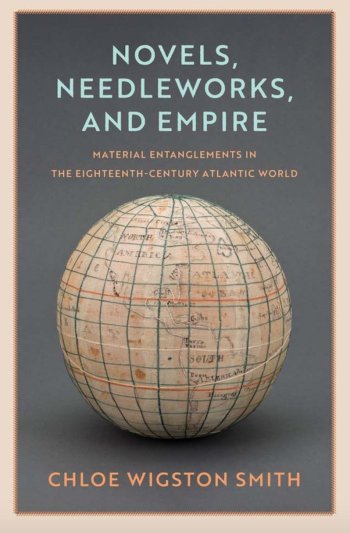 The first sustained study of the vibrant links between domestic craft and British colonialism
In the eighteenth century, women’s contributions to empire took fewer official forms than those collected in state archives. Their traces were recorded in material ways, through the ink they applied to paper or the artifacts they created with muslin, silk threads, feathers, and shells. Handiwork, such as sewing, knitting, embroidery, and other crafts, formed a familiar presence in the lives and learning of girls and women across social classes, and it was deeply connected to colonialism.
Chloe Wigston Smith follows the material and visual images of the Atlantic world that found their way into the hands of women and girls in Britain and early America—in the objects they made, the books they held, the stories they read—and in doing so adjusted and altered the form and content of print and material culture. A range of artifacts made by women, including makers of color, brought the global into conversation with domestic crafts and consequently placed images of empire and colonialism within arm’s reach. Together, fiction and handicrafts offer new evidence of women’s material contributions to the home’s place within the global eighteenth century, revealing the rich and complex connections between the global and the domestic.
Chloe Wigston Smith is professor of eighteenth-century literature at the University of York, where she teaches in the Department of English and the Centre for Eighteenth Century Studies. She is the author of Women, Work, and Clothes in the Eighteenth-Century Novel.
c o n t e n t s
List of Illustrations
Introduction: Entangled Forms
1 Making the Four Corners of the Globe, Oroonoko, and Euphemia
2 Small Marks in Thread: Samplers, Moll Flanders, and Material Expression
3 Global Domestic Objects: Embroidered Maps, Lydia, and The Female American
4 Pins, Needles, and Wampum in Mary Rowlandson and Hobomok
5 Companionship in Black Attendant Needlework, The History of Sir George Ellison, and The Woman of Colour
Coda: Material Entanglements, Then and Now
Notes
Acknowledgments
Index
Call for Papers | Textiles and Masculinities
From ArtHist.net and the Design History Society:
Textiles and Masculinities
Online, Design History Society, 15 June 2024
Proposals due by 11 April 2024
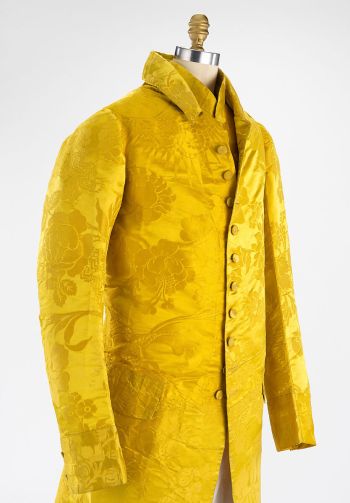
Banyan, British, ca. 1780, silk (New York: The Metropolitan Museum of Art, 1978.135.1).
The complex and evolving relationships between masculinities and textiles have been underrepresented in histories of design to date. This picture contrasts with the cultural and social importance textiles have in maintaining, contesting, and performing masculinities. This online symposium will share international research on historical and contemporary textiles in global contexts. We invite researchers at any level who investigate some aspect of masculinities and textiles to submit an abstract.
Themes include but are not limited to:
• Fashion textiles and masculinities
• Maintaining, performing, or contesting masculinities through textiles
• Queer, non-binary, and fluid gender identities and textiles
• Masculinities, textiles, and interior design
• Decolonising textiles and masculinities
• Textiles for menswear in fashion for all
• Design, production, and consumption of textiles and masculinities
Due to the language limits of the organisers, the symposium will take place in English. We acknowledge that information/knowledge can be disseminated in different ways, and so we are open to different presentation styles and formats. To be considered for a 15-minute presentation, please submit a 300-word abstract and a 50- to 100-word biography to the DHS Senior Administrator Jenna Allsopp at designhistorysociety@gmail.com by 11 April 2024. Applicants will be notified of the outcome of the submission within two weeks of the closing deadline. Please contact Dr Fiona Anderson (Glasgow School of Art) at f.anderson@gsa.ac.uk with any questions.










 Enfilade
leave a comment