New Book | The Centrality of Slavery
From Penn Press:
John Craig Hammond, The Centrality of Slavery: Empire and Enslavement in Colonial Illinois and Missouri (Philadelphia: University of Pennsylvania Press, 2025), 288 pages, ISBN: 978-1512828429, $45. Early American Studies Series.
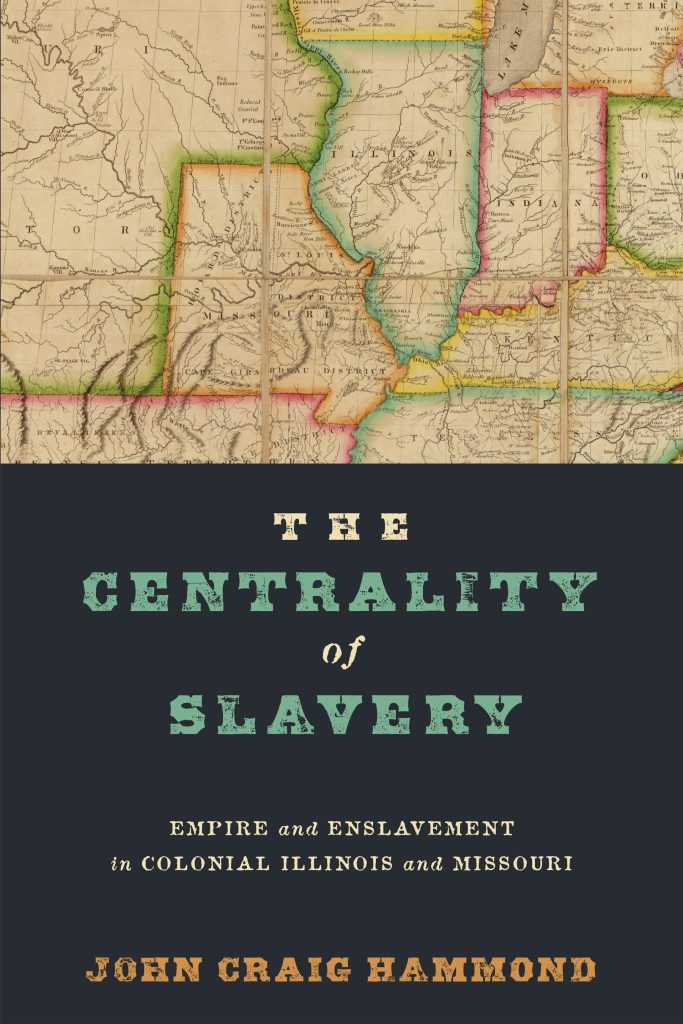 How French and American colonizers created systems of enslavement in the Middle Mississippi Valley.
The Centrality of Slavery examines how French and American colonizers used the powers of various imperial regimes to create slave societies in present-day Missouri and Illinois from the 1720s through the 1820s. The first book-length study of slavery and empire in both Illinois and Missouri, it begins with the origins of Native American and African American enslavement in the region. It then traces how successive French, Spanish, British, and American regimes shaped the development of slavery over the course of a century, examines the significance of the Northwest Ordinance’s ban on slavery in Illinois, and then analyzes the diverging histories of slavery in Illinois and Missouri in the early 1800s. The book concludes with an analysis of the Missouri Crisis and the compromise of 1820, along with the Middle Mississippi Valley’s significance in the road towards disunion and civil war in the late 1850s. More broadly, The Centrality of Slavery argues that the Middle Mississippi Valley sat astride the crossroads of imperial North America. The practices of empire and enslavement forged and fought over there exerted an outsized influence on the history of slavery in North America and the United States. Rather than treating the region’s eighteenth-century past as a prologue to the rise of the United States, John Craig Hammond analyzes the colonial history of the region on its own terms, through the European colonizers, American settlers, and enslaved people of Indigenous and African descent who shaped the development of slavery in the Middle Mississippi Valley.
John Craig Hammond is Associate Professor of History at Penn State University, New Kensington.
New Book | The Household War
From Penn Press:
John Blanton, The Household War: Property, Personhood, and the Domestication of Anglo-American Slavery, 1547–1729 (Philadelphia: University of Pennsylvania Press, 2025), 400 pages, ISBN: 978-1512828306, $55.
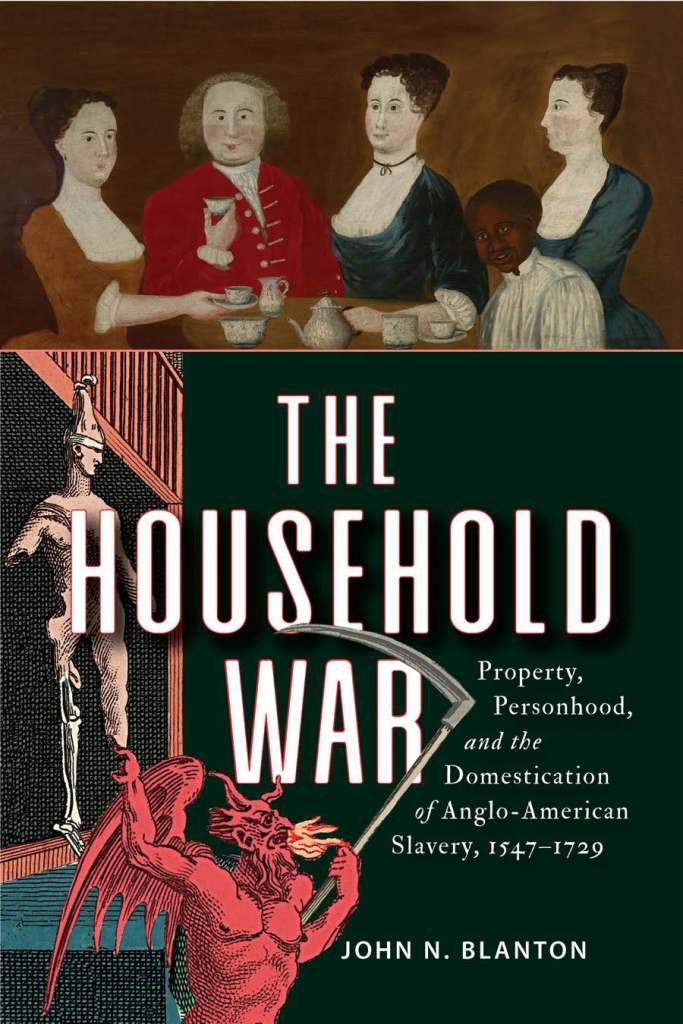 A bold reinterpretation of perennial debates over the origins and development of slavery in colonial English North America.
The Household War offers a bold reinterpretation of perennial debates over the origins and development of slavery in colonial English North America. John N. Blanton argues that the law and practice of slavery in the empire’s earliest American colonies were shaped by a tension between two competing definitions of the institution. One strand of thought, war-slavery ideology, claimed that the power of life and death transformed war captives into chattel slaves. The power to kill defined both war and slavery. But bringing war captives into enslavers’ private households was a dangerous proposition, and so a parallel ‘domestication’ ideology emerged calling for limitations on the power of enslavers and the recognition of the enslaved as persons held to labor in a variant of English servitude.
The Household War examines how the tensions between war-slavery and domestication ideologies, along with crucial political, economic, and cultural differences, shaped the development of slavery in Virginia and Massachusetts from their founding through 1729, creating distinct systems of bondage in England’s flagship mainland colonies. In Massachusetts, where a diversified and dynamic commercial economy afforded opportunities for mobility and access to material resources, the dominance of domestication ideology enabled enslaved people to negotiate their bondage, attain free status, and build free Black households and communities. Virginia, however, committed itself to war-slavery early in its development, with enslaved people defined as articles of property subject to enslavers’ power of life and death while the extreme inequality of plantation society made free Black household formation nearly impossible. Long before American independence highlighted their differences, then, Massachusetts and Virginia were already on distinct trajectories, laying the foundation for a future house divided on the question of slavery.
John N. Blanton is Assistant Professor of History at City College of New York.
Online Talks | Patricia Ferguson, Ivan Day, Neil Buttery, and Paul Crane
From the Museum of Royal Worcester:
Museum of Royal Worcester | Online Winter Talk Series, 2025–26
The Museum of Royal Worcester is thrilled to present another season of fascinating online talks to keep the winter blues at bay. Curl up with a warm drink and join us as we explore art, food, and history with three brilliant speakers.
◊ ◊ ◊ ◊ ◊
Ivan Day | Frozen Delights: A History of Porcelain and Ice Cream
Wednesday, 21 January 2026, 6pm
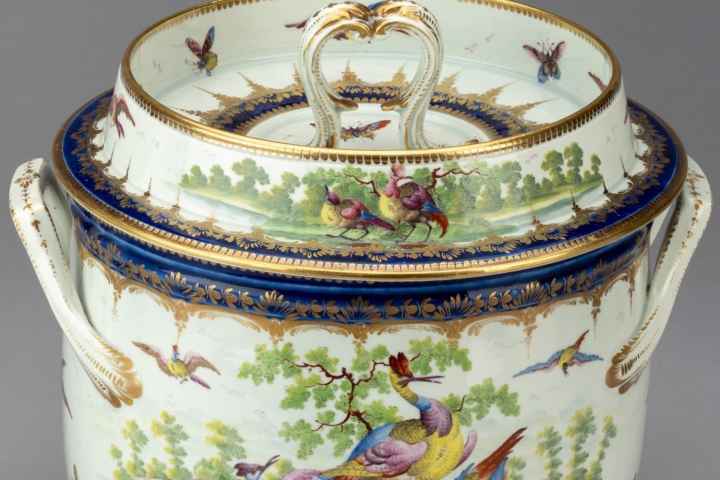
Ice Pail, 1776, William Davis Factory (Museum of Royal Worcester).
During the eighteenth century, ice cream became the ultimate show-off luxury for adorning a fashionable dinner table. As a result, new items for serving this novelty dish started to appear on the market. The challenge was to produce an attractive container which could be displayed centre stage on the sideboard or table, but which was also capable of preventing the ice cream from melting. These specialised three-part vessels first appeared in France in 1720s, where they were called seaux à glace—ice cream coolers. They employed a mixture of ice and salt to refrigerate their contents. By the 1770s the fashion for these beautiful vessels became an aristocratic craze, and nearly every European manufactory was producing them. In England, the Worcester factory played a leading role in developing some of the finest of these vessels. Ivan Day will guide us through the development of ice cream coolers and ice cream cups, with a focus on the marvellous examples produced at Worcester. Book here»
Ivan Day is one of the UK’s most celebrated food historians, broadcasters, writers, and curators, specialising in the reconstruction of period kitchens and historic table displays. His work has been exhibited in many institutions worldwide, including the Museum of London, the Metropolitan Museum of Art, and the Getty Research Institute. His publications include Cooking in Europe, 1650–1850 and Ice Cream: A History.
◊ ◊ ◊ ◊ ◊
Neil Buttery and Paul Crane | Sugar, Slavery and Empire / The Evolution of Worcester Sucriers
Wednesday, 4 March 2026, 6pm

A rare early Dr Wall Worcester Sucrier and Cover with Flame finial, ca. 1753. A unique example retaining its cover, the shape derived from silver. Ex Rous Lench collection Worcestershire.
Join food historian Neil Buttery and ceramics expert Paul Crane in a presentation discussing the role of sugar and the associated enslavement of African peoples in the growth and development of the British Empire and Worcester Porcelain in the eighteenth century. Neil will explore how the reach of the ‘sugar-slave complex’ was all-pervading, influencing the sale and evolution of fancy goods, especially those associated with the tea table, which, of course, included porcelain. As a case study, Paul will focus on the evolution of the sucrier in the first fifty years of Worcester Porcelain. Book here»
Neil Buttery is a multi award-winning food historian, author, podcaster, and chef. He hosts The British Food History Podcast and co-hosts A is for Apple: An Encyclopaedia of Food & Drink. His publications include A Dark History of Sugar, Before Mrs Beeton: Elizabeth Raffald, England’s Most Influential Housekeeper, Knead to Know: A History of Baking, and The Philosophy of Puddings. Dr. Buttery has recently collaborated with the Museum of Royal Worcester on projects to deliver narratives on the history of food and porcelain to wider communities. His permanent display “Dr. Wall’s Dinner” at MoRW recently won the Food on Display Award at the British Library Food Season Awards in 2025.
Paul Crane is an independent historian and consultant to the Brian Haughton Gallery, London. He is a descendant of Dr. John Wall (1708–1776), who founded the Worcester Porcelain Manufactory in 1751. Paul presently sits as a Trustee of the Museum of Royal Worcester, formerly the Dyson Perrins Museum in the city of Worcester. He also is a Fellow of the Society of Antiquaries, an independent historian and researcher, and a Liveryman of the Worshipful Company of Art Scholars.
◊ ◊ ◊ ◊ ◊
Patricia Ferguson | Exploring the Rococo through Chelsea’s Gold Anchor Vases
Tuesday, 2 December 2025, 6pm — A recording is available here»
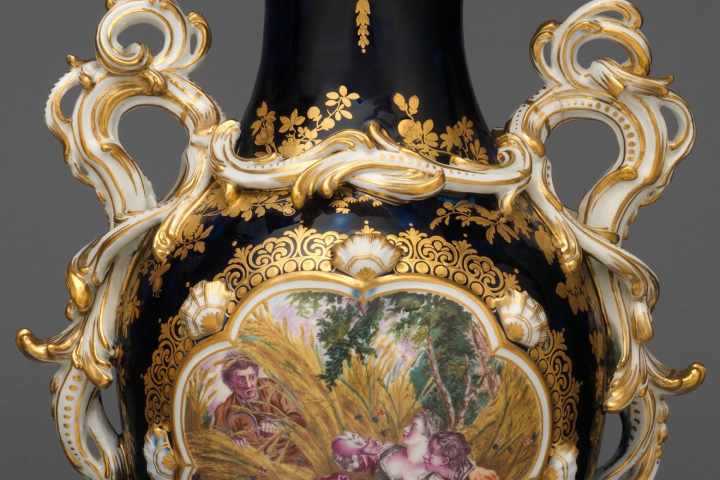
Vase (one of a pair), Chelsea Porcelain Factory, ca. 1762 (New York: The Metropolitan Museum, 1970.313.2a, b).
Of all design styles, Rococo was perhaps the most rebellious—ornate, theatrical, and a true ‘style without rules’. Emerging in France in the 1720s–30s, it featured curved, asymmetrical motifs drawn from nature, especially the acanthus leaf, and marine-inspired forms that gave rise to its name, from rocaille (‘rock’ or ‘shell’). Its greatest achievements appeared in the decorative arts—furniture, silver, and ceramics. By the 1750s–60s, English porcelain factories like Worcester and Chelsea embraced Rococo, even as taste was shifting toward Classical order. Worcester adapted Rococo silver shapes for tablewares, but Chelsea—under Flemish silversmith Nicholas Sprimont—produced some of the boldest Rococo porcelain in Europe, rivaling Meissen and Sèvres. This talk explores Chelsea’s gold anchor period (ca. 1758–64), its spectacular vases, its rivals, and its enduring legacy.
Patricia F. Ferguson is a ceramic researcher, a former curatorial consultant at the Victoria and Albert Museum and the British Museum, she is an advisor on ceramics for the National Trust and other heritage organizations. Her publications include Pots, Prints, and Politics: Ceramics with an Agenda, from the 14th to the 20th Century (2021); Ceramics: 400 years of British Collecting in 100 Masterpieces (2017); and Garnitures: Vase Sets from National Trust Houses (2017).
Exhibition | Savonnerie Carpets of Louis XIV
Opening soon (for just one week) at the Grand Palais:
Le Trésor Retrouvé du Roi-Soleil / The Rediscovered Treasure of the Sun King
Grand Palais, Paris, 1–8 February 2026
Curated by Wolf Burchard, Emmanuelle Federspiel, and Antonin Macé de Lépinay
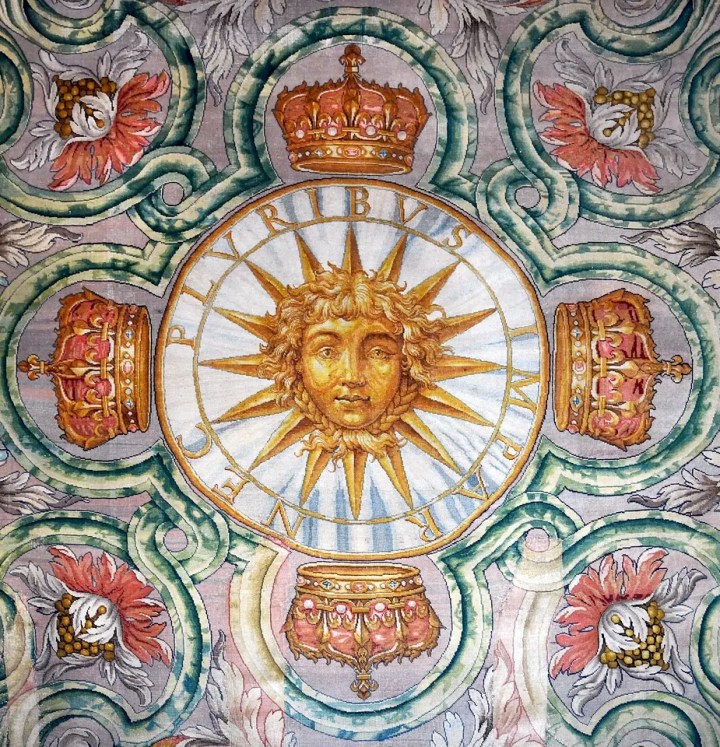 For the first time in history, the monumental carpets commissioned by Louis XIV for the Louvre’s Grand Gallery are brought together and displayed beneath the glass roof of the Grand Palais.
In 1668, as King Louis XIV prepared to make the Louvre his royal residence, he entrusted his First Painter, Charles Le Brun, with a bold and magnificent commission: the creation of 92 carpets, woven at the Savonnerie Manufactory, to adorn the floor of the palace’s most majestic gallery. Each carpet, nine meters wide, was meant to form a spectacular decorative ensemble, one of the most ambitious ever conceived for a royal palace. Fate, however, took a different course. Never installed in the Louvre, these treasures crossed the centuries through revolutions, sales, and dispersals. Today, 41 original carpets remain in the collections of the National Manufactories, 33 of which are complete. Brought together for the first time beneath the glass roof of the Grand Palais, alongside a carpet designed for the Galerie d’Apollon, they offer a display of rare magnificence. A unique and historic event, lasting just one week, inviting visitors to discover these jewels of French heritage in a setting worthy of their splendor.
Exhibition co-produced by the GrandPalaisRmn and Les Manufactures nationales – Sèvres & Mobilier national.
Curators
• Wolf Burchard | Curator, Department of European Sculpture and Decorative Arts, The Metropolitan Museum of Art, New York
• Emmanuelle Federspiel | Conservatrice en chef du patrimoine, inspectrice des collections des Manufactures nationales – Sèvres & Mobilier national
• Antonin Macé de Lépinay | Inspecteur des collections des Manufactures nationales – Sèvres & Mobilier national
Scénographie
• Clément Hado and Anthony Lelonge – Manufactures nationales
Lecture | James Stourton and Hannah Kaye, The British Love for Venice
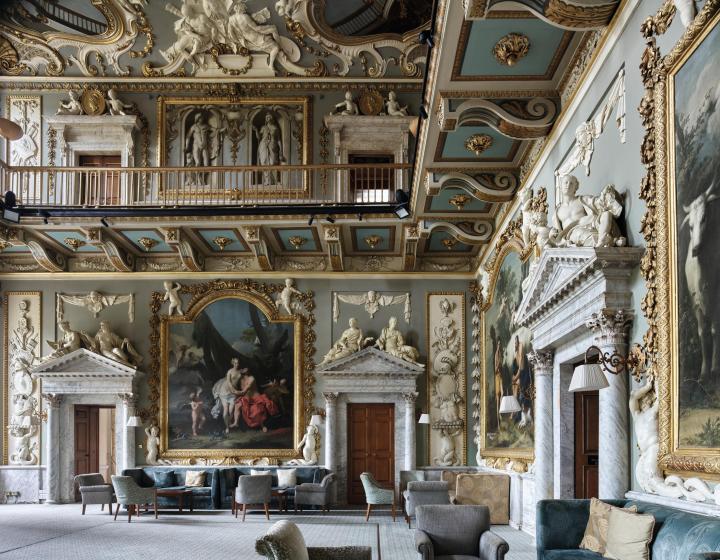
Moor Park, Hertfordshire, England. The estate has housed the Moor Park Golf Club since the 1920s. The 17th-century house was remodelled in the 1720s (with South Sea wealth) to designs by James Thornhill. Jacopo Amigoni was subsequently commissioned to paint the four pictures in the Great Hall. Shown here is Jupiter and Io with Cupid and Attendant Putti.
◊ ◊ ◊ ◊ ◊
From the Venice in Peril Fund:
James Stourton and Hannah Kaye | The British Love Affair with Venice:
Four Centuries of Collecting and Connoisseurship
The Society of Antiquaries, Burlington House, London, 16 March 2026
James Stourton joins Hannah Kaye for a lively conversation exploring the enduring British fascination with Venice and its profound impact on taste and culture. From King Charles I to the present day, they will examine how British connoisseurs, collectors and architects have both shaped—and been shaped by—Venetian art, uncovering the themes and ideas that define this centuries-long cultural exchange.
James Stourton is the award-winning author of thirteen books including Rogues and Scholars, The British as Art Collectors, and Kenneth Clark. He is a Senior Fellow of the Institute of Historical Research of London University and currently a visiting fellow at Oxford University. He started his career as an Old Master paintings specialist with Sotheby’s and rose to become UK Chairman until he stepped down in 2012. He writes regularly on art and architecture for national newspapers and has served on government heritage committees. His first visit abroad was to Venice. Hannah Kaye is a freelance producer and one of the founding creators of Intelligence Squared, the leading forum for agenda-setting debates and discussions around the world. She is a trustee of the World Monument Fund Britain.
Monday, 16 March 2026, 6.30pm. Tickets, £30 / lecture recording, £10. All proceeds will go directly towards the vital conservation work of Venice in Peril Fund.
Lecture | Jane Glover on Mozart in Venice
From the Venice in Peril Fund:
Jane Glover | Mozart in Venice: A Crucial Encounter
The Society of Antiquaries, Burlington House, London, 9 February 2026

Pietro Longhi, A Fortune Teller at Venice, ca. 1756, oil on canvas, 59 × 49 cm (London: National Gallery, NG1334).
In December 1769, the 13-year-old Mozart and his father set out on their first journey to Italy. Over the next fifteen months they would visit all the main cities in the peninsula, absorbing Italian culture and garnering unprecedented attention and accolades. Their final stop, in the spring of 1771, was Venice. And although they came away with little immediate or evident reward, the impact of the city on the now 15-year-old boy was profound and extraordinarily consequential. In this talk, Jane Glover, acclaimed conductor and musician, explores this brief but crucial encounter between a unique prodigy and a unique city.
Jane Glover is currently enjoying her 50th season as a conductor, having made her professional debut at the Wexford Festival in 1975. She has since performed opera and concerts all over the world, including at the Teatro La Fenice in Venice. A Mozart specialist, she has been Music Director of Glyndebourne Touring Opera, Artistic Director of the London Mozart Players, Director of Opera at the Royal Academy of Music, and, since 2002, Music Director of Chicago’s Music of the Baroque. She is the author of Mozart’s Women, Handel in London, and Mozart in Italy.
Monday, 9 February 2026, 6.30pm. Tickets, £30 / lecture recording, £10. All proceeds will go directly towards the vital conservation work of Venice in Peril Fund.
New Book | Death, Disease. and Mystical Experience in Early Modern Art
From Routledge:
Michael Hill and Jennifer Milam, eds., Death, Disease. and Mystical Experience in Early Modern Art (New York: Roultedge, 2025), 452 pages, ISBN: 978-9463729185 (hardback), $180 / ISBN: 978-1003693741 (ebook), $57.
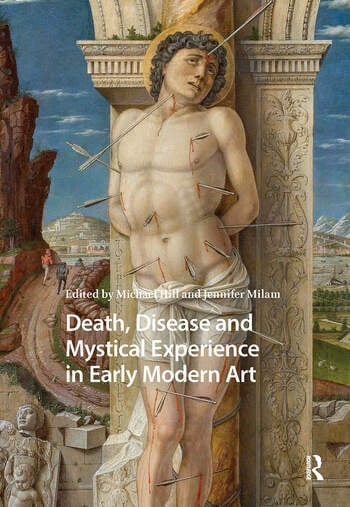 Fear of death and disease preoccupied the European consciousness throughout the early modern era, becoming most acute at times of plague and epidemics. In these times of heightened anxieties, images of saints and protectors served to reassure the faithful of their religious protection against infection. Modes of visual engagement and devotional subject matter were coupled in new ways to reinforce the emotive impact of art works and to reaffirm the perceived reality of the afterlife. In this context, a visual language of mystical devotion, which overcame the limits of the body and even eroticised its suffering, could serve the needs of the desolate and the pained. In this series of essays focused on spiritual sensibilities in Renaissance art and its legacies, authors present original ideas about the themes of death, disease, and mystical experience, based primarily on the study of objects and their documented historical contexts. Methodologically wide-ranging in approach, the resulting volume provides novel insights into the interplay between suffering and art making in the Western world.
Michael Hill is Head of Art History and Theory at the National Art School in Sydney. His research focuses on the art and architecture of the Italian Baroque, Australian sculpture, and art historiography. Michael has also written with Peter Kohane a number of articles of the idea of decorum in architectural theory. Jennifer Milam is Professor of Art History and Deputy Vice Chancellor (Academic) at the University of Newcastle in Waikato. Her research focuses on art, architecture, and garden design during the eighteenth century. Her publications include A Cultural History of Plants in the Age of Enlightenment (Bloomsbury, 2022), Making Ideas Visible in the Eighteenth Century (University of Delaware Press, 2022), Beyond Chinoiserie: Artistic Exchanges Between China and the West during the Late Qing Dynasty (Brill, 2018), Historical Dictionary of Rococo Art (Scarecrow Press, 2011), Fragonard’s Playful Paintings. Visual Games in Rococo Art (University of Manchester Press, 2007), and Women, Art and The Politics of Identity in Eighteenth-Century Europe (Ashgate Press, 2003).
c o n t e n t s
Introduction: Manipulating the Sacred — Jennifer Milam and Michael Hill
1 Mary as Model for Trecento Mourning — Judith Steinhoff
2 Pacem meam do vobis: Earthly Suffering and Celestial Redemption in the Trecento Fresco Program by Vitale da Bologna at Pomposa Abbey — Catherine Blake
3 Dying to be Born Again: Death in the Florentine Sacre Rappresentazioni — Nerida Newbigin
4 The Visual Transformations of St Anthony the Abbot: From Protector of the Sick to Victor over Sexual Desire — Charles Zika
5 Giovanni Cariani’s Woman Reclining in a Landscape: The Erotic Subverted — Carolyn Smyth
6 Touching Visions: Female Mystics Interacting with the Christ Child and with Mary — Patricia Simons
7 Queering Mysticism and the Lactating Virgin: The Madonna delle Grazie with Souls in Purgatory and its Audience of Nuns — Christina Neilson
8 Securing Heavenly Protection in Apocalyptic Times: A Series of Fresco Votives in the Oratory of San Giovanni Battista in Urbino — Di Haskell
9 The Long Goodbye: Resurrecting Rome’s Apostolic Past in The Final Embrace of Saints Peter and Paul — Barbara Wisch
10 The Beautiful Death of the Count of Orgaz: Andrés Núñez, El Greco, and the Making of a Counter Reformation Saint — Karen McCluskey
11 A Vessel to be Filled: Caravaggio’s Conversion of St. Paul in Santa Maria del Popolo — Michael Hill
12 Lo Strascino’s Lamento and the Visual Culture of the French Pox around 1500 — John Gagne
13 Whiz King: Urination as Divination in Prints for Louis XIV — Mark de Vitis
14 David’s Saint Roch: Plague Painting in the Age of Enlightenment — Jennifer Milam
15 Blake’s Petworth House Last Judgment and Female Anatomy — Anthony Apesos
16 Cocteau’s London Elegy: Re-purposed Renaissance Imagery in a Twentieth-Century Crucifixion — Stephen Holford
Index
Call for Applications | Painted Wall Preservation Scholarship
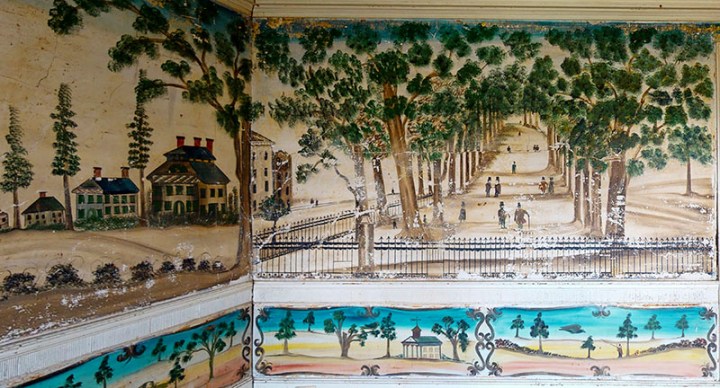 Interior of the Hersey-Whitten House, which was constructed in the late-18th or early-19th century in the village of Center Tuftonboro, New Hampshire. Originally built for the Copp family, it was once a dance hall and inn. Learn more from The Center for Painted Wall Preservation»
◊ ◊ ◊ ◊ ◊
From the scholarship announcement:
The Center for Painted Wall Preservation Scholarship
Applications due by 30 April 2026
The Center for Painted Wall Preservation (pwpcenter.org) invites undergraduate and graduate students, independent scholars, and artisans, whether established or in training, to apply for this scholarship, which aims to develop educational projects that further our mission through documentation, conservation, and preservation—where art, history, craft, and science meet.
This year’s scholarship of $2000 will be awarded to the individual whose proposal for an educational, scholarly project is deemed best designed to further the stated mission of our organization—to further the study, understanding, and appreciation of paint-decorated plaster walls and associated interior colorized items of the 18th and early 19th centuries in New England and New York, and to educate the public about this unique and vulnerable cultural heritage. Interested parties may apply for an Application Process Summary and Application Form by contacting info@pwpcenter.org with ‘Scholarship Fund’ in the subject line. Applications will be accepted from 1 January until midnight, 30 April 2026.
The Center for Painted Wall Preservation is a nationally recognized 501(c)(3) Nonprofit Organization.
Conference | Archives Unbound
From ArtHist.net and KHI:
Archives Unbound: Time and Memory in Romantic Visual Culture
Palazzo Grifoni Budini Gattai, Florence, 2–3 February 2026

The Sarcophagus of Seti I at Sir John Soane’s Museum, engraved by Mason Jackson (Illustrated London News, 1864).
In the Romantic period, the archive was more than a repository of the past: it was a living site of imagination, reconstruction, and desire. Today, archives are again central to debates on memory, preservation, and the recovery of histories. In an age of information overload, media excess, and destabilising fake news, the archive has become a hotly contested field: as verifiable record (resisting distortion) and as partial repository (erasing as much as it preserves). Archives Unbound: Time and Memory in Romantic Visual Culture seizes this moment to discuss Romanticism in dialogue with European and global perspectives, asking how art historians can engage the past with rigour, ethical awareness, and creative scope.
The workshop is a collaboration between the University of Jena’s research group European Romanticism or Romanticisms in Europe?, the University of York’s Department of History of Art, and the Kunsthistorisches Institut in Florenz (KHI). Set against the backdrop of Florence—itself a city-as-archive—the event will examine the archive as both repository and dynamic system of knowledge, memory and power. The workshop coincides with The City as Archive, a major KHI exhibition juxtaposing historical photographs with contemporary works by Armin Linke.
Organisers
Elisabeth Ansel, Hannah Baader, Christin Bates, Costanza Caraffa, Johannes Grave, and Richard Johns
Organising Institutions
University of Jena, University of York, and the Kunsthistorisches Institut in Florenz – Max-Planck-Institut
m o n d a y , 2 f e b r u a r y
9.30 Introduction, Elisabeth Ansel and Christin Bates
10.00 Exhibition | The City as Archive
• Hannah Baader and Costanza Caraffa (exhibition curators)
13.30 Lunch Break
14.30 Session 1
• Michael Smith (York), John Flaxman’s Roman Archive
• Gemma Shearwood (York), Westminster Abbey and St Paul’s Cathedral as Archives of National and Imperial Memory
16:00 Tea Break
16.30 Session 2
• Mira Claire Zadrozny (Jena), The Archival City in Distress: Time and Memory in Images of Paris’ Ephemeral Ruins
• John Norrman (Jena), The Image of the Barricade: Illustrated Periodicals as Archives of a Social Practice of Imagining Crisis, 1848
t u e s d a y , 3 f e b r u a r y
9.30 Greeting
9.45 Session 3
• Andrin Albrecht (Jena), Ludic Romanticism, or, the Five-Color Archive of Magic: The Gathering
• Kohta Nakajima (York), Metaphor as Fragment: Visualising Shakespeare in William Blake’s ‘Pity’ within Eighteenth-Century Reading Culture
11.15 Tea Break
11.45 Session 4
• Selina Kusche (Jena), Stories of a Single Figure? How Understanding History Paintings Requires a Mental Archive
• Jacob Bolda (York), Archives of Intimacy: The Portrait Miniature and the Romantic Subject
13.15 Lunch Break
14.15 Session 5
• Elisabeth Ansel (Jena), Fragmented Archives: The Manifold Aesthetics of Memory, Time, and Ecology in Ossianic Landscapes
• Christin Bates (Jena), Memories in Stone: Ruskinian Ecologies and Images as Climate Archives
• Kate Nankervis (York), ‘The Air Itself Is One Vast Library’: Atmosphere as Archive in British Romanticism
17.00 Final Discussion
Call for Papers | The Quest for Beginnings, 1750–1850
From the Call for Papers:
Origins and Evolution: The Quest for Beginnings, 1750–1850
Ursprung und Entwicklung: Sehnsucht und Suche nach den Anfängen, 1750–1850
Second Wellhöfer Colloquium, Martin von Wagner Museum, Universität Würzburg, 4–5 December 2026
Organized by Damian Dombrowski and Ulrich Pfisterer
Proposals due by 28 February 2026
The recourse to earlier stages of culture belongs to the basic inventory of every civilization. Since the mid-eighteenth century, however, profound transformations have taken place in the modes of such engagement. No longer were scholars, writers, and artists concerned solely with presumed or actual high points within their own pasts; instead, increasing attention was directed toward early forms of social and artistic formation. This ‘originist desire’ constitutes the central theme of this year’s Wellhöfer Colloquium, which every two years addresses research questions in the history of art and culture between 1750 and 1850 from an interdisciplinary perspective.
Across diverse regions of Europe, anthropology and early civilizational history emerged as central fields of scholarly inquiry. The normative authority of classical antiquity began to erode: in Italy, the Etruscans came into focus; in England, the Celts; and within the interior of the classicist Walhalla, the principal ornament was a monumental frieze depicting the history of the Germans from their migration from Asia to the baptism of Widukind. The Homeric epics were translated, revered, and illustrated on an unprecedented scale as the earliest monuments of literature, believed to embody a simplicity subsequently lost—corresponding to a broader revaluation of Mediterranean antiquity, for which Friedrich Schiller’s depiction of a prehistoric idyll in The Gods of Greece is emblematic. In archaeology, early idealism gave way to relativism, teleology to aetiology, and enthusiasm for the classical to an interest in the archaic. Johann Wolfgang von Goethe and Wilhelm von Humboldt pursued the idea of a primal language; Jean-Jacques Rousseau and Marc-Antoine Laugier anchored the ‘primitive hut’ in architectural theory.
Alongside this shift of beginnings into more remote historical strata, the thematic scope of the conference also encompasses the simultaneous reception of the Middle Ages. This reception found concrete expression, for example, in the illustrated volumes of J. B. L. G. Seroux d’Agincourt or in the collection assembled by Sulpiz Boisserée, as well as in visual culture through the style troubadour or the Nazarene movement. In light of a shared preoccupation with origins and authenticity, the traditional opposition between classicist and romantic tendencies loses much of its sharpness, while points of convergence in artistic practice come to the fore. Accordingly, contributions addressing formal archaisms, stylizations, and abstractions are particularly welcome—phenomena that, especially in nineteenth-century France (Ingres), appear to arise from the discourse on origins as a productive counterpoint to late classicist Salon painting.
It would also be worth discussing whether the outline style derived from Greek vase painting (Flaxman) should be situated within the same archaistic framework—and whether the concrete confrontation with archaic works, such as the Aegina pediment sculptures, may have posed excessive challenges to a productive reception. To what extent did the persistence of classicist aesthetics affect artistic and critical encounters with newly uncovered early epochs? And how did the growing knowledge of these periods, in turn, transform prevailing notions of normativity and exemplarity? The range of examples illustrating the new longing for beginnings could be extended almost indefinitely and in every conceivable direction; even the so-called ‘discovery of childhood’ belongs within this conceptual horizon.
Participation is sought not only from image-based disciplines—most notably art history and, in particular, classical archaeology—but the discussion would ideally be enriched by contributions from philological fields and the history of science. The invitation to the conference includes coverage of travel and accommodation costs. The organizers invite proposals for 20-minute papers in English or German. Please submit an abstract (maximum 2000 characters including spaces) and a short CV (maximum 1500 characters including spaces) by 28 February 2026 to Ulrich.Pfisterer@lrz.uni-muenchen.de and damian.dombrowski@uni-wuerzburg.de. Notification of participation will be given by 15 March 2026.
Organizers
• Damian Dombrowski (Martin von Wagner Museum der Universität Würzburg)
• Ulrich Pfisterer (Zentralinstitut für Kunstgeschichte, München)










 Enfilade
leave a comment