Installation | Tradition and Celebration across the Jewish Calendar
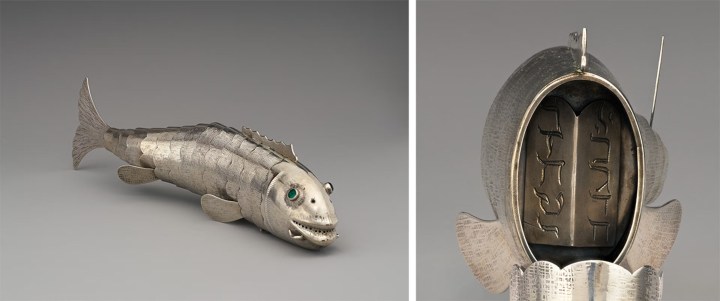
Fish-form Spice Container (Besamim), 1813, Vienna, silver, foil-backed glass, 8 × 34 × 7.6 cm, 450g
(New York: The Metropolitan Museum of Art, New York, 2025.104)
◊ ◊ ◊ ◊ ◊
Riva Arnold describes the seven works in this installation from The Met’s Department of European Sculpture and Decorative Arts:
Tradition and Celebration across the Jewish Calendar
The Metropolitan Museum of Art, New York, on view until 3 March 2026
Tucked within the galleries of the Department of European Sculpture and Decorative Arts (ESDA) is a special display of new acquisitions and objects that have never been on view before. The seven works in this temporary installation are part of a rotating exhibit of case studies organized by the department’s curators, fellows, and researchers. The current selection—on view until March 3, 2026—highlights craftsmanship, materials, and community celebrations from the Jewish populations of Austria, Italy, France, and the Netherlands between the sixteenth and nineteenth centuries.
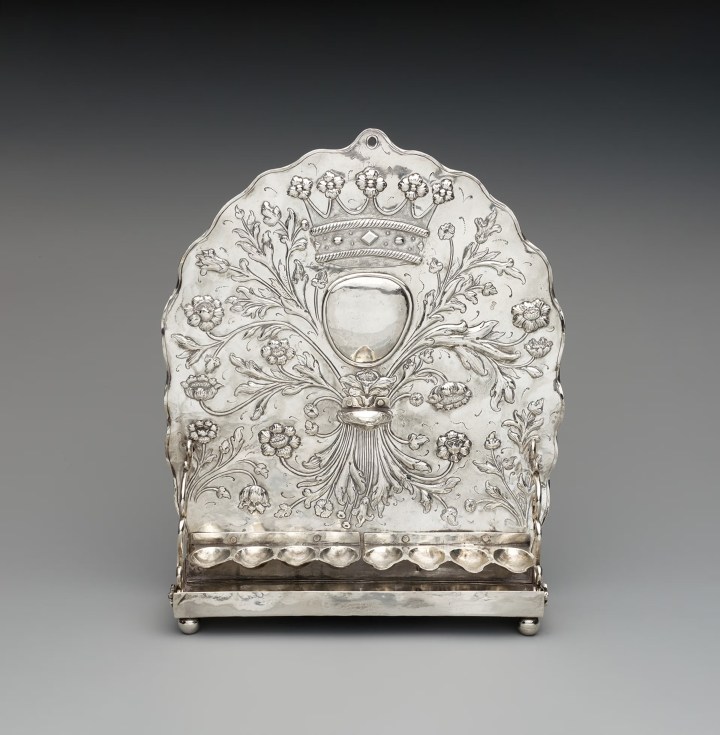
Johannes van der Lely, Hanukkah Lamp, 1706, Leeuwarden, silver, 31 × 26 cm (New York: The Metropolitan Museum of Art, 2025.585).
For over a decade, ESDA has been acquiring Judaica objects connected to Jewish life, culture, and religion. The selected items represent universal themes related to special days in the Jewish calendar, which follows a lunisolar cycle. This means that the days and months are based on the cycles of the moon, with each day beginning at sunset;[1] a leap month is added every few years to ensure that holidays are observed in their correct season. For example, Rosh Hashanah, associated with the new year, is celebrated in the fall, and Passover, associated with renewal, is in the spring.
Joyful holiday traditions and domestic milestones, such as the birth of a new baby or a wedding, kept communities together despite societal upheaval and economic fluctuations. Judaica produced in the Rococo or Baroque periods displayed extravagant decorative motifs typical of that era, with outstanding craftsmanship that evidences a material culture spanning metalwork, porcelain, leather, and enamel. . .
The full essay is available here»










 Enfilade
leave a comment