Resource Spotlight | The Anthony M. Clark Archive at the NGA
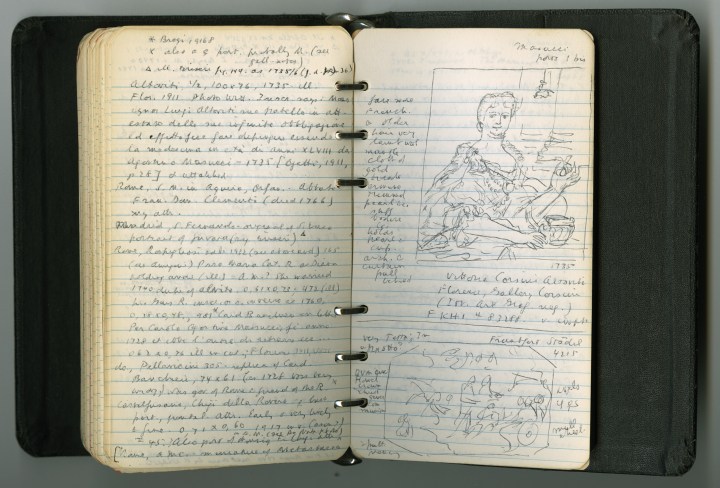
Notebook on 18th-century artists: M–MAS opened to page on “Agostino Masucci,” Anthony M. Clark Archive, Department of Image Collections, National Gallery of Art Library, Washington, DC.
◊ ◊ ◊ ◊ ◊
Nearly everything that appears here at Enfilade is aggregated from other sources with the aim of spreading news of exhibitions, books, conferences, and other scholarly events and opportunities. Nothing, however, precludes other kinds of posts, including original contributions. Huge thanks to Missy Lemke for this very helpful introduction to the Anthony M. Clark Archive at the NGA! –CH
Overview of the Anthony M. Clark Archive at the National Gallery of Art
By Melissa Beck Lemke, Image Specialist for Italian Art, Image Collections,
National Gallery of Art, Washington, D.C.
The National Gallery of Art’s Department of Image Collections is a photographic archive documenting art and architecture from all over the world. It includes over 3 million photographs, negatives, reproductive prints, and digital images acquired predominately from scholars, photographers, dealers, and museums. Our scholars’ archives are unique and allow us to instantly improve our collection in that area of specialty.
The archive of Anthony M. Clark (1923–1976) is one such example. It came to the NGA in 2012 through the generosity of Clark’s colleague and friend, Edgar Peters Bowron (Pete). The archive is a rich collection documenting not only Tony’s interest in Roman Settecento painting, but also artists of all media across Europe. It consists of photographs, research notes, portrait engravings and miscellaneous files related to his personal art collection, teaching, and scholarship.
Tony Clark was a significant figure in the field of Roman 18th-century painting. He graduated from Harvard in 1945 with a degree in fine arts, but eventually his interests shifted to art history. He was the Curator of Paintings and Sculpture, and eventual Director, of the Minneapolis Institute of Art. In 1973, he was made Curator of European Painting at The Metropolitan Museum of Art, but left in 1975 after disagreements with its director, Thomas Hoving, about changes to his exhibition The Age of Revolution: French Painting, 1774–1830. Tony went on to teach at the Institute of Fine Arts in New York and Williams College in Williamstown, MA. In 1976 he had a fellowship at the American Academy in Rome to complete work on his survey of Roman 18th-century painting. While jogging by the Villa Doria-Pamphili, he had a heart attack and died; he was 53 years old.
Tony was lauded for his contributions to growing the collections at Minneapolis and for his important exhibitions at the Met. Although he did not publish a great deal, he did leave behind reams of research documents in preparation for his intended publications. Scholars have continued Tony’s work, most especially Pete Bowron, as evidenced by his 2-volume catalogue raisonné on Pompeo Batoni published in 2016. Tony’s continued influence and significance in the field was displayed recently by a stunning exhibition held in honor of what would have been his 100th birthday at the Nicholas Hall Gallery in New York in October of 2023, entitled The Hub of the World: Art in Eighteenth-Century Rome.
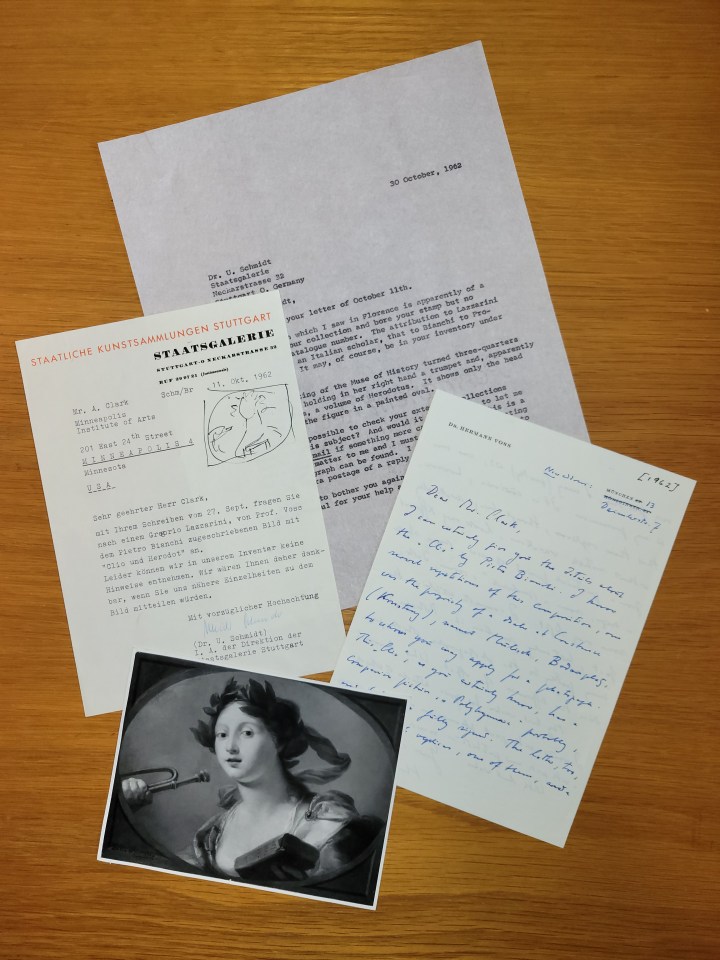
Photograph and letters regarding Pietro Bianchi, Clio Holding a Trumpet and Herodotus, formerly with Dorotheum, Vienna, Anthony M. Clark Archive, Department of Image Collections, National Gallery of Art Library, Washington, DC.
The addition of the Clark Archive was transformative for the department of Image Collections’ 18th-century holdings. It added over 11,000 black-and-white photographs and color transparencies of paintings, drawings, and sculptures by nearly 300 artists. They are often annotated or accompanied by letters and other ephemera which have been filed together within the photo archive. The decision to incorporate the Clark materials into the NGA’s photo collection allows researchers to view them alongside photographs obtained from dealers, photographers, and other scholars providing a broader view of each subject.
Tony’s work is documented not only through the photos, but also in 60 small, 6-ringed binders which record his research and thoughts on nearly 1,300 artists, as well as hundreds of historical personalities, dealers, collections, churches, and palaces. The notebooks are characterized by Tony’s small script and charming drawings. One can imagine him making notes and sketches within a church or museum and slipping the small book back into his jacket pocket. They also contain copious notes from books, archives, bibliographies, and monographic lists.
The artists most significantly represented are: Pompeo Batoni (11 books), Giuseppe and Pier Leone Ghezzi (1 book), Sebastiano Conca (231 pages), Giuseppe Cades (177 pages), Corrado Giaquinto (132 pages), Carlo Maratta (130 pages), Benedetto Luti (125 pages), Antonio Cavallucci (112 pages), Angelica Kauffman (110 pages), and Francesco Trevisani (106 pages). His concentration on Kaufman is noteworthy considering the paucity of scholarship on female artists at the time. Clark’s extant artist lists include eleven other women of varying levels of renown.
Tony was a scholar of 18th-century Europe—not only its painters and sculptors, but also its scientists, humanists, poets, royals, and religious figures, as evidenced by his notebooks entitled “Persons.” Unfortunately, only two books from the “Persons” series have survived (those for A–L) with entries on 208 individuals, some brief and others significant, like 19 pages on the titular queen of England, Maria Clementina Sobieska, 11 pages on the English music historian and composer Charles Burney, and 13 pages on the French patron Pierre Crozat. Created in an age well before the internet, they serve as an encyclopedia of the 18th century.
The notebooks and photo archive stand as a monument to Clark’s scholarship. Twenty-nine of the notebooks have been digitized and added to the the National Gallery’s Image Collections database. This includes persons, popes, churches, palaces, visits to New York dealers, and all artists except for the 13 books on Batoni. The names of all the people, sites and dealers included in the notebooks are keyword searchable within the database. This material’s inclusion in the National Gallery’s Image Collections will ensure its preservation and accessibility for other scholars to continue Tony’s work. For more information on the archive see our website or contact Missy Lemke at m-lemke@nga.gov.










leave a comment