New Book | The First Emancipation
From Princeton UP:
Jeremy Popkin, The First Emancipation: The Forgotten History of Abolition in Revolutionary France (Princeton: Princeton University Press, 2026), 440 pages, ISBN: 978-0691246925, $40.
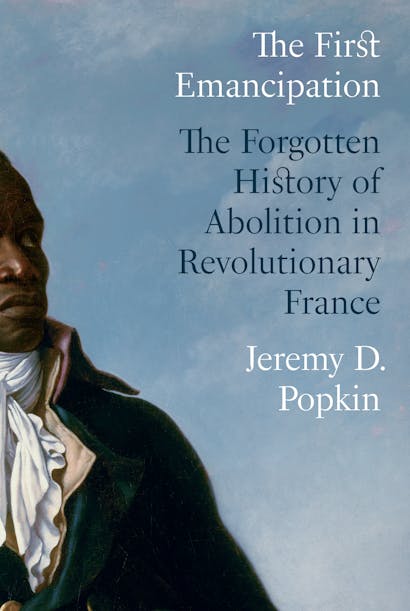 The First Emancipation is a dramatic account of how slavery and race profoundly influenced the course of the French Revolution and had a central impact on the lives of key leaders, including Mirabeau, Robespierre, Toussaint Louverture, and Napoleon. Acclaimed historian Jeremy D. Popkin brings this often-forgotten story to life, highlighting the arguments put forward by French abolitionists and their opponents and the profound repercussions of the first abolition of slavery in a Western empire.
When the French revolutionaries passed the Declaration of the Rights of Man and Citizen in 1789, they immediately faced a burning question: did that document’s first article—“Men are born and remain free and equal in rights”—apply to the 800,000 enslaved Black people in the country’s colonies? Over the next dozen years, revolutionary leaders fought over this question. The First Emancipation tells how French lawmakers initially protected slavery in their constitution but reversed themselves in 1794, making France the first western country to abolish slavery throughout its empire. Yet only eight years later, in 1802, Napoleon tried to force the emancipated Black populations of the colonies back into slavery. His decision led to his first major military defeat and to the proclamation of the independence of the Black nation of Haiti, but also to the reestablishment of slavery in other French colonies, where it would not finally be abolished until 1848. The story of how France emancipated its enslaved people and declared them full citizens only to return many of them to bondage, The First Emancipation reveals that the course of abolition in the modern world was more winding and halting than is often remembered.
Jeremy D. Popkin is the William T. Bryan Chair Professor Emeritus of History at the University of Kentucky. His many books include A New World Begins: The History of the French Revolution and You Are All Free: The Haitian Revolution and the Abolition of Slavery.
Exhibition | Revolutionary Prints from Britain and America
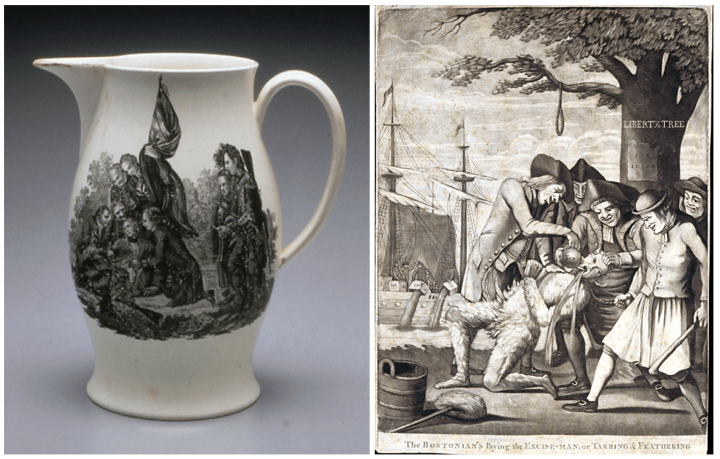
Left | Josiah Wedgwood, creamware jug, transfer printed with an image based on the painting The Death of General Wolfe by Benjamin West (Milwaukee: Chipstone Foundation; photo by Gavin Ashworth). Right | Philip Dawe, The Bostonians Paying the Excise-Man or Tarring and Feathering, 1774, London, mezzotint with engraving (Milwaukee: Chipstone Foundation; photo by Gavin Ashworth).
◊ ◊ ◊ ◊ ◊
Now on view at the Haggerty Museum of Art:
Defying Empire: Revolutionary Prints from Britain and America
Haggerty Museum of Art, Marquette University, Milwaukee, 4 June — 1 August 2026
Curated by J. Patrick Mullins, with Jonathan Prown and Jessica Cooley
On the occasion of the Semiquincentennial of the U.S. Declaration of Independence, the Haggerty Museum of Art at Marquette University welcomes visitors to visualize a passionate, participatory Revolution. Its summer exhibition, Defying Empire: Revolutionary Prints from Britain and America, explores how eighteenth-century British and American prints shaped public opinion about politics, from the French and Indian War through the end of the Washington presidency. Drawn from the collections of the Chipstone Foundation and the Haggerty Museum, the exhibition brings together more than twenty prints on paper, a selection of transfer printed ceramics, and an eighteenth-century maple dining table. Through works by both Britons and Americans of diverse political persuasions, it interprets the Revolutionary era as a time of transatlantic cultural exchange in which political ideas were communicated not just by documents like the Declaration but also objects from the fine and decorative arts.
In the eighteenth century British-speaking world, printed cartoons, portraits, and landscapes circulated widely, accessible to a much broader public than most official documents. These images could trigger such responses as amusement, contempt, reverence, and outrage, spurring viewers to political action. As creators and consumers, middle-class and working-class men and women used etchings, mezzotints, punchbowls, and teapots to participate in elite conversations about imperial authority and colonial resistance. Defying Empire provides an array of these politically charged artworks, including such featured objects as a creamware jug by Josiah Wedgwood interpreting The Death of General Wolfe, prints by William Hogarth satirizing Whig leaders like William Pitt and John Wilkes, Charles Willson Peale’s iconic portraits of George Washington and Benjamin Franklin, and Paul Revere’s inflammatory Bloody Massacre. Replicas of additional prints are displayed on a ‘coffeehouse table’ for visitors to handle and examine at their leisure.
Defying Empire: Revolutionary Prints from Britain and America was curated by Dr. J. Patrick Mullins, Associate Professor of History and Public History Director at Marquette University, in collaboration with Mr. Jonathan Prown, Dr. Jessica Cooley, and the staffs of the Chipstone Foundation and Haggerty Museum of Art. A virtual exhibit and catalog of curatorial essays will be available in Fall 2026 at the Chipstone website. For more information, visit the museum online, or contact Dr. Patrick Mullins at john.mullins@marquette.edu.
Support for this exhibition is generously provided by the John P. Raynor, S.J. Endowment Fund and in part by a grant from the Wisconsin Arts Board with funds from the State of Wisconsin and the National Endowment for the Arts.










leave a comment