Resource Spotlight | The Anthony M. Clark Archive at the NGA
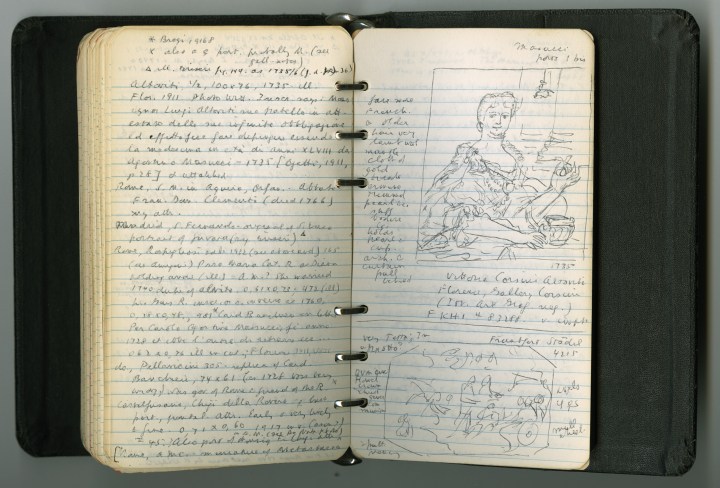
Notebook on 18th-century artists: M–MAS opened to page on “Agostino Masucci,” Anthony M. Clark Archive, Department of Image Collections, National Gallery of Art Library, Washington, DC.
◊ ◊ ◊ ◊ ◊
Nearly everything that appears here at Enfilade is aggregated from other sources with the aim of spreading news of exhibitions, books, conferences, and other scholarly events and opportunities. Nothing, however, precludes other kinds of posts, including original contributions. Huge thanks to Missy Lemke for this very helpful introduction to the Anthony M. Clark Archive at the NGA! –CH
Overview of the Anthony M. Clark Archive at the National Gallery of Art
By Melissa Beck Lemke, Image Specialist for Italian Art, Image Collections,
National Gallery of Art, Washington, D.C.
The National Gallery of Art’s Department of Image Collections is a photographic archive documenting art and architecture from all over the world. It includes over 3 million photographs, negatives, reproductive prints, and digital images acquired predominately from scholars, photographers, dealers, and museums. Our scholars’ archives are unique and allow us to instantly improve our collection in that area of specialty.
The archive of Anthony M. Clark (1923–1976) is one such example. It came to the NGA in 2012 through the generosity of Clark’s colleague and friend, Edgar Peters Bowron (Pete). The archive is a rich collection documenting not only Tony’s interest in Roman Settecento painting, but also artists of all media across Europe. It consists of photographs, research notes, portrait engravings and miscellaneous files related to his personal art collection, teaching, and scholarship.
Tony Clark was a significant figure in the field of Roman 18th-century painting. He graduated from Harvard in 1945 with a degree in fine arts, but eventually his interests shifted to art history. He was the Curator of Paintings and Sculpture, and eventual Director, of the Minneapolis Institute of Art. In 1973, he was made Curator of European Painting at The Metropolitan Museum of Art, but left in 1975 after disagreements with its director, Thomas Hoving, about changes to his exhibition The Age of Revolution: French Painting, 1774–1830. Tony went on to teach at the Institute of Fine Arts in New York and Williams College in Williamstown, MA. In 1976 he had a fellowship at the American Academy in Rome to complete work on his survey of Roman 18th-century painting. While jogging by the Villa Doria-Pamphili, he had a heart attack and died; he was 53 years old.
Tony was lauded for his contributions to growing the collections at Minneapolis and for his important exhibitions at the Met. Although he did not publish a great deal, he did leave behind reams of research documents in preparation for his intended publications. Scholars have continued Tony’s work, most especially Pete Bowron, as evidenced by his 2-volume catalogue raisonné on Pompeo Batoni published in 2016. Tony’s continued influence and significance in the field was displayed recently by a stunning exhibition held in honor of what would have been his 100th birthday at the Nicholas Hall Gallery in New York in October of 2023, entitled The Hub of the World: Art in Eighteenth-Century Rome.
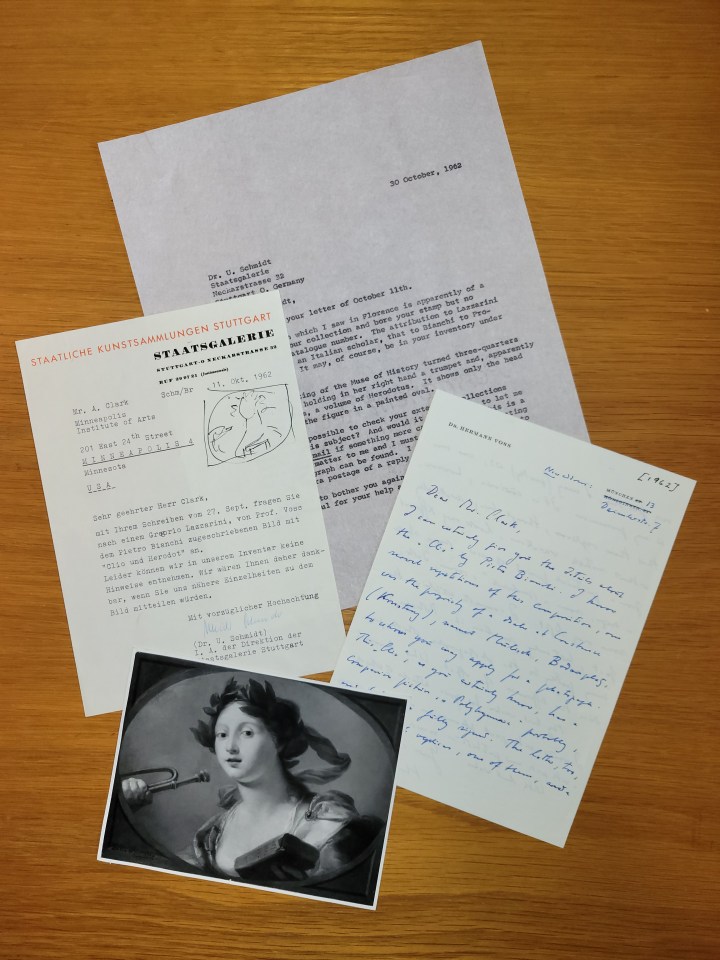
Photograph and letters regarding Pietro Bianchi, Clio Holding a Trumpet and Herodotus, formerly with Dorotheum, Vienna, Anthony M. Clark Archive, Department of Image Collections, National Gallery of Art Library, Washington, DC.
The addition of the Clark Archive was transformative for the department of Image Collections’ 18th-century holdings. It added over 11,000 black-and-white photographs and color transparencies of paintings, drawings, and sculptures by nearly 300 artists. They are often annotated or accompanied by letters and other ephemera which have been filed together within the photo archive. The decision to incorporate the Clark materials into the NGA’s photo collection allows researchers to view them alongside photographs obtained from dealers, photographers, and other scholars providing a broader view of each subject.
Tony’s work is documented not only through the photos, but also in 60 small, 6-ringed binders which record his research and thoughts on nearly 1,300 artists, as well as hundreds of historical personalities, dealers, collections, churches, and palaces. The notebooks are characterized by Tony’s small script and charming drawings. One can imagine him making notes and sketches within a church or museum and slipping the small book back into his jacket pocket. They also contain copious notes from books, archives, bibliographies, and monographic lists.
The artists most significantly represented are: Pompeo Batoni (11 books), Giuseppe and Pier Leone Ghezzi (1 book), Sebastiano Conca (231 pages), Giuseppe Cades (177 pages), Corrado Giaquinto (132 pages), Carlo Maratta (130 pages), Benedetto Luti (125 pages), Antonio Cavallucci (112 pages), Angelica Kauffman (110 pages), and Francesco Trevisani (106 pages). His concentration on Kaufman is noteworthy considering the paucity of scholarship on female artists at the time. Clark’s extant artist lists include eleven other women of varying levels of renown.
Tony was a scholar of 18th-century Europe—not only its painters and sculptors, but also its scientists, humanists, poets, royals, and religious figures, as evidenced by his notebooks entitled “Persons.” Unfortunately, only two books from the “Persons” series have survived (those for A–L) with entries on 208 individuals, some brief and others significant, like 19 pages on the titular queen of England, Maria Clementina Sobieska, 11 pages on the English music historian and composer Charles Burney, and 13 pages on the French patron Pierre Crozat. Created in an age well before the internet, they serve as an encyclopedia of the 18th century.
The notebooks and photo archive stand as a monument to Clark’s scholarship. Twenty-nine of the notebooks have been digitized and added to the the National Gallery’s Image Collections database. This includes persons, popes, churches, palaces, visits to New York dealers, and all artists except for the 13 books on Batoni. The names of all the people, sites and dealers included in the notebooks are keyword searchable within the database. This material’s inclusion in the National Gallery’s Image Collections will ensure its preservation and accessibility for other scholars to continue Tony’s work. For more information on the archive see our website or contact Missy Lemke at m-lemke@nga.gov.
Exhibition | Celtic Art Across the Ages
Now on view at Harvard Art Museums, the exhibition spans a wide period including the reception of Celtic art in the 18th and 19th centuries.
Celtic Art Across the Ages
Harvard Art Museums, Cambridge, Massachusetts, 6 March — 2 August 2026
Curated by Susanne Ebbinghaus, with Penny Coombe, Laure Marest, and Matthew Rogan
 Discover the many forms of Celtic creativity and their artistic legacies in this sweeping story that spans ancient to modern times.
When you think of the word ‘Celtic’, what do you picture? Perhaps intricate knotwork designs, legendary warriors, or mystical spirituality? Maybe even a certain NBA team? Celtic Art across the Ages will introduce visitors to the worlds of the various peoples who were historically labeled ‘Celts’—through the objects they created, the interactions they had across the European continent, and the myths that shaped their legacy, then as now. The exhibition stretches from 800 BCE through today, showcasing the craftsmanship, innovation, cultural connections, and multilayered reception that characterized Celtic art in Europe and beyond.
The first major exhibition on this topic to take place in the United States, Celtic Art across the Ages offers an unprecedented opportunity to explore masterful metalwork, including exquisitely decorated weaponry, jewelry, and horse and chariot trappings of the first millennium BCE Iron Age and early medieval times, all brought to light through archaeological discoveries of the last 200 years. See how imagery transformed under Roman rule, and trace the revival of Celtic art and identities in the modern era. From shape-shifting ancient ornaments to the more well-known Celtic iconography of medieval Ireland and Scotland, the objects in this exhibition reveal rich and complex artistic traditions that defy stereotypes of what constitutes ‘Celtic art’.
The exhibition is curated by Susanne Ebbinghaus, George M.A. Hanfmann Curator of Ancient Art and Head of the Division of Asian and Mediterranean Art, with Penny Coombe, Kelekian Curatorial Fellow in Ancient Art, Laure Marest, Damarete Associate Curator of Ancient Coins, and Matthew Rogan, Senior Curatorial Assistant for Special Exhibitions and Publications.
The catalogue is disributed by Yale UP:
Susanne Ebbinghaus, ed., Celtic Art Across the Ages (Cambridge: Harvard Art Museums, 2026), 272 pages, ISBN: 978-0300286380, $45. With contributions by Franck Abert, Sophia Adams, Bettina Arnold, Kathryn Brush, Kimberly Cassibry, Michael Dietler, Christian Dupont, Susanne Ebbinghaus, Astrid Fendt, Ana Franjić, Martin Goldberg, Gloria Polizzotti Greis, Karina Grömer, Vanessa Haussener, Veronika Holzer, Thomas Hoppe, Fraser Hunter, Marina Kliger, Rachel Love, Laure Marest, Catherine McKenna, Nancy Netzer, Laurent Olivier, Sean Rainbird, Matthew Rogan, Maeve Sikora, Adrian Stähli, Georg Tiefengraber, and Katharina Ulmschneider.
Exhibition | Lacoste Donation to the Louvre: French Silver
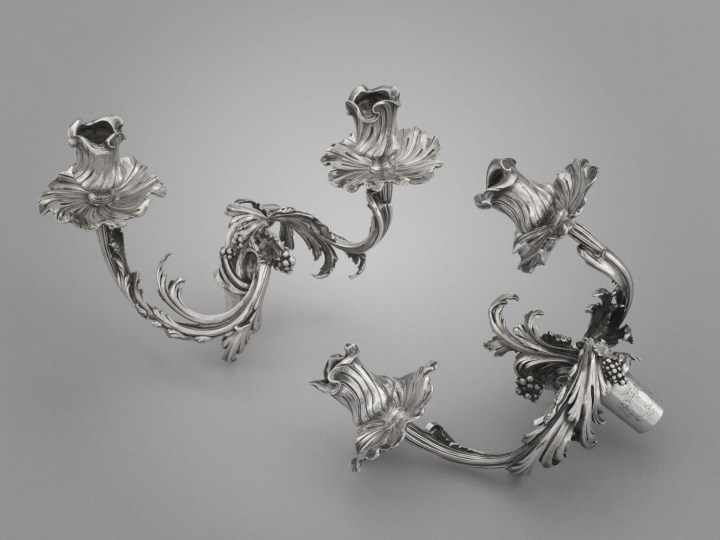
Charles II Ballin (1661–1754), Paire de chandeliers
(Paris: Musée du Louvre, photo by Julien Vidal)
◊ ◊ ◊ ◊ ◊
From the press release for the exhibition:
The Michel Lacoste Donation to the Musée du Louvre:
French Metalwork from Pierre Mangot to Jean-Élisée Puiforcat
Musée du Louvre, Paris, 26 June — 11 January 2027
Curated by Anne Foray-Carlier
The Louvre has opened a special exhibition devoted to a major promised donation from collector Michel Lacoste, bringing together 100 pieces of French silverwork from the 16th to the 18th century. The Michel Lacoste Donation to the Musée du Louvre: French Metalwork from Pierre Mangot to Jean-Élisée Puiforcat will be on view in the museum’s Sully Wing, Room 605, until 11 January 2027. For more than six months, visitors will be able to see the Lacoste pieces displayed together alongside the Louvre’s own holdings of silver and ceramics.
The donation, formalized in November 2025, reflects decades of collecting by Lacoste, the youngest son of French tennis legend René Lacoste, whose nickname ‘the Crocodile’ became the emblem of the famous sportswear brand founded in 1933. Because Michel Lacoste is a Swiss national, the gift was structured as a deferred donation of existing property, meaning the works will become property of the French State upon his death. For now, the Louvre is giving the public a rare opportunity to see the collection as a whole.
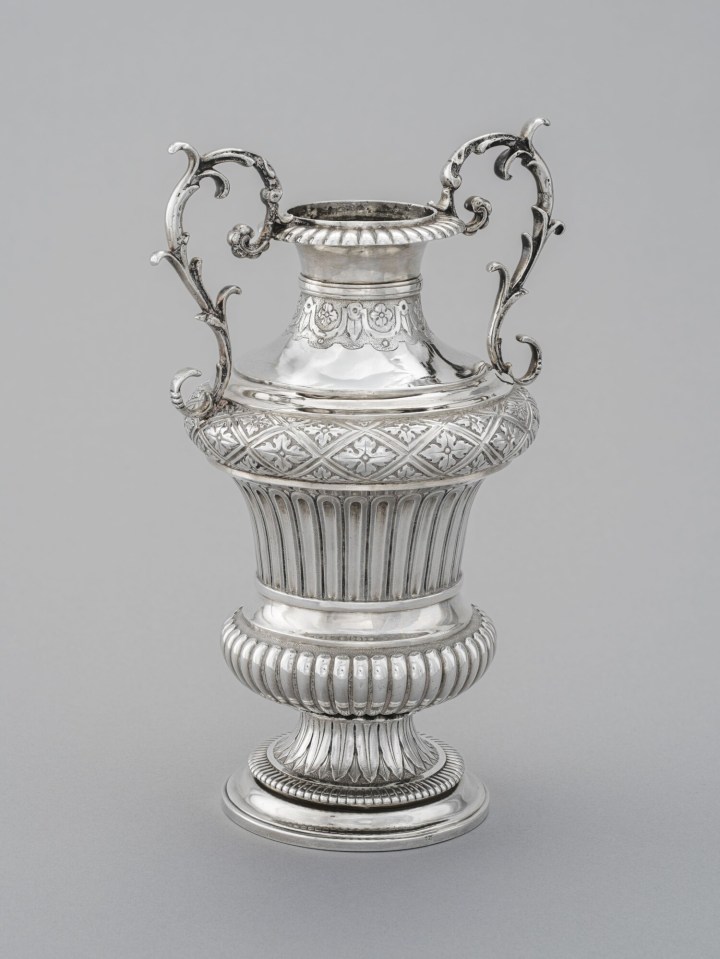
Jean-Baptiste Loir, Vase à deux anses en argent (Silver Two-Handled Vase), 1701–02 (Paris: Musée du Louvre, photo by Julien Vidal).
The 100 works represent roughly a quarter of the silver collection assembled by Lacoste since the 2000s. Chosen in close consultation with the Louvre’s Department of Decorative Arts, the pieces were selected to complement and enrich the museum’s existing holdings, particularly in the area of 17th-century French silverwork. Nearly a quarter of the donation consists of Parisian and provincial works from that century, a field in which examples have become increasingly scarce on the art market.
The display also introduces important names not yet represented in the Louvre’s collection, including Jean-Baptiste Chéret, Pierre-François Bonnestrenne, and Joseph-Théodore Vancombert. Other pieces deepen the museum’s representation of celebrated masters such as Nicolas Delaunay, Claude II Ballin, François-Thomas Germain, and Jacques-Nicolas Roëttiers.
To make room for the donation, the Louvre has reworked the existing presentation in Room 605. Some objects have been temporarily removed, while others from storage have been added to create visual and historical dialogues with Lacoste’s pieces. A colorful scenographic design helps visitors immediately identify the works from the donation and see them in relation to the museum’s permanent collection. The exhibition is curated by Anne Foray-Carlier, Senior Heritage Curator, Department of Decorative Arts.
One of the most notable aspects of Lacoste’s choices is the attention given to provincial centers of French silverwork in the 17th and 18th centuries. While many of these works drew inspiration from Parisian models, they also reveal local originality, technical confidence, and a refined sense of form.
Lacoste’s passion for silverwork began with a catalogue. As a young man, he was given the sale catalogue of the famed Puiforcat collection by his maternal grandmother. The auction, planned for 1955, never took place because the Greek shipowner Stavros Niarchos acquired most of the works and later donated them to the Louvre with reservation of usufruct. That gift transformed the museum’s holdings in French silverwork at a time when the collection was still relatively limited.
Captivated by the Puiforcat collection and by the figure of Louis-Victor Puiforcat as a collector, Lacoste began visiting auction houses, meeting specialized dealers, and building relationships with experts and art historians. His first major acquisitions came during the celebrated sales of the David David-Weill collection in the 1970s. Although he sold part of that early collection in 1999, he soon began collecting again.
With this donation, Lacoste is now sharing a lifelong passion with the public and helping secure the future of a group of works that speak to the elegance, technical brilliance, and historical depth of French silverwork. The choice of the Louvre feels especially fitting. The museum already holds much of the Puiforcat collection that first inspired Lacoste, and with this new donation, that story of collecting, transmission, and public heritage comes full circle.
Call for Papers | Many (More) Antwerp Hands, 1500–1750
From the Call for Papers:
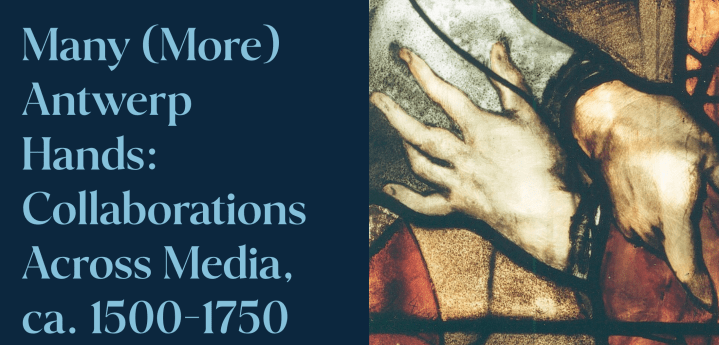
Many (More) Antwerp Hands: Collaborations across Media, 1500–1750
Rubenshuis, Antwerp, 22–23 April 2027
Proposals due by 31 July 2026
In early modern Antwerp, making was rarely a solitary act. Artists and artisans participated in complex processes of production that relied on an array of specialists, materials, techniques, and areas of knowledge. Collaboration as a dominant organizing principle of artistic creation in Antwerp was critically foregrounded in a 2018 Rubenianum conference, which explored how artists pooled their skills, divided their labor, and forged creative partnerships in one of early modern Europe’s most productive artistic centers. An edited volume with its origins in the conference, Many Antwerp Hands: Collaborations in Netherlandish Art, 1400–1750 (Harvey Miller Publishers), was published in 2021. Both the conference and the book positioned painting, and to a lesser extent printmaking, as its primary media.
In the years since, scholarship on early modern Netherlandish art has increasingly turned its attention to media beyond painting and the graphic arts, while also asking new questions about how those media relate to one another. In particular, sculpture and the decorative arts (metalwork, textiles, and glass, among others) have attracted renewed interest. With this interest, there is also a sharper awareness of how these objects rarely emerged from a single hand, discipline, workshop, or material. Instead, artistic production in Antwerp relied on wide networks of contributors whose roles were integral to the conception, execution, and reception of works of art. Collaboration can thus be read across media, among a variety of specialists, and traversing the boundaries imposed by institutional structures and art historical categories.
It is within this context that the Rubenshuis will return to the subject of collaboration in 2027 for the second chapter of Many Antwerp Hands, broadening the conversation to include the full range of media, materials, intermedial exchanges, and actors that shaped artistic life in early modern Antwerp. This conference will take place in the year of the 450th anniversary of Rubens’s birth and look ahead to the planned reopening of the Rubenshuis in 2030, embracing that moment of renewal as an opportunity to imagine a materially diverse and interconnected future for the study of early modern Netherlandish art.
We invite proposals that engage with collaboration across a broad range of media, practices, and perspectives, with early modern Antwerp as their center of gravity. Contributions might address the collaborative making of individual objects, the structures that enabled or constrained collaboration, the movement of designs and materials locally and globally, and the individual actors who shaped Antwerp’s culture of making. Papers may also call into question the spatial or institutional boundaries of artistic collaboration in Antwerp, as well as reconsider the categories through which artistic labor has traditionally been defined and valued. We welcome perspectives from beyond the visual arts, exploring how artisans collaborated with practitioners of the performing and literary arts, or with those working in natural philosophy and the emerging sciences. Finally, we encourage scholarship that sheds light on the contributions of women and underrepresented racial and religious groups connected to Antwerp’s artistic economy.
Papers might address, but are not limited to:
Formal Networks
Guilds, academies, and societies as sites where collaboration is facilitated or constrained
Informal Networks
Collaborations between women and through kinship networks (families, marriages, friendships)
The Workshop
Internal organization, division of labor, and collaborative production
Paper as Catalyst
The role of drawing and design in activating collaborative processes
Travel and Exchange
Antwerp artists collaborating across distances and borders; economic networks as channels for collaboration (trade, supply chains)
Conceptual Collaboration
Shared ideas, programs, and intellectual exchange between makers
Material Transformations
How materials change hands, forms, and meanings across media
Interspherical Collaborations
Exchanges between the visual arts and other spheres of making (i.e. natural philosophy, emerging sciences, performing and literary arts)
Paintings as Objects
The painted surface as a material thing that travels, is reworked, and participates in larger collaborative chains (i.e. frame and panel makers, pigment sourcing and making)
Animal Materials
Substances of animal origin and the collaborative networks their use implies
Gender
Formal and informal roles of women in collaborative artistic production, including in workshops, religious settings, or the domestic sphere
Underrepresented Spaces and Actors
Environments and participants not traditionally recognized as sites of art making
Abstracts of no more than 400 words, accompanied by a short academic bio and up to 2 images (if applicable), should be submitted to manyantwerphands2027@gmail.com by 31 July 2026. Abstracts should clearly articulate the research question addressed, the object(s), artist(s), or material(s) under consideration, and the methodological approaches used to examine them. Speakers can expect to be notified by September 2026. Those whose proposals are accepted will be asked to submit a draft of their paper approximately six weeks before the conference. Papers should be in English and 20 minutes in length. For any questions about the conference or its call for papers, please email manyantwerphands2027@gmail.com.
Organized by the Rubenshuis, Antwerp, with visiting researchers:
• Emily Hirsch (Brown University, United States)
• Hanne Schonkeren (Vrije Universiteit Brussel, Belgium)
• Margot Steurbaut (Rice University, United States)
• Annelies Verellen (McGill University, Canada)
Conference | Sculpture and Trompe l’œil in European Ceramics
From the conference programme:
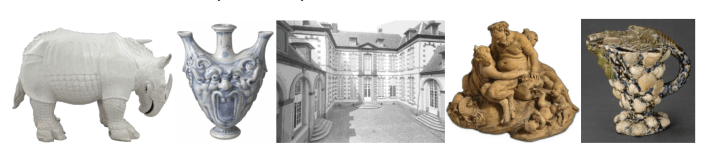
Sculpture and Trompe l’œil in European Ceramics:
From Bernard Palissy to the Present Day
Second Edition of the Annual Conference on European Sculpture and Decorative Arts
Online, 12–13 July 2026
A combined effort of the Centre de Recherches Historiques sur les Maîtres Ébénistes and the Low Countries Sculpture Society, whose libraries and archives have merged and are housed in the Hôtel de la Roche (1750) at Mons, the Annual International Conference had its inaugural edition in July 2025. This edition, dedicated to European ceramics, aims to address issues relating to figurative sculpture in the round, to relief sculpture and to trompe l’oeil, all in the medium of ceramics. This includes the imitation of other materials, such as wood or precious stones, and the mimetic representation of animals and plants. Sculpture and trompe l’oeil are recurring themes but have been little studied in a comprehensive manner in European ceramic art, not even in Art Deco ceramics, which frequently use sculptural forms, both in tableware and in purely decorative pieces.
The term trompe l’oeil comes from the world of easel painting, and the conference will be an opportunity to define more precisely the use and usefulness of this term in the world of ceramics. Our conference proposes to study cases that can shed light on this practice, from the Renaissance to the present day, in terms of the rendering of forms, colours and textures. These cases may concern the production, consumption, collecting and display of these types of ceramics throughout Europe and North America, from the Renaissance to the present day. Issues of design history, collaborations between creators and producers, artists and artisans, as well as the relations with any other people involved in the production of these ceramics may be studied. The theme will draw, in particular but not exclusively, on the rich tradition of ceramics in the Low Countries, from Antwerp majolica, via Tournai porcelain and Bouffioulx stoneware, to contemporary productions.
The conference will take place without audience (apart from the speakers, moderators and a few benefactors), but it will be filmed and broadcast live on YouTube for free, on our dedicated channel, The Low Countries Sculpture Society. The conference proceedings will be published in 2027 in a new academic journal dedicated to European sculpture and decorative arts, based on our annual international conferences.
Scientific Committee
Jean-Dominique Augarde, Centre de Recherches Historiques sur les Maîtres Ebénistes, Paris / Mons
Yves De Leeuw, collector and exhibition curator
Bernard Dragesco, Dragesco-Cramoisan Gallery, Paris / Château de Barly
Errol Manners, historic ceramics specialist, London
Sylvie Millasseau-Wengraf, art historian, Switzerland
Tamara Préaud, formerly Cité de la Céramique, Sèvres, and president, The French Porcelain Society, London
Miriam E. Schefzyk, The J. Paul Getty Museum, Los Angeles
Volker Seiberth, University of Heidelberg / The Low Countries Sculpture Society
Pier Terwen, art historian and conservator of sculpture and ceramics, Leiden
Organising Committee
Katia Berseneva, Ecole du Louvre, Paris / The Low Countries Sculpture Society
Guillaume Hambye, notary, Mons
Laurence Lenne, Galerie Art & Patrimoine, Ath
Léon Lock, The Low Countries Sculpture Society, Brussels / Mons
Grégory Maugé, Centre de Recherches Historiques sur les Maîtres Ébénistes, Paris / Mons
Thierry Naveaux, The Low Countries Sculpture Society, Brussels / Mons
Sébastien Tercelin de Joigny, Tercelin de Joigny Gallery, Mons / Seneffe
Jenny Tondreau, Collegiate church of Sainte-Waudru, Mons
s u n d a y , 1 2 j u l y
9.30 Léon Lock (The Low Countries Sculpture Society) — Introduction
10.05 Keynote Lecture
• Patricia Ferguson (London) — Artifice and Spectacle: the Conceit of a Lettuce as Large as Life for the European Table in the Mid-18th Century
11.00 Break
11.30 Session 1 | Trompe l’œil and Mimesis I
Moderator: Errol Manners
• Melody Hsu (McGill University, Montreal) — Book Flask: Trompe l’Œil and Deception in Early Modern Europe
• Mariette Boudgourd (École Pratique des Hautes Études, Paris) —Jardinières bûches, verres paysages et cendriers poissons. De nouvelles formes de la nature « genre Palissy » au XIXe siècle en France
12.45 Lunch break
14.00 Session 2 | Trompe l’œil and Mimesis, II
Moderator: Volker Seiberth
• Nadia Mariana Consiglieri, Universidad de Buenos Aires — Reptiles, amphibians and trompe l’œil in a Bernard Palissy ceramic piece from the Museum of Decorative Arts in Buenos Aires
• Carina-Nathalia Madonna Visconti-Paff (Sapienza Università di Roma) — The Illusion of Lustre: Trompe l’œil in Hungarian Zsolnay Ceramics, Eosin Imitations of Metals and Nature in the Art Nouveau Style
15.15 Break
15.45 Session 3 | The Sculptor and the Sculptural in Ceramics
Moderator: Bernard Dragesco
• Jean-Dominique Augarde (Centre de Recherches Historiques sur les Maîtres Ebénistes, Paris/Mons) — Piat Joseph Sauvage et le Salon de 1798
16.20 Keynote Lecture
• Errol Manners (historic ceramics specialist, London) — Louis-François Roubiliac and Chelsea Porcelain: A Reassessment
m o n d a y , 1 3 j u l y
9.30 Session 4 | Manufactures, Workshops, and Sculptors in Ceramics
Moderator: Sylvie Millasseau-Wengraf
• Valérie Montens (Musées royaux d’Art et d’Histoire, Brussels) and
Elise Urbain Ruano (Domaine & Musée royal de Mariemont) — Entre virtuosité technique et langage décoratif : la sculpture en porcelaine à la manufacture d’Ixelles de 1830 à 1953
• Carys Wilkins et Claire Blakey (National Museums Scotland, Edinburgh) — European Ceramic Sculpture Rediscovered at National Museums Scotland
• Grégory Maugé (Centre de Recherches Historiques sur les Maîtres Ébénistes, Paris / Mons) and Léon Lock (The Low Countries Sculpture Society, Brussels / Mons) — La sculpture en céramique en Hainaut au XXe siècle
Call for Papers | The Art of Failure, 1450–1900
From ArtHist.net:
The Art of Failure: Hybridity, Risk and the Limits of Artistic Projects, 1450–1900
Die Kunst des Scheiterns: Hybridität, Risiko und die Grenzen des
künstlerischen Handelns, 1450–1900
9th Philipp Hainhofer Colloquium, Augsburg, 19–21 March 2027
Proposals due by 30 September 2026
The Augsburg art entrepreneur Philipp Hainhofer (1578–1647) designed highly elaborate display furniture, most of which contained numerous, equally masterfully crafted fittings and ranked among the most complex works of art of his time. Whilst the Pomeranian Art Cabinet (1611–1617), the earliest of these grand pieces of furniture, was created as a commissioned artwork, Hainhofer had his later major projects produced only for the open market. These works combined artistic and iconographic conception, the organisation of a collaborative working process that brought together a wide variety of arts, the marketing of the finished product, and, not least, logistics, transport and conservation. His late pieces of furniture reached such a degree of complexity and scale that, whilst exceptionally artistic, they were virtually impossible to sell due to their high prices and the difficulty of handling them. In other words: Hainhofer deliberately pursued an artistic concept, even though it was fraught with a high risk of failure.
For this reason, the 9th Philipp Hainhofer Colloquium has chosen the issue of failure in the arts and sciences as its starting point. As is known, Hainhofer was not only an art agent; he also acted as a mediator of knowledge and political information. Consequently, the focus will be on projects and works in the visual arts as well as those in the field of knowledge dissemination, spanning from the late Middle Ages to the period around 1900. The aim is to take a comparative approach to examine specific projects in art and book production against the backdrop of the risk of failure and to identify the critical factors involved.
A variety of aspects may play a role here. First, the general conditions must be addressed, such as material and technical problems during production or innovation processes leading to new, experimental, yet untested methods. Furthermore, the discrepancy between the artistic or publishing ambitions of producers on the one hand, and market pressures and the expectations of audiences and clients on the other, can be identified as a key reason projects might fail. Ambitions and strategies of competition can escalate to such an extent during the creative process that, from a certain point onwards, projects become unmanageable and resources—both in terms of time and funding—are stretched to breaking point. Furthermore, such projects may become difficult to communicate to the public or remain incomprehensible due to a lack of comparability, a consideration that applies not only to art but also, in a similar vein, to publishing ventures. Likewise, the aspect of functionality must be taken into account, particularly in projects involving architecture and the applied arts, but also in sculpture (for example, in the case of funerary monuments).
The planned conference will therefore focus primarily on the inherent momentum of artistic and scientific working processes, under the key concepts of ‘hybridisation’, ‘complexity’ and ‘scale’. The scope is intended to encompass all genres of art and book production, ranging from projects such as Hainhofer’s art cabinets to the concept of the Gesamtkunstwerk in the late 19th century.
Researchers from all academic disciplines are therefore invited to submit proposals for an interdisciplinary exchange on the conference theme. Please send your proposal (max. 2000 characters) together with a CV (including details of relevant publications, if applicable) by 30 September 2026 to: Hainhofer-Kolloquium-9@t-online.de
Travel and accommodation costs for speakers (in the case of tandem teams, usually for one person only) will be covered by the organiser. If you are traveling from abroad, we will also try to cover the costs, but we may only be able to cover a portion of the travel costs. The conference languages are German and English. PhD students and postdoctoral researchers are strongly encouraged to apply.
Accepted papers will be published in an edited volume by Andreas Tacke, Michael Wenzel, and Marika Keblusek, in the Hainhoferiana series by Michael Imhof Verlag (Petersberg) in March 2028; the deadline for submission of all manuscripts is 3 October 2027.
Organised and funded by the DFG long-term project (HAB, Wolfenbüttel and the LEUCOREA Foundation, Lutherstadt Wittenberg) for the annotated digital edition of Philipp Hainhofer’s travel and collection accounts (namely Prof. Dr. Dr. Andreas Tacke) and the Institute for European Cultural History (IEK) at the University of Augsburg (namely Prof. Dr. Günther Kronenbitter and Prof. Dr. Ulrich Niggemann) in cooperation with Dr. Michael Wenzel (Herzog August Bibliothek, Wolfenbüttel) and Dr. Marika Keblusek (Associate Professor at the Leiden University Centre for the Arts in Society).










leave a comment