Exhibition | Inspired by Flaxman
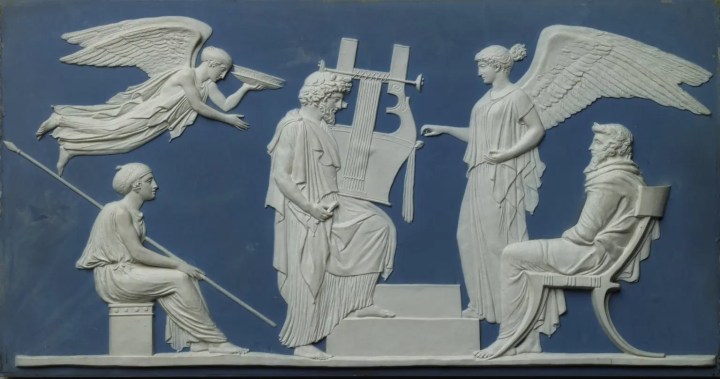
Wedgwood, The Apotheosis of Homer, 1777–80
(National Museums Liverpool, Lady Lever Art Gallery)
◊ ◊ ◊ ◊ ◊
Now on view at the York Art Gallery:
Turner, Wedgwood, and Beyond: Inspired by Flaxman
York Art Gallery, 18 September 2026 — 17 January 2027
Curated by Beatrice Bertram and Richard Johns
Marking 200 years since the death of York-born artist John Flaxman, this exhibition celebrates his life, work, and lasting influence on art and design.
Showcasing Flaxman’s remarkable skill as a draughtsman, sculptor, and designer, the exhibition explores his influence on fellow artists including J.M.W Turner, William Blake, and potter Josiah Wedgwood. Objects from York Art Gallery’s collection are displayed alongside key loans from UK institutions including the National Gallery, Royal Academy, V&A, and the Barber Institute of Fine Art, amongst others.
Flaxman is one of the York-born artists engraved into the façade of York Art Gallery, celebrating the incredible talent that emerged from the city. Following classic Grecian and Roman styles, Flaxman’s designs were used on the iconic Wedgwood pottery as well as inspiring drawings, paintings, stonework, buildings, sculpture, metalwork, chess pieces, funerary monuments, and more. Though not as well-known as Turner or Wedgwood have come to be, Flaxman had a significant influence on art that extends through to modern day from humble beginnings in the city.
Turner, Wedgwood, and Beyond: Inspired by Flaxman is curated by Beatrice Bertram, Senior Curator at York Art Gallery, and Richard Johns, Senior Lecturer in the History of Art at the University of York. The exhibition has been supported by and produced in partnership with the University of York’s History of Art Department and accompanied by an academic publication, this is the first major exhibition dedicated to Flaxman in York.
◊ ◊ ◊ ◊ ◊
From Paul Holberton Publishing with distribution by Yale UP:
Beatrice Bertram and Richard Johns, eds., Turner, Wedgwood, and Beyond: Inspired by Flaxman (London: Paul Holberton Publishing, 2026), 128 pages, ISBN: 978-1917976220, £25 / €30 / $35.
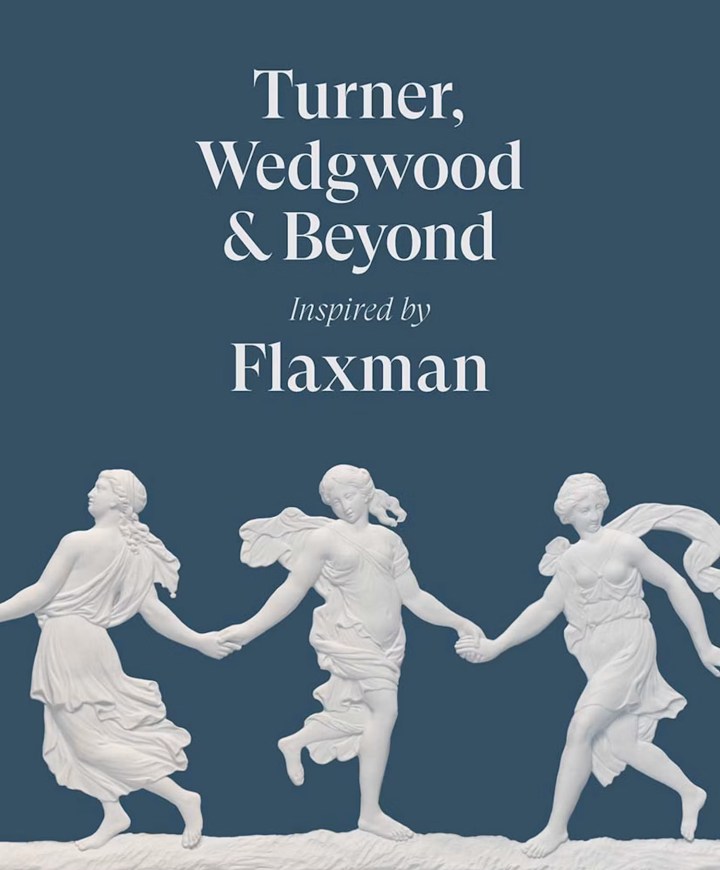 This collection of thought-provoking new writing explores the far-reaching creative legacy of the sculptor, designer, and illustrator John Flaxman (1755–1826). Timed to coincide with the bicentenary of Flaxman’s death in 1826, it accompanies a major exhibition at York Art Gallery, developed in collaboration with the University of York.
Flaxman found his subjects in the epic myths of ancient Greece and on the streets of modern Rome, in the drama of a game of chess, and in the global events that unfolded in his lifetime. His work has, in turn, inspired generations of artists and makers. For the first time in more than 40 years, Turner, Wedgwood, and Beyond: Inspired by Flaxman explores the full range and impact of the artist’s work across different media. A collection of insightful essays and shorter ‘objects in focus’ by leading curators, artists, art historians, and literary critics introduce Flaxman for a new audience, as an artist whose work in ceramic, marble, silver and gold, and on paper continues to resonate.
Each author takes an object or concept from the exhibition as a starting point to bring new light to Flaxman’s legacy, including the creative dialogue between his art and the work of William Blake, William Etty, Henry Fuseli, Angelica Kauffman, J.M.W. Turner, and Josiah Wedgwood. The result is an ambitious reframing of the artist’s creative connections, with new perspectives on the collaborative nature of Flaxman’s enterprise, his identity as a disabled artist, the colonial reach of his monumental sculpture, the poetical legacies of Homer, Dante and Shakespeare, and more.
Turner, Wedgwood and Beyond: Inspired by Flaxman is edited by the exhibition co-curators, Beatrice Bertram and Richard Johns, with additional contributions by Pat Barker (Booker Prize winner and author of The Silence of the Girls), Kenneth Clark (University of York), Jason Edwards (University of York), Tony Heaton (sculptor and disability activist) and Martin Myrone (art historian), Catrin Jones (V&A Wedgwood Collection), Brigid von Preussen (Oxford University), Erica Sheen (University of York), and Michael Smith (University of York).
Call for Applications | Distant Viewing Workshops
From ArtHist.net and the University of Richmond’s Distant Viewing Lab:
Mellon Distant Viewing Workshops
Online, 15–18 February 2026, meets virtually each day from 10am to 2pm (Eastern time)
In-person, University of Richmond, 8–11 March 2026
Applications due by 31 October 2026
The Distant Viewing Lab at the University of Richmond invites applications for two separate training workshops in 2027 sponsored by the Mellon Foundation.
Over four days, participants will learn
• ways to formulate humanities questions that are amenable to computational analysis
• how to apply state-of-the-art AI algorithms to study visual and multimodal collections
• develop custom AI annotations to understand an image archive of their choice
• theory and method of distant viewing
The March workshop will have an emphasis on teaching and research in a liberal arts environment.
We welcome applications from researchers with a range of backgrounds and experiences, including but not limited to: art history, data science, digital humanities, film and media studies, library and information science, museum studies, and science and technology studies. Whether based in the United States or abroad, participants may also be at different points in their careers, including PhD candidates, early-career researchers, faculty at any rank, and those based in museums, archives, libraries, and related areas. We anticipate about 15 people per workshop.
Due by 31 October 2026, application materials include: CV/résumé and a statement of interest (300–500 words) that addresses current research or interests related to distant viewing or visual culture, what you hope to gain from the workshop, and (optionally) how you might apply what you learn. There is no technical background required for participation; however, please briefly describe any relevant background you may have (prior coursework, tools you’ve used, related projects).
A stipend to cover travel and related expenses will be provided thanks to a generous grant from the Mellon Foundation. Applicants can expect to hear back by 13 November 2026. More about the Distant Viewing Lab is available here. Please address any questions to jennifer.marine@richmond.edu. Please submit applications to https://distantviewing.org/workshops/.
New Book | Birth of a Global City: London in a Revolutionary World
From Penguin Random House:
Jerry White, Birth of a Global City: London in a Revolutionary World, 1789–1815 (London: Bodley Head, 2026), 528 pages, ISBN: 978-1847927354, £30.
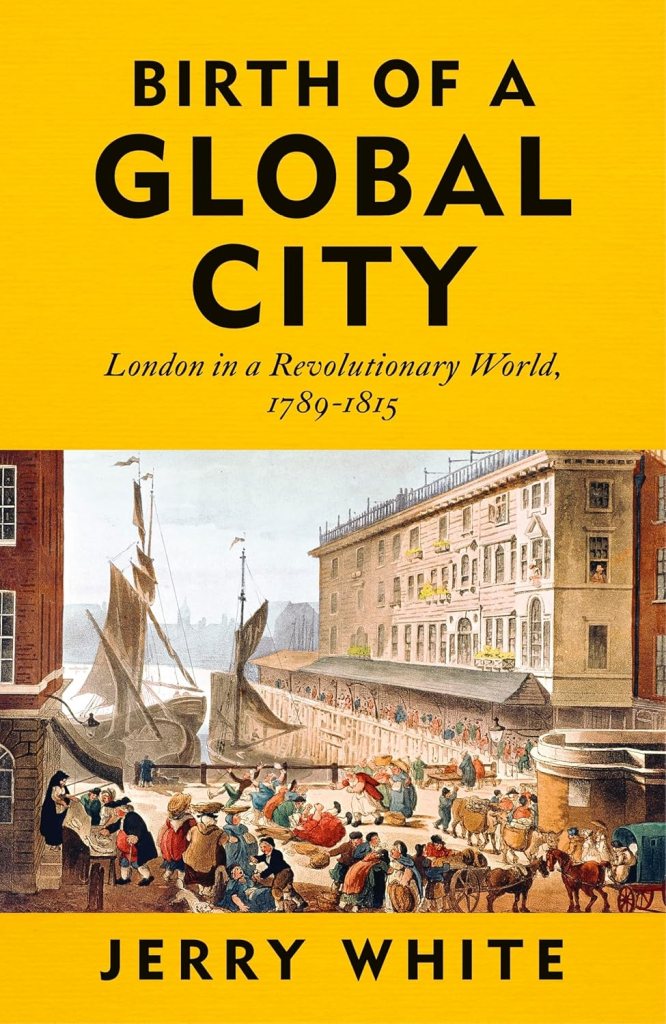 The French Revolutionary and Napoleonic Wars changed London beyond recognition, turning it into the capital of the world—the centre of international finance and trade. Victory over France in 1815 ushered in the ‘British Century’: the next hundred years would be defined by Britain’s capitalist innovation and financial might, naval supremacy and imperial ambition. In this brilliant portrait of these pivotal years, Jerry White looks at how revolution and war on the Continent transformed the capital. While the manufacture of war materials brought wealth for some, high food prices led to bread riots. The war divided public opinion, with ultra-patriots clamouring for the defeat of ‘Boney’, while others sought to emulate the democratic reforms pioneered across the Channel. Crucially, the chaos and uncertainty on the continent led to a mass flight of aristocratic wealth, foreign bankers and European merchants to London, which would help turn the capital into the world’s leading financial centre.
Jerry White shows how huge docks transformed the Port of London into the world’s trading centre; how the City of London financed the war against France and Nathan Mayer Rothschild provided the gold that crushed Napoleon at Waterloo; how a newly embellished Paris stimulated the reconstruction of central London and fuelled its expansion; and how this moment of Britain’s greatest imperial expansion revived briefly the London slave trade before it was finally ended in 1807. It was this turbulent period of war and political turmoil that created London as we know it today.
Jerry White teaches London history at Birkbeck, University of London. He is the author of an acclaimed trilogy of London from the eighteenth to the twentieth centuries. His more recent books include Mansions of Misery: A Biography of the Marshalsea Debtors’ Prison and Zeppelin Nights: London in the First World War. He was awarded the honorary degree of Doctor of Literature by the University of London in 2005 and is a Fellow of the Royal Historical Society.
c o n t e n t s
A Note on Money
Maps
Prologue: A World Turned Upside Down
Part 1 | Chaos, 1789–1801
1 Divided City
2 Gateway to a Turbulent World
3 Pitt’s Gold
Part 2 | Foundations, 1802–1815
4 Revolution on the River
5 Party v Country
6 Wellington’s Gold
7 London Remade
Afterword: The End of the Beginning
Acknowledgments
List of Illustrations
Notes
Bibliography
Index










leave a comment