Met Names Andrea Bayer Deputy Director for Collections, Administration
Press release (8 November 2018) from The Met:
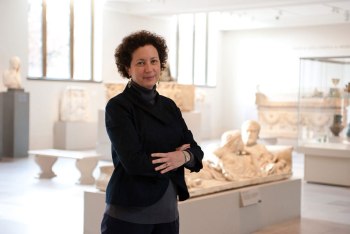
Andrea Bayer (Photo courtesy of The Metropolitan Museum of Art).
Max Hollein, Director of The Metropolitan Museum of Art, announced today that Andrea Bayer has been appointed Deputy Director for Collections and Administration. In May 2018, Dr. Bayer was appointed Interim Deputy Director for Collections and Administration, continuing in her position as Jayne Wrightsman Curator in the Department of European Paintings.
“Andrea Bayer is a highly respected scholar, an imaginative exhibition curator, and an esteemed colleague at The Met,” said Hollein. “Throughout her time as Interim Deputy Director and before, she has shown exceptional leadership and great loyalty to our beloved Museum. I have been deeply impressed by her commitment and capabilities during my first few months as Director of the Museum and am excited that she has just accepted our offer to become Deputy Director.”
“As Curator in the Department of European Paintings, often working on projects that went across multiple departments, I know how rewarding it is to work alongside colleagues throughout the Museum,” said Bayer. “I am thrilled to take on this new role, one which will allow me both to support the Director and continue to collaborate with these colleagues on an institutional level.”
Since joining The Met’s Department of European Paintings in 1990 as a scholar of Italian Renaissance art, Andrea Bayer has curated groundbreaking exhibitions including Dosso Dossi, Court Painter in Renaissance Ferrara (1999); Painters of Reality: The Legacy of Leonardo and Caravaggio in Lombardy (2004); Art and Love in Renaissance Italy (2008–09); and the current exhibition Celebrating Tintoretto: Portrait Paintings and Studio Drawings, with Alison Manges Nogueira, Associate Curator in the Robert Lehman Collection. Bayer also co-curated Unfinished: Thoughts Left Visible, one of the inaugural exhibitions at The Met Breuer.
Bayer was named Curator in European Paintings in 2007 and was appointed Jayne Wrightsman Curator in 2014. She served as Interim Head of Education in 2008–09 and for six years acted as coordinating curator for the Curatorial Studies program with New York University’s Institute of Fine Arts. Bayer is also Co-Chairman of the Director’s Exhibition Committee.
In addition to authoring numerous exhibition catalogs, Bayer has written two Museum Bulletins and recently co-authored two articles for the Metropolitan Museum Journal: “Andrea del Sarto’s Borgherini Holy Family and Charity: Two Intertwined Late Works” and “An Examination of Paolo Veronese’s Portrait of Alessandro Vittoria,” both in volume 52 (2017).
Andrea Bayer studied at Barnard College and Princeton University and received her PhD from Princeton University in 1990.
Conference | HECAA Sessions at UAAC, 2018
Thanks to Christina Smylitopoulos for again chairing this year’s HECAA sessions at UAAC. Next year’s conference is scheduled for Québec City. Full program details for 2018, including abstracts and speaker information, is available here.
Universities Art Association of Canada / l’association d’art des universités du Canada
University of Waterloo, Ontario, 25–27 October 2018
F R I D A Y , 2 6 O C T O B E R 2 0 1 8
HECAA Open Session, Part 1, 2:00–3:30
Chair | Christina Smylitopoulos (University of Guelph)
1 Sarah Carter (McGill University), Physiognomies of Genius: Competition and Friendship in Aphorisms on Man
2 Andrea Korda (University of Alberta), The Eclipse of Visual Education? Object Lessons from Pestalozzi to Mayo
3 Loren Lerner (Concordia University in Montreal), The Infant, the Mother, and the Breast in the Paintings of Marguerite Gérard
HECAA Open Session, Part 2, 4:00–5:30
Chair | Christina Smylitopoulos (University of Guelph)
1 Caroline Murphy (MIT), Sensation and Sacred History: The Museo Sacro in Eighteenth-Century Rome
2 Alena Robin (Western University), Transatlantic Perspectives of a Passion Series by Mexican Painter José de Ibarra
3 Justina Spencer (Carleton University), Sartorial Alterity and the Cartographic Impulse: Costume Illustrations in French Travel Memoirs of the Ottoman Empire
New Book | Becoming Property
From Yale UP:
Katie Scott, Becoming Property: Art, Theory, and Law in Early Modern France (New Haven: Yale University Press, 2018), 384 pages, ISBN: 978-0300222791, $75.
 This original and relevant book investigates the relationship between intellectual property and the visual arts in France from the 16th century to the French Revolution. It charts the early history of privilege legislation (today’s copyright and patent) for books and inventions, and the translation of its legal terms by and for the image. Those terms are explored in their force of law and in relation to artistic discourse and creative practice in the early modern period. The consequences of commercially motivated law for art and its definitions, specifically its eventual separation from industry, are important aspects of the story. The artists who were caught up in disputes about intellectual property ranged from the officers of the Academy down to the lowest hacks of Grub Street. Lessons from this book may still apply in the 21st century; with the advent of inexpensive methods of reproduction, multiplication, and dissemination via digital channels, questions of intellectual property and the visual arts become important once more.
Katie Scott is Professor of History of Art and Architecture at the Courtauld Institute of Art, London.
Lecture | Katie Scott on Artists as Consumers
From BGC:
Katie Scott | Artists as Consumers:
A Picture, a Snuffbox, a Teacup, a Carriage, an Umbrella, and a Bath
Bard Graduate Center, New York, 5 December 2018
Katie Scott will deliver a Françoise and Georges Selz Lecture on Eighteenth- and Nineteenth-Century French Decorative Arts and Culture on Wednesday, December 5, at 6pm. Her talk is entitled “Artists as Consumers: A Picture, a Snuffbox, a Teacup, a Carriage, an Umbrella, and a Bath.”
This paper is part of a collaborative research project into the material culture of eighteenth-century French artists. It focuses not on the studio, however, but on the domestic interior and on the diverse stuffs of social life. It asks how prominent artists such as Nicolas de Largillière, Jean-Baptiste Oudry, Jean-Baptiste Pigalle, and Jacques-Philippe Le Bas responded to the range of consumer goods, both luxury and every-day, flooding the Parisian market in which they lived and worked. Did ownership of gold boxes and porcelain, and also baths and umbrellas, serve to articulate artistic identity in new ways? Was that artistic identity single and determined largely by official institutions such as the Académie royale de peinture et de sculpture, or was it multiple and inflected by individual taste and patterns of consumption? In short, what did material things mean to artists, and what did these same things say about them?
Katie Scott is Professor in the History of Art at the Courtauld Institute of Art in London. She has a longstanding interest in the interior and in seventeenth- and eighteenth-century French decorative arts, which she teaches at both the undergraduate and graduate level, and which is the focus of much of her research. Her current research project, which she will present in this lecture, is a collaboration with Dr. Hannah Williams (Queen Mary University, London) that will result in a book to be published by Getty Publications in 2020.
Call for Articles | Boletín de Arte, Special Issue on Animals
From H-ArtHist:
Boletín de Arte 40 (2019), Special Issue: Animals and Art History
Edited by Reyes Escalera Pérez and Concepción Cortés Zulueta
Articles due by 28 February 2019 (in Spanish, English, French, or Italian)
As humans, we live surrounded by animals that we often ignore, or that we tend to substitute with or filter through our meanings, perceptions and symbolism. However, in recent decades animals have been increasingly present among the concerns and interests of our societies not just through their representations, but also as subjects and agents whose perspectives are worth considering. In parallel, animal studies (or human-animal studies) have reclaimed animals as a field of inquiry of the humanities and social sciences, including art history. This transversal approach is usually acquainted with biology and other related disciplines, interacts with other area studies (gender, postcolonial, queer, etc.), and is reinforced and may be accompanied by frameworks like posthumanism, or by environmental concerns.
This Animals and Art History issue of Boletín de Arte is open to address the subject of non-human animals from all periods, methodologies and approaches of art history. Possible topics include, but are by no means limited to, the following:
• Representations of animals (portraits, photographs, scientific illustrations, etc.)
• Biographies of historical or artistic animals
• Emblems and treaties on animals
• Museums and animals, animals inside the white cube
• Nature and symbology of animals
• Artistic genres or topics about animals
• Artists and their animals
• Artists who collaborate with other animals
• Animals as creators or artistic agents
• Cinema and animals
• Videos of animals on the Internet
• Animals, art and gender
• Animal activism and art
• Eco-art and animals
• Art or designs for other animals
• Animals and aesthetics
In order to be accepted for consideration and double blind peer reviewed evaluation, the articles have to address the topic of Animals and Art History with a maximum of 31,500 characters (including spaces) and with no more than 10 images. The submission has to be made on-line, by registering through the on-line platform of the Boletin. Please find detailed submission guidelines at the Boletín’s website (scroll down for the guidelines’ English version).
Boletín de Arte, an open access journal edited since 1980 by the Department of Art History, University of Málaga, proposes a special thematic issue commemorating its 40th anniversary. This special issue will focus on the representation, presence, and agency of non-human animals in art history and visual culture.
Please note that this CFP and special thematic issue affects only the ‘Articles’ and ‘Varia’ sections, not the sections of ‘Book Reviews’ and ‘Exhibition Criticism’. For any queries, contact Reyes Escalera (drescalera@uma.es) and Concepción Cortés (ccorteszulueta@uma.es).
Conference | Moving Landscapes: Gardens
From The Huntington:
Moving Landscapes: Gardens and Gardening in the Transatlantic World, 1670–1830
The Huntington Library, Art Collections, and Botanical Gardens, San Marino, 7–8 December 2018
Both as physical locations and as fantasies of selfhood, gardens always speak of where and how we see ourselves in the world. Focusing on the imagination and creation of gardens in the disparate geographies of 18th-century Europe, the Caribbean, and North America, this conference explores transatlantic ideas of nation, location, and self, and asks how the experience of gardens might be shared across nations, oceans, and cultures.
Funding provided by The Huntington’s William French Smith Endowment and The USC-Huntington Early Modern Studies Institute
F R I D A Y , 7 D E C E M B E R 2 0 1 8
8:30 Registration and coffee
9:30 Welcome by Steve Hindle (The Huntington) and opening remarks by Stephen Bending (University of Southampton)
Session 1 | Making Places in the Atlantic World
Moderator: Stephen Bending
• John Dixon Hunt (University of Pennsylvania), Raising the Veils of Isis, Then What?
• Tom Williamson (University of East Anglia), Production, Power and the Natural: Explaining the Differences between English and American Gardens in the Eighteenth Century
12:00 Lunch
1:00 Curatorial tours of the botanical collections
3:00 Session 2 | New World Landscapes and Transatlantic Imaginings
Moderator: Jennifer Milam (University of Melbourne)
• Therese O’Malley (NGA CASVA, Washington, D.C.), The Garden in the Wilderness
• Joseph Manca (Rice University), The Human Presence in George Washington’s Gardens at Mount Vernon
S A T U R D A Y , 8 D E C E M B E R 2 0 1 8
9:00 Registration and coffee
9:30 Session 3 | Planting the Transatlantic Garden
Moderator: Stephen Bending
• Finola O’Kane Crimmins (University College Dublin), Improving the Atlantic World: Transatlantic Tourists and their Landscape Designs, Comparisons and Route
• Elizabeth Hyde (Kean University), A Reciprocal Exchange of the Productions of Nature: Plants and Place in France and America
11:00 Session 4 | Transatlantic Designs
Moderator: Jennifer Milam
• Emily Cooperman (ARCH Preservation Consulting), The Last Polish of a Refined Nation: Philadelphia and Garden Art in the Atlantic World
• Jonathan Finch (University of York), The Estate Landscape: A Transatlantic Dialogue
1:00 Lunch
2:00 Session 5 | Experiencing the Transatlantic Landscape
Moderator: Stephen Bending
• Jill Casid (University of Wisconsin-Madison), Landscape Vertigo
• Rachel Crawford (University of San Francisco), Fragmented Gardens
4:00 Roundtable
4:30 Closing remarks by Jennifer Milam
Call for Session Proposals | EAHN 2020, Edinburgh
From EAHN:
European Architectural History Network Sixth International Meeting
University of Edinburgh, 10–13 June 2020
Proposals due by 31 December 2018
 EAHN2020 takes place at the University of Edinburgh. The call for sessions and roundtable proposals is now open, with details available here.
A UNESCO World Heritage Site since 1995, Edinburgh has a well-preserved Medieval Old Town, a New Town built in the early 19th century on Enlightenment principles, and some of the UK’s best examples of post-war modernism. Edinburgh is also the seat of the remarkable Scottish Parliament designed by Miralles Tagliabue EMBT, which opened in 2004. Edinburgh is a city in which questions of architectural history are unusually live: What to build, what not to build, and what to preserve are questions at the centre of both local and national political debate. EAHN2020 will be based in the central George Square campus and will make use of the extraordinary Playfair Library, amongst other notable buildings. Join us for an extensive programme of architectural tours, of the city and the region. EAHN2020 promises to be an outstanding conference. It will be accompanied by an exhibition at the Talbot Rice Gallery, with four specially commissioned works of art on an architectural theme.
Proposals are sought in two basic formats: (1) a session and (2) a roundtable debate. A session should consist of 4–5 paper presentations, with a respondent and time for dialogue and discussion at the end. A roundtable debate should be an organised as a discussion between panel members, and the format would suit topics of particular urgency or contemporary relevance. Roundtables should also aim to activate audience discussion as far as possible. Sessions and roundtables may be chaired by more than one person.
Anyone wishing to chair a session or a roundtable debate is invited to submit proposals by 31 December 2018. Chairs should make clear whether their proposal is a session or a roundtable. Please note that EAHN is self-funding, and chairs are expected to provide all their conference expenses, including travel and accommodation.
Key Dates
September 2018 Call for Sessions and Round Table Proposals opens
December 2018 Call for Sessions and Round Table Proposals closes
April 2019 Final selection of sessions and round tables
May 2019 Call for Papers opens
September 2019 Call for Papers closes
October 2019 Final selection of abstracts by chairs
December 2019 Draft Programme Available
January 2020 Early bird registration opens
February 2020 Registration Deadline for all chairs and speakers
March 2020 Comments on papers by chairs
April 2020 Submission of final version of papers
10–13 June 2020 EAHN International Conference
Thomas Campbell to Direct the Fine Arts Museums of San Francisco
From the FAMSF press release (30 October 2018). . .

Photo by Scott Rudd; courtesy Fine Arts Museums of San Francisco.
The Board of Trustees of the Fine Arts Museums of San Francisco (FAMSF) and the Corporation of the Fine Arts Museums (COFAM) today appointed Thomas P. Campbell as the new director and CEO of the largest public arts institution in Northern California, effective 1 November 2018. As head of FAMSF, which comprise the de Young museum in Golden Gate Park and the Legion of Honor in Lincoln Park, Mr. Campbell will oversee a wide-ranging curatorial program and education programs and will manage a staff of more than 500.
“I am deeply gratified to take up the responsibility of leading the Fine Arts Museums of San Francisco,” Campbell said. “It is a great privilege to become part of an institution with such outstanding curatorial expertise and famously loyal audiences and supporters, and I am especially pleased to have the opportunity to continue the great work done by my friend and predecessor Max Hollein. I am eager to begin collaborating with the Trustees, the staff, and the entire cultural network of San Francisco.”
Mr. Campbell served as Director and CEO of The Metropolitan Museum of Art from 2009 to 2017, having joined the Met as a curator in 1995. During his tenure at the Met, he led a revitalization and modernization achieved through award-winning exhibitions and publications, major capital projects, and historic donations of works of art. Attendance grew by more than 50 percent to a record seven million visitors a year, with audiences that are now more diverse than ever before.
Most recently, from November 2017 through October 2018, he was a Getty/Rothschild Fellow with residencies at the Getty Research Institute in Los Angeles and at Waddesdon Manor in the UK, undertaking independent study of the impact of global changes on museums and cultural life in general. . . .
Over his thirty-year career, Mr. Campbell has dedicated his life to the preservation, study and promotion of art as a gateway to human understanding. A distinguished art historian who was educated at Oxford and the Courtauld Institute, University of London, he joined the Metropolitan Museum of Art in 1995 as an assistant curator in the Department of European Sculpture and Decorative Arts and supervising curator of the Antonio Ratti Textile Center. As curator, he conceived and organized the acclaimed exhibitions Tapestry in the Renaissance: Art and Magnificence (2002) and Tapestry in the Baroque: Threads of Splendor (New York, 2007; Madrid, 2008). The 2002 exhibition was named ‘Exhibition of the Year’ by Apollo Magazine, and its catalogue won the Alfred H. Barr, Jr. Award (College Art Association) for distinguished exhibition catalogue in the history of art (2003). His book, Henry VIII and the Art of Majesty: Tapestries at the Tudor Court, a reappraisal of the art and patronage of the era, was published in 2007.
During his tenure as Director, he elevated the Met’s national and international profile through conservation exchanges in the Middle East and India, ambitious loan exhibitions in China, Japan and Brazil, the launching of a biannual global museum directors’ colloquium, and a new international donor council.
Exhibition | Sidesaddle, 1690–1935

Johan Zoffany, The Drummond Family, detail, ca. 1769, oil on canvas, 41 × 63 inches
(New Haven: Yale Center for British Art, Paul Mellon Collection)
◊ ◊ ◊ ◊ ◊
On view at the National Sporting Library & Museum:
Sidesaddle, 1690–1935
National Sporting Library & Museum, Middleburg, VA, 8 September 2018 — 24 March 2019
Curated by Ulrike Weiss and Claudia Pfeiffer
In art and sport, the poised equestrian riding aside embodies the essence of elegance, power, and grace. Hidden beneath the flowing skirts of the rider is the sidesaddle, the design of which has evolved dramatically in response to the physical demands of sporting women (and sometimes men) requiring a firm seat as they began to meet the challenges of jumping and galloping across the countryside.
Sidesaddle, 1690–1935 presents a revealing perspective on the history and culture of women as equestrians, their depictions in sporting art, and the evolution of sidesaddle tack and attire represented in British, Continental, and American art from the 17th to the 20th centuries. The exhibition showcases over sixty paintings, works on paper, and sculptures on loan from museums and private collections. Co-curators Dr. Ulrike Weiss, Lecturer at the University of St. Andrews in Scotland, and Claudia Pfeiffer, the George L. Ohrstrom, Jr. Curator of Art at NSLM, are contributing essays to the accompanying catalog.
Ulrike Weiss and Claudia Pfeiffer, Sidesaddle, 1690–1935 (Middleburg: National Sporting Library & Museum, 2018), ISBN: 978-0996890540, $25.
OpEd | HECAA at 25 Conference Recap
Back home from the HECAA at 25 Conference in Dallas, I feel my mind still whirling from what was perhaps the best conference I’ve ever attended. As strange as it may sound, a previous contender for me had been CSECS 2001 in Saskatoon, which included an extraordinary panel on ‘Post-Mortem Investigations: Then and Now’, organized around Samuel Johnson’s autopsy, a session that included not only Anita Guerrini, Helen Deutsch, and John Bender but also medical doctors and a dissected corpse(!), all with an eye toward anatomical similarities and differences across the eighteenth and twenty-first centuries. The HECAA at 25 Conference brought the past and present into conversation in no less compelling ways, even with no cadaver. Indeed, I’m left with a clear distillation of something like pure vitality.
Having edited Enfilade since 2009, I’m aware of how irregular it is for me to chime in with anything more than a few words introducing a posting. From the start, I was keen to build a platform for the sharing of news related to the long eighteenth century with a very light editorial voice. In 2009 blogs were often derided as self-indulgent means for sharing breakfast and shampoo preferences, and I was set on staying out of the way. If it was clear to me that there were lots of exciting things happening in the field of eighteenth-century art, architecture, and visual studies, it was equally true that we as scholars were doing a particularly bad job of telling others (even ourselves) about those exciting things. Building out that communication piece seemed like a useful service to HECAA.
Rather stupidly, I hadn’t grasped that the nature of the web would very quickly transform a communication mechanism built for a small organization into one with a world-wide audience. And yet, if HECAA members constitute only a small minority of Enfilade readers, the connection between the platform and the organization remains important. And that’s why I feel compelled to report back about the conference. The views shared here are entirely my own as I am in no way speaking for the organization. And crucial, I think, for everyone reading—even if you aren’t a HECAA member—the successes of the conference readily pertain to other academic events.
Three things stand out for me: coherence of the program, communicative opportunities thoughtfully embedded into the schedule, and connections with extraordinary works of art and artifacts added not simply as incidental after-thoughts. First, the very simple decision to include no concurrent sessions meant that participants had a shared experience over the course of the three or four days. It meant that sessions unfolded as part of an ongoing conversation. It meant that the usual conference chaos resulting from choices (where am I trying to go? What did you just hear? You should have been in that session!) was entirely abrogated. Revelatory plenary addresses by Melissa Hyde and Daniela Bleichmar weren’t exceptional events that brought everyone together but extended versions of the kinds of talks others gave (amazing talks actually), with all of us engaged together. Second, time for good conversations, in a variety of settings, was carefully planned. Along with the usual coffee and lunch breaks, there were lively receptions, a boisterous evening of food and drink (with the restaurant all to ourselves and dinner served family style), and as an experiment of sorts, structured break-out sessions with preassigned groups. The efficacy of the group discussions presumably varied, but the activity stands out for me as hugely successful. Some of the most interesting ideas I heard discussed all weekend came out there (thanks goes not only to my group’s facilitators Amber Ludwig and Susanna Caviglia but also Aaron Wile for asking an opening question that couldn’t have been more effective). Third, time for looking at art was built into the schedule, with opportunities for exploring the strong holdings of the Meadows Museum, the Dallas Museum of Art, and the Kimbell Art Museum. How many art historical conferences have I attended where actual art was absent from the schedule? Too many.
All three qualities are widely applicable, and organizers should consider them. But there’s another crucial point to all of this, and it’s central to why I’m writing: the conference worked because HECAA is an amazing community of scholars. The final session on Saturday was aimed at thinking about the future of the field of eighteenth-century art studies. It was thought-provoking and (interestingly) the point at which some of the most significant points of difference emerged. To that conversation, I would like to add a modest addendum. For any discussion of what the ‘field’ might best do in the next five, ten, or twenty-five years is necessarily premised on there being a community to do that work. And here, I’m careful not to conflate HECAA with the whole study of eighteenth-century art and architecture (readers of Enfilade prove the point). But it’s no small matter to build a vibrant academic society characterized by goodwill, intellectual hospitality, and the nurturing of scholars along all stages of a career.
That should be celebrated, even as it also bestows responsibilities, obligations to both the present and the future. Organized by Amy Freund—brilliant and indefatigable—the conference underscores the impact an individual can have for a community (with thanks to all who served on the organizing committee). Taking a long view, HECAA has benefited tremendously from founding members who have remained committed to the organization for decades. The impact of Mary Sheriff was profound. I also can’t help mentioning Michael Yonan, who deserves the lion’s share of credit for what the organization has become; he was an enormously effective president at a time when things could have taken a rather different turn. Other officers—treasurers Jennifer Germann and Christina Lindeman and our current president Amelia Rauser—have been adept and sagacious. J18, an online journal affiliated with HECAA, launched by Noémie Etienne, Meredith Martin, and Hannah Williams offers another example of a few people making a huge contribution.
My point is that scholarship—whether conducted by the university professor, the museum curator, or the independent scholar—is a communal activity. My plea as we think forward to the future of HECAA is how to further cultivate that conviviality. I want to say very clearly that HECAA’s health didn’t just happen; examples of numerous academic organizations, big and small, in decline reinforce the point. As conversations happen around delineating future goals and projects, I would here note just one priority that resonates for me (admittedly one among several): widening the membership base with an egalitarian eye toward inclusion. The future of higher education will depend not only on tenured-track positions but ever growing numbers of affiliated faculty and adjuncts. I deeply want HECAA to be an intellectual home for independent scholars, for instructors at community colleges, a welcome place not only for curators at large museums but also directors of small house museums and members of the heritage community, for scholars who will have limited travel budgets for conferences. The goal is perfectly aligned with the core values of the organization. Conversations, for example, about how or why everyday museum visitors may feel comfortable or uncomfortable, at home or alienated by eighteenth-century exhibitions go directly to questions of higher education and the museum landscape broadly conceived. I want the field to matter not only for students at a prestigious liberal arts college or an R1 university, and part of that project means building out a wider community of scholars and museum professionals. Addressing how the eighteenth century matters today requires us to attend to questions of audience, constituency, and sociability.
The HECAA at 25 Conference manifestly demonstrated the organization’s capacity to be a profoundly supportive, stimulating community. Thanks to all of you who have helped forge that community. Thanks to all of you who were there in Dallas for such an extraordinary conference.
–Craig Hanson










 Enfilade
leave a comment