Lectures at The Clark, Spring 2018
A selection of lectures this spring at The Clark in Williamstown, MA (in addition to those associated with the exhibition Drawn to Greatness: Master Drawings from the Thaw Collection). . .
Lauren Cannady | Rococo Thought Patterns
13 February 2018, 5:30pm
If eighteenth-century curiosity cabinets were repositories for the dead and ossified, the garden was a parallel cabinet that provided a space for the viable, for living curiosities. Given that the organizing principle of the garden parterre was applied not only to plants, but equally to naturalia in the cabinet, this lecture will map the ways in which pattern and design within these different spaces served as one model in early modern empirical thinking and knowledge transmission.
Lauren R. Cannady is assistant director of the Research and Academic Program and Manton Research Fellow at the Clark Art Institute. She was previously a fellow at the Metropolitan Museum of Art, the Deutsches Forum für Kunstgeschichte in Paris, and the Columbia University/NYU Consortium for Intellectual and Cultural History. She has published on eighteenth-century aesthetic philosophy and systems of the decorative and is preparing a book manuscript titled Natural Seduction: Thinking through the Early Modern French Garden. Her second project considers artisanal practice, collaboration, and exploitation in the global eighteenth century.
Nina Dubin | Master of the World
17 April 2018, 5:30pm
In the wake of the world’s first international financial crisis, Cupid claimed pride of place in French eighteenth-century art. The naked, winged infant deity personified not only the folly of love, but also the forces of inconstancy, mutability, and flightiness that were viewed as hallmarks of a modernizing credit economy.
Nina Dubin is associate professor of art history at the University of Illinois at Chicago and the author of Futures & Ruins: Eighteenth-Century Paris and the Art of Hubert Robert (Los Angeles: Getty Research Institute, 2010; 2012). Her work has been supported by institutions including the Getty Research Institute and the Center for Advanced Study in the Visual Arts at the National Gallery of Art, where she was a Samuel H. Kress Senior Fellow from 2013 to 2014. A specialist in European art since 1700, she is currently writing a book on love letter pictures in eighteenth-century France.
New Book | Colouring the Caribbean
From Manchester UP:
Mia Bagneris, Colouring the Caribbean: Race and the Art of Agostino Brunias (Manchester: Manchester University Press, 2017), 272 pages, ISBN: 978-15261-20458, £75 / $115.
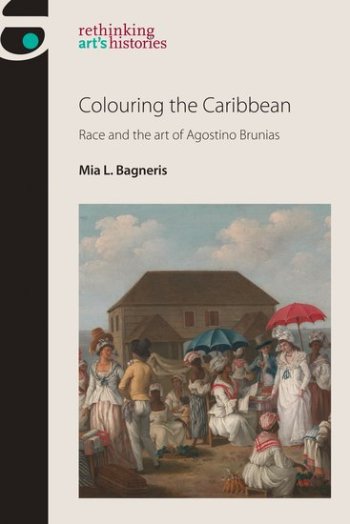 Colouring the Caribbean offers the first comprehensive study of Agostino Brunias’s intriguing pictures of colonial West Indians of colour—so called ‘Red’ and ‘Black’ Caribs, dark-skinned Africans and Afro-Creoles, and people of mixed race—made for colonial officials and plantocratic elites during the late-eighteenth century. Although Brunias’s paintings have often been understood as straightforward documents of visual ethnography that functioned as field guides for reading race, this book investigates how the images both reflected and refracted ideas about race commonly held by eighteenth-century Britons, helping to construct racial categories while simultaneously exposing their constructedness and underscoring their contradictions. The book offers provocative new insights about Brunias’s work gleaned from a broad survey of his paintings, many of which are reproduced here for the first time.
Mia L. Bagneris is Jesse Poesch Junior Professor of Art History at Tulane University.
C O N T E N T S
Introduction
1 Brunias’s Tarred Brush, or Painting Indians Black: Race-ing the Carib Divide
2 Merry and Contented Slaves and Other Island Myths: Representing Africans and Afro-Creoles in the Anglo-American World
3 Brown-Skinned Booty, or Colonising Diana: Mixed-Race Venuses and Vixens as the Fruits of Imperial Enterprise
4 Can You Find the White Woman in This Picture? Agostino Brunias’s ‘Ladies’ of Ambiguous Race
Coda: Pushing Brunias’s Buttons, or Re-Branding the Plantocracy’s Painter: The Afterlife of Brunias’s Imagery
Index
Exhibition | Cathedral of Cloth: Ebley Mill
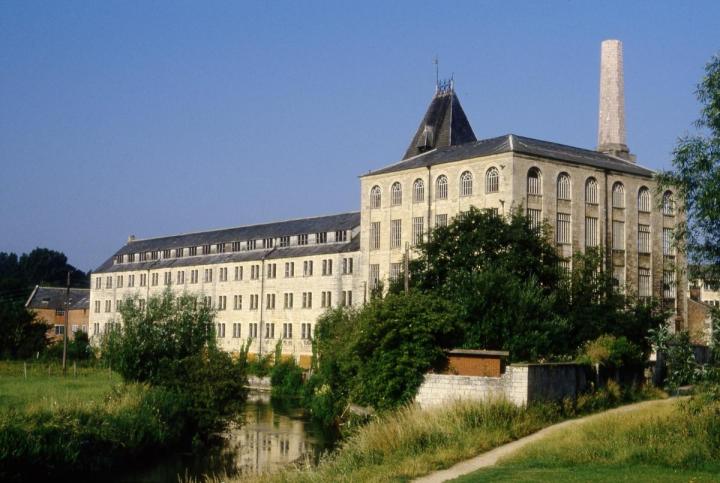
The long range of Ebley Mill was begun in 1818; in 1862, G. F. Bodley added the wing at the end.
◊ ◊ ◊ ◊ ◊
While this is predominantly a nineteenth-century exhibition, Stroud is certainly replete with eighteenth-century significance. From the Museum in the Park:
Cathedral of Cloth: Life and Times at Ebley Mill
Museum in the Park, Stroud, Gloucestershire, 3 February — 4 March 2018
In 2018 Ebley Mill celebrates the building of the Long Block at Ebley 200 years ago. The story of the Mill reaches back to the early 1400s. It was owned by a fashionable man about town before Samuel Marling made it into the powerhouse of the Stroud Valleys. The finest cloth for Victorian gentlemen was made there, but also materials for 1960s dolly birds and racing car drivers. This fascinating exhibition reveals the stories of the famous people and the ordinary workers connected to the Mill and includes many rarely seen items.
Presented by Stroudwater Textile Trust in partnership with the Museum in the Park.
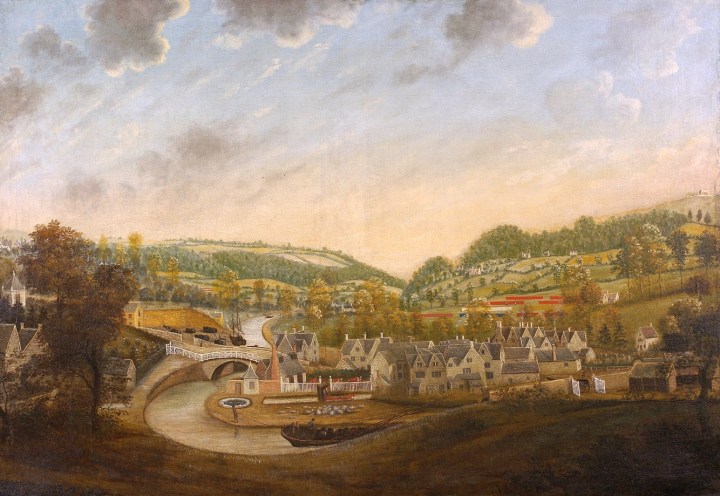
Unidentified artist, View of Wallbridge, Stroud in Gloucestershire, ca. 1790 (Stroud: Museum in the Park). The painting shows “Stroud at a time when spinners and weavers worked at home in their cottages. These were the days before large machinery was housed in huge mills such as Ebley Mill” (from the Museum in the Park’s website).
Exhibition | Power and Beauty in China’s Last Dynasty

Press release (12 October 2017) from Mia:
Power and Beauty in China’s Last Dynasty: Concept and Design by Robert Wilson
Minneapolis Institute of Art, 3 February — 27 May 2018
Curated by Liu Yang
The Minneapolis Institute of Art (Mia) is collaborating with celebrated theater artist Robert Wilson to organize a first-of-its-kind exhibition highlighting the drama, rituals, and opulence of the Qing Empire, the last imperial dynasty of China. The exhibition will present objects from Mia’s renowned collection of Chinese art, including rare court costumes, jades, lacquers, paintings, and sculpture, to be displayed in an immersive, experiential environment conceived of by Wilson. Power and Beauty in China’s Last Dynasty: Concept and Design by Robert Wilson, curated by Liu Yang, Mia’s Curator of Chinese Art, will be on view February 3 through May 27, 2018.

Manchu Emperor’s Ceremonial 12-Symbol jifu Court Robe, 1723–35, Qing Dynasty, silk tapestry (kesi) (Minneapolis Institute of Art, 42.8.11).
“The staging and storytelling involved in this exhibition speak to Mia’s belief in art’s ability to inspire wonder and fuel curiosity,” said Matthew Welch, Mia’s Deputy Director and Chief Curator. “Through the use of the theatrical elements of lighting, sound, and progression, we examine the layers of imperial life—from the external presentation of the court to the internal, private life of the emperor. We want the visitor to feel as though they are part of this otherworldly, intoxicating, and sometimes even dangerous world.”
During the Qing (pronounced ‘ch’ing’) court’s reign (1644–1912), the arts flourished—rivaling that of Europe’s great kingdoms. This backdrop of opulence served to affirm imperial power and prestige, and acted as stagecraft to enhance the emperor’s leading role as the ‘son of heaven’. Court costume, for example, was heavily embroidered or woven with symbolic designs to represent cosmological order. Roiling waves and faceted rocks around the hem evoke the earth’s oceans and mountains. Stylized clouds hover above, indicating the heavens. Dragons, a longstanding symbol of imperial authority and might, cavort in the clouds, suggesting the emperor’s rule of heaven and earth.
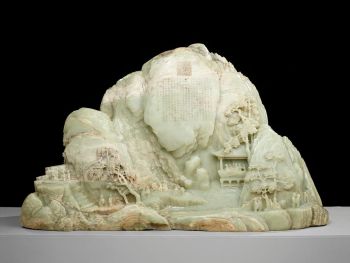
Jade Mountain Illustrating the Gathering of Poets at the Lan T’ing Pavilion, 1790, Qianlong Period (1736–95), Qing Dynasty, light green jade (Minneapolis Institute of Art).
“Mia has one of the world’s great collections of Chinese art outside of China,” said Liu Yang, Mia’s curator of Chinese Art and head of China, South, and Southeast Asian Art. “Our collection of Qing dynasty textiles is one of the most comprehensive in the West, and we have many other important objects associated with the Qing emperors and their courts. It is personally very exciting for me to be able to highlight these objects in an unexpected and fresh manner by working with Robert Wilson.”
“Mia could not be more delighted to work with Robert Wilson on the creation of this exhibition,” said Kaywin Feldman, Mia’s Nivin and Duncan MacMillan Director and President. “His unique approach to exhibition design and his willingness to push the boundaries make him an ideal collaborator. His style often involves dramatic contrasts—brightness and darkness, fullness and emptiness—which bring a new perspective to these historic objects.”
The exhibition progresses through a series of galleries that lead visitors from the performative, external world of the imperial court to the intimate, interior world of the emperor. Each gallery will also feature an original soundscape created by Wilson.
Objects highlights include
• a ceremonial twelve-symbol jifu court robe worn by the emperor
• a formal court robe worn by the empress
• a 640-pound jade mountain commissioned by the Qianlong emperor
• a multi-color lacquered and carved imperial throne
• a meditating Buddha carved from white jade enthroned within a Tibetan-style stupa of green jade
• an imperial portrait of prince Duo Lou
• a carved lacquer box adorned with nine auspicious dragons and bearing the Qianlong emperor’s seal
◊ ◊ ◊ ◊ ◊
Born in Waco, Texas, Robert Wilson is among the world’s foremost theater and visual artists. His works for the stage unconventionally integrate a wide variety of artistic media, including dance, movement, lighting, sculpture, music, and text. His images are aesthetically striking and emotionally charged, and his productions have earned the acclaim of audiences and critics worldwide. After being educated at the University of Texas and Brooklyn’s Pratt Institute, Wilson founded the New York–based performance collective “The Byrd Hoffman School of Byrds” in the mid‐1960s, and developed his first signature works, including Deafman Glance (1970) and A Letter for Queen Victoria (1974–75). With Philip Glass he wrote the seminal opera Einstein on the Beach (1976). Wilson’s artistic collaborators include many writers and musicians, such as Heiner Müller, Tom Waits, Susan Sontag, Laurie Anderson, William Burroughs, Lou Reed, and Jessye Norman. He has also left his imprint on masterworks such as Beckett’s Krapp’s Last Tape, Brecht/Weill’s Threepenny Opera, Debussy’s Pelléas et Melisande, Goethe’s Faust, Homer’s Odyssey, Jean de la Fontaine’s Fables, Puccini’s Madama Butterfly, and Verdi’s La Traviata. Wilson’s drawings, paintings, and sculptures have been presented around the world in hundreds of solo and group showings, and his works are held in private collections and museums throughout the world. Wilson has been honored with numerous awards for excellence, including a Pulitzer Prize nomination, two Premio Ubu awards, the Golden Lion of the Venice Biennale, and an Olivier Award. He was elected to the American Academy of Arts and Letters, as well as the German Academy of the Arts, and holds eight Honorary Doctorate degrees. France pronounced him Commander of the Order of Arts and Letters (2003) and Officer of the Legion of Honor (2014); and Germany awarded him the Officer’s Cross of the Order of Merit (2014). Wilson is the founder and Artistic Director of The Watermill Center, a laboratory for the arts in Water Mill, New York.
After completing his PhD at the School of Oriental and African Studies at the University of London in 1997, Liu Yang served as the curator of Chinese art at the Art Gallery of New South Wales. There he mounted an impressive number of major exhibitions, including shows on Chinese painting, Buddhist sculpture, jades, bronzes, calligraphy, modern prints, and Daoist art. Since joining Mia in 2011, Liu has curated exhibitions on the contemporary ink painter Liu Dan as well as on ancient ritual bronzes and treasures associated with China’s first emperor, Qin Shi Huang.

Imperial Throne, Qianlong Period (1736–95), Qing Dynasty, polychrome lacquer over softwood frame (Minneapolis Institute of Art, 93.32a-d).
Exhibition | Ragnar Kjartansson: The Sky in a Room
From the National Museum Cardiff:
Ragnar Kjartansson: The Sky in a Room
National Museum Cardiff, 3 February — 11 March 2018
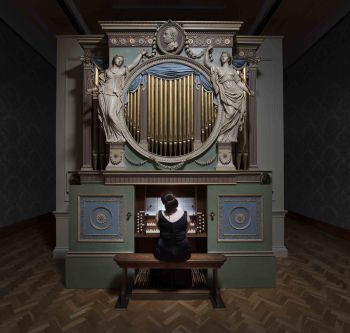
Chamber Organ, 1774, commissioned by Sir Watkins Williams Wynn for his London town house in St James’s Square. The case was designed by Robert Adam (National Museum Cardiff).
Icelandic artist Ragnar Kjartansson will return to Wales to present a brand-new site-specific performance piece, The Sky in a Room, co-commissioned by Artes Mundi and Amgueddfa Cymru – National Museum Wales. The performance will see a series of organists performing the 1959 hit song “Il Cielo In Una Stanza” (“The Sky in a Room”) on the 1774 Sir Watkins Williams Wynn organ, and it will run from 3 February to 11 March at National Museum Cardiff.
Developed after Kjartansson’s participation in Artes Mundi 6 in 2015, the exhibition is made possible by the Derek Williams Trust Purchase Prize, which enables Amgueddfa Cymru to purchase work by Artes Mundi shortlisted artists. It is also the first performance piece acquired by the Museum.
As part of the work, all of the paintings, objects and decorative furniture from the Museum’s Art in Britain 1700–1800 gallery have been removed. In the centre of the empty gallery is a solo performer, seated at a chamber organ originally commissioned by the Welsh patron of the arts Sir Watkins Williams Wynn in 1774. Throughout the day, across the five-week duration of the performance, the organist sings and plays “Il Cielo In Una Stanza,” a famous Italian love song written by Gino Paoli in 1959. The lyrics of this song recall the power of love to disappear walls into forests and ceilings into sky. Kjartansson’s work similarly transforms the Museum, dissolving space and time through the hypnotic repetition of the song.
Ragnar Kjartansson was born in Iceland in 1976. Live performance and music are central to his practice which also incorporates film, installation and painting. His film installation The Visitors featured in Artes Mundi 6.
Artes Mundi brings exceptional and challenging international artists to Wales, generating unique opportunities to engage creatively with the urgent issues of our time. Artes Mundi 8 takes place at National Museum Cardiff, 26 October 2018 – 24 February 2019.
The winner of the prestigious £40,000 Artes Mundi prize will be announced in January 2019 following a four-month exhibition of works by the shortlisted artists. The shortlist was selected from over 450 nominations spanning 86 countries and comprises five of the world’s most celebrated contemporary artists, whose works explore what it means to be human. They are: Anna Boghiguian, Bouchra Khalili, Otobong Nkanga, Trevor Paglen and Apichatpong Weerasethakul.
Exhibition | First Academies: Benjamin West

Benjamin West, Death on the Pale Horse, 1817, oil on canvas, 447 × 765 cm
(Philadelphia: PAFA, 1836.1)
◊ ◊ ◊ ◊ ◊
Opening next month at PAFA:
First Academies: Benjamin West and the Founding of the RA of Arts and PAFA
Pennsylvania Academy of the Fine Arts, Philadelphia, 2 March — 3 June 2018
Curated by David Brigham
Investigating the role of Benjamin West in the founding of arts academies in England and the United States.
On the occasion of the 250th anniversary of the founding of the Royal Academy of Arts (RA) in London, the Pennsylvania Academy of the Fine Arts (PAFA) is pleased to recognize the role that Benjamin West (1738–1820) played in founding each of these first sustained academies in England and the United States. Born outside of Philadelphia, West traveled to Europe at age twenty-one to study painting and, rather than return home, he was lured by immediate patronage and recognition to remain in England where he would become one of the founders in 1768 of the RA, its second president, and court painter to George III. While West never returned to America, he educated three generations of American artists in his London studio, including Charles Willson Peale, Gilbert Stuart, Thomas Sully, and Rembrandt Peale.
In 1805, when PAFA was founded, West was selected as the first Honorary Academician. By lending his name to the first sustained art academy in North America, then RA President West contributed to PAFA’s nascent reputation and importance. West accepted the honor and wrote, “It is my wish that your Academy should be so indowed [sic] in all points which are necessary to instruct, not only the mind of the student in what is excellent in art—but that it should equally instruct the eye and the judgement [sic] of the public to know, and properly appreciate Excellence when it is produced….”
This exhibition explores West’s important role in the establishment of the RA and PAFA through more than sixty paintings, drawings, prints, sculptures, manuscripts, and books. In addition to the founding stories of the RA and PAFA, this exhibition recognizes the other artist-founders of PAFA, West’s role as the teacher of eighteenth- and early-nineteenth-century American artists, and the development of monumental history paintings such as Christ Rejected and Death on the Pale Horse.
Call for Papers | SAHGB Architectural History Workshop, 2018
Call for Participation from SAHGB:
The Society of Architectural Historians of Great Britain
Workshop for Doctoral Students and Early Career Scholars
The Gallery, London, 17 March 2018
Proposals due by 16 February 2018
The Society of Architectural Historians of Great Britain (SAHGB) invites proposals for the 2018 Architectural History Workshop. This is our annual event for postgraduate students and early career scholars to share and develop their ideas; it aims to provide an informal space away from your own institution where you can discuss, debate, practice and enjoy the company of like-minded researchers working within the history of the built environment, broadly conceived.
We invite participation in a number of ‘lightning’ rounds, where contributors are asked to speak for no more than ten minutes in any appropriate format that engagingly explores and presents your research. This research can be at any stage from a research proposal that you wish to talk about, issues arising from your research, final work as you write-up, post-doctoral reflections, or anything in-between. Speakers from previous events are particularly welcome to update us on the progress of their work.
The event is limited to postgraduate students (full-time or part-time) and early career scholars (those who have completed their PhDs within the last 5 years). We particularly encourage participation from:
• Masters students considering doctoral study
• Doctoral students in relevant disciplines
We are interested in all periods and regions of study, and the full range of methodological approaches to architectural history. The society welcomes submissions of work relating to the history of the built environment from all disciplines, including but by no means limited to:
• Architecture
• Art History
• History (including urban, social and cultural history)
• Archaeology
• Anthropology
• Geography
On as diverse a range of themes as possible, including:
• Histories of design
• Histories of planning
• Histories of construction
• Histories of buildings in use
• Histories of interiors and interior design
• Histories of practice and professionalism
Alongside presentations, the workshop will feature a session on ‘Careers in Architectural History’ presented by a panel of invited speakers from museums, heritage bodies, architectural practices, and more. Speakers will be announced in the near future. The keynote speaker will be the Chairman of the SAHGB, Professor Anthony Geraghty (University of York).
If you are interested in making a contribution, please complete the submission form on our website. The closing date for applications is Friday, 16 February 2018. The result of all applications will be communicated by Tuesday, 20 February, with confirmation from the speakers requested by Thursday, 22 February. The workshop will take place on Saturday, 17 March at The Gallery, 70, Cowcross Street, London, EC1M 6EL. No funding is available. A contribution of £10 is requested from all attendees to cover costs (inclusive of all catering). Details of the 2017 workshop can be viewed on the Society’s website. For further information or clarification of any sort please contact the conference organizers at ahw2018@sahgb.org.uk.
New Book | Tiepolo’s Pictorial Imagination
The Second Annual Thaw Lecture presented by William Barcham in May 2016 at The Morgan Library & Museum is now available in print from the museum’s shop:
William Barcham, Tiepolo’s Pictorial Imagination: Drawings for Palazzo Clerici (New York: The Morgan Library & Museum, 2017), 63 pages, ISBN: 9780875981819, $17.
 In 1740 Giambattista Tiepolo completed his grand ceiling fresco for the Gallery of Palazzo Clerici, Milan. Unlike his previous ceilings, this was a long gallery that could not be seen in its entirety from a single viewpoint; instead, the ceiling unrolls overhead in a scroll-like manner as visitors pass down the long Gallery. A large group of preparatory studies survives for the ceiling, and these permit us to consider how Tiepolo responded to this daunting assignment and produced a series of interrelated figure groups to decorate the vault. Nearly all today at the Morgan Library & Museum and the Metropolitan Museum of Art in New York and the Museo Horne in Florence, these drawings have long been recognized as studies for the ceiling, but never before has there been a sustained attempt to trace Tiepolo’s creative process through the dozens of sheets. William Barcham’s study of the Clerici drawings thus offers new perspectives not only on the Clerici ceiling but more broadly on Tiepolo’s pictorial imagination and inventive genius.
Queen’s House Lecture Series: Remarkable Women

From Royal Museums Greenwich:
Queen’s House Lecture Series: Remarkable Women
Queen’s House, Greenwich, Thursdays in March 2018
Hear about the lives of five remarkable women through our Queen’s House lecture series this National Women’s History Month. Spanning the Elizabethan and Victorian Ages, follow the lives of five extraordinary women: matriarch and entrepreneur Bess of Hardwick, poet and writer Lady Mary Wortley Montagu, local Deptford businesswoman Mary Slade, antiquarian collector Sarah Sophia Banks, and the world traveller Annie Russell-Cotes. Thursdays in March, 10.30–12.30, £8 (concession £6), Orangery & South Parlours.
1 March
Christine Riding (Royal Museums Greenwich) — Lady Mary Wortley Montagu
8 March
Arlene Leis — Sarah Sophia Banks (1744–1818): A ‘Truly Interesting Collection of Visitor Cards and Co.’
15 March
David Taylor (National Trust) — Exalting the Divine: Bess of Hardwick’s Picture Collection at Hardwick Hall
22 March
Margarette Lincoln — Mary Slade and Working Women in Eighteenth-Century Deptford
29 March
Amy Miller — Annie Russell-Cotes
Urban History, February 2018
The eighteenth century in the latest issue of Urban History:
 Urban History 45 (February 2018)
A R T I C L E S
Matthew Jenkins, “The View from the Street: The Landscape of Polite Shopping in Georgian York,” pp. 26–48.
Shopping during the eighteenth century is increasingly viewed by scholars as an important leisure activity and an integral part of wider schemes of urban improvement. However, the physical evidence in the form of standing buildings is rarely considered. This article will demonstrate how a detailed examination and reconstruction of the urban landscape of York can illuminate how these practices were performed. The use of building biographies also allows owners to be identified and linked with specific shop types and surviving fabric. This enables exploration of how the physical environment influenced perceptions of the streetscape and the experience of interior retail space.
David Gilks, “The Fountain of the Innocents and Its Place in the Paris Cityscape, 1549–1788,” pp. 49–73.
This article analyses how the Fountain of the Innocents appeared and also how it was used and perceived as part of the Paris cityscape. In the 1780s, the plan to transform the Holy Innocents’ Cemetery into a market cast doubt on the Fountain’s future; earlier perceptions now shaped discussions over reusing it as part of the transformed quarter. The article documents how the Fountain was dismantled in 1787 and re-created the following year according to a new design, explaining why it was created in this form. Finally, the article considers what contemporary reactions to the remade Fountain reveal about attitudes toward the authenticity of urban monuments before the establishment of heritage institutions and societies.
Boris Stepanov and Natalia Samutina, “An Eighteenth-Century Theme Park: Museum-Reserve Tsaritsyno (Moscow) and the Public Culture of the Post-Soviet Metropolis,” pp. 74–99.
The article discusses the dramatic history of the Tsaritsyno Park and museum-reserve. By the mid-2000s, it had become one of Moscow’s iconic places and a zone where urban public culture was shaped. The authors trace the history of this architectural ensemble and park in terms of their role in сity culture and analyse changes in the historical culture of contemporary post-Soviet Moscow. The Tsaritsyno Park and museum exemplify these changes. An unfinished country residence of Catherine II, with a Grand Palace that had stood as a ruin for over 200 years, it has been radically renewed by the Moscow city authorities in what came to be labelled ‘fantasy restoration’. The palace was finished and now serves as the core of the museum, organized according to a controversial historical policy. Tsaritsyno as a whole became a cultural oddity featuring historical attractions for the public, effectively an ‘eighteenth-century theme park’.










 Enfilade
leave a comment