Exhibition | Winckelmann, Florence, and the Etruscans
Winckelmann turns 300 next December 9th. In anticipation of the event, the National Archaeological Museum presents this exhibition:
Winckelmann, Florence, and the Etruscans: The Father of Archeology in Tuscany
Winckelmann, Firenze e gli Etruschi: Il padre dell’archeologia in Toscana
Museo Archeologico Nazionale, Florence, 26 May 2016 — 30 January 2017

Anton von Maron, Portrait of Johann Joachim Winckelmann, 1767, oil on canvas, 136 × 99 cm (Weimar: Stadtschloss).
Johann Joachim Winckelmann (1717–1768), the Prussian art scholar who was superintendent of antiquities of Rome, had a purpose behind his stay in Florence: to broaden knowledge of the Etruscan civilization. From 1758 to 1759, Winckelmann lived in Florence, where he hoped to complete his work. Ahead of the three hundredth anniversary of his birth—and while waiting to celebrate more widely with a conference in 2017—the Archaeological Museum of Florence presents the exhibition Winckelmann, Firenze e gli Etruschi (Winckelmann, Florence and the Etruscans), from May 26 to January 30, 2017.
Winckelmann’s studies of classical works, particularly his Geschichte der Kunst des Alterthums (The History of Art in Antiquity) of 1764, promoted the aesthetics of neoclassicism and created a sensibility and a taste that influenced all of late eighteenth-century Europe; furthermore, the Winckelmann methodological approach provides the basis of modern art history. The exhibition, installed on the ground floor of Florence’s Archaeological Museum, consists of three sections. The first addresses the study of antiquities and private collecting in mid-eighteenth-century Florence. The second section is more specific to Winckelmann’s Florentine studies, including his cataloguing of Baron von Stosch’s collection of gems, of which casts are on exhibit. Finally, the third section shows the cultural legacy that Winckelmann left to the Grand Ducal city and the whole of Europe, with the neoclassical style born from this man’s notes and publications.
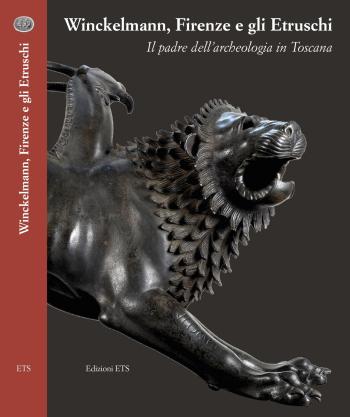 Visitors are welcomed to the exhibition by the large, late-Etruscan bronze sculpture of The Orator (Aulus Metellus). It must be remembered, however, that in Winckelmann’s opinion, Etruscan art was not at the level of Greek art because of the Etruscans’ inability to detach themselves from their passions. After visiting this exhibit, visitors can continue on to the Museum to admire other masterpieces of Etruscan art, including the Chimera and the Idolino.
Barbara Arbeid, Stefano Bruni, Mario Iozzo, eds., Winckelmann, Firenze e gli Etruschi: Il padre dell’archeologia in Toscana / Winckelmann, Florenz und die Etrusker: Der Vater der Archäologie in der Toskana (Pisa: Edizioni ETS, 2016), 347 pages, ISBN: 978 8846745187 (Italian) / ISBN: 978 8846745194 (German), 28€.
London’s Blue Plaques Turn 150

From English Heritage:
London’s famous blue plaques link the people of the past with the buildings of the present. Now run by English Heritage, the London blue plaques scheme is thought to be the oldest of its kind in the world and celebrates its 150th anniversary this year. Across the capital over 900 plaques, on buildings humble and grand, honour the notable men and women who have lived or worked in them.
The official blue plaques app is now available to download for free for iPhone and Android. Use the app to follow guided walks around Soho and Kensington, or explore all of the 900 plaques by finding ones nearby and searching for your favourite figures from history. From Sylvia Pankhurst’s former home in Chelsea to Jimi Hendrix’s flat in Mayfair, let English Heritage’s blue plaques guide you through the streets of London. Download the free app now from the Apple App Store for iPhone or the Google Play Store for Android.
◊ ◊ ◊ ◊ ◊
Frank and Sue Ashworth have been making the Blue Plaques from their home since 1986; for photos, see The Daily Mail (2 May 2016).
Katie Engelhart recently wrote about the Blue Plaques for The New York Times (10 November 2016).
Capability Brown Festival 2016 Marks Designer’s 300th Birthday

Blenheim Palace
◊ ◊ ◊ ◊ ◊
Press release for the Festival, which includes events throughout the year:
Capability Brown Festival 2016
The Capability Brown Festival 2016 is the first-ever nationwide celebration of the work of Lancelot ‘Capability’ Brown (1716–1783). It marks the 300th anniversary of his birth in August 1716. The Festival unites 19 partner organisations, in the UK’s largest festival of its kind to date. It is funded with a grant from the Heritage Lottery Fund, with additional match funding, and funding in kind, from the Festival’s partners and supporters. The Festival is managed by the Landscape Institute.
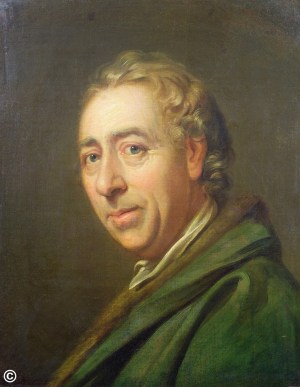
Richard Cosway, Portrait of Lancelot ‘Capability’ Brown, ca.1770–75 (Private Collection/Bridgeman Images)
The Festival has two key strands. The first is about increasing audiences and public access to the sites Brown worked or advised on. People will be able to explore and engage with Brown’s legacy landscapes, features and houses. The Festival will encourage as many Brown sites as possible to open in 2016, including those not ordinarily open to the public, and will support site owners and guardians in interpreting their landscapes for visitors. The second strand of the project is to discover more about Brown’s work and how he created his amazing landscapes and management systems with the tools available in the eighteenth century. Researchers, volunteers, independent groups and individuals, universities and sites themselves are being encouraged to undertake research projects on Brown and his work. This will be collated and shared through exhibitions, websites, social media and a range of events.
The Capability Brown Festival 2016 will
• Celebrate Capability Brown as an artist and landscape designer
• Encourage an increased number of people and a more diverse audience to visit, learn about and enjoy Brown’s landscapes
• Commission a range of interesting and innovative projects to encourage sites and people to get involved across the country
• Encourage a greater appreciation of our designed landscape heritage.
 To achieve this the Festival project team will
• Offer a comprehensive programme of support to owners of Brown sites, aiming to open as many as possible during Festival year, including those not normally open to the public
• Develop a network of hub sites across England to support and engage the Brown sites in their area or region
• Work with sites, with a special focus on those in urban areas and those commissioned to run projects, to bring Brown to new audiences
• Interpret all or as many sites as possible, using research by volunteers who will be trained and supported by the Festival
• Use media, PR, partner and central communication opportunities to promote understanding of Brown’s art and design influence
• Stimulate new research, and create a definitive record of Brown sites
• Ensure that the Festival’s findings, research and learning resources are accessible to as many people as possible, and share learning as it develops through a programme of regional seminars
• Engage volunteers in all aspects of the 2016 celebrations.
Lancelot ‘Capability’ Brown changed the face of eighteenth-century England, designing country estates and mansions, moving hills and making flowing lakes and serpentine rivers. Brown was baptised on 30 August 1716 at Kirkharle, Northumberland, the fifth of the six children of William Brown, a yeoman farmer and Ursula, née Hall, who had worked in the big house on the Kirkharle estate. He went to the village school at Cambo, and then began work as a gardener at Kirkharle, leaving in 1739. In 1741 he reached Stowe, Buckinghamshire where he rapidly assumed responsibility for the execution of both architectural and landscaping works in the famous garden. It was at Stowe in 1744 that Brown married Bridget Wayet, with whom he eventually had nine children. While at Stowe, Brown also began working as an independent designer and contractor and in autumn 1751, shortly after Cobham’s death, he was able to move with his family to the Mall, Hammersmith, the market garden area of London. His nickname of ‘Capability’ is thought to have come from his describing landscapes as having ‘great capabilities’.
Brown’s style derived from the two practical principles of comfort and elegance. On the one hand there was a determination that everything should work, and that a landscape should provide for every need of the great house. On the other his landscapes had to cohere and look elegant. While his designs have great variety, they also appear seamless owing to his use of the sunk fence or ‘ha-ha’ to confuse the eye into believing that different pieces of parkland, though managed and stocked quite differently, were one. His expansive lakes, at different levels and apparently unconnected, formed a single body of water as if a river through the landscape, that like the parkland itself, ran on indefinitely. This effortless coherence is taken for granted today in a way that was predicted in his obituary: ‘where he is the happiest man he will be least remembered, so closely did he copy nature his works will be mistaken’.
Brown offered a number of different services to his clients: for a round number of guineas, he could provide a survey and plans for buildings and landscape, and leave his client to execute his proposal; more frequently he provided a foreman to oversee the work, which would be carried out by labour recruited from the estate. Even in 1753, when he opened his account with Drummond’s Bank, Brown was employing four foremen and by the end of the decade he had over twenty foremen on his books. Finally, he could oversee and refine the work himself, usually by means of visits for a certain number of days each year. He also practiced architecture, and during the 1750s contributed to several country houses, including Burghley House, Blenheim, Chatsworth and Harewood. However, his architecture played second fiddle to his ‘place-making’. In 1764 he was appointed to the gardens of Hampton Court, Richmond and St James’s, and he then moved to Wilderness House, Hampton Court.
Brown had suffered from asthma all his life, and his habit of the constant travel, together with his practice of not always charging for work (he would sometimes allow his client to determine the value of what he had done and seems frequently to have submitted plans and surveys without a bill), did affect both his health and finances. He continued to work and travel however until his sudden collapse and death on February 6th, 1783. He died at his daughter Bridget Holland’s house in London, but was buried at Fenstanton, in Cambridgeshire, the only place he is known to have owned property and where he became Lord of the Manor.
Brown is best remembered for landscape on an immense scale, constructing not only gardens and parkland, but planting woods and building farms linked by carriage drives, or ‘ridings’, many miles from the main house. Although his work is continually reassessed, every landscape gardener and landscape architect since, both in Britain and across the developed world, has been influenced in one way or another by Brown. Over two centuries have passed since his death, but such are the enduring qualities of his work that over 150 of the 260 or so landscapes with which he is associated remain worth seeing today. The images that Brown created are as deeply embedded in the English character as the paintings of Turner and the poetry of Wordsworth.
Founding Partners
The Landscape Institute
The National Trust
The Historic Houses Association (HHA)
English Heritage
Historic England
VisitEngland
The National Garden Scheme
The Gardens Trust
Kolab
The National Association of Decorative & Fine Arts Societies (NADFAS)
VisitBritain
Parks & Gardens UK
Festival Partners
Blenheim Palace
The Royal Horticultural Society
Bridgeman Images
The Embroiderers’ Guild
Festival Supporter
The Georgian Group
Festival Funder
Heritage Lottery Fund
Happy Birthday, Enfilade!
From the Editor
As Enfilade turns six, I continue to be amazed at the growth of the site—all because of you fabulous readers! This spring we passed the half-million hits threshold. A typical month brings in more than 10,000 visits, and over 1300 of you are subscribers. Thank you.
And so I’ll extend my usual annual pleas:
1) Buy an art book this week. In the world of academic art history publishing, several hundred books sold over a few days is stellar. It’s an important way to communicate that the eighteenth century is a thriving field with a vital, engaged audience.
2) Renew your HECAA membership. In the normal world $30 doesn’t really count as philanthropy. For a small academic society it does. And thanks to Michael Yonan’s indefatigable work with the IRS in securing HECAA’s 501c3 status, all donations are now tax deductible in the United States. So send in a contribution of $100 or $5. But donate something. We accept PayPal.
3) Finally, send in news you’d like to see reported! Years into this, and I’m not sure what surprises me more: how easy it is to know what’s going on in the field all over the world, or how difficult it is to know what’s going on in the field all over the world! I’m glad to post announcements about conferences, forthcoming books, journal articles, exhibitions, fellowship opportunities, &c. The postings readers most enjoy are inevitably original content, reports of interesting collections, house museums, resources, and the like. No reason to be shy.
Again, thanks to all of you and all the best!
Craig Hanson
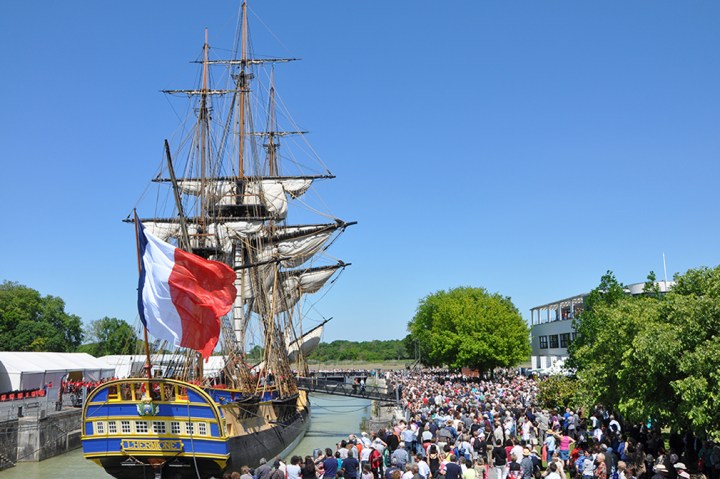
Hermione Voyage 2015
◊ ◊ ◊ ◊ ◊
From the Hermione Voyage 2015 website:
Twenty years ago, a small group dreamed of reconstructing an exact replica of General Lafayette’s 18th-century ship called the Hermione. Today, the majestic vessel is the largest and most authentically built Tall Ship in the last 150 years. The Hermione has set sail in France, launching an adventure that comes to the USA in the summer of 2015 for an unprecedented voyage.
In April 2015, after a period of sea trials and training in 2014, the Hermione set sail for the USA. The journey started from the mouth of the River Charente, in Port des Barques, where Lafayette boarded on March 10th, 1780. The transatlantic crossing was expected to take 27 days in total, before making landfall at Yorktown, Virginia.
As the Hermione moves up the Eastern seaboard, it will be accompanied by a range of pier side activities. These include in some ports a traveling exhibition and a heritage village that will be accessible to the public. The Hermione Voyage 2015 is part of an expansive outreach program with cultural events, exhibitions, and educational programs that celebrate the trip and mark its progress. A robust digital activation for the voyage expands the reach of the project to millions of people.
Exhibition | Leipzig 1813, The Battle of the Nations
Leipzig marks the 200th anniversary of the Battle of the Nations (19 October 1813) with a 1:1 scale panorama by Yadegar Asisi, depicting the city in the aftermath of the battle — Europe’s largest prior to World War I, with 90,000 dead and injured. From a press release:
Leipzig 1813, The Battle of the Nations: A Panorama by Yadegar Asisi
Leipzig Panometer, 3 August — December 2013

◊ ◊ ◊ ◊ ◊
Having opened on August 3, Yadegar Asisi’s monumental 360° panorama Leipzig 1813: Amidst the Confusion of the Battle of the Nations is now on display at the Panometer Leipzig. The world’s largest panorama, 3500 m² in size and on a scale of 1:1, shows us the city of Leipzig immediately following the Battle of the Nations, which took place on October 19, 1813. The visitor views the scene from the vantage point of the roof of the church of St. Thomas at the western border of the city, with an excellent view both of the city centre and of the surrounding areas, where the most violent battles took place.
It came as something of a surprise to Yadegar Asisi that he was to spend so much time – since 2009 – working so intensively on this theme. “Having grown up in Leipzig, the Battle of the Nations was present in the form of the monument but not in as far as the actual events were concerned“, says the artist. “For a long time it didn’t really mean anything to me, until I asked myself the question of what Leipzig was like in 1813 and what the battle meant to the city. I came to the conclusion that I would present this European event from the perspective of Leipzig and its citizens. Under no circumstances did I wish to create a battle panorama. In fact, it has turned out to be more of an anti-war panorama.”
Asisi presents Leipzig as it would have looked in 1813, complete with its architecture still relatively intact. The city is struggling to come to terms with the repercussions of the battle: 90,000 dead and injured, countless numbers of refugees from the burned-out villages in the surrounding areas. The crowds in the alleyways and squares are in turmoil as the victorious troops move in and the French take flight, leaving behind them hundreds of thousands of people in a state of despair.
The successful ten-year collaboration between Asisi and the composer Erik Babak, well known for his work in international film and television productions, again bears fruit in Leipzig 1813; the accompanying music features a chorus of 40 voices and passages from the poem “Abroad” by Heinrich Heine. The panoramic experience is rounded off with sound effects reflecting the era and the confusion of the scene.
The complex figuration in the architectural design was the greatest challenge facing Asisi during his work on Leipzig 1813. Troops numbering around 600,000 soldiers, with over 90,000 dead and injured, all had to find their places in and around Leipzig, which had only 35,000 inhabitants at the time. For this purpose alone, it was necessary to stage four lavish photo shootings with several hundred extras in costume, saddle horses, teams of horses and traps. Scenes featuring soldiers, citizens of Leipzig, marketeers, refugees, the wounded and the dead, were re-enacted and coordinated as though a film were being made. To this end, Asisi’s expert advisor Helmut Börner smoothed the way for a cooperation with the “Verband Jahrfeier Völkerschlacht b. Leipzig 1813 e.V.”.
An encounter with the novelist Sabine Ebert led to a piece of special media interaction. Details from the panorama Leipzig 1813 can be discovered in Sabine Ebert’s most recent work 1813 – Kriegsfeuer (1813 – Warfire), just as scenes from the book can be found in Yadegar Asisi’s panorama. For example, the author is depicted in the panorama wearing the same clothes as one of her protagonists on the cover of the book.
The accompanying exhibition introduces the free city of Leipzig on the evening before the battle on an emotional and intuitive level. It leads visitors around the outside circumference of the panorama, presenting Leipzig as a town famous for its trade, learning, publishing and music, before the greatest battle there had ever been breaks out outside its gates. A “making-of” film will be shown in the auditorium, explaining how the complex circular picture was created and documenting the milestones of its production, which covered a period of almost five years.
An extensive mediation programme, including various guided tours, lectures and special events, is scheduled in connection with the panorama. This programme is designed to bring visitors into closer contact with life as it was at the time of the battle, 200 years ago.
Additional information is available here»
◊ ◊ ◊ ◊ ◊
For those of you interested in panoramas generally, see the website of the International Panorama Council. The organization’s conference takes place in November:
2013 International Panorama Conference
Switzerland, 22–24 November 2013
The conference days will include visits to Bourbaki Panorama Lucerne, Alpineum Museum with its Alpine Dioramas and to Glacier Garden Museum with its optical spectacles. On November 25 a post-conference program rounds up the panoramic experience in the beautiful city of Lucerne and includes a trip to Einsiedeln to visit the Crucifixion of Christ Panorama.
Marking the 225th Anniversary of Gainsborough’s Death
When Valerie Hedquist, who’s finishing a book on the reception history of Gainsborough’s Blue Boy, recently pointed out to me that today will mark the 225th anniversary of Gainsborough’s death, I was happy to invite her to contribute a posting, even happier that she agreed. And thus here, for a brief moment, she leads us alongside the painter’s coffin towards Kew . . . –CH
◊ ◊ ◊ ◊ ◊
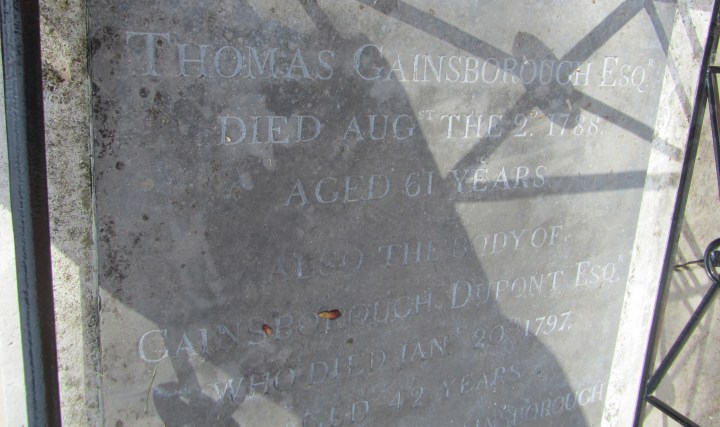
Born in 1727, Thomas Gainsborough fell ill in April 1788 and died of cancer several months later on Saturday, 2 August — 225 years ago today.
According to newspaper accounts, his death brought together “some of the most brilliant characters of the age.” Among the fifteen “few select friends” named in the obituary notice of the Whitehall Evening Post was Jonathan Buttall, regarded until recently as the subject of The Blue Boy. Along with men with connections to art, music, and theater, Buttall joined the procession of black-shrouded mourners traveling with the Gainsborough one last time as they accompanied his casket from the artist’s Pall Mall home westward to his burial plot at the Kew Green churchyard of St. Anne’s. While these individuals lived and worked in diverse London neighborhoods, their residences mostly concentrated in and around the artistic center of Soho, in contrast to the upscale West End, where Gainsborough had resided since 1774.
Who were these mourners? The surgeon and anatomist John Hunter and his neighbor, Sir Joshua; Thomas Linley and the playwright Richard Brinsley Sheridan; the American Benjamin West and the Swedish-born Scot, Sir William Chambers; the ‘father of English watercolour’ Paul Sandby; the wax portraitist Isaac Gosset and the stipple engraver Francesco Bartolozzi; the miniaturists Samuel Cotes and Jeremiah Meyer; the brother-in-law of the critic and newspaper publisher Sir Henry Bate Dudley, William Pearce; and Gainsborough’s nephew, Gainsborough Dupont, who, according to recent work by Susan Sloman, may be the actual sitter for Blue Boy.* Writing in his diary, Joseph Farington claimed it was Pearce at the artist’s bedside when he spoke his last words: “Vandyck was right.”
◊ ◊ ◊ ◊ ◊
* The most complete argument is made in Susan Sloman, “Gainsborough’s Blue Boy,” The Burlington Magazine 155 (April 2013): 231-37. Also see, Sloman, “ ’A Divine Countenance’: Gainsborough’s Portrait of His Nephew Rediscovered,” The Burlington Magazine 146 (May 2004), 319-22; and Sloman, in the exhibition catalogue Van Dyck in Britain, ed. by Karen Hearn (London: Tate Publishing, 2009).
Exhibition | The Taste of Diderot
This upcoming exhibition at the Musée Fabre de Montpellier marks the 300th anniversary of Diderot’s birth (5 October 1713); today, incidentally, is the anniversary of his death (31 July 1784). From the museum’s programme brochure:
Le Goût de Diderot
Musée Fabre de Montpellier, 5 October 2013 — 12 January 2014
Fondation de l’Hermitage, Lausanne, 7 February — 1 June 2014
Le goût est sourd à la prière. Ce que Malherbe a dit de la mort,
je le dirais presque de la critique; tout est soumis à sa loi.
Diderot, Préface du Salon de 1765
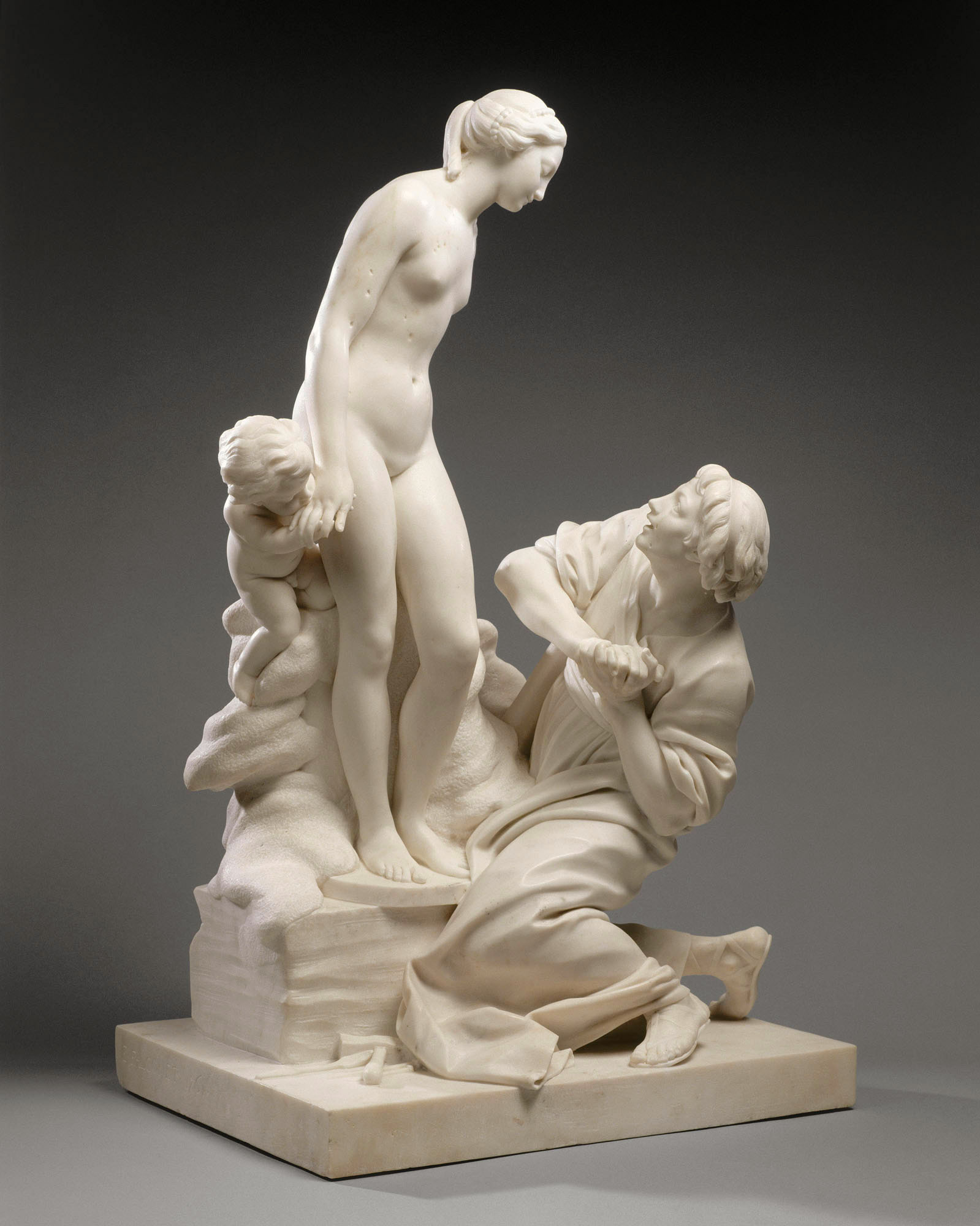
Etienne-Maurice Falconet, Pygmalion et Galatée, 1761, marbre ©RMN-Grand Palais (musée du Louvre) / Hervé Lewandowski
Le musée Fabre de Montpellier Agglomération et la Fondation de l’Hermitage de Lausanne s’associent pour célébrer le tricentenaire de la naissance de Denis Diderot (1713–1784), une figure majeure des Lumières françaises.
Philosophe, romancier, dramaturge, encyclopédiste, Diderot a également joué un rôle pionnier dans le domaine des arts, en rédigeant à partir de 1759, pour la Correspondance littéraire, les comptes rendus des expositions publiques de peinture et de sculpture que l’Académie royale organisait tous les deux ans dans le Salon carré du Louvre. Ces textes serviront et servent encore de modèle et de référence à la critique d’art.
A travers une sélection de peintures (Boucher, Chardin, Vien, Greuze, Vernet, David…), de sculptures (Pigalle, Falconet, Houdon…), de dessins et de gravures, l’exposition propose un aperçu de ce qu’était l’art au temps des Lumières auquel Diderot fut confronté, et de la manière dont il développa et exerça son goût propre. Sa culture visuelle, plastique, architecturale se développe progressivement, ses Salons deviennent au cours des années 1760 la rubrique fétiche de la Correspondance littéraire. Dans les années 1770, il est sollicité comme courtier par Catherine II lors des grandes ventes des collections privées françaises. Goethe lit ses Essais sur la peinture en Allemagne, ses idées esthétiques et sa dramaturgie influencent de façon décisive le courant Sturm und Drang.
Mais ce qu’on retiendra surtout, ce sont les mises en relation audacieuses qu’il propose, où genres, modes, médiums se rencontrent : Greuze avec Boucher, le vrai faux moral et le faux vrai libertin ; Deshays et Doyen avec Homère, Vien et Falconet avec Anacréon, pour que le peintre soit aussi un poète ; Vernet le paysagiste avec les verres et les fruits de Chardin, pour la magie de l’art. L’exposition proposera au spectateur de faire l’expérience de ces rencontres, guidé par la verve inimitable de Diderot.
Note (added 31 March 2014) — The original posting failed to note the mounting of the exhibition in Lausanne.
Happy Birthday, Sir Joshua!

Joshua Reynolds, Self-portrait, ca. 1747–49 (London: National
Portrait Gallery). Image from Wikimedia Commons
◊ ◊ ◊ ◊ ◊
To mark the birthday of Sir Joshua Reynolds (1723–92), who would turn 290 today, I draw readers’ attention to this blog posting from the material culture seminar series organized by CRASSH at the University of Cambridge. Katy Barrett summarizes presentations made by Matthew Hunter and Mark Hallett on June 11, each of whom addressed Reynolds’s output under the larger rubric of ‘painted things’. Audio is available here»
The Slave Owner, the Cook, His Sister, and Her Lover
Published last September, Craughwell’s book underscores Jefferson’s complicated attitudes and debts to slavery. On, this, the day of the United State’s birth and Jefferson’s death, that strikes me as useful. It’s certainly fascinating to see the American introduction of macaroni and cheese as part of a trans-Atlantic story involving both Europe and Africa. Happy Independence Day. –CH
◊ ◊ ◊ ◊ ◊
From Quirk Books:
Thomas J. Craughwell, Thomas Jefferson’s Crème Brûlée: How a Founding Father and His Slave James Hemings Introduced French Cuisine to America (Philadelphia: Quirk Books, 2012), 256 pages, ISBN: 978-1594745782, $20.
 This culinary biography recounts the 1784 deal that Thomas Jefferson struck with his slaves, James Hemings [brother of Sally Hemings]. The founding father was traveling to Paris and wanted to bring James along “for a particular purpose”— to master the art of French cooking. In exchange for James’s cooperation, Jefferson would grant his freedom.
Thus began one of the strangest partnerships in United States history. As Hemings apprenticed under master French chefs, Jefferson studied the cultivation of French crops (especially grapes for winemaking) so the might be replicated in American agriculture. The two men returned home with such marvels as pasta, French fries, Champagne, macaroni and cheese, crème brûlée, and a host of other treats. This narrative history tells the story of their remarkable adventure—and even includes a few of their favorite recipes.
Abram Barkshian reviewed the book for The Wall Street Journal (14 September 2012).










 Enfilade
leave a comment