Exhibition | Anton Graff: Faces of an Era
The exhibition opened last weekend on the two-hundredth anniversary of the artist’s death (22 June 1813). From the Museum Oskar Reinhart:
Anton Graff: Gesichter einer Epoche
Museum Oskar Reinhart, Winterthur, 22 June — 29 September 2013
National Gallery in Berlin, 25 October 2013 — 23 February 2014
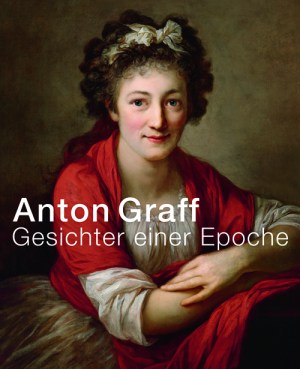 Anton Graff, who was born in Winterthur, was the most important portrait painter in the German-speaking world around 1800. He influenced the image of the bourgeoisie and nobility and the image of poets and thinkers on the brink of Modernism like no other. When he died in 1813, he left behind around 1800 portraits depicting a panorama of transitioning European society.
In celebration of the 200th anniversary of his death, the Museum Oskar Reinhart in Winterthur and the National Gallery in Berlin are honouring the work of Anton Graff in a comprehensive exhibition for the first time in 50 years. After a first stop at the Museum Oskar Reinhart from 22 June to 29 September 2013, the exhibition will be able to be seen in the National Gallery in Berlin between 25 October 2013 and 23 February 2014. The exhibition and the richly illustrated catalogue, which will be published by the Munich-based Hirmer Publishers, came about thanks to the cooperation of both institutions.
Marc Fehlmann and Birgit Verwiebe, eds., Anton Graff: Gesichter einer Epoche (Munich: Hirmer Publishers, 2013), 336 pages, ISBN: 978-3777420509, 40€.
◊ ◊ ◊ ◊ ◊
From Berlin’s Alte Nationalgalerie:
Bis in das Innere der Seele“ zu schauen, darin bestand, den Worten des Philosophen Johann Georg Sulzer zufolge, die Meisterschaft des großen Porträtisten Anton Graff. Der überaus produktive Künstler zählt zu den herausragenden Bildnismalern des späten 18. und frühen 19. Jahrhunderts. Sein größtes Verdienst war, die Berühmtheiten seiner Epoche zu porträtieren. Ihm ist das Panorama des deutschen Geistes zu danken, das die Bildnisse der bedeutendsten Dichter und Denker umfasst, wie etwa Lessing, Nicolai, Mendelssohn, Sulzer, Wieland, Gellert, Herder und Schiller.
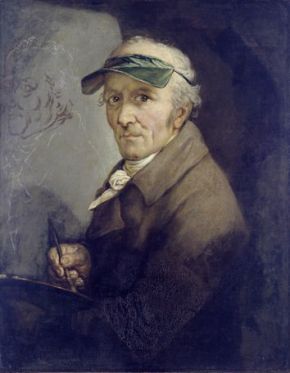
Anton Graff, Self-portrait with the Green Eye-shade, 1813 (Staatliche Museen zu Berlin, Nationalgalerie)
Graff wurde 1736 in Winterthur geboren und nahm dort seinen ersten Kunstunterricht. In Augsburg, Ansbach und Regensburg bildete er sich weiter. 1766 – 30jährig – wurde er in Dresden kurfürstlich-sächsischer Hofmaler und Mitglied der Akademie. Regelmäßig führten ihn Reisen nach Berlin, Leipzig und in die Schweiz. Gegen Ende seines Lebens wurde Graff gleichsam zu einer Symbolfigur für den Kreis junger Romantiker in Dresden. 1813, mit 76 Jahren, starb der Maler.
Graff hat seine Zeitgenossen nicht im Gestus der Repräsentation festgehalten. Vielmehr lag ihm daran, das Wesen des Einzelnen auszuloten, seine Individualität zu entdecken, seine seelischen und geistigen Qualitäten wiederzugeben. Auch heute noch spricht die innere Gestimmtheit der aufgeklärten geistigen Elite in Deutschland unmittelbar aus Graffs meisterhaften Werken. Mit Bildnissen von Königen und Fürsten, vom aufstrebenden Bürgertum, von Staatsmännern, Gelehrten, Künstlern, Kaufleuten, Geistlichen schuf er eine Galerie der deutschen Gesellschaft an der Schwelle zur Moderne.
Ein halbes Jahrhundert hat es keine Ausstellung zum Werk Graffs gegeben. Nun, anlässlich des 200. Todestages, wird sein Werk wieder umfassend präsentiert.
Die Retrospektive „Anton Graff. Gesichter einer Epoche“ entstand in Kooperation mit dem Museum Oskar Reinhart, Winterthur. Dort sind rund 80 Werke vom 22. Juni bis 29. September 2013 zu sehen. In der Alten Nationalgalerie Berlin wird die Ausstellung anschließend in erweiterter Form mit rund 140 Werken vom 25. Oktober 2013 bis 23. Februar 2014 gezeigt.
Huguenots of Spitalfields Festival
Thanks to Emma Barker for noting this upcoming festival with events taking place across London:
Huguenots of Spitalfields Festival
London, 8-21 April 2013
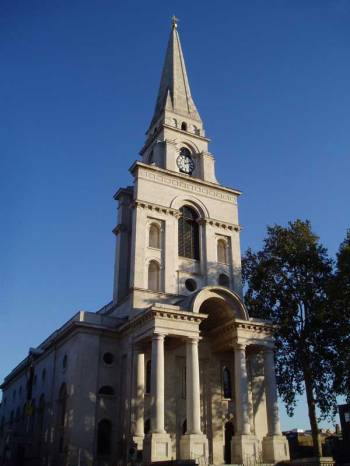
Christ Church, Spitalfields, London
2013 is the year of two significant anniversaries in the intertwined history of the Spitalfields district in London and the silk weaving industry created by Huguenots (French Protestant refugees who fled Catholic France from the 16th century). It is the 250th anniversary of the death of Anna Maria Garthwaite (1690-1763), an outstanding English textile designer who played an important part in the story of the Spitalfields silk weavers. It is also the 415th anniversary of the signing of the Edict of Nantes, on 13th April 1598. This decree by Henry IV of France served as a guarantee to the Protestant Huguenots that their rights to worship would be respected. However, it was revoked by Louis XIV in 1685 with the result that large numbers of French protestants fled to England to escape persecution. Over twenty thousand settled in Spitalfields where there was already an established weaving community.
Come and spend the day in Spitalfield, take a walk and browse around the Market, call in at Christ Church Spitalfields, the finest Baroque church in the country; visit Dennis Severs’ House, drop into the Town House
for coffee and delicious cakes. There is so much to see
and do — you will not be disappointed.
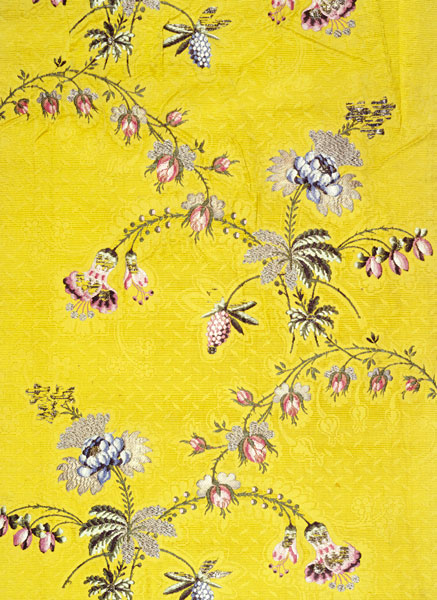
Silk panel, 1748-50 Spitalfields silk (The Museum of London)
Programme of Events
Supported by the Huguenot Society and the Spitalfields Trust
Between 8th and 21st April 2013, a series of activities to commemorate these two anniversaries will take place at different venues in Spitalfields. The celebratory programme will include
Daily Walks – The Immigrants’ Story, Historic Spitalfields, The Silk Weavers of Spitalfields
Talks by experts at the Bishopsgate Institute, Guildhall Library, V&A Museum, London Metropolitan Archives & The Natural History Museum
• Thanksgiving Service on Thursday 11th April at Christ Church, Spitalfields
• Extended opening hours for Dennis Severs’ House
• At Home With Anna Maria: a fundraising soirée on 16th April in Fournier Street with Clare Browne, curator of European textiles at the V&A and Dan Cruickshank
• Tours of Sandys Row Synagogue and Bisopsgate Institute
• The Big Weave: Saturday 13th April, which is an arts & crafts fair in Spitalfields Market. Stitches in Time will be hosting weaving workshops
The Popol Vuh: An Eighteenth-Century Manuscript Copy
With the December 21st solstice marking the end of a 5,125-year cycle of the Mayan ‘Long Count’ calendar, a posting on the oldest copy of the Mayan sacred text, the Popol Vuh, seems appropriate. The manuscript was produced in 1701-03 and is now part of the collection of the Newberry Library in Chicago.
◊ ◊ ◊ ◊ ◊
From The Newberry:
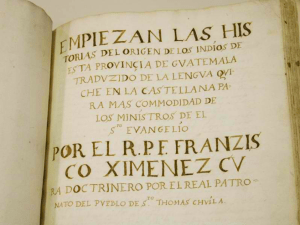
Title page, Popol Vuh. 1701-03 (Chicago: The Newberry Library, Vault Ayer MS 1515)
The Popol Vuh, which has been translated as Book of the Council, Book of the Community, Book of the People, and The Sacred Book, is the creation account of the Quiché Mayan people. It contains stories of the cosmologies, origins, traditions, and spiritual history of the Mayan people. It is considered by many Mayans as their equivalent to the Christian Bible and is held in deep reverence by them. In an effort to make it more widely available and reduce non-essential handling of the text, an important digitization project is underway and almost complete. It includes the complete conservation of the manuscript.
The Newberry’s manuscript of the Popol Vuh is one of the most widely known and possibly the earliest surviving copy. Quiché nobility probably wrote the original manuscript of the Popol Vuh in the mid-sixteenth century, in the Quiché language, using Latin orthography. The Newberry’s Popol Vuh was most likely copied from this original manuscript (now lost) in 1701-03, in the Guatemalan town of Chichicastenango, by Dominican Father Francisco Ximenez. His copy includes the Quiché text and a Spanish translation in side-by-side columns. In addition to the Popol Vuh, the manuscript also contains a Cakchikel-Quiché-Tzutuhil grammar, Christian devotional instructions, and answers to doctrinal questions and other material by Ximenez.
Conservation preparation and treatment are major components of the Popol Vuh digital project. With increased handling of the delicate manuscript during the filming and scanning process, it is absolutely critical to stabilize the paper and inks. A multi-disciplinary group of curators, librarians, conservators, and other experts reviewed the Popol Vuh’s condition and created the following procedure to provide appropriate conservation of the document.
The group decided that the binding, which was not original, should be removed and the ink checked under a microscope and stabilized. Removal of the binding included: separation of the covers from the text, cleaning the glue and paper linings from the spine, cutting the sewing threads, and separating the pages. By removing the old binding, the pages laid flat for filming. After the text was digitized, the manuscript was mended, page-by-page. Mending rejoins tears and strengthens any weak areas of the page, such as loss from insects, moisture damage, or wear from use. After additional consultation, a new binding style was chosen that was sympathetic to the Popol Vuh’s history, and a custom fitted enclosure created to house the Popol Vuh.
The new electronic versions of the Popol Vuh make the manuscript more accessible to a larger number of readers. In order to preserve the item for future generations of researchers, access to the actual sacred text of the Popol Vuh is available by appointment only. To make an appointment, please contact John Brady, Director of Reader Services, at bradyj@newberry.org.
Visitors to the Newberry may access the new electronic versions of the Popol Vuh in the Reference Center on the third floor. Ohio State University has recently released a digital version of the Popol Vuh. In addition, Brigham Young University’s Neal A. Maxwell Institute for Religious Texts (formerly the Institute for the Study and Preservation of Ancient Religious Texts) produced a DVD-ROM of the Popol-Vuh. This DVD is available for use in the 3rd floor reference area and is also for sale in the Newberry Bookstore. A facsimile of the work is also available in the Reference Center.
More information is available here»
Happy Thanksgiving
On this Thanksgiving Holiday (at least a holiday for Americans), I thought readers might enjoy a bit of history of the turkey in North America. Bonny Wolf recently reported on wild turkeys at National Public Radio for Weekend Edition Sunday (11 November 2012). The final sentences stood out for me:
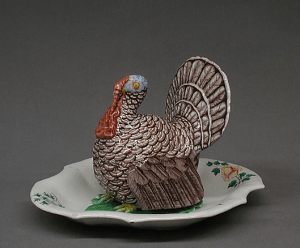
Tureen with Cover in the form of a Turkey, Florsheim Factory, Germany, ca. 1750, Tin-enameled earthenware, 6 x 10 inches (NY: Metropolitan Museum of Art)
Oddly, the ancestors of most supermarket turkeys are from Mexico. The Spanish took them to Europe in the 1500s, and the birds became popular all over the continent. When English settlers came to America, they brought turkeys back to the New World. Those are the turkeys that were developed into today’s commercial varieties, completing the turkey’s roundtrip.
The linked source for the claim comes from a 2010 article, “Ancient Mitochondrial DNA Analysis Reveals Complexity of Indigenous North American Turkey Domestication,” published in the Proceedings of the National Academy of Sciences of the United States of America. Fascinating. Global eighteenth-century indeed.
◊ ◊ ◊ ◊ ◊
I’m in no position to vouch for the scholarly credibility of the following article, but it’s also interesting. James Earl and Mary C. Kennamer and Ron Brenneman provide a “History of the Wild Turkey in North America,” for the NWTF Wildlife Bulletin (yes, of course, there’s a National Wild Turkey Federation) . . .
The Europeans were familiar with guinea fowl, and peafowl, but then their explorers found a New World bird similar to, but not exactly like, what they were used to seeing. Those early explorers often wrote of finding guinea and peafowl–type birds. Their descriptions though were later determined to be of a new bird soon known as the wild turkey. Even Linnaeus, who proposed the scientific name Meleagris gallopavo in 1758, used names reminiscent of the earlier confusion. The genus name Meleagris means “guinea fowl,” from the ancient Greco–Romans. The species name gallopavo is Latin for “peafowl” of Asia (gallus for cock and pavo for chickenlike). Linnaeus’ descriptions, however, seem to be based primarily on the domestic turkey imported to the U.S. by Europeans. He also described a Mexican subspecies from a specimen taken at Mirador, Veracruz, but which is probably extinct today. . .
Happy Thanksgiving!
-CH
Display | 700th Anniversary of Edward III
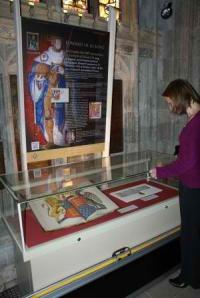
While hardly an obvious inclusion for Enfilade, this small exhibition at Windsor includes several eighteenth-century sources. The coat of arms of Edward on display, for instance, comes from the sketchbook of Henry Emlyn (1729-1815), the architect and supervisor of George III’s restoration of the chapel (SGC M.172). John Anstis’s 1724 Black Book, or Register of the Order (SGC RBK DL.13 volume I) is also on view. These and similar items serve as reminders of the historiographical and antiquarian importance of the period. -CH
◊ ◊ ◊ ◊ ◊
From the College of St George:
King Edward III Anniversary
St George’s Chapel, Windsor, 19 June 2012 — 3 January 2013

St George’s Chapel, Windsor Castle
◊ ◊ ◊ ◊ ◊
2012 marks the 700th anniversary of the birth of Edward III at Windsor Castle. Born on 13 November 1312, the first son of Edward II and Isabella of France, Edward III became King of England at the age of fourteen, in January 1327, on the abdication of his father.
 His reign, lasting fifty years, was dominated by war with Scotland and France, which has led to him being chiefly remembered as a warrior. However, it also saw great building projects, the evolution of the English parliament, the establishment of English as the official language and the longest period of domestic peace in Medieval England. Edward III had a long and close relationship with Windsor. Having been born in the Castle, he was baptised here on 16 November 1312, in St Edward’s Chapel, built by his ancestor Henry III in around 1240 and subsequently rededicated by Edward III to St Mary the Virgin, St George the Martyr and St Edward the Confessor. Several of his children were born at Windsor, and it was here that his Queen Consort, Philippa, died in 1369.
In commemoration of the 70oth anniversary of Edward III’s birth at Windsor, an exhibition of documents, rare books and artefacts from the St George’s Chapel Archives and Chapter Library will be on display in the South Quire Aisle of the
Chapel from 19 June 2012 to 3 January 2013.
The four exhibition cases and explanatory panels cover the following themes:
• Edward III as King
• Edward III and Windsor
• Edward III and St George’s Chapel
• Edward III and the Order of the Garter
Together they illustrate key aspects of the life of this great English king and explore his relationship with Windsor, which he was to make the spiritual home of his new chivalric order, the Order of the Garter, founded here in or shortly before 1348.
Jewish High Holidays
On Site
With Yom Kippur (The Day of Atonement) beginning this evening at sundown, it seems like an appropriate time to note an exceptional piece of eighteenth-century English architecture: the Bevis Marks Synagogue in London, the oldest synagogue in Britain, with a history of continuous worship stretching back 311 years. I was one of 2000 fortunate people to visit the building on Sunday in conjunction with London’s annual Open House weekend.
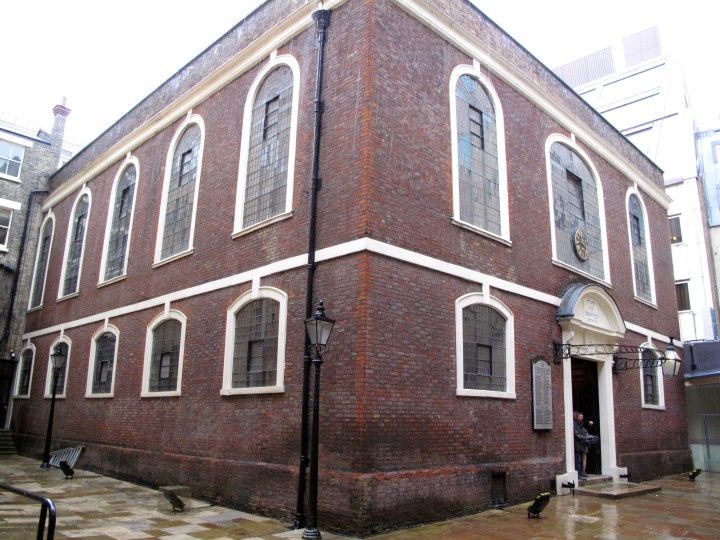
Joseph Avis, The Bevis Marks Synagogue in London, 1701
◊ ◊ ◊ ◊ ◊
A short walk from the Aldgate Tube stop and historically just north of the actual gateway, the Bevis Marks Synagogue was completed in September 1701, the work of Joseph Avis, a Quaker carpenter who had previously worked with Christopher Wren on St Bride’s in Fleet Street. With a few exceptions, the interior and furnishings of this Grade I listed building are original. Some of the benches, in fact, date to the middle of the seventeenth century, when the community met in the upper floor of a house in nearby Creechurch Lane.
It was under Cromwell that these Spanish and Portuguese Jews–many of whom had strong ties to Amsterdam–were legally recognized and allowed to practice their faith openly (in addition to the right to a space for worship, they were granted permission to establish a cemetery). Services today are carried out almost entirely in Hebrew, though there are two exceptions: announcement are made in Portuguese, and prayers for the Queen are said in English.
 Architecturally, the building relates to contemporary dissenting traditions and corresponds to the rebuilding of the fifty-one churches by Wren. One of the points I took away from the visit was simply how easy and useful it would be to include the Bevis Marks Synagogue when teaching Wren and the reconstruction of London following the Great Fire. It would provide a physically tangible way to engage the history of Jews in England, looking both backward and forward. One could, for instance, address the arrival of Jews with William the Conqueror, the expulsion under Edward I in 1290, and the migration of Jews from the Iberian Peninsula after 1492. Looking forward into the eighteenth century, I would like to know more about The Board of Deputies of British Jews, which was formally established on the accession of George III to the throne in 1760. With the synagogue, the character and limits of religious tolerance in the period are nicely introduced. As I’m really just thinking aloud here, I’m sure many of you who teach have already been doing
this and doing it well in your classes–so by all means feel free to chime in
with suggestions.
To all those keeping the fast, G’mar Tov.
-CH
Display | Citizens of the World: David Hume and Allan Ramsay
On this day, August 10th, of 1784 Allan Ramsay died at the age of 70; October 2013 marks the tercentennial of his birth. From the Scottish National Portrait Gallery:
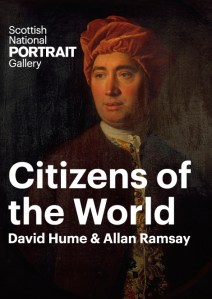 Citizens of the World: David Hume and Allan Ramsay
Scottish National Portrait Gallery, Edinburgh, 1 December 2011 — 31 December 2015
Scotland made a remarkable contribution to the European Enlightenment of the eighteenth century with many of her citizens contributing to the ferment of ideas and shifts in attitude which transformed the world. Two Scots, David Hume, the great philosopher, and Allan Ramsay, the outstanding painter, were at the centre of this cultural and intellectual revolution. This display explores their world, their friends, their families and their patrons.
Happy Bastille Day
Commentary from The Onion:
“I Think I’d Make A Pretty Good HBO Show,” The Onion (19 June 2012)
By 18th-Century France
 I don’t think I’m talking out of turn here when I say that, as far as historical eras are concerned, I am probably one of the richest and most exciting periods in Western history. That’s not me bragging; it’s just a generally accepted truth at this point. After all, not every century of a nation’s past can boast successive international wars, a radical intellectual movement, and a bloody revolution, but I’ve got all of that and then some. In fact, one would be pretty hard-pressed to find a period more compelling and ripe for gripping drama than myself.
Which is why, when you think about it, it’s pretty crazy there hasn’t been an HBO original series about me about by now. Something like 40,000 people were beheaded during me, for God’s sake. Put that into a made-for-TV drama that weaves a rich tapestry of historical narrative with gritty tales of intrigue, murder, and sex, and I’m pretty much an untapped gold mine of programming, right?
I know, I know, everyone and their mother thinks they have a great idea for a cable television show, but stick with me on this one. Between sprawling aristocratic estates juxtaposed with sordid underworlds and political upheaval driven by ambitious but flawed political figures, I can deliver the full HBO package. You want elegant costumes? Check. Candelabras? Check. Beautiful women with moles? Check and check. I’m packed full of cool stuff. You could slot me in on, say, Sunday nights at nine and probably get a 2.5 Nielsen rating, easy. . .
The full article is available here»
Enfilade at Three — Buy a Book and Open a Door
From the Editor
 Enfilade turns three today, and to celebrate, I’m announcing a campaign to establish June 22 as Buy-an-Art-Book Day. As I’ve said repeatedly, you deserve credit for making this site so much more than I could have possibly envisioned when I stepped on-board several years ago as newsletter editor. With more than 220,000 hits on some 1300 posts, Enfilade attests to the global depth of interest in eighteenth-century art — both among scholars and a wider, engaged public. The site now receives around 10,000 hits each month with some 1500 from returning visits. In short, there are hundreds of you who read Enfilade on a regular basis, and the site’s success depends on you. Thank you!
With these numbers in mind, it seems to me that Enfilade readers could mobilize to make an impact — modest perhaps but still an impact. In transitioning from traditional print formats to the digital realm, academic publishing, particularly art historical publishing, faces tremendous challenges. With the ‘business’ of the academy more generally plagued by questions of sustainability, it’s easy to see how hard decisions about budgets have wreaked havoc on the sales of books (when major universities are cutting whole departments, declining library budgets may seem relatively benign, but in both cases, fewer books will be sold). For most of us, such gloomy observations are all too familiar, and you don’t turn to Enfilade for more bad news. Today is after all a birthday celebration!
So as a gesture of positive action, I’m asking all of you to buy a book today (and fellow bloggers to spread the word). It’s easy to think that it won’t matter, but it does. Most people are astounded to learn just how small the circulation numbers are for art history books published by university presses. However humbling it may be for those of us who spend years of our lives producing a book, it’s not uncommon for only 400 or 500 copies to be sold. Surpass 1000 and you’re a superstar. There’s a tendency to assume that university presses receive generous funding from their host universities. It’s almost never the case. If they’re not in the business to turn huge profits, they must still be economically viable. Several years ago, I heard Susan Bielstein, executive editor at the University of Chicago Press, give a talk on the nuts and bolts of publishing. How did she begin? By asking members of her audience (almost entirely composed of art historians) to go buy a book. She was entirely serious. So am I.

Many of you buy lots of art history books already. Bravo! Buying a book today won’t be any major change for you. As I think about my own buying habits, they tend to go something like this: I buy discounted display copies at conferences, I buy things I need for an upcoming talk, I buy remaindered copies of books I should have bought a year or two earlier, or I buy used copies I need for an article via Amazon. None of that’s what I have in mind in launching Buy-an-Art-Book Day. Those used books do nothing to help the authors or the university presses who produced them. For that matter, new purchases through Amazon often result in smaller royalties than buying from the publisher directly. Ever wonder who shoulders the expense of that reduced price? Yes, the publisher and the writer.
If 200 or 300 of you buy an art history book this week — ideally one treating the eighteenth century and, better yet, one written by a HECAA member — it would send a strong message that there is an eager audience for such books. Whether you spend $6 or $1000, buy a book.
I like the metaphor of an enfilade because of the way it suggests an open — almost limitless — vista, with each room leading to a deeper, more intimate experience. But such a vision is premised on those doors being opened. Reading a book — buying a book — is one way we turn the handle, one way we open doors to the eighteenth century.
-Craig Hanson
‘Gloriana’ to Lead the Flotilla for the Diamond Jubilee in London

The Gloriana launched in April 2012; from Leon Watson’s
story for the Mail Online, 19 April 2012; Photo by David Parker
◊ ◊ ◊ ◊ ◊
From The BBC (19 April 2012)
The £1m boat that will the lead the Thames Diamond Jubilee Pageant has been launched on the river. The 94ft (28.6m) royal barge Gloriana was escorted through the streets of London on the back of a truck. It had been transported from a unit in Brentford to Isleworth, west London, where it was placed in the Thames. A pageant of more than 1,000 boats involving some 20,000 people will sail down the river on 3 June to mark the Queen’s 60 years on the throne. . . .
Lord Sterling said: “I became enamoured with the idea of building something timeless and got inspiration from Canaletto’s paintings that showed the great barges of the 18th Century and decided to build one. If we had to give it a style, it would be Regency. Including 18 rowers, it will carry 52 people. No-one’s really built anything like this for 200 years and the way we’ve built it, it will last for 200 years if looked after” . . .
◊ ◊ ◊ ◊ ◊
From the official event website:

Photo from ‘Luxatic’; click image to access the article.
On Sunday 3rd June 2012, over one thousand boats will muster on the River Thames in preparation for Her Majesty The Queen to take part in the Thames Diamond Jubilee Pageant. The formal river procession will be between 2pm and 6pm, starting upriver of Battersea Bridge and finishing downriver of Tower Bridge. The boats will muster between Hammersmith and Battersea and disperse from Tower Bridge to West India Docks.
It will be one of the largest flotillas ever assembled on the river. Rowed boats and working boats and pleasure vessels of all shapes and sizes will be beautifully dressed with streamers and Union Flags, their crews and passengers turned out in their finest rigs. The armed forces, fire, police, rescue and other services will be afloat and there will be an exuberance of historic boats, wooden launches, steam vessels and other boats of note.
The flotilla will be bolstered with passenger boats carrying flag-waving members of the public placed centre stage (or rather mid-river) in this floating celebration of Her Majesty’s 60 year reign. The spectacle will be further enhanced with music barges and boats spouting geysers. Moreover, there will be specially constructed elements such as a floating belfry, its chiming bells answered by those from riverbank churches.
The opening ceremony of London’s Olympic Games will be just six weeks away and the public that crowd the riverbanks and bridges will give a rousing reception to the many boats that have travelled from far and wide to represent UK port cities, the Commonwealth countries and other international interests. Downriver of London Bridge, there will be a gun salute and the flotilla will pass through a spectacular Avenue of Sail made by traditional Thames sailing boats, oyster smacks, square riggers, naval vessels and other impressive ships.
The Thames Diamond Jubilee Pageant celebrates Her Majesty’s 60 years of service by magnificently bringing the Thames to life; making it joyously full with boats, resounding with clanging bells, tooting horns and sounding whistles; recalling both its royal heritage and its heyday as a working, bustling river.










 Enfilade
1 comment