At Auction | Indian and Islamic Art at Bonhams
From the Bonhams press release:
Bonhams Sale 21720 | Indian and Islamic Art
London, 8 April 2014
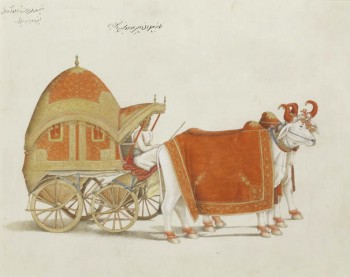
Lot 299: Painting from the Fraser Album of The Bullock-drawn Carriage of Prince Mirza Babur, Delhi, 1815–19
Bonhams will sell three stunning images from The Fraser Album, discovered amongst the papers of this Scottish family in 1979, at its next auction of Indian and Islamic art on April 8th in London. The Album consists of more than ninety watercolors of breathtaking quality, which provide an extraordinary portrait of life in and around Delhi in the early 19th century. This was an area which was relatively unknown to the British at that date, with Mughal control ceded to them only in 1803 and the Emperor nominally in power.
James Baillie Fraser (1783–1856) and his brother William (1784–1835) came from Inverness. William went to India aged 16 as a trainee political officer in the East India Company while James arrived a year later, taking a commercial position in Calcutta. James, a talented artist himself, published collections of views of the Himalayas and of Calcutta.
When James joined William in Delhi in 1815 the two brothers commissioned local artists to depict servants, tradesmen and figures from the irregular military units, some of which were employed by the British, including Gurkha soldiers and the colourfully-attired troopers of bodies such as Skinner’s Horse. More than one artist was employed on the paintings which go to make up the album. The best examples are usually attributed to Ghulam Ali Khan, but it is likely that the rest were produced by other members of his family. The works date between 1815 and 1820. The two lots in the present sale capture the richness of ceremonial life in Delhi, and are also representative of the British fascination with types of transport and servants which appears in other more typical examples of Company School painting.
The first image is of an elephant and driver, probably from the Mughal Emperor’s stable, with a hunting howdah equipped with a rifle, bows and a pistol, from Delhi or Northern India, 1815–19 (estimate £20,000–30,000).
The second Fraser Album image is of the bullock-drawn carriage of Prince Mirza Babur, Delhi or Northern India, 1815–19 (estimate £20,000–30,000). The inscriptions read: ‘The special chariot of the son of the spiritual preceptor of the horizons (Murshidzada-i afaq), Mirza Babur Bahadur’. The honorific title refers to Mirza Babur’s father, the Mughal Emperor Bahadur Shah II, in his role as a Sufi spiritual leader.
The third image is that of a cotton-carder at work, attributed to the artist Ghulam ‘Ali Khan (fl. 1817–55) Delhi, circa 1820 (estimate £20,000–30,000). This detailed and technically accurate painting shows a captured moment from daily life. The action depicted is in fact strictly referred to as ‘bowing’, running the taut string of the bow across the pile of fibers to fluff up the cotton.
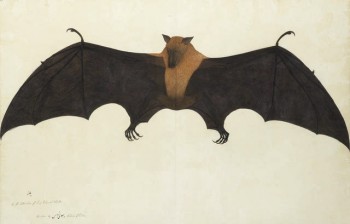
Lot 292: A painting by Bhawani Das from the Impey Album,
A Great Indian Fruit Bat, or Flying Fox (Pteropus giganteus),
Calcutta, ca 1778–82
Another important painting in this Bonhams sale of Indian and Islamic art is from the Impey Album, by the artist Bhawani Das: a Great Indian Fruit Bat, or Flying Fox (Pteropus giganteus) Calcutta, circa 1778–82. The Great Indian Fruit Bat, or Flying Fox, has a wingspan of 1.5 meters, well captured in this painting. This is a pen and ink, watercolor with gum arabic, heightened with bodycolour, on watermarked paper, inscribed at lower left In the Collection of Lady Impey at Calcutta/Painted by [in Persian in nasta’liq script, Bhawani Das] Native of Patna, (estimate £80,000–120,000).
Sir Elijah Impey was the East India Company’s Chief Justice of Bengal from 1774 to 1782. He was a well-known patron of Indian artists, but his wife, Mary, Lady Impey, who joined him in Calcutta in 1777, was particularly interested in the flora and fauna of the surrounding area, creating her own menagerie. She then commissioned studies of animals and plants from various artists from the nearby city of Patna, the most senior of whom were the Muslim Shaykh Zayn-al-Din, and the Hindus Ram Das and Bhawani Das, the painter of the present lot. The precision of these artists’ technique, which stemmed from the Mughal tradition, appealed to British patrons, and the technique and the subject-matter have become known as ‘Company School’. The series commissioned by Lady Impey (as well as others in a similar style by unknown artists) are particularly striking because of their large size, using sheets of English watermarked paper. There were 326 works in the original series, which were brought back to England with the Impeys in 1783, and were sold at Phillips (now Bonhams) in London in 1810.
◊ ◊ ◊ ◊ ◊
Note (added 10 April 2014) — The painting of the great Indian fruit bat sold for £458,500, four times its presale estimate. More information is available here»
ed to sell for £80,000-£120,000, but
At Auction | Stubbs’s Tygers at Play (Two Leopard Cubs)

George Stubbs, Tygers at Play, 40 by 50 inches, c.1770–75 (est. £4–6 million)
Press release (27 March 2014) from Sotheby’s:
Tygers at Play, one of George Stubbs’s most celebrated works, is to lead Sotheby’s London Evening Sale of Old Master and British Paintings on 9 July 2014. Painted circa 1770–75, this masterful depiction of two leopard cubs ranks among Stubbs’s most popular subjects, reproduced in numerous prints. The painting itself, however, has rarely been seen in public, having been exhibited only four times since its original appearance at the Royal Academy of Arts in London. Testament to the artist’s exceptional eye for capturing the animal form, this admirably preserved work boasts impeccable provenance, having been sold only once since it was commissioned from the English painter. It remained in the possession of a single family until 1962, when it was acquired by the present owners. Coming from a distinguished British aristocratic collection, Tygers at Play will be offered with an estimate of £4–6 million.
Talking about the sale of the painting, Julian Gascoigne, Specialist, British Paintings at Sotheby’s commented: “Major big cat compositions by Stubbs very rarely appear at auction. Having only passed through two careful owners since it was painted, this work is in perfect condition, down to the delicate whiskers of the leopards, which is exceptionally rare for a work of this date. Never has the art market been so global and the universal beauty of Stubbs’s animals appeals today to an ever-growing array of collectors across the world. We therefore very much look forward to exhibiting this extraordinary work in Hong Kong, Moscow, New York, and London in the three months leading up to the sale.”
Of Stubbs’s four paintings of leopards, Tygers at Play is by far the most ambitious and dramatic. This rare example of the artist’s understanding of animal anatomy is also illustrative of his preoccupation with wild and exotic animals from the late 1760s and 1770s, which resulted in some of Stubbs’s greatest paintings, including his famous Lion and Horse series (a theme which emanated from his encounter with classical antiquity in Rome in 1754), as well as his famous paintings of an Indian Rhinoceros (c.1790/91, Hunterian Museum, Royal college of Surgeons), a Zebra presented to Queen Charlotte in 1762 (Paul Mellon Collection, Yale Centre for British Art, New Haven), and his portrait of The Kongouro from New Holland, recently acquired by the National Maritime Museum, Greenwich.
The seemingly incorrect title, Tygers at Play, which was used by Stubbs in the Royal Academy exhibition in 1776 and in the lettering for the engraving in 1780, seems curiously old fashioned given the artist’s studious and observant depiction of what are quite clearly leopards. A possible explanation would be that before circa 1750 the word tiger, or tyger was used as the generic term for all striped or spotted members of the cat family that were not lions.
Stubbs’s fascination with exotic animals was partly a symptom of the rise of menageries in mid-18th century London, stocked with wild beast brought back from Africa and India by men like Warren Hastings, and the contemporary fascination with exotic specimens from far off lands, which was fuelled by expeditionary voyages such as Captain Cook’s journey to the South Pacific in 1766 and his subsequent discovery of Australia in 1770.
Worldwide Exhibitions
Hong Kong Convention Centre: 3–7 April 2014
Moscow, New Manege Exhibition Hall: 25–27 April 2014
Sotheby’s New York: 31 May – 4 June 2014
Sotheby’s London: Early July 2014
Programming at the 2014 New York Ceramics Fair
Coinciding with New York’s Winter Antiques Week is the city’s Ceramics Fair, which will feature approximately “36 galleries offering all things ‘fired’—porcelain, pottery, glass, cloisonné and enamels, in a setting perfect for the exhibition and sale of important small objects.” A press release outlines programming, which will include an exhibition combining historic and contemporary pieces:
The Bacchanalistas: Passions + Pleasures
15th New York Ceramics Fair, Bohemian National Hall, New York, 22–26 January 2014
Curated by Leslie Ferrin
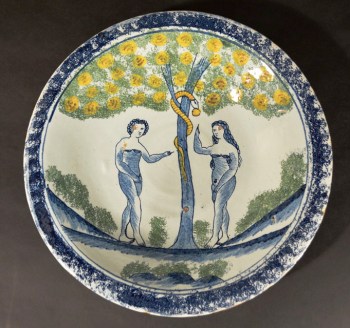
Large English Delftware Adam & Eve Dish, Bristol, ca. 1700–20
(Photo: Earle Vandekar of Knightsbridge)
The fifteenth edition of New York Ceramics Fair promises not only a dazzling array of traditional and contemporary treasures to entice the eye, but also thought-provoking lectures, panel discussions with top interior designers, and an exhibition called The Bacchanalistas: Passions + Pleasures, curated by Leslie Ferrin, the contemporary ceramics specialist.
The Bacchanalistas: Passions + Pleasures will present an overview of contemporary ceramics by living artists whose art draws inspiration from ceramic history. Themes of passion, eroticism, sexuality, abundance and excess of food and wine will be shown through figural sculpture, animated painted vessels and still life from the 16th century through today. To convey her theme, Ms. Ferrin invited the participating dealers at the New York Ceramics Fair to submit historic objects to juxtapose with the contemporary artists.
“Bacchanalia, the Roman festival of Bacchus, the Greco-Roman god of wine, freedom, intoxication and ecstasy were attended by a secret society and became legendary,” says Ms. Ferrin. “Ancient ceramic objects were in use during these parties and then later created to commemorate such events. Today a generation of artists is inspired by those objects and create their own for celebratory experiences. Decorative arts and fine art worlds collide with references to feast, sexuality and over the top pleasures. While not exactly a mystery cult, our contemporary art scene appears to some to operate today as the Bacchanalia did during Roman times, wild parties and excess in the name of pleasure and culture.”
The fair has designated Friday as their Designer Day featuring Alexa Hampton, Kitty Hawks, and David Scott on a panel called “Porcelain Perfect: How Top Decorators Accessorize with Ceramics,” in cooperation with the New York School of Interior Design, and moderated by Judith Gura, noted author and member NYSID. Mario Buatta, the highly acclaimed interior designer, will entertain his audience with “If You Can’t Hide It, Decorate It” followed by a book-signing of his best-seller Mario Buatta: 50 Years of American Style and Decoration, published by Rizzoli.
W E D N E S D A Y , 2 2 J A N U A R Y
12:00 “Tortoise Shell Ware Made in This Town: A Re-examination of the Benjamin Leigh and John Allman Partnership in Boston” Angelika Kuettner, Associate Registrar for Imaging and Assistant Curator of Ceramics, Colonial Williamsburg.
2:00 “English and Continental Glassware in Early America” Leslie B. Grigsby, Winterthur’s Curator of Ceramics and Glass.
4:00 “Perfected in New York City: Jean-Pierre Colné and the Origins of Mechanized Glass Cutting,” Ian Simmonds, antiques dealer and researcher.
F R I D A Y , 2 4 J A N U A R Y
12:00 “Porcelain Perfect: How Top Decorators Accessorize with Ceramics,” prominent interior decorators Alexa Hampton, David Scott and Kitty Hawks will discuss the importance of ceramics in decorating. Sponsored in co-operation with The New York School of Interior Design, the discussion will be moderated by Judith Gura, author and NYSID member and area co-ordinator.
2:00 “If You Can’t Hide It, Decorate It,” Mario Buatta, the internationally acclaimed interior designer. Mr. Buatta will sign copies of his new book, Mario Buatta: Fifty Years of American Style and Decoration.
S A T U R D A Y , 2 5 J A N U A R Y
12:00 “Making Pottery Tell Its Own Story: Royal Worcester’s Vases with Scenes of Chinese Porcelain Production,” Ron Fuchs II, Curator of the Reeves Collections at Washington and Lee University.
2:00 “Angels and Demons: The Pleasures of Pottery and Porcelain” Robert Hunter, the editor of Ceramics in America.
4:00 “The Bacchanalistas: Passions + Pleasure,” Leslie Ferrin, Director, Ferrin Contemporary. Coinciding with the exhibition, Ms. Ferrin’s lecture will present an overview of contemporary ceramics by living artists whose art practice draws inspiration from ceramic history. Themes of passion, eroticism, sexuality, abundance and excess of food and wine will be shown through figural sculpture, animated painted vessels, and still life.
All the lectures are free with show admission and are sponsored by the Chipstone Foundation.
◊ ◊ ◊ ◊ ◊
The New York Ceramics Fair, which takes place in the Grand Ballroom of the Bohemian National Hall, 321 East 73rd Street (between 1st and 2nd Avenues), opens with a private preview on Tuesday evening, from 5 to 8:30 PM. Tickets are $90 each. The show opens to the public on Wednesday, January 22 and runs through Sunday, January 26. Hours are 11 AM–7 PM and on Sunday, 11 AM–4 PM. Ticket price with catalogue is $20 per person and can be used throughout the duration of the fair.
The New York Ceramics Fair is produced by Meg Wendy/MCG Events LLC and Liz Lees/Caskey Lees Inc.
In addition to the New York CeramicsFair, Caskey-Lees currently produces the San Francisco Tribal & Textile Arts Show in San Francisco.
Exhibition | Winter Antiques Show in New York to Highlight the PEM
Press release (13 August 2013) from the Winter Antiques Show:
Fresh Take, Making Connections at the Peabody Essex Museum
60th Winter Antiques Show, Park Avenue Armory, New York, 24 January — 2 February 2014

Pair of carp tureens, 1760–80, Porcelain, Jingdezhen, China, with gilded bronze mounts, possibly from Spain (Peabody Essex Museum)
The Winter Antiques Show’s 2014 loan exhibition will celebrate the Peabody Essex Museum (PEM) in Salem, Massachusetts. Fresh Take, Making Connections at the Peabody Essex Museum is comprised of more than 50 paintings, sculptures, textiles, and decorative objects. One of America’s oldest and fastest growing museums, PEM was founded in 1799 and its collection showcases an unrivaled spectrum of American art as well as outstanding Asian, Asian export, Native American, African, Oceanic, maritime, and photography collections. The exhibition will be on view during the run of the Winter Antiques Show, from January 24 to February 2, 2014.
PEM celebrates its 215th year in 2014, and has recently embarked on a $650 million capital campaign and expansion that will place the museum among the top 10 art museums in the country in terms of gallery space and total endowment. The museum’s campus boasts 22 historic buildings celebrating Salem’s rich architectural and garden heritage and Yin Yu Tang, a 200-year old Chinese house that is the only example of its kind in the United States. PEM offers a vibrant schedule of changing exhibitions, a lively contemporary art program, performances, and an interactive education center.

Painted Side Chair, ca. 1795, Salem, MA, wood, paint, reproduction
upholstery (Peabody Essex Museum)
Fresh Take, Making Connections at the Peabody Essex Museum is a microcosm of the PEM experience. Works of art from diverse cultures and time periods are grouped together, uniting and contrasting objects of creative expression in unexpected ways. Highlights of the exhibition range from a spectacular inlaid ivory chair from India (18th century) to a mahogany dressing chest by Thomas Seymour (c. 1810); from an English brass mariner’s astrolabe used to determine time and latitude by the stars (late 1500s) to a stick chart used by Micronesian sailors navigating the Pacific Ocean (early 20th century); from a view of Salem Common by George Ropes (1808) to a Joseph Cornell collage inspired by Magritte’s surrealist landscape (c.1964); from a bronze Japanese reliquary from the Koki-ji Temple, Kawachi-gun, Osaka Prefecture (1679) to a Chinese bridal headdress made of Kingfisher feathers, silk, pearls, and semi-precious stones (c. 1800s).
One of the many highlights is a striking portrait of Nathaniel Hawthorne by Charles Osgood (1809– 1890). The 1840 portrait was painted when Hawthorne worked in the Boston Custom House, ten years before The Scarlet Letter was published. It is the best-known likeness of the young author.
The founding organization of today’s Peabody Essex Museum was the East India Marine Society. A centerpiece of the exhibit is the 1803 sign painted by Michele Felice Cornè (1752–1845) for the original Society’s exhibition hall. The sign depicts Salem Harbor and a ship, probably the Mount Vernon, on which the artist emigrated from Naples to America in 1800. Banner and letters were added in 1825 by sign painter Samuel Bartol for the new East India Marine Hall, where it was placed over the door.
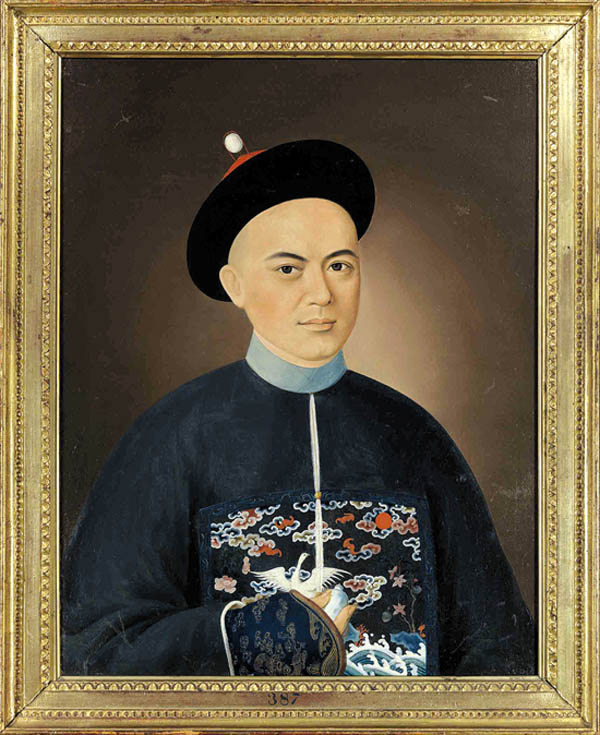
Spoilum, Portrait of Eshing, ca. 1805, Guangzhou (Canton).
Oil on canvas (Peabody Essex Museum)
A Spoilum portrait of a prominent Cantonese silk merchant is also included in the exhibition (1805). Spoilum (active 1785–1810) was one of the first Chinese artists to work in a Western style, and though he never traveled outside of China, his paintings often resemble early American portraiture. The artist is best known for his portraits of English and American merchants, so this portrait of Eshing (a Chinese merchant) is particularly rare. Eshing frequently did business with Salem merchants, and this portrait was acquired as a gift from one of these merchants to the East India Marine Society in 1809.
Demonstrating the wide travels of Salem’s wealthy merchants is a Brazilian headdress collected by Michael W. Shepherd on a trip up the Amazon River in 1847. The mid 19th-century headdress is made primarily of red and blue macaw feathers, an important expression of wealth for many indigenous people of South America. This type of headdress would have been worn by caciques (Native chiefs).
Jeff Daly, formerly senior design advisor to the director at the Metropolitan Museum of Art, will design the Winter Antiques Show’s loan exhibition and plans to create a modern kuntskammer to hold the many treasures from PEM, much like they were displayed in the original East India Marine Society exhibition hall.
The exhibition is sponsored by Chubb Personal Insurance for the 18th consecutive year.
About the Winter Antiques Show
The Winter Antiques Show celebrates its 60th year Diamond Jubilee as America’s most prestigious antiques show, featuring 73 renowned experts in American, English, European, and Asian fine and decorative arts in a fully vetted show. The show was established in 1955 by East Side House Settlement, a social services institution located in the South Bronx. All net proceeds from the show benefit East Side House Settlement. The Winter Antiques Show will run from January 24 to February 2, 2014, at the Park Avenue Armory, 67th Street and Park Avenue, New York City. The Winter Antiques Show hours are 12–8pm daily except Sundays and Thursday, 12–6 pm. Daily admission to the show is $25, which includes the show’s award-winning catalogue. To purchase tickets for the Opening Night Party on January 23, 2014, or Young Collectors Night on January 30, 2014, call (718) 292-7392 or visit the show’s website.
About East Side House Settlement
East Side House Settlement was founded in 1891 to help immigrants and lower income families on the East Side of Manhattan. In 1962, it moved to the South Bronx where it serves 8,000 residents annually within one of America’s poorest congressional districts, the Mott Haven section of the South Bronx. Among the initiatives that focus on educational attainment as the gateway out of poverty is the innovative and highly acclaimed Mott Haven Village Preparatory School.
Aronson Antiquairs Presents Puzzle Jugs at the Winter Antiques Show
Regular readers may recall my irrationally exuberant affection for puzzle jugs. -CH
As noted at Art Daily (4 January 2014)
Delft Puzzle Jugs from Aronson Antiquairs of Amsterdam
60th Winter Antiques Show, Park Avenue Armory, New York, 24 January — 2 February 2014

◊ ◊ ◊ ◊ ◊
At the 60th Annual Winter Antiques Show in New York, January 23 – February 2, 2014, Aronson Antiquairs of Amsterdam will showcase an amusing collection of Suijgkannen or Delft Puzzle Jugs. “Delft Puzzle Jugs from the 17th and 18th centuries are among the most prized examples of the amusing novelty, but Delft examples were seen as early as 1650. The style gained popularity throughout Europe. Puzzle Jugs were designed with hollow rims and handles and diverting spouts and tubes. They challenged and entertained guests at both homes and taverns. You never knew if a dinner party would be a success and whether your guests would like the food and wine and have a good time. But with a variety of Puzzle Jugs on hand you could get a good laugh out of those trying their dexterity and luck by making a game of it,” says Robert Aronson, fifth generation Dutch Delft dealer of Aronson Antiquairs of Amsterdam.
 Puzzle Jugs got their name from their ingenious design which could include a perforated neck, and hollow handle and rim. Sometimes as many as five or six concealed tubes or pipes were incorporated into the jug, making it even more difficult to imbibe the liquid, most often ale or wine. The trick was to drink the liquid without spilling the jug’s contents all over your shirt. It was common for tavern-keepers to offer these jugs in various drinking games, with guests wagering on who would master the puzzle. It helped to be highly dexterous and clever—itself a challenge during a night of merriment.
The oldest known, the Exeter Puzzle Jug, was produced in western France around 1300 and discovered in England in 1899. It was given to the Royal Albert Memorial Museum in Exeter, Devon. Many Puzzle Jugs had inscriptions on the body of the jug that ranged from simple to poetic, typically something along the lines of “Here gentlemen, come try your skill. I’ll hold a wager, if you will, that you don’t drink this liquid all without your spill or let some fall.”. . .
Highlights at the Aronson Antiquairs stand will include nine outstanding Delft Puzzle Jugs from a private collection including a Blue and White Delft Puzzle Jug from the Ten Tooren-Smith Collection, The Netherlands, which dates to 1760 and portrays an elegant couple on the body. The gallant gentleman is doffing his hat and approaching his sweetheart who holds a fan. The 22.8cm puzzle jug features a baluster-form body and panels of trellis diaperwork beneath the floral and foliate-pierced neck. The puzzle is in the tubular rim affixed with three nozzles which interrupts a flowering vine border continuing onto a hollow loop handle.
A second Blue and White Ring-Form Delft Jug dates to 1725–35 and features a circular body painted with a Chinese pheasant perched on a c-scroll forming the stem of a flowering leafy peony branch. It is pierced with three roundels, each centering a six petal flowerhead below three teardrop-shaped nozzles issuing from the tubular neck (24.4cm).
A third Delft Blue and White Puzzle Jug (23.4cm high) is from an earlier period, 1688–92, and was in Dr Gunther Grethe’s Hamburg Collection. Aronson says, “This jug has a GV mark in blue, probably is from Gijsbrecht Claesz, Verhaast. The spherical body is painted with a large insect and birds in flight above a chrysanthemum border. The cylindrical neck is pierced with three four-petal blossoms and eight dots against a foliate-patterned blue ground between floral borders, and affixed beneath the rim with a tubular device molded with seven blossoms, one of them pierced, and continuing into the flower and scroll-patterned hollow loop handle.”
Aronson says that the whimsical characteristics of Delft Puzzle Jugs appeal to collectors now because, “These are novelty pieces with amusing stories to tell that reveal how people lived centuries ago. Those who enjoy having a peek at what brought a smile to the face of our ancestors collect Delft Puzzle Jugs now. We are lucky to have acquired this collection of nine examples.” Prices range from $16,000 to $25,000.
At Auction | Portrait of François-Henri d’Harcourt by Fragonard
From Bonhams:
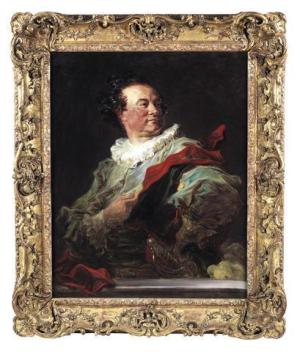 A major work by the 18th-century French artist Jean-Honoré Fragonard, The Portrait of François-Henri d’Harcourt, sold for £17,106,500 this evening (5 December) setting a world record price for the artist at auction [Bonhams, Auction 21413, Lot 85]. The previous record was £5,300,000 for a painting sold in London in 1999. It is also the highest price for an Old Master Painting sold at auction anywhere in the world this year. The painting was the leading work in the sale of paintings and sculpture from the renowned collection of the German philanthropist, the late Dr Gustav Rau which raised more than £19 million. The proceeds will be used to benefit the Foundation of the German Committee for UNICEF—for the children of the world.
Bonhams Director of Old Master Paintings, Andrew McKenzie, said, “The portrait of François-Henri d’Harcourt is one of the paintings on which Fragonard’s reputation as an artistic genius rests. It is impossible to overstate its cultural and artistic significance. Handling this great painting for sale was a huge privilege and a landmark in the history of the art market.” . . .
One of Fragonard’s famous fifteen fantasy portraits, The Portrait of François-Henri d’Harcourt was the most significant of the artist’s works to have appeared on the market for many years. Only two other fantasy portraits remain in private hands making this painting rarer than portraits by Frans Hals, Joshua Reynolds or even Rembrandt.
Jean-Honoré Fragonard (1732–1806) was a master of genre painting and a leading exponent of the Rococo style of which The Swing in the Wallace Collection in London is probably the best known example. In great demand as a portraitist in the dying days of the Ancien Régime, Fragonard fell on hard times after the French Revolution, and although he continued to live in France, he died in obscurity and poverty. Fragonard’s fantasy portraits—often depicting friends and acquaintances—were painted quickly with bold, fluid brush work which anticipated the Impressionists in bravura and technique. This style was referred to by some contemporaries as the artist’s, “swordplay of the brush.” The portrait of François-Henri d’Harcourt is unusual among Fragonard’s fantasy portraits because the subject is identified. Many of the other portraits are personifications of the arts rather than representations of named individuals.
At Auction | Passover Haggadah from 1726
The story of this recently discovered manuscript was featured at The Antiques Trade Gazette back in September and then at the BBC in October; but it has received lots of attention over the past few days after being featured in The Daily Mail and The Independent. It’s estimated to fetch between between £100,000 and £150,000.
Update (added 24 November): As reported by the Manchester Evening News, the Haggadah fetched £210,000.
Silver, Judaica, Jewellery, and Watches Sale
Adam Patridge Auctioneers, Macclesfield, 22 November 2014
 In July 2013 this important Haggadah was found in a routine house contents valuation. It will be offered for auction on the 22nd November at The Cheshire Saleroom as part of a specialist one day auction of Judaica, Silver, Jewellery & Watches.
A rare and important 18th-century Passover Seder Haggadah, written and illuminated on vellum by Aaron Wolff Shreiber Herlingen of Gewitsch, Pressberg, 5486 [1726 CE]. The pictorial title border depicts Aaron and Moses and is inscribed in Hebrew “Written by Aaron son of Benjamin Wolff 1726 for Mendel Oppenheimer. This Aaron was a friend of Moses Mendelsohn.” Aaron Wolff Herlingen was active 1721–1755 and held the position of official scribe at the Imperial Library in Vienna.
Original Viennese red-dyed vellum binding over pasteboard, 20-leaf, each 242mm x 162mm, containing 45 coloured vignettes of 27mm x 45mm and 11 coloured vignettes of 77mm x 120mm. Slight food and wine staining throughout.
It is thought that the manuscript was commissioned to mark the birth of Emanuel Mendel Oppenheimer (1726–80), the first child of Samuel Emanuel Oppenheimer of Vienna and a close descendant of the great banker and imperial court diplomat Samuel Oppenheimer (1630–1703).
Provenance: This was inherited by the current vendor in 2007. It has been in the family for over 100 years.
At Auction | Centuries of Style at Christie’s
Press release (5 November 2013) from Christie’s:
Centuries of Style: Silver, European Ceramics, Portrait Miniatures and Gold Boxes (#1162)
Christie’s, London, 26–27 November 2013
 Christie’s announced the forthcoming bi-annual sale of Centuries of Style: Silver, European Ceramics, Portrait Miniatures and Gold Boxes (Sale 1162) that will be held over two consecutive days in London on Tuesday, 26 and Wednesday, 27 November 2013. This sale offers collectors a superb opportunity to add to their collections with a wide-range of important, rare and unique treasures.
Silver
The silver section of the sale presents exemplary pieces of extraordinary quality from the 16th century to the 21st century, it is expected to realise in the region of £1.5 million. The auction is led by two very important private collections of Georg Jensen silver, which contain many outstanding pieces by the maker and the largest collection to be offered in London in recent years. Among the stars is a rare and important Danish fish dish, cover and mazarine, designed by Harald Nielsen (1892–1977). This beautifully crafted silver displays the greatest originality of design and is amongst the largest items made by the Jensen workshop, measuring 65 centimetres wide. This work is expected to realise between £80,000 and £120,000. Further examples of the highest quality of European silver include a pair of Danish five-light candelabra (estimate: £40,000–60,000), which is one the most spectacular piece of Jensen silver to be offered. A further highlight is a magnificent Danish jug designed by Henning Koppel (1918–1981) (estimate: £25,000–35,000). Known as the ‘African Girl’, due to its elegant handle stacked with ‘necklaces’, this pitcher was the first in the series that was designed in 1948 and has become an icon of Scandinavian modern design.
Gold Boxes and Objects of Vertu
 This sale presents a varied and interesting array of gold boxes and objects of vertu, displaying examples of the many techniques employed by European goldsmiths during the 18th and 19th centuries. This section of the sale is led by a highly important and incredibly rare Louis XV enamelled gold snuff-box, by Louis Charonnat (Lot 298, estimate: £150,000–200,000). This striking piece displays outstanding enamelling extract, which has been attributed to Charles-Jacques de Mailly, who worked in Paris during the 1760s and 1770s and later in St Petersburg. De Mailly is known for his grisaille allegorical scenes which are surrounded by brightly coloured flower garlands.
A French jewelled enamelled gold presentation snuff-box, circa 1860, by Louis Tronquoy, a highly-sought after name in the world of gold boxes, is another important example (estimate: £40,000–60,000). The striking box is set with diamonds that form the initials of Isma’il Pasha (1830–1895) Khedive of Egypt and Sudan. A presentation box, it was given by Isma’il to a Dutch contractor who was working for him in Egypt during the late 19th century. Further highlights include an important private Greek collection belonging to the Late Mrs. Melas (1908–1983), comprising twenty-five boxes with estimates ranging from £2,000 up to £60,000. This outstanding collection started in 1954 when Mrs. Melas purchased a boîte-à-miniatures set with miniatures by the 18th-century engraver Jacques-Joseph de Gault, from the auction of the King Farouk Collection, The Palace Collections of Egypt, in Cairo. A leading example is an exquisite Louis XVI goldlined boîte-à-miniatures, by Adrien Vachette (estimate: £20,000–30,000).
Portrait Miniatures
 Charming British portrait miniatures are a notable part of the sale, they are offered alongside an array of rare and important Continental sitters and artists. A remarkable group of royal sitters is led by two exceptional examples by Nicholas Hilliard (1547–1619), King James I of England and VI of Scotland (1566–1625) (estimate: £15,000–20,000) and King Charles I (1600–1649) when Duke of York (estimate: £15,000–25,000). Further highlights from this group include an exquisitely detailed miniature of King James II of England and VII of Scotland (1633–1701) by Samuel Cooper, the second son of Charles I, who ascended to the throne upon the death of his brother, Charles II (estimate: £40,000–60,000).
Members of the German royal families of Bavaria, Hesse-Cassel and Prussia are well represented by a portrait of Queen Louise of Prussia (1776–1810) (estimate: £6,000–8,000) and two remarkable miniatures by Anton König (1722–1787) and Daniel Chodowiecki (1726–1801) depicting the German Emperor Frederick the Great, King of Prussia during the 1740s through to the 1780s. Both König’s Frederick the Great (estimate: £6,000–8,000) and Chodowiecki’s Frederick the Great on Horseback (estimate: £20,000–30,000) depict the King planning his military movements in battle. Frederick the Great remains one of the most renowned German rulers of all time for his military successes and his domestic reforms that made Prussia one of the leading European nations. Further highlights include exemplary works by Heinrich Füger (1751–1818), led by an impressive miniature of Leopold II, Holy Roman Emperor (1747–1792) (estimate: £30,000–50,000).
European Ceramics
One of the many spectacular and unusual offerings in the European ceramics section is a striking pair of hispano-moresque copper lustre and blue drug-jars from the mid-15th century (estimate: £35,000–40,000). These boldly decorated pieces have not been on the market for over fifty years; they are very rare examples, remarkably large in size and in exceptionally good condition. A further rare piece is a Staffordshire salt glaze Stoneware ‘scratch-blue’ Jacobite loving-cup (estimate: £7,000–10,000). The cup depicts Charles Edward Stuart (1720–1788), known as the ‘Bonnie Prince Charlie’. He instigated the unsuccessful Jacobite uprising of 1745 in which he attempted to restore the Stuarts to the throne of the Kingdom of Great Britain. The Meissen section of the sale is led by an important private collection of good early pieces decorated with Chinoiserie and European subjects, comprising sixteen lots with estimates ranging from £2,000 up to £12,000.
At Auction | Thomas Hudson’s Portrait of Flora MacDonald
From the Bonhams press release:

Thomas Hudson, Portrait of Flora MacDonald, oil on canvas
126 x 101 cm. (50 x 40 inches).
A portrait of Flora MacDonald, a heroine of the Jacobite risings, who helped Bonnie Prince Charlie escape after the Battle of Culloden is to be sold at Bonhams Scottish pictures sale in Edinburgh on Thursday, 5 December. It is estimated at £7,000–10,000.
Following his defeat at Culloden on 16 April 1746, Charles Edward Stuart — Bonnie Prince Charlie — fled the field and went into hiding. Pursued by the army of George II, whose claim to the British throne he had challenged, the Prince took refuge on the Hebridean island of Benbecula, which was under the control of the government. The MacDonalds — secretly sympathetic to the Jacobite cause — agreed to help Prince Charles escape. Flora was given official permission to leave the island accompanied by a manservant, an Irish spinning maid — actually the Prince in disguise — and six oarsmen. After landing on the Isle of Skye, the Prince made good his escape. Flora however had aroused suspicion and was arrested. She was taken to London, initially imprisoned in the Tower, and later kept under house arrest.
Though Flora is celebrated in song, on screen, in paintings and even on shortbread tins, portraits of her drawn from life are rare. This depiction by the respected English artist Thomas Hudson is likely to have been painted after she was completely freed under the Act of Indemnity in 1747 when she became something of a celebrity.
Flora is depicted wearing a satin dress and tartan bow and holding a rose which is how she usually appears in portraits. Despite the romantic story attached to her name she claimed to have been motivated more by charity than politics, telling George II’s son, the Duke of Cumberland and merciless victor at Culloden, that she would have been equally ready to help him had he been in distress.
Private Goes Public, Private Art Dealers Association Exhibition
Press release (22 July 2013) from PADA (a CAA affiliate society, incidentally). . .
Private Goes Public (Private Art Dealers Association)
13 East 69th Street, New York, 1–16 November 2013
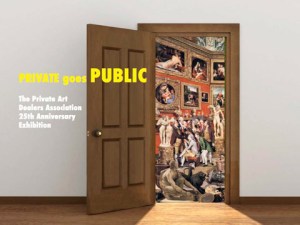 The Private Art Dealers Association (PADA), the first trade association to represent private art dealers, is celebrating its 25th anniversary with its first-ever public exhibition, Private Goes Public, 1–16 November 2013. Over thirty members of the 50-member strong PADA organization will exhibit a full range of fine art from the 17th to the 21st centuries at 13 East 69th Street, where galleries of three PADA members are located. European and American paintings, drawings, prints, photographs, and sculpture will be offered, all available for sale. An illustrated catalog will provide details on each of the dealers exhibiting at this show. (more…)










 Enfilade
leave a comment