Online Book Launch | Enlightened Eclecticism
This Friday at 6.30pm (GMT) via Zoom:
Adriano Aymonino, Enlightened Eclecticism: The Grand Design of the 1st Duke and Duchess of Northumberland
Online Book Launch, Sir John Soane’s Museum, London, 19 November 2021
 Hosted by Sir John Soane’s Museum in their beautiful library, and presented in collaboration with the Society for the History of Collecting, this virtual event will celebrate the publication of Adriano Aymonino’s new book, Enlightened Eclecticism: The Grand Design of the 1st Duke and Duchess of Northumberland.
The central decades of the eighteenth century in Britain were crucial to the history of European taste and design. One of the period’s most important campaigns of patronage and collecting was that of the 1st Duke and Duchess of Northumberland: Sir Hugh Smithson (1712–86) and Lady Elizabeth Seymour Percy (1716–76). This book examines four houses they refurbished in eclectic architectural styles—Stanwick Hall, Northumberland House, Syon House, and Alnwick Castle—alongside the innumerable objects they collected, their funerary monuments, and their persistent engagement in Georgian London’s public sphere. Over the years, their commissions embraced or pioneered styles as varied as Palladianism, rococo, neoclassicism, and Gothic revival. Patrons of many artists and architects, they are revealed, particularly, as the greatest supporters of Robert Adam. In every instance, minute details contributed to large-scale projects expressing the Northumberlands’ various aesthetic and cultural allegiances. Their development sheds light on the eclectic taste of Georgian Britain, the emergence of neoclassicism and historicism, and the cultures of the Grand Tour and the Enlightenment.
S C H E D U L E
18.30 Introduction by Frances Sands (Curator of Drawings and Books, Sir John Soane’s Museum)
18.40 Talk by Kate Retford (Professor of Art History, Birkbeck, University of London)
19.10 Talk by Adriano Aymonino (Senior Lecturer and Director of Undergraduate Programs, Department of History and History of Art, University of Buckingham)
19.30 Conversation and questions moderated by Adriana Turpin (Director of Institut Des Etudes Superieurs Des Arts UK)
Exhibition | Hogarth and Europe

William Hogarth, The March of the Guards to Finchley, 1749–50
(London: The Foundling Museum)
◊ ◊ ◊ ◊ ◊
From the press release (1 November 2021) for the exhibition:
Hogarth and Europe
Tate Britain, London, 3 November 2021 – 20 March 2022
Curated by Alice Insley and Martin Myrone
Few artists have defined an era as much as William Hogarth (1697–1764), whose vivid, satirical depictions of 18th-century England continue to capture the imagination today. Tate Britain’s major exhibition Hogarth and Europe presents his work in a fresh light, seen for the first time alongside works by his continental contemporaries. It explores the parallels and exchanges that crossed borders and the cosmopolitan character of Hogarth’s art. Hogarth’s best-known paintings and prints—such as Marriage A-la-Mode (1743), The Gate of Calais (1748), and Gin Lane (1751)—are shown alongside works by famed European artists, including Jean-Siméon Chardin in Paris, Pietro Longhi in Venice, and Cornelis Troost in Amsterdam. Together they reveal how changes in society took art in new directions, both in Britain and abroad.
 Featuring over 60 of Hogarth’s works, brought together from private and public collections around Europe and North America, the exhibition draws decades of research to show Hogarth in all his complexity—whether as staunch patriot or sharp critic, bawdy satirist or canny businessman. It also examines the shifting status of artists in the 18th century, from workshop artisans and court painters to independent freelancers enjoying prominence alongside actors, musicians, and writers. The rapid expansion of urban centres like London, Paris, Amsterdam, and Venice also saw the city itself become a major subject in art for the first time. Tate Britain juxtaposes these metropolitan scenes from across Europe, showing the bustling London streets of Hogarth’s Southwark Fair (1733) and The March of the Guards to Finchley (1749–50) together with vibrant depictions of Étienne Jeaurat’s Paris and Longhi’s Venice.
This was an age of opportunity and innovation, but also materialism, self-delusion, exploitation, and injustice. In Europe, new heights of luxury emerged with extreme poverty, while growing cities saw overcrowding and disease. The rising demand for consumer goods at home came at the expense of the labour and lives of enslaved and colonised people overseas. Against the backdrop of this changing world, artists like Hogarth pioneered a new painting of modern life, revealing its pleasures and dynamism but also its dangers and stark inequalities. In the 1730s he began his ‘modern moral series’: frank and engaging narratives charting the rise and fall of everyday characters corrupted by immorality and vice. Hogarth and Europe includes these celebrated series, including A Rake’s Progress (1734), which were immediately popular and widely circulated through print. At Tate Britain they are shown alongside paintings by the Italian Giuseppe Crespi, including The Flea (1707–09), and the Parisian Nicolas Lancret, to show how this new artistic genre of urban storytelling developed across Europe.
The 18th century also saw greater informality and ease in portraiture, expressing the new ideas emerging around individuality and personal freedom that remain familiar today. The exhibition culminates in a room focussing on such pictures, including Miss Mary Edwards (1742)—a painting not seen in the UK for over a century—depicting the eccentric, wealthy patron who commissioned many of Hogarth’s best-known works. Additional highlights include paintings of his sisters Mary and Anne Hogarth, as well as Heads of Six of Hogarth’s Servants (c.1750–55). Through juxtapositions with European artworks, the exhibition looks afresh at these and many other works by one of Britain’s most important artists, giving visitors a chance to see Hogarth’s position on the international stage in a new light.
Hogarth and Europe is curated by Alice Insley, Curator, British Art c 1730–1850 and Martin Myrone, former Senior Curator, pre-1800 British Art, Tate Britain (now Convenor, British Art Network at the Paul Mellon Centre). The exhibition is accompanied by a fully illustrated catalogue featuring essays by eminent scholars and artists including Lubaina Himid and Sonia E. Barrett.
Martin Myrone and Alice Insley, eds., Hogarth and Europe (London: Tate, 2021), 208 pages, ISBN: 978-1849767682, £40 / $55.
The exhibition guide is available here»
New Book | Hogarth: Life in Progress
From Profile Books:
Jacqueline Riding, Hogarth: Life in Progress (London: Profile Books, 2021), 544 pages, ISBN: 978-1788163477, £30 / $40.
 On a late spring night in 1732, a boisterous group of friends set out from their local pub. They are beginning a journey, a ‘peregrination’ that will take them through the gritty streets of Georgian London and along the River Thames as far as the Isle of Sheppey. And among them is an up-and-coming engraver and painter, just beginning to make a name for himself: William Hogarth.
Hogarth’s vision, to a vast degree, still defines the eighteenth century. In this, the first biography for over twenty years, Jacqueline Riding brings him to vivid life, immersing us in the world he inhabited and from which he drew inspiration. At the same time, she introduces us to an artist who was far bolder and more various than we give him credit for: an ambitious self-made man, a devoted husband, a sensitive portraitist, an unmatched storyteller, philanthropist, technical innovator, and author of a seminal work of art theory.
Following in his own footsteps from humble beginnings to professional triumph (and occasional disaster), Hogarth illuminates the work and life of a great artist who embraced the highest principles even while charting humanity’s lowest vices.
Jacqueline Riding is a historian and art historian specialising in British history and art of the long eighteenth century. Former curator of the Palace of Westminster and Director of the Handel House Museum, she is an award-winning author as well as a consultant for museums, galleries, historic buildings, and feature films. She was the adviser on Mike Leigh’s Mr. Turner (2014) and Peterloo (2018) and Wash Westmoreland’s Colette (2018).
Lecture | Frédéric Ogée, Pleasures of the Senses and the Imagination
From the conference series Sociabilité et libertinage au siècle des Lumières, organized at the Cognacq-Jay Museum in conjunction with this year’s summer exhibition Realm of the Senses, from Boucher to Greuze / L’ Empire des sens, de Boucher à Greuze (19 May — 18 July 2021), curated by Annick Lemoine . . .
Frédéric Ogée | Plaisirs des sens, plaisirs de l’imagination dans l’art et la littérature anglaise du 18ème siècle
Online and In-Person, Musée Cognacq-Jay, Paris, 26 November 2021, 17.00
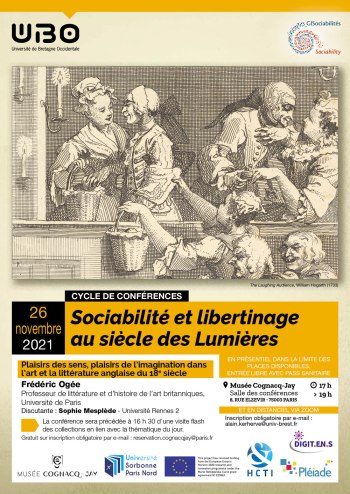 Dans le sillage de sa « Glorieuse Révolution » de 1688, l’Angleterre inaugura le siècle des Lumières en découvrant le plaisir d’un certain nombre de libertés : « régler le pouvoir des rois en leur résistant » (Voltaire), publier sans entrave, ré-évaluer l’héritage des Anciens, regarder la Nature à travers le prisme de Newton plutôt que celui des prêtres, entreprendre à crédit, célébrer la sensibilité et l’imagination. Les Anglais ont ainsi cherché de nouveaux équilibres entre la liberté de l’individu—son goût, sa subjectivité, sa perception du monde, son « progrès » —et les nécessités de la sphère collective, qu’elle soit publique ou privée. Ecrivains et artistes se sont vite employés à représenter cette nouvelle sociabilité, pour la modéliser et la polir autant que pour la promouvoir, au travers de remarquables expériences littéraires et picturales où les personnages se meuvent et s’émeuvent sous l’œil complice du spectateur-lecteur. Influencés par la philosophie empiriste ils font l’expérience du plaisir des sens pour accéder à la connaissance, d’eux-mêmes et du monde. La présente conférence permettra d’évoquer cette remarquable période de créativité qui, de Daniel Defoe et William Hogarth à Jane Austen et Thomas Lawrence, contribua au triomphe de la Grande-Bretagne sur la scène du monde.
Discutante: Sophie Mesplède (Université Rennes 2)
Frederic Ogee est professeur de littérature et d’histoire de l’art britanniques à l’Université de Paris. Ses principaux domaines de recherche sont l’esthétique, la littérature et l’art au cours du long 18ème siècle (1660–1815), sur lesquels il a souvent donné des conférences dans des universités européennes, nord-américaines et asiatiques. Commissaire de l’exposition sur le peintre anglais William Hogarth au Musée du Louvre en 2006, il est l’auteur de plusieurs ouvrages, notamment Diderot and European Culture, un recueil d’essais (Oxford: 2006, réédité 2009), J.M.W. Turner : Les paysages absolus (Hazan, 2010), et Jardins et Civilisations (Valenciennes, 2019), suite à une conférence organisée à l’Institut Européen des Jardins et Paysages de Caen. Il écrit actuellement une série de quatre monographies sur quelques grands artistes anglais (Thomas Lawrence, J.M.W. Turner, Thomas Gainsborough et William Hogarth) pour les éditions Cohen & Cohen (Paris), à paraître entre 2022 et 2025. De 2014 à 2017, il a été membre du conseil scientifique du musée Tate Britain à Londres et, depuis 2014, est membre du Conseil Scientifique de la Ville de Paris.
Conférence en présentiel dans la limite des places disponibles, entrée libre avec pass sanitaire ET en distanciel via Zoom. Participation libre sur inscription obligatoire: reservation.cognacqjay@paris.fr et alain.kerherve@univ-brest.fr. La conférence sera précédée à 16h30 d’une visite flash des collections en lien avec la thématique du jour.
Emmanuelle Brugerolles, Marine Carcanague, Marie-Anne Dupuy-Vachey, Guillaume Faroult, Yuriko Jackall, F. Joulie, É. Kerner, A. Laing, C. Le Bitouzé, A. Le Brun, A. Lemoine, N. Lesur, H. Meyer, L-A. Prat, S. de Saint-Léger, M. Szanto, L’ Empire des sens, de Boucher à Greuze (Paris Musées / Musée Cognac-Jay, 2020), 152 pages, ISBN: 978-2759605002, €30.
Resource | Price Guide for Period Frames
From the press relase (via Art Daily) . . .
 Eli Wilner & Company has announced that the Price Guide for American and European Period Frames will be made available as a free download. The decision was reached in response to tremendous interest being shown by collectors in donating their antique frames to nonprofit cultural institutions, and in response to requests from numerous art insurance brokers for the Price Guide to be more widely available. The book is a unique reference tool, with particular value to collectors, museum professionals, academic scholars, and appraisers.
Formerly priced at $795, the current edition of the Price Guide for American and European Period Frames was released in late 2020, and constitutes a completely updated and revised version of Wilner’s first edition published in 1995 by Avon Books. The book includes a new collection of over 100 period frame images, along with descriptions and retail pricing. The prices are based on retail frame sales by Eli Wilner & Company, with a sample paid invoice featured at the beginning of each section of the book. The increasing rarity of period frames of the quality showcased here, is reflected in the high prices that these objects can fetch in a retail market. The finest examples of period frames have been sold in the marketplace for hundreds of thousands of dollars. One collector is known to have spent nearly $10 million forming a period frame collection.
As a specialist in period framing for nearly 40 years, Eli Wilner has completed over 15,000 framing projects for private collectors as well as more than 100 institutions. The Wilner gallery is held in high regard by both institutions and private collectors for our expertise, extensive inventory, and superior quality of craftsmanship. This regard and confidence is evidenced by clients such as The White House, The Metropolitan Museum of Art, the Detroit Institute of Arts, Yale University Art Gallery, and many private individuals. In 2019, Eli Wilner & Company was honored by the Historic Charleston Foundation with the Samuel Gaillard Stoney Conservation Craftsmanship Award, for their work in historic picture frame conservation.
The Price Guide for American and European Period Frames is available for download as a PDF file here»
New Book | The Oxford Handbook of History and Material Culture
From Oxford UP:
Ivan Gaskell and Sarah Anne Carter, eds., The Oxford Handbook of History and Material Culture (Oxford: Oxford University Press, 2020), 680 pages, ISBN: 978-0199341764, $150.
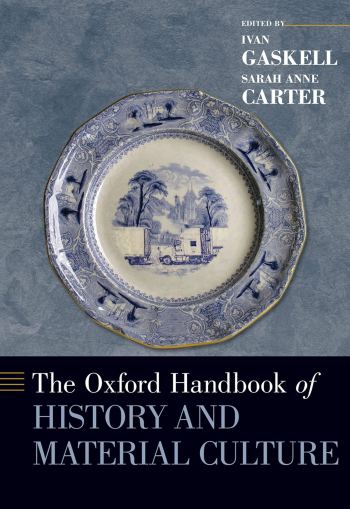 The past has left a huge variety of traces in material form. If historians could figure out how to make use of them to create accounts of the past, a far greater range of histories would be available than if historians were to rely on written sources alone. People who do not appear in writings could come into focus; as could the concerns of people that have escaped writing but whose material things belie their desires and actions. This book explores various ways in which aspects of the past of peoples in many times and places otherwise inaccessible can come alive to the material culture historian. It is divided into five thematic sections that address history, material culture, and—respectively—cognition, technology, symbolism, social distinction, and memory. It does so by means of six individually authored case studies in each section that range from pins to pearls, Paleolithic to Punk.
Ivan Gaskell is Professor of Cultural History and Museum Studies at Bard Graduate Center, New York City. Sarah Anne Carter is Visiting Executive Director of the Center for Design and Material Culture, and Visiting Assistant Professor in Design Studies at the University of Wisconsin-Madison.
C O N T E N T S
List of Contributors
Acknowledgments
Introduction: Why History and Material Culture?
I History, Material Culture, and Cognition
• Words or Things in American History? — Steven Conn
• Artifacts and Their Functions — A. W. Eaton
• Mastery, Artifice, and the Natural Order: A Jewel from the Early Modern Pearl Industry — Mónica Domínguez Torres
• Food and Cognition: Henry Norwood’s A Voyage to Virginia — Bernard L. Herman
• On Pins and Needles: Straight Pins, Safety Pins, and Spectacularity — Amber Jamilla Musser
• Mind, Time, and Material Engagement — Lambros Malafouris and Chris Gosden
II History, Material Culture, and Technology
• Material Time — John Robb
• Remaking the Kitchen, 1800–1850 — J. Ritchie Garrison
• Boston Electric: Science by ‘Mail Order’ and Bricolage at Colonial Harvard — Sara J. Schechner
• Making Knowledge Claims in the Eighteenth-Century British Museum — Ivan Gaskell
• The Ever-Changing Technology and Significance of Silk on the Silk Road — Zhao Feng
• Science, Play, and the Material Culture of Twentieth-Century American Boyhood — Rebecca Onion
III History, Material Culture, and the Symbolic
• The Sensory Web of Vision: Enchantment and Agency in Religious Material Culture — David Morgan
• Sensiotics, or the Study of the Senses in Material Culture and History in Africa and Beyond — Henry John Drewal
• The Numinous Body and the Symbolism of Human Remains — Christopher Allison
• Symbolic Things and Social Performance: Christmas Nativity Scenes in Late Nineteenth-Century Santiago de Chile — Olaya Sanfuentes
• Heritage Religion and the Mormons — Colleen McDannell
• From Confiscation to Collection: The Objects of China’s Cultural Revolution — Denise Y. Ho
IV History, Material Culture, and Social Distinction
• Persons and Things in Marseille and Lucca, 1300–1450 — Daniel Lord Smail
• Cloth and the Rituals of Encounter in La Florida: Weaving and Unraveling the Code — Laura Johnson
• Street ‘Luxuries’: Food Hawking in Early Modern Rome — Melissa Calaresu
• Ebony and Ivory: Pianos, People, Property, and Freedom on the Plantation, 1861–1870 — Dana E. Byrd
• The Material Culture of Furniture Production in the British Colonies — Edward S. Cooke Jr.
• Material Culture, Museums, and the Creation of Multiple Meanings — Neil G. W. Curtis
V History, Material Culture, and Memory
• Chronology and Time: Northern European Coastal Settlements and Societies, c. 500–1050 — Christopher Loveluck
• Materialities in the Making of World Histories: South Asia and the South Pacific — Sujit Sivasundaram
• Mapping History in Clay and Skin: Strategies for Remembrance among Ga’ anda of Northeastern Nigeria — Marla C. Berns
• Remember Me: Sensibility and the Sacred in Early Mormonism — Laurel Thatcher Ulrich
• Housing History: The Colonial Revival as Consumer Culture — Thomas Denenberg
• Collecting as Historical Practice and the Conundrum of the Unmoored Object — Catherine L. Whalen
Conclusion: The Meaning of Things
Index
Exhibition | The Way Sisters: Miniaturists of the Early Republic

Attributed to Mary Way, Dressed miniature portraits of a husband and wife of the Deshon family, ca. 1800, mixed media with fabrics and painted paper (Lyman Allyn Art Museum: Gift of Ursula and Gertrude Grosvenor, 1949.122 a & b).
◊ ◊ ◊ ◊ ◊
From the press release (28 October 2021) for the exhibition:
The Way Sisters: Miniaturists of the Early Republic
Lyman Allyn Art Museum, New London, Connecticut, 30 October 2021 — 23 January 2022
Curated by Tanya Pohrt with Brian Ehrlich
The Lyman Allyn Art Museum is pleased to mount a major new exhibition that presents the story and art of May Way (1769–1833) and Elizabeth (Way) Champlain (1771–1825), two sisters and artists from New London, Connecticut. The sisters were among the earliest professional women artists working in the United States. Opening 30 October 2021, The Way Sisters: Miniaturists of the Early Republic will be on view until 23 January 2022.
“This is the first museum exhibition to focus on the Way sisters, and it includes objects that have never been publicly exhibited,” said Dr. Tanya Pohrt, the exhibition’s curator. “These two women made important and lasting contributions to the art and history of Connecticut and a young nation. Their work deepens our understanding of early American art with objects and stories from the past that still resonate today.”
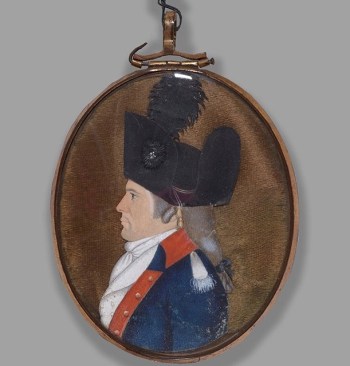
Mary Way, Portrait of Charles Holt (1772–1852), 1800, signed on verso, watercolor and fabric on paper applied to fabric (Private Collection, courtesy of Nathan Liverant & Son, LLC).
The women adapted their schoolgirl training in textiles to create collaged and painted portraits that pushed the boundaries of miniatures as an art form, while serving to expand gender roles for women. Mary Way began her career as a miniaturist around 1789 or 1790, producing painted and unique ’dressed’ portrait miniatures in profile with sewn and adhered fabric clothing that were unlike anything else made in America at the time.
Evidence suggests that Elizabeth (Way) Champlain, known as Betsey, also produced dressed and painted miniatures in roughly the same period. She remained in New London throughout her life and was active as a miniaturist until her sudden illness and death in 1825. Mary Way, who never married, moved to New York City in 1811, seeking new patrons and hoping to expand her artistic sphere. Facing stiff competition, she managed to eke out a living until she went blind in 1820 and was forced to return to New London, where her family supported her until her death in 1833.
Over the course of their careers, the Way sisters portrayed friends, relatives, and acquaintances, as well as a larger network of the mercantile elite from southeastern Connecticut. Telling a story of struggle and accomplishment, this exhibition traces what is known of the sisters’ artistic production, celebrating their stylistic and material innovations. It also examines the identities of their sitters, exploring New London’s history in the decades following the American Revolution.
On November 10, Pohrt and Brian Ehrlich, M.D., advisor to the exhibition, will give an in-person gallery talk. The lecture and reception begin at 5.30. The exhibition is made possible with support from Connecticut Humanities; the Department of Economic and Community Development, Office of the Arts; and an anonymous foundation.
The Lyman Allyn Art Museum welcomes visitors from New London, southeastern Connecticut, and all over the world. Established in 1926 by a gift from Harriet Allyn in memory of her seafaring father, the Museum opened the doors of its beautiful neo-classical building surrounded by 12 acres of green space in 1932. Today, it presents a number of changing exhibitions each year and houses a fascinating collection of over 17,000 objects from ancient times to the present: artworks from Africa, Asia, the Americas, and Europe, with particularly strong collections of American paintings, decorative arts, and Victorian toys and doll houses.
Brian Ehrlich, Catherine Kelly, D. Samuel Quigley, and Elle Shushan, The Way Sisters: Miniaturists of the Early Republic (New London: Lyman Allyn Art Museum, 2021), 100 pages, ISBN: 978-1878541086.
Exhibition | La Ménagerie de Chantilly
Now on view at the Château de Chantilly:
La Ménagerie de Chantilly
Château de Chantilly, 8 September 2021 — 3 January 2022
Curated by Florent Picouleau
 Archive material, books, plans, prints, and drawings provide a glimpse into a less well-known aspect of the history of the Château de Chantilly. The remarkable menagerie at Chantilly, with its collection of exotic animals, was one of the largest of its kind in the 17th and 18th centuries, rivaled only by that of Versailles.
À partir du Moyen Âge, posséder des animaux étrangers est un marqueur de richesse auquel prétendent, dès la Renaissance, les seigneurs de Chantilly. De la fin du XVIe siècle à celle du XVIIIe, le domaine appartient aux familles des Montmorency et des Bourbon-Condé. Pour se divertir et satisfaire leur curiosité, ils introduisent, d’abord dans le parc du château, puis dans l’une des plus extraordinaires ménageries du royaume, des animaux exotiques ou autochtones qui embellissent les jardins et valorisent l’image des propriétaires.
Les cheptels s’accroissent à tel point qu’à la fin du XVIIe siècle il apparaît indispensable de leur construire un lieu spécifique, une ménagerie au moins digne de celle de Louis XIV à Versailles. Point de convergence de la zoologie, de l’architecture animalière, de l’art, de la curiosité scientifique, elle s’inscrit pleinement, jusqu’à sa disparition amorcée en 1792, dans la vie culturelle et mondaine des XVIIe et XVIIIe siècles.
Dans le prolongement de l’exposition sur l’Orangerie de Chantilly proposée en 2017, le service des archives ressuscite désormais, au croisement de l’histoire, de l’histoire naturelle et de l’architecture, une autre partie du parc qui a, elle aussi, grandement contribué à la renommée du château et de ses propriétaires du XVIe au XVIIIe siècle.
Les visiteurs découvrent ainsi des documents rares ou inédits issus des archives et de la bibliothèque de Chantilly, du musée Condé, ou prêtés par la Bibliothèque de l’Institut de France et le Muséum national d’histoire naturelle. L’exposition leur dévoile les multiples sources du travail historique et la difficulté de la reconstitution.
Commissariat
Florent Picouleau, Chargé d’archives au musée Condé
The press packet (in French) is available as a PDF file here»
Florent Picouleau, La Ménagerie de Chantilly, XVIe–XIXe siècles (Dijon: Éditions Faton, 2021), 160 pages, ISBN: 978-2878443059, €35.
Exhibition | The King’s Animals

Now on view at Versailles:
Les Animaux du Roi / The King’s Animals
Château de Versailles, 12 October 2021 — 13 February 2022
Curated by Alexandre Maral and Nicolas Milovanovic
From its location in the heart of a vast forest in the Île-de-France region, the Palace of Versailles has always fostered a dynamic relationship with the animal kingdom. From animals as objects to be studied or collected to those used as political attributes and symbols of power, the exhibition explores the bond between the court of Versailles and animals—whether ‘companion animals’ (primarily dogs, cats, and birds), exotic beasts, or ‘wild’ creatures. It also brings two long-lost areas of the estate back to life: the Royal Menagerie and the Maze. Once the pride and joy of Louis XIV’s gardens, they can still be admired today in drawings, paintings and testimonies from the period.
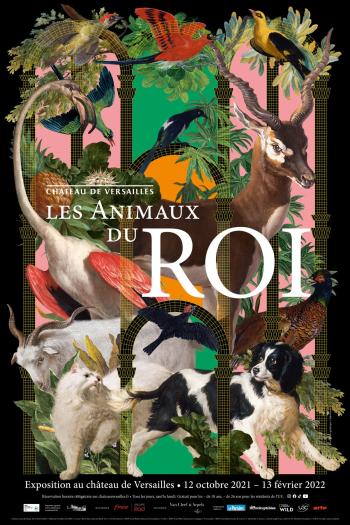 The Royal Menagerie, which the Sun King had installed close to the Grand Canal, was home to the rarest and most exotic animals—from coatis to quaggas, cassowaries to black-crowned cranes (nicknamed the ‘royal bird’)—constituting an extraordinary collection in which the king took ever greater pride. The animals in the menagerie were also a great source of inspiration for the artists of the time: they helped Claude Perrault with his Histoire naturelle, as well as serving the Royal Academy of Sciences as subjects for dissections and, later, Louis XV and Louis XVI, in their naturalism pursuits.
In addition to decorative items from the interior of the menagerie—particularly the paintings by Nicasius Bernaerts—on display are well-known garden sculptures, such as those in the Latona Fountain and the Maze. The latter comprised no fewer than 300 animals made from lead, arranged into a scene from Aesop’s fables and depicting a vision of the world in which animals make political, often moralising, always educational, pronouncements. In all, 37 sculptures recovered from the erstwhile grove will be on display.
More information about the Labyrinth (in French) is available here»
As well as the actual animals that were collected and studied, animal symbolism was used to represent power. The exhibition illustrates the link between the establishment of Versailles as a seat of power—from the construction of the palace itself on the site of Louis XIII’s old hunting lodge—and animal symbolism. Part of the exhibition is devoted to the daily hunt—a key activity pursued by warrior kings in times of peace as a form of training and demonstration of power. The hunt, consequently, features prominently in royal iconography.
 The animals themselves will return in droves to Versailles, because they never disappeared completely. They live on in the work of the king’s top painters; from Bernaerts, Boel and Le Brun, to Desportes and Oudry, many artists produced portraits of these exotic, wild and more familiar animals. As well as paintings, on view are portraits woven by the Gobelins Manufactory plus animals that were dissected, engraved, then preserved at the Academy of Sciences and in the King’s Garden, which is now the National Museum of Natural History. The exhibition also includes the skin of the Asian elephant gifted to Louis XV, which was donated to the Pavia Museum by Napoleon, and the skeleton of the very first elephant at Versailles, which was presented to Louis XIV by the king of Portugal and lived at Versailles for 13 years.
Finally, the exhibition addresses the role at court of companion animals for both the royal family and courtiers. As is evident from many portraits, companion animals were present everywhere, enlivening the royal apartments and brightening up the daily lives of children and adults alike. Many of the sovereigns, such as Marie Lesczcynska, wife of Louis XV, chose to surround themselves with their favourite animals. The court’s interest in the animal world led to greater sensitivity towards animals, in direct contrast to the Cartesian theory of animal-machines. Madame Palatine and, later, Madame de Pompadour, were particularly passionate about them.
Exhibition Curators
• Alexandre Maral, Curator General, Head of the Sculpture Department of the Musée National des Châteaux de Versailles et de Trianon
• Nicolas Milovanovic, Head Curator of the Paintings Department of the Louvre Museum
Alexandre Maral and Nicolas Milovanovic, eds., Les Animaux du Roi (Paris: Lienart éditions / musée national des châteaux de Versailles et de Trianon, 2021), 464 pages, ISBN: 978-2359063455, 49€.
New Book | Le prince et les animaux
From Lavoisier:
Joan Pieragnoli, Le prince et les animaux: Une histoire zoologique de la cour de Versailles au siècle des Lumières, 1715–1792 (Brussels: Éditions de l’Université de Bruxelles, 2021), 295 pages, ISBN: 978-2800417615, €27.
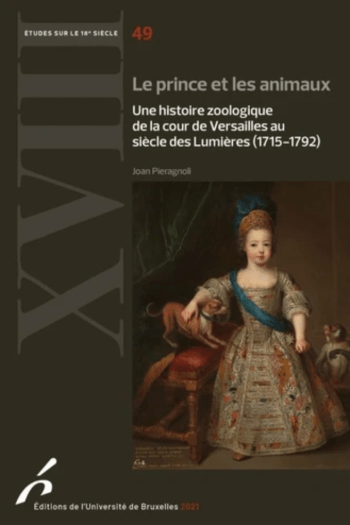 Entre utile et futile, les animaux accompagnent l’existence quotidienne du prince dont les chiens et les chevaux réclament de monumentaux bâtiments à Versailles. Mais au siècle des Lumières les animaux favorisent aussi l’apparition d’un Versailles intime à travers l’artisanat du luxe et de multiples constructions zoologiques de fantaisie.
Durant le règne de Louis XIV, les animaux contribuent à ériger Versailles en véritable monument à la gloire du prince, car ils sont des symboles de pouvoir et deviennent le prétexte de bâtiments grandioses. Cependant, au XVIIIe siècle, les derniers Bourbons délaissent ostensiblement leur principale demeure.
L’histoire zoologique proposée ici, en considérant les pratiques de chasse et la gestion des populations animales qu’elles impliquent, prétend d’abord expliquer cette désaffection. Elle invite également à évoquer un Versailles méconnu, où l’architecture zoologique de fantaisie consacre l’apparition d’une demeure intime au sein de la résidence officielle. Moins qu’à la magnificence, les animaux se trouvent désormais associés à la quête de l’existence privée confortable privilégiée par le roi et son entourage. À travers l’artisanat, l’industrie du luxe et la gastronomie les bêtes participent d’une consommation somptuaire qui définit l’art de vivre des Lumières. Mais l’opinion, indisposée par le coût des ménageries et celui des équipages, juge sévèrement des dépenses qui permettent aux princes de se comporter comme de simples particuliers. Le faste équestre et cynégétique, notamment, joue un rôle prépondérant dans l’effondrement de la monarchie, car les réformes destinées à limiter le nombre de chiens et de chevaux nécessaires au service de la cour interviennent trop tard. Déjà, la Révolution éclate et conduit à des choix autrement plus radicaux.
Docteur en histoire, Joan Pieragnoli s’est spécialisé dans l’étude des animaux durant la période moderne et a consacré plusieurs articles et ouvrages à la Ménagerie de Versailles. Il a récemment collaboré au Dictionnaire Louis XIV (Robert Laffont, 2015) dont il a signé les notices dédiées aux animaux et a publié La cour de France et ses animaux, XVIe–XVIIe siècles (PUF, 2016).
S O M M A I R E
Les animaux : un « habitus du prince » ?
Le cadre social Le cadre administratif et architectural • Le contexte anthropologique
I | Les animaux et le retour de la cour à Versailles
1 Les animaux et la Maison du roi
Les équipages de vénerie • Les équipages de fauconnerie • Les équipages et les animaux de la Chambre • Les écuries du roi
2 Les temps retrouvés de la chasse
Les saisons et les chasses • Les séquences de la chasse • L’économie de la chasse
3 Repeupler la Ménagerie
Protagonistes de l’approvisionnement et itinéraires • Les animaux : peuplement et transport • Les grandes étapes de l’approvisionnement
II | Les animaux et la privatisation des plaisirs royaux
4 L’architecture royale : bâtiments zoologiques et vie sociale
Situation et fonction des constructions royales • Les animaux et la distribution du corps de logis • Les basses-cours et les autres dépendances d’utilité
5 La société des chasses royales
Les chiens et les membres des équipages • La maison régnante • Les courtisans
6 Le renouveau de l’alimentation carnée
L’approvisionnement de la viande et du poisson • La redistribution de la viande sur les tables de la cour • La structure de la consommation
III | Les animaux au crépuscule de Versailles
7 Des animaux de bonne compagnie
L’animal aimé : les témoignages artistiques • Le bestiaire de l’intime • Le soin et la nourriture
8 La Ménagerie : abandon et renouveau d’une institution royale
La Ménagerie : une institution obsolète ? • Le renouveau du peuplement de la Ménagerie • Le fonctionnement quotidien
9 Les animaux à l’heure des réformes
L’héritage du règne de Louis XV et les premières mesures de Louis XVI • Les grandes réformes • Le fonctionnement quotidien
Conclusion générale










leave a comment