New Book | Utamaro and the Spectacle of Beauty
This new, expanded paperback edition is distributed in North and South America by The U. of Chicago Press:
Julie Nelson Davis, Utamaro and the Spectacle of Beauty (London: Reaktion Books, 2021), 296 pages, ISBN: 978-1789142358, $40.
 Japanese artist Kitagawa Utamaro (1753–1806) was one of the most influential artists working in the genre of ukiyo-e, ‘pictures of the floating world’, in late eighteenth-century Japan, and was widely appreciated for his prints of beautiful women. In 1804, at the height of his success, Utamaro published a set of prints related to a banned historical novel. The prints, titled Hideyoshi and his Five Concubines, depicted the military ruler Toyotomi Hideyoshi’s wife and concubines, and consequently, he was accused of insulting Hideyoshi’s dignity. Utamaro was sentenced to be handcuffed for fifty days and is thought to have been briefly imprisoned. According to some sources, the experience crushed him emotionally and ended his career as an artist.
In this new expanded edition, Julie Nelson Davis draws on a wide range of period sources, makes a close study of selected print sets, and reinterprets Utamaro in the context of his times. Reconstructing the place of the ukiyo-e artist within the commercial print market, she demonstrates how Utamaro’s images participated in a larger spectacle of beauty in the city of Edo (present-day Tokyo).
Julie Nelson Davis is associate professor of East Asian art in the Department of Art History at the University of Pennsylvania. She is the author of Dramatic Impressions: Japanese Theater Prints from the Gilbert Luber Collection.
C O N T E N T S
Introduction: Utamaro, Ukiyo-e, and the City of Prints
1 Constructing the Artist Known as Utamaro
2 ‘Pictures of Beauties’ and Other Social Physiognomies
3 Behind the Brocade and Other Yoshiwara Illusions
4 Utamaro and the Feminine Spectacle
5 Making History into the Pageant of the Floating World
References
Works Cited
Acknowledgements
List of Illustrations
Index
Exhibition | Yinka Shonibare CBE: End of Empire

Yinka Shonibare CBE, End of Empire, 2016; fiberglass mannequins, Dutch wax printed cotton textile, metal, wood, motor, globes, and leather; 116 × 201 × 39 inches.
◊ ◊ ◊ ◊ ◊
Opening this spring at the Museum der Moderne:
Yinka Shonibare CBE: End of Empire
Museum der Moderne, Salzburg, 22 May — 12 September 2021
Curated by Thorsten Sadowsky and Marijana Schneider
One of the most prominent and versatile artists working in the UK today, Yinka Shonibare CBE (b. London, 1962) makes work that scrutinizes the legacy of Western colonialism and its lingering traces. The British-Nigerian artist rose to renown with installations featuring headless life-sized figures in historic costumes tailored out of colorful batik-dyed fabrics. A self-described ‘postcolonial hybrid’, Shonibare zooms in on episodes from art and history, primarily from eighteenth- and nineteenth-century Europe, employing subversive creative strategies to visualize them in tragicomic scenes of human activity. Shonibare’s multimedia oeuvre probes constructions of race, class, and national and cultural identities through a sustained study of the historic interdependencies between Africa and Europe. The retrospective gathers ca. sixty works from the past thirty years.
The catalogue is distributed in North American by The University of Chicago Press:
Thorsten Sadowsky, ed., Yinka Shonibare CBE: End of Empire (Munich: Hirmer Publishers, 2021), 256 pages, ISBN: 978-3777435893, $45.
 Since the 1990s, the British-Nigerian artist Yinka Shonibare CBE has developed opulently executed sculptures and installations, colorful collages, and theatrically staged photographs and films. The signature material in Yinka Shonibare’s multimedia artworks, so-called African fabric, is a cipher. Originally produced in Manchester and intended for sale in Indonesia, the brightly colored fabric gained its name after British imperialists shifted their focus to colonial Africa. Featuring this product of both colonization and self-identification, Shonibare’s sculptures and installations revisit the conflicted legacy of many historical artifacts in order to explore the complex hybridity of postcolonial life with unique irony. Illustrated by two hundred full-color reproductions of his work, Yinka Shonibare CBE: End of Empire offers an up-close encounter with the tensions and history that motivate this singular artist, tracing colonialism and its consequences for leaders, worldviews, and body images in his oeuvre.
Thorsten Sadowsky is director of the Museum der Moderne in Salzburg, Austria.
Exhibition | Thomas Lawrence: Coming of Age
From The Holburne Museum:
Thomas Lawrence: Coming of Age
The Holburne Museum, Bath, 9 January — 3 May 2021 (currently closed)
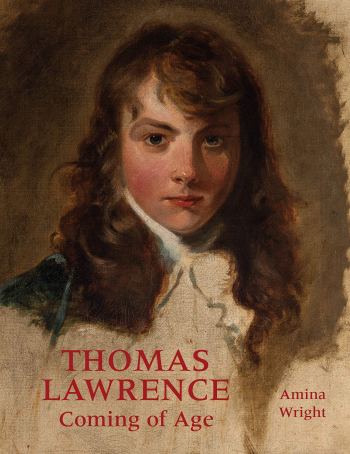 When he arrived in Bath in 1780, aged just eleven, Thomas Lawrence (1769–1830) was already being hailed as a prodigy in the mould of Renaissance masters such as Raphael, Dürer, and Michelangelo. The Holburne Museum’s new exhibition, Thomas Lawrence: Coming of Age, focuses on works made when the artist was between the ages of ten and twenty-two, giving visitors fresh insights into the early development of one of Britain’s greatest portrait painters and the range of his uniquely prodigious talent. The show includes some of Lawrence’s earliest and most brilliant works in pencil, pastel, and oil—several of which have been rarely seen in public.
When the Royal Academy’s 22nd annual exhibition opened in April 1790, its most sensational paintings included twelve portraits by Lawrence. Visitors and critics could scarcely believe that the artist was only 20 (he was due to celebrate his 21st birthday the following week); in fact, one reviewer published Lawrence’s birth certificate to prove that the creator of several of the exhibition’s most outstanding and original works had yet to come of age.
The Holburne exhibition presents fifteen works, following the future President of the Royal Academy over a period of twelve years, from childhood to his early-twenties. Seven of these years were spent in Bath, where he learned the professional skills of a portrait painter, and five in London where, despite his youth, he produced some of his most brilliant and memorable work. The show begins in 1779 as Lawrence, the Bristol-born son of an innkeeper from Devizes in Wiltshire, makes his debut as a child prodigy in Oxford. It follows him to the competitive and colourful world of Bath, where he made friends with actors such as David Garrick and writers, including the famed diarist Fanny Burney, and other influential patrons. Bath being Bath, his sitters included some of the most famous and glamorous members of British high society, including the legendary Georgiana Spencer, later Duchess of Devonshire, whose 1782 pastel on paper portrait has been kindly loaned to the exhibition by the Chatsworth House Trust. The story ends in the early 1790s shortly before his election as a full member of the Royal Academy, aged 25.
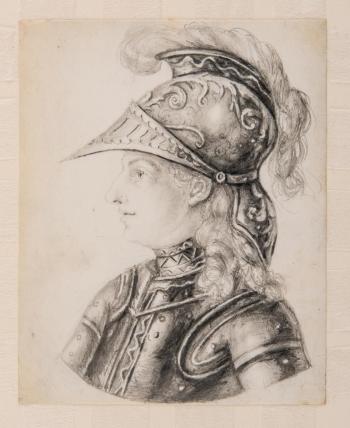
Thomas Lawrence, Head of Minerva, 1779, pencil drawing (Private Collection).
Lawrence had demonstrated an aptitude for sketching when he was around the age of four and had begun producing saleable work aged six. It is known from the few surviving early portraits that he began working in graphite pencil, drawing quick, small-scale head and shoulder profiles on vellum. Coming of Age features several such portraits: the earliest, a Head of Minerva (private collection) made in 1779 during his brief sojourn in Oxford; an accomplished and imaginative profile portrait of his sister Anne (British Museum), drawn in 1781; and a sketch of his cousin, Miss Hammond (British Museum), made in the same year, vividly capturing the young girl’s character and energy.
The artist’s father, recognising his son’s artistic gifts, had taken Thomas to Oxford and London on something of a promotional tour. It was in the capital that Lawrence met the preeminent English painter and President of the Royal Academy, Sir Joshua Reynolds, who is said to have pronounced the youngster as his successor and, according to Fanny Burney’s account from 1780: “The most promising genius he had ever met with.”
Lawrence’s father was declared bankrupt in 1779, and the family relocated to Bath, a thriving city with a wealthy and fashionable society, which would afford the putative artist ample opportunity to demonstrate his skills and make money.
Near the time of his eighteenth birthday, Lawrence moved to London where, despite his youth, he produced some of his most brilliant and memorable work, a fine example of which is the Holburne’s own preparatory sketch for a portrait (now in the Los Angeles County Museum of Art), of Arthur Atherley (1791). Five years after leaving Bath, Lawrence exhibited his final three-quarter-length portrait of Arthur Atherley at the Royal Academy. At the time, he was just three years older than his nineteen-year-old sitter, who had recently left Eton College. The Holburne portrait of Atherley is both striking and memorable, showing the determined the youngster as he launches into the adult world.

Thomas Lawrence, Portrait of Elizabeth Carter, pastel on vellum, ca. 1788–89, 35 × 30 cm (London: National Portrait Gallery).
Coming of Age charts Lawrence’s development as an artist, showing his use of different materials and burgeoning technical craft. As his ability in oil and chalk grew, he gradually abandoned pastel portraits. His last and best head in crayons is a likeness of the elderly classical scholar Elizabeth Carter (ca. 1788–89, National Portrait Gallery). Carter was renowned as a woman of exceptional intellectual powers and also possessed great warmth as a person, which Lawrence’s portrait evokes, revealing her combination of the cerebral and the grandmotherly, deftly using pastel to convey the soft plumpness of her face and the elaborately trimmed and starched cap, while her thoughtful expression suggests a mind tuned to higher things.
The Holburne’s Director, Chris Stephens, says: “Thomas Lawrence did as much as any other artist, before or after him, to define the age in which he lived. The Holburne is renowned for celebrating local creativity and bringing the best of world art to the region, and this is perfectly encapsulated in the study of Thomas Lawrence’s youthful works, a true Bath story. He is our very own answer to Raphael. The exhibition was inspired by our acquisition of one of Lawrence’s greatest works, his Portrait of Arthur Atherley, 1791. It is one of a number of portraits by Lawrence of young men, and women, in their late teens, on the cusp of adulthood. This is, perhaps, a unique phenomenon of an artist portraying young adulthood when he was, himself, not much older than the sitters. It is around this idea of young people facing a rite of passage, confronting the hopes and fears of leaving adolescence for adulthood, that we find some of the contemporary resonances in Lawrence’s art.”
◊ ◊ ◊ ◊ ◊
Amina Wright, Thomas Lawrence: Coming of Age (London: Philip Wilson Publishers, 2021), 112 pages, ISBN: 978-1781300947, £18.
C O N T E N T S
Acknowledgements
Foreword
Introduction
1 Portrait of the Artist as a Young Prodigy
2 Striking Likenesses
3 Old Masters and New Horizons
4 Risking my Reputation
5 The Most Hazardous Step
6 Gleams of Power
Notes
Select Bibliography
Image Credits
Index
Print Quarterly, March 2021
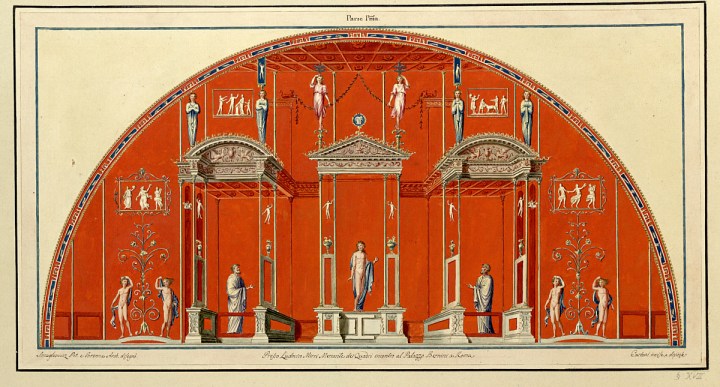
Marco Carloni, Franciszek Smuglewicz, and Vincenzo Brenna, plate nine from Vestigia delle Terme di Tito e Loro Interne Pitture, 1776–78, hand-coloured etching (London: The British Museum).
◊ ◊ ◊ ◊ ◊
The eighteenth century in the latest issue of Print Quarterly:
Print Quarterly 38.1 (March 2021)
A R T I C L E S
Francesca Guglielmini, “Ludovico Mirri’s Vestigia and Publishing in Eighteenth-Century Rome”, pp. 29–49.
This article is a detailed study of the publishing activities and business model of the erudite antiquarian, art dealer and print publisher Ludovico Mirri (1738–1786). His ambitious project Vestigia delle Terme di Tito e Loro Interne Pitture (The Remains of the Baths of Titus and Their Paintings) is discussed in detail alongside eight previous unpublished images of hand-coloured etchings of grotesque wall decorations taken from antique ruins in Rome and surroundings, now in the British Museum, here proposed as an extension of the original Vestigia. Four appendices contain a compilation of uncoloured and coloured impressions of the Vestigia etchings; a description of the contents of the Vestigia and Giuseppe Carletti’s accompanying booklet; known copies of the Vestigia in public collections; and a list of supplementary plates, including those eight mentioned in the British Museum collection.
David Stoker, “The Marshall Family’s Print Publishing Business”, pp. 50–63.
This article explores the little researched late activities of the Dicey print publishing business which was run by members of the Marshall family into the nineteenth century after Cluer Dicey (1715–1775) retired in 1770. The article discusses various publications produced by each member of the Marshall family, from Dicey’s partner Richard Marshall (d. 1779) to his grandson John II Marshall (b. 1793).
N O T E S A N D R E V I E W S
Antony Griffiths, Review of The Lost Library of the King of Portugal (2019), pp. 72–74.
This review sheds light on new research uncovered about the lost library of John V, King of Portugal, specifically archival documents. A significant portion of this review tells the fascinating story of how orders were sent to the Portuguese ambassadors in various European capitals in 1724 for an impression of every available print in those countries. These indeed happened but the various volumes of prints disappeared in the cataclysm of 1755, except for three volumes representing British, French, and Italian prints which were rediscovered in recent decades.
Domenico Pino, “Anton Maria Zanetti II and Limited Editions in Venice, c. 1734,” pp. 74–76.
This note seeks to interpret a handwritten inscription found on the verso of a print by Anton Maria Zanetti the Younger (1706–1778) in the British Museum. The inscription provides important evidence on early exploitation of limited editions in printmaking among the Zanetti clan and their contemporaries.
Antoinette Friedenthal, Review of La vita come opera d’arte: Anton Maria Zanetti e le sue collezioni (2018), pp. 108–14.
This review of an exhibition catalogue exploring Anton Maria Zanetti the Elder (1680–1767) offers an overview of his intellectual and artistic interests. His admiration for Parmigianino is discussed in detail, as well as his own reconstruction of the technique of chiaroscuro woodcuts. The review concludes with a few paragraphs on his forays into publishing.
New Book | The Enlightenment: The Pursuit of Happiness, 1680–1790
(The cover for the British edition, from Allen Lane, looks much ‘happier’ to me.–CH). From Harper Collins:
Ritchie Robertson, The Enlightenment: The Pursuit of Happiness, 1680–1790 (New York: Harper, 2021), 1008 pages, ISBN: 978-0062410658, £40 / $45.
 A magisterial history that recasts the Enlightenment as a period not solely consumed with rationale and reason, but rather as a pursuit of practical means to achieve greater human happiness.
One of the formative periods of European and world history, the Enlightenment is the fountainhead of modern secular Western values: religious tolerance, freedom of thought, speech and the press, of rationality and evidence-based argument. Yet why, over three hundred years after it began, is the Enlightenment so profoundly misunderstood as controversial, the expression of soulless calculation? The answer may be that, to an extraordinary extent, we have accepted the account of the Enlightenment given by its conservative enemies: that enlightenment necessarily implied hostility to religion or support for an unfettered free market, or that this was ‘the best of all possible worlds’. Ritchie Robertson goes back into the ‘long eighteenth century’, from approximately 1680 to 1790, to reveal what this much-debated period was really about.
Robertson returns to the era’s original texts to show that above all, the Enlightenment was really about increasing human happiness—in this world rather than the next—by promoting scientific inquiry and reasoned argument. In so doing Robertson chronicles the campaigns mounted by some Enlightened figures against evils like capital punishment, judicial torture, serfdom and witchcraft trials, featuring the experiences of major figures like Voltaire and Diderot alongside ordinary people who lived through this extraordinary moment.
 In answering the question ‘What is Enlightenment?’ in 1784, Kant famously urged men and women above all to “have the courage to use your own intellect.” Robertson shows how the thinkers of the Enlightenment did just that, seeking a well-rounded understanding of humanity in which reason was balanced with emotion and sensibility. Drawing on philosophy, theology, historiography, and literature across the major western European languages, The Enlightenment is a master-class in big picture history about the foundational epoch of modern times.
Ritchie Robertson is Professor of German at Oxford University, a fellow of the British Academy, and a lead reviewer for The Times Literary Supplement.
Online Talk | Fortune and Folly in 1720
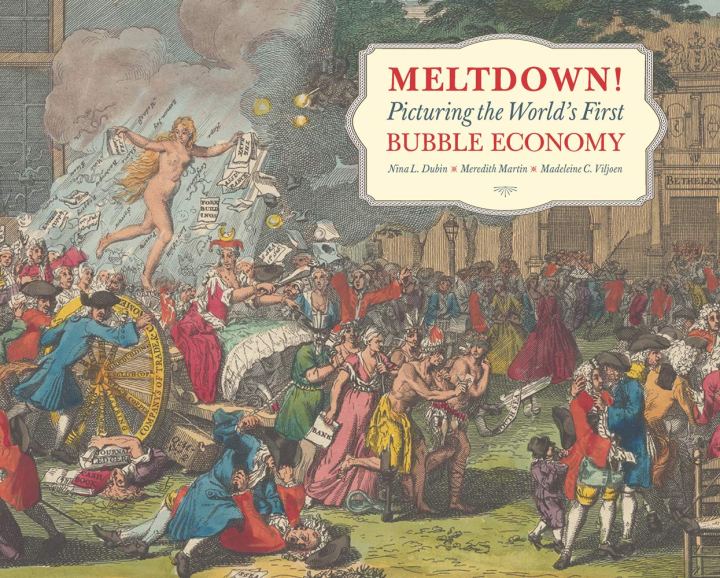
Wednesday evening on Zoom, from the BGC:
Nina Dubin, Meredith Martin, and Madeleine Viljoen | Fortune and Folly in 1720: Picturing the World’s First Bubble Economy
Françoise and Georges Selz Lectures on Eighteenth- and Nineteenth-Century French Decorative Arts and Culture
Online, Bard Graduate Center, New York, 3 March 2021, 6.00pm
This talk will explore The New York Public Library’s upcoming exhibition Fortune and Folly in 1720 (Fall 2021) and its accompanying publication Meltdown! Picturing the World’s First Bubble Economy (Harvey Miller/Brepols, 2020). Co-curated and co-authored by Dubin, Martin, and Viljoen, they tell two parallel stories: one of the spectacular rise and fall of the first bubble economy, and another of the enterprising art industry that chronicled its collapse. The Mississippi and South Sea Bubbles, spawning the invention of French banknotes as well as joint-stock companies built on fantasies of New World trade, imposed on everyday Europeans a crash course in new financial products. In turn, a bubbling print market relentlessly caricatured the meltdown of 1720, offering viewers an entertaining primer on the otherwise bewildering realities of modern economic life. Three hundred years later, our current moment offers a uniquely fitting vantage point from which to reconsider the significance of the bubbles and of the artworks that channeled the fears and desires they unleashed.
The event will be live with automatic captions. It will be held via Zoom; a link will be circulated to registrants by 3pm on the day of the event.
Nina L. Dubin is an associate professor of Art History at the University of Illinois at Chicago. Specializing in European art since 1700, she has published widely on the production of art within an economy of risk.
Meredith Martin is an associate professor of Art History at New York University and the Institute of Fine Arts. Specializing in European art of the long eighteenth century, she has published widely on gender and architectural patronage as well as maritime art, mobility, and exchange in the early modern world.
Madeleine C. Viljoen is Curator of Prints and the Spencer Collection at The New York Public Library. Responsible for the Library’s collection of prints and rare illustrated books, she has published widely on early modern printed images, with special attention to the goldsmith-engraver, the reproductive print, and ornament.
Exhibition | The Search for Ancient Ionia, 1764
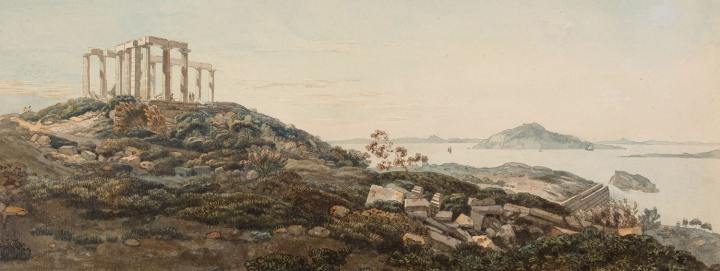
William Pars, Temple of Poseidon at Sounion, 1764, pen and grey ink with watercolour and bodycolour and some gum arabic
(London: The British Museum)
◊ ◊ ◊ ◊ ◊
From the Soane Museum:
The Romance of Ruins: The Search for Ancient Ionia, 1764
Sir John Soane’s Museum, London, 3 March – 11 July 2021
Curated by Ian Jenkins
Produced in collaboration with the British Museum, this exhibition showcases a series of powerful and poetic watercolours made on an expedition to discover the ruins of ancient Ionia (modern Turkey) in 1764. The expedition, funded by the Society of Dilettanti, included artist William Pars, antiquary Richard Chandler, and architect Nicholas Revett.
The beauty and fame of the Ionian cities—part of the Greek world from the 8th century BC and ruined in antiquity—lived on in the writings of ancient commentators such as Herodotus and Strabo. This exhibition focuses on the published accounts of the expedition, produced in lavish volumes funded by the Society of Dilettanti, and the evocative images by the brilliant young artist William Pars, placing them in dialogue with the collections and architecture of Sir John Soane, who deeply admired ancient Greek architecture. Pars’ drawings record the classical ruins encountered in Turkey and Greece, and also the living landscape–its flora and fauna, and the customs, manners and dress of the people, bringing to life extracts from Chandler’s diary account. These images represent Enlightenment themes of travel and discovery and embody melancholy reflections on the passing of the great age of antiquity and the reduction of its monuments. They capture the spirit of Edward Gibbon’s reflection on the fall of civilizations and in so doing they portray the romance of ruins.
This exhibition has been made possible thanks to the generosity of David and Molly Lowell Borthwick. The accompanying catalogue has been kindly supported by the Society of Dilettanti Charitable Trust.
◊ ◊ ◊ ◊ ◊
Ian Jenkins, ed., The Romance of Ruins: The Search for Ancient Ionia, 1764 (London: Sir John Soane’s Museum, 2021), 240 pages, ISBN: 978-1999693244, £40.
 The Romance of Ruins: The Search for Ancient Ionia, 1764 focuses on a series of highly finished watercolours by the brilliant young artist William Pars. These were based on sketches and drawings made on the spot during the Society of Dilettanti’s 1764 expedition to Ionia. This remarkable set of pictorial documents has never been fully published in spite of their beauty and cultural significance. The book includes an introduction by the exhibition’s curator, Ian Jenkins, Senior Curator at the British Museum; a series of essays by eminent scholars including Alastair Blanshard, J. Lesley Fitt, Jason M. Kelly, Philip Mansel, and Kim Sloan; and a catalogue of works in the exhibition.
New Book | American Furniture, 1650–1840
Distributed by Yale University Press:
Alexandra Alevizatos Kirtley, American Furniture, 1650–1840: Highlights from the Philadelphia Museum of Art (Philadelphia Museum of Art, 2021), 336 pages, ISBN: 978-0876332962, $50.
 American Furniture, 1650–1840: Highlights from the Philadelphia Museum of Art is the first publication dedicated to one of the finest collections of its type in the country. Best known for furniture by artisans from Philadelphia and southeastern Pennsylvania, the museum’s collection includes significant examples from cities and regions farther afield. Interpretive texts for each work focus on design sources, showing how early American furniture participated in an international visual language. A vibrant local economy was bolstered by coastal trade bringing Caribbean mahogany and European imports that continued to influence local production. By the 1740s Philadelphia had developed a distinctive idiom and led the developing nation in style and aesthetics. This volume provides an important resource for scholars of American furniture, illuminates the cultural and mercantile life of the fledgling nation, and offers a lively introduction to the donors, curators, and personalities who have shaped the institution from its earliest days to the present.
Alexandra Alevizatos Kirtley is the Montgomery-Garvan Curator of American Decorative Arts at the Philadelphia Museum of Art.
New Book | Painting in Stone: Architecture and the Poetics of Marble
From Yale UP:
Fabio Barry, Painting in Stone: Architecture and the Poetics of Marble from Antiquity to the Enlightenment (New Haven: Yale University Press, 2020), 448 pages, ISBN: 978-0300248166, $65.
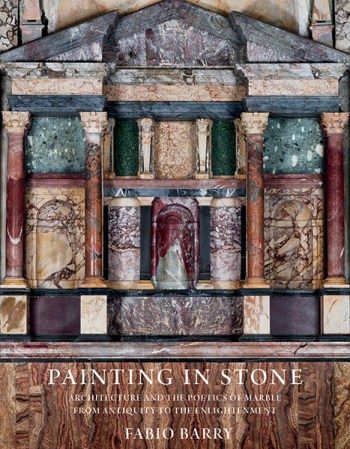 Spanning almost five millennia, Painting in Stone tells a new history of premodern architecture through the material of precious stone. Lavishly illustrated examples include the synthetic gems used to simulate Sumerian and Egyptian heavens; the marble temples and mansions of Greece and Rome; the painted palaces and polychrome marble chapels of early modern Italy; and the multimedia revival in 19th-century England. Poetry, the lens for understanding costly marbles as an artistic medium, summoned a spectrum of imaginative associations and responses, from princes and patriarchs to the populace. Three salient themes sustained this ‘lithic imagination’: marbles as images of their own elemental substance according to premodern concepts of matter and geology; the perceived indwelling of astral light in earthly stones; and the enduring belief that colored marbles exhibited a form of natural—or divine—painting, thanks to their vivacious veining, rainbow palette, and chance images.
Fabio Barry is assistant professor in the Department of Art and Art History at Stanford University.
New Book | Living with Architecture as Art
The exhibition is scheduled to open this spring, with the catalogue now available via Paul Holberton Publishing:
Architectural Training and Practice in Paris in the 19th and Early 20th Century:
Selected French Drawings from the Peter May Collection
New-York Historical Society, 9 April — 13 June 2021
Living with Architecture as Art: The Peter May Collection of Architectural Drawings, Models, and Artefacts (London: Ad Ilissum, 2021), 2 vols., 352 pages each, ISBN: 978-1912168194, £260 / $325.
Introduction by the collector peter may; catalogue by Maureen Cassidy-Geiger; essays by Maureen Cassidy-Geiger, Charles Hind, Basile Baudez, Matthew Wells; afterwords by architect Mark Ferguson and interior designer Bunny Williams.
 This stunning two-volume publication introduces readers to one of the largest private collections of architectural drawings in the world. Showcasing drawings and related models and artefacts dating from 1691 to the mid 20th century, this lavish tome includes both a catalogue and new texts by leading authorities and provides a fascinating look at these often very beautiful by-products of architectural training and practice.
One of the largest private collections of architectural drawings in the world has been assembled over 30 years by investor and philanthropist Peter May. Comprising more than 600 sheets that have all been carefully preserved and handsomely framed, the drawings and related models and artefacts date from 1691 to the mid 20th century. This handsome two-volume publication will introduce amateurs and specialists alike to the largely unknown collection. The book includes a catalogue and innovative texts by leading authorities that present the raison-d’être for the production and preservation of these sometimes neglected by-products of architectural training and practice that have been collected off-and-on through history by individuals and institutions.
The architectural sheets acquired for the collection are principally 19th- or early 20th-century competition or certification drawings by design students. Others are presentation drawings for public commissions, reconstruction studies or interior designs. The catalogue is arranged by category, to demonstrate May’s inclination towards specific building types such as commercial or cultural institutions, train stations and spas, landmarks and monuments, private and royal residences, and cast-iron architecture. Also included is a category for landscape designs and garden architecture, reflecting May’s experience as a gentleman farmer with a predilection for building.
Peter May informs the reader about his history as a collector and builder. Maureen Cassidy-Geiger discusses the formation of the collection and with Basile Baudez introduces the French system of architectural education, from which some of the finest drawings come. Charles Hind offers a history of design training in Britain and writes about patterns of collecting and the market for architectural drawings. Matthew Wells’s subject is the history of architectural models.
Maureen Cassidy-Geiger is a curator and scholar with special expertise in European decorative arts, patterns of collecting and display and the history of architecture, court culture, gardening and travel. Her most recent book on architecture was The Philip Johnson Glass House: An architect in the Garden (Rizzoli, 2016). Charles Hind, FSA, is Chief Curator of Drawings at RIBA in London. A Palladio specialist, he was with Sotheby’s, 1986–93, as their expert in architectural drawings and British watercolors. Basile Baudez is Assistant Professor in the Department of Art & Archaeology, Princeton University, previously at Paris-Sorbonne University, University of Pennsylvania and at the Pratt Institute. Matthew Wells is Lecturer in the Department of Architecture at the ETH (Eidgenössische Technische Hochschule) in Zurich. His dissertation “Architectural Models and the Professional Practice of the Architect, 1834–1916” was awarded the Theodor-Fischer Prize from the Zentralinstituts für Kunstgeschichte in Munich.










leave a comment