New Book | The Wig: A Hairbrained History
From Reaktion Books and the University of Chicago Press:
Luigi Amara, The Wig: A Hairbrained History, translated by Christina MacSweeney (London: Reaktion Books, 2020), 256 pages, ISBN: 978-1789143461, £15 / $23.
Whether in a court room or a dressing room, wigs come in many forms, and represent many things: from power, to sexuality, to parody, to health, to self-identity, to disguise. Wigs are present at parties and in chemotherapy rooms, in pop music and contemporary art. In this witty and eloquent book, Luigi Amara reflects on the curious history of the wig, and along the way takes a sideways look at Western civilization. Amara illuminates how the wig has starred throughout history, from ancient Egypt to the court of Louis XIV, and from British courtrooms to drag shows today. Containing many striking and unusual images, the book appeals to a wide audience, from those interested in the history of fashion to philosophy, art, culture, and aesthetics.
Luigi Amara is the author of many poetry collections, essays, and children’s books, including Nu)n(ca, winner of the International Poetry Prize in Spanish, and The School of Boredom. He lives in Mexico City. Christina MacSweeney is an award-winning literary translator specializing in Latin American fiction.
 C O N T E N T S
An Otherworldly Prologue
A Theory of Disguise
Casanova, Wigs and Masks
The She-wolf of the Night: Messalina
The Rage Called Wig
Samson at the Roland-Garros
The Counter-philosophy of the Wig
The Future Was a Purple Wig
The Mannequin and the Dark Object of Desire
Andy Warhol’s Wig
The Hemisphere in a Wig
On the Other Side of the Mirror of Horror
Music Curls
Capillary Plagiarism
The Indiscreet Charm of Hair
On Remains and Other Relics
Dressing Up Justice
Towering Hairdos
Abbé de Choisy or the Inner Woman
Cindy Sherman in Simulationland
Death Will Come and Shall Be Wearing a Wig
A Bald Wig in Search of a Head
In and Out of the Theatre
Stony Hair
Wigs at the Extremes of Crime
On Nudity or Venus in a Wig
Reinvention by Hair
Devotional Hairstyles
The Chimeric Wig
That Old Camp Stridency
The Tangled Mop of Fetish
A Knife Named Guillotine
The Discourse of False Hair
Bedside Reading
Photo Acknowledgements
New Book | The Eternal City: A History of Rome in Maps
From the University of Chicago Press:
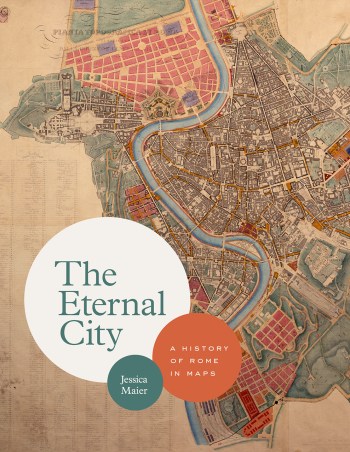
Jessica Maier, The Eternal City: A History of Rome in Maps (Chicago: University of Chicago Press, 2020), 240 pages, ISBN: 978-0226591452, $40.
One of the most visited places in the world, Rome attracts millions of tourists each year to walk its storied streets and see famous sites like the Colosseum, St. Peter’s Basilica, and the Trevi Fountain. Yet this ancient city’s allure is due as much to its rich, unbroken history as to its extraordinary array of landmarks. Countless incarnations and eras merge in the Roman cityscape. With a history spanning nearly three millennia, no other place can quite match the resilience and reinventions of the aptly nicknamed Eternal City.
In this unique and visually engaging book, Jessica Maier considers Rome through the eyes of mapmakers and artists who have managed to capture something of its essence over the centuries. Viewing the city as not one but ten ‘Romes’, she explores how the varying maps and art reflect each era’s key themes. Ranging from modest to magnificent, the images comprise singular aesthetic monuments like paintings and grand prints as well as more popular and practical items like mass-produced tourist plans, archaeological surveys, and digitizations. The most iconic and important images of the city appear alongside relatively obscure, unassuming items that have just as much to teach us about Rome’s past. Through 140 full-color images and thoughtful overviews of each era, Maier provides an accessible, comprehensive look at Rome’s many overlapping layers of history in this landmark volume.
The first English-language book to tell Rome’s rich story through its maps, The Eternal City beautifully captures the past, present, and future of one of the most famous and enduring places on the planet.
Jessica Maier is associate professor of art history at Mount Holyoke College. She is the author of Rome Measured and Imagined: Early Modern Maps of the Eternal City, also published by University of Chicago Press.
 C O N T E N T S
Introduction: Rome as Idea and Reality
Further Reading
1 Rome Takes Shape
Rome before Rome
A Walled City
Urban Districting
Further Reading
2 Rome of the Caesars
Destination Rome
An Incomplete Puzzle
Making Sense of the Shattered Past
Filling in the Gaps
A Model City
Further Reading
3 Rome of the Popes
Sacred Buildings and Secular Symbols
The Medieval Cityscape
Pathos and Wonder
Further Reading
4 Rome Reborn
A City Ready for Its Close-Up
The City Seen through a Wide-Angle Lens
The City Measured
A Panoramic View of Urban Revitalization
Further Reading
5 Rome of the Scholars
Archaeology in Its Infancy
An Ancient Roman Theme Park
A Ghostly Fantasy
Further Reading
6 Rome of the Saints and Pilgrims
The Way of the Faithful
Scenes from a Pilgrimage
A Pilgrimage Map for the Modern Era
Further Reading
7 Rome of the Grand Tourists
Rome as Theater
The Origins of the Tourist Plan
Rome Surveyed
A Panoramic Vision
Further Reading
8 Rome of the Mass Tourists
The Guidebook Impresario’s Rome
Rome for a Rather Important Woman Traveler
Rome in Your Pocket
Rome for Italian Tourists
Further Reading
9 Rome Enters the Modern Age
2,500 Years in, a Master Plan for Rome
When Trams Ruled Rome
An Olympic City, and a New Beginning
Further Reading
10 Rome Past, Present, and Future
Rapid Transit for a Rapidly Changing City
A Master Plan for the Third Millennium: (Un)sustainable Rome
Further Reading
Acknowledgments
Index
Exhibition | The Piranesi Principle

Giovanni Battista Piranesi, Colosseum in Rome, Bird’s Eye View from the North, ca. 1760–70
(Staatliche Museen zu Berlin, Kunstbibliothek / Dietmar Katz)
◊ ◊ ◊ ◊ ◊
A very brief posting appeared here at Enfilade in February. Here’s the expanded version; from the Staatliche Museen zu Berlin:
The Piranesi Principle: Marking the 300th Birthday of the Great Italian Master
Das Piranesi-Prinzip: Zum 300. Geburtstag des großen italienischen Meisters
Kunstbibliothek, Berlin, 4 October 2020 — 7 February 2021
Giovanni Battista Piranesi (1720–1778) was one of the great polymaths of the 18th century. He carved out an international career as an archaeologist, artist, collector, designer, publisher and author. The principle behind his success was to grasp the multifaceted nature of reality and transform it into something new. He found inspiration everywhere: in the artifacts of bygone epochs and faraway regions, in images from science, technology and opera, and even in denunciations and defeats. This exhibition celebrating the 300th anniversary of his birth brings this Piranesi principle back to life in all its creativity. It is centred around Piranesi’s masterpieces of engraving, his books, pamphlets, satirical illustrations, and drawings from the collections of the Kunstbibliothek and the Kupferstichkabinett, some of which are being shown for the very first time.
Piranesi’s Rome
The exhibition begins with a trip back through time to Piranesi’s Rome. While today’s tourists marvel at the city’s ancient ruins in an urban setting, in the 18th century the Venetian-born artist lived and worked in a city surrounded by a landscape of ruins, in which monuments overgrown by plants protruded from the ground. It was in this context that Piranesi found the motifs for his images and architectural visions, collected artefacts for his ‘Museo’, and conducted research into art and architectural history—the results of which he published in monumental works such as the Antichità Romane (1756). And it was here that he found his clientele and his audience: artists, art scholars, archaeologists, antiques and art dealers came from all over the world to make their fortune in the ‘eternal city’—or, like Piranesi himself—to earn their immortality.
Piranesi’s Stage
Opera and theatre have been influential mass media since the Baroque era. Performances took place not only in private residences, but also on the street and in public squares, where religious festivities were staged as elaborate spectacles. In the 18th century, theatre was a big business, for which artists designed stage sets and decorations, and in doing so revolutionised the viewing habits of their audiences. Piranesi, who had already become acquainted with this scene in Venice, picked up on these ideas and used them to dramatise his compositions. Both his Vedute (Views) and his famous Carceri (Prisons) largely owe their magic to the influence of the theatre of the time.
Piranesi’s Laboratory
As well as the dream factory of theatre, the technical imagery of the sciences was another a source of great fascination for Piranesi. Imagining his workshop as a laboratory, he experimented with creating futuristic images in order to find ways to communicate the findings of his research on archaeology and art with scholars and the public alike. In the section Piranesi’s Laboratory, the exhibition focuses on the monumental display panels, reconstructions and maps that made him famous within the sciences far beyond Italy, and saw him named a member of the Society of Antiquaries in London in 1757 and an honorary member of the Accademia di San Luca in Rome in 1761. His images are ground-breaking and ahead of their time above all because of their resemblance to a computer desktop featuring a multitude of windows open simultaneously. They succeeded in sealing Piranesi’s status as a pioneer of visual communication.
Piranesi’s Palazzo
This section takes viewers to the central site of his work: Palazzo Tomati, not far from the Spanish steps, where Piranesi resided from 1761 onwards, ran a large workshop, and opened his ‘Museo’ (a warehouse of antiques and self-manufactured objects) to tourists and art scholars. The drawings by Piranesi that are held by the Kunstbibliothek, including his renowned fireplace designs, provide important information about his work process. Piranesi was open to everything: he drew on both Roman and Egyptian antiquity, Etruscan and Greek art, and often came up with daring hybrid forms. Even the wastepaper in his studio provided points of departure and stimulus for his creative processes. Recycling and re-using were part of his daily routine in the workshop, especially as paper was a valuable resource. The exhibition makes evident how the recto and verso of his prints, drawings and notes were used over and over again for new sketches.
Piranesi’s Arena
Finally, in the section Piranesi’s Arena, the exhibition presents Piranesi as a polarising figure in the international art scene. Four people in his life are presented to exemplify this tension, beginning with fellow Venetian Pope Clement XIII (1693–1769), who was particularly important due to his role as a patron, and then looking at three antagonists who infuriated Piranesi to such an extent that he resorted to unusual artistic weapons. He dedicated an entire publication to taking down the argument of French art scholar Pierre-Jean Mariette (1694–1774), who had questioned the significance of Roman antiquity, with words and pictures. The name of his Irish patron, Lord Charlemont (1728–1799), who had withdrawn funding for one of his largest projects, was visually erased from public memory. And to express his displeasure in a dispute with French archaeologist Bertrand Capmartin de Chaupy (1720–1798), he produced a detailed and masterfully elaborate depiction of his own excrement.
An exhibition of the Kunstbibliothek – Staatlichen Museen zu Berlin and the Humboldt-Universität zu Berlin, in cooperation with the Kupferstichkabinett – Staatlichen Museen zu Berlin
The exhibition and catalogue were jointly conceived by students, curators, and researchers at the Kunstbibliothek and the Department for Art and Visual History at the Humboldt-Universität zu Berlin. An exhibition catalogue, edited by Georg Schelbert and Moritz Wullen, will be published by E.A. Seemann Verlag, Leipzig, 144 pages, 135 colour illustrations, ISBN 978-3865024435 (German edition), 978-3865024442 (English edition), €27.

Giovanni Battista Piranesi, Vignette: Satire targeting Bertrand Capmartin De Chaupy, 1769
(Staatliche Museen zu Berlin, Kunstbibliothek / Dietmar Katz)
New Book | Women and the Art and Science of Collecting
From Routledge:
Arlene Leis and Kacie Wills, eds., Women and the Art and Science of Collecting in Eighteenth-Century Europe (New York: Routledge, 2020), 212 pages, ISBN 978-0367856663, $160.
 Through both longer essays and shorter case studies, this book examines the relationship of European women from various countries and backgrounds to collecting, in order to explore the social practices and material and visual cultures of collecting in eighteenth-century Europe. It recovers their lives and examines their interests, their methodologies, and their collections and objects—some of which have rarely been studied before. The book also considers women’s role as producers, that is, creators of objects that were collected. Detailed examination of the artefacts—both visually, and in relation to their historical contexts—exposes new ways of thinking about collecting in relation to the arts and sciences in eighteenth-century Europe. The book is interdisciplinary in its makeup and brings together scholars from a wide range of fields. It will be of interest to those working in art history, material and visual culture, history of collecting, history of science, literary studies, women’s studies, gender studies, and art conservation.
Arlene Leis is an independent art historian who received her PhD from the University of York. Kacie L. Wills received her PhD in English from the University of California, Riverside, and is Assistant Professor of English at Illinois College.
C O N T E N T S
Part I: Artificialia and Naturalia
1 Anne Harbers and Andrea Gáldy, Science, Gender and Collecting: The Dutch Eighteenth-Century Ladies’ Society for Physical Sciences of Middelburg
2 Irina Schmiedel, Between Art and Science: Portraits of Citrus Fruit for Anna Maria Luisa de’ Medici
3 Kelsey Brosnan, Anne Vallayer-Coster’s Still Life with Sea Shells and Coral
Part II: Travel, Borders, and Networks
4 Katharina Schmidt-Loske, Maria Sibylla Merian: A Woman’s Pioneering Work in Entomology
5 Erica Hayes and Kacie L. Wills, Sarah Sophia Banks’s Coin Collection: Female Networks of Exchange
6 Lizzie Rogers, Conversing with Collecting the World: Elite Female Sociability and Learning through Objects in the Age of Enlightenment
7 Maria Antonietta Spadero, Portrait of Charlotte de France: from Naples to Sicily, a Collection in Transit
8 Charis Ch. Avlonitou, The Collecting Activity of Catherine II in Eighteenth-Century Russia: Pioneering Action or Sheer Demonstration of Power?
Part III: Displaying, Recording, and Cataloguing
9 Madeleine Pelling, ‘I made memorandums’: Mary Hamilton, Sociability, and Antiquarianism in the Eighteenth-Century Collection
10 Nicole Cochrane, Eleanor Coade, John Soane, and the Coade Caryatid
11 Ryna Ordynat, Anne Wagner’s Album (1795–1805): Collecting Feminine Friendship
12 Hanneke Grootenboer, An Art Cabinet in Miniature: The Dollhouse of Petronella Oortman
Part IV: Beyond the Eighteenth Century
13 Anna Frances O’Regan, Collection, Display, and Conservation: The Print Room at Castletown House
14 Arlene Leis, Olivia Lanza di Mazzarino (1893–1970): A Lady’s Collection of Eighteenth-Century Folding Fans
Gothic Architecture and Sexuality in the Circle of Horace Walpole
From Penn State UP:
Matthew Reeve, Gothic Architecture and Sexuality in the Circle of Horace Walpole (University Park: The Pennsylvania State University Press, 2020), 280 pages, ISBN: 978-0271085883, $75.
 Gothic Architecture and Sexuality in the Circle of Horace Walpole shows that the Gothic style in architecture and the decorative arts and the tradition of medievalist research associated with Horace Walpole (1717–1797) and his circle cannot be understood independently of their own homoerotic culture. Centered around Walpole’s Gothic villa at Strawberry Hill in Twickenham, Walpole and his ‘Strawberry Committee’ of male friends, designers, and dilettantes invigorated an extraordinary new mode of Gothic design and disseminated it in their own commissions at Old Windsor and Donnington Grove in Berkshire, Lee Priory in Kent, the Vyne in Hampshire, and other sites.
Matthew Reeve argues that the new ‘third sex’ of homoerotically inclined men and the new ‘modern styles’ that they promoted—including the Gothic style and chinoiserie—were interrelated movements that shaped English modernity. The Gothic style offered the possibility of an alternate aesthetic and gendered order, a queer reversal of the dominant Palladian style of the period. Many of the houses built by Walpole and his circle were understood by commentators to be manifestations of a new queer aesthetic, and in describing them they offered the earliest critiques of what would be called a ‘queer architecture’.
Exposing the role of sexual coteries in the shaping of eighteenth-century English architecture, this book offers a profound and eloquent revision to our understanding of the origins of the Gothic Revival and to medievalism itself. It will be welcomed by architectural historians as well as scholars of medievalism and specialists in queer studies.
Matthew M. Reeve is Associate Professor of Art History at Queen’s University and Fellow of the Society of Antiquaries of London.
C O N T E N T S
List of Illustrations
Preface: Medievalism, Modernity, and the History of Sexuality
Abbreviations
Introduction
1 The New Medievalism: Constructing the Gothic in the Circle of Horace Walpole
2 Horace Walpole’s Strawberry Hill
3 Queer Family Romance in the Strawberry Hill Collection
4 Dicky Bateman and the Gothicization of Old Windsor
5 ‘The Spirit of Strawberry-Castle’: Donnington Grove, The Vyne, and Lee Priory
6 From Strawberry Hill Gothic to the Gothic Revival
Notes
Bibliography
Index
Exhibition | A Superb Baroque: Art in Genoa, 1600–1750
The exhibition was scheduled to be on view at the NGA this past summer; it will now arrive in Washington after appearing in Rome. From the NGA:
A Superb Baroque: Art in Genoa, 1600–1750 / La Superba e il Barocco
Scuderie del Quirinale, Rome, 25 March — 1 August 2021
National Gallery of Art, Washington, D.C., 26 September 2021 — 9 January 2022
Curated by Jonathan Bober, Piero Boccardo, and Franco Boggero
 By the 17th century, Genoa was the banking center of Europe with a functioning republican government and enormous wealth that enabled its artists and their patrons to create a singularly rich and beautiful expression of baroque style, with works of extraordinary material sumptuousness, visual splendor, and exuberant feeling. The first major presentation of the Genoese baroque in the United States, this landmark exhibition—accompanied by a fully illustrated catalog—presents some 130 paintings, sculptures, decorative arts, drawings, and prints ranging from 1600 through 1750.
Forming the core of the exhibition are works by the school’s well-known painters—Bernardo Strozzi, Giovanni Benedetto Castiglione, and Alessandro Magnasco—as well as key works by other Italians and foreigners drawn to the city’s flourishing environment—Peter Paul Rubens, Giulio Cesare Procaccini, Orazio Gentileschi, Anthony van Dyck, and Francesco Solimena. Some of the very finest works by such native painters as Valerio Castello, Domenico Piola, and Gregorio De Ferrari are also on view. Monumental decorative ensembles from churches and residences are represented by corresponding oil sketches and presentation models, several grand in scale themselves. Also included are full-size statues by masters—Pierre Puget, Filippo Parodi, and Anton Maria Maragliano—terracotta sketches, and exquisite bronze repetitions of monumental groups, as well as spectacular ceremonial silver from early in the period.
Among the drawings and prints featured are many by the same artists who executed the paintings and objects, with some connected to them. These works reveal the striking characteristics of Genoese draftsmanship: complex techniques, pictorial elaboration, and autonomous function. In fantasy and fluency, the etchings—particularly those of Castiglione and Bartolomeo Biscaino—surpass those of any other Italian school.
The exhibition is curated by Jonathan Bober, Andrew W. Mellon Senior Curator of Prints and Drawings, National Gallery of Art; Piero Boccardo, Superintendent of the City Collections of Genoa; and Franco Boggero, director, historic and artistic heritage section, Soprintendenza Archeologia, Belle Arti e Paesaggio, Genoa.
The exhibition is organized by the National Gallery of Art, Washington, and the Scuderie del Quirinale, Rome, with special cooperation from the City and Museums of Genoa. The exhibition is made possible by the Robert Lehman Foundation. Additional funding is provided by The Exhibition Circle of the National Gallery of Art.
The catalogue is now available from Princeton UP:
Jonathan Bober, Piero Boccardo, Franco Boggero, Peter Lukehart, and Andrea Zanini, A Superb Baroque: Art in Genoa, 1600–1750 (Princeton: Princeton University Press in association with the National Gallery of Art, Washington, DC, 2020), 384 pages, ISBN: 978-0691206516, $65 / £54.
Genoa completed its transformation from a faded maritime power into a thriving banking center for Europe in the seventeenth century. The wealth accumulated by its leading families spurred investment in the visual arts on an enormous scale. This volume explores how artists both foreign and native created a singularly rich and extravagant expression of the baroque in works of extraordinary variety, sumptuousness, and exuberance. This art, however, has remained largely hidden behind the facades of the city’s palaces, with few works, apart from those by the school’s great expatriates, found beyond its borders. As a result, the Genoese baroque has been insufficiently considered or appreciated.
Lavishly illustrated, A Superb Baroque is comprehensive, encompassing all the major media and participants. Presented are some 140 select works by the celebrated foreigners drawn to the city and its flourishing environment—from Peter Paul Rubens, Anthony van Dyck, and Giulio Cesare Procaccini to Pierre Puget, Marcantonio Franceschini, and Francesco Solimena; by the major Genoese masters active for much of their careers in other settings—Bernardo Strozzi, Giovanni Benedetto Castiglione, Filippo Parodi, and Alessandro Magnasco; and above all by the brilliantly synthetic but unfamiliar masters who worked primarily in Genoa itself—Gioacchino Assereto, Valerio Castello, Domenico Piola, and Gregorio De Ferrari. Offering three levels of exploration—essays that frame and interpret, section introductions that characterize principal currents and stages, and texts that elucidate individual works—this volume is by far the most extensive study of the Genoese baroque in the English language.
Exhibition | Tantra: Enlightenment to Revolution
From the press release for the exhibition:
Tantra: Enlightenment to Revolution
The British Museum, London, 24 September — 24 January 2021
Curated by Imma Ramos
 A radical philosophy that transformed the religious, cultural, and political landscape of India and beyond is explored in a landmark new exhibition at the British Museum. Supported by the Bagri Foundation, Tantra: Enlightenment to Revolution charts the rise and spread of Tantra, a set of beliefs and rituals that first emerged in India around AD 500. The exhibition explores Tantra’s early medieval transformation of Hinduism and Buddhism, along with its links to the Indian fight for independence and the rise of 1960s counterculture in the West.
Tantra: Enlightenment to Revolution is the first major exhibition in the UK focusing on the history of Tantra and its global impact. It is the very first time the British Museum—which houses one of the biggest and most comprehensive collections of Tantric material in the world—will explore this subject in an exhibition. Over 100 objects will be on show, including masterpieces of sculpture, painting, prints, and ritual objects. Tantra’s impact is evident across Asia’s diverse cultural and religious traditions, but it remains largely unknown—or misrepresented—in the West. Little is known beyond its association to sex and yoga. The exhibition demonstrates that from its inception, Tantra has challenged political, sexual, and gender norms around the world and that it has always been linked to successive waves of revolutionary thought.
Tantra is a philosophy rooted in sacred instructional texts called ‘Tantras’. They take their name from the Sanskrit word ‘tan’, meaning ‘to weave’ or ‘compose’, and are often written in the form of a conversation between a god and goddess. The exhibition will feature four examples of some of the earliest surviving Tantras in the world, on loan from Cambridge University Library. Made in Nepal from around the 12th century, these texts outline a variety of rituals for invoking one of the many all-powerful Tantric deities, including through visualisations (imaginatively identifying with a deity) and yoga. Tantras often also described rituals that transgressed existing social and religious boundaries, such as sexual rites and engagement with intoxicants and the traditionally taboo. Such rituals affirmed all aspects of existence as sacred, including the body and the sensual, in order to achieve liberation and generate power. One example in the exhibition describes the benefits of actively engaging in sexual activity with a partner in order to ultimately transcend desire itself: ‘By passion the world is bound; by passion too it is released’.
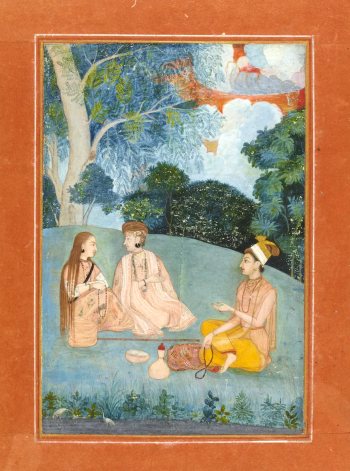
A woman visiting two Nath yoginis, North India, Mughal, ca. 1750 (London: The British Museum).
The exhibition particularly explores Tantra’s radical challenge to gender norms. The Tantric worldview sees all material reality as animated by Shakti—unlimited, divine feminine power. This inspired the dramatic rise of goddess worship in India and confronted traditional gender roles. Goddesses and female Tantric practitioners are featured prominently in the exhibition, ranging from a 9th-century sandstone temple relief from Madhya Pradesh depicting the ferocious goddess Chamunda dancing on a corpse, to an 18th-century courtly painting showing female gurus offering Tantric initiation. These depictions transcended conventional images of womanhood as passive and docile. A number of contemporary works by female artists will be on display, highlighting the ongoing relevance of Tantra’s impact on gender. These works harness Tantric goddesses through the bodies of real women, including Sutapa Biswas’ 1985 mixed media work Housewives with Steak-Knives, which evokes the Tantric goddess Kali in a modern feminist form.
Tantra also became a tool of revolution during the fight for India’s independence in the late 19th century. Indian revolutionaries in Bengal harnessed Tantra for its insurgent potential during colonial rule, reimagining goddesses such as Kali as symbols of an independent India rising up against the British. Visitors will see dramatic sculptures and artworks of Kali wearing garlands of decapitated heads, which successfully exploited British fears of the goddess as a bloodthirsty ‘demon mother’. In the exhibition the true meaning behind her symbolism, tied to both destructive power and maternal strength, will be decoded.
The final section of the exhibition focuses on the 20th century and Tantra’s modern re-imaginings in Asia and the West. In the 1960s and 1970s, Tantric ideas and imagery inspired global countercultural movements and had an important impact on the period’s radical politics. In Britain and the USA, Tantra was interpreted as a movement that could inspire anti-capitalist, ecological, and free love ideals. The Tantra-inspired psychedelic posters that plastered the streets of London and San Francisco during this time are on show, as well as paintings, photographs, and sculptures illustrating Tantra’s enduring influence in art and popular culture.
The exhibition is organized by Dr. Imma Ramos, a curator of the South Asia collections at the British Museum.
Imma Ramos, Tantra: Enlightenment to Revolution (London: Thames & Hudson, 2020), 288 pages, ISBN: 978-0500480625, £35 / $50.
Exhibition | Exotic Switzerland? Looking Outward
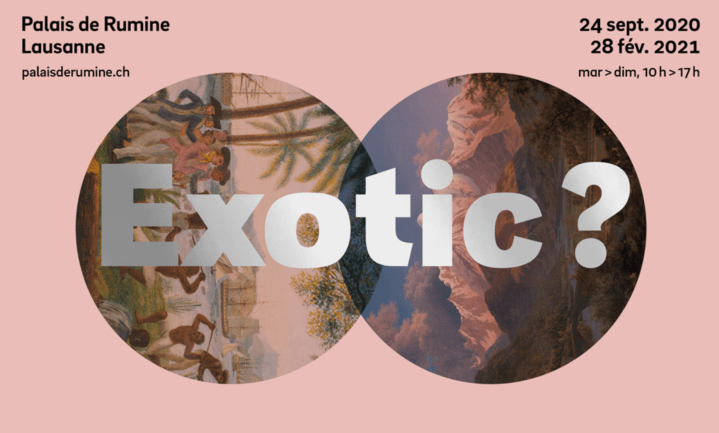
Opening next week at the Palais de Rumine:, with additional information, including programming, available here»
Une Suisse exotique? Regarder l’ailleurs en Suisse au siècle des Lumières
Exotic Switzerland? Looking Outward in the Age of Enlightenment
Palais de Rumine, Lausanne, 24 September 2020 — 28 February 2021
Organized by Noémie Étienne
What is exotic? How long has this word been used? How do we define what is exotic and what is not? Is Switzerland exotic? In Europe, the Enlightenment is a key period in building up this view, of which we are still the heirs. This era was that of both human rights and the quadrangular trade, including trade in enslaved people. It can be reread critically. Swiss history is often only considered within the borders of Europe, but the Swiss maintained close and complex ties with distant countries.
Why This Exhibition?
 This exhibition is the result of a collaboration between the team of Professor Noémie Étienne (Bern University, Swiss National Science Foundation) and the three museums of science and history of the Palais de Rumine. Exotic? will be presented in the large temporary exhibition rooms of the Palais. It offers a historical and critical perspective in order to understand the emergence of this view of the Other and the acts of classification that accompanied it. Indeed, nothing is ‘exotic’ in itself: exoticism is the product of representations, mediations, and translations, which assign a place to things and people in a given historical and political context. This exhibition depicts the image of a dynamic and complex Switzerland that became part of the world, mostly through individual initiatives. It also adds complexity to an idealised interpretation of the 18th century, which was certainly an era of great scientific and artistic innovation but also of the first economic globalisation, and colonisation.The issues of colonialism, power, gender, race and economy are at the heart of this exhibition, which aims at reflecting about Switzerland’s past, especially the careers of individuals who wished to take part in colonisation and international trade.
Who Were Swiss Travellers in the 18th Century?
Many Swiss People travelled beyond the borders, mostly individually. However, these journeys were often made under the aegis of a foreign crown and were often linked to economic, political, and religious networks that could go beyond the borders of the territory (Huguenot, banking, missionary, foreign service, and military networks). These travellers settled in the countries they visited and developed their careers in close cooperation with the peoples and territories concerned.The objects that were collected by artists and scientists in the 18th century were brought back to Switzeland and included in local collections. Two types of collection can be differentiated: on one hand, those made through intermediaries that accompanied British and French national explorations, and on the other hand those created directly by Swiss People. During these voyages, which lasted several years, the crews collected objects and specimens that they brought back to Europe and then traded or sold. At the same time, they kept travel journals and filled sketchbooks in which they described the objects and the contexts of what they collected as well as the peoples they encountered.
The nature of the objects that were collected by Swiss People has many commonalities with examples that can be studied in neighbouring countries. One of the characteristics was the use of collections for education, particularly due to the presence of cabinets in the Protestant Academies, such as in Lausanne and Zurich. This use was part of a pedagogical process that favoured a pragmatic view of things, and differentiated the cabinets of the Swiss Academies from the German ‘Wunderkammer’, the royal cabinets and the princely collections of European courts.
Innovation and Technology Transfer
The circulation of techniques and objects that came from the outside world promoted the development of new technologies all over Europe and especially in Switzerland. This was the case of the porcelain factories in Zurich and Nyon that produced for a local clientele. However, other factories that developed in Switzerland manufactured objects (watches, enamels) for export to China and Turkey. The cities of Basel, Geneva and Neuchâtel also produced printed textiles known as ‘Indian chintz’, imitating a technique used in India.
Is Switzerland Exotic?
Switzerland became gradually a subject of curiosity for travellers who were interested in its folklore and landscapes: it was therefore exotic for those who visited it. This movement was prepared from the 18th century onward by the inhabitants of the large cities: they built up an image of Alpine and rural cultures that was a great success and that can still be found today in advertising and in tourist marketing.
Public and Cultural Mediation
The exhibition aims at reaching all kinds of people, especially through a varied scientific and cultural programme, while putting forward a new approach to Swiss history. It will attempt to connect the images that were produced in the 17th and 18th centuries to imaginations by offering avenues for thinking about alterity today through a historical perspective and contemporary art (performances, sounds, images). In view of the sensitive subject, many mediation activities will accompany this exhibition: guided tours and workshops, of course, but also a play produced by high school students, short films made by the students of the Swiss film director Lionel Baier at the University of Art and Design ECAL, lectures in coffee grounds by the Women Telling The Future collective, lectures, and a partnership with the programme of the Vidy theatre.
Objects Displayed
The exhibition will bring together 150 pieces from more than 30 Swiss collections and cultural institutions. Most of these pieces are very rarely shown. The typologies of the objects are diverse: specimens of natural history, paintings, textiles, porcelains, non-European artefacts, archives, books and maps.
Contemporary Artists
There will be a selection of works by contemporary artists (Marie van Berchem, Fabien Clerc, Susan Hefuna, Senam Okudzeto and Uriel Orlow), giving a different perspective of the exhibited objects and of the more general aims of the exhibition.
Publications
The English edition of the catalogue is distributed in North America and Britain by The University of Chicago Press:
 Noémie Étienne with Claire Brizon, Chonja Lee, and Étienne Wismer, Une Suisse exotique ? Regarder l’ailleurs en Suisse au siècle des Lumières (Dijon: Les presses du réel, 2020), 376 pages, ISBN: 978-2889280520, 40€.
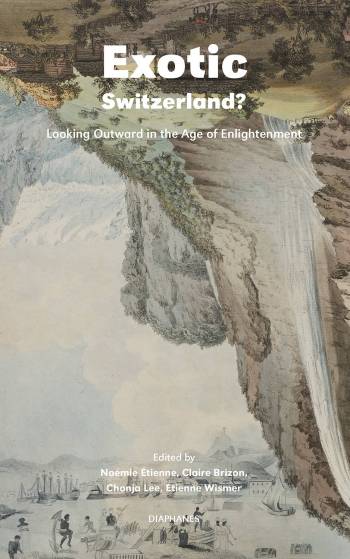
Noémie Étienne with Claire Brizon, Chonja Lee, and Étienne Wismer, Exotic Switzerland? Looking Outward in the Age of Enlightenment (Lausanne: Diaphanes, 2020), 256 pages, ISBN: 978-3035802276, $40.
Why is an object, an artwork, or a person deemed ‘exotic’? How is the gaze built upon those things or people who seem to belong to other regions or cultures? This notion is studied here in relation to a specific context: the Enlightenment era from the Swiss perspective. The publication brings together for the first time research from academics and specialists of the museum world in order to rethink this time period and this geography. It assembles contributions of essays as well as shorter texts centered on pictures, objects, books, and natural specimens from Swiss museum collections. ‘Exotic’, in this context, means that which comes from elsewhere and can be used and ‘improved’ for the benefits of European powers. This adjective invites us to reconsider both the long eighteenth century and the international history of Switzerland.
Noémie Étienne is professor of Early Modern Art History at the University of Bern. Claire Brizon is a doctoral student in art history at the University of Bern. Chonja Lee is a postdoctoral researcher at the University of Bern. Étienne Wismer is a doctoral student in art history at the University of Bern.
Susan Tallman on Art History’s Loose Canons

Willem van Haecht, Apelles Painting Campaspe, ca. 1630 (The Hague: Mauritshuis). Used as an illustration for Susan Tallman’s review in The New York Review of Books (24 September 2020).
◊ ◊ ◊ ◊ ◊
Note from the Editor
Thanks to all of you for your patience with postings that have grown far more irregular than I would have liked. My family and I have been well, though admittedly, diligence (generally) hasn’t been quite the virtue it was for me prior to COVID. I have good intentions of eventually resuming the regular rate of posts (more or less), though getting there may take some time (pandemic obviously continues to make regular parts of life, including teaching, more complicated). One realization I’ve had over the past few months: I’m much less excited generally about Enfilade in the absence of exhibitions. I don’t actually make it to that many exhibitions in a given year, a fraction of those listed on the site. And yet, exhibitions generate for me (even vicariously) lots of intellectual energy. To all of you who do that work in and with museums, I’m more grateful than ever. Thank you.
I experienced, however, a similar jolt of stimulation while reading the most recent issue of The New York Review of Books (24 September 2020). I love Susan Tallman’s review of Christopher Wood’s A History of Art History (Princeton UP, ) and Éric Michaud’s The Barbarian Invasions: A Genealogy of the History of Art (MIT Press, 2019). In addition to working as an engaging review, Tallman’s piece (“Who Decides What’s Beautiful?,” pp. 16–20) is one of the most concise, satisfying summaries of art history as a discipline I know of—effectively framing the discipline in relation to the ethical and moral stakes of this particular moment in time. Enfilade readers will likely find other reviews from the issue also of interest:
• David Bell on Maurice Samuels’s The Betrayal of the Duchess: The Scandal That Unmade the Bourbon Monarchy and Made France Modern (Basic Books, 2020).
• Kathryn Hughes on new studies of Wordsworth.
• Larry Wolff on Thomas Irvine’s Listening to China: Sound and the Sino-Western Encounter, 1770–1839 (University of Chicago Press, 2020).
• Leah Price on Anthony Grafton’s Inky Fingers: The Making of Books in Early Modern Europe (Belknap/Harvard UP, 2020) and Jordan Alexander Stein’s When Novels Were Books (Harvard UP, 2020).
–Craig Hanson
New Book | The Life and Work of Rosalba Carriera
Soon available from AUP:
Angela Oberer, The Life and Work of Rosalba Carriera (1673–1757): The Queen of Pastel (Amsterdam: Amsterdam University Press, 2020), 332 pages, ISBN: 9789462988996, €119 / $140.
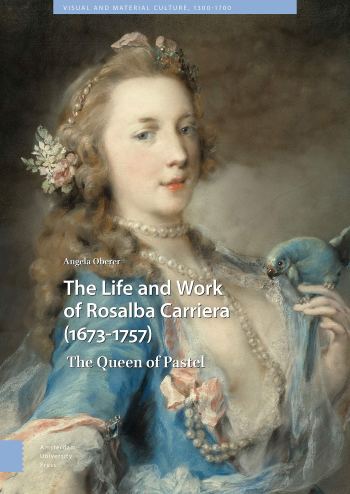 The Life and Work of Rosalba Carriera (1673–1757): The Queen of Pastel is the first extensive biographical narrative in English of Rosalba Carriera. It is also the first scholarly investigation into the external and internal factors that helped to create this female painter’s unique career in eighteenth-century Europe. It documents the difficulties, complications, and consequences that arose then—and can also arise today—when a woman decides to become an independent artist. This book contributes a new, in-depth analysis of the interplay among society’s expectations, generally accepted codices for gendered behavior, and one single female painter’s astute strategies for achieving success, as well as autonomy in her professional life as a famed artist. Some of the questions that the author raises are: How did Carriera manage to build up her career? How did she run her business and organize her own workshop? What kind of artist was Carriera? Finally, what do her self-portraits reveal in terms of self-enactment, possibly autobiographical turning points?
Angela Oberer graduated from Bonn University with a master’s thesis on “The Cycle of the True Cross Relic at the Scuola Grande di San Giovanni Evangelista in Venice.” In 2002 she received her doctoral degree at the Technische Universität in Berlin with a thesis on Signorelli’s and Sodoma’s fresco cycle in Monte Oliveto Maggiore. Since 2003 she had taught art history at various U.S. study abroad programs in Florence—currently at Georgetown University, Florence, at AIFS, at CET (which is associated with Vanderbilt University), and at other programs that work with colleges and universities from across the United States.










 Enfilade
leave a comment