New Book | Porcelain Pugs
Published by Mercatorfonds and distributed by Yale UP:
Claire Dumortier and Patrick Habets, eds., with a foreword by Julia Weber, photography by Hughes Dubois, and contributions by A. Reyes, Ulrich Pietsch, Sarah K. Andres-Acevedo, Hans Ottomeyer, Roland Hanke, Marie-Laure de Rochebrune, and Barbara Beaucamp-Markowski, Porcelain Pugs: A Passion, The T. & T. Collection (Brussels: Mercatorfonds, 2020), 224 pages, ISBN: 9780300246537, $60.
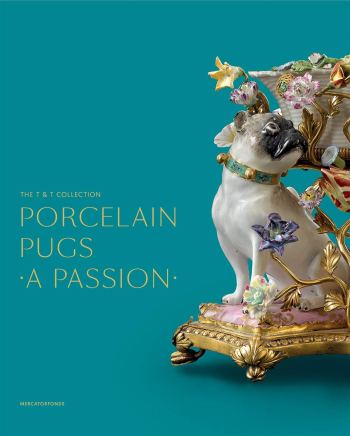 A superb collection of 18th-century porcelain pugs is showcased here alongside historical and artistic context for the beautiful objects.
A treasure trove for dog-lovers and porcelain enthusiasts alike, this book celebrates a collection of more than 100 porcelain pugs, most of which were designed in the mid-18th century by Johann Joaquim Kändler, the eminent modeler in the Meissen porcelain factory in Germany. Stunning new photography of the objects is accompanied by essays that place the figures in their historical and artistic context. Pugs were introduced to Europe in the late 16th or early 17th century and quickly gained popularity among the European aristocracy thanks to the animals’ even temperament and sociability. In 1740, a secret society called the Order of the Pug was established as an offshoot of the Freemasons; the pug was selected to represent the society due to its reputation for reliability, trust, and steadfastness. Also featured here is a survey of pug imagery in contemporary European decorative arts, including on snuff-boxes, flasks, and cane handles.
Claire Dumortier is honorary curator of the ceramics collections of the Royal Museum of Art and History in Brussels. Patrick Habets is emeritus professor of the Catholic University of Louvain.
New Book | Becoming America
Distributed by Yale UP (portions of the collection have been on view at The Huntington since October 2016) . . .
James Glisson, ed., with contributions by John Demos, Jonathan and Karin Fielding, Robin Jaffee Frank, James Glisson, Stacy Hollander, Christina Nielsen, Sumpter Priddy, Elizabeth V. Warren, and David Wheatcroft, Becoming America: Highlights from the Jonathan and Karin Fielding Collection of Folk Art (San Marino: The Huntington Library, Art Collections, and Botanical Gardens, 2020), 264 pages, ISBN: 9780300247565, $50.
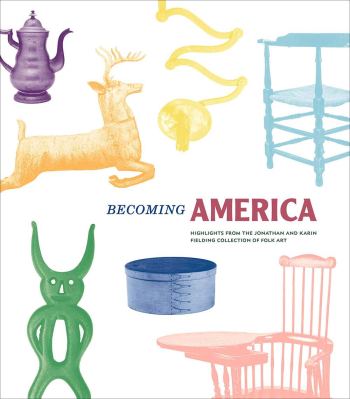 Becoming America offers a multifaceted view of one of the foremost collections of 18th- and 19th-century American folk and decorative art from the rural Northeast. Essays by leading specialists discuss the culture of furniture workshops, exuberant painted decoration, techniques of sewing and quilting, and poignant stories about the families depicted in the portraits. The collection itself includes Shaker boxes, a beaded Iroquois hat, embroidered samplers, metalwork, scrimshaw, handwoven rugs, ceramics, and a weather vane. The majority of these works have never before been published. With lively essays and profuse illustrations, this handsome volume brings to life the aesthetic of early Americans living in the countryside and is an essential exploration of the period’s taste and style.
James Glisson is interim chief curator of American art at The Huntington. Jonathan Fielding is the former director of the Los Angeles County Department of Public Health and Distinguished Professor at UCLA. Karin Fielding is a trustee of the American Folk Art Museum in New York.
New Book | British Art and the East India Company
From Boydell & Brewer:
Geoff Quilley, British Art and the East India Company (Martlesham, Suffolk: Boydell Press, 2020), 370 pages, ISBN: 9781783275106, $120.
 This book examines the role of the East India Company in the production and development of British art during the eighteenth and early nineteenth centuries, when a new ‘school’ of British art was in its formative stages with the foundation of exhibiting societies and the Royal Academy in 1768. It focuses on the Company’s patronage, promotion and uses of art, both in Britain and in India and the Far East, and how the Company and its trade with the East were represented visually, through maritime imagery, landscape, genre painting, and printmaking. It also considers how, for artists such as William Hodges and Arthur William Devis, the East India Company, and its provision of a wealthy market in British India, provided opportunities for career advancement, through alignment with Company commercial principles. In this light, the book’s main concern is to address the conflicted and ambiguous nature of art produced in the service of a corporation that was the ‘scandal of empire’ for most of its existence and how this has shaped and distorted our understanding of the history of British art in relation to the concomitant rise of Britain as a self-consciously commercial and maritime nation, whose prosperity relied upon global expansion, increasing colonialism and the development of mercantile organisations.
Geoff Quilley is Professor of Art History at the University of Sussex, specializing in the relation of British and western visual culture to empire and global expansion in the eighteenth and nineteenth centuries. He was previously Curator of Fine Art at the National Maritime Museum, London, and has written and edited numerous books, including Empire to Nation: Art, History and the Visualization of Maritime Britain, 1768–1829 (Yale University Press 2011).
C O N T E N T S
Introduction: Corporate Patronage and Company Artists
‘That Extensive Commerce’: The Maritime Image of the East India Company
Travels in India: Landscape and Colonial Patronage
Networks of Knowledge, Power, and Cultural Exchange
The Cries of India: Colonial Power, Classification, and the Diffusion of Knowledge
By Way of China
Collecting India
Conclusion
Notes
Bibliography
Index
New Book | The Napoleonic Wars: A Global History
From Oxford UP:
Alexander Mikaberidze, The Napoleonic Wars: A Global History (Oxford: Oxford University Press, 2020), 960 Pages, ISBN: 978-0199951062, $40.
 Austerlitz, Wagram, Borodino, Trafalgar, Leipzig, Waterloo: these are the places most closely associated with the era of the Napoleonic Wars. But how did this period of nearly continuous conflict affect the world beyond Europe? The immensity of the fighting waged by France against England, Prussia, Austria, and Russia, and the immediate consequences of the tremors that spread throughout the world.
In this ambitious and far-ranging work, Alexander Mikaberidze argues that the Napoleonic Wars can only be fully understood in an international perspective. France struggled for dominance not only on the plains of Europe but also in the Americas, West and South Africa, Ottoman Empire, Iran, India, Indonesia, the Philippines, Mediterranean Sea, and the Atlantic and Indian Oceans. Taking specific regions in turn, Mikaberidze discusses major political-military events around the world and situates geopolitical decision-making within its long- and short-term contexts. From the British expeditions to Argentina and South Africa to the Franco-Russian maneuvering in the Ottoman Empire, the effects of the French Revolution and Napoleonic Wars would shape international affairs well into the next century. In Egypt, the wars led to the rise of Mehmed Ali and the emergence of a powerful state; in North America, the period transformed and enlarged the newly established United States; and in South America, the Spanish colonial empire witnessed the start of national-liberation movements that ultimately ended imperial control.
Skillfully narrated and deeply researched, here at last is the global history of the period, one that expands our view of the Napoleonic Wars and their role in laying the foundations of the modern world.
Alexander Mikaberidze is Professor of European History at Louisiana State University at Shreveport, where he is also Ruth Herring Noel Endowed Chair for the Curatorship of the James Smith Noel Collection. He is the author of several books, including The Burning of Moscow: Napoleon’s Trial by Fire 1812 and The Battle of Borodino: Napoleon versus Kutuzov.
C O N T E N T S
1 The Revolutionary Prelude
2 The Eighteenth-Century International Order
3 The War of the First Coalition, 1792–97
4 The Making of ‘La Grande Nation’, 1797–1802
5 The Second Coalition War and the Origins of the ‘Great Game’
6 The Rites of Peace, 1801–02
7 The Road to War, 1802–03
8 The Rupture, 1803
9 The Elephant Against the Whale: France and Britain at War, 1803–1804
10 The Emperor’s Conquest, 1805–07
11 ‘War through Other Means’: Europe and the Continental System
12 The Struggle for Portugal and Spain, 1807–12
13 The Grand Empire, 1807–12
14 The Emperor’s Last Triumph
15 The Northern Question, 1807–11
16 ‘An Empire Besieged’: The Ottomans and the Napoleonic Wars
17 The Qajar Connection: Iran and the European Powers, 1804–14
18 Britain’s Expeditionary Warfare, 1805–10
19 Britain’s Eastern Empire, 1800–15
20 The Western Question? Struggle for the Americas, 1808–15
21 The Turning Point, 1812
22 The Fall of the French Empire
23 The War and Peace, 1814–1815
24 The Aftermath of the Great War
Notes
Select Bibliography
Index
New Book | King of the World: The Life of Louis XIV
Forthcoming from the U of C Press (though its distribution center is temporarily shut down, e-books are now 30% off, and some titles will ship from other locations). I’ll also put in a plug for Hyde Park’s Seminary Co-op Bookstore, one of the world’s great academic bookstores; its Front Table makes for fine online browsing. Like all independent bookstores, the Seminary Co-op faces daunting challenges in the weeks ahead. So keep reading, and all the better if some of those books are coming from independent booksellers you care about. –CH
Philip Mansel, King of the World: The Life of Louis XIV (Chicago: The University of Chicago Press, 2020), 608 pages, ISBN: 978-0226690896, $35.
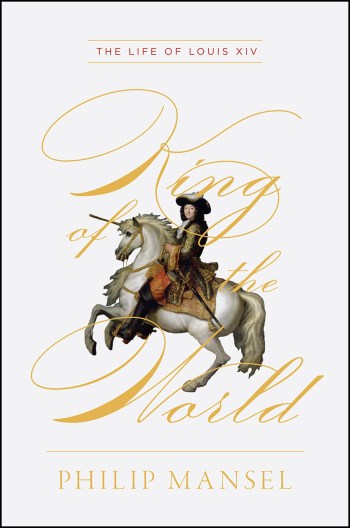 Louis XIV was a man in pursuit of glory. Not content to be the ruler of a world power, he wanted the power to rule the world. And, for a time, he came tantalizingly close. Philip Mansel’s King of the World is the most comprehensive and up-to-date biography in English of this hypnotic, flawed figure who continues to captivate our attention. This lively work takes Louis outside Versailles and shows the true extent of his global ambitions, with stops in London, Madrid, Constantinople, Bangkok, and beyond. We witness the importance of his alliance with the Spanish crown and his success in securing Spain for his descendants, his enmity with England, and his relations with the rest of Europe, as well as Asia, Africa, and the Americas. We also see the king’s effect on the two great global diasporas of Huguenots and Jacobites, and their influence on him as he failed in his brutal attempts to stop Protestants from leaving France. Along the way, we are enveloped in the splendor of Louis’s court and the fascinating cast of characters who prostrated and plotted within it.
King of the World is exceptionally researched, drawing on international archives and incorporating sources who knew the king intimately, including the newly released correspondence of Louis’s second wife, Madame de Maintenon. Mansel’s narrative flair is a perfect match for this grand figure, and he brings the Sun King’s world to vivid life. This is a global biography of a global king, whose power was extensive but also limited by laws and circumstances, and whose interests and ambitions stretched far beyond his homeland. Through it all, we watch Louis XIV progressively turn from a dazzling, attractive young king to a belligerent reactionary who sets France on the path to 1789. It is a convincing and compelling portrait of a man who, three hundred years after his death, still epitomizes the idea of le grand monarque.
Philip Mansel is one of Britain’s leading historians of France and the Middle East. He is the author of many books, including, most recently, Aleppo: The Rise and Fall of Syria’s Great Merchant City; The Eagle in Splendour: Inside the Court of Napoleon; and Levant: Splendour and Catastrophe on the Mediterranean.
C O N T E N T S
List of Illustrations
Maps
Family Trees
Introduction: A Thousand Years of France
1 The Gift of God
2 Our Good City of Paris
3 The Struggle for France
4 M. le Cardinal
5 The Power of Queens
6 Fouquet’s Fall
7 Making France Work
8 The Pursuit of Immortality: The Louvre and Versailles
9 Conquering Flanders
10 Fighting the Netherlands
11 To the Rhine
12 The King Outdoors
13 Inside Versailles
14 Inside Louis XIV
15 The Global King: From the Mississippi to the Mekong
16 The Huguenot Cataclysm
17 England Changes Sides: The Flights of King James
18 France against Europe
19 Spain Changes Sides: The Accession of King Philip
20 The Triumph of Europe
21 Towards the Precipice
22 Nemesis Averted
23 Funeral Games
24 The Shadow of Versailles
Acknowledgements
Notes
Bibliography
Index
The Burlington Magazine, March 2020
The eighteenth century in The Burlington:
The Burlington Magazine 162 (March 2020) — Drawings

Luigi Valadier, Pyx, 1769–71, gilt silver, 22 × 11 cm, one of eighteen pieces of a pontifical mass service belonging to the cathedral of Portalegre, Portugal (Church of S. Miguel, Castelo Branco).
A R T I C L E S
• Teresa Leonor M. Vale “A Portuguese Bishop’s Pontifical Mass Service by Luigi Valadier,” pp. 196–203. A gilt silver pontifical mass service belonging to the cathedral of Portalegre, Portugal, is here identified as the work of the celebrated Roman silversmith Luigi Valadier and dated 1769–71. It is closely similar to a contemporary service owned by Cardinal Domenico Orsini and both services can be linked to a group of drawings from Valadier’s workshop.
S H O R T E R N O T I C E S
Kee Il Choi, Jr., “Ornament from China: Sources for a Garden Folly Design by Jean-Jacques Lequeu,” pp. 216–19.
R E V I E W S
• Kirstin Kennedy, Review of Carolina Naya Franco, Joyas y alhajas del Alto Aragón: esmaltes y piedras preciosas de ajuares y tesoros históricos (2018).
• Stéphane Loire, Review of Nicola Spinosa, ed., Francesco Solimena (1657–1747) e le Arti a Napoli (2018).
• Aileen Dawson, Review of Claudia Bodinek (with contributions by Peter Braun, Tobias Pfeifer-Helke und Claudia Schnitzer), Raffinesse im Akkord: Meissener Porzellanmalerei und ihre Grafischen Vorlagen (2018).
• David Bindman, Review of the exhibition Canova Thorvaldsen: The Birth of Modern Sculpture (Milan: Gallerie d’Italia, 2019–20).
• Daniel Stewart, Review of the exhibition Troy: Myth and Reality (London: British Museum, 2019–20).
• Christiane Elster, Review of the exhibition History in Fashion: 1500 Years of Embroidery in Fashion (Leipzig: GRASSI Museum of Applied Arts, 2019–20).
• Philippa Glanville, Review of the exhibition Feast and Fast: The Art of Food in Europe, 1500–1800 (Cambridge: Fitzwilliam Museum, 2019–20)
• Kamila Kocialkowska, Review of the exhibition Peter the Great: Collector, Scholar, Artist (Moscow Kremlin Museums, 2019–20).
• Eckart Marchand, Review of the exhibition Near Life: The Gipsformerei: 200 Years of Casting Plaster (Berlin: James-Simon-Galerie, 2019–20).
New Book | The Campbells of Cawdor and their Welsh Estates
From Boydell & Brewer:
John Davies, The Changing Fortunes of a British Aristocratic Family, 1689–1976: The Campbells of Cawdor and their Welsh Estates (Martlesham, Suffolk: Boydell & Brewer, 2019), 353 pages, £85.
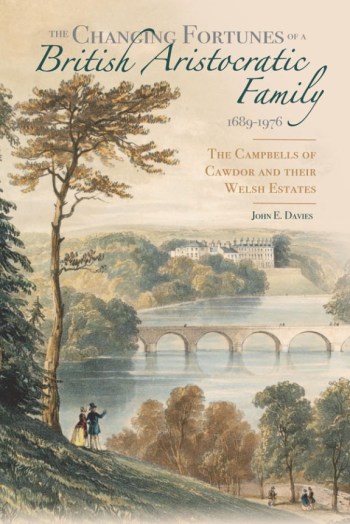 Traces the development of a typical British aristocratic family, its estates and its activities over the period when the landed aristocracy was at its height and over the period when the aristocracy had to cope with increasing democratisation.
For over two hundred years, the Campbells of Cawdor were major landowners, industrialists and politicians. Originating in Nairnshire, Scotland, they moved in the late seventeenth century to south Wales, where they became the second largest landowner in Wales and owners of significant coal and lead mines. They participated politically in the British state as MPs, peers, lords of the admiralty including one first lord, treasury lords, admirals, and army officers. They supported local good causes, were involved in London ‘society’, and were major art collectors. As such their story is fairly typical of many other aristocratic families in the period. This book traces the development of the family, its estates, and activities from the late seventeenth to the late twentieth century. It shows how they established their wealth and power during the eighteenth century—the period when the landed aristocracy was at its height—how they responded in the nineteenth century to the moves towards more democratic forms of local and national government, and how—despite the difficulties aristocratic families and estates faced in the twentieth century—they survived, selling off their Welsh lands and returning to their Scottish base, which remains a flourishing agricultural estate and tourist destination.
John E. Davies was the County Archivist for Carmarthenshire and is now an independent historical researcher. He completed his doctorate at Swansea University.
C O N T E N T S
Introduction
Cawdor and Campbell
Estate Administration
The Agricultural Estate: The Cawdors as Farmers and Landlords
The Cawdors as Industrial Landowners
The Cawdors in the Community: Church and Education
The Melee of Local Governance
The Cawdors in Politics: Interest Building, Consolidation, and Decline
Private and Exclusive Lives
The End of the Welsh Estates
Conclusion
Bibliography
New Book | Anglo-Saxonism and the Idea of Englishness
From Boydell & Brewer:
Dustin M. Frazier Wood, Anglo-Saxonism and the Idea of Englishness in Eighteenth-Century Britain (Martlesham, Suffolk: Boydell Press, 2020), 239 pages, ISBN: 978-1783275014, $99.
 Long before they appeared in the pages of Ivanhoe and nineteenth-century Old English scholarship, the Anglo-Saxons had become commonplace in Georgian Britain. The eighteenth century—closely associated with Neoclassicism and the Gothic and Celtic revivals—also witnessed the emergence of intertwined scholarly and popular Anglo-Saxonisms that helped to define what it meant to be English. This book explores scholarly Anglo-Saxon studies and imaginative Anglo-Saxonism during a century not normally associated with either. Early in the century, scholars and politicians devised a rhetoric of Anglo-Saxon inheritance in response to the Hanoverian succession, and participants in Britain’s burgeoning antiquarian culture adopted simultaneously affective and scientific approaches to Anglo-Saxon remains. Patriotism, imagination, and scholarship informed the writing of Enlightenment histories that presented England, its counties, and its towns as Anglo-Saxon landscapes. Those same histories encouraged English readers to imagine themselves as the descendants of Anglo-Saxon ancestors—as did history paintings, book illustrations, poetry, and drama that brought the Anglo-Saxon past to life. Drawing together these strands of scholarly and popular medievalism, this book identifies Anglo-Saxonism as a multifaceted, celebratory and inclusive idea of Englishness at work in eighteenth-century Britain.
Dustin M. Frazier Wood is a Lecturer in English at the University of Roehampton.
C O N T E N T S
Introduction: Anglo-Saxonism, Medievalism, and the Eighteenth Century
1 Anglo-Saxonisms of the Early Eighteenth Century
2 Antiquaries and Anglo-Saxons
3 Anglo-Saxon History and the English Landscape
4 Imaging and Imagining Anglo-Saxonness
5 Anglo-Saxonist Politics and Posterity
Conclusion: Sharon Turner’s History of the Anglo-Saxons
Bibliography
New Book | Lessons of Travel in Eighteenth-Century France
From Boydell & Brewer:
Gábor Gelléri, Lessons of Travel in Eighteenth-Century France: From Grand Tour to School Trips (Martlesham, Suffolk: Boydell Press, 2020), 245 pages, ISBN: 978-1783274369, $130.
 A study of the literature of the ‘art of travel’ in eighteenth-century France, showing how consideration of who should travel and for what purpose provided an occasion for wider debate about the social status quo.
Early modern educational travel is usually associated with the Grand Tour: a young nobleman’s journey through the established highlights of Europe. Lessons of Travel presents how, in eighteenth-century France, this practice was heavily contested, and the idea of educational travel had far wider implications. Through the study of a huge range of both canonical and little-known sources discussing ‘the art of travel’, from abbé Pluche’s educational best seller, The Spectacle of Nature, through Rousseau’s Émile to practical prospectuses for collective educational travel in the revolutionary period, Gabor Gelleri investigates what it meant to ‘think about travels’ in eighteenth-century France. Consideration of who should travel and for what purpose, he argues, contributed to an international intellectual tradition but also provided a pretext for debate on the social status quo, including such issues as the place of the merchant class, the necessity for professional training, the uses of travel for young women and the education of a new generation of citizens of the Revolution.
Gábor Gelléri is Lecturer in French at Aberystwyth University.
C O N T E N T S
Introduction: On Reading Arts of Travel
Defining the Grand Tour
From Touring to Training: The Case of Diplomacy, 1680–1830
Trading with Men, Dealing with God: Abbé Pluche’s Ideas on Travel
Travelling on a Moebius Strip: Émile’s Travels
The End of an Era? The Prize Contest of the Academy of Lyon, 1785–87
Inventing School Trips? Revolutionary Programmes of Collective Educational Travel
Conclusion
Bibliography
New Book | Time and Place: Notes on the Art of Calendars
For any of you mindful today of the Calendar Act of 1750, which finally brought Britain into alignment with the Continent through its acceptance of the Gregorian calendar, thus beginning the New Year on January 1 rather than March 25 (the change, including a loss of eleven days, actually went into effect in September 1752). From Little Toller Books:
Alexandra Harris, Time and Place: Notes on the Art of Calendars (Dorset: Little Toller Books, 2019), 104 pages, ISBN: 978-1908213808, £12 / $18.
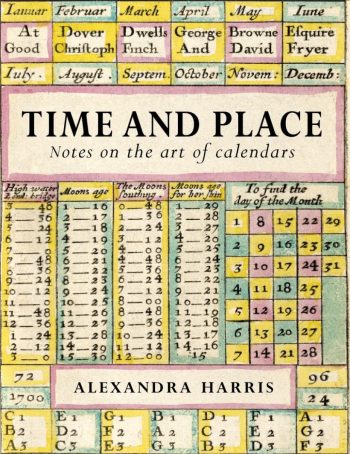 Dates are invented things. Nothing in nature decrees that today is today. But for millennia humans have divided time into portions, and given those portions names which are shared widely across cultures, creating a common agreement on the date. This convention is useful in practical ways: we can make arrangements and can communicate time elapsed or time ahead. But the calendar also makes a certain kind of truth and establishes that today is today. As calendars and almanacs developed, art from their specific time and place was naturally incorporated. In this small book showcasing the finest and most interesting art that has gone into almanacs, from the eight century onwards, Alexandra Harris brings in everything from Benedictine calendars to Old Moore’s Almanack.
Alexandra Harris is a renowned, prize-winning writer, critic, and cultural historian. Her books include Romantic Moderns, Weatherland, Modernism on Sea, and Virginia Woolf.










 Enfilade
leave a comment