Exhibition | Power Mode: The Force of Fashion
Now installed at the Fashion Institute of Technology:
Power Mode: The Force of Fashion
The Museum at FIT, New York, 10 December 2019 — 9 May 2020
Curated by Emma McClendon
 Today, we see a multitude of sartorial power symbols, from ‘power suits’ to ‘power heels’. But what makes a garment ‘powerful’? According to sociologist and political theorist Steven Lukes: “We speak and write about power, in innumerable situations, and we usually know, or think we know, perfectly well what we mean … And yet, among those who have reflected on the matter, there is no agreement about how to define it, how to conceive it, how to study it, and, if it can be measured, how to measure it.”
If we think of power in terms of kinetic force (for example, electrical power or a person’s physical power over another), clearly an inanimate item of clothing does not have actual power. The force of fashion is symbolic. It is social. It lies in the sphere of interpersonal relations and cultural dynamics. There is no single, universally accepted definition of power. Power means different things to different people at different times. As such, its connection to fashion is multifaceted, and a multifaceted approach is necessary for considering the role fashion plays in power dynamics both historically and today.
The exhibition is organized into five thematic sections, each devoted to a particular type of sartorial ‘power’. In each section, men’s and women’s clothing are considered side by side, and pieces from as early as the eighteenth century are juxtaposed with looks from contemporary collections.
The exhibition opens with a display of military and military-inspired ensembles, including a U.S. Army lieutenant colonel’s ‘dress blue’ uniform, a World War II–era ‘Ike’ jacket, and looks from Yves Saint Laurent, Burberry, and Ralph Lauren. Modern military uniforms combine tailoring with an elaborate code of patches, braiding, stripes, colors, and metalwork that makes the soldier a walking extension of the state’s power. In fashion, a company logo replaces the state’s seal, but uniform-inspired silhouettes, colors, textiles, and buttons become visual shorthand for the power, strength, and authority of the military. It is the power of association.
The next section focuses on different modes of status dressing that have emerged over the last 250 years, from ermine capes and luxurious brocade fabrics to contemporary “It” bags and logo-covered products. Aspiration, wealth, and Thorstein Veblen’s theory of “conspicuous consumption” are key to understanding the role status dressing plays in modern society. An 18th-century robe à la française demonstrates the importance of ornate, expensive textiles to courtly dress, while a Balenciaga puffer coat shows the way brand names have become crucial decorative elements in luxury fashion today.
From status dressing, the exhibition moves to consider the history of the suit. The sharply tailored suit is perhaps the most conventional example of ‘power dressing’. Indeed, the term power dressing was often used to describe the big-shouldered suits worn by upwardly mobile business men and women during the 1980s. However, the history of the suit is more nuanced. Anne Hollander points out, “Heads of state wear suits … and men accused of rape and murder wear them in court to help their chances of acquittal.” In court rooms and office spaces, the suit isn’t just a symbol of authority. It is also a sign of blending in—submitting to established norms and dress codes.
The fourth section considers the role of resistance dressing. Blue jeans, printed T-shirts, and black leather jackets have become some of the most common symbols of resistance in clothing. They signal a certain type of power that is subversive of established authority. It is the power of protest and rebellion. There is a tension between resistance clothing and ‘fashion’, with the later often being dismissed as surface-level commodification. But the relationship is not so simple—fashion can also be a vehicle for protest as seen in the recent work of Kerby Jean-Raymond for his label Pyer Moss.
Finally, the fifth section analyzes objects that are culturally coded as ‘sexy’. Corsets, leather, lingerie, and high-heeled boots are but a few examples. The power dynamics of these garments are inherently complex. How a garment is interpreted can fluctuate between dominance and subjugation. As fashion critic Holly Brubach once said of Versace’s famous 1992 bondage collection, it “riles women who think this is exploitative and appeals to women who think of his dominatrix look as a great Amazonian statement. It could go either way.”
Power Mode is a curatorial experiment. It aims to combine theory with history and object analysis in order to better understand the complex nature of power in fashion as well as the ways fashion can be key to a broader understanding of power dynamics in culture. The exhibition is organized by Emma McClendon, associate curator of costume.
Emma McClendon, ed., Power Mode: The Force of Fashion (Milan: Skira, 2019), 128 pages, ISBN: 978-8857239873, $45 / €39.
 A more in-depth discussion of the themes represented in the exhibition is articulated in the lavishly illustrated accompanying book, also titled Power Mode: The Force of Fashion, edited by exhibition curator Emma McClendon and published by Skira. The book delves deeper into theory and history to investigate how certain garments have come to be culturally associated with power, as well as how their meanings have evolved over time. It also examines how fashion designers have interpreted these stylistic archetypes—both to convey and to subvert power. Chapter texts by McClendon are joined by object-based essays from renowned fashion scholars Valerie Steele, Christopher Breward, Jennifer Craik, and Peter McNeil, as well as Pulitzer Prize–winning journalist Robin Givhan. The book also includes an essay by Kimberly M. Jenkins on the intersection of race, fashion, and power. This collection of texts will offer readers a variety of perspectives to help form a theoretical framework for considering the power dynamics inherent in fashion objects.
New Book | Artistische Wanderer
From Deutscher Kunstverlag (with thanks to the author for the English translations). . .
Gerrit Walczak, Artistische Wanderer: Die Künstler(e)migranten der Französischen Revolution (Berlin/Munich: Deutscher Kunstverlag, 2019), 448 pages, ISBN: 978-3422981201, €48.
 Dozens of painters were part of the emigration occasioned by the outbreak of the French Revolution in 1789. Whether French or foreigners established in France, these artists were driven out of the country by the rapid demise of the art market in the wake of political instability. Yet the dynamics of radicalization and war soon eroded distinction between economic migration and political exile.
Whether officially designated as émigrés or not, painters such as Élisabeth Vigée-Le Brun, Jean-Laurent Mosnier, Henri-Pierre Danloux, François-Xavier Fabre, and Louis Gauffier practiced their profession in Rome and Florence, London, Hamburg and Saint Petersburg. Whilst some of them established themselves in their host countries until the end of the Revolution, others successively transferred between the European metropoles. This first comprehensive study of the Revolution’s “artistic wanderers”—a term coined in Hamburg in 1799—traces their transnational itineraries and investigates productions shaped by transfer, acculturation, and innovation.
Gerrit Walczak is habilitated adjunct professor (Privatdozent) of art history at the Technical University Berlin, and has previously taught at the universities of Bochum, Köln, and Greifswald. He presently serves as interim editor of the Zeitschrift für Kunstgeschichte. His research focuses on the transnational migration of artists, on 18th-century art, its academies, and the art market. He is the author of Bürgerkünstler: Künstler, Staat und Öffentlichkeit im Paris der Aufklärung und Revolution (Deutscher Kunstverlag 2015).
C O N T E N T S
Here translated from the German
1 Introduction: Revolution and Mobility
Migration, Emigration, and Exile
Itinerant Artists and their Trajectories
Art Markets and Exile Art
2 Paris: The Initial Conditions of Artistic Emigration
The Fiction of Escape
Economy and Violence
Anti-Emigration Laws and Repression
3 Rome: The French Academy and the Revolution
Rome and Paris until the Fall of the Monarchy
Commissions and Appropriations
The End of the French Academy and its Fallout
4 Florence: Exiles, Tourists, and Occupiers
History Paintings for Foreigners
Tuscan Landscapes
French Grand Tour-Portraiture
5 London: Rivalries and Confrontations
Genius loci
Acculturation and its Limits
Political Stances
6 Hamburg: A Place of Passage
The Lure of Boom Economy
Tradesmen and other Clients
Reception and Receptivity
7 Saint Petersburg: Integration / Extraction
Providers to the Imperial Court
Modes of Transfer
Flux and Reflux
8 Coda: Re-migrations
The Salon of 1802
Humiliations
Souvenirs
Acknowledgements
Bibliography
Index
New Book | Luxe intime
From CTHS, with additional information available here:
Anne Perrin Khelissa, Luxe intime: Essai sur notre lien aux objets précieux (Aubervilliers: Comité des travaux historiques et scientifiques, 2020), 125 pages, ISBN: 978-2735509126, 14€.
 Notre rapport aux objets intimes (meubles, boîtes, tableaux, luminaires, services de table, vêtements, bijoux…) est historiquement daté. Sans une certaine conscience de soi, nous n’aurions pu leur accorder autant de sens : leur demander de satisfaire des besoins et des désirs, tout en les inscrivant dans des chaînes relationnelles et symboliques multiples. Ce changement advient au XVIIIe siècle et se perçoit actuellement encore dans nos sociétés de consommation. À l’heure où la planète croule sous les déchets et où l’objet du quotidien par excellence devient le téléphone portable, il semble important de s’interroger sur les fondements de notre être aux choses. Comment parler des objets intimes et du lien empathique que l’on tisse avec eux ? Quel langage et quelle sensibilité sont-ils les plus à même d’exprimer leur part technique et poétique, leur empreinte historique et leur aura transgénérationnelle ? Comment penser la culture matérielle occidentale au regard des contacts qu’elle a entretenu avec les autres cultures étrangères ? En puisant dans l’historiographie féconde de ce domaine, profondément renouvelée ces dix dernières années avec les apports des Cultural Studies et de la Global History, l’auteur esquisse une voie de rencontre où s’associent les discours, entre approche historique, sociale, littéraire, anthropologique et muséale.
Anne Perrin Khelissa est historienne de l’art, maître de conférences à l’université Toulouse – Jean-Jaurès et membre du Laboratoire de recherche FRAMESPA (UMR 5136 CNRS). Spécialiste du xviiie siècle, elle est l’auteur d’un ouvrage sur l’habitat aristocratique génois, Gênes au xviiie siècle : le décor d’un palais (CTHS-INHA, 2013), ainsi que de plusieurs publications sur les arts au Siècle des lumières.
T A B L E D E S M A T I È R E S
Introduction
L’objet domestique
• Culture matérielle
• Une approche par les sens
• Espace privé, espace public
• Agencer les intérieurs
• Circulations des objets
L’objet en société
• Du signe au sens
• Objets de distinction sociale
• Le luxe au service du politique
• Le présent diplomatique
• Appropriation et butin
Fabriquer l’objet
• Produire
• Savoir et savoir-faire
• Les arts et métiers
• Réminiscences
L’objet de notre imaginaire
• Utilité et fantaisie
• Histoire de l’art
• Prêter une âme aux objets
• Langage
Conclusion
Remerciements
Bibliographie sélective
New Book | History, Painting, and the Seriousness of Pleasure
From the Oxford University Studies in The Enlightenment series:
Susanna Caviglia, History, Painting, and the Seriousness of Pleasure in the Age of Louis XV (Liverpool: Voltaire Foundation in association with Liverpool University Press, 2020), 330 pages, ISBN: 978-1789620399, $99.
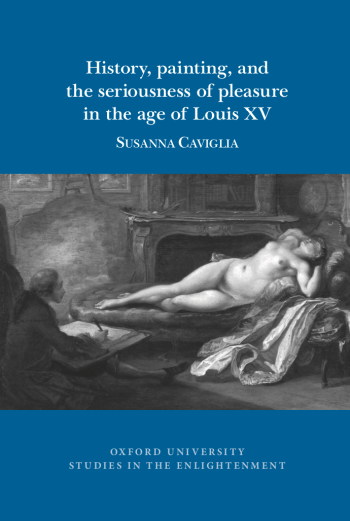 French painting of Louis XV’s reign (1715–74), generally categorized by the term rococo, has typically been understood as an artistic style aimed at furnishing courtly society with delightful images of its own frivolous pursuits. Instead, this book shows the significance and seriousness underpinning the notion of pleasure embedded in eighteenth-century history painting. During this time, pleasure became a moral ideal grounded not only in domestic life but also defining a range of social, political, and cultural transactions oriented toward transforming and improving society at large. History, Painting, and the Seriousness of Pleasure in the Age of Louis XV reconsiders the role of history painting in creating a new visual language that presented peace and happiness as an individual’s natural rights in the aftermath of Louis XIV’s bellicose reign (1643–1715). In this new study, Susanna Caviglia reinvestigates the artistic practices of an entire generation of painters born around 1700 (e.g. Francois Boucher, Charles-Joseph Natoire, and Carle Vanloo) in order to highlight the cultural forces at work within their now iconic images.
Susanna Caviglia is the Andrew W. Mellon Assistant Professor of Art, Art History & Visual Studies at Duke University. Her work focuses on early modern European art and culture with an emphasis on France and Italy. Her interests include the body in art, theory and practice of drawing, and cross-cultural relationships within the Mediterranean world. She is the author of Charles-Joseph Natoire (1700–1777) (Arthena, 2012).
C O N T E N T S
List of illustrations
Acknowledgments
Introduction
• Historical perspective: The peaceable kingdom of Louis XV
• The painters
• Toward a new artistic idiom
I. Historia in stasis
Chapter 1: The action de repos
• Prolegomena to the theory and practice
• Meditation, contemplation
• The dynamic body suspended
• Narrative disrupted
• Moments in the present and the future
Chapter 2: Corporeality and repose
• Fontenelle’s ideal
• Corporeal conversations
• Figures of seduction
• The expression of repose
• From narrative representation to figural presentation
II. The figure in artistic practice
Chapter 3: Figure/study/artwork
• Copying the figure
• The whole and the part
• The emergence of corporeal repose
• The new body language
Chapter 4: The story beyond the figure
• From study to subject
• Autonomous figures in painting
• Repertoires of models
• Life study and historical subject
III. The fabrication of a new grand genre
5: Before the painting
• The figure: From the idea to the painting
• The emergence of new creative practices
• The single body and the multiplication of bodies
• The figure: From reuse to quotation
Epilogue: On novelty in painting
• Brand new beauties
• The painting of the present
Bibliography
Index
◊ ◊ ◊ ◊ ◊
Note (added 19 March 2020) — The original posting included only an abbreviated table of contents.
Art Market | The Bachofen von Echt Ukiyo-e Collection
Scheduled to correspond with New York Asia Week, exhibitions like this one at Scholten Japanese Art may still be on view this week, though the auctions have been postponed until June, as noted by The Art Newspaper (also see this press release, published at Art Daily on 17 March). . .
The Baron J. Bachofen von Echt Collection of Golden Age Ukiyo-e
Scholten Japanese Art, New York, 12–21 March 2020
Scholten Japanese Art is pleased to participate in Asia Week 2020 with an extraordinary offering of Japanese woodblock prints: The Baron J. Bachofen von Echt Collection of Golden Age Ukiyo-e. The collection is comprised of a highly selective group of twenty-two figural woodblock prints produced during a period considered the highpoint of the genre, known as the ‘golden age’ of ukiyo-e, reaching its peak in the last decade of the 18th century. The prints depict bijin-ga (literally ‘beautiful person’), the influencers of their time—famous courtesans, waitresses, and beloved actors—with works by the most acclaimed ukiyo-e artists of the late 18th and early 19th century. There are works in this collection that are possibly unique, or one of only a handful of recorded examples, with connections to some of the most prominent early collectors and dealers of ukiyo-e. In many cases, these are the only examples still remaining outside of museum collections.

Kitao Shigemasa, Geisha and Maid Carrying a Shamisen Box, unsigned, with seal Hayashi Tadamasa, ca. 1777.
The term ukiyo (literally ‘floating world’) references an older Buddhist concept regarding the impermanence of life, but during the prosperity of the Edo Period in Japan the term began to be used to encompass and embolden everyday indulgences because of that impermanence. One of the tangible records of those indulgences was the production of nishiki-e (literally ‘brocade pictures’), the full-color prints that we recognize today as ukiyo-e—images of the floating world celebrating youth and beauty, which began in ca. 1765. After the advent of full-color woodblock printing, the market for nishiki-e, accessible to everyday people, steadily grew, and the materials and methods used to create this art rapidly evolved. A significant change that came about in the 1770s was that the craftsmen involved with production developed techniques for full-color printing on larger sheets of paper, and, as a result, this led to the general adoption of the standard ‘oban’ (approximately 15 by 10 inches) size by publishers. Larger paper was followed by an increase of the scale of the figures within compositions. An excellent example of this is the earliest print in the group, a ca. 1777 design by Kitao Shigemasa (ca. 1739–1820), Geisha and Maid Carrying a Shamisen Box (15 by 10 1/8 inches). Shigemasa was primarily a designer of illustrated books, producing over 250 in his lifetime, many of which were erotic in nature. With a comparatively small output of single sheet designs, the scarcity of extant Shigemasa prints belies his talent and influence on the genre. He worked with over twenty publishers, often with the innovative Tsutaya Juzaburo (1750–1797), whose impact looms large in the ‘golden age’ and likewise, in the Bachofen Collection. In 1774, the first book published by Tsutaya, Thousands at a Glance (Hitome senbon), featured illustrations by Shigemasa. Approximately three years later Tsutaya published an untitled series depicting full-length images of geisha of which this is a part.

Eishosai Choki, Woman and Servant in Snow (Sechu sho shiki jo), this impression unsigned and without censor or publisher seals, published by Tsutaya Juzaburo, ca. 1790.
One of the finest prints included in this show, Woman and Servant in Snow, ca. 1790 (14 1/2 by 10 inches), is by an artist whose work is particularly rare to the market: Eishosai Choki (fl. ca. 1780–1809). Also published by Tsutaya Juzaburo, the print demonstrates one of the hallmarks of golden age prints—the introduction of lavish printing techniques such as mica ground printing. The print is from an untitled group of four portraits of beauties presented in a dramatic outdoor setting that are among the most reproduced and coveted works in all of the ukiyo-e genre. The designs are distinctive in the way that Choki positions the figure off to the side, roughly occupying only two-thirds of the composition. In this print we see a beauty pausing beneath an open umbrella which shields her from the fat flakes of falling snow, shimmering (or shivering) against a cold mica background. She leans on the back of her burly servant who is bending over, reaching beyond the frame of the composition to clean the clumps of heavy wet snow off of her geta. Although they are a study in contrasts, she is lovely and delicate, he is solid with rough whiskers on his face, Choki conveys a sense of quiet intimacy shared between the two.
An example of a lavish printing is by Hosoda Eishi (1756–1829), Selection of Beauties from the Pleasure Quarters: Hanamurasaki of the Tamaya in Procession (15 by 10 inches), which utilizes both an incredibly dramatic dark mica background as well as metallic printing on the hem of the sauntering courtesan, Hanamurasaki. This design was formerly in the esteemed collection of the French connoisseur Henri Vever (1854–1942) and was the subject of extensive research by the American collector Louis V. Ledoux (1880–1948), who had a variant impression which he identified as a later state of the print. His research led him to conclude that there may have been four states of this scarce print, of which this (the Vever impression) is the earliest and (he thought) one of only three extant examples. Current research clarifies that this one is one of only two recorded impressions of the earliest version of the print.
Another development in print production was the issuance of multi-panel prints- most typically in the format of triptychs. One of the most stunning works in the show which shares the Vever Collection provenance is a triptych by a student of Eishi, Chokosai Eisho (fl. ca. 1795–1801) titled A Glimpse of the Ogiya: Hashidate, Nanakoshi and Hanabito (triptych 15 by 28 inches). This breath-taking composition presents three beautiful women who are seated in a brothel reception room decorated with an elaborate painting of a peacock covering the background wall. The three women are identified from right to left as the well-known and high-ranking courtesans: Hashidate, Nanakoshi, and Hanabito. The title places them at the Ogiya brothel located in the Yoshiwara. All three courtesans worked at the Ogiya and seem to be engrossed in a private conversation away from their customers. Perhaps they are sharing an amusing story related to the folded love letter which Hashidate is handing to Nanakoshi. There are few copies of this triptych extant and almost all are now in museum collections.
The bijin-ga of ukiyo-e were represented by beautiful women and beautiful men, and kabuki actors enjoyed celebrity-worship that would surely resonate with that of today. The Bachofen Collection includes three prints depicting kabuki actors, including a powerful bust-portrait by Utagawa Kunimasa (1773–1810), Actor Ichikawa Yaozo III as a Bandit (15 by 10 inches). This intense okubi-e portrait of Ichikawa Yaozo III (Suketakaya Takasuke II, 1747–1818) shows the actor in the role of a yamagatsu (lumberjack), who is actually a legendary warrior in disguise. The print was made at the time of Yaozo’s performance in a play that was staged at the Miyako-za theater in the 11th lunar month of 1796. The artist Kunimasa died at the young age of only 37 with approximately 125 recorded designs with few impressions extant. Of the four known examples of this print, this is the only one currently in private hands.
The Bachofen Collection has several highly important works by Kitagawa Utamaro (1753–1806), arguably the leading painting and print artist of his time who practically owned the market for images of beauties in the 1790s and early 1800s, until his untimely death in 1806 which marks the close of the ‘golden age’ period. In most ukiyo-e collections just one of these works would be the treasured highlight, in this collection there are nine Utamaro prints, including three okubi-e (‘big head’ or bust portraits) and one half-length portrait, each one a masterpiece in and of itself.
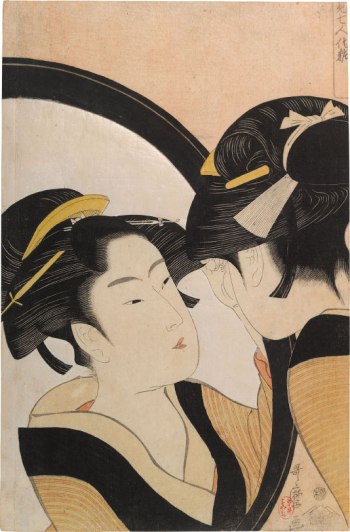
Kitagawa Utamaro, Seven Women Applying Make-up before a Full-length Mirror (Sugatami shichinin kesho), signed Utamaro ga with censor’s seal kiwame (approved) publisher’s mark of Tsutaya Juzaburo (Koshodo), sealed Wakai Hayashi, and oval WS (Schindler) collector’s seal on verso, ca. 1792–93. The title indicates this print is one from an intended series of seven, although only this one design is recorded.
The earliest Utamaro print in the exhibition is a compositional tour-de-force. Dated to around 1792–93, the print, Seven Women Applying Make-up Before a Full-length Mirror (14 1/4 by 9 1/2 inches), was issued at the beginning of a productive period for Utamaro during which he designed a number of ambitious half-length and bust portrait images of beauties primarily in collaboration with the publisher Tsutaya. The title in the bookmark-shaped cartouche indicates this print is one from an intended series of seven, although only this one design is recorded. While the term ‘sugatami’ in the title refers to a full-length mirror, the composition is that of a reflection of a bust portrait of a beauty as seen from over her shoulder. The effect is to both share her gaze into the mirror, while simultaneously appreciating her coiffure from behind as well as a titillating view of her erikubi (the nape of her neck). Her facial features and the crest on her kimono suggest that this is a portrait of one of Utamaro’s favorite subjects, the teahouse waitress Naniwa Okita. Tsutaya spared no expense with this production, generously embellishing the print with mica both on the background and on the mirror. The red seal to the left of the signature sheds light on the print’s provenance of having been in the hands of Wakai Kenzaburo (1834–1908), a highly influential Japanese art dealer and collector who was vital to the formation of ukiyo-e collections in Paris in the 1870s and 1880s. Wakai’s seal confirms that this exact impression was illustrated in Dr. Julius Kurth’s 1907 monograph on Utamaro (the first in a European language) when it was in the hands of Rex & Co in Berlin, an early importer of Asian art; it then passed into the hands of Werner Schindler (1905–1986) of Bienne, Switzerland. Highlights from the Schindler Collection were exhibited in several cities in Japan in 1985, and this print was illustrated on the cover of the exhibition catalogue.
In about 1792–93, the publisher Tsutaya began producing print series by Utamaro depicting half-length portraits of beauties with glittering full-mica backgrounds. These lavish images elevated print production to new aesthetic heights, establishing both Utamaro and Tsutaya as pre-eminent ukiyo-e artist and publisher, respectively. The portrait of Wakaume of the Tamaya in Edo-machi itchome, kamuro Mumeno and Iroka (14 1/2 by 9 5/8 inches) is dated to around 1793–94 and is associated with a group of three portraits that were likely intended as an informal triptych, each featuring a courtesan identified in the title cartouche with her house and naming her two kamuro (child attendants) with an accompanying kyoka poem. Of the three designs, this composition functions best at the central panel because the figure’s body faces one way while she turns to look in the opposite direction, and one of her kamuro peeks out from behind in a rare instance of frontal portraiture. The courtesan is Wakaume of the zashiki-mochi (‘having her own suite’) rank of the Tamaya house, and two kamuro, Mumeno and Iroka, are mentioned in the cartouche along with a poem playing on the literal meaning of her name, Wakaume, or White Plum.
The ca. 1795–96 bust portrait, Painting the Eyebrows (15 by 10 inches), is another masterpiece by Utamaro included in this group. It depicts a beauty leaning forward in concentration while applying make-up to her eyebrows. We catch a glimpse of her reflection from another angle in her hand-mirror, which is highlighted with mica to suggest the polished surface. This print was produced by a rather small publishing house, Isemago, about whom very little is known, which may explain why this design is extremely scarce. Of the three recorded impressions of this design, this is the only one currently in private hands.
The final Utamaro okubi-e in the exhibition is a delightful portrait of the famous courtesan Komurasaki of the Tamaya House after a Bath (15 by 10 inches) from around 1797–99. The portrait is of the famous courtesan Komurasaki, who held the highest rank of yobidashi (‘on call’), which meant she only could be seen by making an appointment through a teahouse, the same rank as her ‘house sister’ Hanamurasaki featured in the full-length mica-ground print by Eishi. This print bears the collector’s seal of the artist Paul Blondeau (ca. 1860–1920) and was later in the collection of Charles Haviland (1839–1921), which was sold in Paris in 1922. This print is one of only two recorded impressions of this design.
The exhibition will feature twenty-two woodblock prints including works by major ukiyo-e artists such as: Kitao Shigemasa (1739–1820), Torii Kiyonaga (1752–1815), Katsukawa Shuncho (fl. ca. 1780–1795), Eishosai Choki (fl. ca. 1780–1809), Hosoda Eishi (1756–1829), Chokosai Eisho (fl. ca. 1795–1801), Chokyosai Eiri (fl. ca. 1795–1800), Ichirakutei Eisui (fl. ca. 1795–1803), Utagawa Toyokuni I (1769–1825), Katsukawa Shunei (1762–1819), and Kitagawa Utamaro (1753–1806).
Katherine Martin, Highlights of Japanese Printmaking: Part Six, The Baron J. Bachofen von Echt Collection of Golden Age Ukiyo-e (2020), $40.
◊ ◊ ◊ ◊ ◊
Note (added 17 March 2020)— The original posting did not include the link to the press release posted at Art Daily.
Print Quarterly, March 2020
The eighteenth century in the current issue of Print Quarterly:
Print Quarterly 37.1 (March 2020)

Antoine Trouvain and Pierre Lepautre after Bon Boullogne, Thesis Print of François Bourgarel for Mathematics, 1695, engraving, top 336 x 540 mm, bottom 462 x 540 mm (Paris, Bibliothèque Nationale de France).
N O T E S A N D R E V I E W S
• John Roger Paas, Review of Simon Turner, ed., The New Hollstein German Engravings, Etchings, and Woodcuts, 1400–1700: Johann Stridbeck the Elder and the Younger, compiled by Dieter Beaujean and based on the research material of Josef H. Biller, parts 1–4 (Ouderkerk aan den IJssel: Sound & Vision Publishers, 2018), pp. 72–73.
The fact that artists are prolific and find a market in their lifetime is no guarantee that their work will enjoy critical acclaim in the long run or be avidly sought after by collectors. Such is the case of the Stridbecks, Johann the Elder (1641–1716) and Johann the Younger (1666–1714), Augsburg printmakers active from the late seventeenth century to the second decade of the eighteenth. . . . [But] their prints help to give us a deeper understanding of the print market and of public taste at the time, and we are fortunate that the more than a thousand prints of the Stridbecks have now been carefully collected and catalogued.
• Louis Marchesano, Review of Véronique Meyer, Pour la plus grand gloire du roi: Louis XIV en theses (Rennes: Presses Universitaires de Rennes, 2017), pp. 73–75.
This book provides an insightful account of the thesis print phenomenon by focusing on prints dedicated to the French king. It explores the function of these prints in the candidate’s life at university and outside, the production, reception and diffusion of the sheets and analyses the king’s image and its evolution in the period from his birth in 1638 to his death in 1715.
• Niklas Leverenz, “Isidore-Stanislas Helman and J. Pélicier,” pp. 75–76.
This short note focuses on a recently discovered signature of J. Pélicier on the proof state of a 1787 print previously attributed to Isidore-Stanislas Helman (1742–1809). This evidence suggests that Helman must have relied on a team of etchers for his large body of work, unusually allowing some of them to put their name on the plates.
P U B L I C A T I O N S R E C E I V E D
• Who is Who Chez les Colbert? La collection d’estampes de Joseph de Colbert, exhibition catalogue (Sceaux: Musée du Domaine départemental de Sceaux / Ghent: Éditions Snoeck, 2019), p. 96.
• Sandra Pisot, ed., Goya, Fragonard, Tiepolo: Die Freiheit der Malerei, exhibition catalogue (Hamburg: Hamburger Kunsthalle / Munich: Hirmer Verlag, 2019), p. 96.
• Laurent Baridon, Jean-Philippe Garric, and Martial Guédron, eds., Jean-Jacques Lequeu: Bâtisseur des Fantasmes, exhibition catalogue (Paris: Petit Palais, Bibliothèque Nationale de France / Éditions Norma, 2018), p. 97.

J. Pélicier, Emperor Qianlong Welcoming the Elderly Citizens of his Empire for a Celebration in their Honour, 1787, etching, 303 x 428 mm (Private Collection).
Book Launch | The Art of the Jewish Family
This month at BGC:
Book Launch—Laura Leibman, The Art of the Jewish Family
Bard Graduate Center, New York, 23 March 2020, 6:00–7:30pm
Author Laura Leibman in conversation with Jonathan Sarna and Barbara Kirshenblatt-Gimblett, moderated by Dean Peter N. Miller, to celebrate the publication of The Art of the Jewish Family: A History of Women in Early New York in Five Objects.
Laura Arnold Leibman, The Art of the Jewish Family: A History of Women in Early New York in Five Objects (Chicago: The University of Chicago Press, 2020), 350 pages, ISBN: 978-1941792209, $35.
 In order to rethink early Jewish American women’s lives, The Art of the Jewish Family examines five objects owned by Jewish women who lived at least a portion of their lives in early New York between 1750 and 1850. Each chapter creates a biography of a single woman through her object, but also uses her story to shed light on larger changes in Jewish American women’s lives. The women Leibman discusses are diverse: some rich, some poor; some Sephardi, some Ashkenazi; some born enslaved, and some who were slave owners themselves. In creating these biographies, Leibman proposes a new methodology for early American Jewish women’s history, one which could be applied to other areas in Jewish history for which records on women are sparse. This method looks at both material objects and fragmentation as important evidence for understanding the past. What social and religious structures, Leibman asks, caused early Jewish women to disappear from the archives?
The objects she considers span the 1750s through the 1850s. They are (1) a letter written in 1761 by an impoverished Hannah Louzada requesting assistance from Congregation Shearith Israel; (2) a famous set of silver cups owned by Reyna Levy Moses (1753–1824); (3) a beautiful ivory miniature of Sarah Brandon Moses (1798–1829), who was born enslaved in Barbados but became one of the wealthiest Jewish women in New York; (4) a commonplace book created by Sarah Ann Hays Mordecai (1805–1894); and (5) a family silhouette of Rebbetzin Jane Symons Isaacs (1823–1884) and her young brood.
Looking past texts to material culture, Leibman expands our ability to understand early Jewish American women’s lives and restores some of their agency as creators of Jewish identity. While the vast majority of early American texts about Jewish women were written by men with men as the primary intended audience, objects made for and by Jewish women help us consider women as consumers and creators of identity. Everyday objects provide windows into those women’s daily lives, highlighting what they themselves valued, how they wanted their contemporaries to see and understand them, and how they passed identity on to their children and grandchildren.
Laura Arnold Leibman is professor of English and humanities at Reed College.
Art of the Jewish Family is published in Cultural Histories of the Material World, a series dedicated to publishing monographs, works in translation, and collective project volumes that mark out the frontiers of BGC’s knowledge map. All books derived from the Leon Levy Foundation lectures in Jewish Material Culture will be published in this series.
New Book | The Pocket: A Hidden History of Women’s Lives
The book appeared last summer in hardback and is already sold out; a paperback is scheduled for release in the coming months from Yale UP.
Barbara Burman and Ariane Fennetaux, The Pocket: A Hidden History of Women’s Lives, 1660–1900 (New Haven: Yale University Press, 2020), 264 pages, ISBN: 978-0300253740 (paperback), $25.
 Pencils, a sketchbook, cake, yards of stolen ribbon, thimbles, snuff boxes, a picture of a lover, two live ducks: these are just some of the fascinating things carried by women and girls in their tie-on pockets, an essential accessory throughout the 18th and 19th centuries.
This first book-length study of the tie-on pocket combines materiality and gender to provide new insight into the social history of women’s everyday lives—from duchesses and country gentry to prostitutes and washerwomen—and explore their consumption practices, work, sociability, mobility, privacy, and identity. The authors draw on an unprecedented study of surviving pockets in museums and private collections to identify their materials, techniques, and decoration; their use is investigated through sources as diverse as criminal trials, letters, diaries, inventories, novels, and advertisements. Richly illustrated with paintings, satirical prints, and photographs of artifacts in detail, this innovative book reveals the unexpected story of these deeply evocative and personal objects.
Barbara Burman is an independent scholar, and Ariane Fennetaux is associate professor of 18th-century British history at the Université Paris Diderot.
Journal for Eighteenth-Century Studies, March 2020
In the latest issue of the Journal for Eighteenth-Century Studies:
Journal for Eighteenth-Century Studies 43.1 (March 2020).
 A R T I C L E S
• Amanda Vickery, “Branding Angelica: Reputation Management in Late Eighteenth‐Century England,” 3–24.
• Alberto del Campo Tejedor, “The Barber of Enlightened Spain: On the Politics and Practice of Grooming a Modern Nation,” pp. 25–42.
• Ana Sáez‐Hidalgo, “Anglo‐Spanish Enlightenment: Joseph Shepherd, an English ‘ilustrado’ in Valladolid,” pp. 46–60.
• Robert W. Jones, “Elizabeth Sheridan’s Post‐Celebrity,” pp. 61–78.
• Jonathan Taylor, “‘Who Bravely Fights, and Like Achilles Bleeds’: The Ideal of the Front‐Line Soldier during the Long Eighteenth Century,” pp. 79–100.
E D I T E D M A N U S C R I P T S
• Jessica Wen Hui Lim, “Barbauld’s Lessons: The Conversational Primer in Late Eighteenth‐Century British Children’s Literature,” 101–20.
R E V I E W S
• Madeleine Pelling, Review of Susanna Avery‐Quash and Kate Retford, eds., The Georgian London Town House: Building, Collecting and Display, pp. 121–22.
• Megan Kitching, Review of Keith Michael Baker and Jenna Gibbs, eds., Life Forms in the Thinking of the Long Eighteenth Century, pp. 122–24.
• Charlotte Fletcher, Review of Barbara Burman and Ariane Fennetaux, The Pocket: A Hidden History of Women’s Lives, 1660–1900, pp. 124–25.
• Hannah Hutchings‐Georgiou, Review of Andrew Carpenter, ed., The Poems of Olivia Elder, pp. 125–26.
• Thomas Lalevée, Review of Gabriel Galice and Christophe Miqueu, eds., Rousseau, la république, la paix: actes du colloque du GIPRI (Grand‐Saconnex, 2012), pp. 126–28.
• Helen Metcalfe, Review of Sally Holloway, The Game of Love in Georgian England: Courtship, Emotions, and Material Culture, pp. 128–29.
• Olive Baldwin Thelma Wilson, Review of Berta Joncus, Kitty Clive, or The Fair Songster, pp. 129–31.
• Joachim Whaley, Review of Claudia Keller, Lebendiger Abglanz: Goethes Italien‐Projekt als Kulturanalyse, pp. 131–32.
• Ben Wilkinson‐Turnbull, Review of A. C. Elias, John Irwin Fischer, and Panthea Reid, eds., Jonathan Swift’s Word‐Book: A Vocabulary Compiled for Esther Johnson and Copied in Her Own Hand, pp. 132–33.
• Max Skjönsberg, Review of Margaret Watkins, The Philosophical Progress of Hume’s Essays, pp. 133–35.
Exhibition | Angelica Kauffman
Now on view at the Kunstpalast and coming to London’s RA in June:
Angelica Kauffman: Artist, Superwoman, Influencer
Kunstpalast, Düsseldorf, 30 January — 24 May 2020
Royal Academy of Arts, London, 28 June — 20 September 2020
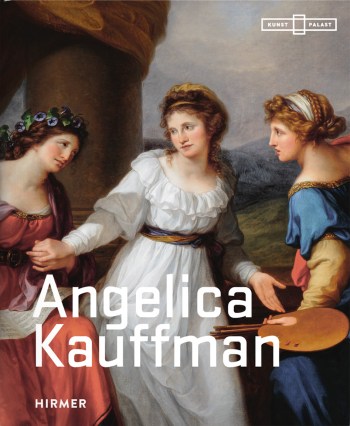 Angelica Kauffman was a founding member of the Royal Academy and an artist who defied convention. In this major exhibition we trace her trajectory from child prodigy to one of the most sought-after painters of her time. Born in Switzerland in 1741, Angelica Kauffman (1741–1807) was quickly recognised as a child prodigy, before receiving further artistic training in Italy. Arriving in London in 1766, she enjoyed an unprecedented career as a history painter and portraitist before moving to Rome in 1782, where her studio became a hub of the city’s cultural life. Kauffman’s career was unusual for a female artist in the late 18th and early 19th century. A highly acclaimed portraitist, she identified herself primarily as a history painter, working for patrons across Britain and the continent, including Catherine the Great amongst others. This exhibition will focus on Kauffman’s work at the height of her career, tracing the life and work of this celebrated artist.
The catalogue is published by Hirmer and distributed in North America by The University of Chicago Press:
Bettina Baumgärtel, ed., with contributions by B. Baumgärtel, I. M. Holubec, J. Myssok, and H. Valentine, Angelica Kauffman (Munich: Hirmer Publishers, 2020), 208 pages, ISBN: 978-3777434629, £35 / $45.










 Enfilade
leave a comment