New Book | Where Caciques and Mapmakers Met
From UNC Press:
Jeffrey Alan Erbig, Where Caciques and Mapmakers Met: Border Making in Eighteenth-Century South America (Chapel Hill: The University of North Carolina Press, 2020), 280 pages, ISBN: 978-1469655055 (ebook), $20 / ISBN: 978-1469655048 (paperback), $25 / ISBN: 978-1469655031 (hardcover), $90.
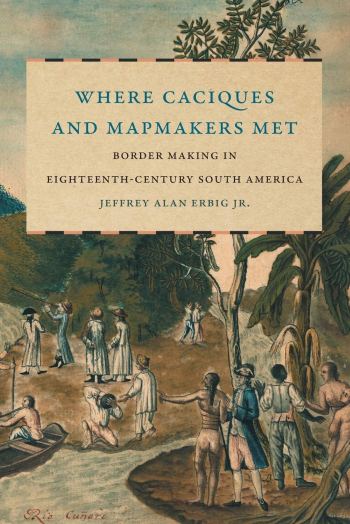 During the late eighteenth century, Portugal and Spain sent joint mapping expeditions to draw a nearly 10,000-mile border between Brazil and Spanish South America. These boundary commissions were the largest ever sent to the Americas and coincided with broader imperial reforms enacted throughout the hemisphere. Where Caciques and Mapmakers Met considers what these efforts meant to Indigenous peoples whose lands the border crossed. Moving beyond common frameworks that assess mapped borders strictly via colonial law or Native sovereignty, it examines the interplay between imperial and Indigenous spatial imaginaries. What results is an intricate spatial history of border making in southeastern South America (present-day Argentina, Brazil, and Uruguay) with global implications.
Drawing upon manuscripts from over two dozen archives in seven countries, Jeffrey Erbig traces on-the-ground interactions between Ibero-American colonists, Jesuit and Guaraní mission-dwellers, and autonomous Indigenous peoples as they responded to ever-changing notions of territorial possession. It reveals that Native agents shaped when and where the border was drawn, and fused it to their own territorial claims. While mapmakers’ assertions of Indigenous disappearance or subjugation shaped historiographical imaginations thereafter, Erbig reveals that the formation of a border was contingent upon Native engagement and authority.
Published with support provided by the William P. Clements Center for Southwest Studies at Southern Methodist University in Dallas, Texas.
Jeffrey Alan Erbig Jr. is assistant professor of Latin American and Latino studies at the University of California, Santa Cruz.
C O N T E N T S
List of Figures, Maps, and Tables
Acknowledgments
Abbreviations
Introduction
1 An Archipelago of Settlements and Tolderías
2 Projecting Possession
3 Mapping the Tolderías’ Mansion
4 Simultaneous Sovereignties
5 Where the Lines End
Conclusion
Notes
Bibliography
Exhibition | François Boucher: Rococo Artist

François Boucher, Shepherd and Shepherdess, 1760, oil on canvas, 81 × 65 cm
(Staatliche Kunsthalle Karlsruhe)
◊ ◊ ◊ ◊ ◊
Opening next month at the Staatliche Kunsthalle:
François Boucher: Künstler des Rokoko / Artiste Rococo
Staatliche Kunsthalle Karlsruhe, 14 November 2020 — 7 February 2021
François Boucher (1703–1770) est encore considéré de nos jours comme l’artiste rococo français par excellence. À l’occasion du 250e anniversaire de sa mort, la Kunsthalle de Karlsruhe présente la première exposition en Allemagne qui lui soit exclusivement consacrée.
 Bien que né dans un milieu modeste, Boucher s’est affirmé comme l’un des principaux artistes de son époque. Premier peintre du roi, il comptait parmi ses commanditaires la marquise de Pompadour ainsi que la margravine Caroline-Louise de Bade. Son style rayonna dans toute l’Europe et ses compositions furent reprises pour un grand nombre de tapisseries et de décors de théâtre, de meubles et de porcelaines.
La diversité des styles qu’il aborda et des sujets qu’il traita reste impressionnante jusqu’à l’heure actuelle. Ses élégantes scènes de genre ainsi que les représentations qu’il a données de paysages bucoliques et de sujets mythologiques se distinguent par leur inventivité, leur humour et l’ironie qui s’en dégage. Par leur exécution subtile et leur palette délicate, ses œuvres nous sensibilisent à la sensualité pouvant irradier d’une toile.
Ses dessins et ébauches à l’huile illustrent parfaitement sa manière de travailler. Tantôt puissantes et virtuoses, tantôt empreintes de retenue et témoins d’une introspection, ces esquisses s’affirment comme desœuvres d’art à part entière.
Artiste fascinant, Boucher, a ainsi développé un style très riche dont l’influence est perceptible jusque dans l’art moderne – Un style que l’exposition de la Kunsthalle permettra de redécouvrir.
L’exposition se complète par une installation sonore d’Elina Lukijanova qui reproduit des éléments stylistiques du Rococo à l’aide de bruits et de mots de notre époque.
Astrid Reuter, ed., François Boucher: Künstler des Rokoko (Cologne: Wienand, 2020), 336 pages, ISBN: 978-3868325812, 45€. With essays by Astrid Reuter, Barbara Bauer, Alexander Eiling, Peter Fuhring, Holger Jacob-Friesen, Melissa Hyde, Oliver Jehle, Françoise Joulie, Alastair Laing, Hans Plechinski, Aileen Ribeiro, Dorit Schäfer, Martin Schieder, Perrin Stein, Christoph Martin Vogtherr, and Kirsten Voigt.
New Book | Lectures on Art: Selected Conférences, 1667–1772
From Getty Publications:
Christian Michel and Jacqueline Lichtenstein, eds., Lectures on Art: Selected Conférences from the Académie Royale de Peinture et de Sculpture, 1667–1772, translated by Chris Miller (Los Angeles: Getty Publishing, 2020), 488 pages, ISBN 978-1606066461, $75.
 Between 1667 and 1792, the artists and amateurs of the Académie Royale de Peinture et de Sculpture in Paris lectured on the Académie’s conférences, foundational documents in the theory and practice of art. These texts and the principles they embody guided artistic practice and art theory in France and throughout Europe for two centuries.
In the 1800s, the Académie’s influence waned, and few of the 388 Académie lectures were translated into English. Eminent scholars Christian Michel and Jacqueline Lichtenstein have selected and annotated forty-two of the most representative lectures, creating the first authoritative collection of the conférences for readers of English. Essential to understanding French art of the seventeenth and eighteenth centuries, these lectures reveal what leading French artists looked for in a painting or sculpture, the problems they sought to resolve in their works, and how they viewed their own and others’ artistic practice.
Christian Michel is a professor of art history at the Université de Lausanne, a leading scholar of artistic production in seventeenth- and eighteenth-century Europe, and the author of many essays, articles, and books. Jacqueline Lichtenstein was a philosopher and art historian specializing in the history and criticism of art and aesthetics. She taught at the University of Paris-IV-Sorbonne, the University of Paris- X Nanterre, the École du Louvre, and the University of California, Berkeley. Lichtenstein died in 2019. Chris Miller is a widely published critic and translator, co-founder of the Oxford Amnesty Lectures, and author of Forms of Transcendence: The Art of Roger Wagner (2009).
New Book | Freemasonry and the Visual Arts
From Routledge:
Reva Wolf and Alisa Luxenberg, eds., Freemasonry and the Visual Arts from the Eighteenth Century Forward: Historical and Global Perspectives (London: Bloomsbury Visual Arts, 2020), 304 pages, ISBN: 978-1501337963 (hardback), $120 / ISBN: 978-1501366925 (paperback), $35.
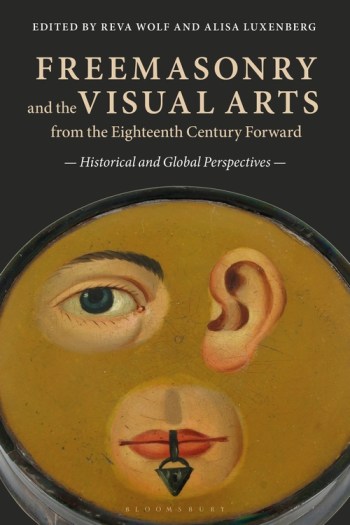 With the dramatic rise of Freemasonry in the eighteenth century, art played a fundamental role in its practice, rhetoric, and global dissemination, while Freemasonry, in turn, directly influenced developments in art. This mutually enhancing relationship has only recently begun to receive its due. The vilification of Masons, and their own secretive practices, have hampered critical study and interpretation. As perceptions change, and as masonic archives and institutions begin opening to the public, the time is ripe for a fresh consideration of the interconnections between Freemasonry and the visual arts. This volume offers diverse approaches, and explores the challenges inherent to the subject, through a series of eye-opening case studies that reveal new dimensions of well-known artists such as Francisco de Goya and John Singleton Copley, and important collectors and entrepreneurs, including Arturo Alfonso Schomburg and Baron Taylor. Individual essays take readers to various countries within Europe and to America, Iran, India, and Haiti. The kinds of art analyzed are remarkably wide-ranging-porcelain, architecture, posters, prints, photography, painting, sculpture, metalwork, and more-and offer a clear picture of the international scope of the relationships between Freemasonry and art and their significance for the history of modern social life, politics, and spiritual practices. In examining this topic broadly yet deeply, Freemasonry and the Visual Arts sets a standard for serious study of the subject and suggests new avenues of investigation in this fascinating emerging field.
Reva Wolf is Professor of Art History, State University of New York at New Paltz. Alisa Luxenberg is Professor of Art History, University of Georgia.
C O N T E N T S
Acknowledgments
List of illustrations
Reva Wolf and Alisa Luxenberg, Introduction: The Mystery of Masonry Brought to Light
1 David Martín López, Freemasonry in Eighteenth-Century Portugal and the Architectural Projects of the Marquis of Pombal
2 Cordula Bischoff, The Order of the Pug and Meissen Porcelain: Myth and History
3 Reva Wolf, Goya and Freemasonry: Travels, Letters, Friends
4 David Bjelajac, Freemasonry’s ‘Living Stones’ and the Boston Portraiture of John Singleton Copley
5 Nan Wolverton, The Visual Arts of Freemasonry as Practiced ‘Within the Compass of Good Citizens’ by Paul Revere
6 Alisa Luxenberg, Building Codes for Masonic Viewers in Baron Taylor’s Voyages pittoresques et romantiques dans l’ancienne France
7 Talinn Grigor, Freemasonry and the Architecture of the Persian Revival, 1843–1933
8 William D. Moore, Solomon’s Temple in America: Masonic Architecture, Biblical Imagery, and Popular Culture, 1865–1930
9 Martin Cherry, Freemasonry and the Art Workers’ Guild: The Arts Lodge No. 2751, 1899–1935
10 Cheryl Finley and Deborah Willis, Picturing Black Freemasons from Emancipation to the 1990s
11 Katherine Smith, Saint Jean Baptiste, Haitian Vodou, and the Masonic Imaginary
Selected Bibliography
Index
New Book | Humphry Repton: Landscape Design in an Age of Revolution
From Reaktion Books and the University of Chicago Press:
Tom Williamson, Humphry Repton: Landscape Design in an Age of Revolution (London: Reaktion Books, 2020), 352 pages, ISBN: 978-1789142990, £35 / $50.
 Humphry Repton (1752–1818) remains one of England’s most interesting and prolific garden and landscape designers. Renowned for his innovative design proposals and distinctive before-and-after images, captured in his famous ‘Red Books’, Repton’s astonishing career represents the link between the simple parklands of his predecessor Capability Brown and the more elaborate, structured, and formal landscapes of the Victorian age. This lavishly illustrated book, based on a wealth of new research, reinterprets Repton’s life, working methods, and designs, and examines why they proved so popular in a rapidly changing world.
Tom Williamson is professor of landscape history at the University of East Anglia.
C O N T E N T S
Introducing Humphry Repton
1 Before Repton
2 The Shape of a Career
3 Repton in Business: Working Methods
4 The Public Landscape: ‘Character’ and ‘Appropriation’
5 Domesticity and ‘Cheerfulness’
6 Shaping Style: Influences, Contemporaries, Social Change
Epilogue: Repton’s Legacy
References
Bibliography
Acknowledgements
Photo Acknowledgements
Index
New Book | Goya: A Portrait of the Artist
From Princeton UP:
Janis Tomlinson, Goya: A Portrait of the Artist (Princeton: Princeton University Press, 2020), 448 pages, ISBN: 978-0691192048, $35 / £30.
 The life of Francisco Goya (1746–1828) coincided with an age of transformation in Spanish history that brought upheavals in the country’s politics and at the court which Goya served, changes in society, the devastation of the Iberian Peninsula in the war against Napoleon, and an ensuing period of political instability. In this revelatory biography, Janis Tomlinson draws on a wide range of documents—including letters, court papers, and a sketchbook used by Goya in the early years of his career—to provide a nuanced portrait of a complex and multifaceted painter and printmaker, whose art is synonymous with compelling images of the people, events, and social revolution that defined his life and era.
Tomlinson challenges the popular image of the artist as an isolated figure obsessed with darkness and death, showing how Goya’s likeability and ambition contributed to his success at court, and offering new perspectives on his youth, rich family life, extensive travels, and lifelong friendships. She explores the full breadth of his imagery—from scenes inspired by life in Madrid to visions of worlds without reason, from royal portraits to the atrocities of war. She sheds light on the artist’s personal trials, including the deaths of six children and the onset of deafness in middle age, but also reconsiders the conventional interpretation of Goya’s late years as a period of disillusion, viewing them instead as years of liberated artistic invention, most famously in the murals on the walls of his country house, popularly known as the ‘black’ paintings.
A monumental achievement, Goya: A Portrait of the Artist is the definitive biography of an artist whose faith in his art and his genius inspired paintings, drawings, prints, and frescoes that continue to captivate, challenge, and surprise us two centuries later.
Janis A. Tomlinson has written and lectured extensively on the art of Goya. Her books include Goya: Order and Disorder, Goya: Images of Women, Goya in the Twilight of Enlightenment, and Francisco Goya: The Tapestry Cartoons and Early Career at the Court of Madrid.
Exhibition | The Torlonia Marbles
Notice of the exhibition appeared here at Enfilade last November; here’s the updated information; the catalogue is published by Electa.
The Torlonia Marbles: Collecting Masterpieces
I Marmi Torlonia: Collezionare Capolavori
Musei Capitolini at Palazzo Caffarelli, Rome, 14 October 2020 — 29 June 2021
Curated by Carlo Gasparri and Salvatore Settis
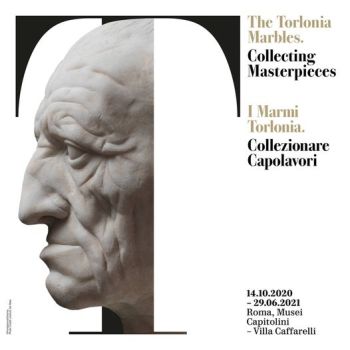 The Torlonia Marbles: Collecting Masterpieces presents 96 works selected from the 620 cataloged marbles belonging to the Torlonia Collection, the prestigious private collection of ancient sculptures, significant for the history of art, excavations, restoration, taste, museography, and archaeological studies. The exhibition is organized in five sections, telling the story of the collecting of ancient Greek and Roman marbles in reverse chronology beginning with the founding of the Torlonia Museum in 1875 by Prince Alexander Torlonia. The second section brings together the nineteenth-century finds of antiquity in the Torlonia properties. The next section addresses eighteenth-century collecting, with sculptures from the acquisitions of Villa Albani and the collection of the sculptor and restorer Bartolomeo Cavaceppi. A selection of sculptures owned by Vincenzo Giustiniani, one of the most sophisticated Roman collectors of the seventeenth century then follows, with the final section presenting pieces from collections of aristocratic families of the fifteenth and sixteenth centuries.
New Book | Fragonard: Painting Out of Time
From Reaktion Books and the University of Chicago Press:
Satish Padiyar, Fragonard: Painting Out of Time (London: Reaktion Books, 2020), 248 pages, ISBN: 978-1789142099, £35 / $55.
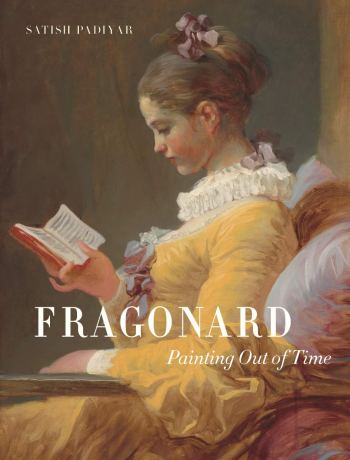 At the time of his death in 1806, the rococo artist Jean-Honoré Fragonard had not painted for two decades. Following a period of huge public success, the painter’s reputation fell. Fragonard: Painting Out of Time takes this prolonged artistic silence as a point of departure to investigate the maverick personality of Fragonard within the lively society of eighteenth-century France. Personally secretive, Fragonard nevertheless created revealing images that undermined a normal sense of space and time. Satish Padiyar investigates the life and work of the last of the libertine painters of the ancien regime, a contemporary of Denis Diderot and Jean-Jacques Rousseau, and presents dramatic new perspectives on works such as The Progress of Love, painted for Madame du Barry, the infamous The Bolt, and the ever-popular The Swing.
Satish Padiyar is Honorary Research Fellow at The Courtauld Institute of Art. His previous publications include Chains: David, Canova, and the Fall of the Public Hero in Postrevolutionary France (2007).
C O N T E N T S
Introduction
1 Secrets
2 Surprise
3 Dreams
References
Select Biography
Acknowledgements
Photo Acknowledgements
Index
New Book | The Wig: A Hairbrained History
From Reaktion Books and the University of Chicago Press:
Luigi Amara, The Wig: A Hairbrained History, translated by Christina MacSweeney (London: Reaktion Books, 2020), 256 pages, ISBN: 978-1789143461, £15 / $23.
Whether in a court room or a dressing room, wigs come in many forms, and represent many things: from power, to sexuality, to parody, to health, to self-identity, to disguise. Wigs are present at parties and in chemotherapy rooms, in pop music and contemporary art. In this witty and eloquent book, Luigi Amara reflects on the curious history of the wig, and along the way takes a sideways look at Western civilization. Amara illuminates how the wig has starred throughout history, from ancient Egypt to the court of Louis XIV, and from British courtrooms to drag shows today. Containing many striking and unusual images, the book appeals to a wide audience, from those interested in the history of fashion to philosophy, art, culture, and aesthetics.
Luigi Amara is the author of many poetry collections, essays, and children’s books, including Nu)n(ca, winner of the International Poetry Prize in Spanish, and The School of Boredom. He lives in Mexico City. Christina MacSweeney is an award-winning literary translator specializing in Latin American fiction.
 C O N T E N T S
An Otherworldly Prologue
A Theory of Disguise
Casanova, Wigs and Masks
The She-wolf of the Night: Messalina
The Rage Called Wig
Samson at the Roland-Garros
The Counter-philosophy of the Wig
The Future Was a Purple Wig
The Mannequin and the Dark Object of Desire
Andy Warhol’s Wig
The Hemisphere in a Wig
On the Other Side of the Mirror of Horror
Music Curls
Capillary Plagiarism
The Indiscreet Charm of Hair
On Remains and Other Relics
Dressing Up Justice
Towering Hairdos
Abbé de Choisy or the Inner Woman
Cindy Sherman in Simulationland
Death Will Come and Shall Be Wearing a Wig
A Bald Wig in Search of a Head
In and Out of the Theatre
Stony Hair
Wigs at the Extremes of Crime
On Nudity or Venus in a Wig
Reinvention by Hair
Devotional Hairstyles
The Chimeric Wig
That Old Camp Stridency
The Tangled Mop of Fetish
A Knife Named Guillotine
The Discourse of False Hair
Bedside Reading
Photo Acknowledgements
New Book | The Eternal City: A History of Rome in Maps
From the University of Chicago Press:
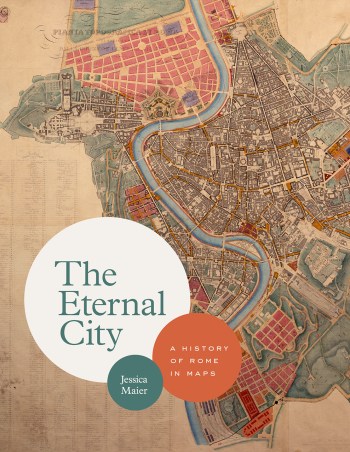
Jessica Maier, The Eternal City: A History of Rome in Maps (Chicago: University of Chicago Press, 2020), 240 pages, ISBN: 978-0226591452, $40.
One of the most visited places in the world, Rome attracts millions of tourists each year to walk its storied streets and see famous sites like the Colosseum, St. Peter’s Basilica, and the Trevi Fountain. Yet this ancient city’s allure is due as much to its rich, unbroken history as to its extraordinary array of landmarks. Countless incarnations and eras merge in the Roman cityscape. With a history spanning nearly three millennia, no other place can quite match the resilience and reinventions of the aptly nicknamed Eternal City.
In this unique and visually engaging book, Jessica Maier considers Rome through the eyes of mapmakers and artists who have managed to capture something of its essence over the centuries. Viewing the city as not one but ten ‘Romes’, she explores how the varying maps and art reflect each era’s key themes. Ranging from modest to magnificent, the images comprise singular aesthetic monuments like paintings and grand prints as well as more popular and practical items like mass-produced tourist plans, archaeological surveys, and digitizations. The most iconic and important images of the city appear alongside relatively obscure, unassuming items that have just as much to teach us about Rome’s past. Through 140 full-color images and thoughtful overviews of each era, Maier provides an accessible, comprehensive look at Rome’s many overlapping layers of history in this landmark volume.
The first English-language book to tell Rome’s rich story through its maps, The Eternal City beautifully captures the past, present, and future of one of the most famous and enduring places on the planet.
Jessica Maier is associate professor of art history at Mount Holyoke College. She is the author of Rome Measured and Imagined: Early Modern Maps of the Eternal City, also published by University of Chicago Press.
 C O N T E N T S
Introduction: Rome as Idea and Reality
Further Reading
1 Rome Takes Shape
Rome before Rome
A Walled City
Urban Districting
Further Reading
2 Rome of the Caesars
Destination Rome
An Incomplete Puzzle
Making Sense of the Shattered Past
Filling in the Gaps
A Model City
Further Reading
3 Rome of the Popes
Sacred Buildings and Secular Symbols
The Medieval Cityscape
Pathos and Wonder
Further Reading
4 Rome Reborn
A City Ready for Its Close-Up
The City Seen through a Wide-Angle Lens
The City Measured
A Panoramic View of Urban Revitalization
Further Reading
5 Rome of the Scholars
Archaeology in Its Infancy
An Ancient Roman Theme Park
A Ghostly Fantasy
Further Reading
6 Rome of the Saints and Pilgrims
The Way of the Faithful
Scenes from a Pilgrimage
A Pilgrimage Map for the Modern Era
Further Reading
7 Rome of the Grand Tourists
Rome as Theater
The Origins of the Tourist Plan
Rome Surveyed
A Panoramic Vision
Further Reading
8 Rome of the Mass Tourists
The Guidebook Impresario’s Rome
Rome for a Rather Important Woman Traveler
Rome in Your Pocket
Rome for Italian Tourists
Further Reading
9 Rome Enters the Modern Age
2,500 Years in, a Master Plan for Rome
When Trams Ruled Rome
An Olympic City, and a New Beginning
Further Reading
10 Rome Past, Present, and Future
Rapid Transit for a Rapidly Changing City
A Master Plan for the Third Millennium: (Un)sustainable Rome
Further Reading
Acknowledgments
Index










leave a comment