Exhibition | Fiji: Art & Life in the Pacific
Press release (19 November 2019) for the exhibition (noted previously here). . .
Fiji: Art & Life in the Pacific
Sainsbury Centre, Norwich, 15 October 2016 — 12 February 2017
Los Angeles County Museum of Art, 15 December 2019 — 19 July 2020
Peabody Essex Museum, Salem, Massachusetts, 12 September 2020 — 3 January 2021
Curated by Steven Hooper, Karen Jacobs, Katrina Igglesden, and Nancy Thomas

Double Portable Temple (bure kalou), Fiji, early 19th century; coir, wood, reed, and shells, 44 × 25 × 21 inches (Salem, Massachusetts: Peabody Essex Museum, gift of Joseph Winn Jr. in 1835, photo by Jeffrey Dykes).
The Los Angeles County Museum of Art presents Fiji: Art & Life in the Pacific, the first substantial project on the art of Fiji to be mounted in the U.S. The exhibition features over 280 artworks drawn from major international collections, including Fiji Museum, the British Museum, the Museum of Archaeology and Anthropology (Cambridge), the Smithsonian, and distinguished private collections. The exhibition includes figurative sculpture, ritual kava bowls, breastplates of pearl shell and whale ivory, large-scale barkcloths, small portable temples, weapons, and European watercolors and paintings. Additionally, Fiji: Art & Life in the Pacific showcases historical photographs from LACMA’s recently acquired Blackburn Collection, as well as a newly commissioned 26-foot double-hulled sailing canoe (drua) constructed in Fiji using traditional materials and techniques.
Fiji: Art & Life in the Pacific was organized and curated by Professor Steven Hooper, Dr. Karen Jacobs, and Ms. Katrina Igglesden at the Sainsbury Centre in Norwich, England, where it was on view October 15, 2016–February 12, 2017. The exhibition has been reformatted for the presentation at LACMA, with additional major loans from U.S. collections. The exhibition at LACMA is curated by Nancy Thomas, senior deputy director, art administration and collections at LACMA, with support from the organizing curators.
“LACMA is pleased to collaborate with Professor Steven Hooper and his colleagues from the Sainsbury Centre, Norwich,” said Nancy Thomas. “Research for the project was informed by over 40 years of collaboration with Indigenous Fijian and international scholars and support from the UK’s Arts & Humanities Research Council and the Fijian government, resulting in this deeply researched and comprehensive exhibition.”
Fiji: Art & Life in the Pacific is presented in the Lynda and Stewart Resnick Exhibition Pavilion, a major expansion of LACMA’s campus made possible through a landmark gift from trustee Lynda Resnick and Stewart Resnick, the philanthropists and entrepreneurs behind The Wonderful Company and FIJI Water. Since the Resnick Pavilion opened in 2010, its reconfigurable galleries have hosted nearly 50 significant exhibitions covering a diverse cross-section of art history. FIJI Water is the presenting sponsor of the exhibition.
“It’s an honor to be able to share the beauty of Fijian arts and culture through this stunning exhibition,” said LACMA CEO and Wallis Annenberg Director Michael Govan. “We’re pleased to present this show in the Resnick Pavilion, which has become the heart of LACMA’s campus. I’m deeply grateful to Lynda and Stewart for their commitment to bringing this important exhibition to the U.S., and for their incredible legacy benefiting the larger cultural community of Los Angeles.”
“Fiji holds a very special place in our hearts, and Stewart and I are gratified to support this exhibition,” said Lynda Resnick, vice chair and co-owner of The Wonderful Company. “It is our hope that these works from across the archipelago will help visitors fully appreciate the country’s magnificent culture.”
Following the presentation at LACMA, the exhibition will be on view at the Peabody Essex Museum in Salem, Massachusetts, from September 12, 2020 through January 3, 2021. FIJI Water is also presenting sponsor of the Peabody Essex Museum presentation. In addition, generous support from FIJI Water funded the construction of the drua and its transportation from Fiji to Los Angeles.
Consisting of an archipelago of more than 300 islands, Fiji’s landscape is rich, with fertile soils on most islands providing ample food crops and lagoons with extensive reef systems supplying fish and shellfish. The local environment produced the majority of materials represented in the exhibition, including a wide variety of timbers for housing, canoes, and weapons; plant materials for textiles, mats, roofing, ropes, and bindings; clay, bamboo, and coconuts for containers; and shells and other marine materials for adornments.
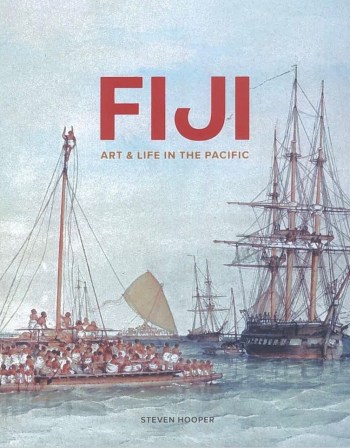 Fiji: Art & Life in the Pacific showcases the range and quality of these artworks from the past two centuries and highlights the skill and creative adaptability of the artists and craftspeople who made them. The exhibition presents these artworks in eight thematic sections, including: Voyaging, Fiber and Textile Arts, Warfare, Embodying the Ancestors, Adorning the Body, Chiefly Objects, Respecting the Ancestors, and Fiji Life. The later section illustrates 19th-century Fiji with 22 remarkable photographs including studio portraits, landscapes, architecture, and other features of daily life.
The first section, Voyaging, focuses on the role and implements of travel by sea. Nearly 3,000 years ago, explorers likely from the current region of Vanuatu, undertook a 500-mile voyage before settling in Fiji. Subsequent migrations took place, with voyagers settling on the two main islands Viti Levu and Vanua Levu, while others inhabited outer islands where canoe transport was essential. In the 18th century, immigrant Samoan and Tongan canoe builders working for Fijian chiefs introduced a new Micronesian-style rig which led to the development of massive double-hulled canoes in the 19th century, often measuring more than 100-feet long. Fast-moving canoes were used for regional transport and for fishing, while spears and nets were the main fishing methods in Fiji in the 19th century. In addition to fishing equipment, this section features a contemporary drua (double-hulled sailing canoe). Without a fixed bow or stern, drua can sail in either direction by adjusting the mast and sail. They provided open-ocean transport and troop transportation in times of warfare. The drua featured in LACMA’s exhibition was commissioned as a heritage project in Fiji to encourage the retention of canoe-building skills. It has no metal components and is made from local timber with coconut-husk-fiber lashings, shell decorations, and a pandanus-leaf matting sail.
Fiber and textile arts were and remain today a significant aspect of Fijian culture. Masi is the Fijian word for the paper mulberry tree as well as for the cloth made from its inner bark. To produce it, the bark is stripped from young tree saplings and the inner bark is separated and soaked in water. The bark is then beaten into thin sheets, layered and folded and joined to make cloths of any size. Masi can then be decorated by stenciling, rubbing, or painting. Large presentation cloths have been made for investitures, weddings, or state gifts. A striking three-piece barkcloth attire, an example of which is on view in this section, could be worn by both men and women on important ceremonial occasions. Other textile arts included elaborate woven mats, which could be used as prestige gifts; as well as rectangular baskets and fans which showed off virtuoso weaving techniques and served as popular exchange items.
Warfare was frequent in Fiji until the mid-19th century and the country continues to maintain a proud martial tradition. More than weapons, Fijian clubs and spears are ritual objects and expressions of supreme carving and military skill. The multiple clubs on view in this section represent the widest range of their design. A club or two was the expected accoutrement for active Fijian men, and pomp and display were important aspects of military action. Combat was traditionally preceded by vigorous parading, performance, and boasting.

Double Figure Hook, Fiji/Tonga, 18th to early 19th century; sperm whale ivory, fiber, and glass beads, 5 inches (Museum of Archaeology and Anthropology, University of Cambridge, collected by Sir Arthur Gordon, Viti Levu, 1876, 1955.247).
A section of the exhibition is dedicated to works embodying the ancestors. While it seems that figures were not worshipped as deities, they were kept in temples and shrines as embodiments of deified deceased individuals, usually ancestors. Figures from the 19th century are rare from Fiji, with just a few dozen examples, some preserved in Fiji Museum, Suva. There appear to be two basic figure types, standing figures with bases or pegs, and those incorporated into hooks used for suspending offerings. This section features one of only three known surviving double-figure hooks made of whale ivory, collected in 1876 by the first resident British governor of Fiji, Sir Arthur Gordon. Field reports refer to such hooks as “the most revered of all objects.”
Adorning the body was an aspect of Fijian ceremony and expression and included necklaces, pendants, and other precious wares. Key forms of personal ornament shown in this section are whale-ivory and pearl-shell breastplates, valued for their subtle design variations and alluring reflective and color properties, which were suited for chiefly wear. Fijians themselves did not hunt whales, but obtained teeth from sperm whales stranded on local reefs and beaches and from European traders in the 19th century. As a result, whale ivory was the basis for many other forms of ‘valuables’, retained or gifted at events or occasions of social exchange. Sperm whale teeth were sawn vertically and horizontally to produce thin “tusks” which were strung closely together to create striking necklaces.
The section on chiefly objects highlights the tabua, the most significant Fijian valuable. Made from a sperm whale tooth that had been oiled, smoked, polished, and fitted with a coconut-husk fiber cord, it is presented as a gift on important occasions. At such occasions, the donors and recipients hold the tabua in their hands and make formal speeches to acknowledge the participants and explain the purpose of the offering. For Fijians, whale teeth were symbolically associated with the cosmological power of the sea and of chiefs. This section also examines the cultural importance of yaqona, an important drink known generally in the Pacific as kava. The pounded or powdered root of a species of pepperbush is mixed with fresh water in a large wooden bowl, then served with respectful formality to guests in coconut-shell cups. Though yaqona is nonalcoholic, it has relaxing properties and is still consumed by Fijians formally or socially on occasions when relatives or friends gather. Other forms of chiefly regalia are showcased in this section, including finely carved clubs and elaborate headrests.
A number of works in the exhibition provide insight into traditional Fijian Life. This section highlights implements for the making of masi, an adze for cracking of ivi nuts, a bamboo tube for the transportation of water, and an end-blown trumpet for multiple forms of communication. A key domestic object was the bar headrest, made of single or multiple pieces of wood, which offered air circulation and protection for hairdos on tropical nights for sleepers reclining on woven mats. Other works in this section include pottery such as elaborate multi-chambered vessels that often took the shape of natural forms including turtles or citrus fruits. They were rubbed with hot resin from dakua trees to achieve a glossy varnish.
Religious observance in the early 19th century focused mainly on divine ancestors to whom temples were dedicated rather than creator gods, as found in many other areas of the world. In Fiji there was a direct correlation between divine power and phenomena that affected human life, such as rain, drought, crop fertility, and especially illness. Accordingly, there was a very practical aspect to Fijian ritual, which involved prayers, chants, sacrificial offerings, obeisance, and other forms of worship in order to please the gods and elicit from them desired outcomes. The section Respecting the Ancestors features model temples which duplicate the architecture of full-scale temples and were possibly taken as portable shrines on canoe voyages. They are made of great lengths of coconut-husk-fiber cordage and their elaborate construction was a form of sacrifice and skilled sacred work. In pre-Christian ritual, yaqona was made in concentrated form for consumption by priests, who sucked it through a reed tube from a shallow dish, some of which had elaborately carved pedestals. A wide range of these dishes are included in this section, along with rare anthropomorphic bowls presenting human or animal-like characteristics.
The exhibition also presents a remarkable display of period photographs from Fiji. Nineteenth-century photographs of the Pacific were produced by foreign travelers, commercial entrepreneurs, and professional photographers, most often men from New Zealand, Australia, Canada, and Britain. Works in this section come from LACMA’s extensive collection of Pacific photography, which includes several hundred photographs, albums, cartes-de-visite, and stereographic photos of Fiji. Many images are examples of staged studio portraiture—they capture traditional dress, weapons, and hairstyles, yet impose a colonial perspective on the sitter. Additional images document landscapes and architecture or feature aspects of daily life. As photo archives are digitized and more widely shared, it is anticipated that continuing research will help others find the relatives of original subjects, to reclaim details of lost traditions, and to communicate the rich history of the region.
Steven Hooper, Fiji: Art & Life in the Pacific (Norwich: University of East Anglia, 2016), 288 pages, ISBN: 978-0946009701, $40.
New Book | Shopping Spaces and the Urban Landscape
From Amsterdam UP:
Clé Lesger, Shopping Spaces and the Urban Landscape in Early Modern Amsterdam, 1550–1850 (Amsterdam: Amsterdam University Press, 2020), 268 pages, €119.
 In this study, the appearance and location of shops in Amsterdam during the early modern period is linked to major changes in the urban economy, the size and socio-spatial distribution of its population, and the structure of the urban grid. Not only is there ample attention for the spatial distribution of shops across the urban landscape, but for the first time it is also accurately charted what the exterior and interior of Amsterdam shops actually looked like and how they changed in the course of the centuries. Partly as a result of this, it has proved possible to give an impression of the ways in which retailers and customers interacted.
Clé Lesger is an associate professor of economic and social history at the University of Amsterdam. His main fields of interest are urban history in general, the retailing industry, and patterns of land-use and residential segregation in early modern and modern cities. Recently he published a history of retailing in Amsterdam (1550–2000) and co-edited with Jan Hein Furnée The Landscape of Consumption: Shopping Streets and Cultures in Western Europe, 1600–1900 (Palgrave 2014).
New Book | Art, Trade, and Imperialism in Early Modern French India
From Amsterdam UP:
Liza Oliver, Art, Trade, and Imperialism in Early Modern French India (Amsterdam: Amsterdam University Press, 2019), 260 pages, ISBN: 978-9463728515, €99.
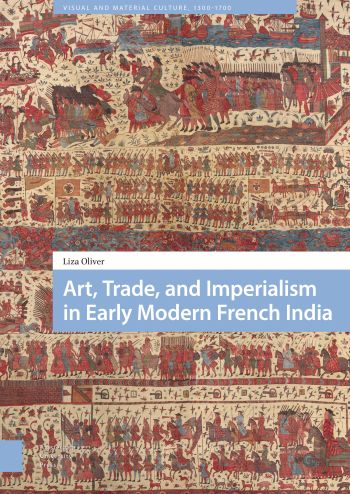 French mercantile endeavors in late seventeenth- and eighteenth-century India were marked by novel intersections of aesthetics, science, and often violent commercialism. Connecting all of these worlds were the thriving textile industries of India’s Coromandel Coast. This book focuses on the integration of the Coromandel textile industries with French colonies in India from the founding of the French East India Company in 1664 to its debilitating defeat by the British during the Seven Years’ War. Narratives of British trade and colonialism have long dominated eighteenth-century histories of India, overshadowing the French East India Company’s far-reaching sphere of influence and its significant integration into the political and cultural worlds of South India. As this study shows, the visual and material cultures of eighteenth-century France and India were deeply connected, and together shaped the century’s broader debates about mercantilism, liberalism, and the global trade of goods, ideas, and humans.
Liza Oliver is the Diana Chapman Walsh Assistant Professor in Art History and South Asia Studies at Wellesley College.
Print Quarterly, December 2019
The eighteenth century in the current issue of Print Quarterly:
Print Quarterly 36.4 (December 2019)

Étienne Fessard and Augustin de Saint-Aubin, after Charles Natoire, Gaetano Brunetti, and Paolo Antonio Brunetti, Perspective View of the Chapel of Enfants Trouvés in Paris, 1759, etching and engraving, sheet (trimmed) 80 × 59 cm (New York, Metropolitan Museum of Art).
A R T I C L E S
Rena M. Hoisington, “Étienne Fessard’s Prints of the Chapel of the Hôpital des Enfants Trouvés in Paris,” pp. 404–25.
Soon after Charles Natoire (1700–1777) completed his cycle of paintings for the Chapel of the Hôpital des Enfants Trouvés in Paris, Fessard announced a subscription plan for a series of prints reproducing them. Often addressed merely for their documentary value, these prints are here analysed as objects in themselves. The article explores their complex publication history and assesses them in the context of Fessard’s career. Also analysed is the series’ repercussion on the reputation of the artists involved in their realization, Natoire included.
N O T E S A N D R E V I E W S
Colin Harrison, Review of Peter Whitfield, Oxford in Prints: 1675–1900 (Bodleian Library, 2016), p. 448.
The book explores how Oxford has been pictured between 1675 and 1922 by illustrating a selection of volumes in the collection of the Bodleian Library. The largest group consists of almanacks printed by the University, which took their definitive format of a topographical headpiece with a calendar beneath in the early eighteenth century.
Jean Michel Massing, Review of Cheryl Finley, Committed to Memory: The Art of the Slave Ship Icon (Princeton University Press, 2018), p. 484–88.
The book “focuses on the life, and afterlife, of famous anti-slavery icon,” the 1788 engraved Plan of an African Ship’s lower Deck with Negroes in the proportion of only one to a Ton (484). Part One “considers abolitionist slave ship prints from the period 1788 to 1900; the remainder of the book is devoted to their stature as an icon reappropriated by twentieth-century African American, British and African artists” (488).
P U B L I C A T I O N S R E C E I V E D
Mungo Campbell and Nathan Flis, eds., William Hunter and the Anatomy of the Modern Museum, exhibition catalogue (Yale Center for British Art, and The Hunterian, University of Glasgow, in association with Yale University Press, 2018), p. 472.
Exhibition | Portraying Pregnancy
From the press release for the exhibition:
Portraying Pregnancy: From Holbein to Social Media
The Foundling Museum, London, 24 January — 26 April 2020
Curated by Karen Hearn
Th e Foundling Museum is proud to present the first major exhibition to explore representations of the pregnant female body through portraits from the past 500 years, Portraying Pregnancy: From Holbein to Social Media, which opens on 24 January 2020.
Until the twentieth century, many women spent most of their adult years pregnant. Despite this, pregnancies are seldom made apparent in surviving portraits. This exhibition brings together images of women—mainly British—who were depicted at a time when they were expecting (whether visibly so or not). Through paintings, prints, photographs, objects, and clothing from the fifteenth century to the present day, Portraying Pregnancy explores the different ways in which pregnancy was, or was not, represented; how shifting social attitudes have impacted on depictions of pregnant women; how the possibility of death in childbirth brought additional tension to such representations; and how more recent images, which often reflect increased female agency and empowerment, still remain highly charged. This exhibition is the first of its kind and provides an exceptional opportunity to situate contemporary issues of women’s equality and autonomy in a 500-year context.
The earliest portrait featured in the exhibition—and a major highlight—is Hans Holbein II’s beautiful drawing of Sir Thomas More’s daughter, Cicely Heron, made in 1526–27, lent by Her Majesty The Queen from the Royal Collection. Sketched from life, it is a rare, clear-eyed, observation of a pregnant woman. In many pre-twentieth-century works in the exhibition, however, the sitter’s pregnancy has been edited out. The mezzotint made after Sir Joshua Reynolds’s full-length portrait of Theresa Parker, for example, shows no visible sign of her pregnancy, in line with conventions of the time, despite rich documentary evidence that by her second sitting in February 1772, Theresa was heavily pregnant.
Today, women with access to birth control can expect to plan if, or when, they become pregnant. Prior to the 1960s, many women would have experienced, between marriage and menopause, a number of pregnancies—and their daily lives might alter little for most of the gestation period. This is exemplified in a portrait of the celebrated eighteenth-century actress, Sarah Siddons, shown in the role of Lady Macbeth, which she famously played up until the final weeks of pregnancy.
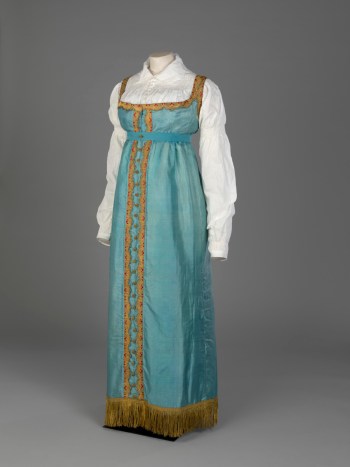
Russian style dress belonging to Princess Charlotte, ca. 1817, silk, gold, metallic and silk lace, gold metallic fringe (Royal Collection Trust, 74709).
Fear of dying in childbirth was very real, and often justified. Until the early twentieth century, most births took place at home, often attended by family members, and consequently many women witnessed death in childbirth. Elizabethan and Jacobean portraits of visibly pregnant women, such as Marcus Gheeraerts II’s portrait of a heavily-pregnant unknown woman, dated 1620, appeared in the same era as the ‘mother’s legacy’ text—in which a woman wrote a ‘letter’ for the benefit of her unborn child, in case she should not survive her confinement. An example is the manuscript that the well-educated Elizabeth Joscelin wrote in 1622 for the child that she was carrying. Maternal mortality is also powerfully represented by George Dawe’s 1817 portrait of the pregnant Princess Charlotte, the heir to the British throne, wearing a fashionable loose ‘sarafan’ dress, as well as by the actual surviving garment, lent by Her Majesty The Queen from the Royal Collection, which will be displayed alongside it. Charlotte died in childbirth, in November that year.
While Christianity played a central role in everyday life, conceiving a baby (or not), was seen as a gift from God. Historically, the New Testament story of The Visitation—the meeting of the pregnant Virgin Mary and her cousin, Elizabeth—was a particularly inspiring and comforting one for pregnant women. Images of it had been widespread in England prior to the sixteenth- century Reformation, and reappeared in the late nineteenth and early twentieth centuries. The Pre-Raphaelite artists’ doctrine of absolute realism saw them model their depictions of it on pregnant women among their own social circle.
Augustus John’s ca. 1901 full-length portrait of his wife, Ida, must have seemed astonishingly transgressive to viewers at the time, as it clearly depicts her as pregnant. It was not until the later twentieth century that pregnancy stopped being ‘airbrushed out’ of portraits. In 1984, the British painter, Ghislaine Howard, produced a powerful self-portrait of herself as heavily pregnant. However, the watershed moment occurred internationally in August 1991, when Annie Leibovitz’s photographic portrait of the actress, Demi Moore, naked and seven months pregnant, appeared on the cover of Vanity Fair magazine. This image was considered so shocking that some retailers refused to stock the issue. Nevertheless, it marked a culture shift and initiated the trend for more visible celebrations of pregnant bodies—especially nude ones. In 2017, Leibovitz returned to the theme, photographing the pregnant tennis champion, Serena Williams, naked, for Vanity Fair’s August cover.
The final photograph in the exhibition, by Awol Erizku, was commissioned by the singer, Beyoncé Knowles, who posted it on Instagram on 1 February 2017. Erizku’s iconographically complex portrait of Beyoncé, pregnant with twins, veiled and kneeling in front of a screen of flowers, became the most liked Instagram post of that year. Beyoncé’s image powerfully demonstrates how some women have succeeded in taking ownership not just of representations of their pregnant bodies, but also the distribution of their portraits.
This exhibition, curated by Professor Karen Hearn FSA, previously the curator of sixteenth- and seventeenth-century British art at Tate Britain (1992–2012) and now Honorary Professor at University College London, is the first of its kind and provides an exceptional opportunity to situate contemporary issues of women’s equality and autonomy in a 500-year context; it forms part of the Foundling Museum’s ongoing programme of exhibiting art that reflects its mission to celebrate the power of individuals and the arts to change lives. The exhibition is supported by the Drapers’ Company, Norland College and the 1739 Club.
Karen Hearn, Portraying Pregnancy: Holbein to Social Media (London: Paul Holberton, 2020), 112 pages, ISBN: 978-1911300809, £18.
New Book | The Mobility of People and Things
From Routledge:
Elisabeth A. Fraser, ed., The Mobility of People and Things in the Early Modern Mediterranean: The Art of Travel (New York: Routledge, 2019), 160 pages, ISBN: 978-1138488083, $150.
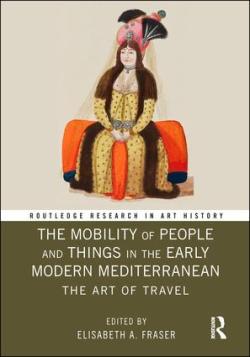 For centuries artists, diplomats, and merchants served as cultural intermediaries in the Mediterranean. Stationed in port cities and other entrepôts of the Mediterranean, these go-betweens forged intercultural connections even as they negotiated and sometimes promoted cultural misunderstandings. They also moved objects of all kinds across time and space. This volume considers how the mobility of art and material culture is intertwined with greater Mediterranean networks from 1580 to 1880. Contributors see the movement of people and objects as transformational, emphasizing the trajectory of objects over single points of origin, multiplicity over unity, and mutability over stasis.
Elisabeth A. Fraser is Professor of Art History at the University of South Florida, Tampa.
C O N T E N T S
List of figures
List of Plates
Chapter Abstracts
Elisabeth Fraser, Introduction
1 Sylvia Houghteling, ‘From Scorching Spain and Freezing Muscovy’: English Embroidery and Early Modern Mediterranean Trade
2 Meredith Martin and Gillian Weiss, A Tale of Two Guns: Maritime Weaponry between France and Algiers
3 Julia Landweber, Furnishing the Taste for Coffee in Early Modern France
4 Ashley Dimmig, Substitutes and Souvenirs: Reliving Polish Victory in ‘Turkish’ Tents
5 Elisabeth Fraser, The Ottoman Costume Album as Mobile Object and Agent of Contact
6 Leyla Belkaïd-Neri, Entangled Styles: Mediterranean Migration and Dress in Pre-Modern Algiers
7 Michèle Hannoosh, The Art of Wandering: Alexander Svoboda and Photography in the Nineteenth-Century Mediterranean
Contributor Biographies
Index
Exhibition | The Golden Age of English Painting
Press release for the exhibition:
The Golden Age of English Painting: From Reynolds to Turner
L’âge d’or de la peinture anglaise: De Reynolds à Turner
Musée du Luxembourg, Paris, 11 September 2019 — 16 February 2020
Curated by Martin Myrone and Cécile Maisonneuve
This exhibition, showing a selection of masterpieces from Tate Britain, highlights a key period in the history of painting in England, from the 1760s to around 1820, capturing the originality and diversity of the period. It takes visitors from the founding of the Royal Academy, with artists such as Reynolds and Gainsborough, to the turning point in the early 19th century, notably with Turner. The public will rediscover the great classics of British art here, all too rarely exhibited in France.
 The reign of George III was preponderant for British art, with the founding of the Royal Academy of Arts, of which Joshua Reynolds (1723–1792), was the first president at the height of his career. This period also saw Thomas Gainsborough (1727–1788) join the Academy. In their own ways, Reynolds and Gainsborough, both masters of portraiture, brought novel visual and intellectual innovations to the genre, honouring the great masters while reinventing the wheel. With signs of an artistic golden age booming, this movement was also supported by major players in trade and industry, and then by the king himself.
The exhibition tackles the confrontation of the two portrait painters, through full-length paintings and intimate studies of members of the royal family or personalities of the day. Reynolds’s intellectual ambitions contrast with Gainsborough’s pictorial ease. Redefining British art alone, they raised the next generation to new heights. A selection of major portraits by their competitors and/or followers, such as John Hopper, William Beechey, and Thomas Lawrence, recall the influence of these two precursors. The exhibition also addresses the themes of lineage, family, and home with the genre painting that gave birth to a new approach to childhood. Reynolds’s extraordinary portrait The Archers puts the concept of wilderness at the service of a heroic representation of the British ruling class, while Gainsborough, George Stubbs, and George Morland focus their attention on the picturesque, through paintings depicting everyday life, especially in rural areas.
With the political and commercial exploitation of overseas territories as the basis for artistic progress, part of the exhibition addresses the presence of Great Britain in India and the Caribbean. Another section discusses the tremendous growth of watercolour, which allowed many artists to stand out by meeting the needs of a new amateur society. The last part of the exhibition shows how British artists such as Henri Fuseli, John Martin, P.J. de Loutherbourg, and J.M.W. Turner sublimated narrative figuration, paving the way for a new conception of art as a support for the imaginary.
Amandine Rabier, L’âge d’or de la peinture anglaise (Paris: Gallimard / Réunion des musées nationaux, 2019), 56 pages, ISBN: 978-2072859595, 10€.
Exhibition | The Torlonia Marbles
From the Fondazione Torlonia . . . (In 1866 the Torlonia family bought the Villa Albani and its collection):
The Torlonia Marbles: Collecting Masterpieces
Musei Capitolini at Palazzo Caffarelli, Rome, 25 March 2020 — 10 January 2021
Curated by Carlo Gasparri and Salvatore Settis
From 25 March 2020 to 10 January 2021, ninety-six marbles from the Torlonia Collection will be on view to the public at a major show in Rome, in the new exhibition venue of the Musei Capitolini at Palazzo Caffarelli. The exhibition The Torlonia Marbles: Collecting Masterpieces is the first step of the agreement signed the 15th of March 2016 between the Ministry for the Cultural Heritage Activities and Tourism and the Torlonia Foundation, and is a result of the institutional agreement signed by the Directorate General for Archaeology, Fine Arts and Landscape and the Special Superintendency of Rome with the Torlonia Foundation itself. The scientific project for enhancing the collection is entrusted to Salvatore Settis, who is curating the exhibition with Carlo Gasparri; both are archaeologists and academics of the Accademia dei Lincei. The exhibition is organized by Electa, publisher of the catalog. The sculptures selected have been restored thanks to the contribution of Bvlgari.
This will be the opportunity to inaugurate the new prestigious exhibition venue in Roma Capitale of the Musei Capitolini at Palazzo Caffarelli. The choice of the location was dictated by the intention to focus the exhibition on the history of collecting. In this respect, the history of the Torlonia Museum at the Lungara (founded by Prince Alessandro Torlonia in 1875), with its 620 catalogued works of art, appears of outstanding importance. This collection is the result of a long series of acquisitions and some significant shift of sculptures between the various residences of the family. We can even say that the Torlonia Marbles constitute a collection of collections or rather a highly representative and privileged cross-section of the history of the collecting of antiquities in Rome from the 15th to the 19th centuries. The items on display are not only outstanding examples of ancient sculpture (busts, reliefs, statues, sarcophagi, and decorative elements), but also a reflection of a cultural process—the beginnings of the collecting of antiquities and the crucially important transition from the collection to the Museum, a process where Rome and Italy have had an indisputable primacy. In this way the exhibition traces the formation of the Torlonia Collection. The last of its five sections eloquently relates to the adjacent exedra of bronzes and the statue of Marcus Aurelius in the Musei Capitolini, bringing out the ties between the beginnings of private collecting of antiquities and the significance of the donation of the Lateran bronzes to the city of Rome by Sixtus IV in 1471.
The project to organize the exhibition of the Torlonia Collection in the renovated spaces of the new venue of the Musei Capitolini at Palazzo Caffarelli, restored to life by David Chipperfield Architects Milan. The March 2020 event is the first stage of a traveling exhibition, for which agreements are in progress with major international museums and which will conclude with the identification of permanent exhibition spaces for the opening of a new Torlonia Museum.
Also see the article by Elisabetta Povoledo from The New York Times (28 October 2019).
New Book | Painting with Fire
From The University of Chicago Press:
Matthew C. Hunter, Painting with Fire: Sir Joshua Reynolds, Photography, and the Temporally Evolving Chemical Object (Chicago: The University of Chicago Press, 2019), 304 pages, ISBN: 978-0226390253, $50.
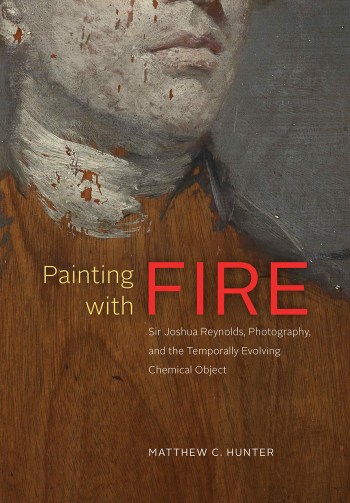 Painting with Fire shows how experiments with chemicals known to change visibly over the course of time transformed British pictorial arts of the long eighteenth century—and how they can alter our conceptions of photography today. As early as the 1670s, experimental philosophers at the Royal Society of London had studied the visual effects of dynamic combustibles. By the 1770s, chemical volatility became central to the ambitious paintings of Sir Joshua Reynolds, premier portraitist and first president of Britain’s Royal Academy of Arts. Valued by some critics for changing in time (and thus, for prompting intellectual reflection on the nature of time), Reynolds’s unstable chemistry also prompted new techniques of chemical replication among Matthew Boulton, James Watt, and other leading industrialists. In turn, those replicas of chemically decaying academic paintings were rediscovered in the mid-nineteenth century and claimed as origin points in the history of photography.
Tracing the long arc of chemically produced and reproduced art from the 1670s through the 1860s, the book reconsiders early photography by situating it in relationship to Reynolds’s replicated paintings and the literal engines of British industry. By following the chemicals, Painting with Fire remaps familiar stories about academic painting and pictorial experiment amid the industrialization of chemical knowledge.
Matthew C. Hunter is associate professor in the Department of Art History and Communication Studies at McGill University. He is the author of Wicked Intelligence: Visual Art and the Science of Experiment in Restoration London, also published by the University of Chicago Press.
C O N T E N T S
Introduction: Slow-Motion Mobiles
1 ‘Pictures . . . in time petrify’d’
2 Joshua Reynolds’s ‘Nice Chymistry’ in the 1770s
3 ‘Rend’rd Imortal”: The Work of Art in an Age of Chemical Reproduction
4 Space, Time, and Chemistry: Making Enlightenment ‘Photography’ in the 1860s
Conclusion: Art History in/as an Age of Combustion
Acknowledgments
Notes
Bibliography
Index
New Book | Ancient Marbles in Naples in the Eighteenth Century
From Brill:
Eloisa Dodero, Ancient Marbles in Naples in the Eighteenth Century: Findings, Collections, Dispersals (Leiden: Brill, 2019), 630 pages, ISBN: 978-9004362857, €139 / $167.
 In Ancient Marbles in Naples in the Eighteenth Century Eloisa Dodero aims at documenting the history of numerous private collections formed in Naples during the 18th century, with particular concern for the ‘Neapolitan marbles’ and the circumstances of their dispersal. Research has thus made it possible to formulate a synthesis of the collecting dynamics of Naples in the 18th century, to define the interest of the great European collectors, especially British, in the antiquities of the city and its territory and to draw up a catalogue which for the first time brings together the nucleus of sculptures reported in the Neapolitan collections or coming from irregular excavations, most of which shared the destiny of dispersal, in some cases here traced in definitive fashion.
Eloisa Dodero is curator archaeologist at the Capitoline Museums, Rome. She is involved in the publication of the Paper Museum of Cassiano dal Pozzo (Brepols) and in a new, revised edition of Taste and the Antique: The Lure of Classical Sculpture (Brepols).
C O N T E N T S
List of Figures
List of Abbreviations
Introduction
1 The Collections of Antiquities in Naples in the 18th Century: A Changing Scenario
2 Sources for a Knowledge of the Neapolitan Collections of Antiquities in the 18th Century
• The Descrizioni of Naples and the Travel Literature in the 17th and 18th Century
• Erudite Works, Epigraphic Sylloges and Corpora
• The Correspondence of Antiquarians
• Catalogues of Collections
• Private Archives, Inventories and Auction Catalogues
• The Evidence Offered by the Paintings
• The Townley Archive, the Townley Drawings and the Topham Collection of Drawings
3 Collections of Antiquities in Naples between the End of the 17th and the Closing Years of the 18th Century
• Sculptures as Furniture: Ancient Marbles in Old Palaces and Stately Homes
• The Leading Collectors
• Small Collections of Vases, Inscriptions, Coins, Gems
• Wunderkammern in Naples
• The Collections of the Religious Orders
• The Collections of the Foreigners
4 The Channels of Dispersal of the Neapolitan Marbles from the Viceregal Period to the End of the 18th Century
• The Spanish Viceroyalty and the Austrian Viceroyalty
• The Age of the Bourbons
• Marbles of Neapolitan Origin in 18th-Century British Collections
Conclusions
Catalogue – Part 1: Ancient Marbles in 18th-Century Neapolitan Collection
Sculptures as Furniture: Ancient Marbles in Old Palaces and Stately Homes
• Palazzo Carafa di Colubrano (cat. no. 1–43)
• Villa Mazza (cat. no. 44–50)
• Palazzo Firrao (cat. no. 51–52)
• Palazzo Cellamare (cat. no. 53–64)
• The Gaetani d’Aragona, Dukes of Laurenzano (cat. no. 65–71)
The Leading Collectors
• Giuseppe Valletta (cat. no. 72–122)
• Felice Maria Mastrilli (cat. no. 123–133)
• Giovanni Battista Carafa Duke di Noja (cat. no. 134–138)
Small Collections of Vases, Inscriptions, Coins, Gems
• Ferdinando Galiani (cat. no. 139–140)
Wunderkammern in Naples
• Francesco Antonio Picchiatti (cat. no. 141–145)
The Collections of the Foreigners
• Sir William Hamilton (cat. no. 146–200)
• Vinzenz von Rainer zu Harbach (cat. no. 201–202)
Catalogue – Part 2: Sculptures Found in Naples and Its Surroundings Between the 17th and the 18th Century
Pimentel’s Excavations at Cuma (cat. no. 203–217)
The Dispersal
• Berlin (cat. no. 218–222)
• Paris (cat. no. 223–224)
• Saint Petersburg (cat. no. 225)
• Rome (cat. no. 226–233)
Hadrawa’s Excavations in Capri (cat. no. 234–240)
Neapolitan Marbles in British Collections
• Wilton House
• Other Collections Assembled in the First Half of the 18th Century (cat. no. 241)
• Charles Townley Collection (cat. no. 242–252)
• Lyde Browne Collection (cat. no. 251–253)
• Henry Blundell Collection (cat. no. 254–255)
• Thomas Hope Collection (cat. no. 256)
Archival Sources
Bibliography
Index of Sculptures by Location
General Index










 Enfilade
leave a comment