Exhibition | Making Marvels: Science & Splendor

From the press release (21 May 2019) for the exhibition:
Making Marvels: Science & Splendor at the Courts of Europe
The Metropolitan Museum of Art, New York, 25 November 2019 — 1 March 2020
Curated by Wolfram Koeppe
Between 1550 and 1750, nearly every royal family in Europe assembled vast collections of exquisite and entertaining objects. Lavish public spending and the display of precious metals were important expressions of power, and possessing artistic and technological innovations conveyed status. In fact, advancements in art, science, and technology were often prominently showcased in elaborate court entertainments that were characteristic of the period. Opening November 25, Making Marvels: Science and Splendor at the Courts of Europe will explore the complex ways in which the wondrous objects collected and displayed by early modern European monarchs expressed these rulers’ ability to govern.
The exhibition will feature approximately 170 objects—including clocks, automata, furniture, scientific instruments, jewelry, paintings, sculptures, print media, and more—from The Met collection and over 50 lenders. A number of these works have never been displayed in the United States. Among the many exceptional loans will be silver furniture from the Esterházy Treasury; the largest flawless natural green diamond in the world, weighing 41 carats and in its original 18th-century setting; the alchemistic table bell of Emperor Rudolf II; a large wire-drawing bench made for Elector Augustus of Saxony; a rare example of an early equation clock by Jost Bürgi; and a reconstruction of a late 18th-century semi-automaton chess player, known as The Turk, that once famously caught Napoleon Bonaparte cheating.
Making Marvels is the first exhibition in North America to highlight the important conjunction of art, science, and technology with entertainment and display that was essential to court culture. The exhibition will be divided into four sections dedicated to the main object types featured in these displays: precious metalwork, Kunstkammer objects, princely tools, and self-moving clockworks or automata.
In order to emphasize the scientific and technological content of these objects, the exhibition will begin by establishing the high level of material value and artisanal quality that princes had to meet in these displays of wealth and power. Visitors will encounter a set of superbly fashioned silver furniture that was considered the ultimate symbol of power, status, and money during the early modern period. The second section will be dedicated to the unusual objects of the Kunstkammer, as these collections were known in German-speaking provinces. These pieces were typically composed of newly discovered natural materials set in finely crafted mounts of silver or gold, whose highly inventive designs often embodied the most up-to-date knowledge of the natural world. Reflective of the multi-layered objects they housed, Kunstkammern functioned simultaneously as places of amusement, research retreats for the investigation of nature, and political showcases for magnificence.
Knowledge of subjects such as natural philosophy, artisanal craftsmanship, and technology was considered tantamount to the practical wisdom, self-mastery, and moral virtue integral to successful governance. Pursuits such as metalsmithing, surveying, horology, astronomy, and turning at the lathe were part of the education and entertainment of princes in courts across Europe. The exhibition’s third section will present the scientific instruments, artisanal tools, and experimental apparatus used by rulers as they developed the technical skills so important to their princely identity.
The exhibition will conclude with innovations in mechanical technology. Self-moving clockwork machines—perhaps the most well-known technological display objects—were also a rich source for allegories of rulership. Additionally, as courts competed for technical supremacy, many innovations in mechanical technology were developed at the urging of princely patrons. Automata represented the ultimate attempt to use mechanics to create life-like movement, and were extremely popular additions to princely collections from the Renaissance to the Enlightenment. One highlight will be The Draughtsman Writer, a late 18th-century writing automaton that inspired the book The Invention of Hugo Cabret and its movie adaptation. The advanced mechanism of this piece, which stored more information than any machines that came before it, was the forerunner of the computer, the most common technology used today.
Throughout each gallery, videos and digital models will vividly evoke the historical reality of the objects on view and emphasize the similarities between early modern objects and contemporary technological entertainments. Exhibition visitors will discover innovative marvels that engaged and delighted the senses of the past much like 21st-century technology holds our attention today—through suspense, surprise, and dramatic transformations.
Making Marvels is organized by Wolfram Koeppe, Marina Kellen French Curator in The Met’s Department of European Sculpture and Decorative Arts. The exhibition and accompanying catalogue, distributed by Yale University Press, are made possible by the Anna-Maria and Stephen Kellen Foundation.
Wolfram Koeppe, ed., Making Marvels: Science and Splendor at the Courts of Europe (New York: The Metropolitan Museum of Art, 2019), 320 pages, ISBN: 978-1588396778, $65.
Above Image: Gerhard Emmoser, Celestial Globe with Clockwork, 1579; partially gilded silver, gilded brass (case); brass, steel (movement); diameter of globe: 14 cm (New York: The Metropolitan Museum of Art, Gift of J. Pierpont Morgan, 1917).
Exhibition | Hogarth: Place and Progress
Press release (via Art Daily) for the exhibition:
Hogarth: Place and Progress
Sir John Soane’s Museum, London, 9 October 2019 — 5 January 2020
 Hogarth: Place and Progress unites all of the paintings and engravings in Hogarth’s series for the first time, displayed across the Georgian backdrop of Sir John Soane’s Museum. Through these works the exhibition will explore the artist’s complex stance on morality, society, and the city, and the enduring appeal of his satires.
• The concept of progress has positive connotations in the twenty-first century but was often construed negatively in Hogarth’s time. Hogarth’s complex and often darkly satirical narrative progresses move from moral abandon and social ostracism, to poverty, madness and death.
• New research pinpoints precise locations in London depicted in Hogarth’s works and examines the key role they play in a moral reading of Hogarth’s paintings.
• Hogarth’s ability to see beyond social conventions continues to resonate with 21st-century audiences, as he presented with wit and empathy the depictions of immorality and vice that he perceived in all classes of society.
The Soane Museum’s own Rake’s Progress and An Election will be joined by Marriage A-la-Mode from the National Gallery, The Four Times of Day from the National Trust and The Trustees of the Grimsthorpe and Drummond Castle Trust, as well as the three surviving paintings of The Happy Marriage from Tate and the Royal Cornwall Museum. The exhibition also includes engraved series of prints, lent by Andrew Edmunds, such as The Four Stages of Cruelty, Industry and Idleness, and Gin Lane and Beer Street. The works span Hogarth’s career as an engraver and painter and the exhibition will explore Hogarth’s increasing skill—or progress—in both fields, culminating in the masterly execution of An Election.
Hogarth’s concept of ‘progress’ was influenced by John Bunyan’s The Pilgrim’s Progress, where the word described a journey towards moral and spiritual redemption through dismal places: from the City of Destruction to the Slough of Despond and Valley of Humiliation. Hogarth: Place and Progress explores how Hogarth’s series depict this idea. Hogarth’s narratives move from moral abandon and social ostracism, to poverty, madness and death and are often presented as highlighting the follies of the upper classes.
The exhibition also examines the idea that Hogarth was not simply ‘the people’s champion,’ but increasingly his narrative series perceived immorality and impropriety at all levels of society. Those most likely to be safe from Hogarth’s satirical wit were those who knew their ‘place’ in the social order and lived up to the positive ideals of their class, high and low alike.
Hogarth’s self-titled ‘Modern Moral Subjects’ present detailed characters, plots and changes of scene, set in specific and recognisable locations. The idea of spiritual progress is shown through visible representations of London life. The key geographic contrast is between the City of London, with its winding alleys and crumbling houses, livery guilds, the Mansion House and Monument, associated with merchants, and the West End where the landed aristocracy live in spacious and orderly squares, physically nearer to the royal place of St James. Between the two, the area around Covent Garden is repeatedly presented as a hotbed of immorality. In A Rake’s Progress, the Rake moves from the City of London to an extravagant property in the West End, then a brothel in Covent Garden, and ultimately travels outside the City walls, ending up in Bedlam, where his dissolute life has led him to insanity and death. The exhibition demonstrates how Hogarth’s ‘Modern Moral Subjects’ married the idea of progress with the moral geography of London, in a dynamic and evolving way throughout his own progress as an artist.
Bruce Boucher, David Bindman, Frederic Ogee, and Jacqueline Riding, Hogarth: Place and Progress (London: Sir John Soane’s Museum, 2019), 144 pages, ISBN: 978-1999693213, £25.
New Book | The New Town of Edinburgh
From Birlinn Ltd:
Clarisse Godard Desmarest, ed., The New Town of Edinburgh: An Architectural Celebration (Edinburgh: John Donald, 2019), 336 pages, ISBN: 978-1910900352, £40.
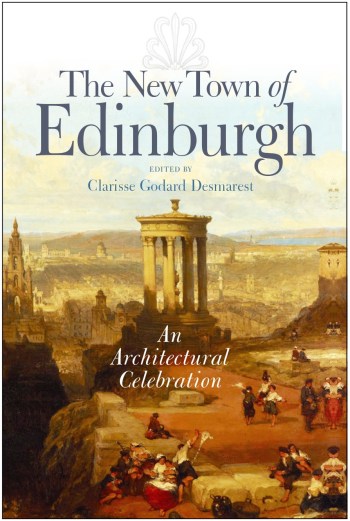 This collection of innovative essays celebrates the New Town of Edinburgh over the 250 years since its original creation. The contributing authors discuss the intellectual, economic, and political contexts that provided the impetus for the city of Edinburgh to expand north of the Old Town, and analyse the New Town’s unique architectural status in terms of its size, monumentality, and degree of preservation. For centuries, Scotland has pursued innovation, improvement, commerce, and contact with England and the Continent; and since medieval times it has been an urbanising land of planned towns. This book reflects on the constantly changing dialogue between Edinburgh’s Old and New Towns—from the eighteenth century to the present time—as the city became increasingly commercialised. It also compares Edinburgh’s New Town with more recent new towns elsewhere, notably nineteenth-century Dunedin in New Zealand and Scotland’s planned new-town movement of the twentieth century. The age of conservation is another of the central themes. By drawing on different approaches to the new town phenomenon in Scotland, this volume pays tribute to Scotland’s vibrant capital and offers insights into new research on Scotland’s urban development.
Clarisse Godard Desmarest is a lecturer at the University of Picardie Jules Verne, Amiens, and a fellow of the Institut Universitaire de France. She specialises in Scottish architectural history and heritage, and has held fellowships at the Institute of Advanced Studies in the Humanities (IASH), Edinburgh College of Art and the School of History, Classics and Archaeology at the University of Edinburgh. She holds an ‘Agrégation in English’ and is a graduate of Sciences Po Paris. Her doctorate at the Sorbonne, jointly supervised by the University of Edinburgh, was awarded a national prize in France for the best thesis on a Scottish subject.
New Book | Calton Hill
From Birlinn Ltd:
Kirsten Carter McKee, Calton Hill and the Plans for Edinburgh’s Third New Town (Edinburgh: John Donald, 2018), 224 pages, ISBN: 978-1910900178, £25.
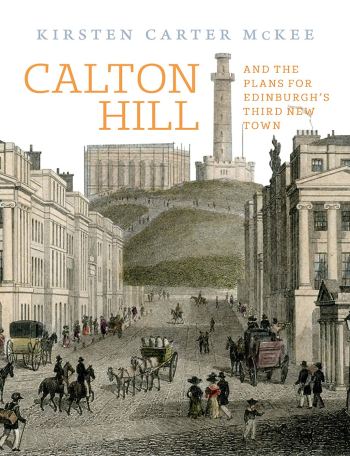 Calton Hill, on the eastern edge of Edinburgh’s centre, has a special relationship with the city. Development of the hill and its surrounding area (often referred to as Edinburgh’s ‘Third New Town’) began in the late eighteenth and early nineteenth centuries by a decision-making elite, who proposed to change the site from a rural periphery into the new urban core of the city. This book shows that the architecture and urban design on Calton Hill was a demonstration of Scotland’s cultural identity and political allegiance to the British State—as key enlightenment figures and theories were celebrated alongside the British naval heroes and the House of Hanover in the early stages of its development. However, as Scotland’s identity within Britain evolved through changes in governance in the nineteenth and early twentieth centuries, Calton Hill—and all that its neo-Greek architecture came to represent—became a metaphor for the friction between Scottish and British Nationalism, resulting in it being considered a ‘Nationalist Shibboleth’ by the last years of the twentieth century. This book considers how the architectural expression of Calton Hill has been perceived, accepted and rejected as ideas surrounding cultural identity, governance and nationalism have changed over the last 200 years.
Kirsten Carter McKee is an architectural historian and cultural landscape specialist. She has a PhD from the University of Edinburgh and has worked for a number of organisations as an archaeologist, historic buildings specialist, and heritage consultant. She is currently a research and teaching fellow in architectural history and conservation at the University of Edinburgh.
New Book | A Rare Treatise on Interior Decoration and Architecture
From Getty Publications:
Simon Swynfen Jervis, ed., A Rare Treatise on Interior Decoration and Architecture: Joseph Friedrich zu Racknitz’s Presentation and History of the Taste of the Leading Nations, translated by Simon Swynfen Jervis (Los Angeles: Getty Publications, 2020), 368 pages, ISBN: 978-1606066249, $85.
 Baron Joseph Friedrich zu Racknitz’s pioneering Presentation and History of the Taste of the Leading Nations in Relation to the Interior Decoration of Rooms and to Architecture (Darstellung und Geschichte des Geschmacks der vorzüglichsten Völker in Beziehung auf die innere Auszierung der Zimmer und auf die Baukunst), published between 1796 and 1799, is little known today. Racknitz, a German aristocrat, traced an early global history of design and ornament through discussions of what he distinguished as twenty-four essential regional historical tastes. He included those of a diverse group of ancient classical civilizations, European nations and peoples, Eastern civilizations, and more exotic reaches of the world.
This sensitive and informed translation also includes reproductions of the original color plates and essays on Racknitz’s biography, his publication, and the German Enlightenment context, making this an essential volume for studying eighteenth- and nineteenth-century architecture, decorative arts, and garden design.
Simon Swynfen Jervis has worked extensively as a curator, writer, and scholar of decorative arts. He has authored dozens of books, articles, guidebooks, and exhibition catalogues and organized exhibitions at British, European, and American institutions.
New Book | The Dramaturgy of the Spectator
From the University of Toronto Press:
Tatiana Korneeva, The Dramaturgy of the Spectator: Italian Theatre and the Public Sphere, 1600–1800 (Toronto: University of Toronto Press, 2019), 274 pages, ISBN 978-1487505356, $80.
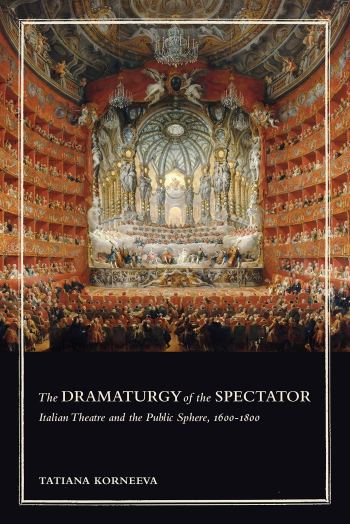 The Dramaturgy of the Spectator explores how Italian theatre consciously adjusted to the emergence of a new kind of spectator who became central to society, politics, and culture in the mid-seventeenth and eighteenth centuries. The author argues that while a focus on spectatorship in isolation has value, if we are to understand the broader stakes of the relationship between the power structures and the public sphere as it was then emerging, we must trace step-by-step how spectatorship as a practice was rooted in the social and cultural politics of Italy at the time. By delineating the evolution of the Italian theatre public, as well as the dramatic innovations and communicative techniques developed in an attempt to manipulate the relationship between spectator and performance, this book pioneers a shift in our understanding of audience as both theoretical concept and historical phenomenon.
Tatiana Korneeva is an assistant professor in Comparative Literature at the Freie Universität, Berlin.
C O N T E N T S
Acknowledgements
Chronology
Introduction
1 How Theatre Invents the Public Sphere
2 The Privileged Visibility of the Viewer
3 The Politics of Spectatorship
4 Public Emotions and Emotional Publics
5 Playwrights Fight Back
6 Liberty and the Audience
Epilogue
Bibliography
Index
New Book | Worn on This Day
From Running Press:
Kimberly Chrisman-Campbell, Worn on This Day: The Clothes That Made History (Philadelphia: Running Press, 2019), 336 pages, ISBN: 978-0762493579, $28.
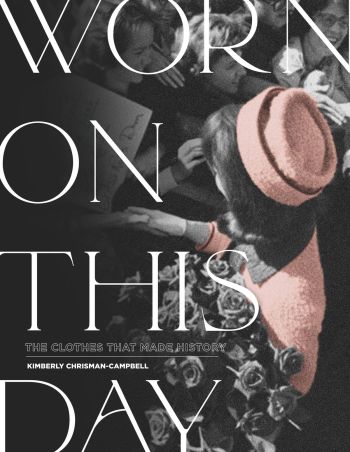 This stunning visual guide is a journey of discovery through fashion’s fascinating history, one day at a time. Beginning on January 1st and ending on December 31st, Worn On This Day looks at garments worn on monumental occasions across centuries, offering capsule fashion histories of everything from space suits to wedding gowns, Olympics uniforms, and armor. It creates thought-provoking juxtapositions, like Wallis Simpson’s June wedding and Queen Elizabeth’s June coronation, or the battered shoes Marie-Antoinette and a World Trade Center survivor wore to escape certain death, just a few calendar days apart. In every case there is a newsworthy narrative behind the garment, whether famous and glamorous or anonymous and humble. Prominent figures like Abraham Lincoln, Marilyn Monroe, and the Duchess of Cambridge are represented alongside ordinary people caught up in extraordinary events. Beautifully illustrated throughout, Worn On This Day presents a revelatory mash-up of styles, stories, and personalities.
Kimberly Chrisman-Campbell is a fashion historian, curator, and journalist. She is the author of the award-winning book Fashion Victims: Dress at the Court of Louis XVI and Marie-Antoinette. Kimberly lives in Los Angeles.
New Book | A History of Art History
From Princeton UP:
Christopher S. Wood, A History of Art History (Princeton: Princeton University Press, 2019), 472 pages, ISBN: 978-0691156521, $35.
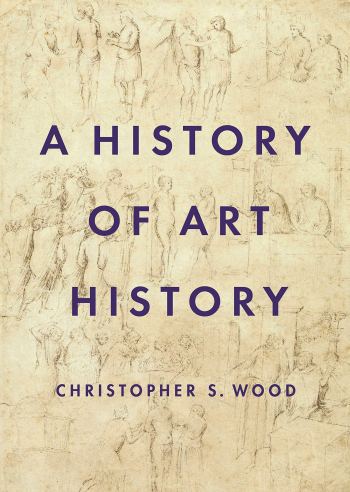 In this wide-ranging and authoritative book, the first of its kind in English, Christopher Wood tracks the evolution of the historical study of art from the late middle ages through the rise of the modern scholarly discipline of art history. Synthesizing and assessing a vast array of writings, episodes, and personalities, this original and accessible account of the development of art-historical thinking will appeal to readers both inside and outside the discipline.
The book shows that the pioneering chroniclers of the Italian Renaissance—Lorenzo Ghiberti and Giorgio Vasari—measured every epoch against fixed standards of quality. Only in the Romantic era did art historians discover the virtues of medieval art, anticipating the relativism of the later nineteenth century, when art history learned to admire the art of all societies and to value every work as an index of its times. The major art historians of the modern era, however—Jacob Burckhardt, Aby Warburg, Heinrich Wölfflin, Erwin Panofsky, Meyer Schapiro, and Ernst Gombrich—struggled to adapt their work to the rupture of artistic modernism, leading to the current predicaments of the discipline. Combining erudition with clarity, this book makes a landmark contribution to the understanding of art history.
Christopher S. Wood is a professor at New York University. He is the author of Forgery, Replica, Fiction: Temporalities of German Renaissance Art and Albrecht Altdorfer and the Origins of Landscape, the coauthor of Anachronic Renaissance, and the editor of The Vienna School Reader: Politics and Art Historical Method in the 1930s.
New Book | Witnessing Slavery
From Yale UP:
Sarah Thomas, Witnessing Slavery: Art and Travel in the Age of Abolition (London: Paul Mellon Centre for Studies in British Art, 2019), 304 pages, ISBN: 978-1913107055, $55.
 Gathering together over 160 paintings, watercolors, drawings, and prints, this book offers an unprecedented examination of the shifting iconography of slavery in British and European art between 1760 and 1840. In addition to considering how the work of artists such as Agostino Brunias, James Hakewill, and Augustus Earle responded to abolitionist politics, Sarah Thomas examines the importance of the eyewitness account in endowing visual representations of transatlantic slavery with veracity. ‘Being there’, indeed, became significant not only because of the empirical opportunities to document slave life it afforded but also because the imagery of the eyewitness was more credible than sketches and paintings created by the ‘armchair traveler’ at home. Full of original insights that cast a new light on these highly charged images, this volume reconsiders how slavery was depicted within a historical context in which truth was a deeply contested subject.
Sarah Thomas is lecturer in the Department of History of Art at Birkbeck, University of London.
Exhibition | Savour: Food Culture in the Age of Enlightenment
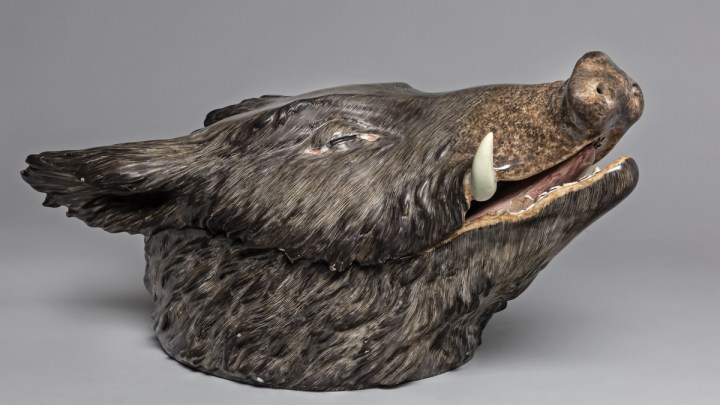
Boar’s Head Tureen, France, probably Strasbourg, ca. 1745; tin-glazed earthenware (faïence)
(Toronto: Gardiner Museum, anonymous loan; photo by Toni Hafkenscheid)
◊ ◊ ◊ ◊ ◊
Opening next month at the Gardiner Museum:
Savour: Food Culture in the Age of Enlightenment
Gardiner Museum, Toronto, 17 October 2019 — 19 January 2020
Wadsworth Atheneum Museum of Art, Hartford, CT, 29 February — 24 May 2020
Curated by Meredith Chilton
Food and dining were transformed in Europe during the age of Enlightenment by profound changes that still resonate today. What many of us eat, the way food is cooked, and how we dine continues to be influenced by radical changes that occurred in France from 1650 until the French Revolution in 1789.

Philippe Mercier, The Sense of Taste, 1744–47, oil on canvas, 132 × 154 cm (New Haven: Yale Center for British Art, Paul Mellon Collection, B1974.3.18).
Savour: Food Culture in the Age of Enlightenment explores the story of this transformation with rare objects, fascinating histories, and amusing stories. We start in the kitchen gardens at Versailles where advances in horticulture expanded the growing seasons of vegetables and fruits, making a greater selection of foods available year-round. Then we visit the steamy kitchens of cooks who advocated light, flavourful cuisine centuries before our time. Next, we discover surprisingly modern philosophies for healthy eating and vegetarianism, and join ardent foodies as they savour meals served on newly invented ceramic and silver wares, from sauceboats to tureens. Along the way, we explore how social changes were impacting eating then, just as now, as the grand formality of the past was abandoned in favour of informality and intimacy.
Savour: Food Culture in the Age of Enlightenment is organized by the Gardiner Museum and curated by Meredith Chilton, C.M., Curator Emerita. Works of art and objects from major North American museums and private collections, as well as key pieces of contemporary ceramics and knitted art, will come together in a delectable feast for the senses designed by Opera Atelier’s Resident Set Designer, Gerard Gauci.
After the Gardiner Museum, the exhibition will tour to the Wadsworth Atheneum Museum of Art, Hartford, Connecticut. The exhibition is accompanied by a cookbook titled The King’s Peas: Delectable Recipes and their Stories from the Age of Enlightenment by Meredith Chilton, with contributions by Markus Bestig, Executive Chef, The York Club, Toronto.

Children Shelling Peas, England, Chelsea, ca. 1759–70; soft-paste porcelain, enamels, and gilding
(Museum of Fine Arts, Boston)
◊ ◊ ◊ ◊ ◊
Meredith Chilton, The King’s Peas: Delectable Recipes and Their Stories from the Age of Enlightenment (Stuttgart: Arnoldsche Verlagsanstalt, 2019), 144 pages, ISBN: 978-3897905603, $50.
Food and dining were transformed in Europe during the Age of Enlightenment, and these profound changes continue to resonate today. What many of us now eat, the way our food is prepared and how we dine are the result of radical changes that occurred in France from 1650 until the French Revolution in 1789. Over thirty French and English recipes of the period are presented in this cookbook, offering readers a taste of the past. Amusing stories, culinary insights, and snippets of history outline the cultural milieu of the time. The King’s Peas is richly illustrated with pictures of paintings, books, silver, glass and ceramics to stimulate the imagination—and the appetite. You are cordially invited to take part in this delectable historical feast.










 Enfilade
leave a comment