New Book | The Architecture of Ruins
From Routledge:
Jonathan Hill, The Architecture of Ruins: Designs on the Past, Present, and Future (New York: Routledge, 2019), 374 pages, ISBN: 978-1138367777 (hardback), $140 / ISBN: 978-1138367784 (paperback), $47.
 The Architecture of Ruins: Designs on the Past, Present and Future identifies an alternative and significant history of architecture from the sixteenth century to the twenty-first century, in which a building is designed, occupied, and imagined as a ruin. This design practice conceives a monument and a ruin as creative, interdependent and simultaneous themes within a single building dialectic, addressing temporal and environmental questions in poetic, psychological, and practical terms, and stimulating questions of personal and national identity, nature and culture, weather and climate, permanence and impermanence, and life and death. Conceiving a building as a dialogue between a monument and a ruin intensifies the already blurred relations between the unfinished and the ruined and envisages the past, the present, and the future in a single architecture.
Structured around a collection of biographies, this book conceives a monument and a ruin as metaphors for a life and means to negotiate between a self and a society. Emphasising the interconnections between designers and the particular ways in which later architects learned from earlier ones, the chapters investigate an evolving, interdisciplinary design practice to show the relevance of historical understanding to design. Like a history, a design is a reinterpretation of the past that is meaningful to the present. Equally, a design is equivalent to a fiction, convincing users to suspend disbelief. We expect a history or a novel to be written in words, but they can also be delineated in drawing, cast in concrete or seeded in soil. The architect is a ‘physical novelist’ as well as a ‘physical historian’.
Like building sites, ruins are full of potential. In revealing not only what is lost, but also what is incomplete, a ruin suggests the future as well as the past. As a stimulus to the imagination, a ruin’s incomplete and broken forms expand architecture’s allegorical and metaphorical capacity, indicating that a building can remain unfinished, literally and in the imagination, focusing attention on the creativity of users as well as architects. Emphasising the symbiotic relations between nature and culture, a building designed, occupied, and imagined as a ruin acknowledges the coproduction of multiple authors, whether human, non-human or atmospheric, and is an appropriate model for architecture in an era of increasing climate change.
Jonathan Hill is Professor of Architecture and Visual Theory at the Bartlett School of Architecture, University College London, where he directs the MPhil/PhD Architectural Design programme. He is the author of The Illegal Architect (1998), Actions of Architecture (2003), Immaterial Architecture (2006), Weather Architecture (2012), and A Landscape of Architecture, History and Fiction (2016); editor of Occupying Architecture (1998) and Architecture—the Subject is Matter (2001); and co-editor of Critical Architecture (2007).
C O N T E N T S
List of Figures
Acknowledgements
Introduction
1 Monuments to Rome
2 The First ‘Ruins’
3 Architecture in Ruins
4 Speaking Ruins
5 Ruin and Rotunda
6 Life in Ruins
7 Wrapping Ruins around Buildings
8 Nations in Ruins
Conclusion: A Monument to a Ruin
Bibliography
New Book | Crowning Glories
From the University of Toronto Press:
Harriet Stone, Crowning Glories: Netherlandish Realism and the French Imagination during the Reign of Louis XIV (Toronto: University of Toronto Press, 2019), 312 pages, ISBN 978-1487504427, $70.
 Crowning Glories integrates Louis XIV’s propaganda campaigns, the transmission of Northern art into France, and the rise of empiricism in the eighteenth century—three historical touchstones—to examine what it would have meant for France’s elite to experience the arts in France simultaneously with Netherlandish realist painting. In an expansive study of cultural life under the Sun King, Harriet Stone considers the monarchy’s elaborate palace decors, the court’s official records, and the classical theatre alongside Northern images of daily life in private homes, urban markets, and country fields.
Stone argues that Netherlandish art assumes an unobtrusive yet, for the history of ideas, surprisingly dramatic role within the flourishing of the arts, both visual and textual, in France during Louis XIV’s reign. Netherlandish realist art represented thinking about knowledge that challenged the monarchy’s hold on the French imagination, and its efforts to impose the king’s portrait as an ideal and proof of his authority. As objects appreciated for their aesthetic and market value, Northern realist paintings assumed an uncontroversial place in French royal and elite collections. Flemish and Dutch still lifes, genre paintings, and cityscapes, however, were not merely accoutrements of power, acquisitions made by those with influence and money. Crowning Glories reveals how the empirical orientation of Netherlandish realism exposed French court society to a radically different mode of thought, one that would gain full expression in the Encyclopédie of Diderot and d’Alembert.
Harriet Stone is Professor of French and Comparative Literature at Washington University in St. Louis.
C O N T E N T S
Acknowledgments
List of Images
Introduction: Hiding in Plain Sight
Part I: Divergent Patterns
1 Two Models in Context: Northern Realist Art in France
2 France at the Intersection: Configuring the French Response to Northern Realism
Part II: Transformations
3 Fractured Spaces: Staging the King’s Portrait
4 In Death as in Life
Part III: Patterns of Change
5 The Great Reveal
6 Legacies
Coda: Trompe l’oeil Illusions and the Thoughts They Inspire
Notes
Works Cited
New Book | Epic Landscapes: Latrobe and the Art of Watercolor
From The University of Virginia Press:
Julia A. Sienkewicz, Epic Landscapes: Benjamin Henry Latrobe and the Art of Watercolor (Charlottesville: The University of Virginia Press, 2019), 288 pages, ISBN 978-1644531594, $65.
 Epic Landscapes is the first study devoted to architect Benjamin Henry Latrobe’s substantial artistic oeuvre from 1795, when he set sail from Britain to Virginia, to late 1798, when he relocated to Pennsylvania. Thus, this book offers the only extended consideration of Latrobe’s Virginian watercolors, including a series of complex trompe l’oeil studies and three significant illustrated manuscripts. Though Latrobe’s architecture is well known, his watercolors have received little critical attention. Epic Landscapes rediscovers Latrobe’s watercolors as an ambitious body of work and reconsiders the close relationship between the visual and spatial sensibility of these images and his architectural designs. It also offers a fresh analysis of Latrobe within the context of creative practice in the Atlantic world at the end of the eighteenth century as he explored contemporary ideas concerning the form of art for Republican society and the social impacts of revolution.
Julia Sienkewicz is Assistant Professor of Art History at Roanoke College.
New Book | Teaching Representations of the French Revolution
From MLA:
Julia Douthwaite Viglione, Antoinette Sol, and Catriona Seth, eds., Teaching Representations of the French Revolution (New York: MLA, 2019), 268 pages, ISBN: 978-1603294652 (cloth), $65 / ISBN: 978-1603294003 (paper), $34.
 In many ways the French Revolution—a series of revolutions, in fact, whose end has arguably not yet arrived—is modernity in action. Beginning in reform, it blossomed into wholesale attempts to remake society, uprooting the clergy and aristocracy, valorizing mass movements, and setting secular ideologies, including nationalism, in motion. Unusually manifold and complicated, the revolution affords many teaching opportunities and challenges. This volume helps instructors seeking to connect developments today—terrorism, propaganda, extremism—with the events that began in 1789, contextualizing for students a world that seems always unmoored and in crisis.
The volume supports the teaching of the revolution’s ongoing project across geographic areas (from Haiti, Latin America, and New Orleans to Spain, Germany, and Greece), governing ideologies (human rights, secularism, liberty), and literatures (from well-known to newly rediscovered texts). Interdisciplinary, intercultural, and insurgent, the volume has an energy that reflects its subject.
C O N T E N T S
Acknowledgments
• Julia Douthwaite Viglione, Antoinette Sol, and Catriona Seth — Introduction
Part I: Historical Contexts
• Julia Douthwaite Viglione, Antoinette Sol, and Catriona Seth — A Narrative Chronology of Events in Revolutionary France
• Lauren Pinzka — Teaching the French Revolution as Myth and Memory
• Christopher Tozzi — Teaching the Revolution through a Military Lens
• Séverine Rebourcet — Liberté, Egalité, Fraternité, and Laïcité: Frenchness, Islam, and French Hip-Hop
Part II: Rhetoric, Rights, and Revolution
• Jeffrey Champlin — Rights, Revolution, Representation: Thinking through the Language of the French Revolution
• Pratima Prasad — Human Rights and Human Wrongs: Slavery and Colonialism in a Time of Revolution
• Habiba Boumlik and Robin Kietlinski — Teaching the French Revolution at a Community College: Challenges and Benefits
• Melanie Conroy — Teaching Republican Culture through Caricature: The Scandal of Charlie Hebdo
Part III: Writing the Revolution
• Julia Douthwaite Viglione, Antoinette Sol, and Catriona Seth — Editors’ Choice: Essential Texts of the French Revolution
• Logan J. Connors — Teaching the Revolution’s Theater as Cultural History
• Amir Minsky — The French Revolution and the German Chimera: Theatricality, Emotions, and the Untransferability of Revolution in J. H. Campe’s Briefe aus Paris
• Erin A. Myers — The Sans-culottides: Learning Revolutionary-Era French Culture through Celebration and a Reading of Hugo’s Quatrevingt-treize
• Jennifer Gipson — Rethinking History: The ‘Marseillaise Noire’ and Legacies of the Revolution in Creole New Orleans
• Matthew Lau — Writing to Appreciate the Enigmas of Danton’s Death and Monsieur Toussaint at the Community College
Part IV: The Revolution in Art and Mass Media
• Beth S. Wright — ‘Speaking to All the Senses at Once’: The French Revolution through the Visual Arts
• Amaya Martin and José A. Martin-Pereda — The French Revolution and the Beginning of Modern Communications
• Giulia Pacini — Ideas on the Table: Teaching with the Faïences Révolutionnaires
• Melissa A. Deininger — The French Revolution and Modern Propaganda
• Dominica Chang — French Revolutionary Women: A Century of Media Representation
• Katherine Astbury — Engaging Students in Research: Stop-Motion Videos, Strip Cartoons, and the Waddesdon Manor Collection of Prints
Part V: Global Reverberations
• J. B. Mertz — Teaching the Revolution Debate: Edmund Burke, His Radical Respondents, and William Blake
• Ronan Y. Chalmin — How Should an Invisible Event Be Taught? The Haitian Revolution as Pedagogical Case Study
• Marlene L. Daut — Teaching Perspective: The Relation between the Haitian and French Revolutions
• Ourida Mostefai — Exile, Displacement, and Citizenship: Émigrés from the French Revolution to the Twenty-First Century
• Rosa Mucignat and Sanja Perovic — The French Revolution Effect: France, Italy, Germany, Greece
• John Pizer — Teaching the French Revolution in Late-Eighteenth- and Early-Nineteenth-Century German Literature Classes
• Yvonne Fuentes — The French Revolution’s Echo in Spain through Literary and Satirical Representations
• Amy E. Wright — From Transnational Political Thought to Popular National Iconography: Latin America’s Cult of Liberté in the Age of Revolution
Part VI: Resources
• Melissa A. Deininger — French Revolution: Dates and People
• Christopher Tozzi — Major Battles of the Revolutionary Period
• Julia Douthwaite Viglione, Dominica Chang, Melanie Conroy, and Melissa A. Deininger — Filmography
• Beth S. Wright — Revolutionary Artwork
Notes on Contributors
Index
Exhibition | Cut and Paste
◊ ◊ ◊ ◊ ◊
Now on view at Edinburgh’s Modern Two; for the earlier period, see the catalogue essay by Freya Gowrley:
Cut and Paste: 400 Years of Collage
Scottish National Gallery Of Modern Art (Modern Two), Edinburgh, 29 June — 27 October 2019
 A huge range of approaches is on show, from sixteenth-century anatomical ‘flap prints’, to computer-based images; work by amateur, professional and unknown artists; collages by children and revolutionary cubist masterpieces by Pablo Picasso and Juan Gris; from nineteenth-century do-it-yourself collage kits to collage films of the 1960s. Highlights include a three-metre-long folding collage screen, purportedly made in part by Charles Dickens; a major group of Dada and Surrealist collages, by artists such as Kurt Schwitters, Joan Miró, Hannah Höch, and Max Ernst; and major postwar works by Henri Matisse, Robert Rauschenberg, and Peter Blake, including the only surviving original source photographs for Blake’s and Jann Haworth’s iconic, collaged cover for the Beatles’ album Sergeant Pepper’s Lonely Hearts Club Band.
The importance of collage as a form of protest in the 1960s and 70s will be shown in the work of feminist artists such as Carolee Schneemann, Linder, and Hannah Wilke; Punk artists, such as Jamie Reid, whose original collages for the Sex Pistols’ album and posters will feature; and the famously subversive collages of Monty Python founder Terry Gilliam. The exhibition also features the legendary library book covers which the playwright Joe Orton and his lover Kenneth Halliwell doctored with collages, and put back on Islington Library’s shelves—a move which landed them in prison for six months. In addition, the exhibition also demonstrates how collage remains important for the practice of many artists working today. Owing to the fragility of much of the work, the exhibition will not tour: it can only be seen at the Scottish National Gallery of Modern Art in Edinburgh.
Patrick Elliott, ed., with essays by Freya Gowrley and Yuval Etgar, Cut and Paste: 400 Years of Collage (Edinburgh: National Galleries of Scotland, 2019), 184 pages, ISBN: 978-1911054313, £25.
New Book | Painting and Calligraphy from the Islamic World
From PHP:
Will Kwiatkowski, Legacy of the Masters: Painting and Calligraphy from the Islamic World (London: Paul Holberton Publishing, 2019), 224 pages, ISBN: 978-1911300731, £50.
 Lavishly illustrated, this exquisite and scholarly book presents a collection of over sixty paintings, drawings, and calligraphic specimens mostly made in the Safavid, Uzbek, Ottoman and Mughal Empires in the period from the 16th through the early 19th century for inclusion in albums (muraqqa). The compilation of these albums, involving the collection and ordering of the works to be included as well as the design and execution of decorative borders, was an art form in itself and amounted to a broader cultural phenomenon that has increasingly become the focus of scholarly attention.
This was the age of the master artist, whose work was eagerly sought by collectors, imitated by admirers and forgers, taken as loot by invaders, and exchanged as gifts that had value across political borders. The international currency of a master artist’s work is particularly apparent in the case of the calligrapher Mir ‘Ali of Herat (d. 1544), whose calligraphies were almost obsessively sought out by the Mughal rulers of India and provided a model for subsequent generations of calligraphers in India and Iran.
In Iran, Shah ‘Abbas’ new capital of Isfahan was the breeding ground for a generation of artists specialized in single-page calligraphic compositions, paintings, and drawings, often working in distinctive styles. These included calligraphers such as Mir ‘Imad al-Hasani and ‘Ali Riza ‘Abbasi, and painters like Riza ‘Abbasi, Muhammad Qasim and, later, Mu’in Musavvir.
The processes of collection and compilation were complex, as albums were gifted and reassembled to suit the tastes and outlook of new owners. An eloquent example of this ongoing evolution is the famous St. Petersburg Album. Compiled and given decorative borders in Iran in the mid-18th century, the album contains a number of Mughal and Deccani paintings and drawings presumed to have been taken to Iran as plunder by Nadir Shah following the invasion of India in 1739. The end of this tradition is marked in the publication by a number of works from Mughal-style albums of calligraphy and painting acquired by officers and administrators of the British East India Company such as Warren Hastings and William Fraser.
The Burlington Magazine, August 2019
The August issue of The Burlington was especially rich for the eighteenth century; apologies for not posting it much sooner, but it’s worth noting. –CH
The Burlington Magazine 161 (August 2019)
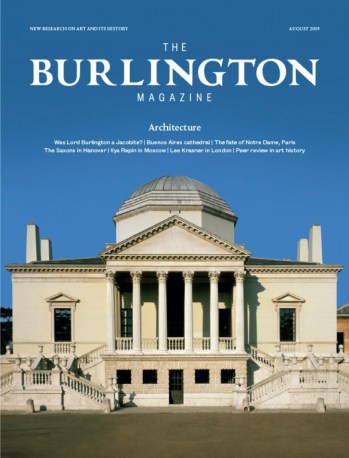 E D I T O R I A L
• “At the Yale Center for British Art,” p. 619. At the end of June Amy Meyers stepped down as Director of the Yale Center for British Art, New Haven, after seventeen years.
A R T I C L E S
• Sam Rose, “Peer Review in Art History,” pp. 621–25. A more recent development than is often realized, and historically imposed in a variety of ways, peer review is a fundamental but rarely discussed aspect of academic life. What impact does it have on publishing in art history?
• Alexander Echlin, “Was Lord Burlington a Jacobite?,” pp. 626–37. A thesis first put forward thirty years ago that Lord Burlington was a Jacobite, who used buildings and gardens to express his clandestine views, has won a measure of support. However, the biographical evidence is circumstantial and the architectural evidence is so ambiguous that it cannot sustain the argument.
• Gauvin Alexander Bailey, “Buenos Aires Cathedral in the Eighteenth Century,” pp. 638–47. Greatly altered in the early eighteenth century, the original appearance of the interior of Buenos Aires Cathedral, designed by Antonio Masella and completed by Manuel Álvarez de Rocha in 1771, is here reconstructed from newly identified visual sources, a watercolour of c.1830 and nineteenth-century photographs.
• Alexandra Gajewski and Michael Hall, “The Fate of Notre-Dame, Paris,” pp. 648–52. The first at Notre-Dame in April destroyed its largely medieval roof and the flèche designed by Violeet-le-Duc as well as badly damaging the vaults. Plans for repairs depend on an assessment of the long-term structural damage to the cathedral, despite which a five-year timetable for the restoration has been imposed by President Macron and a competition for a replacement flèche initiated.
• Giovan Battista Fidanza, “New Evidence for the ‘Barberini Apostles’ by Andrea Sacchi and Carlo Maratti,” pp. 653–59. Unpublished documents in the Barberini Archives in the Vatican Library clarify the patronage, authorship, and dating of a celebrated series of nine paintings of the Apostles commissioned from Andrea Sacchi and Carlo Maratti by Cardinals Antonio Barberini the Younger and Carlo Barberini.
R E V I E W S
• Simon Lee, Review of the exhibitions The Majesties’ Retiring Room and A Painting for a Nation: The Execution of Torrijos (Prado, 2019), pp. 673–76.
• John Bold, Review of Matthew Walker, Architects and Intellectual Culture in Post-Restoration England (Oxford University Press, 2017), pp. 688–89.
• Anthony Colantuono, Review of Claire Farago, Janis Bell and Carlo Vecce, The Fabrication of Leonardo da Vinci’s ‘Trattato della pittura’ (Brill, 2018), pp. 693–95.
• Sandra Miller, Review of Valerie Steele, ed., Pink: The History of a Punk, Pretty, Powerful Colour (Thames & Hudson, 2018), pp. 701–02.
Exhibition | George Stubbs: ‘All Done from Nature’
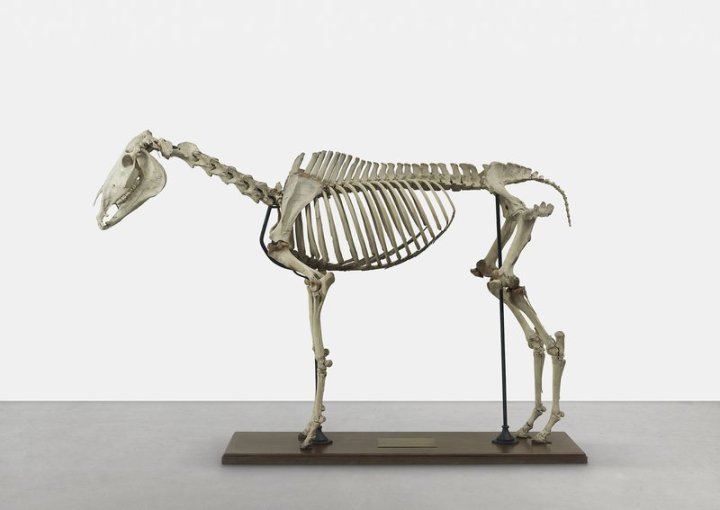
Skeleton of Eclipse (Collection of the Royal Veterinary College, University College London). Eclipse died in 1789 at the age of 25. The Veterinary College was built in 1791, with its first students enrolling in January of 1792.
◊ ◊ ◊ ◊ ◊
Opening next month at MK Gallery:
George Stubbs: ‘All Done from Nature’
MK Gallery, Milton Keynes, 12 October 2019 — 26 January 2020
Mauritshuis, The Hague, 20 February — 1 June 2020
George Stubbs: ‘All done from Nature’ presents the first significant overview of Stubbs’s work in Britain for more than 30 years and brings together 100 paintings, drawings, and publications—from the National Gallery’s Whistlejacket to pieces that have never been seen in public.
 Born in Liverpool in 1724, Stubbs was a quintessential product of the Enlightenment and embodied all of its core principles, questioning traditional authority and embracing the notion that humanity could be improved through the application of reason. Rather than trust to history and the untested example of his artistic and scientific precursors, Stubbs championed doing as a way of thinking and deployed pictorial representation as a form of knowledge and understanding. Today, he is recognised as one of the most original artists of the eighteenth century. His wide-ranging subjects included portraits, conversation pieces, and pictures of exotic and domestic animals—horses included—and his obsession with scientific exactitude has drawn comparison with the work of Leonardo da Vinci.
A major theme of the exhibition is anatomy. The show includes Stubbs’s contributions to a pioneering treatise on midwifery and his preliminary work on A Comparative Anatomical Exposition of the Structure of the Human Body with that of a Tiger and a Common Fowl. It also includes the detailed studies and drawings that led to The Anatomy of the Horse—the greatest coming together of art and science in British art—alongside the actual skeleton of the legendary racehorse Eclipse, which Stubbs depicted on several occasions.
A version of the show will tour to the Mauritshuis in The Hague where it will be the first-ever exhibition on the artist in the Netherlands. The exhibition is accompanied by a fully illustrated catalogue with major contributions from Alison Wright, Jenny Uglow, Martin Myrone, Martin Postle, and Nicholas Clee as well as new and existing poetry by Roger Robinson.
Anthony Spira, Martin Postle, and Paul Bonaventura, George Stubbs: ‘all done from Nature’ (London: Paul Holberton Publishing, 2019), 224 pages, ISBN: 978-1911300687, £35.
More information on the skeleton of Eclipse is available from this article by Mark Brown for The Guardian (6 July 2019).
Print Quarterly, September 2019

James Gillray, New Morality; – or – The Promis’d Installment of the High-Priest of the Theophilanthropes, with the Homage of Leviathan and his Suite, 1798, hand-colored etching, 8 × 24 inches (New Haven: Yale Center for British Art, Paul Mellon Collection, B1981.25.1001).
◊ ◊ ◊ ◊ ◊
The eighteenth century in the current issue of Print Quarterly:
Print Quarterly 36.3 (September 2019)
A R T I C L E S
Allison M. Stagg, “William Cobbett, James Gillray and the Market for Caricatures in 1790s Philadelphia,” pp. 263–74.
In the decades immediate following the American Revolution (1775–83), caricature prints were imported from London to cities along the east coast of North America. Evidence of a transatlantic transfer of British satirical imagery can be found in the numerous advertisements published in American newspapers from this period. Despite the frequency with which caricatures are mentioned in newspapers, few details can readily be discerned from them. The advertisements primarily reference the general arrival of collections of British caricature prints, usually as an addendum to other imported items such as books, stationery and even clocks, and provide little to no mention as to what specific caricatures crossed the Atlantic (263) . . . Details found in documents dating from the last decade of the eighteenth century, however, allow for a more thorough examination of the availability of and interest in imported and American caricatures in Philadelphia in the late 1790s. The primary source is an account book in the collection of the American Antiquarian Society in Worcester, MA, of the famous British radical, polemicist and publisher William Cobbett (1763–1835), who took refuge in American in 1793 (264).
N O T E S A N D R E V I E W S
 Truusje Goedings, Review of Wolf Eiermann, Claudia Steinhardt-Hirsch and Eckhard Leuschner, Prachtvoll illuminirt: Das Handkolorit in der Druckgrafik, 1493–1870 (Hirmer Verlag, 2018), pp. 304–06.
Neglected for a long time, the hand-colouring of prints, book illustrations and maps has been the subject of serious research during the last three decades, resulting in major exhibitions with comprehensive catalogues. . . [The present] catalogue, edited by Wolf Eiermann . . . is another effort to make the picture of 400 year of handcolouring more complete . . . The Sammlung Frank, a private collection in Stuttgart focused on German art and formed in the previous century, served as the main source, supplying about 110 of the 134 catalogued items (304) . . . The period from c. 1760 to 1880 is well represented with about one hundred items, mainly topographical, but also on costumes and natural history, including a rare example of Christian Gottlieb Ludwig’s Ectypa vegetabilium . . . / Nach der Nature verfertigte Abdrucke der Gewachse (nature-printed prints of plants; Halle and Leipzig, 1760–64) with 200 nature prints in contemporary colouring” (306).
Peter Fuhring, Review of Thomas Wilke, Innendekoration: Graphische Vorlagen und theoretische Vorgaben für die wandfeste Dekoration von Appartements im 17. und 18. Jahrhundert in Frankreich, 2 volumes (Scaneg Verlag, 2016), pp. 308–10.
The study of prints related to the decoration of secular interiors in France from the seventeenth and eighteenth centuries, in association with theoretical guidelines, . . . reveals an ambition that is difficult to fulfill. . . So far not a single catalogue or study encompasses the entire French print production of wall decorations, mantelpieces and ceilings made during both centuries. . . Further research is necessary to complete the still lacunar state of our knowledge. This is what Wilkie strives to do. His study is composed of two parts: the first volume offers a presentation of the issues as set out in the title, while the second consists of a catalogue of prints that form the basis of the author’s demonstration (308).
Véronique Meyer, Review of Katie Scott, Becoming Property: Art, Theory, and Law in Early Modern France (Yale University Press, 2018), pp. 313–15.
[Scott’s] recent book . . . examines the relationship between intellectual property and the visual arts in France from the sixteenth century to the beginning of the nineteenth . . . It traces the history of this relationship, highlighting key moments with exemplary case studies as well as citing regulations and legal texts, (313) and examines the role of the parties involved, including booksellers, publishers, engravers, draughtsmen and authors. Although the sixteenth and seventeenth centuries occupy and important place in the book, which shows how the definition of privilege and copyright evolved over the years, it is above all France of the Enlightenment and Revolution that lies at the heart of this study (314). . . [It] is a must for all who are interested in the history of printmaking, the decorative arts and artistic theories and institutions such as the Académie Royale (315).
David Bindman, Review of Cynthia Roman, ed., Hogarth’s Legacy (Yale University Press, 2016), pp. 315–16.
Hogarth’s enormous and long-lasting influence on art and popular imagery is the subject of a series of essays, largely by scholars of eighteenth-century art, including . . . Douglas Fordham, Dominic Hardy, Brian Maidment, Patricia Mainardi, Ronald Paulson, Mark Salber Philips, and Michael Printy. . . Collections of essays inevitably fall somewhere on the spectrum between the tightly focused, based on a close conversation between the authors, and the loose and baggy, in which the connections between the essays are more informal. Although the quality of the essays is uniformly excellent, this volume tends more toward the baggy . . . The main and entirely commendable purpose of the volume seems to have been to make scholarly use and draw further attention to the relatively little-known and underused, and in some areas quite spectacular, collections of Hogarth engravings and late eighteenth-century caricature in the Walpole Library (315).
Roger Paas, Review of Josef Biller, Calendaria Bambergensia: Bamberger Einblattkalender des 15. bis 19. Jahrhunderts von der Inkunabelzeit bis zur Säkularisation, 2 volumes (Anton H. Konrad Verlag, 2018), pp. 317–19.
Biller has dedicated over four decades to the collecting and studying of broadside (316) calendars published for the bishopric of Bamberg, and the results of his in-depth research have now been published in a detailed and richly illustrated two-volume catalogue (318).
Daniel Godfrey, Review of Anke Fröhlich-Schauseil, Schenau (1737–1806): Monografie und Werkverzeichnis der Gemälde, Handzeichnungen und Druckgrafik von Johann Eleazar Zeißig, gen. Schenau (Michael Imhof Verlag, 2018), pp. 319–23.
The son of a damask weaver from Großschönau in Saxony, Schenau fled the outbreak of the Seven Years’ War in 1756 to Paris. There he Frenchified his name and established a reputation as an artist of ‘society paintings’ focused on liaisons between the sexes, coiffure and the texture of material. The mentorship of Johann Georg Wille (1715–1808), engraver, print publisher and art dealer, must have motivated Schenau to execute a set of twelve etchings in 1765, six of children acting as adults and six of heads . . . These were to remain Schenau’s only autograph prints (319) . . . Yet, Schenau’s career developed in symbiosis with the print.
Mark Bills, Review of John Ford, Rudolph Ackermann and the Regency World (Warnham Books, 2018), pp. 323–25.
Although Ackermann belongs to and epitomizes the Regency Period (1788–1830), one cannot help but think that he would be a very useful figure in the art and design world of today (323) . . . John Ford has absorbed an enormous body of material and given us a fascinating chronological account of Ackermann as well as adding important new research and insights (324).
P U B L I C A T I O N S R E C E I V E D
• Joachim Jacoby, Guillaume Jean Constantin (1755–1816): A Drawings Dealer in Paris (Ad Ilissum for the Fondation Custodia, 2018), p. 339.
• Peter Stoll, Französische Buchillustration des 18. Jahrhunderts in der Oettingen-Wallersteinschen Bibliothek (Universität Augsburg Bibliothek, 2018), p. 339.
• Thora Brylowe, Romantic Art in Practice: Cultural Work and the Sister Arts, 1760–1820 (Cambridge University Press, 2019), p. 339.
• Helen Rosslyn, A Buyer’s Guide to Prints (The Royal Academy of Arts in association with the London Original Print Fair, 2018), p. 342.
New Book | Gainsborough’s Blue Boy
From Routledge:
Valerie Hedquist, Class, Gender, and Sexuality in Thomas Gainsborough’s Blue Boy (New York, Routledge, 2019), 202 pages, ISBN: 978-1138543423, $150.
 The reception of Thomas Gainsborough’s Blue Boy from its origins to its appearances in contemporary visual culture reveals how its popularity was achieved and maintained by diverse audiences and in varied venues. Performative manifestations resulted in contradictory characterizations of the painted youth as an aristocrat or a ‘regular fellow’, as masculine or feminine, or as heterosexual or gay. In private and public spaces where viewers saw the actual painting and where living and rendered replicas circulated, Gainsborough’s painting was often the centerpiece where dominant and subordinate classes met, gender identities were enacted, and sexuality was implicitly or overtly expressed.
Valerie Hedquist is Professor of Art History at the University of Montana.
C O N T E N T S
List of Figures
List of Plates
Acknowledgments
Introduction
1 Private Beginnings, Public Performances
2 The Blue Boy from Gainsborough’s Showroom to Grosvenor’s Picture Gallery
3 Public Recognition
4 Reproducing The Blue Boy
5 Farewell to England
6 Welcome to America
7 Changing Roles for The Blue Boy
Conclusion
Bibliography
Index










 Enfilade
leave a comment