New Book | Epic Landscapes: Latrobe and the Art of Watercolor
From The University of Virginia Press:
Julia A. Sienkewicz, Epic Landscapes: Benjamin Henry Latrobe and the Art of Watercolor (Charlottesville: The University of Virginia Press, 2019), 288 pages, ISBN 978-1644531594, $65.
 Epic Landscapes is the first study devoted to architect Benjamin Henry Latrobe’s substantial artistic oeuvre from 1795, when he set sail from Britain to Virginia, to late 1798, when he relocated to Pennsylvania. Thus, this book offers the only extended consideration of Latrobe’s Virginian watercolors, including a series of complex trompe l’oeil studies and three significant illustrated manuscripts. Though Latrobe’s architecture is well known, his watercolors have received little critical attention. Epic Landscapes rediscovers Latrobe’s watercolors as an ambitious body of work and reconsiders the close relationship between the visual and spatial sensibility of these images and his architectural designs. It also offers a fresh analysis of Latrobe within the context of creative practice in the Atlantic world at the end of the eighteenth century as he explored contemporary ideas concerning the form of art for Republican society and the social impacts of revolution.
Julia Sienkewicz is Assistant Professor of Art History at Roanoke College.
New Book | Teaching Representations of the French Revolution
From MLA:
Julia Douthwaite Viglione, Antoinette Sol, and Catriona Seth, eds., Teaching Representations of the French Revolution (New York: MLA, 2019), 268 pages, ISBN: 978-1603294652 (cloth), $65 / ISBN: 978-1603294003 (paper), $34.
 In many ways the French Revolution—a series of revolutions, in fact, whose end has arguably not yet arrived—is modernity in action. Beginning in reform, it blossomed into wholesale attempts to remake society, uprooting the clergy and aristocracy, valorizing mass movements, and setting secular ideologies, including nationalism, in motion. Unusually manifold and complicated, the revolution affords many teaching opportunities and challenges. This volume helps instructors seeking to connect developments today—terrorism, propaganda, extremism—with the events that began in 1789, contextualizing for students a world that seems always unmoored and in crisis.
The volume supports the teaching of the revolution’s ongoing project across geographic areas (from Haiti, Latin America, and New Orleans to Spain, Germany, and Greece), governing ideologies (human rights, secularism, liberty), and literatures (from well-known to newly rediscovered texts). Interdisciplinary, intercultural, and insurgent, the volume has an energy that reflects its subject.
C O N T E N T S
Acknowledgments
• Julia Douthwaite Viglione, Antoinette Sol, and Catriona Seth — Introduction
Part I: Historical Contexts
• Julia Douthwaite Viglione, Antoinette Sol, and Catriona Seth — A Narrative Chronology of Events in Revolutionary France
• Lauren Pinzka — Teaching the French Revolution as Myth and Memory
• Christopher Tozzi — Teaching the Revolution through a Military Lens
• Séverine Rebourcet — Liberté, Egalité, Fraternité, and Laïcité: Frenchness, Islam, and French Hip-Hop
Part II: Rhetoric, Rights, and Revolution
• Jeffrey Champlin — Rights, Revolution, Representation: Thinking through the Language of the French Revolution
• Pratima Prasad — Human Rights and Human Wrongs: Slavery and Colonialism in a Time of Revolution
• Habiba Boumlik and Robin Kietlinski — Teaching the French Revolution at a Community College: Challenges and Benefits
• Melanie Conroy — Teaching Republican Culture through Caricature: The Scandal of Charlie Hebdo
Part III: Writing the Revolution
• Julia Douthwaite Viglione, Antoinette Sol, and Catriona Seth — Editors’ Choice: Essential Texts of the French Revolution
• Logan J. Connors — Teaching the Revolution’s Theater as Cultural History
• Amir Minsky — The French Revolution and the German Chimera: Theatricality, Emotions, and the Untransferability of Revolution in J. H. Campe’s Briefe aus Paris
• Erin A. Myers — The Sans-culottides: Learning Revolutionary-Era French Culture through Celebration and a Reading of Hugo’s Quatrevingt-treize
• Jennifer Gipson — Rethinking History: The ‘Marseillaise Noire’ and Legacies of the Revolution in Creole New Orleans
• Matthew Lau — Writing to Appreciate the Enigmas of Danton’s Death and Monsieur Toussaint at the Community College
Part IV: The Revolution in Art and Mass Media
• Beth S. Wright — ‘Speaking to All the Senses at Once’: The French Revolution through the Visual Arts
• Amaya Martin and José A. Martin-Pereda — The French Revolution and the Beginning of Modern Communications
• Giulia Pacini — Ideas on the Table: Teaching with the Faïences Révolutionnaires
• Melissa A. Deininger — The French Revolution and Modern Propaganda
• Dominica Chang — French Revolutionary Women: A Century of Media Representation
• Katherine Astbury — Engaging Students in Research: Stop-Motion Videos, Strip Cartoons, and the Waddesdon Manor Collection of Prints
Part V: Global Reverberations
• J. B. Mertz — Teaching the Revolution Debate: Edmund Burke, His Radical Respondents, and William Blake
• Ronan Y. Chalmin — How Should an Invisible Event Be Taught? The Haitian Revolution as Pedagogical Case Study
• Marlene L. Daut — Teaching Perspective: The Relation between the Haitian and French Revolutions
• Ourida Mostefai — Exile, Displacement, and Citizenship: Émigrés from the French Revolution to the Twenty-First Century
• Rosa Mucignat and Sanja Perovic — The French Revolution Effect: France, Italy, Germany, Greece
• John Pizer — Teaching the French Revolution in Late-Eighteenth- and Early-Nineteenth-Century German Literature Classes
• Yvonne Fuentes — The French Revolution’s Echo in Spain through Literary and Satirical Representations
• Amy E. Wright — From Transnational Political Thought to Popular National Iconography: Latin America’s Cult of Liberté in the Age of Revolution
Part VI: Resources
• Melissa A. Deininger — French Revolution: Dates and People
• Christopher Tozzi — Major Battles of the Revolutionary Period
• Julia Douthwaite Viglione, Dominica Chang, Melanie Conroy, and Melissa A. Deininger — Filmography
• Beth S. Wright — Revolutionary Artwork
Notes on Contributors
Index
Exhibition | Cut and Paste
◊ ◊ ◊ ◊ ◊
Now on view at Edinburgh’s Modern Two; for the earlier period, see the catalogue essay by Freya Gowrley:
Cut and Paste: 400 Years of Collage
Scottish National Gallery Of Modern Art (Modern Two), Edinburgh, 29 June — 27 October 2019
 A huge range of approaches is on show, from sixteenth-century anatomical ‘flap prints’, to computer-based images; work by amateur, professional and unknown artists; collages by children and revolutionary cubist masterpieces by Pablo Picasso and Juan Gris; from nineteenth-century do-it-yourself collage kits to collage films of the 1960s. Highlights include a three-metre-long folding collage screen, purportedly made in part by Charles Dickens; a major group of Dada and Surrealist collages, by artists such as Kurt Schwitters, Joan Miró, Hannah Höch, and Max Ernst; and major postwar works by Henri Matisse, Robert Rauschenberg, and Peter Blake, including the only surviving original source photographs for Blake’s and Jann Haworth’s iconic, collaged cover for the Beatles’ album Sergeant Pepper’s Lonely Hearts Club Band.
The importance of collage as a form of protest in the 1960s and 70s will be shown in the work of feminist artists such as Carolee Schneemann, Linder, and Hannah Wilke; Punk artists, such as Jamie Reid, whose original collages for the Sex Pistols’ album and posters will feature; and the famously subversive collages of Monty Python founder Terry Gilliam. The exhibition also features the legendary library book covers which the playwright Joe Orton and his lover Kenneth Halliwell doctored with collages, and put back on Islington Library’s shelves—a move which landed them in prison for six months. In addition, the exhibition also demonstrates how collage remains important for the practice of many artists working today. Owing to the fragility of much of the work, the exhibition will not tour: it can only be seen at the Scottish National Gallery of Modern Art in Edinburgh.
Patrick Elliott, ed., with essays by Freya Gowrley and Yuval Etgar, Cut and Paste: 400 Years of Collage (Edinburgh: National Galleries of Scotland, 2019), 184 pages, ISBN: 978-1911054313, £25.
New Book | Painting and Calligraphy from the Islamic World
From PHP:
Will Kwiatkowski, Legacy of the Masters: Painting and Calligraphy from the Islamic World (London: Paul Holberton Publishing, 2019), 224 pages, ISBN: 978-1911300731, £50.
 Lavishly illustrated, this exquisite and scholarly book presents a collection of over sixty paintings, drawings, and calligraphic specimens mostly made in the Safavid, Uzbek, Ottoman and Mughal Empires in the period from the 16th through the early 19th century for inclusion in albums (muraqqa). The compilation of these albums, involving the collection and ordering of the works to be included as well as the design and execution of decorative borders, was an art form in itself and amounted to a broader cultural phenomenon that has increasingly become the focus of scholarly attention.
This was the age of the master artist, whose work was eagerly sought by collectors, imitated by admirers and forgers, taken as loot by invaders, and exchanged as gifts that had value across political borders. The international currency of a master artist’s work is particularly apparent in the case of the calligrapher Mir ‘Ali of Herat (d. 1544), whose calligraphies were almost obsessively sought out by the Mughal rulers of India and provided a model for subsequent generations of calligraphers in India and Iran.
In Iran, Shah ‘Abbas’ new capital of Isfahan was the breeding ground for a generation of artists specialized in single-page calligraphic compositions, paintings, and drawings, often working in distinctive styles. These included calligraphers such as Mir ‘Imad al-Hasani and ‘Ali Riza ‘Abbasi, and painters like Riza ‘Abbasi, Muhammad Qasim and, later, Mu’in Musavvir.
The processes of collection and compilation were complex, as albums were gifted and reassembled to suit the tastes and outlook of new owners. An eloquent example of this ongoing evolution is the famous St. Petersburg Album. Compiled and given decorative borders in Iran in the mid-18th century, the album contains a number of Mughal and Deccani paintings and drawings presumed to have been taken to Iran as plunder by Nadir Shah following the invasion of India in 1739. The end of this tradition is marked in the publication by a number of works from Mughal-style albums of calligraphy and painting acquired by officers and administrators of the British East India Company such as Warren Hastings and William Fraser.
The Burlington Magazine, August 2019
The August issue of The Burlington was especially rich for the eighteenth century; apologies for not posting it much sooner, but it’s worth noting. –CH
The Burlington Magazine 161 (August 2019)
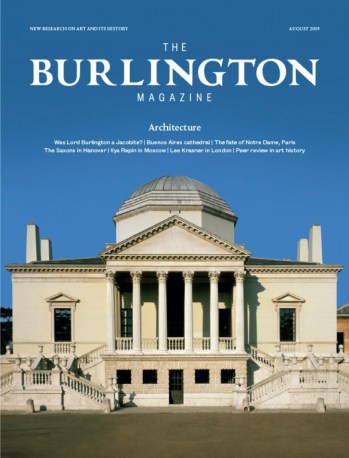 E D I T O R I A L
• “At the Yale Center for British Art,” p. 619. At the end of June Amy Meyers stepped down as Director of the Yale Center for British Art, New Haven, after seventeen years.
A R T I C L E S
• Sam Rose, “Peer Review in Art History,” pp. 621–25. A more recent development than is often realized, and historically imposed in a variety of ways, peer review is a fundamental but rarely discussed aspect of academic life. What impact does it have on publishing in art history?
• Alexander Echlin, “Was Lord Burlington a Jacobite?,” pp. 626–37. A thesis first put forward thirty years ago that Lord Burlington was a Jacobite, who used buildings and gardens to express his clandestine views, has won a measure of support. However, the biographical evidence is circumstantial and the architectural evidence is so ambiguous that it cannot sustain the argument.
• Gauvin Alexander Bailey, “Buenos Aires Cathedral in the Eighteenth Century,” pp. 638–47. Greatly altered in the early eighteenth century, the original appearance of the interior of Buenos Aires Cathedral, designed by Antonio Masella and completed by Manuel Álvarez de Rocha in 1771, is here reconstructed from newly identified visual sources, a watercolour of c.1830 and nineteenth-century photographs.
• Alexandra Gajewski and Michael Hall, “The Fate of Notre-Dame, Paris,” pp. 648–52. The first at Notre-Dame in April destroyed its largely medieval roof and the flèche designed by Violeet-le-Duc as well as badly damaging the vaults. Plans for repairs depend on an assessment of the long-term structural damage to the cathedral, despite which a five-year timetable for the restoration has been imposed by President Macron and a competition for a replacement flèche initiated.
• Giovan Battista Fidanza, “New Evidence for the ‘Barberini Apostles’ by Andrea Sacchi and Carlo Maratti,” pp. 653–59. Unpublished documents in the Barberini Archives in the Vatican Library clarify the patronage, authorship, and dating of a celebrated series of nine paintings of the Apostles commissioned from Andrea Sacchi and Carlo Maratti by Cardinals Antonio Barberini the Younger and Carlo Barberini.
R E V I E W S
• Simon Lee, Review of the exhibitions The Majesties’ Retiring Room and A Painting for a Nation: The Execution of Torrijos (Prado, 2019), pp. 673–76.
• John Bold, Review of Matthew Walker, Architects and Intellectual Culture in Post-Restoration England (Oxford University Press, 2017), pp. 688–89.
• Anthony Colantuono, Review of Claire Farago, Janis Bell and Carlo Vecce, The Fabrication of Leonardo da Vinci’s ‘Trattato della pittura’ (Brill, 2018), pp. 693–95.
• Sandra Miller, Review of Valerie Steele, ed., Pink: The History of a Punk, Pretty, Powerful Colour (Thames & Hudson, 2018), pp. 701–02.
Exhibition | George Stubbs: ‘All Done from Nature’
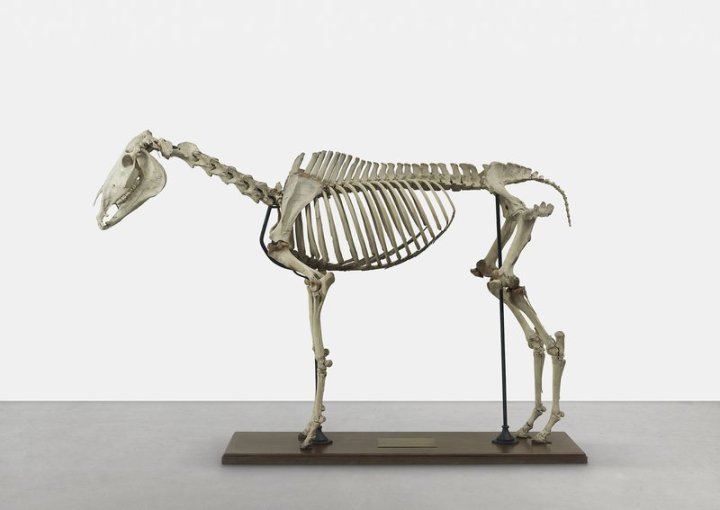
Skeleton of Eclipse (Collection of the Royal Veterinary College, University College London). Eclipse died in 1789 at the age of 25. The Veterinary College was built in 1791, with its first students enrolling in January of 1792.
◊ ◊ ◊ ◊ ◊
Opening next month at MK Gallery:
George Stubbs: ‘All Done from Nature’
MK Gallery, Milton Keynes, 12 October 2019 — 26 January 2020
Mauritshuis, The Hague, 20 February — 1 June 2020
George Stubbs: ‘All done from Nature’ presents the first significant overview of Stubbs’s work in Britain for more than 30 years and brings together 100 paintings, drawings, and publications—from the National Gallery’s Whistlejacket to pieces that have never been seen in public.
 Born in Liverpool in 1724, Stubbs was a quintessential product of the Enlightenment and embodied all of its core principles, questioning traditional authority and embracing the notion that humanity could be improved through the application of reason. Rather than trust to history and the untested example of his artistic and scientific precursors, Stubbs championed doing as a way of thinking and deployed pictorial representation as a form of knowledge and understanding. Today, he is recognised as one of the most original artists of the eighteenth century. His wide-ranging subjects included portraits, conversation pieces, and pictures of exotic and domestic animals—horses included—and his obsession with scientific exactitude has drawn comparison with the work of Leonardo da Vinci.
A major theme of the exhibition is anatomy. The show includes Stubbs’s contributions to a pioneering treatise on midwifery and his preliminary work on A Comparative Anatomical Exposition of the Structure of the Human Body with that of a Tiger and a Common Fowl. It also includes the detailed studies and drawings that led to The Anatomy of the Horse—the greatest coming together of art and science in British art—alongside the actual skeleton of the legendary racehorse Eclipse, which Stubbs depicted on several occasions.
A version of the show will tour to the Mauritshuis in The Hague where it will be the first-ever exhibition on the artist in the Netherlands. The exhibition is accompanied by a fully illustrated catalogue with major contributions from Alison Wright, Jenny Uglow, Martin Myrone, Martin Postle, and Nicholas Clee as well as new and existing poetry by Roger Robinson.
Anthony Spira, Martin Postle, and Paul Bonaventura, George Stubbs: ‘all done from Nature’ (London: Paul Holberton Publishing, 2019), 224 pages, ISBN: 978-1911300687, £35.
More information on the skeleton of Eclipse is available from this article by Mark Brown for The Guardian (6 July 2019).
Print Quarterly, September 2019

James Gillray, New Morality; – or – The Promis’d Installment of the High-Priest of the Theophilanthropes, with the Homage of Leviathan and his Suite, 1798, hand-colored etching, 8 × 24 inches (New Haven: Yale Center for British Art, Paul Mellon Collection, B1981.25.1001).
◊ ◊ ◊ ◊ ◊
The eighteenth century in the current issue of Print Quarterly:
Print Quarterly 36.3 (September 2019)
A R T I C L E S
Allison M. Stagg, “William Cobbett, James Gillray and the Market for Caricatures in 1790s Philadelphia,” pp. 263–74.
In the decades immediate following the American Revolution (1775–83), caricature prints were imported from London to cities along the east coast of North America. Evidence of a transatlantic transfer of British satirical imagery can be found in the numerous advertisements published in American newspapers from this period. Despite the frequency with which caricatures are mentioned in newspapers, few details can readily be discerned from them. The advertisements primarily reference the general arrival of collections of British caricature prints, usually as an addendum to other imported items such as books, stationery and even clocks, and provide little to no mention as to what specific caricatures crossed the Atlantic (263) . . . Details found in documents dating from the last decade of the eighteenth century, however, allow for a more thorough examination of the availability of and interest in imported and American caricatures in Philadelphia in the late 1790s. The primary source is an account book in the collection of the American Antiquarian Society in Worcester, MA, of the famous British radical, polemicist and publisher William Cobbett (1763–1835), who took refuge in American in 1793 (264).
N O T E S A N D R E V I E W S
 Truusje Goedings, Review of Wolf Eiermann, Claudia Steinhardt-Hirsch and Eckhard Leuschner, Prachtvoll illuminirt: Das Handkolorit in der Druckgrafik, 1493–1870 (Hirmer Verlag, 2018), pp. 304–06.
Neglected for a long time, the hand-colouring of prints, book illustrations and maps has been the subject of serious research during the last three decades, resulting in major exhibitions with comprehensive catalogues. . . [The present] catalogue, edited by Wolf Eiermann . . . is another effort to make the picture of 400 year of handcolouring more complete . . . The Sammlung Frank, a private collection in Stuttgart focused on German art and formed in the previous century, served as the main source, supplying about 110 of the 134 catalogued items (304) . . . The period from c. 1760 to 1880 is well represented with about one hundred items, mainly topographical, but also on costumes and natural history, including a rare example of Christian Gottlieb Ludwig’s Ectypa vegetabilium . . . / Nach der Nature verfertigte Abdrucke der Gewachse (nature-printed prints of plants; Halle and Leipzig, 1760–64) with 200 nature prints in contemporary colouring” (306).
Peter Fuhring, Review of Thomas Wilke, Innendekoration: Graphische Vorlagen und theoretische Vorgaben für die wandfeste Dekoration von Appartements im 17. und 18. Jahrhundert in Frankreich, 2 volumes (Scaneg Verlag, 2016), pp. 308–10.
The study of prints related to the decoration of secular interiors in France from the seventeenth and eighteenth centuries, in association with theoretical guidelines, . . . reveals an ambition that is difficult to fulfill. . . So far not a single catalogue or study encompasses the entire French print production of wall decorations, mantelpieces and ceilings made during both centuries. . . Further research is necessary to complete the still lacunar state of our knowledge. This is what Wilkie strives to do. His study is composed of two parts: the first volume offers a presentation of the issues as set out in the title, while the second consists of a catalogue of prints that form the basis of the author’s demonstration (308).
Véronique Meyer, Review of Katie Scott, Becoming Property: Art, Theory, and Law in Early Modern France (Yale University Press, 2018), pp. 313–15.
[Scott’s] recent book . . . examines the relationship between intellectual property and the visual arts in France from the sixteenth century to the beginning of the nineteenth . . . It traces the history of this relationship, highlighting key moments with exemplary case studies as well as citing regulations and legal texts, (313) and examines the role of the parties involved, including booksellers, publishers, engravers, draughtsmen and authors. Although the sixteenth and seventeenth centuries occupy and important place in the book, which shows how the definition of privilege and copyright evolved over the years, it is above all France of the Enlightenment and Revolution that lies at the heart of this study (314). . . [It] is a must for all who are interested in the history of printmaking, the decorative arts and artistic theories and institutions such as the Académie Royale (315).
David Bindman, Review of Cynthia Roman, ed., Hogarth’s Legacy (Yale University Press, 2016), pp. 315–16.
Hogarth’s enormous and long-lasting influence on art and popular imagery is the subject of a series of essays, largely by scholars of eighteenth-century art, including . . . Douglas Fordham, Dominic Hardy, Brian Maidment, Patricia Mainardi, Ronald Paulson, Mark Salber Philips, and Michael Printy. . . Collections of essays inevitably fall somewhere on the spectrum between the tightly focused, based on a close conversation between the authors, and the loose and baggy, in which the connections between the essays are more informal. Although the quality of the essays is uniformly excellent, this volume tends more toward the baggy . . . The main and entirely commendable purpose of the volume seems to have been to make scholarly use and draw further attention to the relatively little-known and underused, and in some areas quite spectacular, collections of Hogarth engravings and late eighteenth-century caricature in the Walpole Library (315).
Roger Paas, Review of Josef Biller, Calendaria Bambergensia: Bamberger Einblattkalender des 15. bis 19. Jahrhunderts von der Inkunabelzeit bis zur Säkularisation, 2 volumes (Anton H. Konrad Verlag, 2018), pp. 317–19.
Biller has dedicated over four decades to the collecting and studying of broadside (316) calendars published for the bishopric of Bamberg, and the results of his in-depth research have now been published in a detailed and richly illustrated two-volume catalogue (318).
Daniel Godfrey, Review of Anke Fröhlich-Schauseil, Schenau (1737–1806): Monografie und Werkverzeichnis der Gemälde, Handzeichnungen und Druckgrafik von Johann Eleazar Zeißig, gen. Schenau (Michael Imhof Verlag, 2018), pp. 319–23.
The son of a damask weaver from Großschönau in Saxony, Schenau fled the outbreak of the Seven Years’ War in 1756 to Paris. There he Frenchified his name and established a reputation as an artist of ‘society paintings’ focused on liaisons between the sexes, coiffure and the texture of material. The mentorship of Johann Georg Wille (1715–1808), engraver, print publisher and art dealer, must have motivated Schenau to execute a set of twelve etchings in 1765, six of children acting as adults and six of heads . . . These were to remain Schenau’s only autograph prints (319) . . . Yet, Schenau’s career developed in symbiosis with the print.
Mark Bills, Review of John Ford, Rudolph Ackermann and the Regency World (Warnham Books, 2018), pp. 323–25.
Although Ackermann belongs to and epitomizes the Regency Period (1788–1830), one cannot help but think that he would be a very useful figure in the art and design world of today (323) . . . John Ford has absorbed an enormous body of material and given us a fascinating chronological account of Ackermann as well as adding important new research and insights (324).
P U B L I C A T I O N S R E C E I V E D
• Joachim Jacoby, Guillaume Jean Constantin (1755–1816): A Drawings Dealer in Paris (Ad Ilissum for the Fondation Custodia, 2018), p. 339.
• Peter Stoll, Französische Buchillustration des 18. Jahrhunderts in der Oettingen-Wallersteinschen Bibliothek (Universität Augsburg Bibliothek, 2018), p. 339.
• Thora Brylowe, Romantic Art in Practice: Cultural Work and the Sister Arts, 1760–1820 (Cambridge University Press, 2019), p. 339.
• Helen Rosslyn, A Buyer’s Guide to Prints (The Royal Academy of Arts in association with the London Original Print Fair, 2018), p. 342.
New Book | Gainsborough’s Blue Boy
From Routledge:
Valerie Hedquist, Class, Gender, and Sexuality in Thomas Gainsborough’s Blue Boy (New York, Routledge, 2019), 202 pages, ISBN: 978-1138543423, $150.
 The reception of Thomas Gainsborough’s Blue Boy from its origins to its appearances in contemporary visual culture reveals how its popularity was achieved and maintained by diverse audiences and in varied venues. Performative manifestations resulted in contradictory characterizations of the painted youth as an aristocrat or a ‘regular fellow’, as masculine or feminine, or as heterosexual or gay. In private and public spaces where viewers saw the actual painting and where living and rendered replicas circulated, Gainsborough’s painting was often the centerpiece where dominant and subordinate classes met, gender identities were enacted, and sexuality was implicitly or overtly expressed.
Valerie Hedquist is Professor of Art History at the University of Montana.
C O N T E N T S
List of Figures
List of Plates
Acknowledgments
Introduction
1 Private Beginnings, Public Performances
2 The Blue Boy from Gainsborough’s Showroom to Grosvenor’s Picture Gallery
3 Public Recognition
4 Reproducing The Blue Boy
5 Farewell to England
6 Welcome to America
7 Changing Roles for The Blue Boy
Conclusion
Bibliography
Index
Exhibition | Lansyer, Canaletto, & Piranesi
Now on view at the Lansyer House Museum:
Lansyer, Canaletto, and Piranesi: Images of Italy
Maison-Musée Lansyer, Loches, 1 May — 11 November 2019
 Après plus d’un an de travaux, la Maison-Musée Lansyer de Loches redevient le théâtre d’une exposition d’envergure mettant en évidence les richesses de ses collections. Du 1er mai au 11 novembre 2019, l‘exposition Lansyer, Canaletto & Piranèse : images d’Italie invite le visiteur au voyage en Italie, à Rome et à Venise, dans les pas du peintre paysagiste Emmanuel Lansyer (1835–1893). Ce circuit au temps du chemin de fer conduit sur les lieux de travail de l’artiste, dans la Rome Éternelle et au cœur de la Sérénissime Venise. Lansyer livre ses impressions sur ces deux villes, mais aussi les difficultés qu’il rencontre pour les représenter. Ainsi, les toiles de l’artiste font visiter la campagne romaine et les quartiers de Venise.
« Portraitiste de ville », Lansyer s’inscrit dans les pas de deux maîtres italiens du siècle précédent : Piranèse et Canaletto. Lansyer acquiert des séries exceptionnelles de gravures à l’eau-forte de ces grands védutistes qui célèbrent la grandeur de Rome et de Venise. Cette collection lochoise constitue l’un des ensembles les plus complets à l’échelle mondiale. Ces œuvres sont le résultat d’un travail artistique d’une extrême précision, dont on pourra admirer les détails, du tracé architectural de Piranèse au geste léger de Canaletto.
Enfin, Lansyer convie à un voyage au temps de la photographie naissante. Cet art en plein essor offre une autre image d’Italie, celle de son peuple et de ses richesses patrimoniales. Les photographies de Rome donnent à voir de très beaux points de vue sur la basilique Saint-Pierre et le forum romain. Celles de Venise s’intéressent aux lieux les plus emblématiques de la reine de la lagune : la place Saint-Marc, le Grand Canal et ses palais. On chemine également à travers des ruelles étroites et autour des puits dans lesquels s’approvisionnent Vénitiens et Vénitiennes en habits traditionnels. Autant de souvenirs de voyage et d’outils de travail pour l’artiste.Au total, une centaine d’œuvres, tableaux, photographies et gravures de la collection d’Emmanuel Lansyer, sont dévoilés au public de manière inédite. Une collection d’une richesse exceptionnelle, léguée à la Ville de Loches par l’artiste, pour l’agrément de tous. Guide de voyage en poche, montez dans le train et devenez un touriste du XIXe siècle le temps de la visite de l’exposition…
The catalogue is available from In Fine éditions d’art:
Lansyer, Canaletto & Piranèse : Images d’Italie (Paris: In Fine éditions d’art, 2019), 112 pages, ISBN: 978-2902302192, 18€.
Sous la direction de Véronique Lourme, responsable du Service Patrimoine de la Ville de Loches; Gilles Bertrand, professeur d’histoire moderne à l’Université de Grenoble; Manuel Royo, professeur d’archéologie et d’histoire de l’art à l’Université François-Rabelais de Tours; Annie Gilet, conservateur en chef honoraire du patrimoine; et Benjamin Bulte, étudiant en histoire de l’art, Université François-Rabelais de Tours.
S O M M A I R E
• Emmanuel Lansyer : un peintre paysagiste en Italie
Le Voyage en Italie au XIXe Siècle
• Lansyer et la tradition du voyage en Italie
• Les conditions et le temps du voyage
Le Voyage à Rome
• Lansyer à Rome ou l’histoire d’une déception
• Les vues de Rome par Piranèse
Le Voyage à Venise
• Le regard de Lansyer sur la Sérénissime
• Canaletto, graveur à l’eau-forte
Le Portrait de Ville
• Résonances entre Canaletto, Piranèse et Lansyer : trois portraitistes de villes
• La photographie : un nouvel outil de travail pour le portrait de ville
• Un voyage dans le temps, dans les pas d’un artiste collectionneur
Catalogue des Oeuvres
• La collection de peintures
• La collection de gravures
• La collection de photographies
Bibliographie
New Book | Handbook on the Reception of Classical Architecture
From Routledge:
Nicholas Temple, Andrzej Piotrowski, and Juan Manuel Heredia, eds., The Routledge Handbook on the Reception of Classical Architecture (London: Routledge, 2019), 592 pages, ISBN: 978-1138047112, $220.
 This is the first comprehensive study of the reception of classical architecture in different regions of the world. Exploring the impact of colonialism, trade, slavery, religious missions, political ideology, and intellectual/artistic exchange, the authors demonstrate how classical principles and ideas were disseminated and received across the globe. By addressing a number of contentious or unresolved issues highlighted in some historical surveys of architecture, the chapters presented in this volume question long-held assumptions about the notion of a universally accepted ‘classical tradition’ and its broadly Euro-centric perspective.
Featuring thirty-two chapters written by international scholars from China, Europe, Turkey, North America, Mexico, Australia, and New Zealand, the book is divided into four sections: 1) Transmission and Re-conceptualisation of Classical Architecture; 2) Classical Influence through Colonialism, Political Ideology and Religious Conversion; 3) Historiographical Surveys of Geographical Regions; and 4) Visual and Textual Discourses. This fourfold arrangement of chapters provides a coherent structure to accommodate different perspectives of classical reception across the world, and their geographical, ethnographic, ideological, symbolic, social, and cultural contexts. Essays cover a wide geography and include studies in Italy, France, England, Scotland, the Nordic countries, Greece, Austria, Portugal, Romania, Germany, Poland, India, Singapore, China, USA, Mexico, Brazil, New Zealand, and Australia. Other essays in the volume focus on thematic issues or topics pertaining to classical architecture, such as ornament, spolia, humanism, nature, moderation, decorum, heresy, and taste.
Nicholas Temple is an architect, Professor of Architecture and Director of the Centre for Urban Design, Architecture and Sustainability (CUDAS) at the University of Huddersfield. A graduate of Cambridge University, he previously served as head of the School of Architecture at the University of Lincoln and was an assistant professor of architecture at the University of Pennsylvania. Temple was a Rome Scholar in Architecture at the British School at Rome, a Paul Mellon Rome Fellow and Bogliasco Fellow and has collaborated on research projects on the history and theory of architecture and urbanism in Europe and China. His most recent research is a British Academy funded project with Professor Cecilia Panti on Lorenzo Ghiberti’s 3rd Commentary. He was shortlisted for the International CICA Bruno Zevi Book Award in 2014 for his book Renovatio Urbis: Architecture, Urbanism and Ceremony in the Rome of Julius II (Routledge, 2011) and is chief editor of the Routledge Research in Architectural History series and co-editor of the Journal of Architecture.
Andrzej Piotrowski, an architect educated in Poland and Professor of Architecture at the University of Minnesota, USA, combines in his scholarship theory and history of architecture. His Jeffrey Cook Award-winning research focuses on the epistemology of design. Covering global issues of architecture, religion, politics, and culture, his findings have been presented in many architectural and cross-disciplinary conferences. Author of Architecture of Thought (University of Minnesota Press, 2011) and co-editor with J. Williams Robinson of The Discipline of Architecture (University of Minnesota Press, 2001), he currently serves as an associate editor of the Traditional Dwellings and Settlements Review.
Juan Manuel Heredia is Associate Professor of Architecture at Portland State University, having completed a PhD and Master of Architecture at the University of Pennsylvania. He also holds a Diploma of Philosophy from Universidad Iberoamericana/Mexico City. Heredia studied and practised architecture in Mexico before moving to the United States in 1999 to pursue graduate studies. His research focuses on architectural theory and history, especially of the 20th century. His work has been published in Arquine and Bitacora (Mexico), On-Site Review (Canada) and Arkitekten (Denmark). In 2009 he co-organised the Second International Architecture and Phenomenology Conference held in Kyoto, Japan. His current writing focuses on 20th-century architecture in Mexico and Latin America.
C O N T E N T S
1. Introduction: A ‘World’ Reception of Classical Architecture Nicholas Temple, Andrzej Piotrowski and Juan Manuel Heredia
Part I: Transmission and Re-Conceptualisation of Classical Architecture
2 The Fates of Fornix Juan Manuel Heredia
3 Architects, Architecture, and the City: Some Themes on the Continuity of Classical Ideas Relating to the Latin Middle Ages Christian Frost
4 Rethinking Ornament in Classical Architecture: Spolia and Architecture as institutio Clare E. L. Guest
5 The Persistence of Natura Naturans from Classical Architecture John Hendrix
6 On Moderation: The Ancient Virtue and its Reception in Architectural Theory Esra Sahin Burat
7 Classical Columns, Mannerism, and the Other Antiquity Andrzej Piotrowski
8 Neoclassical Taste and Antiquarian Scholarship: The Royal Academy of the Three Noble Arts of San Carlos in Mexico, Alexander von Humboldt and Pedro José Márquez Oscar Humberto Flores
9 Eighteenth- and Nineteenth-Century Classicism in England: John Soane’s Language and Imagination Yue Zhuang
Part II: Classical Influences through Colonialism, Political Ideology, and Religious Conversion
10 Honour and the Classical Tradition in Architecture: The Matter of Slavery Charles Burroughs
11 Dismemberment of the Orders and their Reassembly across Portuguese Overseas Settlements Pedro Guedes
12 The Reception and Involution of Classical Architecture in Jesuit Missions in China, 1583–1759 Xiao Jing
13 The Gods That Came from the Sea: The Classical Tradition in New Spain Santiago de Orduña
14 Indo-Portuguese Architecture in Kerala during the Sixteenth and Seventeenth Centuries Helder Carita
15 Neo-classical Architecture in the Straits Settlements: Singapore’s Civic Square, 1819–1936 Raymond Quek
16 Herbert Baker, New Delhi, and the Reception of the Classical Tradition Soumyen Bandyopadhyay and Sagar Chauhan
Part III: Historiographical Surveys of Geographical Regions
17 Scotland’s Enduring Eclectic Classicism Ian Campbell
18 From Fischer von Erlach to Adolf Loos: The Classical in Austria Ross Jenner
19 Avatars of the Classical Tradition in Romanian Architecture Ana Maria Zahariade and Horia Moldovan
20 China (Sixteenth to Eighteenth Centuries): Renaissance Humanism and Chinese Architecture Hui Zou
21 Revising the Classical in Australian Architecture: Colonial New South Wales and Victoria Peter Kohane and Mark Stiles
22 ‘Pretty True Reflection of Our Civilisation’: Classical Architecture in Nineteenth-Century New Zealand Robin Skinner
23 Nordic Visions of a Classical World, 1901–1966 Harry Charrington
Part IV: Visual and Textual Discourses
24 (Re)Invoking Humanism in Modernity: Architecture and Spectacle in Fascist Italy Nicholas Temple and Eleni Tracada
25 Unclassical Forms of Late Roman Architecture and the Roman Baroque: Francesco Borromini and the New Classical Tradition Giuseppe Bonaccorso
26 Power, Patronage and Politics: Giovanni Niccolò Servandoni and the Reception of Neoclassicism in France Louise Pelletier
27 The Reception of European Renaissance Urban Theory in New Spain Juan Luis Burke
28 Thomas Jefferson: The American Landscape and the Architecture Carol William Westfall
29 The Revival of Classical Architecture in Athens, 1830–1860: Educational Institutions in Athens by Christian Hansen, Lysandros Kaftantzoglou and Stamatios Kleanthis Nikolaos Karydis
30 Modernism and Classicism in Brazil: Foundational Myths and Other Stories Daniela Sandler
31 Greek Temple Design and the Kathedrale des erotishen Elends Matthew Mindrup
32 The Underbelly of the Architect: Reproducing Classical Idioms of Power and Culture in Rome Renée Tobe and Tracey Eve Winton
Selected Bibliography
Index










leave a comment