Exhibition | Making Time: The Art of the Kentucky Tall Case Clock
Now on view at the Speed Art Museum:
Making Time: The Art of the Kentucky Tall Case Clock, 1790–1850
Speed Art Museum, Louisville, 2 February — 16 June 2019
Curated by Scott Erbes

Case attributed to Daniel Spencer (American, about 1741–1796), Lexington, Fayette County, Kentucky, Tall Case Clock, 1793–96; cherry, poplar, chestnut, walnut; eight-day brass and steel movement, 98 inches high (Cox Collection).
Making Time: The Art of the Kentucky Tall Case Clock, 1790–1850 is a first-of-its-kind exhibition devoted to early Kentucky tall case, ‘grandfather’ clocks. The exhibition showcases twenty-seven clocks made across a wide swath of Kentucky from the 1790s through the 1840s. The majority of the clocks come from family and private collections and have rarely, if ever, been shared with the public. The exhibition is accompanied by a fully illustrated scholarly catalog that presents significant new research on early Kentucky cabinetmaking and the state’s watch and clock trade.
When shown side-by-side, the clocks reveal the expert hands of many Kentucky artisans; illustrate the hidden world of gears, bells, weights, and pendulums that kept the clocks running and chiming; and record the complex webs of craft, taste, trade, and technology needed to make these practical works of art. Throughout the exhibition, the clock cases illustrate the talents of early Kentucky cabinetmakers, both native-born and those who came to the state in search of success. These artisans transformed local woods like cherry and walnut into towering cases that frequently incorporate flourishes like inlaid decoration, carved ornament, and richly figured veneers. The results range from urbane, Federal-style creations to more idiosyncratic, often boldly inlaid forms. Numerous Kentucky silversmiths are associated with the intricate movements housed within the various clocks.
Just in Time: Exploring Kentucky Tall Case Clocks
Speed Art Museum, Louisville, 18 May, 9:00–3:00
Come join us for a study day exploring the backstories behind early Kentucky tall case clocks with the experts who created the exhibition Making Time: The Art of the Kentucky Tall Case Clock, 1790–1850. Enjoy a morning of presentations focused on the art, history, and technology of these Kentucky treasures; an opportunity to purchase signed copies of the exhibition’s accompanying catalog; and an afternoon tour of the exhibition with its creators. $75.
Scott Erbes (Curator of Decorative Arts and Design, Speed Art Museum), From the Beginning: An Introduction to Kentucky Tall Case Clocks
Early Kentucky tall case clocks tell many stories: of the talented artisans who created them, of local and regional practices, of fashionable taste, of international trade, of the nature of time and timekeeping in Federal America, and of family memory. This overview will touch on these themes and others, setting the stage for the day’s conversations.
Mack Cox (independent researcher and collector), Making the Case for the Art in Kentucky Tall Case Clocks
Kentucky tall case clocks consist of locally made cases mated with clock movements, dials, and other components often made elsewhere. While the latter are often well documented, the Kentucky-made portions and artistic expressions of early Kentucky craftsmen are nearly unknown. Based on over a decade of serious study of Kentucky furniture, this lecture will shed light on the art and Kentucky parts of the Kentucky tall case clock.
Bob Burton (independent researcher and collector), What Makes It Tick: Inside Kentucky Tall Case Clocks
The movements and related parts in Kentucky tall case clocks vary widely in type, materials, and origins. This discussion will reveal these secrets, exploring the time-keeping mechanisms, painted dials, and other components that marked the time in early Kentucky clocks.
Greg Black (independent researcher and collector), Will the Real Elijah Warner Please Stand Up?
Over the past decades, much has been written about Elijah Warner of Lexington, Kentucky, especially that he was a cabinetmaker and clockmaker. The recent discovery of nineteenth-century documents and advertisements cast new light on Warner’s training and occupation and the goods he produced and sold. This presentation will review this information to bring the real Elijah Warner into better focus.
New Book | Art Crossing Borders
From Brill:
Jan Dirk Baetens and Dries Lyna, eds., Art Crossing Borders: The Internationalisation of the Art Market in the Age of Nation States, 1750–1914, Series: Studies in the History of Collecting & Art Markets, Volume 6 (Leiden: Brill, 2019), 351 pages, ISBN: 978-9004291980, €127 / $153.
 Art Crossing Borders offers a thought-provoking analysis of the internationalisation of the art market during the long nineteenth century. Twelve experts, dealing with a wide variety of geographical, temporal, and commercial contexts, explore how the gradual integration of art markets structurally depended on the simultaneous rise of nationalist modes of thinking, in unexpected and ambiguous ways.
Jan Dirk Baetens (PhD, University of Leuven, 2011), is Assistant Professor at Radboud University Nijmegen. He has published widely on the nineteenth-century art market and on nineteenth-century historicism. He is preparing a book-length study on the Belgian history and historical genre painter Henri Leys.
Dries Lyna (PhD, University of Antwerp, 2010), is Assistant Professor at Radboud University Nijmegen. He has published on the art markets and material culture of eighteenth-century cities in the Low Countries, co-editing Concepts of Value in European Material Culture, 1500–1900 (2015). He is currently preparing a book on the rise of art auctions in the Austrian Netherlands.
C O N T E N T S
Acknowledgements
Figures
Contributors
• Jan Dirk Baetens and Dries Lyna, Towards an International History of the Nineteenth-Century Art Trade
• Jan Dirk Baetens and Dries Lyna, The Education of the Art Market: National Schools and International Trade in the ‘Long’ Nineteenth Century
• Bénédicte Miyamoto, ‘Directions to Know a Good Picture’: Marketing National School Categories to the British Public in the ‘Long’ Eighteenth Century
• Leanne Zalewski, Creating Cultural and Commercial Value in Late Nineteenth-Century New York Art Catalogues
• Barbara Pezzini, (Inter)national Art: The London Old Masters Market and Modern British Painting (1900–14)
• Camilla Murgia, The Artistic Trade and Networks of the Italian Community in London around 1800
• Lukas Fuchsgruber, Berlin – Paris: Transnational Aspects of French Art Auctions in the Middle of the Nineteenth Century
• Adriana Turpin, Appropriation as a Form of Nationalism? Collecting French Furniture in the Nineteenth Century
• Sharon Hecker, The Modern Italian Sculptor as International Entrepreneur: The Case of Medardo Rosso (1858–1928)
• Robert Verhoogt, Art Reproduction, and the Nation: National Perspectives in an International Art Market
• Pamela Fletcher and Anne Helmreich, Reframing the ‘International Art Market’
Index
Call for Manuscripts | Brill Series, History of Collecting & Art Market
History of Collecting & Art Market
Brill Book Series, Edited by Christian Huemer
Brill‘s ‘Studies in the History of Collecting & Art Markets’ is a peer-reviewed book series dedicated to original scholarship on the social, cultural, and economic mechanisms underlying the circulation of art. Over the last two decades interest in the formation, display, and dissolution of art collections increased tremendously; art markets, trade routes, and dealer networks became a rich field of interdisciplinary inquiry. Scholarship brought forth a lot of information about the flamboyant personalities to whom the possession of art was a lifestyle; regarding the ‘social life of things’, i.e. the provenance of individual artworks, many research gaps could be closed.
This shift in scholarly attention from the production side to the consumption side of the art world is also reflected in the emergence of specialized post-graduate courses offered by a number of institutions internationally, as well as an ever-increasing stream of exhibitions, conferences, and publications devoted to the subject. Brill‘s book series accommodates scholarly monographs, collections of essays, conference proceedings, and works of reference that engage in the broadly defined topic of art markets and collecting practices throughout history.
We invite scholars to submit their English language manuscript proposal for the book series to Liesbeth Hugenholtz, acquisitions editor at Brill (hugenholtz@brill.com) or to the series editor Christian Huemer (C.Huemer@belvedere.at).
Editor-in-Chief
Christian Huemer (Belvedere Research Center, Vienna)
Editorial Board
Malcolm Baker (University of California, Riverside), Ursula Frohne (Westfälische Wilhelms-Universität Münster), Daniela Gallo (Université de Lorraine, Nancy), Hans van Miegroet (Duke University, Durham), Inge Reist (The Frick Collection, New York – retired), Adriana Turpin (Institut d’Etudes Supérieures des Arts, London), Filip Vermeylen (Erasmus University, Rotterdam)
More information about the series is available here»
New Book | Itch, Clap, Pox
From Yale UP:
Noelle Gallagher, Itch, Clap, Pox: Venereal Disease in the Eighteenth-Century Imagination (New Haven: Yale University Press, 2019), 288 pages, ISBN: 978-0300217056, $65.
 A lively interdisciplinary study of how venereal disease was represented in eighteenth-century British literature and art
In eighteenth-century Britain, venereal disease was everywhere and nowhere: while physicians and commentators believed the condition to be widespread, it remained shrouded in secrecy, and was often represented using slang, symbolism, and wordplay. In this book, literary critic Noelle Gallagher explores the cultural significance of the ‘clap’ (gonorrhea), the ‘pox’ (syphilis), and the ‘itch’ (genital scabies) for the development of eighteenth-century British literature and art. As a condition both represented through metaphors and used as a metaphor, venereal disease provided a vehicle for the discussion of cultural anxieties about gender, race, commerce, and immigration. Gallagher highlights four key concepts associated with venereal disease, demonstrating how infection’s symbolic potency was enhanced by its links to elite masculinity, prostitution, foreignness, and facial deformities. Casting light where the sun rarely shines, this study will fascinate anyone interested in the history of literature, art, medicine, and sexuality.
Noelle Gallagher is Senior Lecturer in Eighteenth-Century Literature and Culture at the University of Manchester. She is the author of Historical Literatures: Writing about the Past in England, 1600–1740.
New Book | Martin Lister and his Remarkable Daughters
Distributed in North America by The University of Chicago Press:
Anna Marie Roos, Martin Lister and his Remarkable Daughters: The Art of Science in the Seventeenth Century (Oxford: Bodleian Library, 2019), 224 pages, ISBN: 978-1851244898, $40.
 A royal physician and fellow of the Royal Society, Martin Lister was an extraordinarily prolific natural historian with an expertise in shells and mollusks. Disappointed with the work of established artists, Lister decided to teach his daughters, Susanna and Anna, how to illustrate images of the specimens he studied. The sisters became so skilled that Lister entrusted them with his great work, Historiæ Conchyliorum, assembled between 1685 and 1692. This first comprehensive study of conchology consisted of more than one thousand copperplates of shells and mollusks collected from around the world. Martin Lister and his Remarkable Daughters reconstructs the creation of this masterwork, presenting original drawings, engraved copperplates, draft prints, and photographs of the finished books.
Susanna and Anna portrayed the shells of this collection not only as curious and beautiful objects, but also as specimens of natural history, rendering them with sensitivity and keen scientific empiricism. Beautiful in their own right, their illustrations and engravings reveal the early techniques behind scientific illustration and offer fascinating insight into the often hidden role of women in the scientific revolution.
Anna Marie Roos is a reader in the history of science and medicine at the University of Lincoln.
New Book | Jefferson on Display
From the University of Virginia Press:
G. S. Wilson, Jefferson on Display: Attire, Etiquette, and the Art of Presentation (Charlottesville: University of Virginia Press, 2018), 308 pages, ISBN: 978-0813941295, $30.
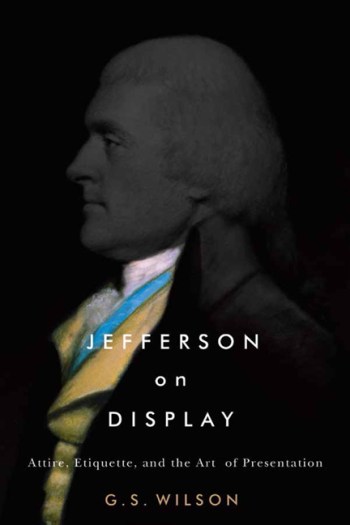 When we think of Thomas Jefferson, a certain picture comes to mind for some of us, combining his physical appearance with our perception of his character. During Jefferson’s lifetime this image was already taking shape, helped along by his own assiduous cultivation. In Jefferson on Display, G. S. Wilson draws on a broad array of sources to show how Jefferson fashioned his public persona to promote his political agenda. During his long career, his image shifted from cosmopolitan intellectual to man of the people. As president he kept friends and foes guessing: he might appear unpredictably in old, worn, and out-of-date clothing with hair unkempt, yet he could as easily play the polished gentleman in a black suit, as he hosted small dinners in the President’s House that were noted for their French-inspired food and fine European wines. Even in retirement his image continued to evolve, as guests at Monticello reported being met by the Sage clothed in rough fabrics that he proudly claimed were created from his own merino sheep, leading Americans by example to manufacture their own clothing, free of Europe.
By paying close attention to Jefferson’s controversial clothing choices and physical appearance—as well as his use of portraiture, architecture, and the polite refinements of dining, grooming, and conversation—Wilson provides invaluable new insight into this perplexing founder.
G. S. Wilson is Shannon Senior Historian at the Robert H. Smith International Center for Jefferson Studies, Monticello.
C O N T E N T S
List of Illustrations
Acknowledgments
Introduction
The European Experience
1 At the French Court and among the Literati
2 Remembering the Revolution
The Politics of the 1790s
3 Returning to a New America
4 Campaigning for Change
The Presidency
5 A New Presidential Profile
6 But Always the Cosmopolitan Gentleman
Retirement at Monticello
7 Contemplating Legacy
8 A Final Image
Epilogue
Notes
Bibliography
Illustration Credits
Index
New Book | Grammars of Approach
From The University of Chicago Press:
Cynthia Wall, Grammars of Approach: Landscape, Narrative, and the Linguistic Picturesque (Chicago: The University of Chicago Press, 2019), 352 pages, ISBN: 978-0226467665 (cloth), $105 / ISBN: 978-0226467832 (paper), $35.
 In Grammars of Approach, Cynthia Wall offers a close look at changes in perspective in spatial design, language, and narrative across the late eighteenth and early nineteenth centuries that involve, literally and psychologically, the concept of ‘approach’. In architecture, the term ‘approach’ changed in that period from a verb to a noun, coming to denote the drive from the lodge at the entrance of an estate “through the most interesting part of the grounds,” as landscape designer Humphrey Repton put it. The shift from the long straight avenue to the winding approach, Wall shows, swung the perceptual balance away from the great house onto the personal experience of the visitor. At the same time, the grammatical and typographical landscape was shifting in tandem, away from objects and Things (and capitalized common Nouns) to the spaces in between, like punctuation and the ‘lesser parts of speech’. The implications for narrative included new patterns of syntactical architecture and the phenomenon of free indirect discourse. Wall examines the work of landscape theorists such as Repton, John Claudius Loudon, and Thomas Whately alongside travel narratives, topographical views, printers’ manuals, dictionaries, encyclopedias, grammars, and the novels of Defoe, Richardson, Burney, Radcliffe, and Austen to reveal a new landscaping across disciplines—new grammars of approach in ways of perceiving and representing the world in both word and image.
Cynthia Wall is professor of English at the University of Virginia. She is an editor of works by Bunyan, Defoe, and Pope, and the author of The Literary and Cultural Spaces of Restoration London and The Prose of Things: Transformations of Description in the Eighteenth Century, the latter also published by the University of Chicago Press.
C O N T E N T S
List of Illustrations
A Note on My Text
Acknowledgments
Introduction
1 The Architectural Approach
The etymology of ‘approach’ (n.s.)
The concept of approach (n.s. and v.): the ‘ancient’ and the ‘modern’ lines
The language of approach (v.): architectural and syntactical design
The traveler’s approach
The novelists approach
2 The Prepositional Building
The park gate lodge
The topographical view: angles and staffage
A Bridge to the next part: ‘A Village on, or across, the Thames‘
3 The Topographical Page
The typographical landscape
The letters on the page:
i. fonts
ii. capitals and italics
iii. catchwords
iv. pointing
4 The Grammar in Between
The rise of grammar
The rise of the preposition
Clarissa and the little words: the avenue and the approach
i. Richardson as printer
ii. Clarissa and prepositions
iii. Clarissa as prepostion
5 The Narrative Picturesque
Syntactical architecture in textual landscapes
i. Bunyan: “thinges . . included in one word”
ii. Defoe: “in a Word”
iii. Haywood: “In fine, she was undone”
The narrative picturesque
i. Radcliffe and the prepositional phrase
ii. Burney and the psychological interior
iii. Austen and the approach to the interior
Coda: A Topographical Page
Notes
Bibliography
Index
New Book | Politics and the Arts in Lisbon and Rome
From Liverpool UP:
Pilar Diez del Corral Corredoira, ed., Politics and the Arts in Lisbon and Rome: The Roman Dream of John V of Portugal (Oxford: Voltaire Foundation/Oxford University Studies in the Enlightenment, 2019), 276 pages, ISBN: 978-1789620122, £65.
 Dealing with a complex king, this edited collection elucidates a monarch’s vision of Rome that deeply affected his political choices and cultural policy during the first half of the eighteenth-century. John (João) V of Portugal (1689–1750) became king in 1707 in a pivotal moment for the European balance of power. The Kingdom of Portugal was still demanding the same privileges as its powerful neighbours and the relation with Rome was considered a vehicle to obtain them. Arts and music had a special and unprecedented place in the king’s plans and this book approaches that dynamic from several interdisciplinary perspectives.
The unifying thread across this book’s chapters remains the omnipresence of Rome as a paradigm on several levels: political, religious, intellectual, artistic, and musical. Rather than providing an exhaustive analysis of the period as a whole, this study offers a fresh approach for English readers to this classic, but little known, topic in Portuguese national historiography.
Pilar Diez del Corral Corredoira is Ramón y Cajal Fellow based at the Art History department of the Universidad Nacional de Educación a Distancia (Madrid). She wrote a PhD on Classical Art and has widely published in international journals including The Burlington Magazine and Storia dell’Arte. Her current research focuses on Iberian cultural identities, artistic mobility, and diplomacy in Rome in the eighteenth century.
Journal of the History of Collections, March 2019
The eighteenth century in the Journal of the History of Collections:
Journal of the History of Collections 31 (March 2019)
A R T I C L E S
 • Lisa Beaven and Karen Lloyd, “Cardinal Paluzzo Paluzzi degli Albertoni Altieri and His Collection in the Palazzo Altieri: The Evidence of the 1698 Death Inventory, Part II,” pp. 1–16. “This article is the second part of a study of the collection of Cardinal Paluzzo Altieri (1623–1698) based on the evidence of his 1698 death inventory. Part I considered his paintings collection, housed on the first piano nobile of the palace. This study moves to the second piano nobile apartment and considers a broader range of material objects, including sculpture, tapestry, devotional objects, and naturalia, some of which (such as the American import, chocolate) reflect the globalization of the early modern world” (from the abstract).
• Noam Sienna, “‘Remarkable Objects of the Three . . . Main Religions’: Judaica in Early Modern European Collections,” pp. 17–29. “The diverse collections of early modern Europe, housed in cabinets of curiosities and Kunstkammern, attempted to capture the wonder of the world through specimens of nature, classical and other artefacts, scientific instruments, works of art, and rare and curious objects from around the world. While it is known that they included objects of ethnographic interest from the New World, Africa, and Asia, the place of Judaica in these collections remains largely unknown and unexplored. This article presents an analysis of the collection and display of Jewish objects in Europe from the sixteenth to the eighteenth centuries” (from the abstract).
• Renata Schellenberg, “The Literary Legacy of the Düsseldorfer Gemäldegalerie,” pp. 31–40. “This article explores a range of literary responses to the Düsseldorf picture gallery in the eighteenth century. It examines in particular the ways in which written accounts of experiencing the Düsseldorf collection reveal the contemporary understanding of its works of art and their modes of display. It investigates the ways in which texts bear witness not just to the art in the collection but also to the social interactions informing their representation to readers” (from the abstract).
• Sileas Wood, “‘After the Very Rare Original’: Artist and Antiquary the Revd John Brand,” pp. 41–52. “During the closing years of the eighteenth century, minister and antiquary the Revd John Brand (1744–1806) undertook an extraordinary project of creating facsimile drawn copies of rare prints, with which to illustrate James Granger’s Biographical History of England. Between 1790 and 1800 Brand personally created over 400 drawn copies of portrait prints which can be identified through his own annotations, a manuscript catalogue, and the catalogue of his posthumous sale. This paper will examine Brand’s surviving works, his processes and the ways in which his drawings were shaped by his status as an antiquary, amateur artist, and print collector” (from the abstract).
• Roberto González Ramos, “Treasures and Collections in the Colegio Mayor de San Ildefonso and University of Alcalá: Trophies, ‘Spolia Sancta’ and Museum,” pp. 111–30. “The Colegio Mayor de San Ildefonso and University of Alcalá was an important cultural institution in the Hispanic world of the early modern era. Founded by Cardinal Ximénez de Cisneros (1436–1517), it assembled an important group of symbolic objects, amongst them trophies, relics, images and mirabilia. The beatification of the founder led not only to a corresponding increase in the numbers of those objects, seen as relics, but also to their display in particular places, with the creation of a number of proto-museums. With the coming of the Enlightenment, a number of veritable museums were formed, with consequent changes in the values attributed to the symbolic items. From that time until the creation in 1836 of the University of Madrid, by making use of the assets and professorships of the University of Alcalá, the remaining symbolic objects were considered primarily as illustrating the history of the institution” (from the abstract).
• Marc Fecker, “Sir Philip Sassoon at 25 Park Lane: The Collection of an Early Twentieth-Century Connoisseur and Aesthete,” pp. 151–70. “Sir Philip Sassoon (1888–1939) housed the largest and most valuable part of his collection in his lavish Park Lane residence in London. It was demolished in the early 1960s and the collection is now dispersed. This paper reconstructs the collection at Park Lane, which consisted predominantly of French eighteenth-century fine and decorative art, as well as English eighteenth-century portraiture and works by contemporary artists, many of which were commissioned by Sassoon. It explores how he moulded the collection he inherited from his parents and his maternal grandparents, Gustave and Cécile de Rothschild, to his own taste, and to his own time, while continuing the Rothschild tradition” (from the abstract).
• Dora Thornton, “Baron Ferdinand Rothschild’s Sense of Family Origins and the Waddesdon Bequest in the British Museum,” pp. 181–98. “Baron Ferdinand Rothschild (1839–1898) is usually remembered for Waddesdon Manor in Buckinghamshire and for the Waddesdon Bequest, his splendid gift of Renaissance treasures to the British Museum, recently reinterpreted in a new gallery. The author analyses Baron Ferdinand’s unpublished reminiscences, revealing his interest in the history and mythology of the Rothschilds as a Frankfurt Jewish banking dynasty. The status and significance of Judaica in the Waddesdon Bequest and other family collections is also explored within the context of nineteenth-century collecting, the development of the art market and an emerging sense of a Jewish European history and identity” (from the abstract).
R E V I E W S
• Peter Mason, Review of Elizabeth Horodowich and Lia Markey, eds, The New World in Early Modern Italy, 1492–1750 (Cambridge University Press, 2017), p. 199.
• Barbara Furlotti, Review of Adriano Amendola, Ritratti di bronzo: Il Medagliere Orsini dei Musei Capitolini di Roma (De Luca Editore d’Arte, 2017), p. 200. “By offering the first catalogue of the Medagliere Orsini, now preserved at the Musei Capitolini in Rome, this lavishly-illustrated volume enriches our knowledge of this prestigious noble clan from an original perspective. The first part of the book features three essays . . . The first essay reconstructs the complex history of the Orsini collection of ancient coins and modern medals between the death of the last Duke of Bracciano, Flavio Orsini (1620–1698), and the acquisition of what was left of the collection by the Municipio di Roma in 1902. The second essay focuses on the collecting interests of some members of the Orsini family [during the sixteenth and seventeenth centuries]. . . The third essay, which is based on a large corpus of unpublished documents, offers interesting insights on Paolo Giordano II’s patronage and on the celebrative medals commissioned by Pope Benedict XIII Orsini (1649–1730). . . The catalogue of the Medagliere Orsini occupies the second part of the book. It includes fifty-two entries dedicated to medals, and seventeen entries for plaquettes and seals” (199).
• Eloisa Dodero, Review of Klauss Fittschen and Johannes Bergemann, eds., Katalog der Skulpturen der Sammlung Wallmoden (Biering & Brinkmann, 2015), pp. 204–05. “The Wallmoden statues are still beautifully displayed in the Institute of Archaeology at Göttingen and the new catalogue . . . is an appropriate fulfilment of almost forty years of research on one of the oldest assemblages of ancient sculptures in Germany and an exceptional testimony of the eighteenth-century reception of ancient art. The collection, which formerly included also paintings, gems, books, drawings, plaster casts and copies after the Antique, was formed in the second half of the eighteenth century by General Johann Ludwig von Wallmoden (1736–1811), later Reichsgraf (Imperial Count) von Wallmoden-Gimborn, an illegitimate son of King George II of Great Britain” (204).
• Stephen Harris, Review of Sarah Easterby-Smith, Cultivating Commerce: Cultures of Botany in Britain and France, 1760–1815 (Cambridge University Press, 2017), pp. 206–07.
• Arthur MacGregor, Review of Margot Finn and Kate Smith, eds., The East India Company at Home, 1757–1857 (UCL Press, 2018), pp. 207–08.
Print Quarterly, March 2019
The eighteenth century in the current issue of Print Quarterly:
Print Quarterly 36.1 (March 2019)
S H O R T E R N O T I C E
Donatella Biagi Maino, “Gaetano Gandolfi’s Album of Prints by Giambattista and Giandomenico Tiepolo,” pp. 45–54. Focusing on a little known album of prints assembled by Gaetano Gandolfi (1734–1802), the article explores the relationship between Bolognese and Venetian art in the second half of the eighteenth century, with a particular emphasis on the generative role of the works of Giambattista and Giandomenico Tiepolo.
N O T E S A N D R E V I E W S
• Angela Nikolai, Review of the exhibition catalogue, Zeichenunterricht: Von der Künstlerausbildung zur ästhetischen Erziehung seit 1500 (Graphische Sammlung ETH Zürich, 2017–18), pp. 63–64. “On its 150th anniversary, the Graphische Sammlung ETH Zurich hosted three exhibitions, the last of which presented and drawings related to artistic training since the sixteenth century” (63), focusing on Italian, Dutch, and German engravings and etchings from the sixteenth to the nineteenth centuries. “The selection ranges from reproductive prints of antiquities and painted academy scenes to anatomical prints or sheets from drawings books” (64).

Chinese Bird-and-Flower wallpaper at Felbrigg Hall, Norfolk, ca. 1752, woodblock-printed outlines with the colours added by hand (David Kirkham / National Trust).
• Ming Wilson, Review of Emile de Bruijn, Chinese Wallpaper in Britain and Ireland (London, Philip Wilson Publishers, 2017), pp. 64–66. Drawing on the archives of the National Trust and on works still in situ, this volume establishes a chronology charting what kind of wallpaper was in fashion in the British Isles from 1740 onwards. “It is no exaggeration to say that this book is a comprehensive listing of all Chinese wallpapers known to be in existence today and an indispensable reference work on the subject, with a history of British interior design thrown into the bargain” (66).
• Armin Kunz, Review of the exhibition catalogue, Copy.Right: Adam von Bartsch: Kunst Kommerz Kennersschaft (Kunstsammlung der Universität Göttingen, 2016), pp. 66–68. The 31 essays “assembled in this volume present welcome additions to these final chapters in the long-neglected history of the reproductive print” (68).

Kitagawa Utamaro, The Courtesan Onitsutaya Azamino Tattooes Her Name and the Word ‘inochi’ (Life) into the Arm of Her Lover Gontar, a Man of the World, ca. 1798–99, woodblock print (Boston: MFA).
• Ellis Tinios, Review of Sarah Thompson, Tattoos in Japanese Prints (MFA, Boston: 2017), pp. 68–69. “Thompson’s concise and informative introductory essay explores the meaning of tattoos in Japanese society. . . Large-scale body tattoos appear to have originated in the late eighteenth century among ‘bandits’ and were then taken up by petty criminals, firemen, and others on the margins of society. The practice was banned in the 1810 with little effect” (68).
• Desmond-Bryan Kraege, review of Rolf Reichardt, ed., Lexikon der Revolutions-Ikonographie in der europäische Druckgraphik, 1789–1889, 3 volumes (Münster, Rhema, 2017), pp. 70–71. “The fruit of extensive documentary research in the collections of almost 50 European institutions,” this publication “provides a good complement to an encyclopaedic work that is set to become an indispensable reference for students of print culture and political art during the long nineteenth century” (71).
• Exhibition catalogue, Hélène Iehl and Felix Reusse, eds, La France, Zwischen Aufklärung und Galanterie: Meisterwerke der Druckgraphik / La France au siècle des Lumières et de la galanterie: Chefs-d’œuvre de la gravure (Michael Imhof Verlag, 2018), p. 92. “This exhibition catalogue celebrates the gift to the museum in Freiburg, Germany, from the local collector Joseph Lienhart, of his collection of French prints of the eighteenth century formed since the 1970s” (92). [Noted under ‘publications received’.]

Anonymous artist after a drawing by Robert Bonnart, published by Nicolas Bonnart I, Portrait of Catherine Thérèse de Matignon, Marchioness of Seignelay, Wearing Fontange, a Black Veil and Mantua with a Blue Petticoat, 1690–96, hand-coloured etching and engraving, 290 × 196 mm (London: British Museum).
• Anthony Griffiths, review of Pascale Cugy, La Dynastie Bonnart: Peintres, Graveurs et Marchands de Modes à Paris sous L’ancien Régime (Presses Universitaires de Rennes, 2017), pp. 103–05. The Bonnart family “are one of the few producers that have given their name to a genre: in the nineteenth century ‘Bonnarts’ became a term used to define the full length men and women in fashionable clothing standing against a plain or a simple background” (103). This book focuses on the production of the Bonnart family over a century, shedding new light on eighteenth-century France not only from an artistic point of view, but also from a social and legal one.
• Mark McDonald, review of exhibition catalogue, Ceán Bermúdez: Historiador del arte y coleccionista ilustrado (Madrid, Biblioteca Nacional de España, 2016), pp. 106–11. Drawing upon a rich variety of sources, this catalogue focuses on one of the most eclectic and interesting figures of the Spanish Enlightenment: the art collector, patron, writer, and historian Juan Augustín Ceán Bermúdez (1749–1829). “Ceán is often described as the first historian of Spanish art and his writings include translations, catalogues, and descriptions of art collections” (106). With five chapters and 158 individual entries, this publication from the 2016 exhibition in Madrid “presents groundbreaking scholarship and is the most complete study of this fascinating figure” (106).










leave a comment