New Book | American Silver in the Philadelphia Museum of Art
From Yale UP:
Beatrice Garvan and David Barquist, with Elisabeth Agro, American Silver in the Philadelphia Museum of Art, Volume 1, Makers A–F (New Haven: Yale University Press, 2018), 464 pages, ISBN: 978-0300229400, $150.
 Beginning with Cesar Ghiselin in 1681, Philadelphia has a long and storied history of silversmithing that includes notable artists such as Joseph Richardson Sr. and Jr., Philip Syng Jr., and Olaf Skoogfors. Celebrating this legacy and showcasing the Philadelphia Museum of Art’s extraordinary and comprehensive collection of American silver, this generously illustrated book features a broad array of objects that range from colonial-era tableware to groundbreaking contemporary designs. Extensive biographies of makers accompany detailed entries on individual pieces that are full of new discoveries related to artist marks, heraldic engravings, and provenance histories. This volume is the first of four—organized alphabetically by makers and retailers—that will eventually encompass the museum’s complete collection of American silver.
Beatrice B. Garvan is curator emerita of American decorative arts, and David L. Barquist is the H. Richard Dietrich, Jr., Curator of American Decorative Arts, both at the Philadelphia Museum of Art.
New Book | L’art et la race
From Les Presses du Réel:
Anne Lafont, L’art et la race: L’Africain (tout) contre l’œil des Lumières (Dijon: Les Presses du Réel, 2019), 476 pages, ISBN: 978-2378960162, 32€.
 L’historienne de l’art Anne Lafont livre une étude inédite sur les relations étroites et paradoxales de l’art et de la race à l’époque des Lumières. Une nouvelle voix dans les travaux actuels sur les questions de race, d’art, d’images et de colonies.
En se fondant sur un corpus d’œuvres d’art connues et moins connues, l’auteure revisite les Beaux-Arts au XVIIIe siècle sous l’angle de la représentation des Noirs, figures qui, non seulement, articulent savoirs anthropologiques et expériences esthétiques, mais aussi histoire du luxe métropolitain et histoire de l’esclavage colonial. Ce livre est fondé sur une recherche de plus de dix ans sur les formes qu’ont prises les figures de l’Africain et de l’Africaine dans l’art continental et colonial français d’avant l’imaginaire abolitionniste. Il couvre les cultures visuelles et artistiques qui vont de la fin du XVIIe siècle—à l’époque de Coypel, Mignard, Largillière… —quand les colonies antillaises commencèrent à percer dans le champ artistique métropolitain, au premier tiers du XIXe siècle—à l’époque de Girodet, Benoist et Léthière jusqu’à Géricault… —quand l’échec de la première abolition de l’esclavage (1802) durcit l’iconographie partisane, mettant la violence des vies dans les plantations à l’ordre du jour de la création artistique.
Publié avec la collaboration de Laurence Bertrand Dorléac – Centre d’Histoire de Sciences Po – et le concours de la Fondation de France.
Anne Lafont est historienne de l’art, directrice d’études à l’École des hautes études en sciences sociales. Elle a étudié au Canada et en France avant d’être pensionnaire de la Villa Médicis. Elle a été ensuite maîtresse de conférences en histoire de l’art moderne à l’université Paris-Est avant de rejoindre l’Institut national d’histoire de l’art où elle a passé dix années. Elle est élue à l’EHESS en 2017 sur un projet intitulé Histoire de l’art et créolités.
Ses travaux ont porté principalement sur l’art des XVIII et XIXe siècles avec un intérêt particulier pour l’œuvre de la Révolution française et l’imagination picturale des nouveaux citoyens, les Noirs, à l’échelle des révolutions atlantiques. En parallèle, elle a initié des recherches sur la question des savoirs naturalistes et anthropologiques en lien avec les cultures visuelles du voyage, de l’expédition scientifique et du cabinet de curiosités (L’artiste savant à la conquête du monde moderne, 2010 ; 1740, L’abrégé du monde, 2012) mais aussi des travaux sur les écrits des femmes sur l’art autour de 1800 (Plumes et pinceaux. Discours de femmes sur l’art en Europe, 2012). Son travail s’oriente désormais vers l’art des Antilles françaises pendant la période coloniale et, d’une manière générale, sur les arts et les cultures de l’Atlantique noir.
New Book | The Georgian London Town House
From Bloomsbury:
Kate Retford and Susanna Avery-Quash, eds., The Georgian London Town House: Building, Collecting, and Display (London: Bloomsbury, 2019), 364 pages, ISBN: 978-1501337291, £90.
 For every great country house of the Georgian period, there was usually also a town house. Chatsworth, for example, the home of the Devonshires, has officially been recognised as one of the country’s favourite national treasures—but most of its visitors know little of Devonshire House, which the family once owned in the capital. In part, this is because town houses were often leased, rather than being passed down through generations as country estates were. But, most crucially, many London town houses, including Devonshire House, no longer exist, having been demolished in the early twentieth century.
This book seeks to place centre-stage the hugely important yet hitherto overlooked town houses of the eighteenth and early nineteenth centuries, exploring the prime position they once occupied in the lives of families and the nation as a whole. It explores the owners, how they furnished and used these properties, and how their houses were judged by the various types of visitor who gained access.
C O N T E N T S
Susanna Avery-Quash and Kate Retford, Introduction
Contexts
1 Joseph Friedman, Town and Country: Patterns of Aristocratic Collecting in Georgian England
2 Matthew Jenkins and Charlotte Newman, London in Pieces: Building Biographies in Georgian Mayfair
Creating the London Town House
3 Neil Bingham, The Regency Transformation of Burlington House, Piccadilly, Documented through the Architectural Drawings of Samuel Ware
4 Adriano Aymonino and Manolo Guerci, Building and Refurbishing the London Town House during the Mid-Eighteenth Century: Francophilia in Interior Decoration
5 Susanna Avery-Quash, John Julius Angerstein’s Collection of Old Masters at Pall Mall: An Eighteenth-Century London Financier and His Circle of Art Advisers
Display in the London Town House
6 Susannah Brooke, The Display and Reception of Private Picture Collections in London Town Houses, 1780–1830
7 Desmond Shawe Taylor, Picture Displays at Carlton House
8 Anne Nellis Richter, Glitter and Fashion in the ‘Louvre of London’: Animating Cleveland House
9 Jeremy Howard, New Light on Norfolk House: The Decoration and Furnishing of Norfolk House for the 9th Duke and Duchess of Norfolk
10 Donato Esposito, Artist in Residence: Joshua Reynolds at 47 Leicester Fields
11 Helen McCormack, Animating Anatomy: 16 Great Windmill Street, Westminster
Bibliography
New Book | Stewards of Memory
From The University of Virginia:
Carol Borchert Cadou, with Luke Pecoraro and Thomas Reinhart, eds., Stewards of Memory: The Past, Present, and Future of Historic Preservation at George Washington’s Mount Vernon (Charlottestville: The University of Virginia Press, 2018), 280 pages, ISBN: 978-0813941516 (cloth), $60, ISBN: 978-0813941523 (paper), $30.
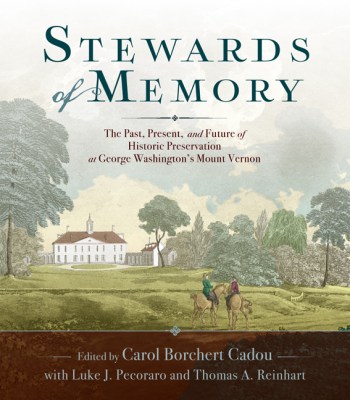 Mount Vernon, despite its importance as the estate of George Washington, is subject to the same threats of time as any property and has required considerable resources and organization to endure as a historic site and house. This book provides a window into the broad scope of preservation work undertaken at Mount Vernon over the course of more than 160 years and places this work within the context of America’s regional and national preservation efforts.
It was at Mount Vernon, beginning with efforts in 1853, that the American tradition of historic preservation truly took hold. As the nation’s oldest historic house museum, Mount Vernon offers a unique opportunity to chronicle preservation challenges and successes over time as well as to forecast those of the future. Stewards of Memory features essays by senior scholars who helped define American historic preservation in the twentieth and early twenty-first centuries, including Carl R. Lounsbury, George W. McDaniel, and Carter L. Hudgins. Their contributions—complemented by those of Scott E. Casper, Lydia Mattice Brandt, and Mount Vernon’s own preservation scholars—offer insights into the changing nature of the field. The multifaceted story told here will be invaluable to students of historic preservation, historic site professionals, specialists in the preservation field, and any reader with an interest in American historic preservation and Mount Vernon.
Support provided by the David Bruce Smith Book Fund and the Fred W. Smith National Library for the Study of George Washington at Mount Vernon.
Carol Borchert Cadou, who spent nineteen years on the collections and preservation staff at Mount Vernon, is Charles F. Montgomery Director and CEO of Winterthur Museum. Luke J. Pecoraro is Assistant Director for Archaeology at George Washington’s Mount Vernon. Thomas A. Reinhart is Director of Architecture at George Washington’s Mount Vernon.
C O N T E N T S
Acknowledgments
Abbreviations
A Chronology of Historic Preservation at Mount Vernon in National Context
• Douglas Bradburn and Carol Borchert Cadou, Introduction
• Carl Lounsbury, New History in Old Buildings: Architectural Research and Public History in the Chesapeake
• Thomas Reinhart and Susan Schoelwer, ‘Distinguished by the Name of the New Room’: Reinvestigation and Reintepretation of George Washington’s Grandest Space
• Luke Pecoraro, ‘We Have Done Very Little Investigation There; There Is a Great Deal Yet to Do’: The Archaeology of Georges Washington’s Mount Vernon
• Robert Fink, Thomas Reinhart, and Alyson Steele, Mount Vernon’s Historic Building Information Management Systerm: Digital Strategies for Preservation in the Twenty-First Century
• George McDaniel, Stepping Up and Saving Places: Case Studies in Whole Place Preservation
• Lydia Mattice Brandt, The Dangers of Preserving while Popular: The Mount Vernon Ladies’ Association’s Image of Mount Vernon versus Contemporary Architecture
• Scott Casper, Saving Mount Vernon, in Black and White: Toward an Alternative History of Historic Preservation
• Carter Hudgins, Mount Vernon and America’s Historic House Museums: Old Roles and New Responsibilities in the Preservation of Place
• Carol Borchert Cadou and Luke Pecoraro, Conclusion
Contributors
Index
Exhibition | Heaven and Earth in Chinese Art

Square curiosity box with multiple treasures, Qianlong 1736–95, Qing Dynasty (1644–1911); wood, jade, bronze, amber, agate, and ink on paper; 20 × 25 × 25 cm (Taipei: National Palace Museum).
◊ ◊ ◊ ◊ ◊
Press release (via Art Daily) for the exhibition:
Heaven and Earth in Chinese Art: Treasures from the National Palace Museum, Taipei
Art Gallery of New South Wales, Sydney, 2 February — 5 May 2019
Curated by Cao Yin
The Art Gallery of New South Wales presents Heaven and Earth in Chinese Art: Treasures from the National Palace Museum, Taipei. The exhibition is a rare opportunity to encounter some of the highest artistic achievements in Chinese history. Featuring 87 masterworks, the exhibition explores the extraordinary creativity of Chinese artists over the centuries, with objects dating from 5000 years ago in the Neolithic period to the nineteenth century.
 Director of the Art Gallery of NSW, Dr Michael Brand said the National Palace Museum holds one of the world’s finest collections of Chinese art with the majority of its holdings originating from the imperial collections of the Qing dynasty (1644–1911). “One of the most-visited museums in the world, the National Palace Museum in Taipei has a collection of outstanding beauty and historical importance.”
“Heaven and Earth in Chinese Art presents the ancient Chinese philosophical concept of tian ren he yi, the harmonious coexistence of nature and humans within the cosmos, which holds particular relevance today as we face the environmental challenges of contemporary life,” Dr Brand said. “The Art Gallery of NSW is the first cultural institution to host these extraordinary objects in Australia providing local audiences an exclusive opportunity to see how Chinese art speaks to the modern world,” Dr Brand added.
Dr Chen, Chi-nan, Director of the National Palace Museum, Taipei, said the museum has had a long-term commitment to international cultural exchange and has successfully curated a large number of exhibitions in Europe, America, and Asia from its collection. “Despite this impressive record, the National Palace Museum, Taipei, has not exhibited in the southern hemisphere, until now,” Dr Chen said. “Major highlights from the National Palace Museum collection travelling to Sydney include one of its most popular treasures: the Meat-shaped stone—a Qing dynasty masterpiece. This is only the third time it has been seen outside Taipei,” Dr Chen said.

Meat-shaped stone, Qing dynasty, 1644–1911 (Taipei: National Palace Museum).
The Meat-shaped stone, carved from jasper and set in a decorative gold stand, draws thousands of admirers a day. The stone most closely resembles the dish dongpo rou which is believed to have been invented by Su Dongpo (also known as Su Shi), an 11th-century Chinese poet and artist.
Art Gallery of NSW exhibition curator and curator of Chinese art, Yin Cao said Heaven and Earth in Chinese Art showcases the many ways in which Chinese artists have represented the trinity of heaven, earth, and humanity. “Since the earliest times, the Chinese have created imaginative stories and rich symbols to explain the unfathomable aspects of the world around them. Each work in Heaven and earth in Chinese art tells a unique story of the society in which it is created and bears a broader cultural and philosophical meaning,” Cao said.
“From the miniature carving of an olive pit to one of the longest paintings in Chinese history, this exhibition presents the highest level of artistic skill and advances in technology over the different eras, and shows the aspiration of Chinese artists as they try to capture the essence of nature and the world around them,” Cao added.
Heaven and Earth in Chinese Art presents paintings, calligraphy, illustrated books, bronzes, ceramics, jade, and wood carvings divided into five thematic sections: Heaven and Earth, Seasons, Places, Landscape, and Humanity.
The exhibition is accompanied by a book Heaven & Earth in Chinese Art: Treasures from the National Palace Museum, Taipei edited and written by exhibition curator Yin Cao with Dr Karyn Lai, associate professor of Philosophy in the School of Humanities and Languages at the University of NSW. It includes catalogue entries by National Palace Museum curators.
Cao Yin with Karyn Lai, Heaven & Earth in Chinese Art: Treasures from the National Palace Museum, Taipei (Sydney: Art Gallery of NSW, 2019), 236 pages, ISBN: 978-1741741438, $40.
Exhibition | Boilly: Scenes of Parisian Life

Opening this month at the National Gallery:
Boilly: Scenes of Parisian Life
National Gallery, London, 28 February – 19 May 2019
Curated by Francesca Whitlum-Cooper
Working in a politically turbulent Paris, Louis-Léopold Boilly (1761–1845) witnessed the French Revolution, the rise and fall of Napoleon, and the Restoration of the French Monarchy. From controversially seductive interior scenes, which saw him get into trouble with the authorities, to ‘first-of-their-kind’ everyday street scenes and clever trompe l’oeils, this exhibition shows Boilly’s daring responses to the changing political environment and art market he encountered, and highlights his sharp powers of observation and wry sense of humour.
Focusing on 20 works from a British private collection never previously displayed or published, this exhibition—the first of its kind in the UK—celebrates an artist who is little known in Britain and provides unparalleled context for our Boilly, A Girl at a Window.
The catalogue is distributed by Yale UP:
Francesca Whitlum-Cooper, Boilly: Scenes of Parisian Life (London: National Gallery Company, 2019), 96 pages, ISBN: 978-1857096439, £17 / $25.
 Louis-Leopold Boilly lived a long life in the most turbulent times. From 1785 he spent half a century at the heart of the Parisian art world, throughout the turmoil of the Revolution, the rise and fall of Napoleon and the restoration of the monarchy. This first English-language publication on Boilly in over twenty years brings together portraiture, interiors on the theme of seduction, and vivid and groundbreaking scenes of raucous Parisian street life. The majority of these pictures have never been published before. The book introduces readers to Boilly’s richly detailed paintings and drawings, emphasising his technical brilliance, his acute powers of observation and his wry sense of humour, and illustrates Boilly’s daring responses to France’s changing political environment and burgeoning art market. It offers an alternative to the accepted view of Revolutionary French art as the purview of grand history painters such as Jacques-Louis David. Boilly popularised trompe l’oeil paintings—he invented the term—and by depicting daily life on the streets of Paris for the very first time, he turned the accepted hierarchies of art on their head.
Francesca Whitlum-Cooper is the Myojin-Nadar Associate Curator of Paintings, 1600–1800 at the National Gallery, London.
New Book | More Eighteenth-Century Neapolitan Staircases
Many Enfilade readers will already know this, but I’m sorry to report that Michael Shamansky’s Artbooks.com will soon close. Here’s an example of the discounts now available. –CH
Dirk De Meyer, with a preface by Marius Grootveld, More Eighteenth-Century Neapolitan Staircases: Showpiece and Utility (Ghent: A&S Books, 2018), 130 pages, ISBN: 978-9076714523, €29, reduced from $50 to $20.
 With particular attention to the work of Ferdinando Sanfelice (1675–1748), this book documents the development of the open staircase typology in Naples at the moment that it shifted from the traditional, monumental Baroque palace staircase towards the later palazzo or condominium staircase serving four, five, or more levels of apartments. These staircases are considered ‘the star(s) of the palace composition in Naples’. The book is the outcome of a master seminar in Architectural History at Ghent University. It continues an initial publication from 2017.
C O N T E N T S
• A Typological Make-over: Staircase Design in 18th-century Naples
• Palazzo Lauriano also called Capuano, c. 1730
• Palazzo Palmarice, 1719
• Double Palazzo in Via Salvator Rosa, c. 1730s
• Double Palazzo in Via Salvator Rosa, c. 1730s
• Palazzo Persico, mid 18th century
• Palazzo in Via Atri, mid or late 18th century
• Palazzo in Via Costantinopoli, mid or late 18th century
New Book | Eighteenth-Century Art Worlds
Published this month by Bloomsbury:
Stacey Sloboda and Michael Yonan, eds., Eighteenth-Century Art Worlds: Global and Local Geographies of Art (London: Bloomsbury Visual Arts, 2019), 312 pages, ISBN: 978-1501335488, $117.
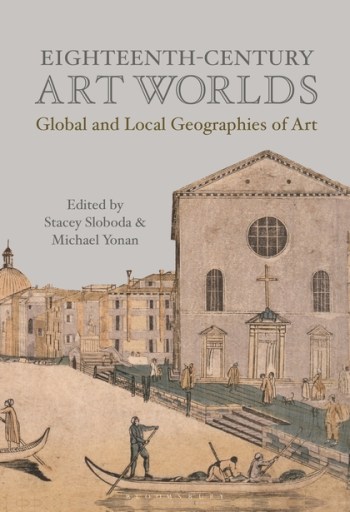 While the connected, international character of today’s art world is well known, the eighteenth century too had a global art world. Eighteenth-Century Art Worlds is the first book to attempt a map of the global art world of the eighteenth century. Fourteen essays from a distinguished group of scholars explore both cross-cultural connections and local specificities of art production and consumption in Africa, the Americas, Asia, and Europe. The result is an account of a series of interconnected and asymmetrical art worlds that were well developed in the eighteenth century.
Capturing the full material diversity of eighteenth-century art, this book considers painting and sculpture alongside far more numerous prints and decorative objects. Analyzing the role of place in the history of eighteenth-century art, it bridges the disciplines of art history and cultural geography, and draws attention away from any one place as a privileged art-historical site, while highlighting places such as Manila, Beijing, Mexico City, and London as significant points on globalized map of the eighteenth-century art world. Eighteenth-Century Art Worlds combines a broad global perspective on the history of art with careful attention to how global artistic concerns intersect with local ones, offering a framework for future studies in global art history.
Stacey Sloboda is Paul H. Tucker Professor of Art at the University of Massachusetts Boston. Michael Yonan is Associate Professor of Art History at the University of Missouri.
C O N T E N T S
List of Illustrations
Acknowledgements
1 Stacey Sloboda and Michael Yonan, Mapping Eighteenth-Century Art Worlds
2 Kristina Kleutghen, Flowering Stone: The Aesthetics and Politics of Islamic Jades at the Qing Court
3 Michele Matteini, The Market for ‘Western’ Paintings in Eighteenth-Century East Asia: A View from the Liulichang Market in Beijing
4 Timon Screech, Floating Pictures: The European Dimension to Japanese Art during the Eighteenth Century
5 Yeewan Koon, A Chinese Canton? Painting the Local in Export Art
6 J. M. Mancini, Pedro Cambón’s Asian Objects: A Transpacific Approach to Eighteenth-Century California
7 Kelly Donahue-Wallace, Making It Ours: Religious Art in Eighteenth-Century Colonial Spanish American Newspapers
8 Mari-Tere Álvarez and Charlene Villaseñor Black, Tortoiseshell and the Edge of Empire: Artistic Materials and Imperial Politics in Spain and France
9 Kristel Smentek, Other Antiquities: Ancients, Moderns, and the Challenge of China in Eighteenth-Century France
10 Hannah Williams, Drifting through the Louvre: A Local Guide to the French Academy
11 Carole Paul, The Art World of the European Grand Tour
12 Michael Yonan, The African Geographies of Angelo Soliman
13 Prita Meier, Toward an Itinerant Art History: The Swahili Coast of Eastern Africa
14 Stacey Sloboda, St. Martin’s Lane in London, Philadelphia, and Vizagapatam
List of Contributors
Bibliography
Index
New Book | Kunstmarkt und Kunstbetrieb in Rom, 1750–1850
From De Gruyter:
Hannelore Putz and Andrea Fronhöfer, eds., Kunstmarkt und Kunstbetrieb in Rom, 1750–1850: Akteure und Handlungsorte (Berlin: De Gruyter, 2019), 304 pages, ISBN 978-3110621884, €100 / $115. Series: Bibliothek des Deutschen Historischen Instituts in Rom 137.
 Rom erlebte in der zweiten Hälfte des 18. Jahrhunderts und in den ersten Jahrzehnten des 19. Jahrhunderts tiefgreifende politische Umbrüche und ökonomische Krisen. Gleichzeitig prägte es als Kunstmetropole wie kein anderer Ort die europäischen Künstler und Kunstszene sowie den Kunstmarkt zwischen Klassizismus und Romantik. Hier studierten die jungen Maler, Bildhauer und Architekten antike und nachantike Kunstobjekte. Sie bildeten sich bei den zeitgenössischen Künstlern fort und nahmen im gegenseitigen Austausch kreativ Impulse auf. Auf dem in Europa rasch an Bedeutung gewinnenden freien Kunstmarkt trieb gerade der schier unerschöpfliche römische Sekundärmarkt (Handel mit Kunstobjekten, die sich auf dem Markt befinden), zu dem auch der Handel mit Antiken gehörte, auch den Primärmarkt (Handel mit „atelierfrischen“ Objekten) an. Der Tagungsband nimmt dieses lebendige und pulsierende Kunstgeschehen in den Blick. Er untersucht Produzenten, Agenten, Verkäufer und Käufer, widmet sich Verhandlungen um Preis und Wert und stellt auch die Frage nach dem Einfluss von Künstlern und Käufern auf die Produktion und Rezeption von Werken Bildender Kunst.
Hannelore Putz, Ludwig-Maximilians-Universität München; Andrea Fronhöfer, Oberhausmuseum Passau.
I N H A L T
Hannelore Putz, Andrea Fronhöfer, Vorwort
• Hannelore Putz, Kunstmarkt und Kunstbetrieb in Rom in der ersten Hälfte des 19. Jahrhunderts: Eine Hinführung
• Paolo Coen, Fra tutela e mercato: Johann Joachim Winckelmann Commissario alle Antichità e Belle Arti
• Clare Hornsby, ‘Rome … to say the Truth Seems to be in a most Tottering State’: The Contrasting Fortunes of Some British Artist-Dealers, 1797–1805
• Gabriele B. Clemens, Die Kunstverkäufe des römischen Adels: Eine Basis neuer europäischer Sammlungen
• Valeria Rotili, L’atelier di Carlo Albacini tra collezionismo e mercato
• Marina Unger, Durand’sche Preise: Archäologie zwischen Wissenschaft und Kunstmarkt im Rom der 1830er Jahre
• Johannes Erichsen, Mehr als ein Sammler: König Ludwig I. von Bayern und die Korona der Kunst
• Mathias René Hofter, Winckelmann und die Kunstkäufe Ludwigs I. von Bayern
• Stefan Morét, Martin von Wagner (1777–1858): Ein Bildhauer und Maler im Dienst König Ludwigs I. von Bayern als Kenner und Käufer von Gemälden
• Johanna Selch, Der Kunstagent und sein Netzwerk. Johann Martin von Wagner in Rom
• Anne Viola Siebert, ‘… so bringen wir noch in Hannover so viel zusammen, um den Geschmack zu wecken’: August Kestner als Kunstkenner und Sammler in Rom, 1817–1853
• Susanne Adina Meyer, ‘Prima di partire’: Orte, Akteure und Strategien des römischen Ausstellungswesens, 1750–1840
• Andreas Stolzenburg, Franz Ludwig Catels Engagement für die deutsche Künstlerschaft in Rom und die Gründung des Pio Istituto Catel
Personen- und Ortsregister
Exhibition | Futuruins
Now on view at the Palazzo Fortuny:
Futuruins
Palazzo Fortuny, Venice, 19 December 2018 — 24 March 2019
Curated by Daniela Ferretti and Dimitri Ozerkov with Dario Dalla Lana
Over 250 works from the Venetian Civic Museums and the State Hermitage Museum, as well as from other Italian and international public and private collections, illustrate the multiple meanings attributed to ruins through the centuries: from the architectural and sculptural remains of the Greco-Roman, Egyptian, Assyrian-Babylonian and Syrian civilisations, to contemporary art that looks at the physical and moral ruins of today’s society—ruins of its architecture, cities and suburbs, but also of men and ideas, as the result of time, negligence, degeneration, natural or political tragedies such as war and terrorism.

Giovanni Battista Piranesi, View of the Foundations of the Theater of Marcellus, detail, from Antichità Romane, volume 4, 1756–57 (Venice: Fondazione Musei Civici di Venezia, Museo Fortuny).
As a result of the collaboration between the City of Venice, the Fondazione Musei Civici di Venezia, and the State Hermitage Museum of St. Petersburg—strengthened by the agreements signed in recent years and the presence of ‘Ermitage Italia’ in the lagoon city—and following Dimitri Ozerkov’s proposal, Palazzo Fortuny will host the exhibition Futuruins from 19 December 2018 to 24 March 2019.
The exhibition reflects on the theme of ruins: an allegory for the inexorable passage of time, always uncertain and changeable, disputed between past and future, life and death, destruction and creation, nature and culture. The aesthetics of ruins is a crucial element in the history of Western civilisation. The ruin as concept symbolises the presence of the past but at the same time contains within itself the potential of the fragment: a fragment that comes from antiquity, covered by the patina of time, which with its cultural and symbolic implications also becomes a valid ‘foundation stone’ for building the future. It comes from the past, confers a wealth of meaning on the present, and offers an awareness to future projects.
 The contemporary itinerary opens with the extraordinary environmental installation by Anne and Patrick Poirier and is followed by works by Acconci Studio, Olivio Barbieri, Botto & Bruno, Alberto Burri, Sara Campesan, Ludovica Carbotta, Ugo Carmeni, Lawrence Carroll, Giulia Cenci, Giacomo Costa, Roberto Crippa, Lynn Davis, Giorgio de Chirico, Federico de Leonardis, Marco Del Re, Paola De Pietri, Jean Dubuffet, Tomas Ewald, Cleo Fariselli, Kay Fingerle, Maria Friberg, Luigi Ghirri, Gioberto Noro, John Gossage, Thomas Hirschhorn, Anselm Kiefer, Francesco Jodice, Wolfgang Laib, Hiroyuki Masuyama, Jonatah Manno, Mirco Marchelli, Steve McCurry, Ennio Morlotti, Sarah Moon, Margherita Muriti, Claudio Parmiggiani, Lorenzo Passi, Fabrizio Prevedello, Dmitri Prigov, Judit Reigl, Christian Retschlag, David Rickard, Mimmo Rotella, Anri Sala, Alberto Savinio and Elisa Sighicelli. In line with the tradition of exhibitions at the Fortuny, there are also a series of works specifically made for Futuruins that offer new stimuli for reflection on the present, works by Franco Guerzoni, Christian Fogarolli, Giuseppe Amato, Renato Leotta, and Renata De Bonis.
Between the two chronological extremes of the exhibition, there is a series of masterpieces in various media—paintings, sculptures, applied arts, graphic works—to suggest the major themes being examined. Many have been selected from Venetian collections—ranging from the jellyfish by Arturo Martini and Franz von Stuck to the fire-lit nocturnal ruins of Ippolito Caffi and Urbino-made ceramics bearing themes of genesis and death—while others come from museums and private collections. For its part, the State Hermitage Museum has loaned more than 80 works by such artists as Albrecht Dürer, Monsù Desiderio, Giovanni Paolo Pannini, Jacopo and Francesco Bassano, Parmigianino, Veronese, Jacob van Host the Elder, Arturo Nathan, and Alessandro Algardi.
The contemporary relevance of ruins has been made apparent in the light of recent history, characterised by wars in which iconic and symbolic aspects stand out (the collapse of the Twin Towers, the devastation of the Baghdad museum, Palmyra…) and of the increasingly extreme climate changes on our planet.
Dimitri Ozerkov, ed., with contributions by Dimitri Ozerkov, Mikhail Piotrovsky, and Gabriella Belli, Futuruins: The Future of Ruins and Ruins of the Future (Berlin: Hatje Cantz, 2019), 816 pages, ISBN 978-3775745413 (English edition), €50.










leave a comment