New Book | Chinese Porcelain in Colonial Mexico
From Palgrave Macmillan:
Meha Priyadarshini, Chinese Porcelain in Colonial Mexico: The Material Worlds of an Early Modern Trade (London: Palgrave Macmillan, 2018), 198 pages, ISBN: 978-3319665467, £79 / $99.
 This book follows Chinese porcelain through the commodity chain, from its production in China to trade with Spanish Merchants in Manila, and to its eventual adoption by colonial society in Mexico. As trade connections increased in the early modern period, porcelain became an immensely popular and global product. This study focuses on one of the most exported objects, the guan. It shows how this porcelain jar was produced, made accessible across vast distances and how designs were borrowed and transformed into new creations within different artistic cultures. While people had increased access to global markets and products, this book argues that this new connectivity could engender more local outlooks and even heightened isolation in some places. It looks beyond the guan to the broader context of transpacific trade during this period, highlighting the importance and impact of Asian commodities in Spanish America.
Meha Priyadarshini is Fellow at the Sciences Po Europe-Asia Programme in Le Havre, France. Her research and teaching interests include global history, material culture studies, colonial Latin American history, and art history. She earned her PhD from Columbia University and has held fellowships at the Getty Research Institute, the European University Institute, and the Kunsthistorisches Institut in Florence.
C O N T E N T S
Introduction
Crafting a Global Brand: Jingdezhen and Its Artisans in the Early Modern World
From Junk to Galleon: Commercial Activity in Manila
A Parián in the Plaza Mayor: Making Space for Asia in Colonial Mexico
Blue-and-white Chocolateros: Crafting a Local Aesthetic in a Colonial Context
Conclusion: Themes from a Connected World
Vanessa Alayrac-Fielding’s review of the book for J18 (October 2018) is available here.
Exhibition | Piqué at the Court of Naples

Giuseppe Sarao, Piqué Table, ca. 1730s
(Saint Petersburg: The Hermitage)
◊ ◊ ◊ ◊ ◊
From Galerie Kugel:
Piqué: Gold, Tortoiseshell, and Mother-of-Pearl at the Court of Naples
Complètement Piqué! Le fol art de l’écaille à la Cour de Naples
Galerie Kugel, Paris, 12 September — 8 December 2018
Galerie J. Kugel presents the first exhibition devoted to the art of piqué, which flourished in Naples during the first half of the 18th century. The technique combines lavish inventiveness, virtuoso skill, and astonishing opulence. These extraordinary objects bring together three precious materials: tortoiseshell, gold, and mother-of-pearl. According to Nicolas Kugel: “This fascinating combination is sublimated by light, which makes the gold shimmer, reveals the iridescence of the mother-of-pearl, and penetrates even the diaphanous darkness of the tortoiseshell.”

Piqué chest with chinoiserie details and four turtle-shaped feet, eighteenth century.
The exhibition includes over 50 objects created between 1720 and 1760 for connoisseurs and the court, particularly for Charles of Bourbon, who became king of Naples in 1734 and made his court one of the most splendid and cosmopolitan in all Europe. The artisans who created these masterpieces were known as Tartarugari. Giuseppe Sarao, the most famous among them, had a workshop adjoining the walls of the royal palace. Several of the pieces in the exhibition were made by Sarao, including a table—the ultimate piqué masterpiece—here lent, for the first time, by the Hermitage Museum in Saint Petersburg.
These talented artists were able not only to join and mold the tortoiseshell using boiling water and olive oil, but also inlaid gold and mother-of-pearl into the still-soft tortoiseshell. They created the most extravagant shapes, which they adorned with fashionable piqué decors such as singeries (scenes where monkeys engage in human activities), chinoiseries, and grotesques.
Alexis Kugel explains: “The exhibition will allow visitors to discover both the incredible inventiveness of the artists and the extraordinarily keen interest this art sparked among 19th-century collectors, including several members of the Rothschild family. Many pieces boasting that prestigious provenance will be presented.”
The extraordinary table from the Hermitage Museum is the greatest masterpiece to have been created using the pique technique. It is also the only table to have retained its original legs. The triangular shape of the legs is also present in the cabinet from the Royal British Collections. The extraordinarily inventive and elaborate tabletop is adorned with over a hundred chinoiserie figures, while countless animals, monkeys, insects, birds, and dragons also inhabit the space. The six main medallions depict Chinese couples in gold and mother-of-pearl, two of which are also found on the turtle casket. The compartments are decorated with small Chinese figures made of cut out and engraved gold. In the centre, four gold vases symbolise the seasons; the figures between refer to the same theme. The centre is adorned with a small cartouche in which two figures rock back and forth on a seesaw. The Chinese theme continues on the legs and stretcher. Underneath the medallion with the Chinese couple there is the monogram SfN (Sarao fecit Napoli). In 1886 Baron Stieglitz purchased the table from the Frankfort antique dealer Goldschmidt, one of the main suppliers to Mayer Carl de Rothschild, also a great connoisseur of tortoiseshell piqué. It was no doubt the death of Mayer Carl that same year (1886) that allowed Stieglitz to acquire the table. It stood in the Stieglitz Museum of Applied Arts and was transferred to the Hermitage after 1924.
The exhibition is accompanied by an illustrated catalogue, offering the first complete study of the subject. The French version will be published by Monelle Hayot and the English version by Rizzoli.
Nazanin Lankarani wrote about the exhibition for The New York Times (7 September 2018).
◊ ◊ ◊ ◊ ◊
From Rizzoli:
Alexis Kugel, Piqué: Gold, Tortoiseshell, and Mother-of-Pearl at the Court of Naples (New York: Rizzoli, 2018), 256 pages, ISBN: 978-8891820617, $60.
 The first volume dedicated to the most complete and outstanding collection of piqué objects ever assembled, a number of which have never been published before. The volume is dedicated to the art of piqué, created in Naples during the first half of the eighteenth century, a technique that combines remarkable inventiveness, virtuoso skill, and astonishing opulence. These extraordinary objects are made of three precious materials: tortoiseshell, gold, and mother-of-pearl. These pieces were made between 1720 and 1760 for the public and the court, especially for Charles de Bourbon, King of Naples. The authors of these creations were known as tartarugari. Among the most famous tartarugari was Giuseppe Sarao, whose studio was next to the walls of the Royal Palace and who created some of the pieces presented in this book. Also included is an extraordinary table from the Hermitage Museum, considered to be the greatest masterpiece created using the piqué technique, and still retaining its original legs. The catalogue will allow readers to discover both the incredible inventiveness of the artists and the extraordinarily keen interest this art sparked among nineteenth-century collectors, including several members of the Rothschild family. The volume presents more than fifty objects, representing the masterpieces of this technique. The objects are introduced by a study of the subject and a text explaining the historical context.
Alexis Kugel is a member of the fifth generation of a family of antiques dealers whose company was founded in Russia at the end of the eighteenth century. Based in Paris since 1924, they expanded the business of silver and jewelry to deal in fine furniture, works of art and sculpture, Kunstkammer objects, ivories, Renaissance jewelry, and scientific instruments.
Exhibition | Fuseli: Drama and Theater
Now on view at the Kunstmuseum Basel:
Fuseli: Drama and Theatre
Kunstmuseum Basel, 20 October 2018 — 2 October 2019
Curated by Eva Reifert

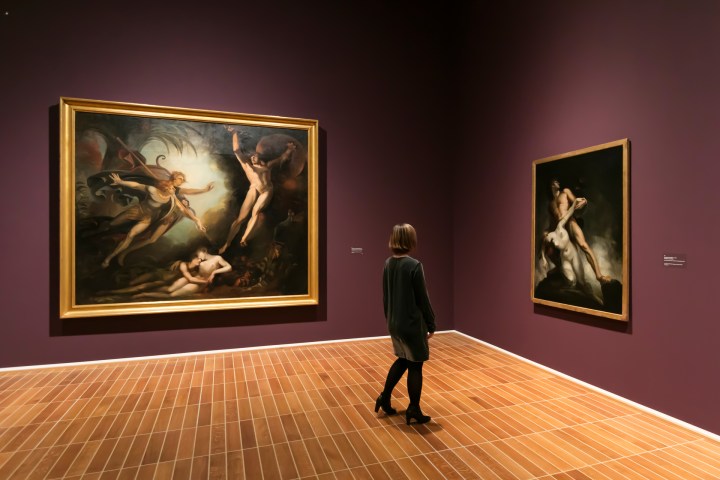
Thirteen years after the last major presentation of his work in Switzerland, at the Kunsthaus Zürich, the Kunstmuseum Basel mounts a comprehensive monographic exhibition of the work of Henry Fuseli (1741–1825), a native son of Zurich who rose to fame in Rome and London. One of the most inventive and unconventional innovators in late-eighteenth-century art, Fuseli stood on the threshold between classicism and nascent Romanticism. His oeuvre bears eloquent witness to the competing artistic paradigms in the waning decades of the Age of Enlightenment.
Fuseli styled himself as a painter of Dark Romanticism and ‘Gothic horror’, and that aspect of his oeuvre is still most familiar to audiences today. Shifting the focus, the exhibition demonstrates that drama and theater were no less vital to his artistic vision: the erudite artist’s creations almost invariably draw on literary motifs, quoting ancient mythology, John Milton’s Paradise Lost, or the recently rediscovered Nibelungen saga. After his return from Rome to London in 1779, Shakespeare’s plays become another major source of motifs in his art, as his contributions to John Boydell’s Shakespeare Gallery illustrate. Drama and Theater—the title captures the interest in the themes from literary and stage works chosen by Fuseli that animates the exhibition, but it also describes his dynamic compositions and constellations of characters and the ‘theatrical’ devices that often enliven his depictions.
Like Fuseli’s art itself, Drama and Theater is hardly subtle. The artist’s seven paintings in the Öffentliche Kunstsammlung Basel, the municipal art collection of Basel, are complemented by works generously provided on loan by the Kunsthaus Zürich and other international museums and private collections. Reflecting on the conjunction of literature, theater, and visual art from another angle, Thom Luz, resident director at Theater Basel, will enhance the exhibition by bringing his contemporary theatrical practice into the gallery. The installation is realized in collaboration with the video artist Jonas Alsleben.
Eva Reifert, ed., Fuseli: Drama and Theatre (London: Prestel, 2018), 240 pages, ISBN: 978-3791357584, £45 / $60.
New Book | Telling Objects
In addition to Telling Objects, the latest output from the Marrying Cultures project, previous publications include:
• Helen Watanabe-O’Kelly and Adam Morton, eds., Queens Consort, Cultural Transfer, and European Politics, 1500–1800 (New York: Routledge, 2016), 274 pages, ISBN: 978-1472458384, $160. With more information here»
• Almut Bues, ed., Frictions and Failures: Cultural Encounters in Crisis (Wiesbaden: Harrassowitz Verlag, 2017), ISBN 978-3447107365, $75. With more information here»
• Elise Dermineur, Queen Luise Ulrike: Gender and Politics in Eighteenth-Century Sweden (New York: Routledge, 2017), 254 pages, ISBN: 978-1472476661, $150. With more information here»
From Harrassowitz Verlag:
Jill Bepler and Svante Norrhem, eds., Telling Objects: Contextualizing the Role of the Consort in Early Modern Europe (Wiesbaden: Harrassowitz Verlag, 2018), 272 pages, ISBN: 978-3447109352, 68€.
 The idea for this volume originated from discussions at the first international conference of the HERA project Marrying Cultures. Colleagues from museums, galleries, and university contexts were asked to focus not on the figure of the early modern consort herself but on specific objects or genres of objects associated with her. When a royal bride moved from one territory to another, she transported quantities of furniture, books, paintings, clothes, or jewelry to her new home. In later life, she often continued to acquire things from her native country or via her dynastic networks or she could serve as a conduit through which objects were ‘exported’.
Two introductory essays look at patterns of exchange and inheritance. The case studies of objects that follow reveal general patterns of cultural exchange set in motion by royal consorts, in several cases focusing on relatively under-studied courts and dynasties. East and west, north and south were interconnected by objects and people through physical travel and via letters and in print. Gifts, trade, or inheritance played a part in moving objects over space and time. These essays give examples of how objects on the move could transfer value (symbolic, dynastic, or financial) and how the perception of these objects, many of which have become part of contemporary national heritage, changed across generations along with the impact they had, both culturally and politically.
C O N T E N T S
Jill Bepler and Svante Norrhem, Introduction
Cultural Transfer and Exchange
• Volker Bauer, Connecting Courts, Castles, Capitals: Cultural Exchange in the Early Modern Society of Princes
• Almut Bues, Inventories and the Movement of Objects
Genres and Materials
• Catharine MacLeod, Facing Europe: The Portraiture of Anne of Denmark (1574–1619)
• Margherita Palumbo, ‘I was much courted by the entire English nation’: The English Books Owned by Sophie of the Palatinate, Electress of Hanover
• Adelina Modesti, ‘Nelle mode le più novelle’: The Latest Fashion Trends (Textiles, Clothing and Luxury Fabrics) at the Court of Grand Duchess Vittoria della Rovere de’ Medici of Tuscany
Individual Objects Transformed
• Ewa Kociszewska, Devotion and Unbelief of the Gonzaga Sisters: The Relic of the True Cross in Poland and France
• Mara Wade, Princess Magdalena Sibylle’s Golden Horn: Dynastic Women and Cultural Transfer between Denmark and Saxony
Gift Culture
• Katrin Keller, Tulips, Tobacco, and Parrots: Consorts and Their Role in the Transfer of Animals and Plants in the Second Half of the Sixteenth Century
• Maureen Cassidy-Geiger, Gender, Dynasty and the Politics of Porcelain: The Fact and Impact of Meissen Gifts to Royal Women, ca. 1714–50
• MarÍlia dos Santos Lopes, A Personal Gift – A Part of Cultural Heritage: The Coach Brought to Lisbon by Maria Anna of Austria
• Joanna Marschner, The Ivory Egg: Elisabeth Charlotte, Princess Palatine’s Gift to Caroline of Ansbach
About the Authors
Index
New Book | The Agency of Display
The essays in this edited volume originated from the conference Collections, Displays and the Agency of Objects (Cambridge University, 20–22 September 2017), which was part of the project ‘Parerga and Paratexts – How Things Enter Language: Practices and Forms of Presentation in Goethe’s Collections’. From Sandstein Verlag:
Johannes Grave, Christiane Holm, Valérie Kobi, and Caroline van Eck, eds., The Agency of Display: Objects, Framings, and Parerga (Dresden: Sandstein Verlag, 2018), 192 pages, ISBN: 978-3954984169, 38€.
 The display of artefacts always implies an external mediation that influences, and often codifies, the reception of the exhibits. Objects are manipulated, restored, appropriated, staged, in short displayed, through various representational strategies that include pedestals, labels, and showcases. These elements, which we could define as parerga, are often ignored because of their utilitarian function. Yet, they play an important role in the history of the artefacts and define the setting in which the objects can exert their agency. They not only shape their meaning, but also determine the effect that these artefacts have on their viewers. Framing devices create the conditions for interactions between the individual and the object to take place. This publication aims to explore the relation between artefacts and viewers as they are manifested in framing devices, and to develop a new theoretical framework for thinking about the power of objects on display.
C O N T E N T S
Acknowledgments
Johannes Grave, Christiane Holm, Valérie Kobi, and Caroline van Eck, The Agency of Display: Objects, Framings, and Parerga—Introductory Thoughts
1 Display Situations
• Ivan Gaskell, Display Displayed
• Elsie Van Kessel, The Street as Frame: Corpus Christi Processions in Lisbon prior to João V
• Hannah Williams, Staging Belief: Immersive Encounters and the Agency of Religious Art in Eighteenth-Century Paris
• Mechthild Fend, Order and Affect: The Museum of Dermatological Wax Moulages at the Hôpital Saint-Louis in Paris
• Cindy Kang, The Barnes Ensembles, Again
2 Parergonal Operations
• Dario Gamboni, Ready-Made Eye-Opener: Models, Functions, and Meanings of the Ironwork in Albert C. Barnes’s Displays
• Peter Schade The Reframing of Lazarus
• Diana Stört, Displaying Knowledge: Goethe’s Cabinets as Epistemic Furniture
• Angela Matyssek, Death by / Life by Wall Label
• Noémie Étienne, When Things Do Talk (in Storage): Materiality and Agency between Contact and Conflict Zones
Contributors
Picture Credits
Imprint
Exhibition | William Hunter and the Anatomy of the Modern Museum

Press release (12 September 2018) for the exhibition:
William Hunter and the Anatomy of the Modern Museum
The Hunterian, Glasgow, 28 September 2018 — 6 January 2019
Yale Center for British Art, New Haven, 14 February — 20 May 2019
Curated by Mungo Campbell with Nathan Flis and Lola Sánchez-Jáuregui
A major new exhibition at The Hunterian, University of Glasgow, will mark an important anniversary in the history of Scotland’s oldest public museum. William Hunter and the Anatomy of the Modern Museum opens on 28 September 2018 and marks the William Hunter Tercentenary—300 years since the birth of Hunterian founder, Dr William Hunter (1718–1783). The exhibition not only offers a critical examination of Hunter—a man of exceptional vision who saw no boundaries between art and science, but explores his life, character, and career as well as his research, collection, and links to Glasgow.
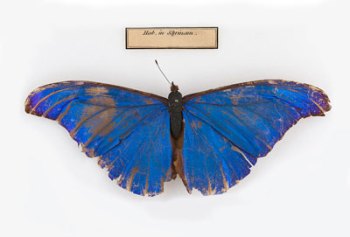
Rhetenor blue morpho butterfly (Morpho rhetenor Cramer), 1775, Suriname (Hunterian, University of Glasgow).
Hunter’s original Enlightenment collection is a rare example which has survived largely intact and these objects and artworks are the foundation of The Hunterian collections today. William Hunter and the Anatomy of the Modern Museum showcases this truly unique collection, encyclopaedic in nature and with its heart in the Scottish Enlightenment. The exhibition also offers a balanced account of the circumstances that made a collection like Hunter’s possible and examines the means by which it was amassed. Visitors will have the opportunity to see key items from Hunter’s collection, reunited for the first time in over 150 years and displayed to highlight the connections between them.
More than 400 items will be on display including: fossils; anatomical specimens and preparations; paintings, drawings and prints; rare books and manuscripts; ethnographical objects; rocks and mineral specimens; coins and medals; shells, corals, beetles, butterflies and examples of taxidermy. The majority come from The Hunterian, and Archives and Special Collections at the University of Glasgow Library, where Hunter’s collection of books and manuscripts is kept.
Key loans include a life size écorché figure from the Royal Academy of Arts in London and Johan Zoffany’s painting William Hunter Lecturing that shows William Hunter delivering an anatomy class, on loan from the Royal College of Physicians in London.
Important conservation work has been carried out on a number of items from Hunter’s collection including paintings, frames, sculptures, textiles, books, works on paper and objects of decorative art.
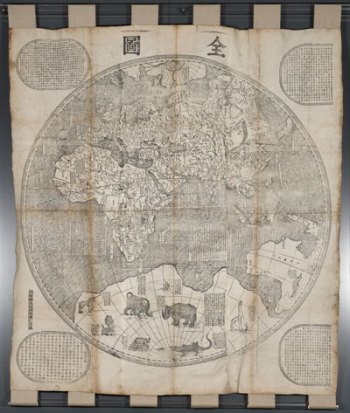
Ferdinand Verbiest, Kunyu Quantu 坤輿全圖 (A Map of the Whole World),1674, woodblock print on paper laid down on cloth, in four parts (Hunterian, University of Glasgow).
Must see items include:
• Four of Hunter’s plaster cast models, now fully restored, which were used in preparation for his great publication Anatomia Uteri Humani Gravidi Tabulis Illustrate (Anatomy of the Gravid Uterus Exhibited in Figures, 1774). A selection of related drawings, prints, and proofs are included, many of which have not been on display before. The casts show the various stages of the pregnant human womb in progressive states of dissection in graphic and stunning naturalistic detail.
• Our unique 17th-century Chinese map of the world, displayed in its entirety for the first time.
• Hunter’s complete collection of 88 gold Roman coins, issued by every Roman Emperor from 27BCE to 491CE. The Hunterian is one of only three places in the world where such a complete series can be seen.
• Hunter’s will — on loan from the National Archives of Scotland and on public display for the first time.
• The life-size écorché figure on loan from the Royal Academy of Arts in London.
• An exceptional and fully restored 18th-century Maori cloak from New Zealand made of flax and feathers.
• The Hunterian Psalter — usually housed in Archives and Special Collections at the University of Glasgow Library, this lavishly illuminated bound English manuscript is dated to 1170 and is considered the greatest treasure of William Hunter’s library.
William Hunter and the Anatomy of the Modern Museum also reveals the contribution made by Hunter to the development of modern museums as we know them today, exploring the interplay between the arts and sciences in the pursuit of knowledge over the course of the 18th century.

Jean-Siméon Chardin, A Lady Taking Tea, 1735, oil on canvas (Hunterian Art Gallery, University of Glasgow).
The exhibition and publication William Hunter and the Anatomy of the Modern Museum are the result of a five-year collaborative research project between The Hunterian and the Yale Center for British Art and showcase new research undertaken by an international team of scholars. The lead curator is Mungo Campbell, Deputy Director of The Hunterian; and the organizing curator at the Yale Center for British Art is Nathan Flis, Head of Exhibitions and Publications, and Assistant Curator of Seventeenth-Century Paintings. They are assisted by Lola Sanchez-Jauregui, William Hunter Tercentenary Curator at The Hunterian. A fully illustrated exhibition catalogue will be published by The Hunterian and the Center in association with Yale University Press.
Running in parallel with William Hunter and the Anatomy of the Modern Museum are two exhibitions offering 21st-century responses to Hunter’s collections, life, and work. Strange Foreign Bodies and Rosengarten showcase the work of leading contemporary artists and writers including Claire Barclay, Christine Borland, Anne Bevan, and Janice Galloway.
Strange Foreign Bodies is a group exhibition of films, prints, and sculptural works by artists including Claire Barclay, Christine Borland, Sarah Browne, Alex Impey, and Phillip Warnell. Taking William Hunter’s Tercentenary as its point of departure, the exhibition offers a 21st-century perspective on Hunter’s Enlightenment project, with processes of mutation, metamorphosis, and technological transformation central to many of the works. We encounter the story of a woman who has turned into an octopus, the philosophical reflections of a heart transplant patient, and the simulated breathing of an animatronic medical mannequin. These ‘strange foreign bodies’ reflect the complexity of all human embodiment today.
Rosengarten is a unique installation that brings together the sculpture of Anne Bevan and the words of Janice Galloway, two of Scotland’s foremost artists in their fields. Inspired by obstetric implements and important historic medical collections, Rosengarten looks at the tools of birthing and powerfully reflects the human and tender emotions of mother and baby that run parallel to the hard and frequently interventive experiences associated with modern childbirth.
William Hunter and the Anatomy of the Modern Museum is at the Hunterian Art Gallery from 28 September 2018 until 6 January 2019 then at the Yale Center for British Art (Yale University, New Haven, Connecticut, USA) from 14 February until 20 May 2019. The project has been generously supported by The Royal Society of Edinburgh, the Paul Mellon Centre for Studies in British Art, Museums Galleries Scotland, and the Rev. Dr Donald McKellar Leitch Urie Bequest. Strange Foreign Bodies, also at the Hunterian Art Gallery, runs from 28 September 2018 until 13 January 2019. Rosengarten is now open at the Hunterian Art Gallery and runs until 20 January 2019. Purchased with funds from the National Collecting Scheme for Scotland and a grant from the Art Fund. Admission to all three exhibitions is free.
S E L E C T E D P R O G R A M M I N G
3 October 2018 — Mungo Campbell (The Hunterian), William Hunter and the Anatomy of the Modern Museum: Curator’s Introduction
10 October 2018 — Christine Whyte (Lecturer in Global History, University of Glasgow), A Triangular Trade of Medical Knowledge: William Hunter, Enslaved Women, and Scottish Medical Expertise
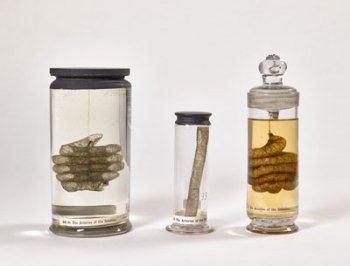
William Hunter and Assistants, Anatomical Specimens: Arteries of the Intestine, 1746–83, portion of human gut with mesentery, turpentine and glass jar; portion of human gut and glass jar; portion of human gut with mesentery, turpentine and glass jar (Hunterian, University of Glasgow).
17 October 2018 — Paul Rea (Senior Lecturer in Human Life Sciences, University of Glasgow), Anatomy in the Digital Age
24 October 2018 — Dominic Paterson (The Hunterian), Strange Foreign Bodies
31 October 2018 — Jeanne Robinson (The Hunterian), ‘Mr Termite’: An Agent of Entomology and the Empire in 18th-Century Sierra Leone
7 November 2018 — Alicia Hughes (University of Glasgow), Title to be confirmed
14 November 2018 — Anne Dulau Beveridge (The Hunterian), The Curious Collector: What William Hunter’s Portraits Tell Us about the Man
21 November 2018 — Maggie Reilly (The Hunterian), Title to be confirmed
28 November 2018 — Michelle Craig (Leverhulme Trust Doctoral Scholar, University of Glasgow), The Curious Collector: Provenance in William Hunter’s Library
5 December 2018 — Matthew Sangster (Lecturer in 18th-Century Literature and Material Culture, University of Glasgow), Conceptions of Knowledge in William Hunter’s Library
12 December 2018 — Jesper Ericsson (The Hunterian), Title to be confirmed
19 December 2018 — Frances Osis (University of Glasgow), Title to be confirmed
◊ ◊ ◊ ◊ ◊
The catalogue is published by the Yale Center for British Art:
Edited by Mungo Campbell and Nathan Flis, with the assistance of María Dolores Sánchez-Jáuregui, William Hunter and the Anatomy of the Modern Museum (New Haven: Yale Center for British Art in association with The Hunterian, 2018), 440 pages, ISBN: 978-0300236651, $65.
 Accompanying a groundbreaking exhibition, this publication is the first in 150 years to assess the contribution made by Hunter, the Scottish-born obstetrician, anatomist, and collector, to the development of the modern museum as a public institution. Essays examine how Hunter gathered his collection to be used as a source of knowledge and instruction, encompassing outstanding paintings and works on paper, coins and medals, and anatomical and zoological specimens. Hunter also possessed ethnographic artifacts from Spain, the Middle East, China, and the South Pacific, and was an avid collector of medieval manuscripts and incunabula; these were all located within one of the most important ‘working’ libraries of eighteenth-century London.
C O N T E N T S
Amy Meyers and Steph Scholten, Directors’ Foreword
Mungo Campbell and Nathan Flis, Acknowledgments
Contributors’ Biographies
Seren Nolan, William Hunter: A Chronology
Part I Physician, Anatomist, Collector
• Mungo Campbell, William Hunter and the Anatomy of the Modern Museum: An Introduction
• Nathan Flis, Skeletons in Hunter’s Closet: James Douglas and the Fashioning of William Hunter
• Craig Ashley Hanson, A Motto for a Museum: William Hunter’s Inheritance from Richard Mead
• Matthew Sangster, Conceptions of Knowledge in William Hunter’s Library
• Meredith Gamer, Scalpel to Burin: A Material History of William Hunter’s Anatomy of the Human Gravid Uterus
• Dominik Hünniger, ‘Extolled by Foreigners’: William Hunter’s Collection and the Development of Science and Medicine in Eighteenth-Century Europe
• Nicholas Thomas, ‘A Great Collection of Curiosities from the South Sea Islands’: William Hunter’s Ethnography
• María Dolores Sánchez-Jáuregui, Anatomical Jars and Butterflies: Curating Knowledge in William Hunter’s Museum
Part II Catalogue of the Exhibition
• Mungo Campbell, Portraits and Papers
• Mungo Campbell, Pedagogy and Professional Practice
• Peter Black, Anatomical Illustration and the Practice of Anatomy
• Maggie Reilly and Stuart McDonald, Anatomical Preparations
• Mungo Campbell, The Anatomy of the Human Gravid Uterus
• Peter Black and Anne Dulau Beveridge, Pictures
• Michelle Craig, The Library
• Donal Bateson, Coins and Medals
• Mungo Campbell, Pacific and Other ‘Curiosities’
• Maggie Reilly and Jeanne Robinson, Shells, Corals, Birds, Insects, and Other Preserved Animals
• John Faithfull and Neil Clark, Ores and Fossils
Appendices
1 Letter from William Hunter to William Cullen, 2–20 April 1765
2 Sale Catalogue of William Hunter’s Personal Effects, 1783
Selected Bibliography
Index
Photography Credits
New Book | Local Antiquities, Local Identities
From Manchester UP:
Kathleen Christian and Bianca de Divitiis, eds., Local Antiquities, Local Identities: Art, Literature, and Antiquarianism in Europe, c. 1400–1700 (Manchester: Manchester University Press, 2018), 352 pages, ISBN: 978-1526117045, £80.
 This collection investigates the wide array of local antiquarian practices that developed across Europe in the early modern era. Breaking new ground, it explores local concepts of antiquity in a period that has been defined as a uniform ‘Renaissance’. Contributors take a novel approach to the revival of the antique in different parts of Italy, as well as examining other, less widely studied antiquarian traditions in France, the Netherlands, Spain, Portugal, Britain and Poland. They consider how real or fictive ruins, inscriptions and literary works were used to demonstrate a particular idea of local origins, to rewrite history or to vaunt civic pride. In doing so, they tackle such varied subjects as municipal antiquities collections in Southern Italy and France, the antiquarian response to the pagan, Christian and Islamic past on the Iberian Peninsula, and Netherlandish interest in megalithic ruins thought to be traces of a prehistoric race of Giants.
Kathleen Christian is Senior Lecturer in Art History at The Open University. Bianca de Divitiis is Associate Professor in the History of Modern Art at the University of Naples Federico II.
C O N T E N T S
Kathleen Christian and Bianca de Divitiis, Introduction
1 Richard Schofield, A Local Renaissance: Florentine Quattrocento Palaces and all’antica Styles
2 Francesco Benelli, The Arch of Trajan in Ancona and Civic Identity in the Italian Quattrocento from Ciriaco d’Ancona to the Death of Matthias Corvinus
3 Kathleen Christian, Roma Caput Mundi: Rome’s Local Antiquities as Symbol and Source
4 Bianca de Divitiis, A Local Sense of the Past: Spolia, Re-Use, and all’antica Building in Southern Italy, 1400–1600
5 Oren Margolis, The Gaulish Past of Milan and the French Invasion of Italy
6 William Stenhouse, Reusing and Redisplaying Antiquities in Early Modern France
7 Fernando Marías, Local Antiquities in Spain: From Tarragona to Córdoba
8 Katrina Olds, Local Antiquaries and the Expansive Sense of the Past: A Case Study from Counter-Reformation Spain
9 João Figueiredo, Luís de Camões’s The Lusiads and the Paradoxes of Expansion
10 Edward Wouk, Semini and His Progeny: The Construction of Antwerp’s Antique Past
11 Krista De Jonge, Resurrecting Belgica Romana: Peter Ernst von Mansfeld’s Garden of Antiquities in Clausen, Luxemburg, 1563–90
12 Konrad Ottenheym, On Romans, Batavians, and Giants: The Quest for the True Origin of Architecture in the Dutch Republic
13 Barbara Arciszewska, The Role of Ancient Remains in the Sarmatian Culture of Early Modern Poland
14 Jenna Schultz, Inventing England: English Identity and the Scottish ‘Other’, 1586–1625
Index
New Book | Painter of Pedigree: Thomas Weaver of Shrewsbury
Published by Unicorn and distributed in the US and Canada by The University of Chicago Press:
Lawrence Trevelyan Weaver, Painter of Pedigree: Thomas Weaver of Shrewsbury, Animal Artist of the Agricultural Revolution (London: Unicorn Publishing Group, 2018), 300 pages, ISBN: 978-1910787670, $45.
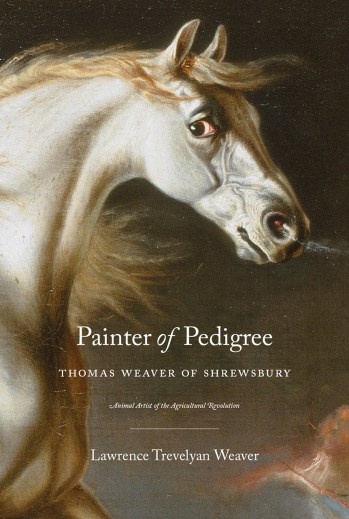 Thomas Weaver of Shrewsbury (1775–1844) is known for his wonderful paintings of animals—prize bulls, pedigreed sheep, and thoroughbred stallions—set against the backdrop of the ever-changing English landscape as the Industrial Revolution gathered steam. Traveling from country house to country house, Weaver with his journeys mapped the networks of kinship, patronage, and aspiration that undergirded the social life of the landed families and gentry of Georgian England.
Drawing on a previously unexamined collection of Weaver’s papers and pictures, including personal and professional correspondence, diaries, contemporary newspaper cuttings, verse, and portraits of his family, Painter of Pedigree brings to life the work of an animal artist in the age of agricultural improvement, revealing the art, artistry, and artifice that went into portraying and promoting these new breeds.
Exhibition | It’s Alive! Frankenstein at 200
From the press release (6 September) for the exhibition:
It’s Alive! Frankenstein at 200
The Morgan Library & Museum, New York, 12 October 2018 — 27 January 2019
Curated by John Bidwell and Elizabeth Denlinger
A classic of world literature, a masterpiece of horror, and a forerunner of science fiction, Frankenstein by Mary Shelley is the subject of a new exhibition at the Morgan. Organized in collaboration with the New York Public Library, It’s Alive! Frankenstein at 200 traces the origins and impact of the novel whose monster has become both a meme and a metaphor for forbidden science, unintended consequences, and ghastly combinations of the human and the inhuman. Portions of the original manuscript will be on display along with historic scientific instruments and iconic artwork such as Henry Fuseli’s Nightmare and the definitive portrait of Mary Shelley. The story’s astonishingly versatile role in art and culture over the course of two hundred years helps explain why the monster permeates the popular imagination to this day.

Joseph Wright, The Alchymist, in Search of the Philosopher’s Stone, Discovers Phosphorus, and Prays for the Successful Conclusion of his Operation, as was the Custom of the Ancient Chymical Astrologers, 1795, oil on canvas (Derby Museums Trust; photography by Richard Tailby).
Co-curated by John Bidwell, the Astor Curator and Department Head of the Morgan’s Printed Books and Bindings Department, and Elizabeth Denlinger, Curator of the Carl H. Pforzheimer Collection of Shelley and His Circle at The New York Public Library, this exhibition presents a diverse array of books, manuscripts, posters, prints, and paintings illustrating the long cultural tradition that shaped and was shaped by Mary Shelley’s myth. A large number of these works come from both the Morgan and the New York Public Library’s collections.
Only eighteen years old when she embarked on the novel, Shelley invented the archetype of the mad scientist who dares to flout the laws of nature. She created an iconic monster who spoke out against injustice and begged for sympathy while performing acts of shocking violence. The monster’s fame can be attributed to the novel’s theatrical and film adaptations. Comic books, film posters, publicity stills, and movie memorabilia reveal a different side to the story of Frankenstein, as reinterpreted in spinoffs, sequels, mashups, and parodies.
“The Morgan is in an excellent position to tell the rich story of Mary Shelley’s life and of Frankenstein’s evolution in popular culture,” said director of the museum, Colin B. Bailey. “Pierpont Morgan was fascinated by the creative process, and one of the artifacts he acquired was a first edition Frankenstein annotated by the author. The collection of works by the Shelleys, both at the Morgan and the New York Public Library, has only grown since then. We are very pleased to collaborate with the NYPL in presenting the full version of this extraordinary tale and how it lives on in the most resilient and timely of ways.”
A copiously illustrated companion volume, It’s Alive! A Visual History of Frankenstein, provides a vivid account of the artistic and literary legacy of the novel along with detailed descriptions of the highlights in the exhibition, while a new online curriculum offers high school teachers resources for the classroom.
The exhibition occupies two galleries: one documenting the life of Mary Shelley and the composition of her book, the other showing how the story evolved in the theater, cinema, and popular culture.
The Influence of the Gothic Style and Enlightenment Science

Benoît Pecheux, plate no. 4 in Giovanni Aldini, Essai théorique et expérimental sur le galvanisme (Paris: De l’imprimerie de Fournier Fils, 1804 / The Morgan Library & Museum, purchased on the Gordon N. Ray Fund, 2016; PML 196238).
Mary Shelley’s Frankenstein; or, The Modern Prometheus sprang from both a passion for Gothic style that pervaded British culture long before the author’s birth in 1797 and the influence of the discoveries of European Enlightenment science. Audiences loved the supernatural in all its formulations—ghosts, graveyards, mysterious strangers, secret warnings, lost wills, hidden pictures, and more. While novels were the primary vehicle for the Gothic, it was also popular with artists of paintings and prints, which were sometimes satirical—the Gothic was parodied as soon as it was taken seriously. The exhibition opens with the greatest horror painting of the eighteenth century, The Nightmare, painted in 1781 by the Swiss immigrant artist Henry Fuseli. Mary Shelley knew about this iconic image and may have used it in writing the climactic scene in Frankenstein.
Shelley was also influenced by the scientific endeavors of the time. She had been born into an age of scientific and technological discovery in Britain, when institutions like the Royal Society began fostering exploration and experimentation. Across Britain spread a thriving circuit of lectures and science demonstrations for the public. A few of these experiments have become part of the Frankenstein legend. While writing the novel, Shelley had been reading Humphry Davy’s Elements of Chemical Philosophy, and she knew about anatomical dissections, contemporary debates about the origins of life, and electrical experiments on corpses. She lends this fascination to Victor Frankenstein, who makes a monster from corpses in his “workshop of filthy creation.”
Mary Shelley’s Life and Conception of Frankenstein

Mary Wollstonecraft Shelley, Frankenstein; or, The Modern Prometheus (London: Printed for Lackington, Hughes, Harding, Mavor & Jones, 1818). This specific copy, purchased by Pierpont Morgan in 1910, is part of The Carl H. Pforzheimer Collection of Shelley and His Circle at The Morgan Library & Museum.
Mary Shelley grew up in a radical and intellectual milieu, the daughter of writers famous in their own time, the feminist theorist Mary Wollstonecraft and the novelist and philosopher William Godwin. After her mother died in childbirth, her father married Mary Jane Clairmont, who had children of her own, and the teenaged Mary Godwin escaped a tense family atmosphere by making long visit to friends in Scotland. When she returned in 1814, she met the poet Percy Bysshe Shelley, already married and a father. They soon fell in love and eloped to Europe, the most decisive act of all their lives.
It was on a trip to Lake Geneva in 1816 accompanied by P.B. Shelley, Lord Byron, and her step-sister Claire Clairmont that Mary Godwin found the inspiration to write Frankenstein. During their stay, the party entertained themselves by reading aloud from a volume of Gothic tales. Byron suggested a contest to write ghost stories, and Shelley joined in energetically, looking for something “to curdle the blood, and quicken the beatings of the heart.” After days of frustrated effort, the idea came to her one night after hearing P.B. Shelley and Lord Byron discuss the origins of life and the possibility of animating a corpse by galvanic action.
“I saw—with shut eyes, but acute mental vision—I saw the pale student of unhallowed arts kneeling beside the thing he had put together.” She returned to England with the beginnings of a novel.
By 1817, she had finished a draft titled Frankenstein; or, The Modern Prometheus. The book appeared in three volumes on January 1, 1818, after P. B. Shelley offered revisions and found a publisher. Luckily for posterity, most of the Frankenstein manuscript has survived, making it possible to see the author’s original ideas, her second thoughts, and her husband’s suggestions. Portions of the manuscript containing key passages in the novel will be on display at the Morgan.
Mary Shelley’s personal life was punctuated by tragedy in ways strangely similar to incidents in the novel. After settling in Italy in the spring of 1818 with her husband, their children William and Clara, step-sister Claire and her daughter Allegra, the family experienced constant sorrow as first William and Clara, and then Allegra died. Their grief was only partly assuaged by the birth of another child, Percy Florence. Through their mourning and marital difficulties, Mary Shelley and her husband maintained a strenuous routine of writing and study and friendships in the English and Italian communities. In July 1822, Shelley suffered a final devastating loss: P. B. Shelley sailed with his friend Edward Williams and their cabin boy to meet their friend Leigh Hunt’s family in Leghorn; on their return their boat met a sudden squall and they drowned.
Frankenstein on Stage and on Screen
When Mary Shelley returned to England in August 1823, one of the few bright spots was Richard Brinsley Peake’s melodrama Presumption! or, the Fate of Frankenstein: a theatrical hit, the play had made her famous. The actor Thomas Potter Cooke’s performance was the key factor: over six feet tall, clad in a gray-blue leotard, his exposed skin painted the same color, with a toga on top, he moved with lyrical athleticism and made the creature both frightening and pathetic. Mary Shelley saw one of Cooke’s performances and enjoyed it greatly. Other adaptations followed: at least fifteen dramas based on the novel were produced between 1823 and 1826.
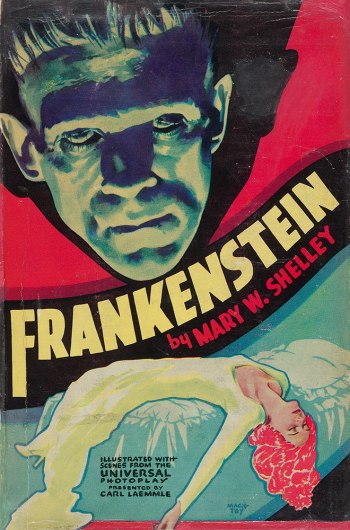
Poster for Mary W. Shelley’s Frankenstein (New York: Grosset and Dunlap, 1931 / The Morgan Library & Museum, purchased on the Gordon N. Ray Fund, 2016; PML 196478. Courtesy of Universal Studios Licensing LLC, © 1931 Univeral Pictures Company, Inc).
A large portion of the exhibition is dedicated to the movies, which have played an essential role in popularizing the story and shaping our pop culture image of the monster. The earliest film of Frankenstein was made by the Edison Studios in 1910, but it is James Whale’s 1931 version that has taken such a prominent place in the popular psyche that it is now better known than the novel. The 1931 Frankenstein and 1935 Bride of Frankenstein gave us a radically reimagined version of the narrative, particularly the creation scene and Boris Karloff’s performance as the monster. James Whale and his special effects technicians introduced the high-voltage lab equipment and set the scene amidst the thunder and lightning now obligatory in horror movies. The creature’s violence was induced by his being tortured with fire. Karloff later said, “Over the years thousands of children wrote, expressing compassion for the great, weird creature who was so abused by its sadistic keeper that it could only respond to violence with violence. Those children saw beyond the make-up and really understood.” The 1935 sequel, with Elsa Lanchester playing both Mary Shelley and the creature’s bride, has also aged well. Both films create sympathy for the creature through his encounters with stupid and sadistic people, and both Karloff and Elsa Lanchester portray their characters with dignity and depth of emotion.
From the creation of the monster, to the creature’s killing of a small child, to violence committed against women, adaptations of Frankenstein again and again have returned to some of the most disturbing but recurring scenes of human experience. Mary Shelley’s unique contribution to culture is the creation of the monster. Her genius was to imagine a way to make life out of death; James Whale’s genius was to imagine a way to depict it in moving images and sound.
Whale’s Frankenstein films sparked a mass of cinematic energy. Other directors drew from it for years after with imitations and derivative films, a few just as frightening, some quite funny, none as haunting. The Morgan has borrowed a series of B-movie posters from a private collector and the Academy of Motion Picture Arts and Sciences to show some of the more faithful, comic, lurid, and execrable treatments of this theme
Makeup artists, perhaps, have come closer than anyone to bringing Victor Frankenstein’s story to life. Jack Pierce’s makeup gave the creature a new face in the 1931 film. Some highlights in the section include the sketches and photographs of this iconic appearance along with a gruesome torso model of Robert De Niro in Kenneth Branagh’s Frankenstein, provided by the Harry Ransom Center at the University of Texas, Austin.
The Creature’s Afterlife: Comic Books and Prints
 The comic book as a separate slim magazine first appeared in 1933 as a promotional insert in newspapers, and Frankenstein has been part of this medium’s history from nearly the beginning. The exhibition includes some of the most interesting examples of the story, some aimed at children and some at adults.
Surprisingly few illustrators have taken on the novel’s challenge, but we present four of the best: Lynd Ward (remembered first of all as a wood engraver), Bernie Wrightson (a renowned comic book artist), Barry Moser (a celebrated book illustrator), and Pierre-Alain Bertola (a polymath Swiss artist who worked on a theatrical version of Frankenstein). All of them are working after, and against James Whale. All pay exquisite attention to Mary Shelley’s text and its ethical implications.
The exhibition closes with Barry Moser’s illustration of the Frankenstein family tomb, leaving us solidly in the tradition of Gothic art with which the show begins. Mary Shelley’s creature is a Gothic nightmare, but one who takes responsibility for himself. Even as his blood boils at the injustices committed against him, he is also “torn by the bitterest remorse.” Seeking quiet in death, he leaps onto his raft and is soon lost to human eyes. As mysterious and volatile in death as in life, Frankenstein’s monster leaves us with more questions than answers—perhaps the decisive reason why artists have been drawn to him for the past two hundred years.
Elizabeth Campbell Denlinger, It’s Alive! A Visual History of Frankenstein (New York: The Morgan Library & Museum, 2018), 336 pages, ISBN: 978-1512603422, $55.
New Book (and Film) | Peterloo
From Head of Zeus Books:
Jacqueline Riding, Peterloo: The Story of the Manchester Massacre (London: Head of Zeus, 2018), 400 pages, 400 pages, ISBN: 978-1786695833, £30.
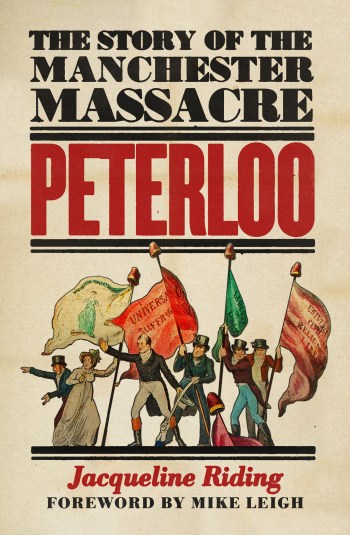 Manchester, August 1819: 60,000 people had gathered in the cause of parliamentary reform. To those defending the status quo, the vote was not a universal right, but a privilege of wealth and land ownership. To radical reformers the fundamental overhaul of a corrupt system was long overdue. The people had come to hear one such reformer, Henry Hunt, from all over Lancashire, walking to the sound of hymns and folk songs. By the end of the day fifteen of them, including two women and a child, were dead or mortally wounded, and 650 injured, hacked down by drunken yeomanry after local magistrates panicked at the scale of the meeting. The British state, four years after defeating the ‘tyrant’ Bonaparte at Waterloo, had turned its forces against its own people, as they peaceably exercised their liberties.
Dr Jacqueline Riding’s compelling book ties in to Mike Leigh’s forthcoming film Peterloo, for which the author was historical advisor, in advance of the bicentenary of Peterloo in 2019.
Jacqueline Riding is author of the award-winning Jacobites: A New History of the ‘45 Rebellion. She is a consultant for museums, galleries and historic buildings, and an historical adviser on feature films.
◊ ◊ ◊ ◊ ◊
According to Wikipedia, the film is “scheduled to be released in the United Kingdom on 2 November 2018, by Entertainment One, and in the United States on 9 November 2018, by Amazon Studios.”










 Enfilade
leave a comment