New Book | Painter of Pedigree: Thomas Weaver of Shrewsbury
Published by Unicorn and distributed in the US and Canada by The University of Chicago Press:
Lawrence Trevelyan Weaver, Painter of Pedigree: Thomas Weaver of Shrewsbury, Animal Artist of the Agricultural Revolution (London: Unicorn Publishing Group, 2018), 300 pages, ISBN: 978-1910787670, $45.
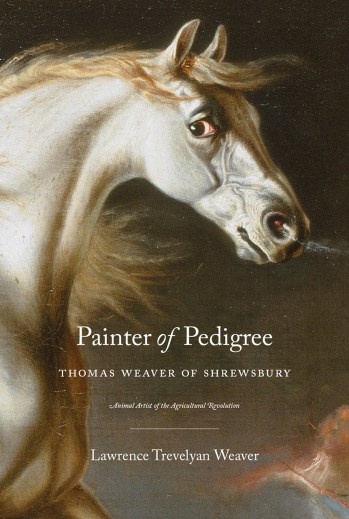 Thomas Weaver of Shrewsbury (1775–1844) is known for his wonderful paintings of animals—prize bulls, pedigreed sheep, and thoroughbred stallions—set against the backdrop of the ever-changing English landscape as the Industrial Revolution gathered steam. Traveling from country house to country house, Weaver with his journeys mapped the networks of kinship, patronage, and aspiration that undergirded the social life of the landed families and gentry of Georgian England.
Drawing on a previously unexamined collection of Weaver’s papers and pictures, including personal and professional correspondence, diaries, contemporary newspaper cuttings, verse, and portraits of his family, Painter of Pedigree brings to life the work of an animal artist in the age of agricultural improvement, revealing the art, artistry, and artifice that went into portraying and promoting these new breeds.
Exhibition | It’s Alive! Frankenstein at 200
From the press release (6 September) for the exhibition:
It’s Alive! Frankenstein at 200
The Morgan Library & Museum, New York, 12 October 2018 — 27 January 2019
Curated by John Bidwell and Elizabeth Denlinger
A classic of world literature, a masterpiece of horror, and a forerunner of science fiction, Frankenstein by Mary Shelley is the subject of a new exhibition at the Morgan. Organized in collaboration with the New York Public Library, It’s Alive! Frankenstein at 200 traces the origins and impact of the novel whose monster has become both a meme and a metaphor for forbidden science, unintended consequences, and ghastly combinations of the human and the inhuman. Portions of the original manuscript will be on display along with historic scientific instruments and iconic artwork such as Henry Fuseli’s Nightmare and the definitive portrait of Mary Shelley. The story’s astonishingly versatile role in art and culture over the course of two hundred years helps explain why the monster permeates the popular imagination to this day.

Joseph Wright, The Alchymist, in Search of the Philosopher’s Stone, Discovers Phosphorus, and Prays for the Successful Conclusion of his Operation, as was the Custom of the Ancient Chymical Astrologers, 1795, oil on canvas (Derby Museums Trust; photography by Richard Tailby).
Co-curated by John Bidwell, the Astor Curator and Department Head of the Morgan’s Printed Books and Bindings Department, and Elizabeth Denlinger, Curator of the Carl H. Pforzheimer Collection of Shelley and His Circle at The New York Public Library, this exhibition presents a diverse array of books, manuscripts, posters, prints, and paintings illustrating the long cultural tradition that shaped and was shaped by Mary Shelley’s myth. A large number of these works come from both the Morgan and the New York Public Library’s collections.
Only eighteen years old when she embarked on the novel, Shelley invented the archetype of the mad scientist who dares to flout the laws of nature. She created an iconic monster who spoke out against injustice and begged for sympathy while performing acts of shocking violence. The monster’s fame can be attributed to the novel’s theatrical and film adaptations. Comic books, film posters, publicity stills, and movie memorabilia reveal a different side to the story of Frankenstein, as reinterpreted in spinoffs, sequels, mashups, and parodies.
“The Morgan is in an excellent position to tell the rich story of Mary Shelley’s life and of Frankenstein’s evolution in popular culture,” said director of the museum, Colin B. Bailey. “Pierpont Morgan was fascinated by the creative process, and one of the artifacts he acquired was a first edition Frankenstein annotated by the author. The collection of works by the Shelleys, both at the Morgan and the New York Public Library, has only grown since then. We are very pleased to collaborate with the NYPL in presenting the full version of this extraordinary tale and how it lives on in the most resilient and timely of ways.”
A copiously illustrated companion volume, It’s Alive! A Visual History of Frankenstein, provides a vivid account of the artistic and literary legacy of the novel along with detailed descriptions of the highlights in the exhibition, while a new online curriculum offers high school teachers resources for the classroom.
The exhibition occupies two galleries: one documenting the life of Mary Shelley and the composition of her book, the other showing how the story evolved in the theater, cinema, and popular culture.
The Influence of the Gothic Style and Enlightenment Science

Benoît Pecheux, plate no. 4 in Giovanni Aldini, Essai théorique et expérimental sur le galvanisme (Paris: De l’imprimerie de Fournier Fils, 1804 / The Morgan Library & Museum, purchased on the Gordon N. Ray Fund, 2016; PML 196238).
Mary Shelley’s Frankenstein; or, The Modern Prometheus sprang from both a passion for Gothic style that pervaded British culture long before the author’s birth in 1797 and the influence of the discoveries of European Enlightenment science. Audiences loved the supernatural in all its formulations—ghosts, graveyards, mysterious strangers, secret warnings, lost wills, hidden pictures, and more. While novels were the primary vehicle for the Gothic, it was also popular with artists of paintings and prints, which were sometimes satirical—the Gothic was parodied as soon as it was taken seriously. The exhibition opens with the greatest horror painting of the eighteenth century, The Nightmare, painted in 1781 by the Swiss immigrant artist Henry Fuseli. Mary Shelley knew about this iconic image and may have used it in writing the climactic scene in Frankenstein.
Shelley was also influenced by the scientific endeavors of the time. She had been born into an age of scientific and technological discovery in Britain, when institutions like the Royal Society began fostering exploration and experimentation. Across Britain spread a thriving circuit of lectures and science demonstrations for the public. A few of these experiments have become part of the Frankenstein legend. While writing the novel, Shelley had been reading Humphry Davy’s Elements of Chemical Philosophy, and she knew about anatomical dissections, contemporary debates about the origins of life, and electrical experiments on corpses. She lends this fascination to Victor Frankenstein, who makes a monster from corpses in his “workshop of filthy creation.”
Mary Shelley’s Life and Conception of Frankenstein

Mary Wollstonecraft Shelley, Frankenstein; or, The Modern Prometheus (London: Printed for Lackington, Hughes, Harding, Mavor & Jones, 1818). This specific copy, purchased by Pierpont Morgan in 1910, is part of The Carl H. Pforzheimer Collection of Shelley and His Circle at The Morgan Library & Museum.
Mary Shelley grew up in a radical and intellectual milieu, the daughter of writers famous in their own time, the feminist theorist Mary Wollstonecraft and the novelist and philosopher William Godwin. After her mother died in childbirth, her father married Mary Jane Clairmont, who had children of her own, and the teenaged Mary Godwin escaped a tense family atmosphere by making long visit to friends in Scotland. When she returned in 1814, she met the poet Percy Bysshe Shelley, already married and a father. They soon fell in love and eloped to Europe, the most decisive act of all their lives.
It was on a trip to Lake Geneva in 1816 accompanied by P.B. Shelley, Lord Byron, and her step-sister Claire Clairmont that Mary Godwin found the inspiration to write Frankenstein. During their stay, the party entertained themselves by reading aloud from a volume of Gothic tales. Byron suggested a contest to write ghost stories, and Shelley joined in energetically, looking for something “to curdle the blood, and quicken the beatings of the heart.” After days of frustrated effort, the idea came to her one night after hearing P.B. Shelley and Lord Byron discuss the origins of life and the possibility of animating a corpse by galvanic action.
“I saw—with shut eyes, but acute mental vision—I saw the pale student of unhallowed arts kneeling beside the thing he had put together.” She returned to England with the beginnings of a novel.
By 1817, she had finished a draft titled Frankenstein; or, The Modern Prometheus. The book appeared in three volumes on January 1, 1818, after P. B. Shelley offered revisions and found a publisher. Luckily for posterity, most of the Frankenstein manuscript has survived, making it possible to see the author’s original ideas, her second thoughts, and her husband’s suggestions. Portions of the manuscript containing key passages in the novel will be on display at the Morgan.
Mary Shelley’s personal life was punctuated by tragedy in ways strangely similar to incidents in the novel. After settling in Italy in the spring of 1818 with her husband, their children William and Clara, step-sister Claire and her daughter Allegra, the family experienced constant sorrow as first William and Clara, and then Allegra died. Their grief was only partly assuaged by the birth of another child, Percy Florence. Through their mourning and marital difficulties, Mary Shelley and her husband maintained a strenuous routine of writing and study and friendships in the English and Italian communities. In July 1822, Shelley suffered a final devastating loss: P. B. Shelley sailed with his friend Edward Williams and their cabin boy to meet their friend Leigh Hunt’s family in Leghorn; on their return their boat met a sudden squall and they drowned.
Frankenstein on Stage and on Screen
When Mary Shelley returned to England in August 1823, one of the few bright spots was Richard Brinsley Peake’s melodrama Presumption! or, the Fate of Frankenstein: a theatrical hit, the play had made her famous. The actor Thomas Potter Cooke’s performance was the key factor: over six feet tall, clad in a gray-blue leotard, his exposed skin painted the same color, with a toga on top, he moved with lyrical athleticism and made the creature both frightening and pathetic. Mary Shelley saw one of Cooke’s performances and enjoyed it greatly. Other adaptations followed: at least fifteen dramas based on the novel were produced between 1823 and 1826.
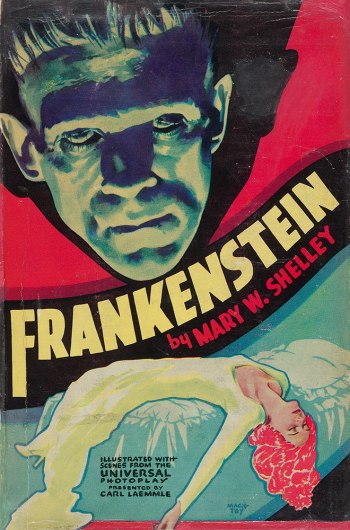
Poster for Mary W. Shelley’s Frankenstein (New York: Grosset and Dunlap, 1931 / The Morgan Library & Museum, purchased on the Gordon N. Ray Fund, 2016; PML 196478. Courtesy of Universal Studios Licensing LLC, © 1931 Univeral Pictures Company, Inc).
A large portion of the exhibition is dedicated to the movies, which have played an essential role in popularizing the story and shaping our pop culture image of the monster. The earliest film of Frankenstein was made by the Edison Studios in 1910, but it is James Whale’s 1931 version that has taken such a prominent place in the popular psyche that it is now better known than the novel. The 1931 Frankenstein and 1935 Bride of Frankenstein gave us a radically reimagined version of the narrative, particularly the creation scene and Boris Karloff’s performance as the monster. James Whale and his special effects technicians introduced the high-voltage lab equipment and set the scene amidst the thunder and lightning now obligatory in horror movies. The creature’s violence was induced by his being tortured with fire. Karloff later said, “Over the years thousands of children wrote, expressing compassion for the great, weird creature who was so abused by its sadistic keeper that it could only respond to violence with violence. Those children saw beyond the make-up and really understood.” The 1935 sequel, with Elsa Lanchester playing both Mary Shelley and the creature’s bride, has also aged well. Both films create sympathy for the creature through his encounters with stupid and sadistic people, and both Karloff and Elsa Lanchester portray their characters with dignity and depth of emotion.
From the creation of the monster, to the creature’s killing of a small child, to violence committed against women, adaptations of Frankenstein again and again have returned to some of the most disturbing but recurring scenes of human experience. Mary Shelley’s unique contribution to culture is the creation of the monster. Her genius was to imagine a way to make life out of death; James Whale’s genius was to imagine a way to depict it in moving images and sound.
Whale’s Frankenstein films sparked a mass of cinematic energy. Other directors drew from it for years after with imitations and derivative films, a few just as frightening, some quite funny, none as haunting. The Morgan has borrowed a series of B-movie posters from a private collector and the Academy of Motion Picture Arts and Sciences to show some of the more faithful, comic, lurid, and execrable treatments of this theme
Makeup artists, perhaps, have come closer than anyone to bringing Victor Frankenstein’s story to life. Jack Pierce’s makeup gave the creature a new face in the 1931 film. Some highlights in the section include the sketches and photographs of this iconic appearance along with a gruesome torso model of Robert De Niro in Kenneth Branagh’s Frankenstein, provided by the Harry Ransom Center at the University of Texas, Austin.
The Creature’s Afterlife: Comic Books and Prints
 The comic book as a separate slim magazine first appeared in 1933 as a promotional insert in newspapers, and Frankenstein has been part of this medium’s history from nearly the beginning. The exhibition includes some of the most interesting examples of the story, some aimed at children and some at adults.
Surprisingly few illustrators have taken on the novel’s challenge, but we present four of the best: Lynd Ward (remembered first of all as a wood engraver), Bernie Wrightson (a renowned comic book artist), Barry Moser (a celebrated book illustrator), and Pierre-Alain Bertola (a polymath Swiss artist who worked on a theatrical version of Frankenstein). All of them are working after, and against James Whale. All pay exquisite attention to Mary Shelley’s text and its ethical implications.
The exhibition closes with Barry Moser’s illustration of the Frankenstein family tomb, leaving us solidly in the tradition of Gothic art with which the show begins. Mary Shelley’s creature is a Gothic nightmare, but one who takes responsibility for himself. Even as his blood boils at the injustices committed against him, he is also “torn by the bitterest remorse.” Seeking quiet in death, he leaps onto his raft and is soon lost to human eyes. As mysterious and volatile in death as in life, Frankenstein’s monster leaves us with more questions than answers—perhaps the decisive reason why artists have been drawn to him for the past two hundred years.
Elizabeth Campbell Denlinger, It’s Alive! A Visual History of Frankenstein (New York: The Morgan Library & Museum, 2018), 336 pages, ISBN: 978-1512603422, $55.
New Book (and Film) | Peterloo
From Head of Zeus Books:
Jacqueline Riding, Peterloo: The Story of the Manchester Massacre (London: Head of Zeus, 2018), 400 pages, 400 pages, ISBN: 978-1786695833, £30.
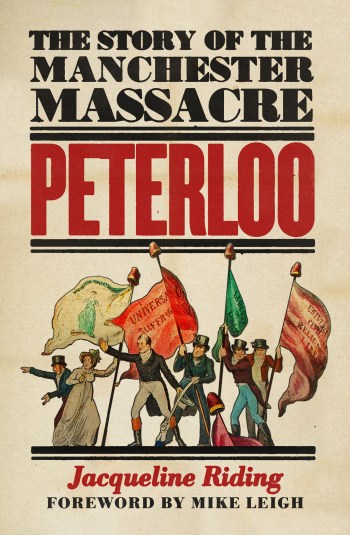 Manchester, August 1819: 60,000 people had gathered in the cause of parliamentary reform. To those defending the status quo, the vote was not a universal right, but a privilege of wealth and land ownership. To radical reformers the fundamental overhaul of a corrupt system was long overdue. The people had come to hear one such reformer, Henry Hunt, from all over Lancashire, walking to the sound of hymns and folk songs. By the end of the day fifteen of them, including two women and a child, were dead or mortally wounded, and 650 injured, hacked down by drunken yeomanry after local magistrates panicked at the scale of the meeting. The British state, four years after defeating the ‘tyrant’ Bonaparte at Waterloo, had turned its forces against its own people, as they peaceably exercised their liberties.
Dr Jacqueline Riding’s compelling book ties in to Mike Leigh’s forthcoming film Peterloo, for which the author was historical advisor, in advance of the bicentenary of Peterloo in 2019.
Jacqueline Riding is author of the award-winning Jacobites: A New History of the ‘45 Rebellion. She is a consultant for museums, galleries and historic buildings, and an historical adviser on feature films.
◊ ◊ ◊ ◊ ◊
According to Wikipedia, the film is “scheduled to be released in the United Kingdom on 2 November 2018, by Entertainment One, and in the United States on 9 November 2018, by Amazon Studios.”
Exhibition | Rosetsu: Ferocious Brush

Nagasawa Rosetsu, Tiger, 1786 door panels from the Zen Temple Muryōji, Kushimoto.
◊ ◊ ◊ ◊ ◊
From the press release for the exhibition:
Rosetsu: Ferocious Brush / Rosetsu: Fantastische Bilderwelten aus Japan
Museum Rietberg, Zurich, 6 September — 4 November 2018
Curated by Khanh Trinh and Matthew McKelway
For eight weeks, Japan’s most famous tiger will reside exclusively at Museum Rietberg in Zurich. The story goes that the Japanese artist Nagasawa Rosetsu (1754–1799) painted this monumental tiger together with its counterpart, a dragon, on the sliding door panels of the Zen temple Muryōji in a single night in the year 1786. Now the entire temple’s painted walls and a number of other, awe-inspiring masterpieces by Rosetsu are being shown for the first time outside of Japan. Rosetsu’s highly dynamic paintings created with vigorous brushstrokes and sometimes with his fingers, but also his delicate compositions painted with fine brushes and rich colour are replete with energy, wit, and modern appeal.
Renowned as one of the most eccentric and imaginative artists in early modern Japan, Nagasawa Rosetsu (1754–1799) produced visually exciting, classification-defying works during his brief career. The exhibition Rosetsu: Ferocious Brush unravels the many mysteries of this enigmatic career. An exclusive and expert selection of works by Rosetsu chosen in consultation with the Agency for Cultural Affairs of the Government of Japan (Bunkachō) reveals his painting subjects, his relationship to Zen Buddhism, his contacts with patrons outside Kyoto, and his choice of extraordinarily bold images.

The exhibition at the Rietberg Museum will survey Rosetsu’s art through a selection of sixty of his most important paintings, beginning with the earliest works in the realist style of his teacher Maruyama Ōkyo (1733–1795) and ending with the haunting and occasionally bizarre final masterpieces of his career. Screen paintings, scrolls, and albums depicting Zen eccentrics, children at play, ethereal beauties, breathtaking landscapes, and vivacious animals and birds will take viewers on a journey through Rosetsu’s own travels and into his fantastic imagination. These works, some of them compellingly realistic and others surprisingly abstract, take us into an early modern Japan we did not know and which feels very contemporary.
The highlight of the exhibition will be a magnificent ensemble of 48 screens and hanging scrolls, displayed in a recreated original floorplan of the Zen temple Muryōji. This Zen temple in the southern part of Japan’s main island holds the largest and most important collection of Rosetsu’s paintings, created in 1786. Various stories recount the creation of this breathtaking ensemble. The installation of these works would present an unprecedented opportunity to view and examine the paintings in a single venue outside their home in Kushimoto, and indeed the first such installation of architecturally specific paintings in an exhibition outside Japan.
Approximately one-third of the works to be exhibited are registered as Important Cultural Properties or Important Art Objects. Complementing these masterpieces from Japan, paintings from museums, temples, and private collections in Japan, Europe, and the United States trace the phases of Rosetsu’s life as he pursued his livelihood in Kyoto and the surrounding provinces. The exhibition closes with a dramatic display of abstract landscapes, ghosts, and perhaps his most astonishing work of all, a depiction of 500 Disciples of the Buddha on a surface of only one square inch.
Rosetsu, who hailed from a low-ranking samurai family, gained his reputation among art circles in the imperial capital Kyoto and its neighbouring regions with his untamed personality and his unusual talent. The exhibits run the gamut of formats and subjects, from exquisitely executed scrolls depicting birds and flowers in brilliant polychrome pigments to large-scale sliding doors and folding screens with fantastic landscapes, bizarre figures, and adorable animals. With his unconventional compositions and powerful brushwork Rosetsu always offers a fresh take on traditional subject matter. His paintings never fail to surprise, entertain, and charm.
The show at the Museum Rietberg is the first comprehensive presentation ever to take place outside of Japan. The exhibition is jointly curated by Dr Khanh Trinh, Curator of Japanese art, Museum Rietberg, Zurich, and Professor Matthew McKelway, Takeo and Itsuko Atsumi Professor of Japanese art history; director of the Mary Griggs Burke Center for Japanese Art, Columbia University in the City of New York.
Khanh Trinh and Matthew McKelway, Rosetsu: Ferocious Brush (London: Prestel, 2018), 296 pages, ISBN: 978-3791357263, $60 / £45. Also available in German.
Exhibition | Isabelle de Borchgrave
From The Frick Pittsburgh:
Isabelle de Borchgrave: Fashioning Art from Paper
Dixon Gallery and Gardens, Memphis, 15 October 2017 — 7 January 2018
The Society of the Four Arts, Palm Beach, 27 January — 15 April 2018
Oklahoma City Museum of Art, 16 June — 9 September 2018
The Frick Art Museum, Pittsburgh, 13 October 2018 — 6 January 2019
The Baker Museum, Artis, Naples, February — May 2019
Curated by Dennita Sewell

Isabelle de Borchgrave, Banyan and Waistcoat, 1998; inspired by a banyan and waistcoat ca. 1730 worn by Peter the Great of Russia.
Co-organized by the Frick in collaboration with four other American museums, this major exhibition presents the full breadth of de Borchgrave’s exploration of historical costume through contemporary paper sculpture. If you’ve never seen the artist’s work, you will be delighted by these breathtaking, life-size renditions of historic clothing created completely from artfully painted, pleated, crumpled, and manipulated paper.
From replicas of Renaissance Italian gowns to recreations of the fantastical modernist costumes of the Ballet Russes, Isabelle de Borchgrave’s work is meticulously crafted and astonishingly beautiful. The artist’s interest in creating paper costumes was sparked by a visit to the Metropolitan Museum of Art in 1994, where she found herself inspired by the historic costumes on display. Back in her studio, she began to experiment with creating renditions of the pieces in paper. Since then, de Borchgrave’s paper costumes have been featured in major exhibitions around the world.
This immersive exhibition celebrates the breadth of de Borchgrave’s work with costume and fashion history and is designed to introduce her work to a wider audience. De Borchgrave’s paper sculptures are masterpieces of trompe l’oeil—even upon close inspection it is often difficult to discern that the costumes are made of paper. At the Frick, de Borchgrave’s work will be exhibited throughout the museum, creating a dialogue with the museum’s collection. Joining the exhibition will be the Frick’s recently commissioned piece inspired by one of our best-known masterpieces—Peter Paul Rubens’ Portrait of Charlotte- Marguerite de Montmorency, Princess of Condé.
The exhibition will include examples from all the artist’s major series, beginning with her exploration of 300 years of fashion history in the works created for Papiers à la Mode. The works from her Splendors of the Medici series are inspired by Italian Renaissance costumes portrayed in Old Master paintings. Her next series, The World of Mariano Fortuny explored the work of the iconoclastic Spanish fashion designer, famously based in Venice, and her most recent series, Les Ballet Russes features fantastical modernist costumes designed by artists like Picasso, Bakst, and Matisse. The Frick’s recent commission will be the only new piece included in the exhibition. A fully illustrated color catalogue accompanies the exhibition.
Exhibition | The Chocolate Girl by Liotard
Notice of the exhibition appeared at Enfilade in April, but here are the details for the catalogue, published in association with Hirmer Verlag:
Stephan Koja and Roland Enke, eds., ‘The Most Beautiful Pastel Ever Seen’: The Chocolate Girl by Jean-Étienne Liotard in the Dresden Gemäldegalerie (Munich: Hirmer Verlag, 2018), 272 pages, ISBN: 978-3777431369, $42.
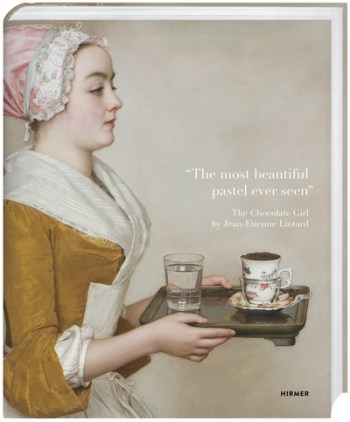 The Chocolate Girl is one of the most famous works by the Swiss artist Jean-Étienne Liotard. This richly illustrated volume leads the reader through the age in which it was created during the French-inspired Rococo and into the Vienna of Empress Maria Theresia, where the work was painted. It also explains the art of pastel painting, in which this enchanting work has been executed. The painting had a tremendous effect in those days and still does so today. Even during Liotard’s life (1702–1789) his pastel painting was highly valued, as the description by the most famous pastel artist Rosalba Carriera as “the most beautiful pastel” demonstrates. The Chocolate Girl shows a simple, unknown domestic servant, until then a rarely chosen subject. In its sober and precise observation it reflects the art of the Enlightenment as well as anticipating the realism of the nineteenth century. Chocolate itself, always associated with pleasure, contributes further to the particular charm. Characteristic works from other creative periods complete the overview of Liotard’s oeuvre.
New Book | Collecting the Past: British Collectors
From Routledge:
Toby Burrows and Cynthia Johnston, eds., Collecting the Past: British Collectors and their Collections from the 18th to the 20th Centuries (New York: Routledge, 2018), 144 pages, ISBN: 978-0815382348, $60.
 Today’s libraries and museums are heavily indebted to the passions and obsessions of numerous individual collectors who devoted their lives to amassing collections of books, manuscripts, artworks, and other culturally significant objects. Collecting the Past brings together the latest research on a wide range of significant British collectors from the eighteenth to the twentieth centuries, including Hans Sloane, Sarah Sophia Banks, Thomas Phillipps, Sydney Cockerell, J. P. Morgan Jr., Alfred Chester Beatty, and R. E. Hart.
Contributors to the volume examine the phenomenon of collecting in a variety of settings and across a range of different materials. Considering the aims and motives that led these collectors to assemble such remarkable collections, the book also examines the history of these collections after the collector’s death. Particular attention is given to the often complicated relationship between collectors and the public institutions that subsequently came to house their collections. Situated within the framework of cultural collecting more generally, this book offers an authoritative series of essays on key collectors.
Toby Burrows is Senior Researcher at the University of Oxford and a Senior Honorary Research Fellow at the University of Western Australia.
Cynthia Johnston is Lecturer in the History of the Book and Communications at the Institute of English Studies, School of Advanced Study, University of London.
C O N T E N T S
1 Toby Burrows and Cynthia Johnston, Collecting the Past: Manuscript and Book Collecting in the Nineteenth and Twentieth Centuries
2 Alice Marples, Creating and Keeping a National Treasure: The Changing Uses of Hans Sloane’s Collection in the Eighteenth Century
3 Arlene Leis, Sarah Sophia Banks: A ‘Truly Interesting Collection of Visiting Cards and Co.’
4 Toby Burrows, ‘There Never Was Such a Collector Since the World Began’: A New Look at Sir Thomas Phillipps
5 Laura Cleaver and Danielle Magnusson, American Collectors and the Trade in Medieval Illuminated Manuscripts in London, 1919–1939: J. P. Morgan Junior, A. Chester Beatty, and Bernard Quaritch Ltd.
6 Stella Panayotova, Sydney Cockerell: A Bibliophile Director-Collector
7 Cynthia Johnston, Spending a Fortune: Robert Edward Hart, Bibliophile and Numismatist, An Industrialist Collector in Blackburn, Lancashire
8 Karen Attar, Ossified Collections: The Past Encapsulated in British Institutions Today
Exhibition | Tudors to Windsors: British Royal Portraits
From the MFAH:
Tudors to Windsors: British Royal Portraits
Museum of Fine Arts, Houston, 7 October 2018 — 27 January 2019
Bendigo Art Gallery, 16 March — 14 July 2019
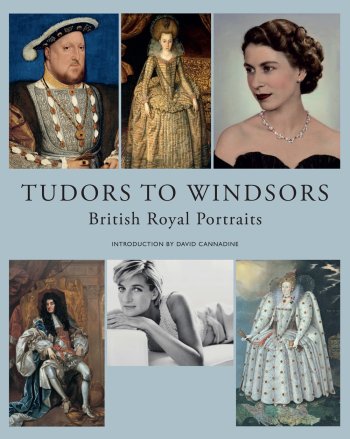 Tudors to Windsors: British Royal Portraits from Holbein to Warhol sheds new light on changing ideas of monarchy and nationhood in Britain. The exhibition features portraits of British royalty spanning 500 years, by artists from Hans Holbein and Sir Joshua Reynolds to Annie Leibovitz and Andy Warhol.
In a sweeping survey, Tudors to Windsors covers the cavalcade of kings, queens, princes, and princesses who have graced the British crown. The MFAH is the only U.S. venue to host this unprecedented exhibition, part of a major partnership with the National Portrait Gallery in London. Some 150 objects—most never before seen outside of England—tell the story of Britain’s monarchy through masterworks of painting, sculpture, and photography.
Visitors have an extraordinary opportunity to come face-to-face with the fascinating figures of British royalty. Tudors to Windsors explores four royal dynasties: the House of Tudor (1485–1603), the House of Stuart (1603–1714), the House of Hanover (1714–1901), and the present-day House of Windsor. Among the many works of art on view are portraits featuring King Henry VIII, Queen Elizabeth I, King George I, Queen Victoria, Queen Elizabeth II, Princess Diana, and Prince William.
Tudors to Windsors: British Royal Portraits, with an introduction by David Cannadine (London: National Portrait Gallery, 2018), 240 pages, ISBN 978-1855147560, $50.
Call for Nominations | Eldredge Book Prize
2019 Charles C. Eldredge Prize
Nominations due by 1 December 2018
The Smithsonian American Art Museum is now accepting nominations for the 2019 Charles C. Eldredge Prize. The prize is given annually by the museum for outstanding scholarship in the field of American art. A cash award of $3,000 is made to the author of a recent book-length publication that provides new insights into works of art, the artists who made them, or aspects of history and theory that enrich our understanding of the artistic heritage of the United States. The Eldredge Prize seeks to recognize originality and thoroughness of research, excellence of writing, clarity of method, and significance for professional or public audiences. It is especially meant to honor those authors who deepen or focus debates in the field, or who broaden the discipline by reaching beyond traditional boundaries.
Single-author books devoted to any aspect of the visual arts of the United States and published in the three previous calendar years (2016–2018) are eligible. To nominate a book, please send a one-page letter explaining the work’s significance to the field of American art history and discussing the quality of the author’s scholarship and methodology. Nominations by authors or publishers for their own books will not be considered. The deadline for nominations is December 1, 2018. Please send them to: The Charles C. Eldredge Prize, Research and Scholars Center, Smithsonian American Art Museum, P.O. Box 37012, MRC 970, Washington, D.C. 20013-7012. Nominations will also be accepted by email: eldredge@si.edu, or fax: (202) 633-8373. For more information about the prize, please visit americanart.si.edu/research/awards/eldredge.
The museum will host a lecture by University of Texas at Austin professor Susan Rather, winner of the 2018 Eldredge Prize, on February 7, 2019, at 4pm. The talk will be related to Rather’s award-winning book, The American School: Artists and Status in the Late Colonial and Early National Era. It will also be available via webcast.
New Book | Marbled Paper
From Oak Knoll Press:
Richard Wolfe, Marbled Paper: Its History, Techniques, and Patterns (New Castle, Delaware: Oak Knoll Press, 2018), 245 pages, ISBN: 978-1584563600, $95.
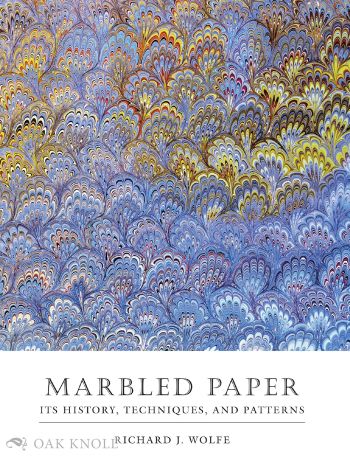 Second edition with corrections, from the original edition published in 1990 by the University of Pennsylvania Press (a publication of the A.S.W. Rosenbach Fellowship in Bibliography). With over 350 color and 80 black-and-white illustrations, and a new Foreword by Sidney Berger.
Richard J. Wolfe (1928–2017) was a rare book librarian, practicing marbler, and collector of marbled papers and books about marbling. This book is the result of more than twenty-five years of research and practical experience. Wolfe personally tracked down and sorted out historical records of marbling from their original sources, and he drew on his own extensive experience as a practitioner to write eloquently on technical and stylistic questions. The resulting study meticulously reconstructs the rise and fall of the craft and recounts its history, techniques, and patterns in such a way as to put all aspects of this fascinating craft in proper perspective.
When first published, Marbled Paper was immediately recognized as the most comprehensive study of marbling to that point, and its status as the standard history of the subject has not been diminished by more recent works. For that reason, and with the goal of making it available again to scholars, students, and practitioners of marbling, Oak Knoll Press is pleased to be able to present this second edition in cooperation with the Wolfe family, completed with minor corrections left by the author.










 Enfilade
leave a comment