New Book | Experimental Selves
From the University of Toronto Press:
Christopher Braider, Experimental Selves: Person and Experience in Early Modern Europe (Toronto: University of Toronto Press, 2018), 448 pages, ISBN: 9781487503680, $90.
 Drawing on the generous semantic range the term enjoyed in early modern usage, Experimental Selves argues that ‘person,’ as early moderns understood this concept, was an ‘experimental’ phenomenon—at once a given of experience and the self-conscious arena of that experience. Person so conceived was discovered to be a four-dimensional creature: a composite of mind or ‘inner’ personality; of the body and outward appearance; of social relationship; and of time.
Through a series of case studies keyed to a wide variety of social and cultural contexts, including theatre, the early novel, the art of portraiture, pictorial experiments in vision and perception, theory of knowledge, and the new experimental science of the late-seventeenth and eighteenth centuries, the book examines the manifold shapes person assumed as an expression of the social, natural, and aesthetic ‘experiments’ or experiences to which it found itself subjected as a function of the mere contingent fact of just having them.
Christopher Braider is a professor of French and Comparative Literature at the University of Colorado, Boulder.
C O N T E N T S
Introduction — Changing the Subject: Early Modern Persons and the Culture of Experiment
1 The Shape of Knowledge: The Culture of Experiment and the Byways of Expression
2 The Art of the Inside Out: Vision and Expression in Hoogstraten’s London Peepshow
3 Persons and Portraits: The Vicissitudes of Burckhardt’s Individual
4 Justice in the Marketplace: The Invisible Hand in Ben Jonson’s Bartholomew Fayre
5 Actor, Act, and Action: The Poetics of Agency in Corneille, Racine, and Molière
6 The Experiment of Beauty: Vraisemblance Extraordinaire in Lafayette’s Princesse de Clèves
7 Groping in the Dark: Aesthetics and Ontology in Diderot and Kant
Conclusion — Person, Experiment, and the World They Made
Print Quarterly, September 2018
The eighteenth century in the current issue of Print Quarterly:
Print Quarterly 35.3 (September 2018) . . .
N O T E S A N D R E V I E W S
• Jean Michel Massing, Review of the collection of essays, Suzanne Karr Schmidt and Edward Wouk, eds., Prints in Translation, 1450–1750: Image, Materiality, Space (Routledge, 2016), pp. 305–08. “The eleven most interesting articles in Prints in Translation . . . developed from a two-day conference panel at the 2014 meeting of the College Art Association on ‘Objectifying Prints: Hybrid Media 1450–1800’ (305).” [Of particular interest to Enfilade readers will be the article by David Pullins, “The State of the Fashion Plate, circa 1727: Historicizing Fashion Between ‘Dressed Prints’ and Dezallier’s Recueils,” discussed briefly by Massing on pp. 307–08.]
• John Roger Paas, Review of the exhibition catalogue Tiphaine Gaumy, ed., Images & Révoltes dans le livre et l’estampe, XIVe–milieu du XVIIIe siècle (Bibliothèque Mazarine & Editions des Cendres, 2016), pp. 308–10. “This catalogue with its thirteen scholarly essays and numerous images—many not widely known—focuses on political events, but more importantly it underscores the seminal importance of all visual material for our general understanding of the past. It is clear that these images are not of secondary historical importance” (310).
• Julia McHugh, Review of Pedro German Leal and Rubem Amaral, eds., Emblems in Colonial Ibero-America: To the New World on the Ship of Theseus (Glasgow University Press, 2017), pp. 311–13. “The three sections of the book correspond to the three main colonies of the New World [New Spain, Peru, and Portuguese America]. In each section, two case studies follow a general survey of emblematic and symbolic culture, which foregrounds the distinct historical and geographical conditions of each administrative territory. These three preliminary essays by Víctor Mínguez, José Júlio García Arranz, and Rubem Amaral Jr. are extremely systematic and comprehensive and would be excellent additions to syllabi for colonial Latin American courses” (311).
 • Thomas Döring, Review of Jef Schaeps, Edward Grasman, Elmer Kolfin, and Nelke Bartelings, eds., For Study and Delight: Drawings and Prints from Leiden University (Leiden University, 2017), pp. 313–15. “The book was published to mark the 200th anniversary of the 1814 bequest of Jan Theodore Royer’s print collection to the University of Leiden. This gift became the basis of the university’s Print Room founded in 1825. . . The publication aims to offer a representative cross-section of the collection. Carefully conceived and handsomely produced, it fully lives up to this claim and to its well-considered title” (313).
• Stephanie Dickey, Review of the exhibition catalogue, Victoria Sancho Lobis, with an essay by Maureen Warren, Van Dyck, Rembrandt, and the Portrait Print (Art Institute of Chicago, 2016), pp. 315–17. “This compact, handsomely produced publication documents an exhibition that featured 116 prints, two albums, and twenty portraits in other media, dating from 1522 to 1993, most from the Art Institute of Chicago’s own collection” (315).
• Rena Hoisington, Review of the exhibition catalogue, Anne-Lise Desmas, Edouard Kopp, Guilhem Scherf, and Juliette Trey, Bouchardon: Royal Artist of the Enlightenment (Getty Publications, 2017), pp. 318–21. “Prefaced by essays written by each of the four contributing curators, this beautifully produced and lavishly illustrated catalogue includes images of hundreds of sculptures, drawings, prints and illustrated books (and a few paintings) discussed according to theme or project, including Bouchardon’s work on two celebrated landmarks in eighteenth-century Paris: the elegant Grenelle Fountain that still graces the street from which it takes its name, completed in 1745; and the equestrian statue of King Louis XV that once presided over the Place Louis XV, begun in 1748, completed after Bouchardon’s death by the sculptor Jean-Baptiste Pigalle and destroyed in 1792” (318).
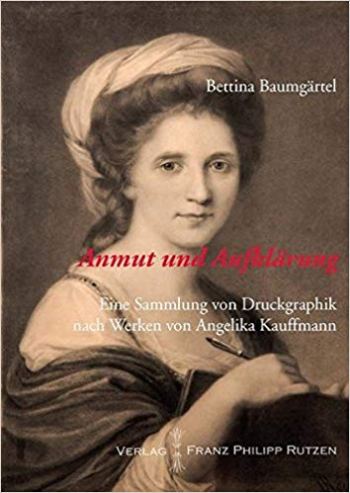
• Wendy Wassyng Roworth, Review of the exhibition catalogue, Bettina Baumgärtel, Anmut und Aufklärung: Eine Sammlung von Druckgraphik nach Werken von Angelika Kauffman (Harrassowitz, 2016), pp. 321–23. “An exhibition at the Winckelmann Museum in Stendhal, Germany . . . presented a selection of prints after Kauffman’s work . . . The exhibition catalogue includes examples of engraved reproductions by British and other printmakers . . . There is a detailed chronology of Kauffman’s life and work; an essay on prints after Kauffman and eighteenth-century printmaking; another essay on the Winckelmann portrait and its influence; a numbered catalogue of works exhibited; and a bibliography of cited sources. The catalogue of works exhibited is divided into sections according to subjects and themes Kauffman portrayed: self-portraits, portraits, mythology, scenes from Shakespeare and other poetry, Roman and early English history, allegory and genre” (322).
• Monika Hinkel, Review of the exhibition catalogue, Timothy Clark, ed., Hokusai: Beyond the Great Wave (Thames & Hudson, 2017), pp. 323–25. “The superb selection, incorporating paintings, woodblock prints, drawings, manuals and illustrated books selected from collections around the world illustrate well the versatility of Hokusai’s striking work. They not only portray the ingenious way in which he amalgamated Japanese-, Chinese- and European-inspired techniques, but also reveal his profound knowledge of mythology, history, the natural world and religion and his strong interest in draughtsmanship” (324–25).
• Stephen Clarke, Review of the book Lucy Peltz, Facing the Text: Extra-illustration, Print Culture, and Society in Britain, 1769–1840 (Huntington Library Press, 2017), pp. 353–55. “Peltz’s book is the product of some fifteen or more years of research, during which period she has published a number of related articles, most notably the correspondence of Granger and Bull in the Walpole Society volume for 2004. The result of her labours is by far the best and most detailed study of a phenomenon that has received surprisingly little scholarly attention. She divides the subject into three broadly chronological sections, using exemplars to tease out meanings and connections rather than aspiring to an impossible vision of encyclopaedic completeness” (354–55).
◊ ◊ ◊ ◊ ◊
Note (added 11 September 2018) — The original posting did not include quotations from the reviews.
New Book | Picturing the Pacific
From Bloomsbury:
James Taylor, Picturing the Pacific: Joseph Banks and the Shipboard Artists of Cook and Flinders (London: Adlard Coles Nautical, 2018), 256 pages, ISBN: 978-1472955432, £25 / $35.
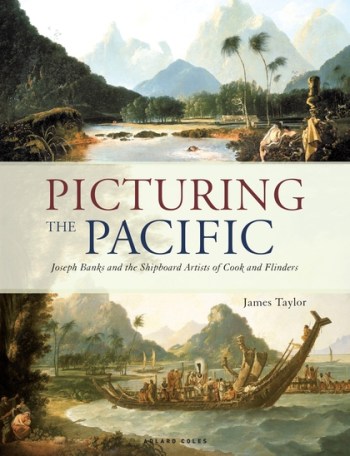 For over 50 years between the 1760s and the early 19th century, the pioneers who sailed from Europe to explore the Pacific brought back glimpses of this new world in the form of oil paintings, watercolours and drawings—a sensational view of a part of the world few would ever see. Today these works represent a fascinating and inspiring perspective from the frontier of discovery. It was Sir Joseph Banks, President of the Royal Society, who popularised the placement of professional artists on British ships of exploration. They captured striking and memorable images of everything they encountered: exotic landscapes, beautiful flora and fauna, as well as remarkable portraits of indigenous peoples. These earliest views of the Pacific, particularly Australia, were designed to promote the new world as enticing, to make it seem familiar, to encourage further exploration and, ultimately, British settlement. Drawing on both private and public collections from around the world, this lavish book collects together oil paintings, watercolours, drawings, prints, and other documents from those voyages and presents a unique glimpse into an age where science and art became irrevocably entwined.
Dr James Taylor, FRSA studied at the Universities of St Andrews, Manchester, and Sussex. He is an accredited lecturer for the National Association of Fine and Decorative Arts; a former curator of paintings, drawings and prints, organiser of exhibitions and galleries and corporate membership manager at the National Maritime Museum, Greenwich; and Victorian paintings specialist with Phillips Fine Art Auctioneers. He is an avid collector of artist-drawn picture postcards.
New Book | Romantic Art in Practice
From Cambridge UP:
Thora Brylowe, Romantic Art in Practice: Cultural Work and the Sister Arts, 1760–1820 (New York: Cambridge University Press, 2018), 280 pages, ISBN: 978-1108426404, $105.
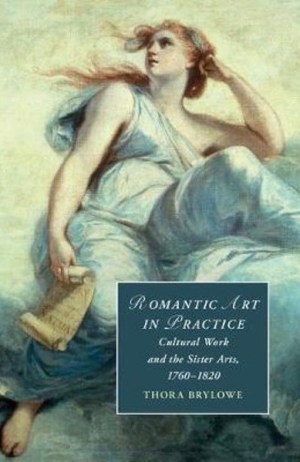 Exploring the relationship between visual art and literature in the Romantic period, this book makes a claim for a sister-arts ‘moment’ when the relationship between painting, sculpture, pottery, and poetry held special potential for visual artists, engravers, and artisans. Elaborating these cultural tensions and associations through a number of case studies, Thora Brylowe sheds light on often untold narratives of English labouring craftsmen and artists as they translated the literary into the visual. Brylowe investigates examples from across the visual spectrum including artefacts, such as Wedgwood’s Portland Vase, antiquarianism through the work of William Blake, the career of engraver John Landseer, and the growing influence of libraries and galleries in the period, particularly Boydell’s Shakespeare Gallery. Brylowe artfully traces the shifting cultural connections between the imaginative word and the image in a period that saw new print technologies deluge Britain with its first mass media. Part of the Cambridge Studies in Romanticism series.
Thora Brylowe is Assistant Professor of English at the University of Colorado, Boulder.
C O N T E N T S
List of Figures
Acknowledgments
Introduction: The Sister-Arts Moment
1 Original Copies: Wedgwood’s Portland Vase in Paint and Poem
2 William Blake, Antiquarians, and the Status of Copy
3 Literary Galleries and the Media Ecology: Painting for Print in the Age of Anthologies
4 Poetry against the Wall: The (Sister) Arts in Crisis
5 Crossing the Line: Engraving, John Landseer, and the Aftermath of the Shakespeare Gallery
6 Ravaged brides: Grecian Urns on Romantic Paper
Notes
Bibliography
Index
New Book | The Invention of Rare Books
McKitterick is especially interested in how the idea of ‘rarity’ emerged as a part of a selection process in the face of the plenitude of print. As a secondary (maybe tertiary) theme, he also considers how books, especially during the eighteenth century, came to be regarded as rare alongside other “material relics of the past,” in part thanks to shared “aspects of connoisseurship both in sculpture and in painting, and even in old buildings” (23). The other crucial text, as noted repeatedly by McKitterick, is Kristian Jensen, Revolution and the Antiquarian Book: Reshaping the Past, 1780–1815 (Cambridge UP, 2011). –CH
From Cambridge UP:
David McKitterick, The Invention of Rare Books: Private Interest and Public Memory, 1600–1840 (New York: Cambridge University Press, 2018), 460 pages, ISBN: 978-1108584265, $63.
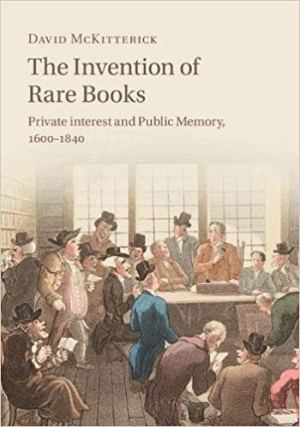 When does a book that is merely old become a rarity and an object of desire? David McKitterick examines, for the first time, the development of the idea of rare books, and why they matter. Studying examples from across Europe, he explores how this idea took shape in the sixteenth and seventeenth centuries, and how collectors, the book trade and libraries gradually came together to identify canons that often remain the same today. In a world that many people found to be over-supplied with books, the invention of rare books was a process of selection. As books are one of the principal means of memory, this process also created particular kinds of remembering. Taking a European perspective, McKitterick looks at these interests as they developed from being matters of largely private concern and curiosity, to the larger public and national responsibilities of the first half of the nineteenth century.
David McKitterick, FBA, was for many years Librarian of Trinity College, Cambridge, and Honorary Professor of Historical Bibliography at Cambridge. His previous publications include the three volume A History of Cambridge University Press (Cambridge, 1992–2004), Cambridge University Library: A History, Volume 2: The Eighteenth and Nineteenth Centuries (Cambridge, 1986), Print, Manuscript and the Search for Order, 1450–1830 (Cambridge, 2003), and most recently Old books, New Technologies (Cambridge, 2013). Professor McKitterick is one of the general editors of the Cambridge History of the Book in Britain.
C O N T E N T S
List of Illustrations
Acknowledgements
List of Abbreviations
Prologue
1 Inventio
2 Books as Objects
3 Survival and Selection
4 Choosing Books in Baroque Europe
5 External Appearances (1)
6 External Appearances (2)
7 Printers and Readers
8 A Seventeenth-century Revolution
9 Concepts of Rarity
10 Developing Measures of Rarity
11 Judging Appearances by Modern Standards
12 The Harleian Sales
13 Authority and Rarity
14 Rarity Established
15 The French Bibliographical Revolution
16 Books in Turmoil
17 Bibliophile Traditions
18 Fresh Foundations
19 Public Faces, Public Responsibilities
20 Conclusion
Notes
Select Bibliography
Index
New Book | The Politics of Parody
From Yale UP:
David Francis Taylor, The Politics of Parody: A Literary History of Caricature, 1760–1830 (New Haven: Yale University Press, 2018), 320 pages, ISBN: 978-0300223750, $50.
 This engaging study explores how the works of Shakespeare, Milton, Swift, and others were taken up by caricaturists as a means of helping the eighteenth-century British public make sense of political issues, outrages, and personalities. The first in-depth exploration of the relationship between literature and visual satire in this period, David Taylor’s book explores how great texts, seen through the lens of visual parody, shape how we understand the political world. It offers a fascinating, novel approach to literary history.
David Francis Taylor is associate professor of eighteenth-century literature at the University of Warwick and the award-winning author of Theatres of Opposition: Empire, Revolution, and Richard Brinsley Sheridan.
C O N T E N T S
Preface
Part One: Prints, Parody, and the Political Public
1 The Literariness of Graphic Satire
2 Looking, Literacy, and the Printshop Window
Part Two: Plotting Politics
3 The Tempest; or, The Disenchanted Island
4 Macbeth as Political Comedy
5 Paradise Lost, from the Sublime to the Ridiculous
6 Gulliver Goes to War
7 Harlequin Napoleon; or, What Literature Isn’t
Appendix: Dramatis Personae
Notes
Acknowledgements
Index
Exhibition | Manufacturing Luxury
Opening next month at the Cognacq-Jay, from the press release:
La Fabrique du Luxe: Les Marchands Merciers Parisiens au XVIIIe Siècle
Musée Cognacq-Jay, Paris, 29 September 2018 — 27 January 2019
Curated by Rose-Marie Herda-Mousseaux
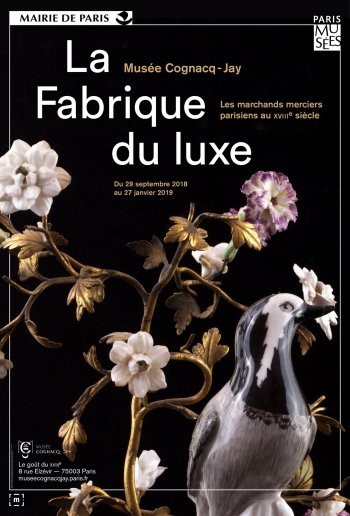 Du 29 septembre 2018 au 27 janvier 2019, le musée Cognacq-Jay organise la toute première exposition consacrée à cette corporation particulièrement codi ée et incontournable dans la diffusion de l’art et du luxe français. À travers les destins de marchands comme Gersaint ou Duvaux, le musée présente une centaine d’œuvres d’art, de documents et d’archives illustrant les origines du luxe à la parisienne.
À la fois négociant, importateur, collecteur, designer et décorateur, le marchand mercier occupe un rôle majeur dans l’essor de l’industrie du luxe à cette époque. Personnage atypique, il entretient des liens dans la haute aristocratie et s’appuie sur un réseau international d’artistes comprenant les meilleures spécialités techniques et artistiques, qu’elles proviennent de Lyon ou de Chine. Les marchands merciers se trouvent au cœur d’un réseau à trois pôles : le commanditaire, l’artisan ou artiste et, phénomène nouveau à la puissance croissante, la « mode ». Aussi, pour se faire connaître et agrandir leurs réseaux, ils développent les mécanismes de la promotion publicitaire, avec le concours de dessinateurs anonymes ou d’artistes comme Boucher ou Watteau.
Dissoute durant la période révolutionnaire, cette corporation suscite encore aujourd’hui l’intérêt des historiens de l’art et d’universitaires qui en font leur sujet de recherches. Le parcours de l’exposition explore le contexte propice à l’épanouissement de ce réseau, les clefs de leur succès et leurs innovations, et s’attache à dépeindre quelques-uns de ses illustres représentants.
Les marchands merciers : une corporation unique
L’appellation “marchand mercier” provient du terme « mercerie » qui, s’il désigne de nos jours les articles liés à l’habillement et à la parure, était synonyme au XVIIIe siècle de « marchandise ». Les statuts de la corporation, codi és en 1613, permettent aux marchands de vendre des objets enjolivés ou assemblés par leurs soins ou de seconde main. Ainsi, au XVIIIe siècle, les marchands merciers deviennent incontournables dans la diffusion des arts et du luxe hors de la cour. Ils acquièrent auprès des manufactures de porcelaine ou des grandes compagnies de transport des objets qu’ils font monter à l’aide d’orfèvres, de bronziers ou d’ébénistes pour créer des pièces décoratives aux formes nouvelles.
Cartographie du luxe parisien
Paris réunit les ingrédients indispensables d’un marché du luxe en plein essor : capitaux, clientèle nombreuse, fournisseurs hautement quali és, large réseau artistique, proximité avec la cour… Il est possible d’identi er des quartiers privilégiés dans l’organisation de ce commerce : la rue Saint-Honoré, bien sûr, mais aussi le Palais de Justice et les rues Saint-Martin et Saint- Denis, où les marchands disposaient d’adresses physiques.
La naissance des stratégies publicitaires
Dans un secteur concurrentiel, les marchands doivent faire preuve d’une stratégie permanente. C’est ainsi que l’émergence des enseignes ou « marques » s’appuient sur des ressorts marketing novateurs : contrats d’exclusivités ou monopoles, identi cation de clients prestigieux dans les réclames ou encore création d’identité visuelle dont témoignent les enseignes et cartes de visite.
L’exemple de Gersaint : un marchand-mercier emblématique
En 1720, Antoine Watteau peint en seulement « huit matins », pour la boutique de son ami Gersaint, une enseigne remarquable qui fait l’admiration du Tout-Paris. Ce coup de publicité fait de Gersaint un des premiers marchands merciers à développer une image publicitaire soignée. Le musée Cognacq-Jay conserve une étude préparatoire de cette œuvre et présente une reconstitution du tableau original à grande échelle.
Commissariat
Rose-Marie Herda-Mousseaux, Conservateur en chef du patrimoine, directrice du musée Cognacq-Jay
La Fabrique du Luxe: Les Marchands Merciers Parisiens au XVIIIe Siècle (Paris-Musées, 2018), 176 pages, ISBN: 978-2759604005, 30€.
The Burlington Magazine, August 2018
The eighteenth century in The Burlington:
The Burlington Magazine 160 (August 2018)
 A R T I C L E S
• Alessandro Spila, “Ferdinando Fuga’s Proposals for Displaying Relics in S. Maria Maggiore, Rome,” pp. 646–53. Recently identified drawings show Fuga’s initial design [produced in the 1740s] for a pair of nave platforms in S. Maria Maggiore intended for the display of relics displaced by the recent reorganization of the choir. They were not executed, almost certainly because they conflicted with Benedict XIV’s wish to see a radical simplification of the church’s interior.
R E V I E W S
• Claudia Bodinek, Review of the exhibitions 300 Years of the Vienna Porcelain Manufactory (MAK, 2018) and Eternally Beautiful: 300 Years of Vienna Porcelain (Augarten Porcelain Museum, 2018), pp. 674–75.
• Philippe Bordes, Review of the exhibition Napoleon: Power and Splendor (Virginia Museum of Fine Arts, 2018), pp. 676–78.
• Jonathan Yarker, Review of the exhibition The Great Spectacle: 250 Years of the Summer Exhibition (Royal Academy of Arts, 2018), pp. 678–81.
• Roberto Valeriani, Review of Teresa Leonor M. Vale, ed., The Art of the Valadiers (Umberto Allemandi, 2017), pp. 703–05.
Exhibition | 300 Years of the Vienna Porcelain Manufactory
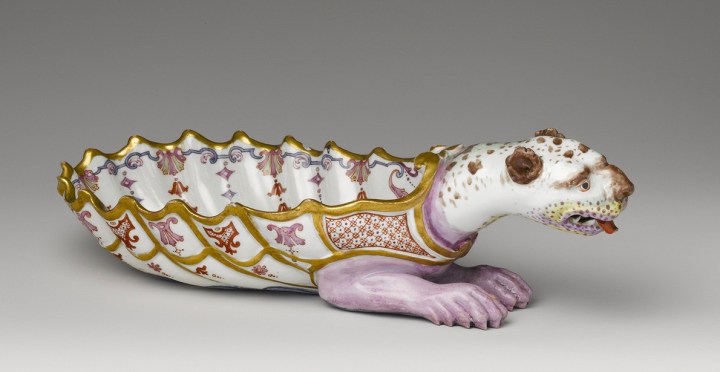
Claudius Innocentius, Du Paquier, Panther Bowl, ca. 1730, glazed, painted, and gilt porcelain, 8 × 25.5 × 10.3 cm
(Vienna: MAK)
◊ ◊ ◊ ◊ ◊
Now on view at Vienna’s MAK:
300 Years of the Vienna Porcelain Manufactory
MAK – Austrian Museum of Applied Arts / Contemporary Art, Vienna, 16 May — 23 September 2018
Curated by Rainald Franz and Michael Macek
With its wide-ranging jubilee exhibition 300 Years of the Vienna Porcelain Manufactory, the MAK is drawing attention to the history and significance of the second-oldest porcelain manufactory in Europe. Founded in May 1718 when the imperial privilege for porcelain production was granted to Claudius Innocentius Du Paquier, the Vienna Porcelain Manufactory set new aesthetic standards over the following decades. Some 1000 objects from the holdings of the MAK as well as national and international collections offer a formidable overview of Viennese developments in the context of Asian precursors and European competitors.
 The MAK has housed the legacy of the Vienna Porcelain Manufactory—under imperial ownership from 1744 and closed in 1864—and has been dedicated to researching porcelain since its founding years. With examples from all eras of production, the legacy provides an overview of some 150 years of porcelain production in Vienna. Viennese porcelain production covered a wide spectrum of ceramics: from dinnerware sets and vases to clocks, from high-quality porcelain sculptures to scenic and floral miniatures, from porcelain paintings with cobalt blue and gold decorations in relief to large-format porcelain pictures with floral still lifes.
The exhibition 300 Years of the Vienna Porcelain Manufactory presents the latest research findings with as yet unpublished documents on major works by the Vienna Porcelain Manufactory, such as the porcelain room from the Palais Dubsky in Brno (ca. 1740) and the centerpiece from Zwettl Abbey (Vienna, 1767/68). Both the ‘Dubsky Room’, one of the first rooms to be decorated with European porcelain, and the centerpiece from Zwettl Abbey are on permanent display in the MAK Permanent Collection Baroque Rococo Classicism, designed by Donald Judd.
The catalogue is distributed by ACC Art Books:
Christoph Thun-Hohenstein and Rainald Franz, eds., 300 Jahre Wiener Porzellan / 300 Years of the Vienna Porcelain Manufactory (Stuttgart, Arnoldsche Art Publishers 2018), 272 pages, ISBN: 978-3897905306, 48€ / $85.
With contributions by Rainald Franz, Andreas Gamerith, Michael Macek, Errol Manners, Waltraud Neuwirth, Kathrin Pokorny-Nagel, A. Philipp Revertera, Elisabeth Schmuttermeier, Ulrike Scholda, Leonhard Weidinger and Johannes Wieninger and a foreword by Christoph Thun-Hohenstein.
C O N T E N T S
• Christoph Thun-Hohenstein, Viennese Porcelain as a Resonance
• Rainald Franz, Three Centuries of Viennese Porcelain and Three Centennials
• Rainald Franz and Michael Macek, The Dubsky Chamber and the MAK: An 18th-Century Aristocratic Porcelain Room and its History
• Andreas Gamerith, At a Loss for Words: The Zwettl Centerpiece and its Origins
• Rainald Franz, The Viennese Porcelain Set for the Duke of Wellington
• Errol Manners, The Travels of an Arcanist, Joseph Jakob Ringler
• Johannes Wieninger, Exemplars from East Asia
• Elisabeth Schmuttermeier, Porcelain versus Silver
• Michael Macek, The Hülfswerk von Engelhardtszell 1798–1809 and its Impact beyond 1809
• Waltraud Neuwirth, Johann Poysel, First Modelleur of the Vienna Porcelain Manufactory: His 1858 Journey to Limoges, Paris, Sèvres, Wallerfangen, and Nymphenburg
• Kathrin Pokorny-Nagel and Ulrike Scholda, The Museum as the Administrator of an Estate: The Closure of the Vienna Porcelain Manufactory and Transfer of Its Holdings to the Imperial Royal Austrian Museum of Art and Industry
• Leonhard Weidinger, The Viennese Porcelain Scene: The Museum and Private Collections
• Rainald Franz, Paul Wittgenstein’s Porcelain Room
• A. Philipp Revertera, Etcetera: Random Thoughts on Collecting (and) Viennese Porcelain
• Rainald Franz and Michael Macek, History of the Vienna Porcelain Manufactory 1718–1864 in its Cultural and Political Context
A Visual History of the Vienna Porcelain Manufactory
Claudius Innocentius Du Paquier, 1718–1744
Imperial Porcelain Manufactory Phase 1, 1744–1749
Imperial Porcelain Manufactory Phase 2, 1750–1783
Conrad Sörgel von Sorgenthal, 1784–1805
Matthias Niedermayer, 1805–1827
Benjamin von Scholz, 1827–1833
Andreas Baumgartner, 1833–1842
Franz von Leithner, 1842–1855
Alexander Löwe, 1856–1862
Alois Auer von Welsbach, 1862–1864
Augarten Porcelain Manufactory, since 1923–24
Exhibition | Eternally Beautiful: 300 Years of Vienna Porcelain
Now on view at the Augarten Porcelain Museum in Vienna:
Eternally Beautiful: 300 Years of Vienna Porcelain, 1718–2018
Augarten Porcelain Museum, Vienna, 20 March — 13 October 2018
 The central theme of the Augarten Porcelain Museum’s jubilee exhibition is the dialogue between the designers and the users of Vienna porcelain since 1718. Select exhibits from the hands and minds of innovative artists and designers from the various eras enter into dialogue with their respective cultural context, distinctive creative styles thus being paired with their era’s distinctive mood. The historical spectrum ranges from astounding miracles of Baroque craftsmanship to light-hearted Rococo objets d’art, from the golden glory of Neoclassical porcelain through the simplicity of Biedermeier to the allusive reminiscences of Historicism, and then continues up to the present day via the delicate creations of Art Déco, the bright colours of the 1950s and the fascinating world of modern design.
In all the most important phases of the Vienna porcelain manufactory first founded by Claudius Innocentius du Paquier in 1718, production has been characterized by an interplay between the vision of the porcelain-makers and the actual lifestyle of the porcelain-users. Conrad von Sorgenthal (1733–1805), the most successful director of the Imperial Porcelain Manufactory, sent staff out as ‘lifestyle scouts’ to sound out the habits, fashions, special preferences and opinions of his customers, so that the findings could then be reflected in the design process. When the Augarten manufactory was founded in 1923 as the successor to the imperial works, it strove to achieve a similar closeness to contemporary lifestyle. The craft of fine porcelain was enriched with significant formal and emotional input not only from designers of the Wiener Werkstätte and but also from a host of excellently trained graduates from the Vienna School of Arts and Crafts. By putting innovative creations from three centuries under the spotlight, the exhibition is intended to stimulate fresh debate and generate a new discourse. As part of the presentation, the Museum has invited the designers currently cooperating with the Augarten manufactory to take part in designing the present-day exhibition space.
Claudia Lehner-Jobst, Ewig Schön: 300 Jahre Wiener Porzellan (Vienna: Residenz Verlag, 2018), 192 pages, ISBN: 9783701734498, 35€.










 Enfilade
leave a comment